Introduction
In developing countries, the majority of poultry products come from traditional production practices. Indigenous chickens continue to be most popular due to their adaptability to harsh conditions and their resistance against local diseases (Ajayi, Reference Ajayi2010; Dorji and Gyeltshen, Reference Dorji and Gyeltshen2012). This indigenous bird manifests a great deal of variation which is due to genetic and environmental factors (Olori and Sonaiya, Reference Olori and Sonaiya1992). Thus, they are reservoirs of genetic materials for genetic studies, improvement, preservation and conservation (Dorji, Duangjinda and Phasuk, Reference Dorji, Duangjinda and Phasuk2012). Poultry production has been playing crucial roles in sustaining and supplementing a cheap protein to the poor (Dorji and Gyeltshen, Reference Dorji and Gyeltshen2012). Importantly, indigenous chickens are kept for their socio-cultural importance (Dorji and Gyeltshen, Reference Dorji and Gyeltshen2012; Dorji, Duangjinda and Phasuk, Reference Dorji, Duangjinda and Phasuk2012). For example, society believes in consuming eggs and meat during pregnancy and after delivery.
The traditional sub-sector consists of poorly uncharacterized indigenous chickens (Dorji and Gyeltshen, Reference Dorji and Gyeltshen2012). Recently, Food and Agriculture Organization of the United Nation (FAO) Domestic Animal Diversity Information System (DADIS) listed ten indigenous strains of chicken in Bhutan. Dorji, Duangjinda and Phasuk (Reference Dorji, Duangjinda and Phasuk2012) conducted genetic study on four strains of Bhutanese local chicken based on the economic importance to the rural society and their popularity. Dorji, Duangjinda and Phasuk (Reference Dorji, Duangjinda and Phasuk2012) documented for greater genetic diversity of Khuilay (naked neck) and lowest for Yuebjha Narp (black chicken). Moreover, they did mention that the phenotypic variation was likely to be highest for Khuilay but they did not quantify. Therefore, the objective of the study was to access diversity of Bhutanese local chicken based on qualitative trait.
Materials and methods
Sample sizes
Considering the agro-ecology, socioeconomic significance of chicken production and population of indigenous chickens, Tsirang was selected and this district has been recognized as important genetic resources of poultry in the country. Thus, farmers are being trained related to conservation activity of traditional birds. The study was based on four Bhutanese indigenous chicken comprising Khuilay (KL = 30), Yuebjha Narp (YN = 30), Phulom (PL = 30) and Seim (SM = 30).
Data collection and analysis
The data captured parameters which are visually judged for variation in the phenotypic traits such as colour of feather, shank, ear lobe and shank, comb type and head type (FAO, 2012). Descriptive statistics of SPSS 16 was used to analyze the data.
Results and discussion
Feather colour
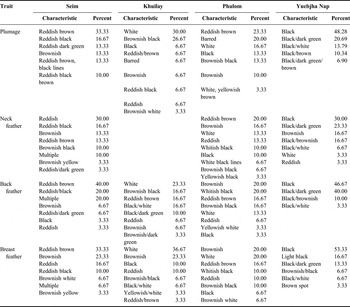
The plumage colour of local chickens available was reddish brown constituting the maximum proportion of plumage colour in SM and PL varieties with 33.33 and 23.33 percent, respectively. An utmost plumage colour was white (30.00 percent) and black (48.28 percent) in KL and YN, respectively. Similarly, a predominant colouring as reddish brown (20.00 percent), black (30.00 percent) and reddish (30.00 percent) in neck feather was observed for PL, YN and SM, respectively. Neck feather was more varied in PL population. On contrary, YN contains the least variation of neck feather colours. The naked neck gene is a dominant gene and is responsible for general reduction of feather over body surface and total loss of feather in neck region (Merat, Reference Merat1986; Ige et al., Reference Ige, Salako, Yakubu and Adeyemi2012).
In terms of back feather colouration, the highest percentage was surveyed in SM, KL, PL and YN was reddish brown (40.00 percent), white (23.33 percent), brownish (20.00 percent) and black (46.67 percent), respectively. The same colour domination was examined for breast feather colourings in SM (reddish brown, 33.33 percent), KL (white, 36.67 percent), PL (brownish, 20.00 percent) and YN (black, 53.33 percent). Importantly, plumage, neck feather, back and breast feather colour were found to be more varied in KL and PL populations (Table 1). This probably explains the greater diversity with respect to feather colourations (Bhuiyan et al., Reference Bhuiyan, Bhuiyan and Deb2005; Faruque et al., Reference Faruque, Siddiqee, Afroz and Islam2010). On the other hand, lowest feathers colour was observed in YN indicating the least diversified among the four Bhutan indigenous chickens (BIC) populations agreeing with Dorji, Duangjinda and Phasuk (Reference Dorji, Duangjinda and Phasuk2012) findings. Their report was based on FAO recommended molecular tools. Moreover, the frizzling and naked neck genes is considered for increased feed efficiency, growth rate, egg production and disease tolerance (Ajayi, Reference Ajayi2010; Egahi, Dim and Momoh, Reference Egahi, Dim and Momoh2013). Moreover, genetic distance between broiler and KL was sufficiently close (Dorji, Duangjinda and Phasuk, Reference Dorji, Duangjinda and Phasuk2012).
Feather colour in four Bhutanese indigenous chicken populations (percent).

Comb type and earlobe
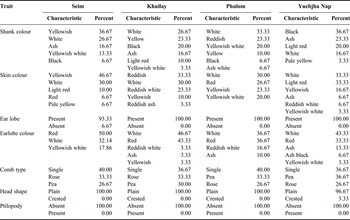
Only three types of comb (rose, pea and single) were found in all four indigenous chickens of Bhutan (Table 2). The finding agrees with the reports of Daikwo, Okpe and Ocheja (Reference Daikwo, Okpe and Ocheja2011) and Ige et al. (Reference Ige, Salako, Yakubu and Adeyemi2012) on native chickens of Nigeria. Egahi et al. (Reference Egahi, Dim, Momoh and Gwaza2010), Dana et al. (Reference Dana, Dessie, van der Waaij and van Arendonk2010) and Badubi, Rakereng and Marumo (Reference Badubi, Rakereng and Marumo2006) reported more than three comb types contradicting with present study. Nevertheless, the common comb occurring was single comb type as examined for Nigerian local birds (Egahi et al., Reference Egahi, Dim, Momoh and Gwaza2010; Apuno, Mbap and Ibrahim, Reference Apuno, Mbap and Ibrahim2011; Daikwo, Okpe and Ocheja, Reference Daikwo, Okpe and Ocheja2011). Parallel result was also obtained from native chickens of Botswana (Badubi et al., Reference Badubi, Rakereng and Marumo2006) and Bangladeshis (Bhuiyan et al., Reference Bhuiyan, Bhuiyan and Deb2005; Faruque et al., Reference Faruque, Siddiqee, Afroz and Islam2010; Uddin et al., Reference Uddin, Ali, Aktar and Khatun2011). This indicates that the bird have been favoured by hot climatic conditions whereby large comb, such as single comb allows for efficient heat regulation (Apuno, Mbap and Ibrahim, Reference Apuno, Mbap and Ibrahim2011). On the other hand, pea type was the most frequently sampled for Ethiopian traditional birds (Dana et al., Reference Dana, Dessie, van der Waaij and van Arendonk2010).
Shank, skin and earlobe colour, comb type, heat type and ptilopody among four indigenous chickens of Bhutan (percent).

Except for the SM, all the BIC birds have ear lobes (Table 2). Earlobe colour was dominated by red (50.00 percent) in SM, white (46.67 percent) in KL, white and red (36.67 percent) and white (43.33 percent) in YN flocks. The dominant white colour was also reported in Nigerian (Egahi et al., Reference Egahi, Dim, Momoh and Gwaza2010; Ige et al., Reference Ige, Salako, Yakubu and Adeyemi2012), Bangladeshis (Faruque et al., Reference Faruque, Siddiqee, Afroz and Islam2010) and Ethiopian (Dana et al., Reference Dana, Dessie, van der Waaij and van Arendonk2010) indigenous chicken. Furthermore, Faruque et al. (Reference Faruque, Siddiqee, Afroz and Islam2010) documented that the red and white earlobe colour dominants in naked neck population and is in line with KL populations.
Ptilopody and head type
Throughout the study crested head and ptilopody were not found in all BIC populations (Table 2). The absence of feather on shank aligns with the finding of Halima (Reference Halima2007) in Northwest Ethiopian local birds. Faruque et al. (Reference Faruque, Siddiqee, Afroz and Islam2010) also observed that the shank feather phenomenon was absent in three genotypes of Bangladeshis native chicken. On contrary, lower percent of ptilopody among Nigerian local birds was examined (Daikwo, Okpe and Ocheja, Reference Daikwo, Okpe and Ocheja2011).
Skin and shank colour
The skin colour ranged from white to red among the studied BIC populations. However, the prime skin colour in SM, KL, PL and YN was yellowish (46.67 percent), reddish (33.33 percent), white (30 percent) and (33.33 percent), respectively (Table 2). Daikwo, Okpe and Ocheja (Reference Daikwo, Okpe and Ocheja2011) also reports multiple shank colour for Nigerian traditional birds. This was contradicting with the Ethiopian local bird's shank colour with white and yellow (Dana et al., Reference Dana, Dessie, van der Waaij and van Arendonk2010). Nevertheless, high percent colour of shank follow the same pattern.
Shank with white colour accounted the most in KL (26.67 percent) and PL (33.33 percent), yellowish (36.67 percent) in SM and black (36.67 percent) in YN. Faruque et al. (Reference Faruque, Siddiqee, Afroz and Islam2010) also mentioned that the white shank colouring dominants in Bangladeshis chickens. This contradicts with Mancha (Reference Mancha2004) whose finding in Plateau chicken was pink, dark ash, ash and light yellow. Genes that affect plumage colour also affect shank colour (Crawford, Reference Crawford1990).The presence of large variations further confirms that higher diversity in KL and PL as suggested by Daikwo, Okpe and Ocheja (Reference Daikwo, Okpe and Ocheja2011).
Conclusion
Bhutanese indigenous chicken has their place in contributing to the genetic collection because of their hardiness and aptitude to survive under low input conditions. Development of conservation strategies is very important to make genetic resources available for meeting the future unpredicted breeding requirement. Among four studied chicken strains in Bhutan, single comb type predominates and there was no feather on shank and head. Based on feather colours, Kuilay seems to be more diversed while Yuebjha Narp reflect lower morphological variation. It is further suggested to conduct morphometric study on Bhutanese chicken populations to confirm our claims.
Acknowledgements
We would like to thank individual farmers for their active participation during this study.