To speak of cyclical history is to remove oneself from modern, progressive civilization; it is to speak of another type of society, where neither reason nor the optimal use of time are the key elements anymore. On the contrary, it will be individuals who control time. It is what I call human happiness in opposition to slavery.
———Patzi Reference Patzi Paco2004 (translation from Dunkerly 2007: 148–49).Manchay sufrini. Waleq chinkapun. Hacienda kutimunmanchu … mana? Rikhurinmanchu? (I suffer greatly. How good that [the hacienda, a bonded labor institution originating in Spanish encomiendas] has been lost. What if the hacienda were to return…? Could it appear again?
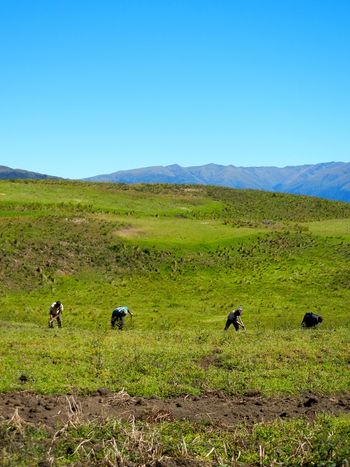
———Doña Cecilia Sanipaya, elderly shepherdess, to the author, Pucara, Bolivia, 2011.Determined to finish harvesting the row, Teodoro, his wife, and two adult sons barely glanced up as they stooped over their potato plots, hands busy breaking apart the dark mounds of clay-rich soil (image 1). Several meager heaps of waych'a (Solanum tuberosum) potatoes lay on a blue tarp beside them. I first met Teodoro, a campesino (peasant) farmer and union leader, in 2011 at a union meeting in the rural Bolivian province of Ayopaya. Now, several months later, I found myself standing on the outskirts of his plot with several municipal officials. The officials were there to survey a now-defunct environmental tourism building as part of a fiscal audit of completed community-development projects. Federico, a Quechua-speaking villager in his forties who had led us there, stood beside me, hands buried in the pockets of his blue jeans. Glancing over at the tarp, he commented in Quechua, “There are very few (pisilla).” “Yes, very few,” Don Teodoro agreed. Interweaving Quechua and Spanish, he explained that the potatoes were diseased: “Before, when the land produced well, we were exploited by the master. We had to give two of every three rows of potatoes and one of ten pigs to him. But now, the land doesn't produce well. It provides just enough to eat. It's contaminated.” He looks up at us, “In some way, slavery (esclavitud) persists.”
Potato harvest. Author's photo.

What might Teodoro's lament of continued slavery teach us about the wielding of time as a mode of political critique (Thomas Reference Thomas2016; Palmié and Stewart Reference Palmié and Stewart2016; Bear Reference Bear2016)? Most basically, his words attest to a concern with hunger and food shortages resulting from the widespread potato blight that affected the entirety of the Ayopaya region that year (Coca-Morante and Tolin-Tordova Reference Coca-Morante and Tolín-Tordoya2013). Yet, that he likened the potato blight to persisting esclavitud (slavery) raises a broader set of questions that exceed issues of agricultural yields or crop diseases. Invoking the utopian limits to Karl Marx's famous formulation, in The Eighteenth Brumaire of Louis Bonaparte, “Men make their own history,” but not under conditions of their own choosing, Bolivian pro-indigenous political theorists and party officials of the Movimiento Al Socialismo (or MAS; Movement toward Socialism) have appealed to time as a key ingredient in indigenous struggles against continued colonial dispossession and even slavery.Footnote 1 For instance, Patzi (Reference Patzi Paco2004) has proposed wresting back control over time as a disruption of enduring systems of capitalist rationality and racialized subjection, glossed as “slavery.” To eradicate racialized inequalities deriving from earlier colonial rule instead required the government abetted revival of ostensibly precolonial forms of “Andean” collectivity and land tenure. This agenda faces notable challenges in the province of Ayopaya, home until the mid-twentieth century to a severely oppressive system of forced labor servitude within regional haciendas, or agrarian estates.
This article examines revolutionary discourses of national historical transformation in Bolivia and tracks how Ayopayan farmers appropriate, contest, and recast them. Efforts to supersede an oppressive past have been key to decolonizing reform initiatives undertaken by the MAS party since 2006, but questions of temporal unfolding have also guided rural farmers’ perceptions of land and place. Between 2010 and 2012, I carried out fieldwork with Quechua-speaking farmers in Ayopaya and with MAS government staff there and in Cochabamba city, and I learned about people's enduring concerns with the recent hacienda past. Against governmental declarations that Bolivia's colonial past was dead, or passed, people like Doña Cecilia and Don Teodoro expressed skepticism that a decolonized present had arrived. They meditated on landscapes as evidence of the enduring grip of earlier histories of indigenous land dispossession, including processes of “recolonization” based on the “reproduction of feudal and imperial modes of domination” (Rivera Cusicanqui Reference Rivera Cusicanqui2012: 97). Indeed, the majority of Teodoro's croplands were planted with genetically engineered oats to be sold to foreign feed companies.Footnote 2 Ayopayan farmers talked about the region's oppressive past to assess deficient state aid and resources in the present, but also, at other times, to confront what were to them unwelcome reform interventions. My discussion centers on illuminating the varied ways that farmers and villagers mobilized the hacienda past to address inequitable land tenure, violated sovereignty, and women's marginalization from political life. In the process, I hope to raise new questions about the critical possibilities opened up by the re-politicization of colonial history in twenty-first-century Bolivia.
SLAVERY IN THE TIME OF PACHAKUTI
Accounts of enduring indigenous subjection like Don Teodoro's stand in stark contrast to the state historiography of revolutionary transformation that held sway until President Evo Morales’ conflictive resignation in 2019. More often, as in Patzi's vision, Bolivian political figures, public intellectuals, and social theorists-turned-statesman have sought to reframe the return to other times as a path to liberation, as a return to value systems that are not rooted in capitalist rationality and racialized “slavery.” The invocation of “slavery” here follows from a broader set of interpretive shifts that began in the late 1700s, when Bourbon reformers reframed older precolonial practices of forced labor in mines (mitanaje) and within agrarian haciendas (yanaconaje) as forms of “slavery” (Larson Reference Larson1998: 85–87).Footnote 3 In the process, practices of labor circulation in farms and mines were rendered newly intelligible as variations on a colonial model of slavery rather than as remnants of an earlier Incan labor system (Winchell Reference Winchell2015: 35). Under MAS, historical works describing the violence of hacienda bondage were popularized in the state printing and recirculation of key texts such as Renato Rosaldo's Mitanaje y Yanaconaje (Goodale Reference Goodale2019). This interpretive sleight of hand was apparent both in the ways that rural farmers talk about labor and its histories and in MAS political discourses and laws.
Political leaders aligned with MAS frequently evoked “slavery” as a colonial evil that the government's pro-indigenous revolutionary agenda would eradicate. New labor laws passed under MAS gave this vision new institutional force. For instance, a 2008 Supreme Decree, “Relations of Servitude and Verification of Their Existence,” amends the earlier agrarian reform law (no. 3545) and charges land reform officials with eradicating haciendas premised on systems of servitude, by “liberating captive families.” It defines servitude (servidumbre) as not just indentured labor but any arrangement in which people work in exchange for basic living needs such as food, or to repay outstanding debts. In this decree, as in late colonial labor reforms, the notion of “slavery” introduces a subtle equivalence between indigenous practices of child circulation (Leinaweaver Reference Leinaweaver2008) and colonial institutions of racialized servitude, both of which are presented as repugnant to rights-based ideals of individual agency. As elsewhere, in Bolivia these labor and kinship arrangements together constitute a new field for intervention contingent on what Elizabeth Povinelli (Reference Povinelli2011: 21) calls “the prior”—that which is seen as customary, prior to colonial rule or to the distribution of equal rights through democracy—which settler states mark as unjust and in need of eradication.
This collapsing of indigenous and colonial institutions within the domain of “the prior” goes against the grain of Andean political movements since the eighteenth century that have sought to counter European attempts at indigenous erasure. Unlike settler states such as Australia or Canada, the region that today stretches across Bolivia, Peru, Ecuador, Chile, and southwest Columbia has long been defined by mass indigenous movements that have violently rejected native ethnocide both as an imperial state project and a broader historical telos. Most famously, the revolutionary figure Túpac Katari (born Julian Apasa Nina) led mass rebellions across the Andean region in 1781, which starved out Spanish inhabitants. His army of more than forty thousand native Andean rebels set up court in El Alto (Bolivia), where he presided for 184 days before his capture and brutal execution by the Spanish. The rebellion sought to end Spanish plunder but also to stymie the spread of Spanish colonial ways, apparent in the movement's forbidding of Spanish language and dress. Before he was publicly quartered by horses and his body dispersed across district towns as a warning to other militants, Katari is said to have announced: “I shall return, and I shall be millions” (Albó Reference Albó and Stern1987; Goodale Reference Goodale2019). Katari has remained a pivotal millenarian political figure for anti-colonial, pro-indigenous organizing in Bolivia. He most recently arose as the figurehead for the Katarista movement that gained sway in the 1980s and which, with other groups, supported Evo Morales Ayma's rise to the presidency in 2005.
Historically, Bolivia's anti-colonial mobilizations have worked against hegemonic narratives of indigenous erasure or assimilation through mestizaje (racial and cultural admixture).Footnote 4 Despite the centrality of indigeneity to mestizaje, as a national project it nonetheless positions native groups as lacking critical faculties, including the ability to write and, especially, to write history, necessary to participate as agents or authors of secular modernity (Wolf Reference Wolf1982). Rejecting this exclusion from history and governance proper, Katarista activists and Aymara scholars working within the Andean Oral History Workshop (Taller de Historia Oral Andina) since the late 1970s have sought to recuperate indigenous Andean practices of history and historical knowledge production (Stephenson Reference Stephenson2002). THOA scholars advocated for Andean oral history as well as weaving and knot systems (khipus) as modes of historical narration and memory (Rivera Cusicanqui Reference Rivera Cusicanqui and Mato1989; Arnold Reference Arnold1993; Salomon Reference Salomon2004). Scholarship revalorizing indigenous memory and oral narrative was accompanied by activist efforts to reconstitute Andean communities based on the ayllu (dual-moiety community model) (ibid.: 103).
If an earlier academic obsession with origins (Harris Reference Harris and Fardon1995: 113) had fueled arguments that, by borrowing from Spanish colonial traditions, people who had become mestizo were no longer truly indigenous, revisionist scholars instead highlighted the generativity and dynamism of indigenous knowledges and political systems. Scholars like Denise Arnold (Reference Arnold1993: 56, Reference Arnold2009) showed how weavings serve as archival documents whose designers use them to narrate indigenous ancestors’ processes of gaining colonial title to land, thereby recalling the shift from layra timpu (Aymara for the “time before”) to the present. Other research has examined Quechua leyendas as forms of historical production that narrate events as paths over landscapes, identifiable by toponyms (Howard-Malverde Reference Howard-Malverde1990; Abercrombie Reference Abercrombie1998). These efforts to write against mestizaje illuminate other modes of practice through which indigenous groups re-narrate colonial pasts and their shaping of the present. They reveal what Rivera Cusicanqui (Reference Rivera Cusicanqui2012: 105), drawing from the Aymara notion of ch'ixi, describes as a sort of “third” temporal space defined by an antagonistic intermingling of indigenous and Spanish, past and present.
With Morales’ election to the Presidency in 2005, aspects of these Katarista visions entered official government chambers and political agendas. As a consequence, twenty-first-century nationalist discourses of revolution in Bolivia have departed in notable ways from European and North American traditions of political theorizing on political change, refracted as they are by Aymara concepts of time as translated and popularized by THOA scholars and Katarista activists. For these scholar-activists turned statesmen, the revolutionary mobilizations that brought MAS to power in 2006 are one instance of pachakuti, an Aymara term (also used in Quechua) that means the turning over (kuti) of space-time (pacha) (Dunkerley Reference Dunkerley2007: 148).Footnote 5 Through this process of reclaiming history, conceived not just as a way of narrating the past but also as a temporal outlook based on anticipating political change, the formerly dispossessed are to find their footing as agents of indigenous revolution.Footnote 6 For supporters and officials aligned with the anti-imperialist, pro-indigenous MAS party (2006–2019), revolution therefore entailed much more than participating in a global telos of modernizing uplift through the assigning of citizen rights. It required cultivating subjects and governance patterns as agents of change toward a specific Andean horizon of emancipatory, indigenous revival and return.
These efforts politicize history and temporal spacing, for instance, by likening certain practices and forms of life to “servitude” and “slavery.” They do so not only to highlight the evil that decolonization must eradicate but also to position inherited labor relations as key sites of relational and psychic work that subjects must undertake to emancipate themselves (Winchell Reference Winchell2018). That this remains so in the wake of Bolivia's tumultuous October 2019 election is evident in the re-popularization of the phrase “morir antes que esclavos vivir” (better to die than to live as slaves), a phrase that today operates as a Facebook frame (image 2), an anti-MAS Facebook page with six thousand followers, a newly recorded cueca song on YouTube;Footnote 7 the title of an opinion piece by Carlos F. Toranzos Soria in Bolivia's Pagina Siete (23 Sept. Reference Soria and Carlos2019) newspaper, and a call to arms to Evo Morales’ critics. This phrase refers to Bolivia's National Anthem (see Orías Reference Orías and Robins2014) and has long been a slogan of popular democratic sentiment in Bolivia. But in 2019 it took on new connotations, accompanied as it was by portrayals of Evo Morales as a cocaine addict who would cling to power until 2050 if allowed to do so (Facebook, 31 Dec. 2019), and racialized calls to “reclaim” Bolivia from corrupt indigenista politicians. The phrase yokes indigeneity to slavery, not only as the basis for marginalized groups’ moral claims to special rights but also as a category of political anachronism and death against which democracy, and life itself, must be won.
Facebook frame “¡Morir Antes Que Esclavos Vivir!” (Die before slaves live!), including Bolivian flag and coat of arms. Applied to author's photo taken on the bus route from Cochabamba city to Ayopaya.

In what follows, I backtrack from the present moment to consider indigenous farmers’ critical engagements with nationalist visions of revolutionary change oriented toward eradicating “slavery” and reviving indigenous, predominately Aymara institutions of land tenure and political sovereignty, particularly during the latter half of Evo Morales's presidency. I then ask what these engagements tell us about history, and time more broadly, as critical modalities whereby marginalized groups in MAS-era Bolivia opposed a more nationalist, state-centered, ethnic revivalist agenda. As I will show, in Bolivia under Morales people invoked historical duration not only to assign blame for weak state programs but also to renegotiate or refuse their interventionist tenets. By tracing these critical redeployments of history, I hope to illuminate the emergence of new conditions of indigenous refusal in Bolivia and also speak to the broader potency of time and temporalizing languages in our present.
BECOMING “PROTAGONISTS OF HISTORY”
In the course of fieldwork I conducted in Bolivia during twenty months between 2010 and 2012 and in follow-up trips in 2015 and 2017,Footnote 8 I became curious about how Quechua farmers’ invocations of persistent “slavery” related to MAS party claims to have superseded an oppressive past. In the MAS party's nationalist vision, political change could be achieved through a revolutionary break from the nation's colonial past, by forging what Patzi called “another type of society” liberated from the forms of temporal discipline on which capitalist surplus-value relies.Footnote 9 If the broad alliance of student, peasant union workers, and indigenous groups who brought Morales to power emphasized the need for indigenous peoples to regain agency vis-à-vis global histories of colonial dispossession and neoliberal plunder—thereby making, as one taxi driver in Cochabamba neatly put it, “indigenous people protagonists of their own history”—what of those subjects who instead view the present through a prism of continued oppression? Teodoro's evocation of “slavery” emphasized continuities of political and economic dispossession that linked their lives to the racialized servitude of the hacienda economy.Footnote 10 His words, spoken a half-century after national agrarian reform and a decade after Bolivia's celebrated third “indigenous revolution” of 2005, implied a tragic betrayal by a progressive history in which the nation's obstructed movement forward seemed to leave time out-of-joint (Scott Reference Scott2014: 2).Footnote 11
Laments of enduring agrarian vulnerability called upon state agencies to fulfill promises to help Quechua- and Aymara-speaking farmers, but they did more than that. As noted earlier, my morning conversation with Teodoro occurred during a visit by four municipal officials to an abandoned eco-center located about a quarter mile from his plot. Though the municipal government had secured a US$4,000 World Bank grant for the center in 2007, it was now closed. Teodoro took a break from harvesting his potatoes to walk us over to the building. Unlocking the door, he guided us through damp, darkened rooms that included a hostel-style sleeping area with bunk beds, a small kitchen, and an office equipped with a generator-powered radio. After the tour, union leaders and municipal officials rested outside and chatted, Teodoro explained that people feared there would be institutional reprisal if the center was damaged, and so they left the building locked and the generator untouched. Unused, the generator's batteries had lost their charge. Like the empty, cavernous rooms, the spent batteries aptly encapsulated the eco-center as a project of vital futurity that might have been but was not: what Reinhardt Koselleck called a “future past” (Reference Koselleck2004: xxiii).Footnote 12
At a time when state legitimacy rested so heavily on the promise of change, particularly governmental assurances of “food sovereignty” (Cockburn Reference Cockburn2014), Teodoro's allusion to entrenched vulnerabilities like food shortages and poverty constituted a stinging critique of MAS governance. As we toured the eco-center, he described how the late, corrupt municipal mayor had appropriated development funds intended for struggling farmers. This was particularly vexing given the severity of that year's potato blight.Footnote 13 Yet, Teodoro's diagnosis of the potato harvest as a historical problem, and as a point of insight into continued slavery, suggested concerns that exceed issues of state aid or services. Echoing popular preoccupations with the shape of history's forward movement elsewhere (Scott Reference Scott2014: 15, 16; see also Brown Reference Brown2001), his concern with the duration of certain aspects of the hacienda system might be understood in terms of a “larger crisis of time” defined by pessimism about the possibility of future emancipation. In Bolivia, such pessimism emerges in dramatic counter-distinction to a formal state historiography centered on the re-founding of Bolivia and the accompanying start of a “new history” in 2006 (Dangl Reference Dangl2019; Postero Reference Postero2017).
Morales’ dramatic rise to the presidency was not initially marked by pessimism about the possibility of an emancipatory future. On the contrary, like the 1994 Zapatista uprising in Mexico, his 2005 election gripped global audiences who saw it as exemplifying the continued—and as many saw it, unlikely—force of indigenous movements in challenging late capitalism, as a display of political alternatives that social theorists like Francis Fukuyama (Reference Fukuyama1989) had long declared dead.Footnote 14 Here I ask how farmers’ reflections on the region's bonded past open up a space of critique from which to assess the failures of MAS political agendas. New agrarian reforms and indigenous autonomy measures sought to spatially inscribe on the Bolivian countryside a more homogenous, reified model of indigeneity (Tockman and Cameron Reference Tockman and Cameron2014). That Ayopayan farmers have been critical of such efforts is apparent in the regional peasant union's rejection of a 2010 proposal to convert the region into collective land, which I discuss below. I approach these conflicts as moments of “grounded refusal” (Simpson Reference Simpson2014: 10), a non-oppositional political practice oriented by questions of membership, belonging, and shared history and not exclusively toward legal recognition. Unlike resistance, such refusals entailed positive elaborations of belonging that sought to go beyond state models of bounded indigenous collectivity or critical efforts to negate them.
My discussion of Ayopaya's hacienda past-in-present builds from longstanding scholarly debates concerning the endurance of colonial and republican pasts in Latin America.Footnote 15 In the face of these divergent colonial inheritances, we find that landscapes, mines, plants, and even soil can become sites of refusal from which people negotiate capitalist extractivism and foster alternate projects of belonging, both human and more-than-human. My analysis of the heterogeneous historical practices that inhabit Ayopaya's post-hacienda landscape follows from this scholarship but gives renewed attention to how marginalized groups appropriate and recast imperial ruins (Stoler Reference Stoler2008: 193). I foreground landscapes as key sites of ethical disagreement about the legitimate place of the colonial past in the present. In taking a stand in these disagreements, Ayopayans adopted elements of the more familiar narrative of political modernity as contingent on slavery's displacement, but they also mobilized aspects of a specific Quechua temporal tradition of emphasizing the potential return or re-appearance of earlier eras (kutimuy), a perspective which rendered abstract, linear history especially conspicuous. For Ayopayans who did not subscribe to a vision of time as necessarily progressive or linear, the state's telos of revolution as forward motion was especially doubtful and problematic.
INDIGENOUS SOVEREIGNTY AND ITS LIMITS
Farmers like Teodoro face poverty and hardship that stem from the region's dramatic history of agrarian servitude as well as from more recent economies of gold, sodalite, and antimony mining.Footnote 16 Teodoro's land, like most parcels in this arid, mountainous part of Bolivia, previously belonged to a hacienda—a sprawling agrarian ranch owned by Spanish-descendent masters and worked by unpaid Quechua- and Aymara-speaking farmers and servants. The brutality of the labor conditions there led to mass worker uprisings in the 1940s. The largest of these was the Chayanta rebellion of 1947, noteworthy as the only armed rebellion in the Cochabamba region before the National Revolution of 1952 (Dandler and Torrico Reference Dandler, Juan Torrico and Stern1987). In addition, mestizo elites continued to extract gold in several nearby mines that leaked toxic chemicals and mercury into the river below Teodoro's plot. These realities of land ownership and extractivism colored Quechua villagers’ assessments of the MAS party government. In fact, Teodoro was eminently familiar with this history. Years earlier, in his capacity as a peasant union leader, he had participated in legal efforts demanding that the Movimiento Nacional Revolucionario (MNR) party government redistribute land to hacienda peasants in accord with the 1953 agrarian reform. At the time of my fieldwork, too, the corrosive effects of these illicit mining economies were evident in the “contaminated” nature of Teodoro's soils.
Late twentieth-century political movements in Bolivia sought to counter indigenous groups’ long social, economic, and political marginalization from mestizo centers and political institutions. Starting in the 1980s, labor unions, students, and indigenous associations joined in a mass national movement to oppose the International Monetary Fund's structural readjustment program, the “New Economic Policy,” which had resulted in massive cuts to social programs and severe roll-backs of labor protections.Footnote 17 Subsequent anti-state movements drew together ecological and ethnic discourses to reframe multinational control over natural resources, especially water and gas, as violations of national and indigenous sovereignty (Perrault Reference Perrault, Gomez and Sawyer2012). These movements changed the course of Bolivian political history. In 2005, Evo Morales Ayma, a coca-grower and indigenous campesino, was elected president. In his inaugural address, tears streamed down his cheeks as he declared the “end of a colonial and neoliberal era.” He vowed, “We will not allow capital to be concentrated in so few hands that many die of hunger. Of course, some have the right to live better, but without exploitation, without robbery, without humiliation, and without enslavement of others” (quoted in Ferreira de Silva Reference Ferreira de Silva2009: 27). In 2006, his MAS party government initiated a reform program that made dramatic changes to existing legislation on education, resource rights, technology, healthcare, military and police work, racism, and maternal and child health (Perrault Reference Perrault, Gomez and Sawyer2012).
Of notable significance in Ayopaya was MAS’ renewed support for collective land titling (INRA 2010). Policy measures passed in 1996 and renewed under Morales in 2006 charged the National Institute for Agrarian Reform (INRA) with new initiatives of individual and collective land titling, monetary aid and institutional support for small farmers, and labor protections for agriculturalists and domestic workers. Through these efforts, MAS promised the long-awaited titling of hacienda land that had been redistributed to peasants in 1953. Under MAS, thousands of Bolivians have received land titles since 2006. To many people's disappointment, however, these titling initiatives did not redistribute land to indigenous farmers so much as deliver formal property titles to existing landowners, leaving intact existing inequities related to earlier hacienda and plantation economies. Moreover, the government has continued to come up against shortages of land to title, and it has often distributed property to male union members while marginalizing the claims of the elderly and women (Farthing and Kohl Reference Farthing and Kohl2012).
The MAS party government, by way of the new 2009 constitution and the 2010 “Framework Law of Autonomies and Decentralization,” also created new legal means to establish indigenous autonomy (Tockman, Cameron, and Plata Reference Tockman, Cameron and Plata2015: 40). Nevertheless, while many scholars and left-leaning international audiences were initially optimistic about MAS's renewed commitment to indigenous sovereignty, scholars have found that in practice bureaucratic stipulations posed severe limits on indigenous autonomy.Footnote 18 In draft proposals for establishing indigenous autonomy, statutes deferred to constitutional law more than the Autonomy Law required. These autonomy statutes made few if any references to internationally recognized indigenous rights laws and instead foregrounded the MAS government's legitimacy as defined within Bolivia's 2009 constitution. Departing from existing international rights stipulations, the Morales government invoked a more restricted definition of territory that identifies natural resources, especially non-renewable resources, as “national property” (Tockman, Cameron, and Plata Reference Tockman, Cameron and Plata2015: 52). Alongside the abrogation of rights to territory in the more legally encompassing sense of this term, the MAS party required that autonomous regions align with existing municipal territorial limits (ibid.: 46). These aspects of the autonomy law highlight the durable force of institutional designs that rely on bounded notions of political space and municipality originating in colonial land settlement and renewed thereafter in varying forms, including a municipal decentralization law passed in the mid-1980s.Footnote 19
Legal pathways to indigenous political autonomy under MAS reflected longstanding governmental concerns with the bounded qualities of indigenous communities. These concerns derive from late colonial and republican efforts to disaggregate haciendas and convert peasants into citizens as well as from native groups’ reworking of a community ownership model as a basis from which to oppose liberal land resettlements premised on individual property. Ayopaya's severe hacienda system had made it a pressure point in late eighteenth-century Bourbon reform efforts to liberate Quechua and Aymara laborers (Larson Reference Larson1998: 187). By the nineteenth century, the break-up of corporate church, latifundio, and community lands through Bolivia's 1874 Disentailment Law arose as a key mechanism for remedying both the “Indian problem” and what reformers saw as the colonial pathos of servitude. Mid-twentieth-century land struggles brought demands for hacienda land redistribution and the return of indigenous community lands expropriated by earlier hacienda expansion (Soliz Reference Soliz2017). In Bolivia, this history of anti-hacienda reform and indigenous struggle has made land rights a particularly potent arena for judging the legitimacy of modernizing governments, including MAS with its promises of decolonial progress. During Bolivia's de-colonial period of MAS rule, too, landscapes retained potency as a privileged material ground from which indigenous groups sought to contest governmental designs.
THRESHOLDS OF LIBERTY
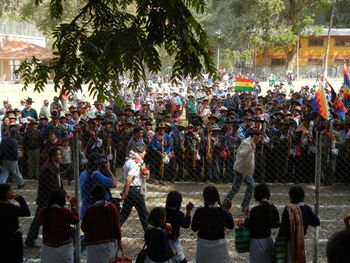
Popular skepticism toward MAS party promises were palpable at the time of my research. At one presidential visit I attended (image 3), crowds of curious school children lined the chain-link fence separating the soccer stadium (housing visiting politicians) from bleachers built for guests. Various rural villages displayed their presence (and support for MAS) with hand-painted signs. Despite the excitement in the town in the days leading up to the event, residents later noted that the stadium that day had been “vacío” (empty) compared to visits during the early days of the Morales regime. However, the regional union of agricultural workers, comprised of Quechua and Aymara farmers, remained staunch MAS supporters. Many farmers knew President Morales personally from having worked with him in the lowland coca fields of Chapare. Sindicato (labor union) farmers formally supported MAS, but they were also quick to challenge its reform agendas. Critiques of MAS's reform program were widespread in Ayopaya, something apparent in the frustrated phrase I often encountered, “Where is the change?”, which alluded to the official MAS party slogan, El proceso de cambio (the process of change). This question was invariably, and predictably, answered by the person who posed it: mana kanchu, Quechua for “there is none.” Farmers also expressed reticence about development projects in the region, like the World Bank-funded eco-center I toured with Teodoro. As the former head of a local agronomical institute that had partnered with foreign investors put it: “The question is, where does the money go?”
A visit by Evo Morales. Author's photo.

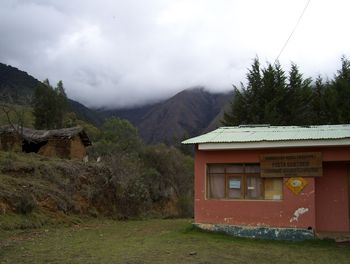
I learned more about popular disenchantment with MAS state development agendas during a visit to the rural village of Sarahuayto in early February 2012. I had been invited there to attend an annual patron saint's day celebration. Upon arriving with two municipal officials and their families, we joined Don Ángel, a union leader and the son of hacienda workers who was now in his late sixties and acting as a fiesta sponsor, in his outdoor patio for flute-playing and drinks. As we sipped brewed corn beer from our metal tinka cups, Ángel explained that the village lacked medical care: the state-employed nurse was always traveling on his motorcycle and did not attend to villagers at the medical post even on scheduled days (image 4). After clarifying that I was not a government official, but a researcher interested in the earlier hacienda system, Ángel shook his head sadly, “Life before was desperate. There was nothing to eat.” We sat solemnly, listening to the rain drum down upon the tin roof.
The medical post. Author's photo.

I turned to Ángel and asked him what he made of the fact that the master's grandson still resided in a former hacienda building nearby. He nodded, “Mana chinkachinchu.” This Quechua phrase turns upon the negation of the verb chinkay, which means to lose, get lost, or cease to be in one's possession or within one's capability.Footnote 20 The phrase implies a subject, here the hacienda institution, and is roughly translatable as, “[The hacienda] has not been eradicated.” In this remark, Ángel reversed the more common designation of the hacienda as chinkachin, lost or eradicated, with the –chi suffix denoting a change caused by human intervention rather than natural causes. For instance, when I asked one Quechua-speaking acquaintance whether the master's children ever passed through the region, he responded, “No. We cannot permit them to come anymore. [The hacienda] has been eradicated (Chinkachin).” Similarly, Doña Flora, whose parents worked as hacienda laborers, noted of the former master: “It is good that [the hacienda] has been eradicated (waleq chinkachin). Now,” she added, “is the time of good liberty” (sumaq libertad tiempo).
Like Teodoro's earlier comparison of wanton harvests and over-farmed soils to the persistence of “slavery,” these accounts linked continued suffering to the tenacity of “the hacienda” as a labor institution and as a broader historical period defined by indigenous groups’ political and economic dispossession (Lyons Reference Lyons2006). Such understandings rendered liberty contingent on forcibly ejecting mestizo masters from hacienda regions, which was indeed a common outcome of 1953 hacienda abolition. In fact, people commonly referred to the pre-1953 era as “hacienda time” (hacienda tiempo) and contrasted it to the post-agrarian reform present. Echoing the language of labor organizers and lawyers sympathetic to the peasant cause, farmers described the reversal of liberties that had been won by the 1953 reform in terms of slavery. For instance, another Quechua sindicato leader in his seventies described as “slavery's return” mestizos’ going back to the countryside after Victor Paz Estenssoro's 1986 election as president, which led to the suppression of worker sindicatos and this man serving a four-year jail term for fomenting worker unrest. For farmers like these, “slavery” assumed weight not only as a term of historical recollection but also as a way to assess and critique their continued marginalization from land and political power, against MAS's proclamations of an emancipatory present.
Understanding liberty in the present as contingent upon colonialism's eradication or displacement worked to politicize perceived continuities with the earlier hacienda era. While hacienda servitude lasted until 1953—more than a century after Bolivia's formal independence from Spain in 1825—as an institution it synthesized the kinds of racial hierarchy and labor violence associated with an earlier imperial era (Gose Reference Gose1994: 20). And while employees and lawyers with whom I spoke at the National Institute for Agrarian Reform (Institúto Nacional de Reforma Agraria) in Cochabamba framed the hacienda system as having been uprooted by the 1953 agrarian reform, rural farmers questioned this assessment. In 2011, I rested on dry pasture grass as Doña Cecilia told me about her childhood as an unpaid hacienda servant. She recounted the brutal cold and her inadequate dress, the master calling her “beast, donkey, dog” (animala, buruu, pirru), and his kicking and hitting her as he passed on horseback. But the injustice had not ended with hacienda abolition; instead, her mother had left land to her “spoiled” siblings and none to her. She was forced to beg. Today she lives alone. Four of her nine children have died, and the rest have moved to the lowlands for work. The exception is one son, who disdains her for not having escaped servitude as he believes he would have.
Doña Cecilia punctuated her account of forced labor “service” with a set of nervous questions: “Might the hacienda return, or not? Could it reappear?” Later, she explained: “People ask me: ‘What if the hacienda were to return?’ It won't return will it, not now? If it did, today's children would be unable to endure it.” She was not the only one to express this concern with the hacienda's potential return. Male sindicato leaders like Teodoro or Ángel tended to discuss the hacienda era in terms of earlier agrarian masters’ absolute loss (chinkachin) of land, but in moments of sadness, inebriation, or in earshot of municipal officials, they, too, expressed doubt with this historical ordering. For them, it was not at all apparent that the vulnerabilities of hacienda life were the stuff of a bygone era: indigenous groups’ reclaiming of land that had been seized from them under the hacienda system was far more precarious than MAS officials acknowledged (Postero Reference Postero2017).
Knowing that continued funding for development projects hinged on maintaining strong ties to MAS party officials, younger sindicato leaders sought to limit my access to women's more critical accounts of contemporary rural life and inequities of land tenure, as did their male kin. When our paths next crossed, Doña Cecilia described having been reprimanded for speaking to me, even though regional sindicato leaders and the municipal government had previously approved my conducting research there. And while Quechua evidentiary traditions are often discussed in terms of the authority they afford to personal experience (Howard-Malverde Reference Howard-Malverde1990), during my fieldwork only men who had been active in anti-hacienda militias during the 1940s and 1950s uprisings were described as “speaking well” about the labor past. Even Doña Cecilia, in the midst of her heart-wrenching account of hacienda violence, apologized: “I don't remember well. I can't tell you because I did not go to school and I can't read. I stayed here, doing nothing.”
In Ayopaya, these gendered tensions between different ways of narrating the past and its relation to the post-hacienda present map onto larger, national-level divisions between a hybrid, socialist-Katarista revolutionary historiography that became hegemonic under Morales, on one hand, and Quechua and Aymara oral history traditions, on the other (see Rivera Cusicanqui Reference Rivera Cusicanqui2012). Through testimonio-like genres of telling (see Rivera Cusicanqui Reference Rivera Cusicanqui1987), women expressed skepticism and anger about not only the region's past but also life in the present. It was not that men's accounts of history were discursive while those of women were not, an assumption that positions Quechua and Aymara peasants—especially women—as “the mute bearers of history” who are “incapable of knowing the past themselves” (Harris Reference Harris and Fardon1995: 107). Men and women alike engaged in narrative traditions that were learned, taught, and socially reproduced. But in alluding to “the hacienda” in its local specificity, women rejected a familiar collapsing of hacienda servitude with slavery. This collapsing had gendered consequences, given that hacienda servants had mainly been women (Gotkowitz Reference Gotkowitz2007). In the late 1940s, as violence erupted in hacienda villages like this one, Quechua hacienda servants and sindicato militants clashed brutally, evident in one male hacienda worker's (pongo) account of having awoken bloodied outside the hacienda estate.Footnote 21 Not all of these accounts were evenly weighted: some achieved the status of esteemed historical knowledge while others were easily discounted as cuentos (tales) or hearsay.Footnote 22
The hierarchies of legitimate historical production that I encountered in Ayopaya aligned with divergent positions vis-à-vis the MAS party government, premised as its initiatives often were on predominately male union and municipal government structures. By and large, those more closely aligned with MAS were more likely to hold out hope that its reform agenda would yield real benefits. For while male sindicato leaders have seemed to hold out the possibility that, with time's passing, the grip of an oppressive past will decline and perhaps even release the present, elderly Quechua women (and former servants) spoke of the past in a way that held that history close as a sort of gage or test against which the present, and contemporary political leaders, could be judged. Teodoro implied that, someday, his fields might yield abundant crops and so the likeness of past and present would fade. By contrast, Doña Cecilia spoke of continued land dispossession and warned that, along with these material inequities, political fortunes might still dramatically decline. Her evaluation of the political present rendered de-colonization contingent upon action—particularly the ability to gain land—and not just words, metaphors, or political circumstances (Tuck and Yang Reference Tuck and Yang2012; see also Rizvi Reference Rizvi2017). At the same time, she refused to equate the present, however mired in suffering, with the earlier period of bonded labor. Elderly people who had lived through the violence of hacienda labor had a key stake in differentiating that time from the present. That the hacienda could return, or that one might question its potential to reappear, implied temporal instability but also clearly demarcated the present, however oppressive, from the era of labor servitude.
Scholars like Denise A. Arnold (Reference Arnold1993: 50) have argued against scholarly tendencies to construct indigenous, local views “from the dualistic and perhaps ethnocentric position of the ‘global’ system, from the ‘outside’ looking in.” This includes scholarship that opposes European history, taken as an abstract record of events determined to have occurred, with Quechua epistemologies of time as evident in myth, legend, or story. I, too, find problematic this notion of dual histories, one indigenous and one colonial, especially given how “local” orientations to time in Ayopaya themselves hinge on evaluating and remembering an imposed imperial institution: the hacienda. As anthropologists have long insisted, there is no indigeneity that is not partly elaborated by colonial histories through missionary violence, tribute practices, armed rebellion, and juridical categories of rights—processes that, together, created “Indians as a generic category” (Harris Reference Harris and Fardon1995: 110). To further complicate matters, in this case a more hegemonic state historiography put forward by MAS integrated aspects of Katarista visions of exemplary revolutionary return, what Olivia Harris describes as the combination of a “longing for what has been lost” and a “hope for continuity with the [precolonial] past” (ibid.).
These efforts to consolidate narratives about the bonded past were politically consequential given the centrality of national historiography to not only citizenship at large but also Bolivia's Katarista identitarian project (ibid.: 119). As elsewhere, the reification of tradition here makes it hard to uphold, since it is difficult to maintain a practice as a bounded object persisting unaltered through colonialism. However, rather than emphasizing the long-run antecedents of contemporary practices, Quechua communities in this region foregrounded “their past in terms of discontinuity.” By invoking the imperfect shift from “hacienda time” to “liberty time,” Ayopayans challenged the promises of incipient indigenous flourishing put forth by nationalist revolutionaries in 1952 and renewed by Morales in 2006. Their accounts suggest a distinct kind of “anticipatory consciousness” (Rivera Cusicanqui Reference Rivera Cusicanqui2012: 96) premised on fostering continuous feedback between past and future. In the cases I have discussed, this feedback illuminated the threshold or overlay between epochal eras otherwise taken to be separate, given presumptions of linear, progressive time.
I now want to consider what these perceptual differences in how people understood the relation of past to present tell us about competing Bolivian elaborations of indigeneity and decolonized futurity. As I will show, in Ayopaya there were tensions between Quechua groups’ felt attachments to arrangements of family land tenure rooted in the hacienda system and the monolithic, nationalist ideals of “indigenous solidarity” proposed by MAS (Lopez Pila Reference Lopez Pila2014: 431). The Ayopayan case further specifies how, despite what often appears as their abstract and reified nature (Van Cott Reference Van Cott2000), nationalist revivalist programs under MAS drew on Aymara models of land tenure, specifically ayllus (Albó Reference Albó, López and Turrión2007). Ayopayans saw this model as particularly objectionable because the hacienda labor systems and the 1953 agrarian redistribution alike foregrounded individual workers (male heads-of-household) rather than peasant communities.
REFUSING BOUNDED INDIGENEITY
On 24 April 2011, I attended a regional sindicato meeting in Ayopaya, in which Quechua and Aymara farmers discussed several development projects in the region. Bolivia's national sindicato organization, the Central Obrero Boliviano, was formed by the Movimiento Nacional Revolucionario (MNR) government after the 1952 socialist revolution. It remains a crucial umbrella institution under which regional, provincial, and village-based organizations operate.Footnote 23
Invited to the meeting by an acquaintance, I sat among mostly male farmers (I counted ninety-one people, just six of them women) in an expansive, dim hall, its air thick with the smell of brewed corn beer. Talk turned to a conflict concerning an agrarian NGO that, in collaboration with the INRA and a graduate student, had initiated the conversion of a portion of the province into Native Community Lands (tierras comunitarias de origen, TCOs). The discussion hinged on the “unity of the province” and the failure of project leaders to consult the sindicato leadership at the departmental level. One man noted, in rapid-fire Quechua, “We have to make sure to defend the land titles. There is the problem of social control as the national peasant union directs the department level. We and our problems are very far apart as a province.” Unionists felt that government ministries and the INRA had used the titling project as an opportunity to subvert municipal politics. As another man complained, “They took peoples’ land titles. This has consequences. What are they going to give their children?”
As the assembly's opposition to this project became palpable, a MAS representative calmly addressed the crowd: “We are in a profound process of change with Evo; we have to see how the question of autonomy figures in this process, with more profundity.” The crowd was not placated. One man rose to say, “This project will affect us because we have property titles and instead we will have just one title for the province. What sacrifice, what pain will be caused by this [decree], signed by our president. And knowing this we started to question the project to create an autonomous indigenous area. Our grandparents got this land as it is, titled individually, and that is how we are walking forward (purishanchis).” “Gringos,” another man grumbled, “are interfering with our lands, as in the past.” After debating the TCO proposal, farmers discussed what to do about a case of competing land claims on the part of two parties, one of whom, by “uses and customs” (i.e., in accordance with the layout of earlier hacienda pasturelands), pastured their animals on shared community land that crossed municipal boundaries. This discussion illuminated the risks of land collectivization, especially for people whose agrarian practices exceed the lines of indigenous territory as elaborated in MAS's 2010 Autonomy Law.
Eight months later, my hands stained by the dust of old documents at the INRA archive in Cochabamba, I found the paper trail produced by this more recent exchange. On 25 April 2011, on the Monday after that conflictive sindicato meeting, the Federación Sindical Única de Trabajadores Campesinos de Cochabamba (FSUTCC, regional peasant syndicate) had delivered a formal letter to the INRA asking that land titling be halted immediately. In the letter, provincial union leaders stated their opposition to land titling. “With the process of titling as a TCO,” they argued “we would be returning to the era of colonialism when campesinos … were never owners of their land or held title to their private property.”Footnote 24 Like farmers’ concerns with crop shortages and their lack of land, the TCO collectivization proposal brought into sharp relief farmers’ continued estrangement from the central government. It also attested to the imposition of standards of indigenous inclusion at odds with existing practices, apparent in the requirement that Ayopayans adhere to a model of bounded indigenous community nested within broader municipal lines. For, as the document annulling the process proclaimed, to be titled as a TCO would result in “being considered and regulated like a park.”
Rejecting the TCO proposal, FSUTCC farmers refused to be confined to the more constricted model of indigenous territory that has been protected in international rights legislation and, in a weaker form, the Bolivian constitution (Tockman and Cameron Reference Tockman and Cameron2014; see also Simpson Reference Simpson2014). FSUTCC members took issue with the state's land collectivization initiative as an attempt to implement a bounded, depoliticized indigenous space: a park.Footnote 25 Critics rightly associated this “community” model of bounded indigeneity with colonial designs. But by mobilizing talk of colonial continuity and return in legal documents—apparent both in the FSUTCC allusion to the proposal as a “return to colonialism” and as an interference in land “as in the past”—sindicato leaders folded accusations of historical entrenchment back upon MAS reformers. They inverted a common refrain that peasants in former hacienda zones are somehow backward and lack political finesse. Instead, unionists portrayed MAS agrarian designs as violations of indigenous sovereignty that would allow gringos and mestizos to again control land and set the terms of political and economic life.
These union debates about land collectivization mobilized history—as time's passing, its rupture, its gaps, and its reversals—as a modality of state critique. FSUTCC members contested this more territorialized model of bounded indigeneity as that which would afford them recognition “like a park,” but they also rearticulated their past as a basis for alternative conceptions of indigenous belonging in the present. In their earlier experiences of hacienda subjection and in their continued commitments to individual property, farmers diverged from twentieth-century ideals of peasant collectivity organized around the model of the “national-popular,” a phrase connoting a national collectivity grounded in its indigenous majority base, and therefore contingent on reviving indigenous life organized by ayllu communities. This model excludes what Rivera Cusicanqui calls “the motley [abigarradas] and acculturated populations—the settlement areas, mining centers, indigenous commercial networks in the internal and black markets, [and] the cities” (2012: 99). The Ayopayan case further specifies how this model excludes groups seen as irretrievably de-cultured by earlier hacienda subjection. Rather than accept hegemonic views of Ayopayans as inauthentic derivatives of colonialism, unionists there rearticulated the past—particularly the region's bloody history of anti-hacienda struggle and the individual property titles those struggles had won them—as a basis for “walking together” (purishanchis) in the present. Unionists’ visions of belonging as forged out of hacienda ruins and upheld by individual titles diverged markedly from MAS ideals of epochal displacement based on eradicating all traces of colonialism from the countryside.
CLEAVING APART PAST AND FUTURE
In Cochabamba, I carried out interviews and fieldwork at the central Instituto Nacional de Reforma Agraria office. I also attended seminars and talks and participated in everyday office work at two grassroots, indigenous revivalist organizations. Their work focused on rural poverty and mitigating agrarian risks by reintroducing indigenous farming techniques. In both INRA and NGO offices, officials were mostly men in their thirties and forties who held degrees in law, agronomy, or civil engineering. The majority came from rural backgrounds and spoke Quechua or Aymara as well as Spanish. I was struck by a common assertion that I encountered across these institutions, that campesinos in former hacienda zones like Ayopaya continued to suffer due to their inability to disentangle themselves from hacienda value systems (Winchell Reference Winchell2018).
Luis, an Aymara- and Spanish-speaking man in his late forties from Potosí, was the founder of a small agronomical institute. During one event, he responded to a colleague's invited research presentation by noting that campesinos (peasants) in Ayopaya were “products of the hacienda” who were not “really indigenous.” An INRA employee echoed this, noting that Ayopayans “lack a historical consciousness”: that is why they maintain “superstitious” attitudes about land that lead them to avoid certain parcels, thereby obstructing the expansion of Bolivia's agrarian frontier.Footnote 26 It followed, he explained, that campesinos had “to learn that the past is past.” As elsewhere, land titling here operated as a means to clarify property ownership but also to “improve” historical understandings and foster “more productive” outlooks.
These INRA officials’ and activists’ desires to displace forms of consciousness and material life associated with the hacienda echo familiar Euro-Anglican philosophical assessments of the punctuations separating past, present, and future. In Between Past and Future (Reference Arendt2006[1961]), Hannah Arendt mapped the origins of what she characterized as a revolutionary urge for rupture with the past and with tradition. Surveying writers of the 1940s French résistance and their engagements with works spanning from Permenides to Kafka, she located this urge in a longstanding anxiety over how to escape from the tangle where past and future intersect into that “timeless, spaceless, supersensuous realm” of thought (ibid.: 11). By rendering this timeless space strange, Arendt called on scholars to attend to the historical and cultural particularity of a specific ideal of political subjectivity that is rooted in a perception of time as discontinuous. History hereby arose for her less as an archive or record of earlier events than as a perceptual regime that orders experience into past, present, and future, an ordering that requires modern political subjects to inhabit a “gap” in time (ibid.: 15; see also Haraway Reference Haraway1988).
The governmental anxieties with the historical sensibilities of rural Ayopayan farmers that I encountered among Cochabamba agrarian activists shared this anxiety with securing a rupture out of history and away from tradition. One of the ways this was to occur was through reformers’ fostering of the autonomy of mind. The need to shift away from “old ways” animated urban officials’ and activists’ views of Ayopayan subjects; it also shaped the daily interactions of Ayopayan municipal officials with rural Quechua- and Aymara-speaking farmers. For instance, Carlos, the municipal head of the culture division was a creole man in his late sixties. Pausing during his fervid preparations for 16 July Independence Day events, he complained to me that los campesinos no longer know how to work: they had been more effective during the hacienda days when their labor was forced. As in mestizaje discourses of the past, this official likened indigenous subjects to bodies without minds, an animalizing discourse that naturalizes mestizo masters and governments as sources of the reasoned discipline required to control what he saw as indigenous villagers’ intrinsic laziness, even lasciviousness. Despite MAS's revivalist agenda, municipal officials like Carlos viewed indigenous farmers in former hacienda villages as living obstructions to national progress.
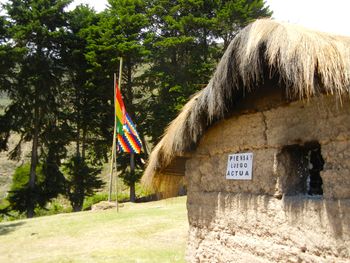
Quechua farmers’ failures to adopt new ways could elicit disciplinary action. Such discipline was tangible, for instance, in a laminated sign that local officials posted outside of one municipal outpost displaying the Spanish phrase: Piensa y luego actúa (Think and then act) (image 5). The sign was meant to shame several villagers who had prepared food over a wood fire they had made inside the building. The message was that they should instead have used the gas stove there, which did not foul the air. But obtaining and then transporting a heavy gas cylinder was arduous and expensive. This signage associated Quechua farmers with actions that occurred in the absence of earlier, premeditated thoughts.Footnote 27 Combined with activists’ views that Ayopayans lacked historical consciousness, the municipal signage displays how micro-practices of thought and action became targets of revolutionary re-crafting.Footnote 28 MAS party leaders and Katarista intellectuals put forward indigenous movements as evidence of a “new time” of national political struggle and ethnic awakening, as revolution or pachakuti (world over-turning) (Hylton et al. Reference Hylton, Paco, Serulnikov and Thomson2003). But for peasants to be included in this new time they would have to develop micro-level, experiential capacities for autonomous mental activity that was liberated from material constraints and entrenched historical patterns related to earlier hacienda economies.
Think and then act. Author's photo.

Not everyone in Ayopaya was equally a target of the sign's message. Teodoro, with his longstanding involvement in the regional peasant syndicate, was the kind of subject reformers sought to produce, someone skilled in socialist languages of labor organizing popularized in Ayopaya in the late 1930s. But others, especially monolingual Quechua speakers and women, had less contact with this political training. In this regard, it is revealing that during my fieldwork it was only male sindicato members who I heard employ the term “slavery.” People never used it to describe their own labor, even if unpaid. Instead they used specific labor categories of servitude (mitanaje or pongueaje) or the weighty if under-defined term “to serve.” Neither did monolingual Quechua-speakers use the term “history.” They referred to the earlier period of bonded hacienda labor as “ñawpaqpi” (in the before/that which is in front of the speaker) or “ñawpaqmanta” (deriving from the before, or from that which is in front of the speaker).
In Quechua people speak about what occurred previously as what has been seen or what is spatially in front of the speaker; in this way, the past arises as something intimately known rather than reified as an archive of events or “history.”Footnote 29 Only people who had firsthand knowledge of the hacienda system comfortably spoke of ñawpaqpi, the before. They commonly opposed this before-time to the present, “these days” (kunan dia), indicating the period of time since the fall of the hacienda system. This suggests that as a heuristic slavery belonged to a post-facto language used by younger villagers and unionists like Don Teodoro to emphasize the abjection, dependency, and perceived helplessness of hacienda laborers, conditions that at times seemed to have outlived that system.
MAS officials and twentieth-century Katarista activists often drew on the popularization of the concept of pachakuti to celebrate indigenous mobilizations as evidence that indigenous groups continue to forcefully disrupt colonial modernity. Bolivian film makers like Jorge Sanjinés have made this historical return a central theme of their artistic works. For instance, Carlos Mamani noted that Sanjinés’ film, La Nacion Clandestina, illuminates an understanding of the past “not as something dead, devoid of functions of renovation,” but rather as a “reversible fact”; in short, “a past that can be future” (1992, cited in Rivera Cusicanqui Reference Rivera Cusicanqui2005: 9). Yet while pro-indigenous activists and MAS officials often celebrated this reversal as beneficial, for Quechua villagers like Cecilia, that times could switch meant that the 2005 MAS revolution was also necessarily transient and uncertain. While phrases like ñawpaqmanta (from the past) took the 1953 agrarian reform as a defining marker separating past and present, for Quechua speakers like Doña Cecilia that separation was unstable. Here the return or potential reversible of times was not necessarily a liberatory matter: it also implied that the social and economic gains won under MAS could confront a future undoing.Footnote 30
The critical redeployments of history by farmers, elderly villagers, and peasant unionists highlight how time not only operates as a battleground for liberal projects of anti-colonial nationalism (Scott Reference Scott2014); popular groups also draw upon it to make sense of explicitly anti-liberal state experiments, such as the MAS party agenda in Bolivia (2006–2019). There, talk of the hacienda's return (kutimuy) exposed widespread ambivalence toward MAS reform agendas (see Mamani Ramírez Reference Mamani Ramírez2015). These critiques were subversive because they articulated a present substantively at odds with MAS discourses of emancipation from colonialism through the revival of indigenous institutions. When farmers proclaimed their attachments to individual and family land tenure patterns that varied sharply from revivalist models of ayllu collectivity, they contradicted not only Katarista visions, but also older, colonial conceptions of highland pastoralists as biologically predisposed to collectivism (Gotkowitz Reference Gotkowitz2007).
Moreover, Quechua women's narrations of hacienda servitude suggest that these different historical perceptual regimes were also gendered. On the one hand, Doña Cecilia disavowed the idea that her knowledge constituted historical expertise. On the other, the slippage she invoked between “hacienda time” and “liberty time” offered a scathing critique of MAS's “agrarian revolution,” one based on what she described as her enduring exclusion from political institutions and land ownership. Her critique emanated less from a position of occupying the present as a “gap” in time than from a threshold of overlaid histories and blurred epochs. In this regard, her narrative went against more hegemonic understandings of de-colonization as a revolutionary telos and a field of masculinist political practice based on “removal” from society. Historical duration hereby arose both as a way to think about tenacious structures of indigenous dispossession and as a perceptual regime attuned to the material linkages and experiential blurring of what were commonly treated as distinct, sequential epochs.
CONCLUSION
To recognize that colonialism structures the present helps us to attend to modernity's ideological conditioning of racialized ownership as property, but also to how landscapes arise as geopolitical sedimentations of prior governance (Robbins Reference Robbins2004; see also Harris Reference Harris1993). Along with acts of forced enclosure, property grids, and policed borders, soil quality and meager harvests, too, arose as sediments of a persisting colonial past. These insights reveal how land does not just narrate (Mar and Edmonds Reference Mar, Edmonds, Mar and Edmonds2010: 2), but also materializes enduring indigenous dispossession. But perhaps this formulation is too neat. This article has traced how, rather than being a natural phenomenological outcome of histories imprinted on places, out-of-jointness emerged within a specific political conjuncture, wherein divergence from a colonial past arose as a critical gage against which to judge the legitimacy of Bolivia's political present. In Morales-era Bolivia (2006–2019), reforms targeting “slavery” and servitude rendered hunger, landlessness, and material abjection untimely as blockages to a decolonized future. The hacienda system's reshaping of Ayopayan ecologies and land relations produced a form of indigenous subjectivity at odds with the ideals of citizenship animating the work of INRA officials and pro-peasant activists, making farmers there “unthinkable” revolutionary subjects (Trouillot Reference Trouillot2015: 33). At the same time, I have shown how, in this MAS-era reform climate, the nation's divergence from a colonial past arose for rural indigenous Bolivians as a critical gage against which to judge the success of state decolonization.
Scholars have shown how, with the colonial encounter, history, or “the prior,” arose as a pressing political problem (Povinelli Reference Povinelli2011); my account additionally supplies an analysis of the opportunities for critique afforded by the rise of Bolivia's bonded past, once again, as a political and ethical battleground of nationalist reform. In their seeming anachronistic nature (Scott Reference Scott2014: 2; see also Swinehart Reference Swinehart2019), Ayopayans’ experiences of life in the “wake of past political time” created for them a heightened awareness of time and of the non-linear relation between past and future. In the accounts I have discussed, farmers alluded to the colonial past not only to seek compensation for past violence or more state aid, but also to underscore their estrangement from reform agendas oriented by a promise that coloniality would be displaced by a newly configured, national indigeneity and abjection by liberty. For those with intimate experiences of enduring dispossession from resources and land, the failures of the promised revolutionary displacement were not entirely surprising; history's duration is only scandalous insofar that one subscribes to a modernist stance of de facto progress that is then set back by the tenacity of other times. Yet neither is it entirely satisfactory to identify the injuries that Ayopayans have faced as being colonial or even postcolonial in origin. After all, hacienda servitude lasted until 1953, well over a century after national independence in 1825. What do we achieve, or lose, by attributing Quechua farmers’ vulnerability to “colonial” or “postcolonial” processes, rather than republican, revolutionary, neoliberal, or even post-liberal ones?
The accounts of Quechua-speaking farmers I have examined here highlight how popular support for Evo Morales eroded during the latter half of his presidency due to the perceived sluggishness of MAS's de-colonizing, pro-indigenous reform agenda. Concerns with institutional misuses of power loomed large leading up to Morales’ campaign for a fourth presidential term in October 2019, after he had lost a 2016 referendum on a constitutional amendment to allow him to run again. But these concerns pale next to reactions when, that November, opposition senator and Interim President Jeanine Añez swiftly turned to police and military repression (Soliz Reference Soliz2019). Morales was forced to step down the next month, after trade unions, the police, and then the military urged him to resign (Fabricant Reference Fabricant2019).
The new regime, led by Añez and backed by a conservative, anti-indigenous faction from Bolivia's eastern lowlands, has since then consistently answered to resurgent, anti-indigenous populists who have fed off of the legal and political uncertainty of the post-electoral moment, particularly a nineteen-day national strike in which pro- and anti-MAS supporters and armed police violently clashed. When Doña Cecilia asked whether there might be a return of the hacienda—long a synecdoche for indigenous groups’ racialized violence and economic dispossession under and since Spanish colonial rule—she anticipated this return to power of an embittered creole elite, a scenario familiar to scholars of Bolivia's 1952 Socialist Revolution. After Morales was ousted, many were shocked to see that racist attacks on indigenous peasant women in the streets, media accounts portraying pro-indigenous activists and protesters as “terrorists” and “rapists,” and public burnings of icons of indigenous power and heritage like the pan-Andean wiphala flag had returned as viable channels of political expression (Collyns Reference Collyns2019; Kovarik Reference Kovarik2019).
Since Morales's resignation in November 2019, journalists and scholars, as well as Bolivian publics, have debated whether his departure constituted a coup or instead the realization of a grassroots movement to reclaim democracy (Kurmanaev and Krauss Reference Kurmanaev and Krauss2019). What both defeatist and triumphalist accounts risk overlooking in their focus on foreign meddling (Fabricant Reference Fabricant2019; Hetland Reference Hetland2019; and Zibechi Reference Zibechi2019) is the broader question of what the designation “coup” does as a descriptor of political realities, and the kinds of agency it elides or recovers (see Rivera Cusincanqui Reference Rivera Cusicanqui2019). As a heuristic of political change and upheaval, “coup” attributes agency, once again, to long-available figures of unmitigated power: foreign governments like the United States, international military cadres, or the groups of mostly-male MAS politicians who supposedly orchestrated mass protests in support of MAS when the ballot results initially came under fire late on election day. Long-time pro-Aymara scholar and activist Rivera Cusicanqui remarked that such behavior was typical of “leftist, misogynistic machos who treat us like cannon fodder” (ibid.). While not untrue, these assessments downplay growing rifts among MAS supporters related to increasing popular disenchantment with the pace and nature of Morales's reform agenda, including among subjects who are rarely attributed the power to affect history, such as the Ayopayan farmers discussed in this article.
It is important to consider the criticisms that Evo Morales’ staunchest supporters leveled against MAS agendas before this national-level breakdown, because doing so interrupts the presumptions of “innocence” implied by standard understandings of victimhood (and “coup”) (Ticktin Reference Ticktin2017: 578). Both triumphalism (the argument that Evo's fall was not a coup but an expression of democratic will and “ethnic rifts”) and defeatism (arguments that it was a U.S.-backed coup) presume that MAS supporters were innocent, as in politically naive and docile (Kurmanaev Reference Kurmanaev2019). But Doña Cecilia or Don Teodoro, for example, were never innocent in the sense of being morally or epistemologically “pure”; child-like or politically disinterested and therefore deserving of (Western) sympathy and aid (Ticktin Reference Ticktin2017: 578).
I do not condone these interventions, nor would I downplay the fears of violent reprisal now felt by Bolivians and erstwhile MAS supporters. But I would caution against allowing sympathies for the pro-indigenous agenda that Evo came to represent (at least abroad) to cloud accounts of recent MAS rule (2006–2019). My conversations with Ayopayan farmers almost a decade ago offer testimony to how Bolivia's most vulnerable subjects, elderly monolingual Quechua-speaking women, weighed support for Morales with unflinching critiques of his reform agenda. They show clearly that rural indigenous support for Evo Morales was never absolute or rooted in unthinking attachments to Evo as a “father” (Kurmanaev Reference Kurmanaev2019). On the contrary, rural people offered deeply denunciatory, even hyper-realist assessments of the failures of state-led, de-colonial change.
My point here is not only that Bolivia's MAS party government was unable to dismantle colonial armatures of liberal governance or of racialized inequality but rather to show how its reform initiatives politicized time and history in ways that informed new trajectories of anti-state critique. This politicization had uneven effects. Revolutionary nationalist discourses of decolonial change elicited new popular visions of progressive history and of indigenous people's places in it. However, this moment also opened up possibilities for marginalized groups to recast a narrative of revolutionary change in order to challenge unwelcome government interventions. Women's most notable contribution to this critique lay in their insistence on viewing contemporary indigenous injuries less as holdovers of hacienda “slavery” than as outcomes of how unionists and political leaders had distributed land, money, and political power in the post-hacienda era. By meditating on landscapes as disruptions to progressive history, Ayopayans challenged MAS reform programs but also refused broader ideals of political subjectivity that pinned critique to an experience from nowhere: that is, as a practice possible only for subjects who had somehow managed to escape the trappings of time and material life. These creative engagements with state historiographies demonstrate that while the thresholds of time and epochal history that marginalized indigenous subjects summoned could be burdensome, they could also be sharpened into critical tools for assessing a weighty, unjust present.