The historiography of mortality in England has sought to define a new ‘modernity’ in burial practice in the nineteenth century, often focusing on the cemetery as a signifier of shifting sensibilities. Commentary has tended to lack a firm grounding in place; indeed, much of the basic framework has been borrowed from French burial historiography. This article takes an alternative approach, and instead locates the history of burial within a very specific English place, taking into account its urban development and associated changes in urban governance. Urban histories of the English Victorian city usually include cemeteries in a list of elements essential to urban infrastructure alongside gas and water supply, sewerage, transport developments and civic buildings.Footnote 1 Cemeteries sit a little uneasily in this framework, since – unlike other sanitary improvements – burial had long been a function of the Church of England. The efforts of sanitary reformers including Edwin Chadwick led to the formulation of new interment regulations based on sanitary principles. In this regard, it appears, burial had moved from the realms of the spiritual into a more secular and scientific domain. The Burial Acts – passed from the early 1850s – in principle established the Home Office as a central arbiter on matters relating to interment, and introduced procedures to effect churchyard closure.
In practice, the legislation underlined the continuing and central role of the Church of England in the provision of space for interment. In many cities, responsibility for decisions on new cemetery development was taken by individual parish vestries. London's St Pancras vestry was amongst the first to take advantage of the legislation, and opened an 88-acre site at Finchley in 1854.Footnote 2 The Burial Acts did not make cemeteries an inevitable development. Guided by ratepayer vote, vestries could also legally decide that their local burial needs were best served by an extension to the existing churchyard. It is notable that in the second half of the nineteenth century, this latter option was by far the most popular: a parliamentary return indicated that between 1863 and 1877 there were at least 2,125 instances of churchyard extension in that 14-year period alone.Footnote 3 The continued centrality of the Church of England in this regard indicates that burial history was in no way linear: in the second half of the nineteenth century, a complex ‘mixed economy’ of burial provision – which had comprised Anglican churchyards, Nonconformist burial grounds and private cemeteries and chapels – became, if anything, even more confused.
This far from straightforward history of burials must itself be lodged within a context of substantial and rapid urban expansion. There were two aspects of this expansion that are particularly notable in the case of burial: the subdivision of existing parishes and creation of new parishes and new parish churches; and the lava-like overflow of town and city populations to absorb surrounding small hamlets and townships that had their own tradition of burial provision. These two elements were certainly evident in the growth of Sheffield, which is the principal focus of this study. In 1801, the six townships that comprised Sheffield parish had a population of 46,000 but by the century's mid-point this number had reached 135,310. By the century's end, the figure had more than doubled again, to 381,793 without any change to the parish boundary.Footnote 4 Sheffield had long been reliant on burial space around its central Parish Church,Footnote 5 the eighteenth-century churches of St Paul and St James and a small handful of Dissenting burial grounds. The opening of the Sheffield General Cemetery by the General Cemetery Company in 1836 comprised an extensive and sanitary addition, situated on the outskirts of Sheffield township. However, the General Cemetery was just one element of new provision constituting a ‘solution’ to the problem of burial, and by no means the most decisive. Other new provision included the churchyards of the 1820s ‘Million Act’ churches and the boom of church building from the 1840s; extensions to existing churchyards, sometimes detached from the mother church and finally new cemeteries established under the Burial Acts. A linear progression from churchyard to cemetery was certainly not evident here, and this fact provokes a review of some of the central contentions of the grand narratives of mortality in the nineteenth century.
Burial historiography
English cemetery historiography borrows a great deal from its French counterpart, and in particular from a small handful of studies focused on burial before, during and immediately after the French Revolution. These studies demonstrate that Enlightenment thinkers had problematized burial as a consequence of scientific theories on the generation of disease. At the same time, architects were indulging in new cemetery design projects. Regulations prescribing burial depth and plot sizes and an early Revolutionary insistence on equality and limited rights to commemorate the dead were superseded by the stronger cultural imperative to memorialize the family unit within a single plot, purchased in perpetuity. Revolutionary and utilitarian extramural cemeteries were superseded by the rather more bourgeois Père Lachaise, where family graves were located within a studiedly Romantic landscape. Nevertheless, the process of re-conceiving burial space posed a formal challenge to the church in France, by shifting interment into scientific and sanitary paradigms.Footnote 6
This specific narrative is generally placed within the broader framework developed by Philippe Ariès, who contended that conceptions of death in the nineteenth century could best be characterized by an over-arching concern for the ‘death of the other’. Grief caused by personal bereavement became central to cultural understandings of mortality, replacing an earlier dominant concern that the dying self would die ‘a good death’, fully shriven and awaiting final judgment. The change in attitudes to death explained alterations to burial practice. According to Johnson, ‘It is only with a growing atheism in the West and the bourgeois appropriation of the cemetery that we find the gradual establishment of a “cult of the dead” and a deep, sentimental concern for the corpse.’Footnote 7 For those able to afford it, perpetuity burial could offer eternal protection from disturbance; and within the cemetery the ability to purchase burial rights reformulated burial space as private property. Commentators have stressed that this option was available only to the wealthy: the dead of the poorer classes disappeared into common graves that were periodically re-used, with bones displaced into a large central ossuary.Footnote 8
New cemeteries also constituted a physical dislocation of practice; congruent with scientific understandings of injurious ‘mephitic vapours’, cemeteries were sited away from the church and on the periphery of settlement. Distance from the spiritual core of the community was literal and symbolic: indeed, for some commentators the cemetery becomes loaded with modernist purpose. Here there is another heavy reliance on Ariès’ grand schema characterizing changing attitudes towards death, contrasting an ancient accommodation with the dead – decomposing in a commingled mass at the centre of the settlement, amongst the living – with a modern anxiety to hide evidences of bodily decay and place the corpse in individuated graves.Footnote 9 Indeed, recent historiography has developed Michel Foucault's conception of the cemetery both as a ‘heterotopia’, or other place, and a space in which new models for governance of the body were exercised.Footnote 10
The central tenets of this historiography have been absorbed into the English history of burial with only slight amendment and without necessarily allowing for a more nuanced cultural specificity. English burial historiography situates the emergence of the cemetery more firmly in the first half of the nineteenth century, when the joint-stock financial framework was applied to cemetery development.Footnote 11 Reference is generally made to Père Lachaise and the ‘garden cemetery’ as a landscape paradigm borrowed by early cemetery advocates and designers, including John Claudius Loudon and John Strang.Footnote 12 Cemetery companies, established in almost all major towns and cities in the second quarter of the nineteenth century, created burial sites that challenged Anglican monopolies. For some commentators, the foundation of these new cemeteries was symbolic of a substantial shift in societal understanding with regard to mortality: the cemetery was ‘a visibly commercial institution’ and ‘one more aspect of consumer culture’, and replaced ancient churchyards that were imbued with substantial spiritual significance and communal resonance.Footnote 13 The immediate catalyst for burial reform was the swift pace of urban development. Rapidly increasing population in towns and cities placed substantial pressure on existing burial provision in the old parish churchyards, which became a liability. Superseded by cemeteries in the 1820s and 1830s, parish churchyards were often closed by Order in Council from the 1850s as new legislation placed restrictions on the continued incidence of intramural interment. Joyce borrows heavily from Ariès in contending that, with the cemetery, death was ‘exiled to the margins of cities, and, if not quite anonymous, became located in a place divorced from everyday life’ and the ‘spatially specific parish rights of burial gave way to absolute and abstract property rights’.Footnote 14 Indeed, for Johnson, the cemetery evidenced ‘a reconfigured economy of death’.Footnote 15
This narrative is now beginning to be regarded as overly simplistic. The sharp distinction between ‘churchyard’ and ‘cemetery’ rests rather too heavily on a false dichotomization. Churchyards were not necessarily ancient, and were as driven by economic and even commercial imperatives as were many early cemetery speculations. Cemeteries were not always a decisively new development, superseding earlier provision.Footnote 16 Certainly in some places this was the case: for example, in York the closure of parish churchyards throughout the city in the 1850s gave the city's General Cemetery a monopoly on burial provision during the second half of the nineteenth century.Footnote 17 In other places, urban development created new settlements and new communities that had no long-standing tradition of local interment. For example, Harrogate was developed largely as a commercial speculation and absorbed the two very small villages of High and Low Harrogate. Neither place had burial provision until the 1830s and villagers were reliant on the churchyard of St John the Baptist in Knaresborough.Footnote 18 Research on burial in more rural areas indicates that new cemeteries were often located alongside existing burial space: for example, the Old Malton Burial Board's cemetery at St Mary's Priory is virtually indistinguishable from the churchyard.Footnote 19
Furthermore, simplistic narratives fail to take into account the hugely complicated nature of urban development and the often very particular frameworks of local governance.Footnote 20 This lack of a necessary local specificity in burial historiography is underlined in this article, which presents an extended study of burial provision in a single location: Sheffield. As will be seen, a history of Sheffield focusing on the establishment of the cemetery supports the notion of dichotomy and linear development but a broader burial history presents a far more complex picture.
Sheffield: a cemetery history
The establishment of the General Cemetery in Sheffield sits very well within the specific contentions of cemetery historiography. The cemetery was laid out by a company in 1836, contemporaneous with the sites immediately associated with the ‘Victorian celebration of death’, such as Nunhead and West Norwood. The London sites had a clear commercial intent, and were very much part of the mid-1830s boom in cemetery speculation. The General Cemetery Company at Sheffield followed earlier Nonconformist precedents in having its origins in the play of religious politics.Footnote 21 The site was not consecrated, and aimed to serve the needs of Sheffield's Nonconformists. In its second annual report, the Company declared that it had been ‘instrumental in providing for every class of the great community of which they are a part, the means of suitable and undisturbed sepulture according to the rite of their own religious faith’.Footnote 22 The new six-acre site, situated ‘on the picturesque acclivity of Sharrow Vale’ was ‘tastefully laid out and planted’.Footnote 23 Company directors aimed to create a cultured resort for promenade and contemplation and in 1837 attached a stonemason's business which, it was hoped, would ‘secure them the richest display of elegance, propriety and taste in the varied memorials which affection might place before the ashes of departed friends’.Footnote 24 The cemetery constituted a fitting addition to other new cultural ‘assets’ for Sheffield that included the nearby Botanical Gardens. Indeed, the landscape designer of the gardens – Robert Marnock – was asked to oversee planting to the extension to the cemetery in the late 1840s.Footnote 25 This extension was wholly consecrated, and aimed to extend the appeal of the cemetery beyond its original market. The site was successful in attracting elite burials: Mark Firth, manufacturer and philanthropist, had donated a local park and served as mayor; and prominent clergy, including Canon Thomas Sales, had been active promoters of church and school building.Footnote 26
A cemetery could not have been more necessary and, situated on the edge of Sheffield township, comprised a sanitary response to the problem of overcrowding in the churchyards and burial grounds located in the central district. Sheffield was expanding rapidly, and public health reports outlined in detail the inadequate nature of Sheffield's intramural churchyards. For example, in 1845, James Smith reported to the Royal Commission on the Health of Towns on burials around the Parish Church:
It is very much crowded with bodies, and as the soil is considerably above the level of the surrounding street, the exudation of putrid liquid from the soil is visible to the eye and offensive to the smell. The soil being a tenacious clay, the decay of the bodies is slow; and where graves are opened, the skeletons are often found still articulated, and their exhumation is most offensive to the inhabitants residing within sight of the burial ground.Footnote 27
James Haywood and William Lee, from the newly established General Board of Health, also reported on conditions in the city's churchyards and were no less forthright:
If people were aware of the painful and disgusting sights which frequently present themselves in preparing a grave, and of the amount of poison which they are constantly breathing, and sometimes drinking, from the dead, it would produce a deep feeling of horror, and a unanimous effort to put an end to the practice.Footnote 28
Three years later, Haywood and Lee calculated that between 1839 and 1846, over 14,000 interments had taken place in the Church of England churchyards in Sheffield's densely populated central township.Footnote 29
Smith's report had referred favourably to the cemetery: ‘for whether we consider the health and comfort of the inhabitants, or the softer feelings of the relatives of the dead, or generally, feelings of public decency, we must approve of the arrangement of having burial places in a remote and undisturbed locality’.Footnote 30 However, the opening of the cemetery did not in itself effect closure of the central churchyards, which required specific legislation. Outside of London, the process of churchyard and burial ground closure was defined by section 1 of the Burial Act (1853).Footnote 31 The Act specified that closure would follow if a General Board of Health burial inspector thought it necessary, and a specific Order in Council would be issued for each churchyard indicating the date from which discontinuation would be effective and any conditions or exceptions. All closure orders were printed in the London Gazette. For Sheffield, the closure order – issued on 8 February 1855 – listed the churchyards of the Parish Church, St James’s, St George’s, St Philip’s, St Mary’s, St John's and the church at Attercliffe, and a number of small denominational burial grounds. As might be expected, interments at the General Cemetery increased sharply and dramatically following the closures, from 400 to 500 annually to an average of over 1,300 a year between 1855 and 1860.Footnote 32 Thus, burial ceased at ‘t’owd church’, as it had been known to generations, bringing to an end a practice that had endured since the twelfth century.Footnote 33
Sheffield: a burial history
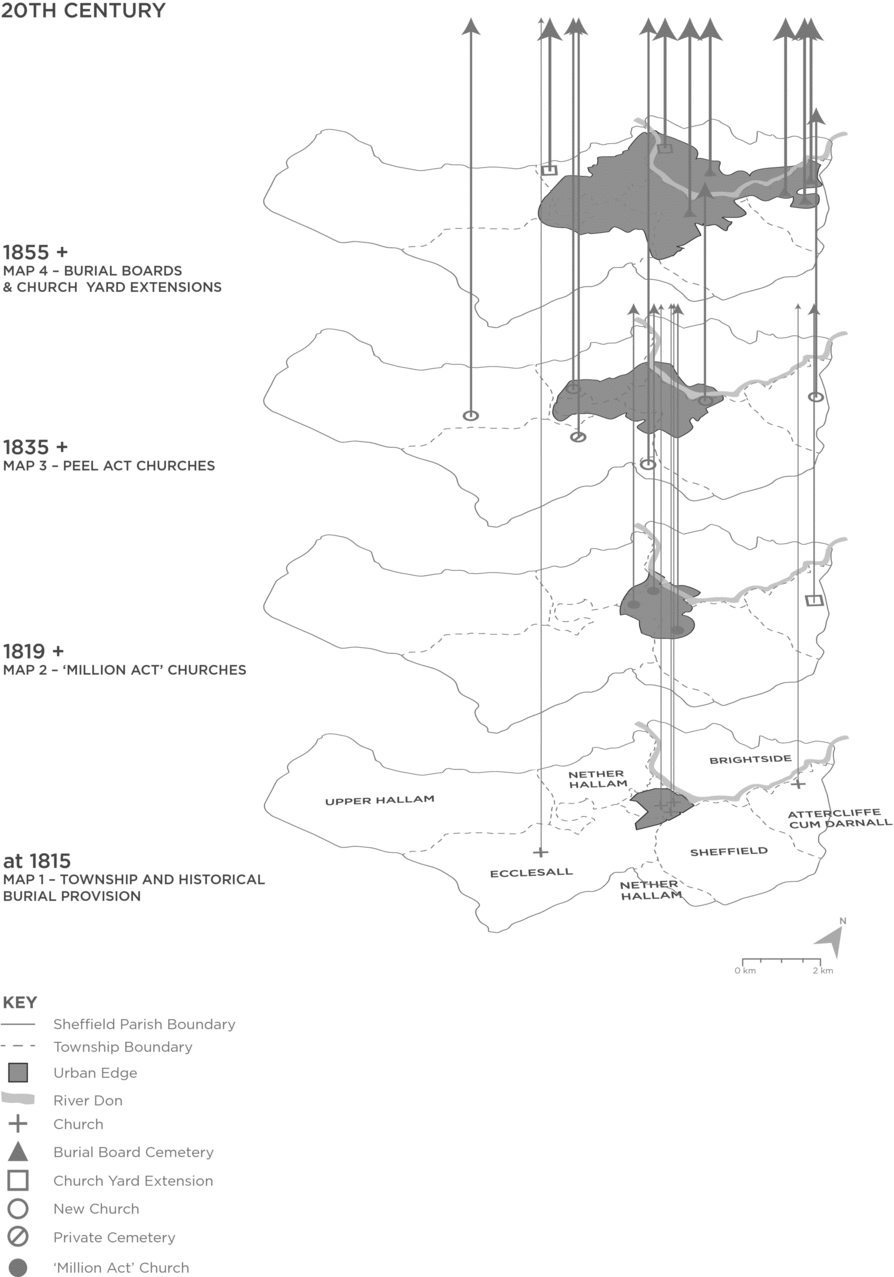
In presenting this cemetery history of Sheffield, conclusions might be drawn on a substantial disruption to traditional burial practice presented by the opening of the cemetery and consequent closure of the town's more central churchyards. In these circumstances, it becomes entirely possible to load the cemetery with political, commercial or even ‘modernist’ meaning, in contradistinction to the ancient tradition represented by burial in the Parish Church. However, the foregoing narrative presents a poor reflection of the complexity of Sheffield's burial history, which at times appeared to be a rather desperate scramble to meet demand for burial space. Burial history in Sheffield is best understood as the accretion of overlapping layers of new burial space, brought by a variety of providers. Charting this history is relatively straightforward since throughout the nineteenth century the boundaries of the ancient parish of Sheffield did not change. Indeed, in 1843, the newly incorporated borough's boundary was matched to the original parish. Large parishes containing a number of distinct settlements often had dispersed burial provision. This was certainly the case in Sheffield, which contained five townships: Sheffield, Ecclesall-Bierlow, Brightside-Bierlow, Attercliffe-cum-Darnall, Nether Hallam and Upper Hallam (see Figure 1). Although Sheffield was by far the most heavily populated of the townships, containing some 68 per cent of the whole parish population, other townships in the borough were themselves of substantial size. For example, Ecclesall-Bierlow had a population of 5,362 in 1801 and its neighbour Brightside-Bierlow had 4,030.Footnote 34 The history of burial in Sheffield is, therefore, best construed as an amalgam of the burial histories of these five places.
Changing ownership and distribution of burial provision in Sheffield during the nineteenth century, set within the context of urban growth. Each arrow indicates the duration for which the burial ground was active and the size of the arrow the scale of burial.

Within the wider parish area, burial took place from the twelfth century in the Parish Church and its three-acre churchyard, located in Sheffield township. Other provision was available at Attercliffe: burials took place at the Old Chapel – opened in 1629 – and continued despite the creation of a larger New Chapel in 1663. A formal Quaker meeting was established in Sheffield township in 1678, and there is evidence of burials at the meeting house from the mid-eighteenth century.Footnote 35 At Ecclesall, burial provision only became available after the fourteenth-century chapel at Millhouses was relocated to Carter Knowle and rededicated to All Saints in 1789: the new church had a two-acre churchyard.Footnote 36 The creation of All Saints took place during what might be regarded as the first wave of new burial provision which spanned the final decades of the eighteenth century and stretched into the early years of the nineteenth. Between 1561 and 1720, burials in the churchyards of the parish had been rising steadily from an annual average of around 60 to c. 500 annually. From this point in the eighteenth century, burials began a sharp and substantial increase.Footnote 37 The building of St Paul’s, to the west of the Parish Church on the township periphery, was completed in 1720; a church dispute meant that interments did not take place until after 1743. The churchyard at the Old Chapel at Attercliffe was extended in 1754 and 1786. By the 1780s, well over 1,000 interments a year were taking place across all the parish churchyards. St James’, consecrated in 1789, was financed through the sale of shares at £50 which entitled the purchaser to a pew and a family vault beneath the chapel.Footnote 38 The site contributed little to meeting demand for burial space: numbers did not generally exceed 50 a year. Various Protestant Nonconformist denominations also opened burial grounds and Roman Catholic provision was available, but Haywood and Lee's survey of burial provision in the late 1840s indicated that, between 1839 and 1846, interments in those locations totalled just 735 against the 14,096 burials taking place in the Anglican churchyards.Footnote 39A two-acre detached churchyard extension for the Parish Church was consecrated in 1817, situated on the western edge of Sheffield township, between Broad Lane and Portobello, and the Old Chapel churchyard at Attercliffe was extended again in 1816.Footnote 40
By the early 1820s, therefore, the parish of Sheffield had already seen a wave of new developments that augmented its ancient provision without necessarily replacing it. Use of these new burial places was driven by preference rather than need, particularly with regard to recourse to the burial vaults of St James’ or the Nonconformist chapel yards. From the 1820s, a second wave of new burial provision was to have perhaps a more radical and long-standing impact, in the construction of four new churches under the Church Building Act (1818), popularly called the ‘Million Act’ since the Act dedicated that sum to new church building. Across England, the Million Act was responsible for creating more new burial space in the 1820s and 1830s than the first generation of joint-stock cemeteries that were a contemporary development. In Sheffield township, three Million Act churches were built during the 1820s. St George's was a chapel of ease for the Parish Church, and was situated on the detached churchyard extension on Broad Lane. The church was completed in 1825, and burials are recorded from 1830. St Philip's was originally constructed within a wooded suburb to the north-west, and its churchyard opened for interments in 1828. The third, and grandest, of this group of churches was St Mary’s, Bramall Lane. The church was located in one of the wealthiest suburbs of the city in 1830, on land donated by the duke of Norfolk and had three acres of burial space. The New Chapel at Attercliffe was also rebuilt under the Million Act in 1826 with a churchyard, and rededicated as Christ Church. Although not strictly speaking Million Act churches, two other additions to the city were notable in the 1830s. St John’s, Park, was located in Sheffield township and built in 1838 by subscription. Land for the church was again donated by the duke of Norfolk, and the churchyard was three acres in extent. Christ Church at Fulwood in Ecclesall, wholly financed by a private individual, was consecrated just a year later.
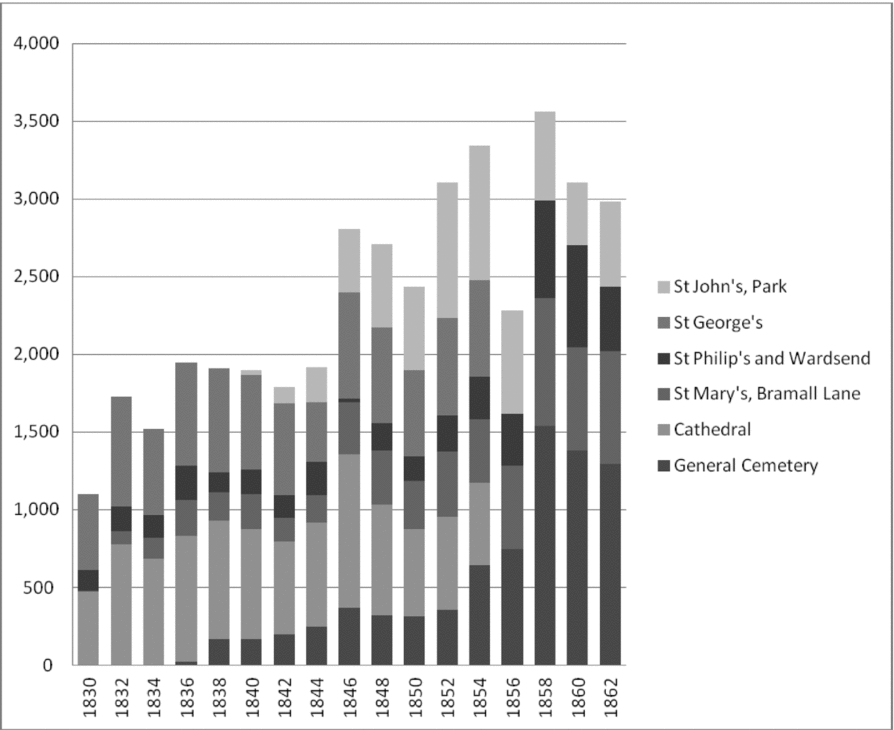
Immediate and heavy use was made of all the new churchyards. Indeed, there were around 430 interments in the churchyard of St Philip's in its first year of operation, although this figure dropped as interments began at St Mary's and St George’s. In the first ten years of use, burials in this latter churchyard alone increased to over 500 a year. Interments at St Paul's and the Parish Church decreased markedly but remained high, with use of the Parish Church largely matching burials at St George's (see Figure 2). As a consequence of this new churchyard provision, the opening of the General Cemetery in 1836 did not bring with it an immediate relocation of burials. In the first five years of its operation, interments totalled no more than 215 a year, and through the 1840s still only averaged around 500.Footnote 41 Even the consecrated addition to the site, with its grand and commodious Anglican chapel, did not substantially alter the pattern of existing burials within the parish churchyards of the various townships. Burials in this section averaged no more than 100 a year in the first five years.Footnote 42 There was a rapid increase in burials at the General Cemetery following the closure of the Sheffield township churchyards, with annual interments far in excess of 1,000 a year. Nevertheless, until the opening of Burngreave Cemetery in 1862, the General Cemetery was still only accommodating around half of the city's interments. Thus, it was clear that the Church of England had retained a substantial hold on burial provision after 1836.
Annual burials in selected Sheffield locations, 1830–62 Source: Sheffield Archives: selected burial registers.

Through the 1840s and 1850s, another new context for the ownership and management of consecrated burial space emerged as a consequence of changes in the structure of both local and ecclesiastical governance. In Sheffield until 1843, local government had been essentially medieval in its structure and organization. Local improvement had been financed by an ancient body of church burgesses and town trustees. Improvement commissioners had been appointed in 1818 and dealt with policing and lighting, but the duke of Devonshire – as lord of the manor – retained responsibility for governing the market area. Each township had a system of overseers funded from the parish rate, and from 1843 there were two Poor Law Unions – Sheffield and Ecclesall. All these bodies had somewhat confused and overlapping functions. A municipal charter was granted for Sheffield in 1843, superseding the church burgesses and town trustees who remained in a largely charitable role. The emergent Sheffield Town Council became embroiled in the play of local radical politics, which tended to stifle public health expenditure.Footnote 43 A Health Committee operated from 1846, but there was no medical officer of health until 1873.Footnote 44 It is notable that none of these agencies necessarily viewed the provision of burial space as a central concern. Although it was clear that intramural interment was a sanitary matter, improvement commissioners tended to focus on issues such as sewerage and housing conditions. Burial was still largely regarded as the responsibility of the Church of England through the aegis of local vestries: one of the functions of the church rate was to finance the maintenance of the churchyard and any necessary extensions.
In Sheffield, the Church of England was itself also subject to organizational change. Under the New Parishes Act (1843), the Ecclesiastical Commissioners were empowered to make subdivisions of existing parishes to increase spiritual provision in the more populous districts. Following the passage of the Act, Sheffield ceased to be a single parish. In the first of what became a rapid accretion of parish subdivisions, the Million Act churches were themselves used as new parish churches, as was – amongst others – St John’s, Park. The Act also provided a context for the provision of fresh burial space. St Thomas, Crookes, Christ Church at Dore, Holy Trinity at Darnall and Christ Church at Heeley, which were all built by private subscription or donation in the 1820s and 1830s, took the opportunity created by the subdivision to begin interring in their churchyards.Footnote 45 This process of subdivision removed the parochial rights of the parishioners of the ‘old’ parish of Sheffield to be buried in the Parish Church, but the new sites were rapidly adopted: within 10 years of its opening, St John’s, Park, was accommodating over 500 burials a year.Footnote 46
The passage of the Burial Acts from the early 1850s therefore occurred during a period of substantial change in Sheffield's civic and ecclesiastical governance and consequent alteration to the pattern of burial provision. The fact that the Burial Acts have generally not been well understood is an eloquent comment on their complexity. The Burial Act (1853) extended the powers of the Burial Act (1852) beyond London and permitted the creation of new cemeteries using funds raised against the church or poor rate. A long series of further enactments was finally brought to a close with the Burial Act (1906). Unlike French burial legislation, under which translation from the use of churchyard to cemetery became mandatory, the English Burial Acts were not prescriptive. Instead, the Acts relied on an ancient process for local decision-making: a local vestry vote decided whether the powers created would be adopted. Burial boards could be formed following a ratepayer vote at a meeting called specifically to consider the creation of a board. Membership of the board was also based on vestry vote, and all expenditure above a specified level had to be approved by the vestry. A Burials Office at Whitehall oversaw the operation of the legislation, but its interventions were reactive rather than proactive. The legislation was largely permissive, and relied on vestry initiative. Loans were raised against the local rate, either from the Public Works Loan Board or – often more competitively – from local financiers.Footnote 47
There is perhaps no agency of local governance less amenable to simple explanation than the vestry, particularly where the operation of burial legislation is concerned. ‘Vestry’ carried both ecclesiastical and civic connotations.Footnote 48 Church parish matters were governed by the vestry, which had responsibility for – amongst other things – the appointment of parish officers who oversaw the collection of the church rate and specific rates for various civic purposes. As has been seen, the church rate was applied to maintenance of the church fabric, including any necessary work to the churchyard where, in common law, parishioners had a right to burial. As a consequence, Church of England vestries played a central role in new burial board establishment. The matter was complicated by further burial acts: the Burial Act (1854) extended the powers to create burial boards to town councils, and the Burial Act (1857) extended the powers again to include improvement commissioners and local boards of health. In fact, the law on the matter became somewhat opaque. Reflecting the chaotic nature of local governance and the rather fluid definition of ‘parish’, it appeared that in principle the powers could be adopted by any ‘vestry-like’ agency.Footnote 49
Within Sheffield, the powers granted under the Burial Acts were adopted by four separate vestries. The closure order for the old and new churchyards at Attercliffe in 1855 led immediately to the creation of Attercliffe Burial Board in May of the same year. A degree of connection between the Burial Board and the ecclesiastical vestry of Christ Church is intimated by the fact that the vicar of the church, the Reverend T. Wilkinson, was immediately elected as board chairman. The board considered it expedient to lay out new burial space adjacent to the existing churchyard: the proposed site was already three-parts enclosed, and was vested in Queen Anne's Bounty. At four acres, the site met the statutory recommendation of one acre per thousand of population, and there was no need to establish a mortuary chapel on the consecrated portion. Indeed, it was estimated that the cost of the whole enterprise would not exceed £1,800.Footnote 50 Similarly, Darnall had become an ecclesiastical district separate from Attercliffe in 1844; a church dedicated to the Holy Trinity and built by private subscription was opened in the following year. This church also had its own burial space, but again – as at Attercliffe – the decision was taken by the vestry to establish a burial board, which raised finance to lay out five acres on the site of an old cricket pitch. The Brightside Burial Board, which was responsible for opening Burngreave Cemetery in 1861, was perhaps less an ecclesiastical than a civic endeavour. Local ratepayers had approached the overseers for Brightside-Bierlow, expressing concern that burial provision for poorer classes was not readily available. An attempt was made to negotiate a favourable rate with the Cemetery Company, but it wrote that no distinction could be made in its charges ‘by giving preference to one Township more than another’.Footnote 51 Other local churchyards at Pitsmoor and Grimesthorpe were small, and vestries in either case could ill-afford an extension. The Brightside-Bierlow vestry finally resolved to establish a cemetery specifically for the township, and purchased a 37-acre site: within 10 years, burials regularly reached over 1,500 a year, matching and often superseding the General Cemetery in scale of operation. Burngreave Cemetery had come at a high cost: expenditure on the land and buildings had been in excess of £11,000.Footnote 52
Within Sheffield township, a different set of developments emerged. The closure order of February 1855 had applied to all the major central Anglican churchyards including the Parish Church, St James’, St George’s, St Philip’s, St Mary's and St John’s, Park. A further closure order was issued for St Paul’s, in March of the same year. However, Orders in Council were not always absolute, and it was generally allowed that burial could continue in certain circumstances. Exceptions were granted in the case of St Philip’s, St Mary's and St John’s: interments could continue providing just one body was placed in each grave, and that use of family vaults could continue. The closure order for St Mary's was contested – presumably by the vestry – repealed and reintroduced within months, but on the understanding that interments take place according to Home Office guidelines. The closure of St John's churchyard was subject to even more protracted negotiations. Here, the vestry was able to secure an extension to the closure date and then go on to lobby and obtain – over a period of 20 years – a further 13 extensions to the date, from what became a clearly exasperated Burials Office.Footnote 53 At the heart of the difficulty lay the inability of the largely moribund Sheffield township authorities to agree a course of action to provide new burial space.Footnote 54 A burial board for the township was finally established in 1862, but following a strong start it quickly ran into difficulty. In this instance, the application to adopt the Burial Acts had been lodged by the town council: aldermen and councillors were prominent in the original board membership, which also included Reverend Thomas Sale. The board's rationale was stated in the earliest minutes, which noted that the population of the township had reached 87,703, but was reliant on the limited burial space afforded by St John's and St Mary’s. Following correspondence with the Burials Office at Whitehall and a visit by Dr P. H. Holland, the burials inspector, the Burial Board calculated that it would need at least 25 acres of land to meet the township's need. A suitable site was located, and negotiations commenced but the estimated cost of the enterprise met with local opposition. Burial Board activity – as has been indicated – reflected the play of ratepayer democracy and in this instance ratepayers vetoed the plans by voting for a resolution to postpone any land-purchase decision until after the next annual board meeting. At this meeting, ratepayers voted in board members who steered the enterprise into still waters. The new board argued that the township had no need for burial space. Existing cemeteries in neighbouring townships contained more than 300,000 burial spaces; even within the wider parish churchyards it was calculated that there was room for 30,000 additional interments. In principle, therefore, there was little need to take action.Footnote 55
Even as burial board operation got under way across other parts of Sheffield, churchyard extension continued to take place. At St Philip’s, the postponed closure order came into absolute force in 1859 and land was purchased at Wardsend by the vicar, John Livesay. Nevertheless, it was clear within a decade or so that this slew of new provision was again insufficient to deal with Sheffield's population growth. The early 1880s saw another round of activity. At Walkley, the vestry of St Mary’s, consecrated in 1869, purchased four acres to create a ‘Church Cemetery’ in Rivelin Glen, and the site was opened in 1880. Around the same time, Attercliffe Burial Board came to the realization that its modest addition to the churchyard was insufficient to deal with demand for interment in the township, where the population had expanded rapidly as a consequence of growth in the steel industry. The cemetery had contained 3,800 grave spaces, but by 1876 there had already been 4,080 interments. The Burial Board had evidently adopted Home Office directives restricting the number of interments in each grave, and the soil had not been amenable to decomposition.Footnote 56 Overall, the board concluded that ‘if no further provision be made the inhabitants will soon have no place to bury their dead’.Footnote 57 The Burial Board was anxious not to repeat its mistakes, and proposed that the rate of population increase justified its choice of a much larger site:
When the present cemetery was formed, the population at that time viz 1859 was about 6,000 it had only reached 7,462 in 1861 when the census was taken; in 1871 the population had reached 16,570 or an increase of 120 per cent in ten years and we have no reason to believe (especially should a revival of trade take place) that this increase will not be maintained. If this should be the case the population of the township would be in ten years from now about 53,539.Footnote 58
A new cemetery was opened at Tinsley Park in 1882, and covered 19.5 acres. Attercliffe was not the only township where pressure on burial space continued to be acute. For Sheffield township, the hoped-for displacement of demand outside the township area had not materialized. Interments continued at St Mary's but a further closure order in 1880 restricted burials substantially. At St John’s, the repeatedly granted postponements carried increasingly restrictive conditions. These were evidently ignored, but it was clear by the late 1870s that no further postponements would be allowed. Movement to create a cemetery for the township could no longer be deferred, and in the late 1870s meetings of the Burial Board recommenced. A new 50-acre cemetery on City Road was opened in 1881.Footnote 59
As the remaining decades of the nineteenth century progressed, population growth continued at a substantial rate, although in central areas commercial and industrial activities reduced the number of residential properties. Demand was therefore eased on the Million Act churchyards. Indeed, by 1927, St John's had acquired ‘a somewhat bare and desolate appearance’.Footnote 60 By contrast, at Eccelsall, All Saints had remained open, by dint of extensions in 1860 and 1893. At the century's end, demand for burial was being met by burial boards established by ecclesiastical and civic vestries and the town council, the private cemetery company, Church of England churchyards and a small number of denominational burial grounds including a Roman Catholic burial ground at Rivelin Glen. Under the Local Government Act (1894), the newly created City Council took over the Burial Board cemeteries but it remained the case that churchyard provision continued to expand; indeed, in 1922 the ‘Church Cemetery’ at Rivelin Glen was extended by three acres.Footnote 61 Thus, a ‘mixed economy’ of burial provision was very much in evidence in Sheffield in 1900, challenging earlier presumptions that through the course of the nineteenth century, the Church of England lost its near-monopoly of burial space.Footnote 62
Understanding the burial narrative
Sheffield's burial narrative is less dichotomized and rather more complex than might be imagined in an industrial city subject to substantial urban expansion. The closure of the central churchyards and the opening of the General Cemetery cannot be taken as being the key events in Sheffield's burial history. In presenting an alternative narrative, this article challenges presumptions about nineteenth-century cemeteries in a number of ways. First, churchyard burial did not present – as one commentator has claimed – ‘of the world of stasis’.Footnote 63 Even by the end of the eighteenth century, new provision was emerging; the Million Act and Peel Act both substantially multiplied the number of churchyards. The presumption that churchyards – by contrast with cemeteries – could ‘speak to place’ and connote ancient tradition clearly did not follow in Sheffield. Christ Church at Pitsmoor was constructed in 1849 but by the 1880s a closure order had restricted its interments to no more than a handful of burials a year. Urban populations spilled out of the existing township boundaries, and new communities and neighbourhoods were created that lacked any intrinsic, ‘place-based’ traditions. Crookes had been a small village without a church or burial provision before St Thomas’ opened in 1839. Similarly, at Pitsmoor ‘there was in it no church or chapel of any religious denomination whatsoever’ before Christ Church was built in 1850.Footnote 64 In these circumstances, it could hardly be said that cemetery provision somehow constituted ‘modernity’, when the church itself was a new construction.
Churchyards and cemeteries developed largely in tandem through the course of the nineteenth century, and cemetery management principles were applied in churchyard extensions. The cemetery was not the only place where status could be inscribed in the landscape. Indeed, burial in the churchyard of All Saints at Ecclesall carried considerable cachet, particularly for the Anglican elite: it was ‘crowded with costly memorials to a great host of prominent citizens and their families’.Footnote 65 The site was regarded by the Cemetery Company as its principle competition.Footnote 66 It is possible to argue that the terms ‘churchyard’ and ‘cemetery’ became, to a large degree, synonymous particularly given the fact that within new burial board cemeteries established by ecclesiastical vestries, the consecrated sections were regarded as parochial burial space. Consequently, the Church of England retained a central role in meeting the need for burial space. The Burial Acts did not signal – as Joyce maintained – ‘a decisive shift to civil power’ since the ecclesiastical authorities retained particular rights in the new cemeteries including the right to appoint clergy and to appropriate burial and memorial erection fees.Footnote 67 Furthermore, Order in Council closures have tended to be represented as a ‘final’ development, ordered by a central government agency.Footnote 68 In actuality, inspections were requested locally and there was negotiation on possible outcomes as St John’s, Park, clearly demonstrated. In these circumstances it becomes difficult to construe new burial provision as the state-ordered destruction of centuries-old practices. In no regard was the French system of burial successfully introduced in England. Indeed, as Kselman indicates, centralizing and secularized burial regulations were not always easy to implement in France itself: in rural areas, the new legislation was often simply ignored.Footnote 69
Conclusion
A history of burial in Sheffield encompassing developments in both cemeteries and churchyards demonstrates that a clearly discernible shift from one to the other was not evident in this industrial city. Burial histories are very particular to place, and are dependent on patterns of denominational affiliation, the chronology of population growth, and the particularities of local governance. Sheffield is not here proposed as an archetype, especially given its extremely rapid development in the eighteenth and nineteenth centuries. Nevertheless it is probable that developments evident in Sheffield were replicated elsewhere: the late eighteenth century is one likely common turning point; the high incidence of new churchyard provision during the 1820s was particularly widespread; on-going churchyard extension was certainly endemic; the co-operation of landed estate owners could be pivotal to the economic feasibility of new cemetery development; and the nature of burial board establishment was markedly variable.Footnote 70
This article brings into question common presumptions about burial history that rely heavily on dichotomized images of cemetery and churchyard, and on the notions of modernity and secularity as key drivers for understanding change in attitudes towards mortality in the nineteenth century. Julie-Marie Strange proposes, in her overview of historical approaches to the study of dying, that ‘the rise of micro-history has militated against grand narratives of cultural change’ with an increasing focus on continuities.Footnote 71 Although this commentary refers to beliefs around death and dying generally, the contention is also applicable to the very specific subject of burial. Sociological musings on the symbolic nature of cemetery space have overlooked the need for more empirical research. The cemetery is so agreeably malleable as a symbolic emblem – fitting neatly into larger theoretical constructs of social hegemony, secularity and ‘modernity’ – that the facts of the matter become almost wilfully overlooked. New analytical frames should be applied to an understanding of burial in an urban context, not least of which is an appreciation of the exigencies of the matter. Both churchyards and cemeteries were created in response to population demand, with location dictated by the pragmatic desire to find land that was suitable for burial, and neither too distant nor too costly. For all the potent symbolism that can be attached to the notion that the dead were sequestered on the city's outskirts, it remained the case that this was where vestries found sufficient acreage at a price acceptable to ratepayers.