





Introduction
Candidozyma auris (C. auris) causes serious invasive fungal infections which are difficult to treat and are associated with crude mortality of 30–60%. Reference Chowdhary, Jain and Chauhan1 Since it was first reported in 2009, C. auris has spread to over 40 countries and across multiple healthcare settings, including both acute and long-term care. Reference Huang, Hurabielle and Drummond2 Residents in long-term acute care hospitals (LTACHs) are disproportionately affected by C. auris. Reference Rossow, Ostrowsky and Adams3 Risk factors for C. auris colonization and infection include invasive medical devices, prior antimicrobial use, prior multi-drug-resistant organism (MDRO) colonization or infection, and extensive healthcare exposure, which are common factors among patients residing in LTACHs. Reference Rossow, Ostrowsky and Adams3,Reference Shastri, Shankarnarayan, Oberoi, Rudramurthy, Wattal and Chakrabarti4 Prevalence of C. auris colonization among LTACH patients is high, with a median of 31% reported in some facilities. Reference Pacilli, Kerins and Clegg5 Despite available public health guidance on infection control practice 6 and collaborative efforts for containment, Reference Karmarkar, O’Donnell and Prestel7–Reference Dratch, Le and Zahn9 C. auris continues to proliferate in these settings. Reference Lyman, Forsberg and Sexton10
The Society of Hospital Epidemiology of America (SHEA) Research Network (SRN), a consortium of healthcare facilities collaborating research projects to advance the fields of healthcare epidemiology and antimicrobial stewardship, was used previously to query infection prevention and control practices for bacterial MDROs and C. auris in acute care hospitals. Reference Lichota, King and Medernach11,Reference Coffey, Grossman and Banach12 Top barriers to containment of other MDROs in U.S.-based acute care hospitals include training and adherence of frontline staff, unavailability of private rooms, and lack of evidence-based strategies to eradicate reservoirs. Reference Coffey, Grossman and Banach12 Similarly, barriers to C. auris containment in U.S.-based acute care hospitals include lack of interfacility communication, lack of infection control at connected healthcare facilities, and lack of frontline staff training. Reference Lichota, King and Medernach11
Barriers to containment of C. auris in LTACHs may be shared with those reported in acute care hospitals, but LTACH environments are unique due to a high concentration of chronically ill individuals, prolonged length of stay, and more limited infection prevention and control resources. As such, understanding current LTACH C. auris containment practices will provide important context to translate and unify containment practices across the healthcare continuum. In this study, we surveyed facilities that were members of the National Association of Long-Term Hospitals (NALTH) network to better understand current LTACH C. auris prevention practices, perceived barriers to control, and potential targets for improved containment.
Methods
Our multidisciplinary team developed a survey comprising 31 multiple choice, free response, and ranked choice questions pertaining to facility characteristics, current C. auris prevention practices, and barriers to C. auris infection prevention. This survey was revised and adapted for the LTACH setting from our survey of acute care hospitals. The survey was distributed in November 2025 to U.S.-based LTACHs in the NALTH network via email using Research Electronic Data Capture (REDCap). Reference Harris, Taylor, Thielke, Payne, Gonzalez and Conde13 To maximize response potential, three monthly reminder email messages followed survey distribution.
The total number of questions answered by each participating facility varied, with branching logic used to clarify responses. Completion of all survey questions was not required for form submission, and facilities could leave questions unanswered. Percentages were calculated against the denominator of the total pool of survey participants (n = 33) unless otherwise noted. For ranked choice questions, responses were analyzed by non-weighted counts. When appropriate, qualitative responses were analyzed using an iterative review process with coding by study team members (KT, SS). Reference Catherine and Nicholas14 Quantitative and descriptive analyses were performed for completed surveys using SAS (Statistical Analysis System version 9.4). 15
Results
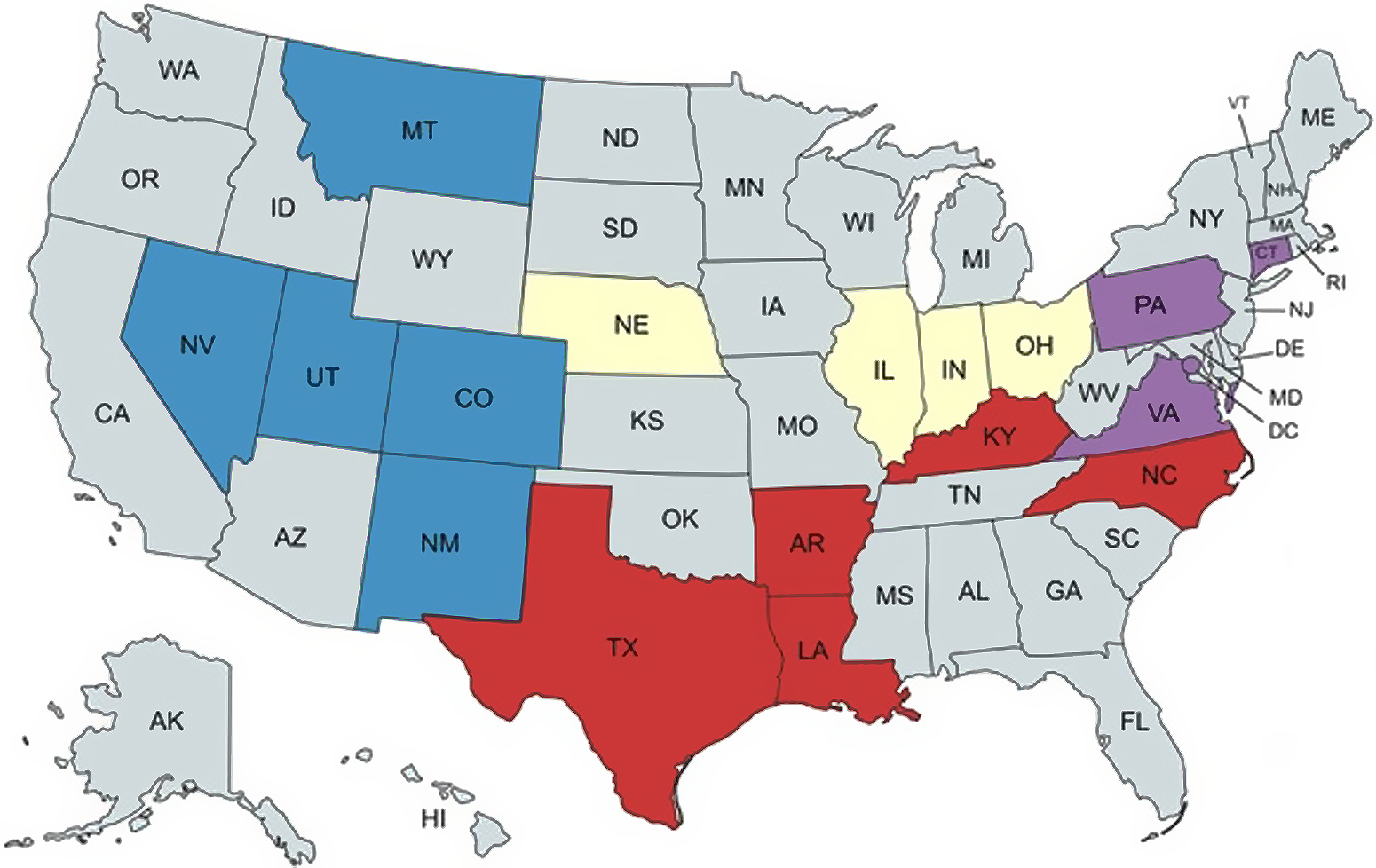
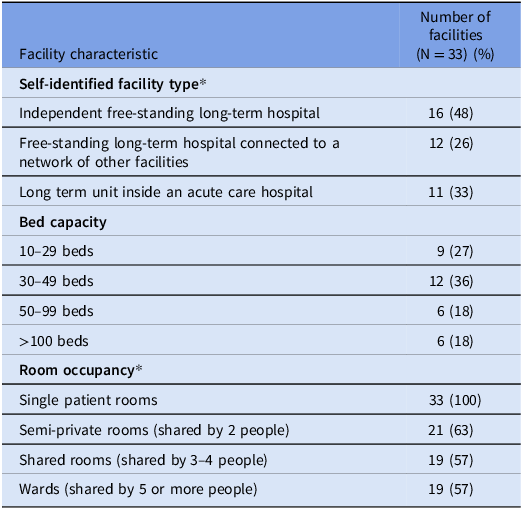
Responses were received from 33 of 56 (58%) U.S.-based NALTH LTACH facilities. Survey responses were nearly complete, with only three questions left unanswered by a single participating facility. Most respondents self-identified as independent free-standing hospitals or free-standing hospitals connected to a network of other facilities (74%) (Table 1, Figure 1). The median facility census on the day of survey completion was 20 (IQR 18–38) residents, and the median number of ventilated residents per facility was nine (IQR 3–12). Facilities reported median staffing ratio of one nurse to five patients and one patient care technician to five patients.
Geographic distribution of 33 long-term acute care hospital participants. Facility location was classified by geographic region, including Southeast (red, n = 15), Midwest (yellow, n = 8), West (blue, n = 6), or Northeast (purple, n = 4).

Participating long-term acute care hospital characteristics

Table 1. Long description
A table detailing characteristics of 33 participating long-term acute care hospitals. The table has 33 rows and 3 columns. The columns are labeled ‘Facility characteristic’, ‘Self-identified facility type’, ‘Bed capacity’, ‘Room occupancy’, and ‘Number of facilities (N = 33) (%)’. The ‘Self-identified facility type’ includes independent free-standing long-term hospital, free-standing long-term hospital connected to a network of other facilities, and long-term unit inside an acute care hospital. The ‘Bed capacity’ includes 10-29 beds, 30-49 beds, 50-99 beds, and more than 100 beds. The ‘Room occupancy’ includes single patient rooms, semi-private rooms, shared rooms, and wards. Each row lists the number and percentage of facilities for each characteristic.
*Selected categories are not mutually exclusive.
Twenty-three facilities (70%) reported ever identifying at least one case of C. auris infection or colonization. Eighteen facilities (54%) reported identifying a case of C. auris within the past three months, and nine (27%) reported suspected within-facility C. auris transmission. Four (12%) facilities had identified an antifungal-resistant C. auris isolate, most frequently to azoles; two facilities had identified C. auris isolates resistant to all three antifungal classes (ie, azoles, echinocandins, and polyenes).
Nearly all facilities (97%) reported having an MDRO prevention policy; however, only 18% had a policy specific to C. auris. Infection control committee membership most commonly included a nurse (96%), pharmacist (81%), hospital administrator (72%), infectious disease physician (69%), and advanced practice provider of unspecified specialty (45%). Sixty percent of facilities held infection control meetings at least once per quarter. The remaining respondents reported holding infection control meetings monthly (27%), annually (3%), or never (6%). Most facilities (72%) reported having a full-time infection preventionist, with the majority (84%) being nurses. All infection preventionist nurses worked on-site for 5 days per week. Less than half (46%) of infection prevention nurses had obtained a Certification in Infection Prevention and Control. Reference Hsu, Zhou, Nosakhare and Marsteller16
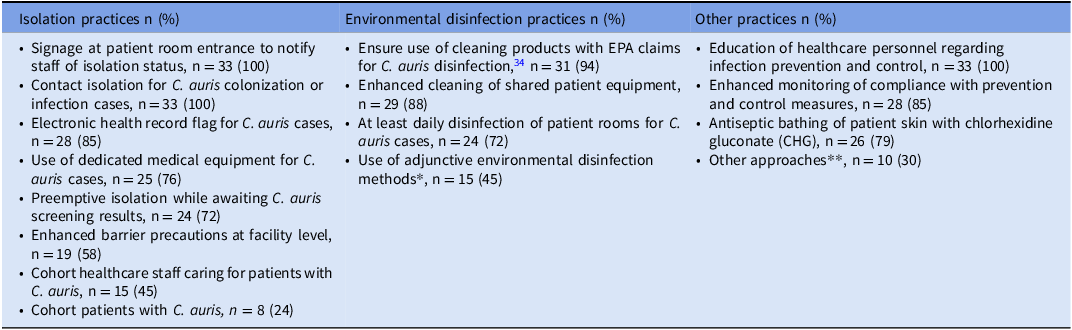
All facilities employed multimodal approaches for C. auris infection prevention (Table 2). More than half of LTACHs reported routine C. auris surveillance programs (n = 21, 64%), including in response to a new case of C. auris or suspected transmission (n = 15) and/or screening for asymptomatic colonization at the time of LTACH admission (n = 12). Universal screening occurred in more than one-third of facilities (n = 12, 36%). Surveillance samples were most commonly collected from the axilla (77%) and inguinal crease (58%). Patients were preemptively isolated pending screening results for C. auris in 72% of facilities. Less than one-quarter of facilities had capabilities for on-site testing of surveillance specimens, with most sending samples to a centralized, commercial reference, or public health laboratory.
Targeted prevention practices reported by participating facilities for suspected or confirmed cases of C. auris

Table 2. Long description
The table is divided into three main columns: Isolation practices, Environmental disinfection practices, and Other practices. Each column lists specific practices along with the number and percentage of facilities employing them. Isolation practices include signage at patient room entrances, contact isolation for C. auris cases, electronic health record flags, use of dedicated medical equipment, preemptive isolation, enhanced barrier precautions, cohort healthcare staff, and cohort patients. Environmental disinfection practices involve ensuring the use of specific cleaning products, Enhanced cleaning of shared equipment, daily disinfection of patient rooms, and use of adjunctive environmental disinfection methods. Other practices include education of healthcare personnel, enhanced monitoring of compliance, antiseptic bathing of patient skin, and other approaches. Each practice is accompanied by the number and percentage of facilities implementing it.
*Specified adjunctive environmental disinfection methods included: bleach (9), ultraviolet light (9), hydrogen peroxide (9), whole-room disinfectant fogging (3).
**Includes family and visitor education, precautions in high traffic areas.
Commonly reported infection control strategies included contact isolation, environmental disinfection, and education of healthcare personnel (Supplemental Table). The most reported isolation strategies included contact isolation (n = 33, 100%), use of electronic health record flags to designate C. auris colonization status (n = 28, 85%), and use of dedicated medical equipment (n = 25, 76%). The most reported environmental disinfection methods included use of cleaning products with claims for C. auris disinfection (n = 31, 94%), enhanced cleaning of shared patient equipment (n = 29, 88%), and at least daily disinfection of patient rooms (n = 24, 72%). Additionally, 85% of facilities partnered with a healthcare contractor for off-site laundering of linens. All facilities employed compliance monitoring (eg, direct observation, secret shopper, supervisor report, peer report) for hand hygiene and personal protective equipment (PPE) (Supplemental Table).
Facilities were most commonly notified regarding inbound transfer of a positive C. auris case via written documents (58%) and verbal communication from the originating facility (55%) prior to transfer. Sixty-nine percent of facilities identified C. auris positivity as a barrier to discharge to a lower level of care. Of the 22 facilities who identified C. auris positivity as a barrier to discharge, all but one reported difficulty in transferring patients to non-ventilator capable skilled nursing facilities; challenges were also reported with discharge to ventilator capable skilled nursing facilities and acute inpatient rehabilitation (both 14/22, 64%). Other barriers to discharge from LTACHs were not assessed.
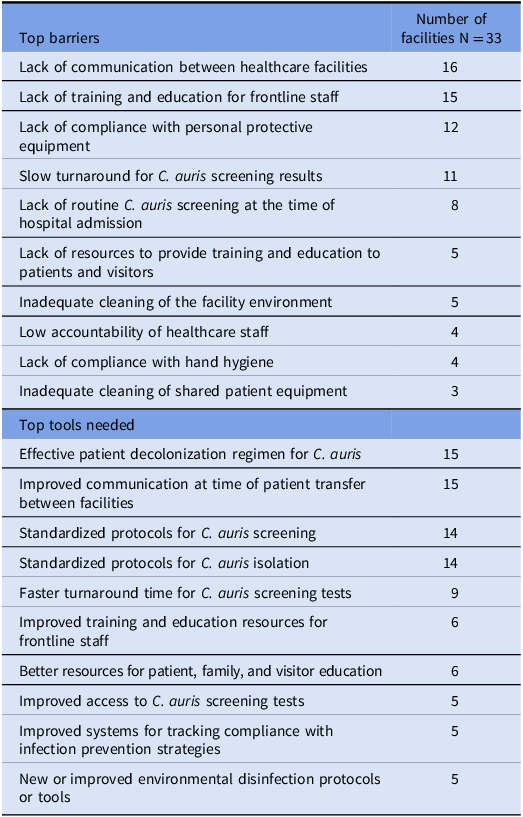
The top three reported barriers and requested tools for improved C. auris containment were recorded as non-weighted counts. Barriers included lack of communication between healthcare facilities at the time of patient transfer (n = 16), lack of training and education for frontline staff (n = 15), and lack of compliance with PPE (n = 12). The most often requested tools anticipated to improve C. auris containment were improved communication between facilities at the time of patient transfer (15, 45%), standardized protocols for C. auris decolonization (15, 45%), and standardized protocols for C. auris screening and isolation (14, 42%) (Table 3).
Top 10 perceived barriers and needed tools to support C. auris containment

Table 3. Long description
A table with two columns and 18 rows. The first column lists top barriers and needed tools, and the second column shows the number of facilities. Top barriers include lack of communication between healthcare facilities (16), lack of training and education for frontline staff (15), and lack of compliance with personal protective equipment (12). Top tools needed include effective patient decolonization regimen for C. auris (15), improved communication at time of patient transfer between facilities (15), and standardized protocols for C. auris screening (14).
Facilities were asked to select their top 3 perceived barriers and tools needed.
Discussion
Effective infection prevention and control of C. auris is a challenge in LTACHs. LTACH populations are disproportionately affected by colonization and infection with MDROS, Reference Munoz-Price17 mediated by high rates of co-morbidities, antibiotic exposure, and invasive medical device use. Reference Hennessee, Forsberg, Beekmann, Polgreen, Gold and Lyman18 To better understand gaps in prevention practices, LTACHs in the NALTH Network were surveyed regarding C. auris prevention practices and current barriers to containment. All participating facilities reported using multimodal infection control strategies and most facilities employed a full-time on-site infection preventionist. Although reported prevention strategies varied, some were universally performed, including placement of signage indicating isolation status and education of healthcare personnel regarding infection prevention and control. Other frequently reported prevention strategies included contact isolation of known C. auris colonized or infected patients, ensuring use of cleaning products demonstrating activity against C. auris, and enhanced cleaning of shared patient equipment. Our findings illustrate awareness and willingness of LTACHs to implement evidence-based strategies for containment of C. auris. Critically, significant challenges to containment remain, with nearly one-third of facilities having experienced suspected intra-facility transmission.
Most facilities (64%) reported performing C. auris surveillance, higher than reported in prior studies (eg, acute care hospitals, long term care facilities; 37–47%) Reference Lichota, King and Medernach11,Reference Hennessee, Forsberg, Beekmann, Polgreen, Gold and Lyman18–Reference Guitard, Bellanger and Dorin19 . In our study, 36% of facilities reported performing universal C. auris admission screening, and 72% of facilities preemptively isolated patients pending those results. Less than one quarter had an on-site laboratory, corroborating prior published reports. Gold et al found that one-third of LTACHs reported routine surveillance, predominantly at the time of admission, with only one-third of those facilities having an on-site laboratory. Reference Gold, Benedict and Haass20 Although it is reassuring that LTACHs performed screening more often than previously reported, this could be improved further. Diagnostic and treatment delays related to sending surveillance samples to outside laboratories may contribute to reluctance among LTACHs to perform screening as well as decreased adherence to pre-emptive contact isolation among staff due to long turnaround time for testing. To further improve surveillance, decreased turnaround time for C. auris testing may make screening findings more actionable for LTACH settings.
We identified several barriers to C. auris containment in LTACHs that strongly align with prior work in acute care hospitals. Reference Lichota, King and Medernach11 The most frequently identified gaps included poor interfacility communication, lack of training and education for frontline staff, and lack of compliance with PPE. The need for effective interfacility communication was a convergent theme across multiple questions, with improved communication between facilities at the time of patient transfer in the top three desired tools for future C. auris containment. Challenges in interfacility communication persist in part due to lack of standardization and requirements for communication at the time of interfacility transfer Reference King, Gilmore-Bykovskyi, Roiland, Polnaszek, Bowers and Kind21–Reference Adler-Milstein, Raphael, O’Malley and Cross23 . Even among states mandating interfacility communication of MDRO status, compliance remains heterogeneous. Reference Ellingson, Noble and Tran24 Statewide web-based registries such as the Illinois XDRO registry Reference Trick, Lin and Cheng-Leidig25 have been developed to overcome this communication barrier, but expansion to inter-state or national databases may be necessary for adequate data exchange to identify and track cases.
Highly desired tools that are anticipated to support future C. auris containment were identified in this study. This includes standardized protocols for C. auris decolonization, screening, and isolation. Effective decolonization protocols for C. auris are not currently available, but isolation and surveillance recommendations from the Centers for Disease Control and Prevention (CDC) 26 are unambiguous. Yet from our survey, 42% of facilities reported that standardized protocols for C. auris isolation and screening were among the most needed tools. Reasons behind this disconnect remain unclear and may be multifactorial in nature; these may include limited awareness of CDC guidelines, struggles to adapt to rapid updates in guidance, an environment that does not strongly support infection control practices, or low clinical burden and less experience with C. auris based on local epidemiology. Regardless, this suggests that LTACH staff may benefit from regularly scheduled training and education materials based on the most updated public health guidelines to reinforce standardized screening and isolation protocols.
To reduce C. auris infections and colonization at the patient level, ongoing research has focused on the development of effective C. auris decolonization strategies. To date, results have been promising but inconsistent. Chlorhexidine gluconate (CHG) bathing is widely used for infection prevention in hospitals but has mixed findings regarding activity against C. auris Reference Johnson, Eix and Lam27,Reference Elbahr, Khairy and Dayyab28 . Augmenting the antiseptic activity of CHG through co-administration with essential oils (eg, tea tree oil, lemongrass oil) Reference Johnson, Eix and Lam27,Reference Wu, Luk and Hung29 or isopropanol Reference Johnson, Eix and Lam27 has demonstrated promising results in animal models Reference Frías-De-León, Betancourt-Cisneros, Martínez-Herrera, Zarate-Segura, Castro-Fuentes and García-Salazar30 but has not yet been tested for effectiveness in real-world settings.
Our study has several strengths and weaknesses. Limitations that must be considered when interpreting the results include: limited generalizability, as only a fraction of U.S.-based LTACHs 31 are NALTH members (Supplemental Figure); self-reporting nature of surveys that may not reflect actual practices; and other weaknesses inherent to survey-based research such as non-response, recall, and social desirability biases. Non-response bias was mitigated through removal of non-responding facilities prior to data analysis. Reference Vetter and Mascha32,Reference Vesely and Klöckner33 Further investigation into the infection control environment and presence of antimicrobial stewardship programs could also be conducted in the future. In terms of strengths, we surveyed practices in LTACHs, which are an understudied care setting, regarding C. auris prevention practices. We received a strong response rate (58%), which we believe reflects the perceived importance of C. auris containment in this setting. Additionally, although the survey allowed incomplete responses, our completion rate was very high; only three questions were left incomplete by a single participating facility.
In summary, this survey of LTACHs in the NALTH network assessed C. auris prevention tools, perceived barriers and targets for infection control improvement. Barriers to C. auris containment appear universal across acute and long-term care facilities and focus on lack of infection prevention education, poor interfacility communication, and desire for standardization of infection prevention tools. Next steps to address gaps in containment should focus on development of effective decolonization protocols, development of standardized educational materials for staff including updated national public health guidance, and improvement in interfacility communication.
Supplementary material
The supplementary material for this article can be found at https://doi.org/10.1017/ice.2026.10548
Acknowledgements
The authors extend immense gratitude to the NALTH network participants and staff. We thank Joe Velazquez and Ryan Dryden for their assistance with survey dissemination.
Financial support
This work was supported by the SHEA Research Scholar Award and by the cooperative agreement U54CK000607 from the CDC. Its contents are solely the responsibility of the authors and do not necessarily represent the official views of SHEA or CDC.
Competing interests
All authors report no conflict of interest relevant to this article.


 Open access

