Introduction
Primary stapedotomy is one of the most successful otological operations. Success rates of up to 90 per cent in achieving air–bone gap closure to within 10 dB are quoted in the literature.Reference Meyer and Lambert1
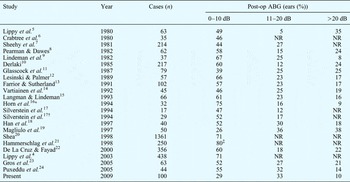
Revision stapes surgery is less successful, with comparable results being quoted for 16–80 per cent of cases.Reference Battista, Wiet and Joy2 These figures have improved in recent years, noticeably with the introduction of laser technology.Reference Battista, Wiet and Joy2–Reference Lippy, Battista, Berenholz, Schuring and Burkey4 A summary of reported outcomes of revision stapes surgery is presented in Table I.
Reported abg following revision stapes surgery

*Argon laser (Horn); †Argon or KTP laser (Silverstein); ‡Including 23 multiple revisions. ABG = air–bone gap; NR = no percentage reported
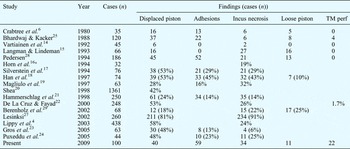
The most common indication for a revision procedure is persistent or recurrent conductive hearing loss.Reference Derlacki10, Reference Farrior and Sutherland13, Reference Hammerschlag, Fishman and Scheer21, Reference Puxeddu, Ledda, Pelagatti, Salis, Agus and Puxeddu24–Reference Lesinski27 The most common cause of conductive hearing loss in these circumstances is prosthesis failure.Reference Derlacki10, Reference Farrior and Sutherland13, Reference Hammerschlag, Fishman and Scheer21, Reference Puxeddu, Ledda, Pelagatti, Salis, Agus and Puxeddu24–Reference Lesinski27 At revision surgery, the prosthesis may be found to be displaced, loose or absent. Other common causes include incus erosion (which may cause piston displacement), fibrous adhesions or re-fixation of the footplate.Reference Derlacki10, Reference Farrior and Sutherland13, Reference Hammerschlag, Fishman and Scheer21, Reference Puxeddu, Ledda, Pelagatti, Salis, Agus and Puxeddu24–Reference Lesinski27 Other indications for revision surgery include dizziness, distortion of sound and other middle-ear problems (e.g. perforation and cholesteatoma).Reference Battista, Wiet and Joy2 Reported findings at revision surgery are shown in Table II.
Reported findings at revision surgery

*Argon. TM perf = tympanic membrane perforation
In cases in which a total stapedectomy was performed at the primary procedure, the piston may be displaced from the centre of the soft tissue graft, without becoming disconnected from the incus, and this complication may occur repeatedly. This problem is not associated with the stapedotomy technique, because the lower end of the piston is stabilised within the stapedotomy. When the stapedioplasty technique is used (i.e. the posterior crus of the stapes is used to connect the incus long process to a soft tissue graft in the oval window), the most common cause of failure is migration of the posterior crus and fixation to the margin of the oval window.Reference Vartiainen, Nuutinen and Virtaniemi14
When the piston has become displaced, it can be replaced. In general, it is better to insert a new piston, rather than simply readjusting the existing one.Reference Langman and Lindeman15 It may be worth considering using a different type of piston, especially if a polyethylene piston was not used at the previous operation. Erosion of the long process of the incus makes piston replacement more difficult. The incus can be removed and reintroduced between the malleus and the oval window, provided that a total or partial stapedectomy has been performed.Reference Vartiainen, Nuutinen and Virtaniemi14 It is also possible to place a piston between the malleus handle and the oval window, but there is a significant risk of extrusion.Reference Pedersen28 If there is no usable incus, a total ossicular replacement can be used.Reference Langman and Lindeman15
Soft tissue dissection during revision surgery may be facilitated by the use of a laser. The carbon dioxide laser is favoured by Lesinski and Palmer.Reference Lesinski and Palmer12 These authors have described a technique for conducting a stapedotomy through a soft tissue membrane in the oval window (e.g. a vein graft). This improves the stability of the piston. Other authors favour the KTP or argon laser. Regardless of the laser type used, if there is a piston in situ, there is a risk that it will be hit by the laser during the procedure. Szymanski et al. have investigated the possible heating of the vestibule during KTP laser revision surgery, in an in vitro model.Reference Szymanski, Mills and Abel30 They found only modest temperature rises, even when the piston was hit on numerous occasions. Heating was greater when a metal piston was in situ, and less when a vein graft was used as a seal around the lower end of the piston.
It is generally agreed that the results of revision stapes surgery are not as good as those of primary procedures. The surgeon has the best chance of providing a good long term result at the time of the first operation. In some cases, hearing deteriorates repeatedly because of recurrent problems, such as recurrence of adhesions or erosion of the incus long process. Previously reported hearing results, in terms of mean post-operative air–bone gaps, are presented in Table I. Poorer results are obtained when the incus is unusable due to erosion.Reference Langman and Lindeman15 Better results are obtained when the primary operation was a stapedotomy, compared with alternative techniques.Reference Pedersen31 There is often post-operative reduction in bone conduction thresholds, especially in late failures. Only Vartiainen et al. have reported post-operative air conduction thresholds; they achieved a mean residual hearing loss of less than 30 dB in only 39 per cent of cases.Reference Vartiainen, Nuutinen and Virtaniemi14
The aim of the present study was to determine the proportion of the senior author's patients who had undergone a second procedure following stapedotomy, and to investigate how many of these patients had obtained a satisfactory hearing result.
Materials and methods
The principal, senior author (RM) had collected data from ear operations prospectively since 1986, using a computer database (Lotus Approach). Data from operations for conductive deafness due to otosclerosis, performed in Dundee and Edinburgh, were analysed for all patients who had undergone primary and revision stapes surgery between 1987 and 2009. All primary operations and revisions were carried out by the senior author. Patients with less than one year of post-revision surgery follow up were excluded from the series, as were patients with incomplete data or secondary revisions.
The senior author's surgical technique evolved over the study period. In the early cases (n = 22), a stapedotomy was created using needles and picks. This was superseded by use of the ‘Skeeter’ micro-drill, around 1990. A KTP laser was used in 13 cases in 1998 and 1999. From 1999 onwards, a vein graft was used to seal the stapedotomy in all cases. In most of the early cases (n = 59) no seal was used, but fat was packed around the piston in 15 cases and gelatine sponge in one. Subsequently, perichondrium was used in 39 cases. This was abandoned in favour of vein, because this material is thinner and the connective tissue on the outside of the vein sticks to the footplate. When a footplate became mobile during surgery but remained intact, a shortened piston was placed between the incus and the upper surface of the footplate. In a few cases, large fenestra were created as a result of fragmentation of a thin footplate. These were sealed with perichondrium in the early cases and vein grafts in the later cases. For revision surgery, adhesions were dissected with micro-instruments until 1998, when the KTP laser became available.
The present study investigated findings at surgery, interventions conducted and one-year hearing results. Mean air–bone gap, hearing loss and bone conduction threshold were calculated using the frequencies 500, 1000 and 2000 Hz. Hearing changes were analysed post-operatively, comparing pre-operative and one year post-operative air conduction thresholds at 500, 1000 and 2000 Hz. The principal study group comprised all primary stapes operations carried out by the senior author during the study period, plus revision procedures performed on the patients in this group. The majority of revision operations carried out by the senior author involved patients whose initial surgery had been conducted by another surgeon. Surgical findings and hearing outcomes for these patients are also presented.
The reporting of revision stapes surgery outcomes was conducted as follows. The frequencies 500, 1000 and 2000 Hz were used for all hearing data. Hearing improvement was defined as air–bone gap closure to 10 dB or less (using pre-operative bone conduction thresholds). ‘Unchanged hearing’ was defined as a post-operative hearing change of less than 10 dB. Finally, mean hearing change was calculated using the mean pre-and post-operative conduction thresholds.
Results and analysis
During the study period, a total of 233 primary and 134 revision operations were carried out. A total of 35 (15 per cent) of the 233 ears which underwent primary surgery required a revision procedure of some sort. Of those, 28 patients (33 ears) had primary and revision surgery performed by the senior author, providing the main body of data in this series. A full data set was available for 28 revision cases; however, three of these were second revisions. In the five incomplete cases, two were awaiting one-year follow up at the time of data collection, and three did not have one-year follow-up audiometric data available. Of patients with full data sets, 20 were female and five male. The average age at primary operation was 42 years, with a range of 28 to 63 years.
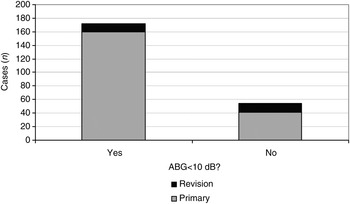
Of the 233 ears undergoing primary surgery, one-year follow-up data were available for 201 operations. Of these cases, 160 (80 per cent) had air–bone gap closure to within 10 dB. Following the revision procedure, a total of 172 cases (86 per cent) had air–bone gap closure to within 10 dB (see Figure 1).
Air–bone gap (ABG) closure to within 10 dB, for 201 cases with one-year follow-up data, representing 233 ears undergoing primary surgery (including 25 primary cases performed by the senior author).

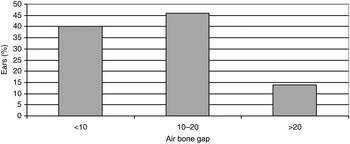
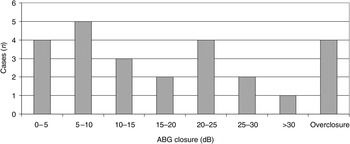
Of the complete series of 100 patients undergoing revision surgery, 72 had a full data set available. Of these cases, air–bone gap closure to within 10 dB was achieved in 29 per cent of cases (see Figure 2).
Air bone gap closure (ABG) for all revision cases.

The mean time between primary and revision surgery was 19 months, with a range of three to 48 months. Revisions were carried out for persistent or recurrent conductive hearing loss.
Within the data set comprising the senior author's own revisions, cases were separated according to timing of revision. Revision surgery was considered to be early if it was conducted within the first post-operative year, and late if conducted after this time. The results for these two groups were analysed separately.
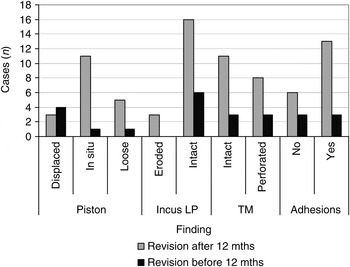
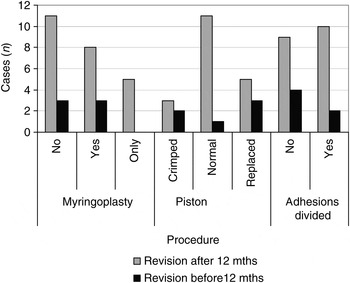
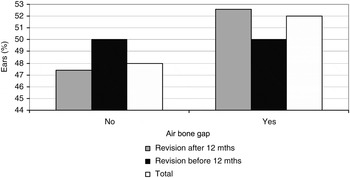
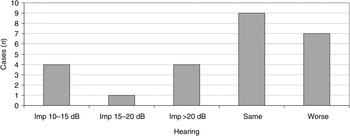
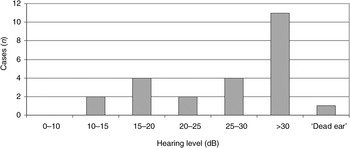
Figure 3 presents the findings at revision surgery for the senior author's primary cases, while Figure 4 summarises the operative interventions conducted. Overall, closure of the post-operative air–bone gap to within 10 dB was achieved in 52 per cent of patients. In revisions under 12 months, this was achieved in 50 per cent of patients, and in revisions over 12 months it was achieved in 52.6 per cent (Figure 5). The results for mean air–bone gap closure, air–bone gap closure to within 10 dB, mean air–bone gap magnitude, mean hearing change and mean hearing loss, one year after revision surgery, are presented in Figures 1, 6, 7 and 8. Air bone gap closure is conventionally cited as a mean of the three frequencies 500, 1000 and 2000 Hz. Figure 2 demonstrates air–bone gap closure for all revision operations.
Findings at revision surgery, for senior author's 25 primary surgery cases.

Intervention procedures at revision surgery, for senior author's 25 primary surgery cases.

Air bone gap closure (ABG) for all revision cases, for senior author's 25 primary surgery cases.

Distribution of mean air–bone gap (ABG) one year after revision surgery, for senior author's 25 primary surgery cases.

Distribution of mean hearing changes one year after revision surgery, for senior author's 25 primary surgery cases. Imp = improved

Mean hearing thresholds one year after revision surgery, for senior author's 25 primary surgery cases.

In 14 cases, a shortened piston was placed on the upper surface of a footplate which had mobilised as a result of stapes manipulation during primary surgery. Of these, nine (64 per cent) had air–bone gap closure to within 10 dB at one year. At the time of writing, five (36 per cent) had required revision surgery because of persistent or recurrent conductive hearing loss. The follow-up period in this group varied between three months and 10 years.
Discussion
The hearing results for revision stapes surgery reported in this paper are very much in line with those published in the literature, bearing in mind that the operations were carried out over a 22-year period. However, to the best of our knowledge this is the first study to report the frequency of revision surgery for an individual surgeon. It is disappointing that 15 per cent of synonymously cases required a second operation, but encouraging that the revision procedures contributed to an overall increase in the success rate. It does not appear that revisions carried out more than a year after the primary procedure fared any worse than those conducted earlier in the post-operative period, but the numbers reported here are too small to be certain.
In five revision cases, the only intervention was repair of a small perforation in the postero-superior quadrant of the tympanic membrane. Some of these perforations were evident early in the post-operative period, but others appeared later. The senior author consistently favoured removal of sufficient bone to allow a clear view of the pyramid. It is clear that, following such bone removal, the adjacent area of the drum often appears thin and sometimes retracted. It is possible that the use of a graft to reinforce the drum in this area would be beneficial.
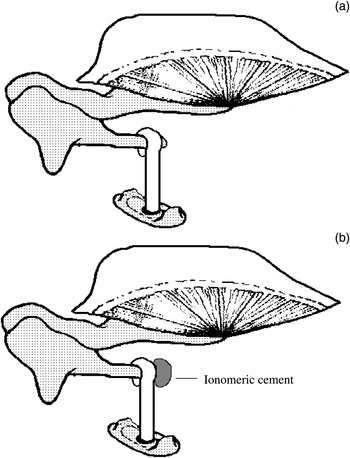
Not surprisingly, incus erosion was only seen in cases undergoing revision surgery more than a year after the primary procedure. This represents the greatest challenge to the otological surgeon who performs stapes revision surgery. The senior author favoured the use of ionomeric cement to reconstruct the incus long process and to stabilise the piston (Figure 9). This worked well provided the incus defect was not too extensive.
Technique for incus repair using ionomeric cement. (a) The piston is replaced as far from the tip of the incus as possible; (b) the piston is stabilised using ionomeric cement.

Mobilisation of the stapes during removal of the stapes arch, or less commonly during fenestration of the footplate, requires appropriate management if inner ear damage is to be avoided. When the footplate fragments, a total stapedectomy with a soft tissue seal of the oval window is the best option. Fragments of the footplate may descend into the vestibule, risking inner ear damage, so the procedure must be conducted with great care. If it remains intact, the placement of a piston on the upper surface of the footplate represents a lower-risk alternative. The results of this study indicate that, while the footplate re-fixes in a proportion of these cases, in others it remains mobile and satisfactory hearing outcomes are obtained. This is not entirely surprising, given the success rate for stapes mobilisation operations. Revision surgery is straightforward in these cases, provided that sufficient time is allowed to elapse for the footplate to become completely fixed.
• The best chance of obtaining a successful outcome in stapedotomy is to achieve this at the primary procedure
• However, revision surgery does increase the medium to long term success rate
• Revision stapes surgery presents the otologist with a number of demanding technical challenges
• It is always worth considering one revision procedure in patients with adequate bone conduction thresholds, but if this fails the patient should be encouraged to wear a hearing aid
During the early years of the study period, the senior author frequently carried out more than one revision procedure on the same patient. As data accumulated, it became clear that there was a ‘law of diminishing returns’, i.e. second and subsequent revision procedures were less likely to produce an optimal hearing result. In cases of recurrent failure, a hearing aid should therefore be seriously considered in preference to a further revision procedure. Multiple revision procedures potentially increase the risk of making the hearing worse.
Conclusion
The best chance of air bone gap closure in stapes surgery is at the primary procedure. However, one revision does increase the long-term success rate and should be offered to patients with adequate bone conduction thresholds.