Introduction
In the early twentieth century, laryngotracheal stenosis was rare. However, incidence has increased since the 1960s because of the development of life-saving medical procedures that inadvertently require prolonged intubation, predisposing patients to develop laryngotracheal stenosis.Reference Choo, Tan and Balakrishnan 1 Treatment aims to provide a patent airway, yet maintain acceptable voice quality and glottic competence for airway protection against aspiration. This can be done surgically via an external or endoscopic approach. Post-operatively, a T-tube is used to maintain laryngotracheal patency.
Five decades ago, Montgomery introduced a tracheal T-tube that acts as a stent yet preserves laryngeal phonation.Reference Montgomery 2 It provides physiological direction of humidified air flow into the lungs, resulting in patient acceptance superior to that for tracheostomy tubes.Reference Montgomery 2 The soft silicone material allows remodelling of the airway and is less traumatic to the tracheal wall as compared to a regular tracheostomy tube. Endoscopic insertion of a tracheal T-tube can be challenging and time-consuming; therefore, maintenance of ventilation throughout the procedure is vital. We describe a simple, practical, safe technique for endoscopic T-tube insertion that enables sustained ventilation during the procedure, for both adult and paediatric patients.
Materials and methods
The patient is placed under general anaesthesia and ventilated through a cuffed tracheostomy tube. Direct laryngoscopy and bronchoscopy are conducted, and the findings are documented.
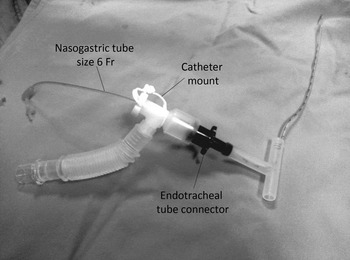
Progressive dilation of tracheal stenosis is performed with successively larger rigid bronchoscopes, up to the required diameter, and a T-tube, previously measured and cut to meet the patient's requirement, is inserted. An endotracheal tube connector is then affixed to the T-tube's extraluminal limb, which is then attached to a catheter mount. A nasogastric tube size 6 Fr is inserted via the opening of the catheter mount, through the endotracheal tube connector and into the T-tube's proximal limb (Figure 1). The tracheostomy tube is then removed and the stoma dilated with a tracheal dilator, before the T-tube's distal limb is inserted into the inferior portion of stoma. Bronchoscopy is performed to grasp the tip of nasogastric tube with forceps and the tube is then externalised through the mouth. The proximal limb of the T-tube is then advanced and positioned through the dilated segment by manoeuvring the nasogastric tube.
A 6 Fr nasogastric tube is passed through the opening of a catheter mount, through an endotracheal tube connector and into the proximal limb of the intraluminal segment of the T-tube.

Video bronchoscopy is subsequently performed to ascertain T-tube positioning and luminal patency.
Discussion
From January 2009 to December 2014, the above-described procedure was performed 18 times on 15 patients, 7 of whom were adults and 8 were paediatric patients. Patient age ranged from 10 months to 67 years. Thirteen patients had subglottic stenosis and two had tracheal stenosis, all proximal to the tracheostoma. All patients tolerated the T-tube, except for the 10-month-old baby with global developmental delay who developed hypersecretion that subsequently disturbed post-operative ventilation. From a total of 15 patients, 8 have been successfully decannulated. The average duration of T-tube usage prior to successful decannulation was six months.
Since Montgomery's original method of T-tube insertion was introduced in the 1960s, various modifications have been described that aim to simplify the technique yet allow successful positioning of the tube within the stenotic laryngotracheal segment.
Montgomery's method involves direct intraluminal placement of the distal limb with the proximal limb compressed, wherein a tug on the extraluminal limb directs the proximal intraluminal limb into place.Reference Montgomery 3 This method does not guarantee correct placement, and airway control may be lost. It requires occlusion to the upper limb, using a Fogarty catheter, to allow ventilation through the external limb.
Cooper and colleagues described a method of inserting the T-tube with the aid of an umbilical tape.Reference Cooper, Todd, Ilves and Pearson 4 According to their method, rigid bronchoscopy is performed following the formation of tracheal stoma. A tape is threaded through the T-tube, passed through the stoma and grasped by forceps, which pulls the tape superiorly. The T-tube is then threaded over the tape and inserted, guided by the tape. Although this method will ensure correct placement of the T-tube, airway control may be compromised during insertion, as it requires first extubation and then insertion of a bronchoscope.
Lin and colleagues modified this technique by introducing a small endotracheal tube into the extraluminal limb of the T-tube and out through the distal portion of the intraluminal limb, maintaining the airway during the entire procedure.Reference Lin, Tan, Cheng and Lee 5 Nevertheless, an umbilical tape or suction tube is still needed to manipulate the T-tube.
Our technique is safe because ventilation is maintained throughout the procedure. In addition, the T-tube can be inserted within a shorter period of time, as compared to the techniques mentioned above. It is also practical, as all the instruments required are available in the operating theatre. Patients can be discharged much earlier than with the conventional open technique. This technique is safe, and has been proven to be successful in maintaining a patent airway both in paediatric and adult age groups.