



1 Introduction
Combinatorial properties of non-principal ultrafilters over
 $\omega $
, that is, ultrafilters on the Boolean algebra
 $\mathcal {P}(\omega )/\textrm{fin}$
, have been extensively studied for the past half century. Key questions centered around the existence of ultrafilters with additional properties such as P-points, the Rudin–Keisler ordering, or cardinal invariants related to ultrafilters. Much less is known about ultrafilters on general Boolean algebras, although in recent years there has been considerable interest in their role in set theory and model theory. In particular, Malliaris and Shelah [Reference Malliaris and Shelah16] developed a new approach to Keisler’s order based on morality of ultrafilters on Boolean algebras, whereas Goldstern et al. [Reference Goldstern, Kellner and Shelah9] used Boolean ultrapowers of forcing iterations to force all cardinals in Cichoń’s diagram to be pairwise different.
In view of this situation, we investigate combinatorial aspects of ultrafilters on complete Boolean algebras, with a particular focus on the following two closely related topics:
-
• the existence of ultrafilters which are not Tukey maximal and
-
• the ultrafilter number.
Our results are mostly (but not exclusively) about Cohen and random algebras.
Section 2 begins by introducing the central notions of this paper. We then follow Kunen’s framework [Reference Kunen15] of index-invariant ideals to give examples of Boolean algebras on which every ultrafilter is Tukey maximal, answering an open question posed by Brown and Dobrinen [Reference Brown and Dobrinen2].
In Section 3 we discuss a cardinal invariant related to Tukey reducibility, namely the ultrafilter number of Boolean algebras. In particular, we focus on the ultrafilter numbers of Cohen and random algebras, discussing their relation with previously studied cardinal invariants the continuum, and proving new consistency results about them via finite-support iterations.
The last two sections, on the other hand, deal with constructions of ultrafilters which are not Tukey maximal. More specifically, in Section 4 we construct non-maximal ultrafilters on Cohen algebras under the assumption that
 $\mathfrak {d}=2^{\aleph _0}$
, whereas in Section 5 we carry out such a construction on the random algebra, under the stronger assumption of
 $\diamondsuit $
.
2 Tukey-maximal ultrafilters
The notion of Tukey reducibility, to which this section is dedicated, has its origin in the work of Tukey on convergence in general topology.
Definition 2.1 (Tukey [Reference Tukey25])
Let
 $\bigl \langle D,\le ^D\bigr \rangle $
and
 $\bigl \langle E,\le ^E\bigr \rangle $
be directed sets. We define
 $$ \begin{align*}\bigl\langle D,\le^D\bigr\rangle\le_{\textrm{T}}\bigl\langle E,\le^E\bigr\rangle\end{align*} $$
if and only if there exist functions
 $f\colon D\to E$
and
 $g\colon E\to D$
such that for all
 $d\in D$
and
 $e\in E$
 $$ \begin{align*} f(d)\le^E e\implies d\le^D g(e). \end{align*} $$
The next theorem provides a general upper bound for directed sets of cardinality
 $\le \kappa $
.
Theorem 2.2 (Tukey [Reference Tukey25, Theorem II-5.1])
Let
 $\kappa $
be a cardinal and
 $\langle D,\le \rangle $
a directed set. If
 ${\lvert {D}\rvert }\le \kappa $
, then
 .
Given a directed set
 $\langle D,\le \rangle $
, as usual we let
 $\operatorname {\textrm{cof}}(\langle D,\le \rangle )$
be the minimum cardinality of a cofinal subset of D. Furthermore, if D has no maximum, let
 $\operatorname {\textrm{add}}(\langle D,\le \rangle )$
be the minimum cardinality of an unbounded subset of D.
Proposition 2.3 (Schmidt [Reference Schmidt21])
Let
 $\bigl \langle D,\le ^D\bigr \rangle $
and
 $\bigl \langle E,\le ^E\bigr \rangle $
be directed sets. If D has no maximum and
 $\bigl \langle D,\le ^D\bigr \rangle \le _{\textrm{T}}\bigl \langle E,\le ^E\bigr \rangle $
, then
 $$ \begin{align*} \operatorname{\textrm{add}}(E)\le\operatorname{\textrm{add}}(D)\le\operatorname{\textrm{cof}}(D)\le\operatorname{\textrm{cof}}(E). \end{align*} $$
Isbell [Reference Isbell11] then initiated the study of Tukey reducibility of ultrafilters. Indeed, note that if U is an ultrafilter on a Boolean algebra
 $\mathbb {B}$
, then
 $\langle U,\ge \rangle $
is a directed set. Motivated by Theorem 2.2, we say that U is Tukey maximal if and only if
 .
Theorem 2.4 (Isbell [Reference Isbell11, Theorem 5.4])
For every infinite cardinal
 $\kappa $
, there exists a Tukey-maximal ultrafilter over
 $\kappa $
.
The above theorem stimulated a fruitful line of research, which is nicely surveyed by Dobrinen [Reference Dobrinen5] and constitutes the main motivation for this work. The following criterion is particularly useful to determine whether an ultrafilter is Tukey maximal. We omit the proof, which is the same as Dobrinen and Todorčević [Reference Dobrinen and Todorčević6, Fact 12].
Proposition 2.5. Let
 $\kappa $
be an infinite cardinal. For an ultrafilter U on a Boolean algebra
 $\mathbb {B}$
, the following conditions are equivalent:
-
•
 ;
-
• there exists a subset
$X\subseteq U$
with
${\lvert X \rvert }=\kappa $
such that every infinite
$Y\subseteq X$
is unbounded in U.


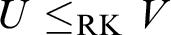
At this point, it is appropriate to discuss the connection with the Rudin–Keisler ordering and ultrafilters over
 $\omega $
. Recall that, whenever U and V are ultrafilters over
 $\omega $
, we have
 $U\le _{\textrm{RK}} V$
if there exists a function
 $f\colon \omega \to \omega $
such that for all
 $X\subseteq \omega $
 $$ \begin{align*} X\in U\iff f^{-1}[X]\in V. \end{align*} $$
Now, as noted by Dobrinen and Todorčević [Reference Dobrinen and Todorčević6, Fact 1], if
 $U\le _{\textrm{RK}} V$
then
 $\langle U,\supseteq \rangle \le _{\textrm{T}}\langle V,\supseteq \rangle $
. We aim to show that this implication is also true, in the Boolean-algebraic context, for the generalized Rudin–Keisler ordering introduced by Murakami.
Definition 2.6 (Murakami [Reference Murakami20])
Let
 $\mathbb {B}$
and
 $\mathbb {C}$
be complete Boolean algebras. For ultrafilters
 $U\subset \mathbb {B}$
and
 $V\subset \mathbb {C}$
, we define
 $U\le _{\textrm{RK}} V$
if there exist
 $v\in V$
and a complete homomorphism
 $f\colon \mathbb {B}\to \mathbb {C}\mathbin {\upharpoonright } v$
such that
 $U=f^{-1}[V]$
.
Proposition 2.7. Let
 $\mathbb {B}$
and
 $\mathbb {C}$
be complete Boolean algebras, with ultrafilters
 $U\subset \mathbb {B}$
and
 $V\subset \mathbb {C}$
. If
 $U\le _{\textrm{RK}}V$
, then
 $\langle U,\ge \rangle \le _{\textrm{T}}\langle V,\ge \rangle $
.
Proof Suppose there exist
 $v\in V$
and a complete homomorphism
 $f\colon \mathbb {B}\to \mathbb {C}\mathbin {\upharpoonright } v$
such that
 $U=f^{-1}[V]$
. Let us define

and note that
 $c\le f(b)$
implies
 $g(c)\le b$
. Furthermore, observe that if
 $c\in V$
then, by completeness of the homomorphism f,

hence
 $f(g(c))\in V$
, which means
 $g(c)\in U$
. In conclusion, the maps f and g witness that
 $\langle U,\ge \rangle \le _{\textrm{T}}\langle V,\ge \rangle $
.
The following is a straightforward corollary which clarifies the relationship to ultrafilters over
 $\omega $
.
Corollary 2.8. Let
 $\mathbb {B}$
be a complete Boolean algebra. For an ultrafilter
 $V\subset \mathbb {B}$
, the following conditions are equivalent:
-
(1) V is not
$\sigma $
-complete; -
(2) there exists a non-principal ultrafilter U over
$\omega $
such that
$U\le _{\textrm{RK}}V$
; -
(3) there exists a non-principal ultrafilter U over
$\omega $
such that
$\langle U,\supseteq \rangle \le _{\textrm{T}}\langle V,\ge \rangle $
.




Proof (1
 $\Longrightarrow $
2) Assuming V is not
 $\sigma $
-complete, there exists a maximal antichain

in
 $\mathbb {B}$
such that for all
 $i<\omega $
,
 $a_i\notin V$
. The function

is a complete homomorphism, hence
 $U=f^{-1}[V]$
is the desired ultrafilter.
(2
 $\Longrightarrow $
3) By Proposition 2.7.
(3
 $\Longrightarrow $
1) Suppose U is a non-principal ultrafilter over
 $\omega $
such that
 $\langle U,\supseteq \rangle \le _{\textrm{T}} \langle V,\ge\rangle$
. By Proposition 2.3 we have
 $\operatorname {\textrm{add}}(V)\le \operatorname {\textrm{add}}(U)=\aleph _0$
, implying V is not
 $\sigma $
-complete.
In the remainder of this section, we introduce the framework of Kunen [Reference Kunen15] and show that certain Boolean algebras have only ultrafilters which are Tukey maximal.
Definition 2.9. A
 $\sigma $
-ideal I over
 $^\omega 2$
is index invariant if for every injective function
 $\Delta \colon \omega \to \omega $
and
 $X\subseteq {^\omega }2$
we have

Let I be an index-invariant
 $\sigma $
-ideal over
 $^\omega 2$
and
 $\alpha $
an infinite ordinal. We define
 $I(\alpha )\subset \mathcal {P}({^\alpha }2)$
as follows:
 $X\in I(\alpha )$
if and only if there exist an injective function
 $\Delta \colon \omega \to \alpha $
and a set
 $Y\in I$
such that for all
 $f\in X$
,
 $f\circ \Delta \in Y$
.
Prototypical examples of index-invariant
 $\sigma $
-ideals are of course the meagre ideal
 $\mathcal {M}$
and the null ideal
 $\mathcal {N}$
, which will be discussed in greater detail from Section 3.
Lemma 2.10 (Kunen [Reference Kunen15, Lemma 1.5])
Let I be an index-invariant
 $\sigma $
-ideal over
 $^\omega 2$
. For every infinite ordinal
 $\alpha $
,
 $I(\alpha )$
is indeed a
 $\sigma $
-ideal over
 $^\alpha 2$
.
Furthermore,
 $I(\alpha )$
is also “index invariant” in the sense that, for every injective function
 $\Gamma \colon \alpha \to \beta $
and
 $X\subseteq {^\alpha }2$
,

Let
 $\operatorname {\textrm{Clop}}(^\alpha 2)$
be the Boolean algebra of clopen subsets of the Cantor space
 $^\alpha 2$
, and
 $\mathcal {B}(^\alpha 2)$
be the
 $\sigma $
-algebra generated by
 $\operatorname {\textrm{Clop}}(^\alpha 2)$
; note that
 ${\lvert {\operatorname {\textrm{Clop}}(^\alpha 2)} \rvert } = {\lvert \alpha \rvert }$
whereas
 ${\lvert {\mathcal {B}(^\alpha 2)} \rvert }={\lvert \alpha \rvert }^{\aleph _0}$
. If I is an index-invariant
 $\sigma $
-ideal over
 $^\omega 2$
, let
 $$ \begin{align} \mathbb{B}(I,\alpha)=\mathcal{B}(^\alpha2)/I(\alpha) \end{align} $$
be the quotient
 $\sigma $
-algebra.
Remark 2.11 By Lemma 2.10, every injective function
 $\Gamma \colon \alpha \to \beta $
induces a
 $\sigma $
-complete embedding
 $\Gamma _*\colon \mathbb {B}(I,\alpha )\to \mathbb {B}(I,\beta )$
such that if
 $X\in \mathcal {B}(^\alpha 2)$
then

Theorem 2.12. Let I be an index-invariant
 $\sigma $
-ideal over
 $^\omega 2$
, containing all singletons. For every infinite cardinal
 $\kappa $
and every ultrafilter U on
 $\mathbb {B}(I,\kappa )$
, we have
 .
Proof Let U be an ultrafilter on
 $\mathbb {B}(I,\kappa )$
. We define a function
 $x\colon \kappa \times 2\to \operatorname {\textrm{Clop}}(^\kappa 2)$
as follows: for every
 $\alpha <\kappa $
,

As U is an ultrafilter, there exists a function
 $g\colon \kappa \to 2$
such that for all
 $\alpha <\kappa $
,

. Let

it is sufficient to show that whenever
 $Y\subseteq X$
is infinite we have
 $\bigwedge Y\notin U$
, then conclude using Proposition 2.5.
Let
 $\Delta \colon \omega \to \kappa $
be an arbitrary injective function. Since we are assuming I contains all singletons, we have
 $\{g\circ \Delta \}\in I$
. Therefore, by definition,

Now using the fact that
 $I(\kappa )$
is a
 $\sigma $
-ideal,

as desired.
Brown and Dobrinen [Reference Brown and Dobrinen2, Question 4.2] asked: if
 $\mathbb {B}$
is an infinite Boolean algebra such that all ultrafilters on
 $\mathbb {B}$
are Tukey maximal, is
 $\mathbb {B}$
necessarily a free algebra? Theorem 2.12 provides a negative answer to this question. Indeed it implies that, if
 $\kappa $
is a cardinal satisfying
 $\kappa ^{\aleph _0}=\kappa $
and I is, for instance, the meagre (or null) ideal, then every ultrafilter on
 $\mathbb {B}(I,\kappa )$
is Tukey maximal. On the other hand,
 $\mathbb {B}(I,\kappa )$
is a
 $\sigma $
-algebra, hence not free by the Gaifman–Hales theorem [Reference Gaifman7, Reference Hales10].
3 The ultrafilter number
This section is dedicated to the study of a cardinal invariant, the ultrafilter number, which is closely related to Tukey reducibility. We shall carry out this study for Boolean algebras of the form
 $\mathbb {B}(I,\kappa )$
, focusing in particular on the situation where
 $\kappa $
is either
 $\omega $
or
 $\omega _1$
, so that the ultrafilter numbers
 $\mathfrak {u}(\mathbb {B}(I,\omega ))$
and
 $\mathfrak {u}(\mathbb {B}(I,\omega _1))$
are indeed two cardinal invariants of the continuum. We begin with standard definitions.
Let
 $\mathbb {B}$
be an infinite Boolean algebra. We let

be the
 $\pi $
-weight of
 $\mathbb {B}$
. Furthermore, we define the ultrafilter number of
 $\mathbb {B}$
as

for simplicity of notation, let also
 $\mathfrak {u}=\mathfrak {u}(\mathcal {P}(\omega )/\textrm{fin})$
. Finally, as usual
 $\mathfrak {d}$
denotes the dominating number.
The main motivation to consider the ultrafilter number in this paper is given by the following observation, which follows directly from Proposition 2.5.
Remark 3.1. Let
 $\mathbb {B}$
be an infinite Boolean algebra. If
 $\mathfrak {u}(\mathbb {B})<{\lvert {\mathbb {B}} \rvert }$
, then there exists a non-principal ultrafilter on
 $\mathbb {B}$
which is not Tukey maximal.
Let
 $\mathcal {N}$
be the ideal over
 $^\omega 2$
consisting of sets which are null with respect to the standard product measure
 $\mu $
. The cardinal
 $\operatorname {\textrm{non}}(\mathcal {N})$
, which is the least size of a set which is not null, will play a role in our discussion. We also assume some familiarity with the meagre ideal
 $\mathcal {M}$
, consisting of sets which are countable unions of nowhere dense sets.
As
 $\mathcal {M}$
and
 $\mathcal {N}$
are both index-invariant
 $\sigma $
-ideals, containing all singletons, we shall consider the corresponding quotient algebras as in (1). In accord with usual notation, for an infinite ordinal
 $\alpha $
let
 $\mathbb {C}_\alpha =\mathbb {B}(\mathcal {M},\alpha )$
be the Cohen algebra and
 $\mathbb {B}_\alpha =\mathbb {B}(\mathcal {N},\alpha )$
be the Random algebra.
Proposition 3.2. Let
 $\alpha $
be an infinite ordinal; then both
 $\mathbb {C}_\alpha $
and
 $\mathbb {B}_\alpha $
are c.c.c. complete Boolean algebras. Furthermore,
-
(1) for every
there exists a non-empty
$C\in \operatorname {\textrm{Clop}}(^\alpha 2)$
such that
and -
(2) for every
and every
$\varepsilon>0$
there exists a non-empty
$C\in \operatorname {\textrm{Clop}}(^\alpha 2)$
such that
$\mu (B\cap C)\ge (1-\varepsilon )\mu (C)$
.


We omit the proof of this well-known fact, but we remark that (1) can be found in Sikorski [Reference Sikorski22, Theorem 35.1], while (2) follows from Lebesgue’s density theorem.
We are ready to undertake the study of
 $\mathfrak {u}(\mathbb {C}_\omega )$
,
 $\mathfrak {u}(\mathbb {C}_{\omega _1})$
,
 $\mathfrak {u}(\mathbb {B}_\omega )$
, and
 $\mathfrak {u}(\mathbb {B}_{\omega _1})$
, beginning with a theorem which summarizes the relations between those four cardinals and other cardinal invariants of the continuum.
Theorem 3.3. The inequalities in the following Hasse diagram hold:

Proof The upper bound
 $\mathfrak {u}(\mathbb {C}_{\omega _1})+\mathfrak {u}(\mathbb {B}_{\omega _1})\le 2^{\aleph _0}$
follows directly from the observation that the Boolean algebras
 $\mathbb {C}_{\omega _1}$
and
 $\mathbb {B}_{\omega _1}$
have both cardinality
 $2^{\aleph _0}$
.
As for
 $\mathfrak {u}(\mathbb {C}_\omega )\le \mathfrak {u}(\mathbb {C}_{\omega _1})$
, Remark 2.11 gives a
 $\sigma $
-complete embedding
 $f\colon \mathbb {C}_\omega \to \mathbb {C}_{\omega _1}$
which, due to the fact that
 $\mathbb {C}_\omega $
is c.c.c., is in fact a complete embedding. Consequently, for every ultrafilter U on
 $\mathbb {C}_{\omega _1}$
we have
 $\operatorname {\textrm{cof}}\bigl (f^{-1}[U]\bigr )\le \operatorname {\textrm{cof}}(U)$
by Proposition 2.3 and Proposition 2.7. The inequality
 $\mathfrak {u}(\mathbb {B}_\omega )\le \mathfrak {u}(\mathbb {B}_{\omega _1})$
is proved analogously.
To prove
 $\mathfrak {u}\le \mathfrak {u}(\mathbb {C}_\omega )$
, it is sufficient to note that no ultrafilter on
 $\mathbb {C}_\omega $
is
 $\sigma $
-complete, then apply Proposition 2.3 and Corollary 2.8. Similarly for
 $\mathfrak {u}\le \mathfrak {u}(\mathbb {B}_\omega )$
.
We now prove the inequality
 $\mathfrak {d}\le \mathfrak {u}(\mathbb {C}_\omega )$
. Let U be an ultrafilter on
 $\mathbb {C}_\omega $
; since U is not
 $\sigma $
-complete, there exists a maximal antichain

such that for all
 $i<\omega $
,
 $a_i\notin U$
. Let
 $X\subset U$
be such that
 ${\lvert X \rvert }<\mathfrak {d}$
, we aim to prove that X is not cofinal in
 $\langle U,\ge \rangle $
. Whenever
 $s\in {^{<\omega }2}$
, we let

be the corresponding element of
 $\operatorname {\textrm{Clop}}(^\omega 2)$
. By point (1) of Proposition 3.2, for every

there exists some
 $s\in {^{<\omega }2}$
such that

. Using this fact, for each
 $x\in X$
we may define a function
 $f_x\colon \omega \to \omega $
as follows. Let
 $i<\omega $
; as every element of U meets infinitely many members of

, let
 $j_i$
be the least
 $j\ge i$
such that

. Then we define

Since
 ${\lvert X \rvert }<\mathfrak {d}$
, there exists an increasing function
 $g\colon \omega \to \omega $
such that for all
 $x\in X$
we have
 $g\nleq f_x$
. Now define

and assume
 $u\in U$
; the other case when
 $\neg u\in U$
is completely analogous. Towards a contradiction suppose now X is cofinal in
 $\langle U,\ge \rangle $
, this implies the existence of some
 $x\in X$
such that
 $x\le u$
. Since g is not dominated by
 $f_x$
, we can find some
 $i<\omega $
such that
 $f_x(i)<g(i)$
; then, by definition of
 $f_x$
there exists some
 $s\colon f_x(i)\to 2$
such that

. Putting everything together, we deduce

which is a contradiction because
 $f_x(i)<g(j_i)$
. This shows that X cannot be cofinal in the ultrafilter and completes the proof of
 $\mathfrak {d}\le \mathfrak {u}(\mathbb {C}_\omega )$
.
The fact that
 $\operatorname {\textrm{cof}}(\mathcal {N})\le \mathfrak {u}(\mathbb {B}_\omega )$
is a consequence of the work of Burke [Reference Burke3]. More precisely, in Case 1 of [Reference Burke3, Theorem 1], he showed the following: if
 has the property that for all
 $b\in \mathbb {B}_\omega $
there exists
 $x\in X$
such that either
 $x\le b$
or
 , then there exists a cofinal subset
 $Y\subseteq \mathcal {N}$
such that
 ${\lvert X \rvert }={\lvert Y \rvert }$
. Therefore, the inequality
 $\operatorname {\textrm{cof}}(\mathcal {N})\le \mathfrak {u}(\mathbb {B}_\omega )$
follows from the observation that, whenever U is an ultrafilter on
 $\mathbb {B}_\omega $
and
 $X\subseteq U$
is cofinal, clearly X satisfies the assumption of Burke’s result.
The other inequalities in the diagram are well known.
Regarding the inequalities in the above theorem, we still do not know whether it is true that
 $\mathfrak {u}(\mathbb {C}_\omega )=\mathfrak {u}(\mathbb {C}_{\omega _1})$
and
 $\mathfrak {u}(\mathbb {B}_\omega )=\mathfrak {u}(\mathbb {B}_{\omega _1})$
in
 $\textrm{ZFC}$
. We now present two consistency results, for which we shall assume some familiarity with finite-support iteration of c.c.c. forcing notions.
Definition 3.4. A notion of forcing
 $\mathbb {P}$
is
 $\sigma $
-centered if
 $\mathbb {P}=\bigcup _{n<\omega }P_n$
where, for all
 $n<\omega $
, every finite subset of
 $P_n$
has a lower bound in
 $\mathbb {P}$
.
It is well known that a finite-support iteration of
 $\sigma $
-centered forcing notions is also
 $\sigma $
-centered; see Tall [Reference Tall24] for further details on this topic.
Theorem 3.5. It is consistent that
 $\mathfrak {u}(\mathbb {C}_{\omega _1})< \operatorname {\textrm{non}}(\mathcal {N})$
.
Towards a proof, we first introduce a notion of forcing inspired by Mathias [Reference Mathias18, Definition 1.0] and discuss its basic features. Let
 be a maximal antichain in
 $\mathbb {C}_\omega $
, which will be fixed throughout the construction. For
 $\alpha <\omega _1$
, let also
 $\mathbb {D}_\alpha \subseteq \mathbb {C}_\alpha $
be a countable dense subalgebra. As previously observed, whenever
 $\alpha \le \beta $
we have naturally a complete embedding
 $\mathbb {C}_\alpha \longrightarrow \mathbb {C}_\beta $
, hence without loss of generality we may represent
 $\mathbb {C}_{\omega _1}$
as an increasing union of subalgebras:
 $\mathbb {C}_{\omega _1}=\bigcup _{\alpha <\omega _1}\mathbb {C}_\alpha $
.
For every infinite
 $\alpha <\omega _1$
and every ultrafilter U on
 $\mathbb {C}_\alpha $
with the property that for all
 $i<\omega $
,
 $a_i\notin U$
, we define a notion of forcing
 $\mathbb {M}(U,\mathbb {C}_\alpha )$
. Forcing conditions are pairs
 $p=\langle s_p,S_p\rangle $
, where:
-
•
$s_p\in \mathbb {C}_\alpha $
; -
• for all
$i<\omega $
,
$a_i\wedge s_p\in \mathbb {D}_\alpha $
; -
• for all but finitely many
$i<\omega $
,
; and -
•
$S_p\in U$
.


The ordering is defined as follows: for
 $p,q\in \mathbb {M}(U,\mathbb {C}_\alpha )$
, by definition
 $$ \begin{align*} q\le_\alpha p\iff s_p\le s_q\text{ and }S_q\le S_p\text{ and }s_q\wedge\neg s_p\le S_p. \end{align*} $$
It is now straightforward to check that
 $\langle \mathbb {M}(U,\mathbb {C}_\alpha ),\le _\alpha \rangle $
is a partially ordered set.
Lemma 3.6. The notion of forcing
 $\mathbb {M}(U,\mathbb {C}_\alpha )$
is
 $\sigma $
-centered.
Proof As the subalgebra
 $\mathbb {D}_\alpha $
is countable, there are only countably many
 $s\in \mathbb {C}_\alpha $
such that
 and the set
 is finite. For every such s, let
 , so that
 $\mathbb {M}(U,\mathbb {C}_\alpha )$
is the countable union of the
 $M_s$
. Furthermore, finitely many conditions
 $p_1,\dots ,p_n\in M_s$
are compatible, as witnessed by the stronger condition
 $\langle s,S_{p_1}\wedge \dots \wedge S_{p_n}\rangle $
.
For an
 $\mathbb {M}(U,\mathbb {C}_\alpha )$
-generic filter G, let

we then have the following:
-
(1)
is infinite, but -
(2) for each
$S\in U$
,
is finite.



The proof relies on standard density arguments. Indeed, to establish Property (1) it is sufficient to prove that for every
 $n<\omega $
the set

is dense in
 $\mathbb {M}(U,\mathbb {C}_\alpha )$
. So let p be an arbitrary condition; since
 $S_p\in U$
, we have that

is infinite, so it is possible to find a strictly increasing sequence

within I. By density of
 $\mathbb {D}_\alpha $
, for every
 $k<n$
let
 $d_k\in \mathbb {D}_\alpha $
be such that
 $d_k\le a_{i_k}\wedge S_p$
. Then it is clear that
 $\langle s_p\vee d_0\vee \dots \vee d_{n-1},S_p\rangle $
is a condition in
 $D_n$
which is stronger than p.
As for Property (2), given
 $S\in U$
the set

is dense. Therefore, there exists
 $p\in G$
such that
 $S_p\le S$
. For every
 $q\in G$
, there exists a condition r which is stronger than both p and q, hence
 $$ \begin{align*} s_q\wedge\neg s_p\le s_r\wedge\neg s_p\le S_p\le S. \end{align*} $$
As
 $q\in G$
is arbitrary, we deduce
 $g\wedge \neg S\le s_p$
which concludes the proof.
In the forcing extension
 $V[G]$
, the set
 $U\cup \{g\}$
has the finite intersection property. Furthermore, if
 $U'$
is any ultrafilter on
 $\mathbb {C}_{\alpha +1}$
extending
 $U\cup \{g\}$
, then
 $U'$
also has the property that for each
 $i<\omega $
,
 $a_i\notin U'$
. We now turn to the main lemma toward the proof of Theorem 3.5.
Lemma 3.7. It is consistent that
 $\mathfrak {u}(\mathbb {C}_{\omega _1})<2^{\aleph _0}$
.
Proof Let us assume V satisfies
 $\aleph _1<2^{\aleph _0}$
. We proceed with a finite-support iteration
 of the forcing introduced above; alongside the iteration, for each
 $\alpha <\omega _1$
we construct a
 $\mathbb {P}_\alpha $
-name
 $\dot {U}_\alpha $
for an ultrafilter on
 $\mathbb {C}_{\omega +\alpha }$
. As the iteration is
 $\sigma $
-centered, in particular the c.c.c. will guarantee that cardinals are preserved in the forcing extension.
First of all, let
 $\mathbb {P}_0=\{\emptyset \}$
and let
 $\dot {U}_0$
be the name for any ground-model ultrafilter
 $U_0$
on
 $\mathbb {C}_\omega $
with the property that for all
 $i<\omega $
,
 $a_i\notin U_0$
. For
 $\alpha <\omega _1$
, suppose
 $\mathbb {P}_\alpha $
and
 $\dot {U}_\alpha $
are given; we let
 $$ \begin{align*} \mathbb{P}_{\alpha+1}=\mathbb{P}_\alpha*\dot{\mathbb{M}}(U_\alpha,\mathbb{C}_{\omega+\alpha}) \end{align*} $$
and
 $\dot {g}_\alpha $
be a
 $\mathbb {P}_{\alpha +1}$
-name for the element of
 $\mathbb {C}_{\omega +\alpha }$
added generically at this stage. We then take
 $\dot {U}_{\alpha +1}$
to be the name for an ultrafilter on
 $\mathbb {C}_{\omega +\alpha +1}$
extending
 $\dot {U}_\alpha \cup \{\dot {g}_\alpha \}$
. Finally, at limit ordinals
 $\delta <\omega _1$
, we simply let
 $\dot {U}_\delta $
be a name for an ultrafilter on
 $\mathbb {C}_{\omega +\delta }$
extending
 $\bigcup _{\alpha <\delta }\dot {U}_\alpha $
.
In the resulting forcing extension
 $V[G]$
, let
 $U=\bigcup _{\alpha <\omega _1}U_\alpha $
. We claim that U is an ultrafilter on
 $\mathbb {C}_{\omega _1}$
; indeed, if
 $b\in \mathbb {C}_{\omega _1}$
then there exists some
 $\alpha <\omega _1$
such that
 $b\in \mathbb {C}_\alpha $
. Hence, at some later stage of the iteration, either b or
 $\neg b$
is decided to be in U. In conclusion, U is an ultrafilter on
 $\mathbb {C}_{\omega _1}$
such that
 $$ \begin{align*} \Big\{g_\alpha\wedge\bigvee\{a_i \mid i\ge n\} \mid \alpha<\omega_1,\ n<\omega \Big\} \end{align*} $$
is cofinal in
 $\langle U,\ge \rangle $
, thus witnessing the fact that
 $\aleph _1=\mathfrak {u}(\mathbb {C}_{\omega _1})<2^{\aleph _0}$
in
 $V[G]$
.
Proof of Theorem 3.5 Let us assume V satisfies Martin’s Axiom [Reference Martin and Solovay17] and consider the forcing of Lemma 3.7, which resulted in a model of
 $\mathfrak {u}(\mathbb {C}_{\omega _1})<2^{\aleph _0}$
. The forcing is
 $\sigma $
-centered, being an iteration of
 $\sigma $
-centered forcings, and it is known that such extension will also satisfy
 $\operatorname {\textrm{non}}(\mathcal {N})=2^{\aleph _0}$
. Indeed, this is explained in detail in the proof of [Reference Blass, Brendle, Brian, Hamkins, Hardy and Larson1, Corollary 41], which is enough to conclude the proof of our theorem.
We have thus established Theorem 3.5 which, together with the inequality
 $\operatorname {\textrm{non}}(\mathcal {N})\le \mathfrak {u}(\mathbb {B}_\omega )$
discussed in Theorem 3.3, also yields the consistency of
 $\mathfrak {u}(\mathbb {C}_{\omega _1})<\mathfrak {u}(\mathbb {B}_\omega )$
. We now turn to the second consistency result.
Theorem 3.8. It is consistent that
 $\mathfrak {u}(\mathbb {B}_{\omega _1})<2^{\aleph _0}$
.
Our proof employs the finite-support iteration of a forcing notion originally introduced by Kunen [Reference Kunen14]. For every infinite
 $\alpha <\omega _1$
and every ultrafilter U on
 $\mathbb {B}_\alpha $
, let
 $\mathbb {K}(U,\mathbb {B}_\alpha )$
be the notion of forcing described as follows. Conditions are functions
 $p\colon \omega \to U$
, where
-
• for all
$n<\omega $
,
$p(n+1)\le p(n)$
; -
• p is eventually constant; and
-
• for all
$n<\omega $
,
$\mu (p(n))>\frac {1}{2^{n+1}}$
.


The order relation is pointwise: for
 $p,q\in \mathbb {K}(U,\mathbb {B}_\alpha )$
, by definition
 $$ \begin{align*} q\le_\alpha p\iff\forall n(q(n)\le p(n)). \end{align*} $$
The following lemma, although originally stated as a consequence of Martin’s Axiom, has a straightforward translation to the present context.
Lemma 3.9 (Kunen [Reference Kunen14, Lemma 4.3.1])
The notion of forcing
 $\mathbb {K}(U,\mathbb {B}_\alpha )$
is c.c.c. Furthermore, if G is a
 $\mathbb {K}(U,\mathbb {B}_\alpha )$
-generic filter and
 $g\colon \omega \to \mathbb {B}_\alpha $
is defined by

then the following hold:
-
• for all
$n<\omega $
,
$g(n+1)\le g(n)$
; -
• for all
$n<\omega $
,
$\mu (g(n))\ge \frac {1}{2^{n+1}}$
; and -
• for every
$u\in U$
there exists
$n<\omega $
such that
$g(n)\le u$
.


Consequently, in the forcing extension
 $V[G]$
, the set
 has the finite intersection property.
Proof of Theorem 3.8 Let us assume V satisfies
 $\aleph _1<2^{\aleph _0}$
. As in the proof of Theorem 3.5, we proceed with a finite-support iteration
 of the c.c.c. forcing just introduced; alongside the iteration, for each
 $\alpha <\omega _1$
we construct a
 $\mathbb {P}_\alpha $
-name
 $\dot {U}_\alpha $
for an ultrafilter on
 $\mathbb {B}_{\omega +\alpha }$
.
The base case of the iteration presents no complications. For
 $\alpha <\omega _1$
, suppose
 $\mathbb {P}_\alpha $
and
 $\dot {U}_\alpha $
are given; we let
 $$ \begin{align*} \mathbb{P}_{\alpha+1}=\mathbb{P}_\alpha*\dot{\mathbb{K}}(U_\alpha,\mathbb{B}_{\omega+\alpha}) \end{align*} $$
and
 $\dot {g}_\alpha $
be a
 $\mathbb {P}_{\alpha +1}$
-name for the function
 $\omega \longrightarrow \mathbb {B}_{\omega +\alpha }$
added generically at this stage. We then take
 $\dot {U}_{\alpha +1}$
to be the name for an ultrafilter on
 $\mathbb {B}_{\omega +\alpha +1}$
extending
 . Finally, at countable limit ordinals, we proceed as usual by taking unions.
In the resulting forcing extension
 $V[G]$
, let
 $U=\bigcup _{\alpha <\omega _1}U_\alpha $
. Then, U is an ultrafilter on
 $\mathbb {B}_{\omega _1}$
such that

is cofinal in
 $\langle U,\ge \rangle $
, thus witnessing the fact that
 $\aleph _1=\mathfrak {u}(\mathbb {B}_{\omega _1})<2^{\aleph _0}$
in
 $V[G]$
.
The following question remains open:
Question 3.10. Is it consistent that
 $\mathfrak {u}(\mathbb {B}_\omega )<\mathfrak {u}(\mathbb {C}_\omega )$
?
4 Non-maximal ultrafilters on Cohen algebras
Usual constructions of ultrafilters over
 $\omega $
which are not Tukey maximal, as in Dobrinen and Todorčević [Reference Dobrinen and Todorčević6, Section 3], rely on the existence of P-points.
Definition 4.1 (Gillman and Henriksen [Reference Gillman and Henriksen8])
An ultrafilter U over
 $\omega $
is a P-point if whenever
 , there exists
 $Y\in U$
such that for each
 $n<\omega $
,
 is finite.
In this section, we shall make use of a related combinatorial notion to obtain non-maximal ultrafilters on some complete c.c.c. Boolean algebras, under the assumption that
 $\mathfrak {d}=2^{\aleph _0}$
.
Definition 4.2 (Starý [Reference Starý23, Definition 3.1])
Let
 $\mathbb {B}$
be a complete c.c.c. Boolean algebra. An ultrafilter U on
 $\mathbb {B}$
is a coherent P-ultrafilter if for every maximal antichain
 in
 $\mathbb {B}$
, the set
 $$ \begin{align*} \Big\{ X\subseteq\omega \mid \bigvee \{p_i \mid i\in X \}\in U \Big\} \end{align*} $$
is a P-point ultrafilter over
 $\omega $
.
We begin with a reformulation which will be useful for the proof of Theorem 4.6.
Lemma 4.3. Let
 $\mathbb {B}$
be a complete c.c.c. Boolean algebra. For an ultrafilter U on
 $\mathbb {B}$
, the following conditions are equivalent:
-
(1) U is a coherent P-ultrafilter;
-
(2) for every maximal antichain
in
$\mathbb {B}$
and every
, there exists
$y\in U$
such that for each
$n<\omega $
the set
is finite.


Proof (1
 $\Longrightarrow $
2) Suppose U is a coherent P-ultrafilter; let a maximal antichain

and a subset

be given. We aim to find first a maximal antichain

such that
-
• for all
$i<\omega $
there exists
$j<\omega $
such that
$p_i\le a_j$
and -
• for every
$n<\omega $
the set
is finite.


To do so, it is convenient to use the following notation: for
 $n<\omega $
, let
 $$ \begin{align*} x^1_n=x_n\quad\text{ and }x^0_n=\neg x_n. \end{align*} $$
Now, for
 $s\in {^{<\omega }2}$
we define

First, it is clear that for all
 $s,t\in {^{<\omega }2}$
, if

then
 $s=t$
. Secondly, by finite distributivity we have for each
 $i<\omega $

and consequently

Thirdly, we observe that for every
 $n<\omega $

and the set on the right-hand side is finite. In conclusion, if we enumerate

then it is clear that

is a maximal antichain in
 $\mathbb {B}$
satisfying the two desired properties.
For every
 $n<\omega $
, the set

is such that

hence, by the assumption that U is a coherent P-ultrafilter, we can find
 $Y\subseteq \omega $
such that

and for each
 $n<\omega $
,

is finite. Now we observe that for
 $n<\omega $

which is finite. From this and the fact that

refines

, it follows that for each
 $n<\omega $
also

is finite.
(2
 $\Longrightarrow $
1) Let
 be a maximal antichain in
 $\mathbb {B}$
. Assume that for each
 $n<\omega $
,
 $X_n\subseteq \omega $
is such that
 . By our hypothesis, there exists
 $y\in U$
such that for each
 $n<\omega $
the set
 is finite. Letting
 , it is obvious that
 and for each
 $n<\omega $
,
 is finite.
We note that general existence results for coherent P-ultrafilters are proved in Starý [Reference Starý23, Section 3]; however, the following is all we need for the purpose of this section.
Proposition 4.4. (Starý [Reference Starý23, Proposition 3.4])
Assume
 $\mathfrak {d}=2^{\aleph _0}$
. Let
 $\mathbb {B}$
be a complete c.c.c. Boolean algebra of cardinality
 $2^{\aleph _0}$
. Then there exists a non-principal coherent P-ultrafilter on
 $\mathbb {B}$
.
An important observation is that, as opposed to P-points, coherent P-ultrafilters may be Tukey maximal. For example, on
 $\mathbb {C}_{2^{\aleph _0}}$
there exists a coherent P-ultrafilter by Proposition 4.4, which is necessarily Tukey maximal by Theorem 2.12.
Lemma 4.5. Let
 $\mathbb {B}$
be a complete c.c.c. Boolean algebra, with a dense subalgebra
 $\mathbb {D}\subseteq \mathbb {B}$
. Let U be a coherent P-ultrafilter on
 $\mathbb {B}$
and A be a maximal antichain with the property that
 $A\cap U=\emptyset $
. Then for all
 $u\in U$
there exists
 $v\in U$
such that
 $v\le u$
and
 .
Proof Let
 $u\in U$
be arbitrary; by density of
 $\mathbb {D}$
, there exists a maximal antichain
 such that:
-
• for all
$i<\omega $
there exists
$a\in A$
such that
$p_i\le a$
and -
• for all
$i<\omega $
, either
$p_i\le u$
or
.


Using the assumption
 $A\cap U=\emptyset $
, it follows that for all
 $a\in A$

Now, by the fact that

is a P-point over
 $\omega $
, there exists
 $Y\subseteq \omega $
, with

, such that for every
 $a\in A$
the set

is finite.
We claim that the element defined as

has the desired properties. Clearly
 $v\in U$
and
 $v\le u$
. Furthermore, for each
 $a\in A$
we have

but there are only finitely many
 $i\in Y$
such that

. This means that
 $a\wedge v$
is a finite (possibly empty) disjunction of elements of the subalgebra
 $\mathbb {D}$
, and therefore
 $a\wedge v\in \mathbb {D}$
.
Theorem 4.6. Let
 $\mathbb {B}$
be a complete c.c.c. Boolean algebra. If U is a coherent P-ultrafilter on
 $\mathbb {B}$
, then

Proof Let
 $X\subseteq U$
be such that
 $\pi (\mathbb {B})<{\lvert X \rvert }$
; we aim to find some infinite
 $Y\subseteq X$
such that
 $\bigwedge Y\in U$
. If U is
 $\sigma $
-complete then this is immediate, so let us assume U is not
 $\sigma $
-complete, which means there exists a maximal antichain
 such that for all
 $i<\omega $
,
 $a_i\notin U$
.
Let
 $\mathbb {D}\subseteq \mathbb {B}$
be a dense subalgebra such that
 ${\lvert {\mathbb {D}} \rvert }=\pi (\mathbb {B})$
. Without loss of generality, we may assume that for all
 $u\in X$
,
 . Indeed, by Lemma 4.5, for all
 $u\in X$
there exists
 $v_u\in U$
such that
 $v_u\le u$
and
 . In case we have chosen the same
 $v_u$
for infinitely many
 $u\in X$
, we have the thesis already. On the other hand, if the map
 $u\mapsto v_u$
is finite-to-one, without loss of generality we may replace X with
 , which also has cardinality greater than
 $\pi (\mathbb {B})$
.
Now, we claim that there is some
 $x\in X$
such that for all
 $n<\omega $

is infinite. If not, then for each
 $x\in X$
we could find some
 $n_x<\omega $
such that the set

is finite. Clearly there exists
 $X'\subseteq X$
, with
 $\pi (\mathbb {B})<{\lvert {X'} \rvert }$
, such that for all
 $x\in X'$
,
 $n_x=m$
for some fixed
 $m<\omega $
. Now, the function

cannot be injective, hence there must be some infinite
 $X''\subseteq X'$
such that
 $x,x'\in X''$
implies
 $(\forall i<m)(a_i\wedge x=a_i\wedge x')$
, contradicting the assumption that the set in (2) is finite. This completes the proof of the claim.
Since for every
 $n<\omega $
the set
 $X_n$
is infinite, recursively we can choose

such that for each
 $n<\omega $
,

. By Lemma 4.3, there exists
 $y\in U$
such that for each
 $n<\omega $
the set

is finite. From now on, we follow the steps of Kanamori [Reference Kanamori13, Theorem 1.10]. For
 $n<\omega $
we define two natural numbers

and

We also define the corresponding interval of natural numbers
 $$ \begin{align*} I_n=[\gamma_n,\delta_n), \end{align*} $$
possibly empty.
Note that for each
 $n<\omega $
we have
 $n\le \gamma _n$
, hence we can easily find by recursion an infinite set
 $W\subseteq \omega $
such that for all
 $n,m\in W$
, if
 $I_n\cap I_m\neq \emptyset $
then
 $n=m$
. Now there is clearly an infinite subset
 $Z\subseteq W$
with the property that

Since U is an ultrafilter, we have
 $x\wedge y\wedge \neg z\in U$
; our goal is now to show that for every
 $n\in Z$
 $$ \begin{align} x\wedge y\wedge\neg z\le x_n. \end{align} $$
Let
 $n\in Z$
be given. As

is a maximal antichain, to establish (3) it is sufficient to prove that for any
 $i<\omega $
 $$ \begin{align*} a_i\wedge x\wedge y\wedge\neg z\le x_n. \end{align*} $$
If i is such that
 $a_i\le z$
then we are done, so let us assume

. This implies that
 $i\notin I_n$
, so there are now two possibilities. If
 $i<\gamma _n$
then by definition
 $a_i\wedge x\le x_n$
. Otherwise, if
 $\delta _n\le i$
then again by definition
 $a_i\wedge y\le x_n$
. This establishes (3) for each
 $n\in Z$
.
In conclusion, by taking
 , it follows that Y is an infinite subset of X such that
 $x\wedge y\wedge \neg z\le \bigwedge Y$
and therefore
 $\bigwedge Y\in U$
. The thesis now follows from Proposition 2.5.
Corollary 4.7. Assume
 $\mathfrak {d}=2^{\aleph _0}$
. Let
 $\mathbb {B}$
be a complete c.c.c. Boolean algebra of cardinality
 $2^{\aleph _0}$
. If
 $\mathbb {B}$
has a dense subalgebra of cardinality
 $<2^{\aleph _0}$
, then there exists a non-principal ultrafilter on
 $\mathbb {B}$
which is not Tukey maximal.
The corollary gives that, assuming
 $\mathfrak {d}=2^{\aleph _0}$
, for every cardinal
 $\aleph _0\le \kappa <2^{\aleph _0}$
there exists an ultrafilter on
 $\mathbb {C}_\kappa $
which is not Tukey maximal. However, this result does not apply to
 $\mathbb {B}_\omega $
, because
 $\mathfrak {d}=2^{\aleph _0}$
implies that all dense subalgebras of
 $\mathbb {B}_\omega $
have cardinality
 $2^{\aleph _0}$
(by the fact that
 $\mathfrak {d}\le \operatorname {\textrm{cof}}(\mathcal {N})$
and [Reference Cichoń, Kamburelis and Pawlikowski4, Theorem 2.5]). Therefore, in the next section we shall take a different approach.
5 Non-maximal ultrafilters on the random algebra
This section complements the previous one by providing the construction of an ultrafilter on
 $\mathbb {B}_\omega $
which is not Tukey maximal, assuming Jensen’s
 $\diamondsuit $
.
Definition 5.1 (Jensen [Reference Jensen12])
Let
 $\diamondsuit $
be the following principle: there exists a sequence
 such that
 $S_\alpha \subseteq \alpha $
and, for every
 $X\subseteq \omega _1$
, the set
 is stationary.
The above principle easily implies
 $2^{\aleph _0}=\aleph _1$
and, by [Reference Jensen12, Lemma 6.5], is true in the constructible universe L.
The first construction of non-maximal ultrafilters over
 $\omega $
using diamond principles is due to Milovich [Reference Milovich19, Theorem 3.11]. Here we focus on
 $\mathbb {B}_\omega $
, which for the sake of convenience we identify with
 during the proof of the next theorem. More explicitly, we shall not distinguish between a set
 $X\in \mathcal {B}(^\omega 2)$
and its equivalence class
 , with the obvious convention that
 .
Theorem 5.2. Assuming
 $\diamondsuit $
, there exists an ultrafilter on
 $\mathbb {B}_\omega $
which is not Tukey maximal.
Proof By
 $\diamondsuit $
, let us fix a sequence
 such that
 $S_\alpha \subseteq \alpha $
and, for every
 $X\subseteq \omega _1$
, the set
 is stationary. As noted before, the existence of such a sequence implies
 $2^{\aleph _0}=\aleph _1$
, hence we may enumerate
 . We proceed to construct recursively a sequence
 such that, at each stage
 $\alpha <\omega _1$
, the set
 has the finite intersection property.
Let
 . For
 $\alpha <\omega _1$
, inductively the set
 has the finite intersection property, so we may choose
 $U_{\alpha +1}$
to be either
 $B_\alpha $
or
 $\neg B_\alpha $
in such a way that
 still has the finite intersection property. Suppose now
 $\delta <\omega _1$
is a limit ordinal; we distinguish two cases:
-
(1) There exists an infinite
$Y\subseteq S_\delta $
such that
has the finite intersection property. Then choose such a Y and define
$U_\delta =\bigcap _{\alpha \in Y}U_\alpha $
. -
(2) There is no such a Y. Then define
.


This completes the recursive construction, whence it follows that
 is an ultrafilter on
 $\mathbb {B}_\omega $
.
Now let
 $X\subseteq \omega _1$
be uncountable; we aim to find an infinite
 $Y\subseteq X$
such that
 $\bigcap _{\alpha \in Y}U_\alpha \in U$
, then conclude by Proposition 2.5 that U is not Tukey maximal. By stationarity there exists, for some sufficiently large
 $\kappa $
, a countable elementary substructure
 $M\preceq H_\kappa $
such that
 $\{X,U\}\subset M$
, and a limit ordinal
 $\delta <\omega _1$
such that
 $X\cap M=S_\delta $
. Now we only need to find an infinite
 $Y\subseteq X\cap M$
such that
 has the finite intersection property, as this will imply that, at stage
 $\delta $
, we are in Case (1) of the construction of U.
To simplify notation, as
 $\delta $
is countable, we may enumerate all the possible finite intersections from
 as
 . By recursion, we shall construct for all
 $n<\omega $
an uncountable
 $X_n\in \mathcal {P}(X)\cap M$
, a countable ordinal
 $\alpha _n\in X_n\cap M$
, and non-empty clopen sets
 . At each step n, the following crucial property will hold true:
 $$\begin{align} (\forall m\le n)(\forall\alpha\in X_n)\ \mu\Biggl(F_m\cap\bigcap_{k<n} U_{\alpha_k}\cap U_\alpha\cap C_{n,m}\Biggr)\ge\biggl(1-\frac{1}{2^{n+2}}\biggr)\mu(C_{n,m}). \end{align}$$
Once the recursive construction is complete, we shall conclude the proof by showing that
 has the desired property.
For the base case of the recursion, we first observe that for every
 $\alpha \in X$
the set
 $F_0\cap U_\alpha $
has positive measure. But X is uncountable, hence by Proposition 3.2 there exists an uncountable
 $X_0\subseteq X$
and a non-empty clopen
 $C_{0,0}$
such that
 $$\begin{align} (\forall\alpha\in X_0)\ \mu(F_0\cap U_\alpha\cap C_{0,0})\ge\frac{3}{4}\mu(C_{0,0}), \end{align}$$
as we wanted. Now choose any
 $\alpha _0\in X_0$
. At this point, we observe that the construction which has just been described can be performed within the model M, hence we can further assume that
 $X_0\in M$
and
 $\alpha _0\in M$
.
For the general case we proceed similarly, but taking into account the decreasing measure of the sets
 $C_{n,m}$
. More precisely, let
 $n>0$
and suppose inductively we have the countable ordinals
 , an uncountable
 $X_{n-1}\subseteq X$
, and clopen sets
 . As in particular
 $\alpha _{n-1}\in X_{n-1}$
, by
 $(\star _{n-1})$
we have for all
 $m<n$
 $$ \begin{align} \mu\Biggl(F_m\cap\bigcap_{k<n} U_{\alpha_k}\cap C_{n-1,m}\Biggr)\ge\biggl(1-\frac{1}{2^{n+1}}\biggr)\mu(C_{n-1,m}). \end{align} $$
Therefore, if
 $m<n$
then for every
 $\alpha \in X_{n-1}$
 $$ \begin{align*} &\mu\Biggl(F_m\cap\bigcap_{k<n} U_{\alpha_k}\cap U_\alpha\cap C_{n-1,m}\Biggr)\\&\quad \ge\mu\Biggl(F_m\cap\bigcap_{k<n} U_{\alpha_k}\cap C_{n-1,m}\Biggr)+\mu\Biggl(F_m\cap\bigcap_{k<n-1} U_{\alpha_k}\cap U_\alpha\cap C_{n-1,m}\Biggr)-\mu(C_{n-1,m})\\ &\quad\ge\biggl(1-\frac{1}{2^{n+1}}\biggr)\mu(C_{n-1,m})+\biggl(1-\frac{1}{2^{n+1}}\biggr)\mu(C_{n-1,m})-\mu(C_{n-1,m})\\ &\quad=\biggl(1-\frac{1}{2^n}\biggr)\mu(C_{n-1,m}), \end{align*} $$
where the second line follows from finite additivity of the measure
 $\mu $
, whereas the third is a consequence of (4) and
 $(\star _{n-1})$
. Now, since
 $X_{n-1}$
is uncountable, by Proposition 3.2 again there exists an uncountable
 $X_n\subseteq X_{n-1}$
and non-empty clopens
 such that
 holds and furthermore:
 $$ \begin{align*} \text{if }m<n\text{, then }C_{n,m}\subseteq C_{n-1,m}\text{ and }\mu(C_{n,m})\ge\biggl(1-\frac{1}{2^n}\biggr)\mu(C_{n-1,m}). \end{align*} $$
Now choose any
 . Again, we observe that each step of the recursive construction can be performed within the model M, hence we can further assume that
 $X_n\in M$
and
 $\alpha _n\in M$
.
We have thus obtained
 , so the proof is complete once we show that, for each fixed
 $m<\omega $
,
 $$ \begin{align*} \mu\Biggl(F_m\cap\bigcap_{n<\omega}U_{\alpha_n}\Biggr)>0. \end{align*} $$
To do so, consider
 $\varepsilon =\prod _{\ell =1}^{\infty }\bigl (1 - \frac {1}{2^\ell }\bigr )>0$
and observe that, by our choice of the clopen sets, for every
 $n\ge m$
we have
 $$ \begin{align*} \mu(C_{n,m})\ge\prod_{\ell=1}^{n}\biggl(1 - \frac{1}{2^\ell}\biggr)\mu(C_{m,m})\ge\varepsilon\,\mu(C_{m,m}). \end{align*} $$
Consequently, for every
 $n\ge m$
 $$ \begin{align*} \mu\Biggl(F_m\cap\bigcap_{k<n} U_{\alpha_k}\Biggr)\ge\frac{3}{4}\mu(C_{n,m})\ge\varepsilon\frac{3}{4}\mu(C_{m,m}) \end{align*} $$
and finally, by countable additivity of the measure
 $\mu $
,
 $$ \begin{align*} \mu\Biggl(F_m\cap\bigcap_{n<\omega}U_{\alpha_n}\Biggr)=\lim_{n\to\infty}\mu\Biggl(F_m\cap\bigcap_{k<n} U_{\alpha_k}\Biggr)\ge\varepsilon\frac{3}{4}\mu(C_{m,m})>0, \end{align*} $$
as desired. This shows that
 has the required properties and completes the proof.
Question 5.3. Does
 $2^{\aleph _0}=\aleph _1$
imply the existence of an ultrafilter on
 $\mathbb {B}_\omega $
which is not Tukey maximal?
Acknowledgments
The first author is partially supported by Grant-in-Aid for Scientific Research (C) 18K03398, Japan Society for the Promotion of Science. The second author is an International Research Fellow of the Japan Society for the Promotion of Science.



