1. Introduction
One of the characteristic features of Germanic languages is the special bond that has evolved between certain verbs and certain adverbs or prepositions (for example, de la Cruz Reference Cruz1973, Hiltunen Reference Hiltunen1983, Claridge Reference Claridge2000). Such verbs and adverbs/prepositions form complex verbs; they reveal a semantic unity that sets them apart from superficially similar strings, as contrasted in 1.
(1)


The preposition on in 1a is part of a locative adverbial and as such unconnected to the verb to wait. By contrast, the particle on in 1b is part of the complex verb to wait on ‘to serve’ whose meaning cannot be predicted on the basis of the meaning of its two constituents.
Complex verbs go by various names such as phrasal verbs, particle verbs, and prefix verbs, all of which are problematic for various reasons. For example, it is not obvious whether the verbs to outgrow and to overflow should be regarded as derivations or compounds. In the latter case, out and over do not qualify as prefixes. Similarly, the term phrasal verb suggests that the complex verb or one of its constituents has phrasal status, which is contrary to fact. What is required in the present context is a name neutral enough not to imply any particular structure and broad enough to encompass all elements that can have a (structural) relationship with verbs. With these criteria in mind, I continue to refer to those constructions as complex verbs and introduce the term adverbal unit to refer to the adverb/preposition.
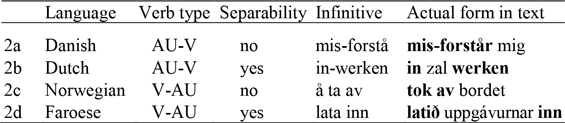
An adverbal unit may precede or follow its verbal host, as in 2a,b and 2c,d, respectively, and it may be separable or inseparable from its host, as in 2b,d and 2a,c, respectively. The crossing of these variables yields four logical options, all of which are attested in Germanic. The following examples are chosen from four different languages.
(2)

The points of interest in 2 are conveniently summarized in table 1 (for a similar classification using stress as a major criterion, see Braunmüller & Höder Reference Braunmüller and Höder2012). Following standard practice, hyphens mark morphological boundaries.
Complex verb types as a function of their separability by direct objects.

The infinitives in table 1 represent the four logical options as set out above. The adverbal unit precedes the verb in 2a,b but follows it in 2c,d. The verb mis-forstå ‘to misunderstand’ in 2a is inseparable, while in-werken ‘to break in’ in 2b is separable. Similarly, the verb å ta av ‘to clear’ in 2c cannot be split by a direct object, while lata inn ‘to turn in’ in 2d can.
The present study probes the possibilities of inserting material into complex verbs. This phenomenon is dubbed intercalation. My point of departure is the assumption that elements that belong together semantically are stored as units in the lexicon. That is, they have a unitary semantic representation. However, they have no unitary syntactic representation. The complex verb to tell off ‘to scold’ is one such example. When these idioms are embedded in real utterances, language users may choose between placing the nominal direct object (O) before or after the adverbal unit. These are two different constructions competing for selection. The term intercalation refers to splitting a complex verb by inserting material between the verb and adverbal unit, which creates a V-O-AU construction. This term does not imply that there is one basic syntactic structure from which the other is derived in a psycholinguistically meaningful sense.
The focus of this work is on comparing the possibilities of intercalation in AU-V and V-AU structures. The null hypothesis would be that intercalation is equiprobable in the two verb types. In fact, it might be argued that the constituent boundary is the same in AU-V and V-AU verbs in view of the fact that the only (or major) difference is one of word/morpheme order. How the order of superficially similar or identical constituents impacts the intercalation possibilities of complex verbs is the major issue to be addressed in this paper.
An alternative to the equiprobability hypothesis says that there is an asymmetry in the intercalation possibilities in AU-V and V-AU structures, such that one order is generally more receptive to intercalation than the other. This may be a language-specific or a language-independent preference. The nature of the complex verb to be intercalated also has to be taken into consideration: Certain (types of) complex verbs might favor one order over the other. In that case, it would be difficult to speak of a generally higher intercalation potential of either AU-V or V-AU. In such a case, one might rather argue for a more or less even distribution of intercalation possibilities across different (types of) complex verbs. A further potentially relevant factor is the mobility of lexical items. Different word classes have different degrees of mobility. For example, adverbs can be fitted more easily in various syntactic positions than members of other word classes. This versatility would make adverbs prime candidates for intercalation.
In any event, as intercalation involves breaking up syntactic elements that form a conceptual unit, it is reasonable to suppose that it has its limits. In particular, I assume that the size of the material being inserted into a complex verb matters: longer (heavier) words or phrases would be considered more disruptive and as such less preferred compared to shorter (lighter) words or phrases.
This raises the question of how to measure the size of intercalating material. This question may be answered from either a linear or a hierarchical perspective. Under the former approach, one counts the number of phrases, words, morphemes or syllables that can be inserted into a complex verb. This approach is motivated by the fact that phono-logical weight is known to exert a strong influence on a variety of ordering decisions (see, among others, Rosenbach Reference Rosenbach2005, Pintzuk & Taylor Reference Pintzuk and Taylor2006, Lohmann Reference Lohmann2014, Röthlisberger et al. Reference Röthlisberger, Grafmiller and Szmrecsanyi2017).
In contrast, under the latter approach, one examines the linguistic status of the intercalating material, that is, whether it is of a phrasal, lexical or morphological nature. For example, Stiebels & Wunderlich (Reference Stiebels and Wunderlich1994) distinguish between morphological and syntactic intercalation. The former refers to the insertion of bound material, whereas the latter refers to the insertion of free-standing units. It should be noted, however, that while this distinction is undoubtedly useful, it ignores the disparity between words and phrases, and is too coarse-grained to deal with the more subtle differences. In this paper, I adopt both the linear and the hierarchical approach and define the size of intercalating material in terms of its prosodic and syntactic weight.
This analysis allows one to derive more precise predictions than what Stiebels & Wunderlich’s (Reference Stiebels and Wunderlich1994) distinction can derive. The heavier a given string, the less likely it is to break up a complex verb. Furthermore, the position of such a string in the structural hierarchy is predicted to correlate with its ability to intercalate a complex verb: Syntactic units may be expected to be most disruptive, lexical units less disruptive, and morphological units least disruptive. It should be added that the boundaries between structural levels are not always clear-cut. Linguistic units are therefore more adequately conceived of in gradient terms. To be specific, a given element may be more or less syntactic relative to another element.
In this paper, the issue of intercalation is tackled from the cross-linguistic perspective, which affords a more comprehensive view than could be provided by the analysis of a single language. This perspective stands or falls on the comparability of complex verbs in Germanic. The working assumption here is that while there is room for between-language variation, the basic structural patterns are similar enough to warrant a crosslinguistic comparison. This approach allows one to test the hypothesis that all languages exhibit basically the same preferences and differ only in the extent to which they follow these preferences.
Before I proceed, it is necessary to get one complication out of the way. In addition to intercalation, in certain languages complex verbs may also undergo constituent reversal. This latter change only affects languages in which the nonfinite form of the complex verb—which I assume to be basic—has the AU-V order. The constituent reversal happens when the adverbal unit is morphologically part of the infinitival form, resulting in a change from nonfinite AU-V to finite V-AU. While intercalation and constituent reversal are independent syntactic processes, they tend to co-occur in certain verbs. If constituent reversal takes place, so does intercalation. In the absence of constituent reversal, there is no intercalation. Compare the Afrikaans examples in 3.
(3)

The complex verb af-skakel ‘to switch off’ is used in its nonfinite form in 3a but in its finite form in 3b. The noninverted AU-V order in 3a prohibits intercalation, whereas the inverted V-AU order in 3b requires intercalation by the object, as shown by the ungrammaticality of 3c. Even though these data from Afrikaans (and likewise from other West Germanic languages) appear to suggest a one-sided dependence of intercalation on constituent reversal, the two processes are basically independent of each other (see Berg Reference Berg2018a). This independence justifies my exclusive focus on intercalation.
This paper is organized as follows. The next section sets the stage for the intercalation analysis by surveying the typology of complex verbs in Germanic. Section 3 examines in some detail the intercalation possibilities in AU-V and V-AU structures and provides a comparison of those two intercalation sites. A theoretical account of the empirical results is outlined in section 4. The final section summarizes the principal ingredients of intercalation.
2. Survey of Structural Options in Germanic
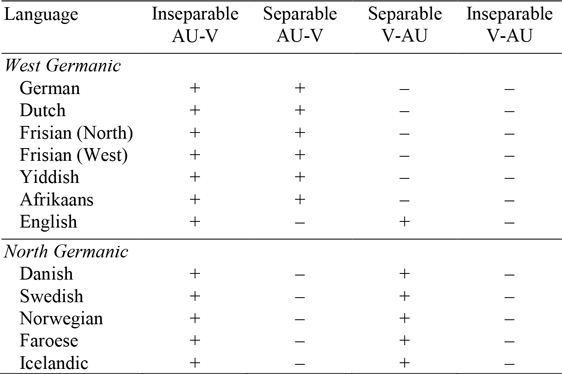
I begin this section with a survey of the structural options in the 12 Germanic languages under consideration (see next section for some background on language sampling). Table 2 reports which of the four verb types listed in table 1 are attested in each language. In the interest of comparing like with like, the focus of the table is on infinitives, which are generally regarded as the base forms. As shown in 3 above, some languages possess complex verbs whose constituent order is inverted when the nonfinite form turns finite (from AU-V to V-AU; see Dehé Reference Dehé2015 for a survey). This inverted order in finite forms should not be equated with the identical order in nonfinite forms because the theoretical status of finite and nonfinite forms is not the same. Note also that table 2 makes a categorical distinction between separable and inseparable verbs. That is, the type of intercalation is ignored for the moment.
Survey of AU-V and V-AU infinitives in Germanic.

As table 2 demonstrates, there is a good deal of consistency in the data. All Germanic languages possess inseparable AU-V verbs and lack inseparable V-AU verbs. This may be taken as a first indication of an asymmetry between the two orders. The AU-V order appears to be more resistant to intercalation than the V-AU order. Interestingly, the two separable verb types are in complementary distribution: If a language has separable AU-V verbs, it lacks separable V-AU verbs, and vice versa. That is, each language tolerates only one separable verb type. This complementary relationship corresponds to genealogy. With one exception to be discussed below, separable verbs respect the distinction between West and North Germanic: Whereas West Germanic languages have separable AU-V verbs, North Germanic languages lack them. Conversely, North Germanic languages have separable V-AU verbs, which are missing from West Germanic languages.
English is the oddball in this genealogical scheme. While belonging to the West Germanic branch, it patterns with the North Germanic languages.Footnote 1 The similarity goes even further. Both English and the North Germanic languages have verbal doublets, which are very close in meaning and distinguished only by the order of verb and adverbal unit, as exemplified in 4 from Danish.
(4)

Both examples in 4 are equally acceptable and largely synonymous, even though there might be some minor semantic and/or stylistic differences. In both cases, the inflected form preserves the order of the constituents of the infinitive, that is, under-skrive for 4a and skrive under for 4b. Unlike the other West Germanic languages, English also has such doublets (for example, to downplay versus to play down, to uphold versus to hold up) even though these are far less common than in languages such as Danish and Swedish. It can be seen, then, that alternative orders may be lexical-ized (stored as independent lexical items) in one and the same language.
Although the nature of this crosslinguistic patterning is not a major concern of the present paper, a few pertinent remarks may not come amiss. Note two powerful implicational relationships: First, as mentioned above, if a language possesses separable AU-V verbs, it lacks separable V-AU verbs (and vice versa). Second, if a language has inseparable AU-V verbs, it lacks inseparable V-AU verbs. It might be inferred from this distribution that there is a functional parallelism between the two alternative orders such that the occurrence of one renders the other superfluous. In this view, serial order is not basic, but (in some as yet unspecified sense) derived.
It is remarkable that separable and inseparable verbs have a very different theoretical status. The occurrence of a separable complex verb with a particular order allows for no crosslinguistic prediction as to the occurrence of its inseparable counterpart. This independence is consistent with the claim that separable and inseparable verbs are functionally disparate. The relationship between the two types of verbs as well as between separability and order is a complex one. While separability and order are functionally distinct notions, separability is associated with changes in morpheme/word order: When the constituents of a separable complex verb become separated, their order is altered (for example, V-AU becomes AU-V).
To conclude, the Germanic languages are homogeneous enough in terms of their complex verb types to warrant a crosslinguistic study. While there are appreciable differences between North and West Germanic (barring English), all Germanic languages possess both AU-V and V-AU verb forms (finite or nonfinite). This is, of course, the prerequisite for comparing the two intercalation sites across languages.
3. Assessing the Intercalation Potential of Complex Verbs
Let me begin this section by spelling out the general logic of the argument. A prosodically light element does not cause significant disruption and requires little force to split a complex verb. Therefore, such an element can be inserted into relatively cohesive complex verbs, with low intercalation potential. In contrast, a prosodically heavy element causes a more severe disruption and requires more force to induce a split. Therefore, such an element can only be inserted into relatively incohesive verbs, with high intercalation potential.
It should be stressed that prosodically light elements are not informative as to how cohesive a particular complex verb is because such elements can be inserted into both cohesive and incohesive complex verbs. In contrast, prosodically heavy elements can only be inserted into incohesive complex verbs and, as such, can be used to determine cohesiveness. To put it differently, cases of mild disruption cannot be used to argue that complex verbs are (in)cohesive in nature. How cohesive these verbs really are can only be decided on the basis of more disruptive cases.
Before moving to the analysis, a few comments on the selection of languages are in order. The sample was compiled based on the following criteria. First, standard languages rather than dialects were selected. Second, only living languages were considered. This criterion led to the exclusion of Gothic even though this language also had separable and inseparable complex verbs (Wright Reference Wright1954:179). Finally, an effort was made to cover a maximum of the structural options allowed in Germanic. When relevant contrasts were found between dialects of the same language, these dialects were treated as separate languages. This decision led to the inclusion of both West and North Frisian and thus to a rather loose sense in which the term language is used. At the same time, Nynorsk and Bokmål were subsumed under Norwegian because complex verbs apparently behave alike in these two languages.
This section is divided into three parts. The intercalation potential of AU-V verbs is examined in section 3.1, that of V-AU verbs in section 3.2. The final section provides a summary of the main results and a comparison of the two intercalation sites.
3.1. The Intercalation Potential of AU-V Verbs
The following analysis proceeds from lighter to heavier intercalating material and hence begins with morphology. Arguably the lightest type of intercalating material is the past participle (p.p.) marker ge in the West Germanic languages Dutch, Afrikaans, German, and Yiddish, as in 5.Footnote 2
(5)

The languages documented in 5 behave alike in that ge is inserted between the adverbal unit and the verb. As an unstressed monosyllabic morpheme, it alters the rhythmic structure of the word only minimally. The lightness of ge allows one to argue that only a limited intercalation potential and thus a high degree of cohesiveness on the part of the complex verb is required to generate past participle forms. Thus, the past participle test furnishes evidence of a susceptibility to intercalation at the high end of the cohesiveness scale.
Neither of the other West Germanic languages (that is, English and Frisian) nor any of the North Germanic languages have such a past participle marker. Therefore, the past participle test does not apply. That is to say, the test does not provide information about the degree of cohesiveness of AU-V verbs in these languages.
Infinitival linking elements represent the second type of material that may break up AU-V verbs. While infinitival linking elements are typically regarded as morphological intercalators, they are more syntactic than the past participle marker in so far as they show a moderate syntactic independence. For example, they can be separated from the verb by the negation particle in English (as in to not believe). The same argument can be made from the phonological perspective: Infinitival linkers tend to have full vowels, while past participle markers have reduced vowels.
Infinitival linkers break up the infinitival forms of complex verbs not only in those languages that require the split of past participles but also in Frisian (Tiersma Reference Tiersma1999:100), as shown in 6.
(6)

The infinitive is obligatorily broken up by the linking element in West Frisian in 6a, German in 6b, and Yiddish in 6c. The same holds for Dutch and Afrikaans. Whether the infinitival form of a complex verb is written separately (as in Frisian) or together (as in German) is a language-specific convention of limited theoretical significance. However, it may be viewed as ancillary evidence for the elevated autonomy of the infinitival linker compared to the past participle marker.
All Germanic languages possess linking elements for infinitival complements. However, languages differ over the placement of these elements. While almost all of the West Germanic languages require infinitival linkers to occur inside complex verbs, the North Germanic languages categorically rule out this option. Again, English is the exception to the rule in that it patterns with the North Germanic languages.
Due to their ubiquity in Germanic, infinitival linkers serve as a general test case for determining the cohesiveness of AU-V verbs. For all languages that ban intercalation of infinitival forms of AU-V verbs by an infinitival linker, the intercalation potential of those verbs is claimed to be zero. For all languages that require such intercalation, the intercalation potential of AU-V verbs may be rated slightly higher than the potential of AU-V verbs broken up by the past participle marker. However, this potential is still rather minor because the degree of disruption caused by the infinitival linker is relatively low.
The third type of element that can break up a complex verb includes adpositions in North Frisian. The origin of such adpositions is a complex adverb consisting of a locational adverb and a postposition, which functions as a preposition elsewhere. For example, the preposition üüb ‘on’ combines with the adverb diar ‘there’ to form a complex pronominal adverb diar-üüb ‘thereupon’. When used with AU-V verbs, this complex pronominal adverb is almost always split, and the adposition üüb is inserted between the verb and the adverbal unit, as shown in 7 (part=particle).
(7)

The AU-V verb am-treble lit. ‘to tread around’ is broken up by the adposition üüb ‘on’. It is clear that the verb governs the adposition (one treads on something), but it is equally clear that the adposition is external to the complex verb. Almost all of the adpositions in Hoekstra’s (Reference Hoekstra2006) data are monosyllabic. Their disruptive effect may therefore be rated rather low. This type of intercalation is found in no other Germanic language.Footnote 3
Complex verbs can also be interrupted by other verbs. On the assumption that verbs have a higher degree of syntacticity than other word classes (Berg Reference Berg1998), this type of intercalating material may be regarded as more syntactic than the North Frisian adpositions. There are two Germanic languages, namely, Dutch and Afrikaans, that allow insertion of auxiliaries and modal verbs into AU-V complexes. Two pertinent examples follow.
(8)

Case 8a documents the insertion of the auxiliary hebben ‘to have’, while 8b shows the insertion of the modal verb wil ‘to want to’. Note in passing that the verb opbellen ‘to ring up’ in 8a accommodates both the auxiliary heeft ‘has’ and the past participle marker ge. Note also that, as in the North Frisian case above, intercalation by a verb is optional. For instance, the auxiliary heeft ‘has’ in 8a may precede or follow the past participle in Dutch. This optionality is in stark contrast to the compulsory nature of intercalation by past participle markers and infinitival linkers. Clearly, intercalation by verbs is different from morphological intercalation.
Dutch and West Frisian, but not Afrikaans, also permit intercalation by lexical verbs. A prototypical property of lexical verbs is that, unlike many auxiliaries and modal verbs, they require a linking element in the case of nonfinite complementation. This linking element is of course the infinitival marker previously discussed. It is a remarkable fact that the linking element is inserted into the AU-V structure, along with a finite verb. In this case, two almost independently manipulable elements are inserted into a complex verb. Thus, the intercalating material is clearly of a syntactic, though not of a phrasal nature. Consider 9.
(9)

In 9a, the complex verb op-bellen ‘to ring up’ is split by the inflected verb probeert ‘tries’ and the infinitival linker te. Similarly, in 9b the complex verb op-fallen ‘to stand out’ is split by the inflected verb doar ‘dares’ and the infinitival linker te. The unstressed nature of te allows one to argue that the two intruders form a prosodic unit. To put it loosely, the adverbal unit and the verb are separated by one and a half words. Note that the close association between the intercalating verb and the infinitival linker does not directly explain why the two break up the complex verb in tandem. The theoretical alternative to prohibiting the split of AU-V verbs by two words is certainly available.
I return finally to North Frisian, which permits intercalation not only by adpositions but also by PPs, as shown in 10.
(10)

In 10, the complex past participle ütj-stäänen ‘stood’ (lit. ‘out-stood’) is split by the PP auer di ‘over you’. The two constituents of the PP are certainly more independent of one another than the verb and the infinitival linker in 9. Moreover, the PP is phrasal, while the verb and the infinitival linker are not. Therefore, the inserted material is more syntactic in nature in North Frisian than in Dutch and West Frisian. The PP is the heaviest unit that can be inserted into AU-V verbs. However, two qualifications should be entered at this point. Hoekstra (Reference Hoekstra2006) comments that all PPs that wind up inside complex verbs have a pronominal complement, which renders the PP less heavy. Further, splits by PPs occur less frequently than splits by adpositions in his data. Note also that North Frisian is the only Germanic language to allow intercalation by PPs. Thus, there are good grounds to argue that PP insertion is a highly exceptional case that marks the upper bounds of intercalation in terms of the syntactic weight of intervening material.
It may be concluded that the possibilities of intercalation are severely restricted in AU-V complexes. Only relatively light material is eligible for insertion into those verbs. All languages that permit intercalation permit “light” intercalation; insertion of somewhat heavier material is only allowed in a small number of languages. Relatively heavy or phrasal material can only be inserted in a single language. There is some crosslinguistic variation to be observed. Complex verbs in Dutch, Afrikaans, and Frisian are more tolerant of intercalation than their counterparts in German, which in turn are more tolerant of intercalation than English and North Germanic complex verbs.
3.2. The Intercalation Potential of V-AU Verbs
On the face of it, it would seem that the analysis of V-AU patterns is hampered by the fact that this verb type is absent from most West Germanic languages (see table 2). Fortunately for me, these languages require a reversal of the constituents of complex verbs in certain syntactic contexts (see above). For example, an infinitive with AU-V order may give rise to an inflected form with V-AU order. Hence, all Germanic languages can be subjected to the analysis below, even though the derivational history of the V-AU surface strings is not uniform.
I begin with arguments of verbs, that is, direct object NPs or NPs preceded by particles (prepositional objects). Separable V-AU structures are asymmetrically distributed in Germanic. With the exception of English, they are absent from the West Germanic languages. By contrast, with the exception of Swedish, they are present in the North Germanic languages. I am not particularly concerned with the distinction between nominal and pronominal objects, which has an effect on word order in many, though not in all languages: All those languages that permit intercalation by nouns also permit intercalation by pronouns.
Of course, NPs can be of variable size. The task is therefore to determine whether there is an interaction between intercalation and NP weight. Is there an upper limit on the size of the NP to be inserted, that is, a point beyond which intercalation is ungrammatical? English provides a useful starting point because one and the same verb may allow, but not require, intercalation. The sample sentences in 11 illustrate this variability.
(11)

The same object NP follows the V-AU verb in 11a but breaks it up in 11b. These two cases are equally acceptable. In contrast, 11c is more marginal as the insertion of the heavy object creates a large distance between the verb and the adverbal unit. Yet, even though such a large distance may be felt to be less than felicitous, there is no question of grammaticality.
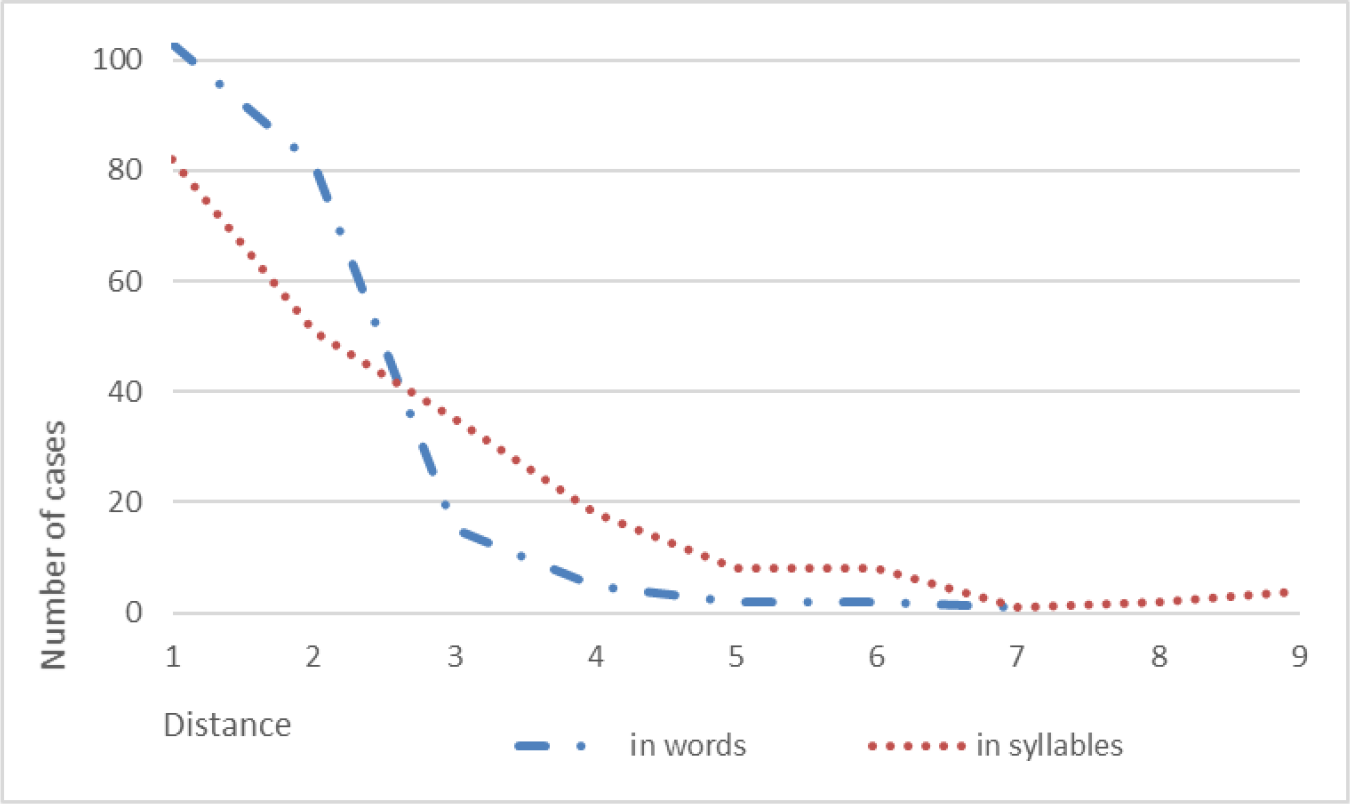
Gries (Reference Gries2003) analyzed quantitatively the distance between the verb and the adverbal unit in a corpus of English complex verbs, both in terms of number of words and number of syllables. His results are reproduced below. Strictly speaking, it is inappropriate to plot both length in words and length in syllables on the same x-axis. However, since I have no intention of comparing the results of the two counts, there is no harm in using this economical design.
Distance between verb and adverbal unit in English complex verbs (Gries Reference Gries2003:84).

Figure 1 shows that the inserted material can be quite heavy and that there does not seem to be a categorical ban on intercalation beyond a particular size. However, it is also obvious from figure 1 that the rate of intercalated examples decreases monotonically with increasing distance between the verb and the adverbal unit (see also Chen 1986:86 and Lohse et al. 2004:243). This finding goes hand in hand with acceptability judgments of native speakers.
The optional nature of intercalation in English provides a welcome opportunity to compare the size of NPs inside and outside V-AU structures. Gries (Reference Gries2003) reports that inserted NPs are significantly shorter than NPs following complex verbs. This important result shows that the weight of NPs is an inhibitory factor in intercalation. The disparate average sizes of NPs inside and outside complex verbs allow one to argue that the intercalated structure has a lower baseline probability of occurrence than the nonintercalated one.Footnote 4 It follows from this that as a general principle, intercalation is a dispreferred option.
As noted at the beginning of this subsection, the other West Germanic languages also display V-AU order resulting from the reversal of the constituents of AU-V verbs. Unlike the case of English discussed above, intercalation combined with reversal is compulsory in the other West Germanic languages. That is, no matter how complex the object NP is, it must split the complex verb. An Afrikaans example of such a split was given in 3b. An extreme case from German is provided in 12.
(12)

Sentence 12 is fully grammatical even though there is a seemingly endless string of words separating the verb from the adverbal unit, which has a dangling feel to it. Notably, German has no way of placing the adverbal unit closer to the verb (unless the intervening material is dropped). This shows that intercalation is quite powerful and that V-AU structures subject to reversal are very fragile units.
The North Germanic languages are heterogeneous with respect to what arguments may break up V-AU verbs. Three sets of languages can be distinguished. Faroese, Icelandic, and Norwegian are like English in allowing one and the same verb to enter into intercalated and nonintercalated constructions. The other two sets are more restrictive. The second set is represented by Danish, which requires intercalation if any NP is present, be it nominal or pronominal. Swedish represents the third set. It is the mirror image of Danish in that it rules out intercalation categorically.Footnote 5 The fact that intercalation is required or permitted in 4 of the 5 languages allows one to argue that V-AU complexes in North Germanic are in general tolerant of intercalation.
The syntactic variability observed in Norwegian, Faroese, and Icelandic provides an opportunity to compare English to North Germanic. The guiding question is whether the behavior of English verbs with respect to intercalation resembles that of North Germanic verbs. The choice fell on Norwegian. An analysis was conducted of all forms of the transitive verbs kaste ut ‘to throw out’, sette ned ‘to reduce’, and slippe ut ‘to release’ on the basis of the Oslo Corpus of Tagged Norwegian Texts (Oslo korposet av taggede norske texter). The following five files, all from Norwegian newspapers, were selected: AV/Ad96/01, AV/Af 94/01, AV/Af96/01, AV/BT94/01 and AV/BT95/01. These comprised 2,479,928 orthographic words in total. The hits were classified according to the distance between the verb and the adverbal unit. To facilitate comparison with Gries Reference Gries2003, distance was measured in number of words rather than morphemes and ranged from zero (no intercalation) to one or more words. The intercalated constructions were categorized according to the type of intervening material, in particular, whether it was a nominal object, a pronominal object or an adverbial. Cases of intercalation by subjects (following inversion) were discarded. The focus was on nominal objects because these cases can be most directly compared to Gries’s (Reference Gries2003) data for English.
After extensive data cleansing, 93 verb tokens remained, of which 82 had the object outside of the complex verb following the adverbal unit, and 11 had the object inside the complex verb. This is quite a lopsided distribution. Intercalation turns out to be a strongly disfavored option (in agreement with Aa 2015:81). One of the 11 intercalated verbs had a first name and a family name as the direct object. Since it is not entirely clear whether the full name should be counted as one word or two, it was left out of the analysis. Two pertinent Norwegian examples follow.
(13)

Both examples in 13 show the present perfect of the infinitive sette ned ‘to reduce’. While the direct object rente ‘interest rate’ follows the complex verb in 13a, the compound noun hotellmoms ‘VAT for hotels’ breaks it up.
In the 82 nonintercalated cases, the average length of the direct objects was 1.45 words. In contrast, in all of the 10 intercalated cases, the verb and the adverbal unit were separated by a single word. This difference does not reach standard levels of significance: t(90)=1.55, p=0.125. However, a closer look at the data reveals a lexical bias. As many as 34 of the 92 items involved rente ‘interest rate’ as the direct object. This is almost certainly a text-specific effect, and those examples should be eliminated. A recalculation without these 34 items increased the difference in length between the direct objects in intercalated versus nonintercalated cases considerably. In the nonintercalated cases, the average length of direct objects was now 2.74 words. This difference is statistically significant: t(56)=2.2, p=0.03.Footnote 6 It may therefore be concluded that length is a relevant factor in the placement of the direct object. The longer the object, the more likely it is to follow the complex verb. In Norwegian in particular, the pattern appears quite restrictive: Only single-word objects have the potential to break up a complex verb. Whether this generalization holds in a larger database remains to be seen.
A comparison of Norwegian and English brings forth two notable commonalities and one notable difference. The complex verbs in the two languages agree in displaying a sensitivity to length as well as a dispreference for intercalation. At the same time, the two languages vary in the strength of this dispreference. Norwegian rejects intercalation more vigorously than English does. While a single-word object marks the upper bounds of intercalation in Norwegian, English is much more liberal in allowing heavy material to split its complex verbs (see figure 1).
I now proceed to an analysis of intercalation by adverbials. Beginning again with English, observe that adverbs and arguments are in complementary distribution in so-called prepositional and phrasal verbs. Verbs that allow the insertion of object NPs disallow the insertion of adverbs and vice versa. The two acceptable options are given in 14a and 15a, and the two unacceptable ones in 14b and 15b. The complementary distribution of adverbs and objects implies that both cannot break up a complex verb at the same time, as shown in 15c,d.
(14)

(15)

Of course, the ungrammaticality of 15c,d is unsurprising. If an adverb cannot occur inside a complex verb, as can be seen in 15b, it is almost guaranteed that additional intervening material will not make the sentence grammatical. The ill-formedness of 15c,d is not a simple function of weight. In much the same way as the object NP may consist of more than one word, the adverb within the complex verb may be modified by another adverb, as exemplified in 16.Footnote 7
(16)

To conclude, so-called phrasal verbs are subject to a one-phrase constraint. Simultaneous insertion of two phrases (ADVP + NP) is not tolerated. However, single phrases may be inserted largely irrespective of their complexity. Moreover, the complementary distribution of adverbs and objects suggests that the cohesiveness of V-AU structures is not particularly strong, and that the resistance to intercalation can be rather easily overcome one way or the other. The one-phrase constraint matters more than which type of phrase is inserted.
Next, I turn to North Germanic. Like English complex verbs, their Faroese counterparts appear to be subject to the one-phrase constraint. When the verb and the adverbal unit are separated by a direct object, an additional insertion of an adverbial is ruled out (as in the English examples in 15c,d). The case of Swedish is particularly instructive. Recall that Swedish is the language most resistant to intercalation. However, this resistance is not absolute. In contrast to what was observed for arguments, adverbs do occur inside V-AU structures, as illustrated in 17. In 17a, the complex verb ringa upp ‘to ring up’ is split by the adverb sällen ‘rarely’. It is even possible to insert complex ADVPs into V-AU structures: 17b shows intercalation of the complex verb ringa upp ‘to ring up’ by the ADVP ganska sällen ‘rather rarely’.
(17)

Swedish may thus be argued to also adhere to the one-phrase constraint and thereby to lose some of its exceptionality within North Germanic.
Norwegian goes a little further. Direct objects inside complex verbs may be accompanied by adverbials, as can be seen in 18.
(18)

The V-AU verb å kaste ut ‘to throw out’ is doubly broken up by the direct object bråkmakeren ‘the troublemaker’ and the manner adverbial på hodet ‘forcefully’. However, these cases are uncommon and in general sound less natural than intercalations involving a single element. Thus, they may be approaching the limits of acceptability. It may be tentatively inferred that Norwegian makes only a modest attempt to go beyond the one-phrase constraint.
Icelandic goes further than the aforementioned North Germanic languages in allowing two syntactic phrases inside complex verbs. Consider 19.
(19)

In 19a, the complex verb taka upp ‘to lift’ undergoes intercalation by both the direct object pakkan ‘the parcel’ and the adverb varlega ‘carefully’. The adverb varlega ‘carefully’ may be modified by the intensifier mjög ‘very’ and still be placed inside the complex verb, as shown in 19b. This latter option leaves no doubt that V-AU verbs in Icelandic can be intercalated by two syntactic phrases simultaneously. Note that this conclusion holds independently of the meaning of the complex verb. The verb taka upp has the literal reading ‘to lift’ and the idiomatic reading ‘to open’. Both readings are compatible with intercalation by two phrases at the same time. In other words, the idiomatic reading does not prohibit this type of intercalation.
Danish differs somewhat from Icelandic in having grammaticalized (obligatory) intercalation by direct objects (see 4b above). It is thus faced with the alternative of either prohibiting adverbial intercalation and thereby abiding by the one-phrase constraint, or permitting adverbial intercalation and thereby ignoring the one-phrase constraint. As a matter of fact, Danish goes for the latter option, as illustrated in 20, which expands example 4b.
(20)

All three ordering variants in 20 are grammatically acceptable. Cases 20a,b show that Danish has no problem accommodating an NP and an ADVP inside a V-AU structure. However, the heaviness of the inserted material makes itself felt at this point. The lighter type of intercalation in 20c is generally preferred to 20a,b.
To conclude, there is a relatively high degree of consistency among the languages possessing V-AU structures. All these languages permit intercalation by single phrases of varying length. As the case of Icelandic shows, it is even possible to have two phrases inside complex verbs. However, this is the exception rather than the rule. This result constitutes strong evidence for the constrained nature of intercalation. Further evidence comes from the larger average size of phrases outside V-AU structures compared to the average size of phrases inside V-AU structures. The constraints on the size of a single phrase splitting V-AU verbs vary from language to language. They are weaker in English than in Norwegian. While bulky material does not lend itself well to being inserted into a V-AU structure, this does not necessarily lead to ungrammaticality. Finally, in several languages there is a notable complementarity between different syntactic elements as potential intercalators. When one type of phrase is eligible, the other is not. This may be interpreted as additional evidence for the constrained nature of intercalation.
3.3. Comparing the Intercalation Potential of AU-V and V-AU Verbs
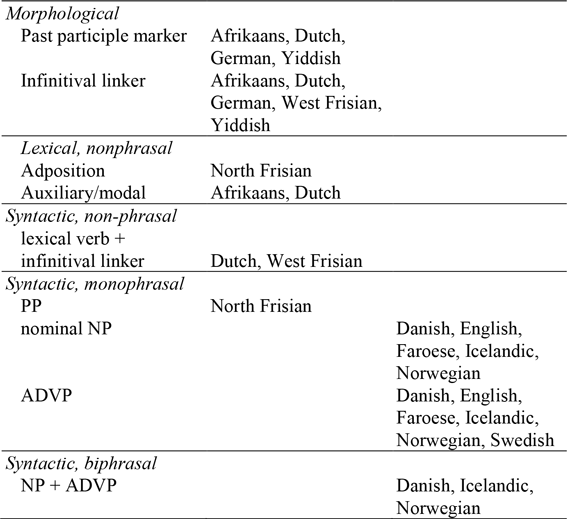
The ensuing comparison is preceded by a summary of the main results. Like table 2, table 3 focuses on the constituent order of infinitives and leaves intercalation following constituent reversal out of consideration.
There are both qualitative and quantitative differences in the intercalation potential of V-AU and AU-V verbs. Let me begin with a simple count of the languages that permit intercalation in the two verb types. Of all languages with AU-V verbs, 50% (6 out of 12) allow morphological intercalation and 17% (2 out of 12) allow intercalation by lexical verbs plus their linking elements. By contrast, of all languages with V-AU verbs, 100% (6 out of 6) allow intercalation by entire phrases. This is the first piece of evidence in support of the alternative hypothesis formulated in section 1, namely, that one order is more tolerant of intercalation than the other. More specifically, these results show that V-AU verbs are more tolerant of intercalation than AU-V verbs.
Next, I counted the number of words that may be inserted into complex verbs across languages. Whereas the maximum number of words inside AU-V structures is two, the maximum number of words inside V-AU structures is much higher. Arguably, English has no clearly defined upper limit in the V-AU type. Even so, intercalating material in excess of six words has an extremely low probability of occurrence. This is the second piece of evidence in support of the alternative hypothesis. More specifically, these results show that V-AU structures are more tolerant of intercalation than AU-V structures. This is true regardless of whether V-AU represents the order of the infinitive or results from a reversal of the adverbal unit and the verb.
Survey of intercalation types in Germanic.

The third quantitative analysis compares the number of phrases in both verb types. It is useful to distinguish between the typical and the extreme cases. Typically, AU-V verbs prohibit intercalation by phrasal material, while V-AU verbs permit intercalation by single phrases. A focus on the upper limits of intercalation in Germanic reveals a similar distribution. While the maximum number of intercalating phrases in AU-V structures is one, the maximum number of intercalating phrases in V-AU structures is two. This is additional evidence in favor of the alternative hypothesis; more specifically, that the intercalation potential is higher in V-AU than in AU-V verbs.
The qualitative comparison confirms this conclusion. The analysis in the preceding subsections uncovered five different types of intercalation, based on the type of intercalating material: morphological, lexical, syntactic nonphrasal, monophrasal, and biphrasal. The five types of intercalating material form a natural cline, from less weighty at the bottom to more weighty at the top. The higher the position of a given intercalating element in the structural hierarchy, the greater its average weight. From the qualitative perspective, there is a major difference between the two types of complex verbs. Whereas AU-V structures generally have their cut-off point below the phrasal level, V-AU structures allow various phrasal types of intercalation, somewhat irrespective of their syntactic complexity. Thus, V-AU verbs accommodate structurally heavier material much more readily than AU-V verbs do.
On all counts, V-AU verbs have a considerably greater intercalation potential than do AU-V verbs. This is true of all Germanic languages without exception. Note, however, that this conclusion is based on a between-language, not a within-language comparison. As no Germanic language has separable V-AU as well as separable AU-V structures, a within-language comparison is ruled out. The next section develops an explanation of the differential susceptibility of AU-V and V-AU verbs to intercalation.
4. Theoretical Discussion
The major result outlined in the previous section is that AU-V verbs have a more restricted intercalation potential than V-AU verbs. This contrast suggests that AU-V verbs are more tightly structured, while V-AU verbs are more loosely structured. To put it differently, the cohesiveness of AU-V verbs is higher than that of V-AU verbs. The higher the degree of cohesiveness, the more strongly intercalation is discouraged, hence only limited intercalation in AU-V structures.
To understand why the adverbal unit and the verb are more tightly integrated in AU-V than in V-AU complexes, it is helpful to examine some properties of the two constituents. Verbs are open-class words with rather specific lexical meanings and a high degree of autonomy. By contrast, prototypical adverbal units belong to the set of closed-class items, which tend to have a more abstract, schematic meaning and a lower degree of autonomy. In a word, they are more grammatical (in a framework that conceives of lexicalness and grammaticalness as endpoints on a continuum).
When a lexical and a grammatical item form a semantic unit, they become dependent on one another for their interpretation. As this interdependency increases, so does the idiomaticity of the semantic unit in question. Crucially, however, this relationship between the lexical and the grammatical item is still an asymmetrical one: The latter tend to be more dependent on the former for its interpretation than vice versa. This principle applies in the case of complex verbs: Given their generally noncompositional nature, there is semantic interdependency between the verb and the adverbal unit. Yet, as grammatical elements with relatively opaque meaning and relatively limited autonomy, adverbal units are more dependent on the verb than vice versa.
However, this asymmetric interdependency between the two elements still does not explain why the adverbal unit and the verb are more tightly integrated in AU-V than in V-AU complexes. To answer this question, let me consider the psycholinguistic implications of the semantic interdependency between verbs and adverbal units. I assume that the structural asymmetry between the verb and the adverbal unit—that is, their lexical versus grammatical status—implies a processing asymmetry that mirrors the semantic relationship described above: The verb and the adverbal unit are dependent on one another for their processing; yet, generally speaking, the processing of verbs depends less on that of adverbal units than the processing of adverbal units depends on that of verbs. I propose that this processing interdependency requires that the two constituents be processed in the same time frame. For this to happen, they need to be activated at the same time. This leads one to the notion of coactivation, that is, the process whereby two (or more) units are simultaneously activated.Footnote 8 By implication, the activation level of adverbal units at the moment of verb processing is generally lower than the activation level of verbs at the moment of adverbal unit processing, regardless of their relative order.
Importantly, the order of the verb and the adverbal unit affects the degree to which the two elements must be coactivated. If the adverbal unit follows the verb, its activation level may be relatively low at the moment the verb is activated, because the verb determines the interpretation of the adverbal unit (more than the other way around). Hence, the degree of coactivation may be relatively low. If, however, the adverbal unit precedes the verb, the activation level of the verb must be high at the moment the adverbal unit is activated. Hence, the degree of coactivation must be quite high.
I argue that coactivation determines the cohesiveness of complex linguistic units. If the two components of a higher-order unit must be strongly coactivated—as in the case of AU-V verbs—they stick tightly together, and so the complex unit tends to behave like a simple unit. In contrast, if the two components of a higher-order unit may be weakly coactivated—as in the case of V-AU verbs—they preserve some of their autonomy, and so the complex unit is not very cohesive.Footnote 9
It is worthwhile stressing that the notion of coactivation allows one to conceive of cohesiveness in gradient terms: Cohesiveness is a gradient notion whether it is used to compare AU-V versus V-AU structures or individual complex verbs within each group. The difference in cohesive-ness between AU-V and V-AU structures is every bit as gradient as the difference in the cohesiveness between different AU-V verbs (or V-AU verbs, for that matter). Moreover, V-AU and AU-V structures may vary in their cohesiveness from language to language (as in the case of English and Norwegian V-AU structures).
Thus, the notion of coactivation is capable of explaining both the similarities and the differences between AU-V and V-AU structures. On the one hand, owing to the more or less idiomatic nature of complex verbs, there is considerable coactivation in the case of adverbal units and verbs, regardless of the order of the two constituents. This leads one to expect intercalation to be a dispreferred option overall, and so it is. On the other hand, the degree of coactivation varies with verb type: As argued above, AU-V verbs show a higher degree of coactivation than V-AU verbs.
A major theoretical claim of the present paper is that differences in intercalation potential derive from various degrees of cohesiveness. The greater the cohesiveness, the lower the intercalation potential. Because AU-V verbs tend to be rather cohesive, their intercalation potential is limited. Conversely, because V-AU verbs are generally rather incohesive, their intercalation potential is higher than that of AU-V verbs. Since the theory that underpins the proposed explanation is a psycholinguistic one, which relies on language-independent processing principles, it has the potential to account for the behavior of complex verbs not just in a single language but in Germanic generally. Consistent with this proposal, not a single Germanic language permits more intercalation in AU-V than in V-AU structures.
It might be objected that cohesiveness cannot serve as an explanation of intercalation potential because of an incompatibility of these two concepts. While cohesiveness and intercalation both pertain to the relationship between two syntagmatic elements, cohesiveness is a gradient notion that has psycholinguistic implications, as stated above. By contrast, intercalation has to do with categorical syntactic patterns, typically described in terms of rules that apply to classes of lexical items (for example, transitive verbs). This purported mismatch would seem to make cohesiveness an inappropriate means of capturing intercalation.
However, this incompatibility is more apparent than real. On closer inspection, the phenomenon of intercalation is not as categorical as it may seem, in the sense that it may not be captured by a set of rules that uniformly apply to a particular class of verbs. Despite a plethora of studies of complex verbs, surprisingly little is known about them at a microstructural level. For example, there is no solid evidence for the view that V-AU verbs form a homogeneous group that would be subject to the same set of rules. On the contrary, there is some evidence that the (in)separability of complex verbs is to some extent idiosyncratic in nature. Compare the three English verbs to lay down ‘to state officially’, to boss about ‘to give orders’, and to let off steam (examples from Fraser 1976:19). The verb to lay down may be broken up, to boss about must be broken up, and to let off steam may not be broken up. It is not immediately obvious why this should be the case. Separability is not just a property of individual verbs. Even one and the same verb may behave differently on different uses. Contrast 21 and 22 from English.
(21)

(22)

The contrast between 21 and 22 reveals that separability is not determined by the individual verb as such but rather by the idiomaticity of the different senses of the same verb form. The literal use of to brush up in 21 is compatible with both orders, whereas the metaphoric use of to brush up in 22 prohibits intercalation. Idiomaticity is a verb-specific factor (Dirven 2001:5), which is known, among other variables, to reduce the likelihood of intercalation (for instance, Fraser Reference Fraser1976, Gries Reference Gries2003, Farrell Reference Farrell2005). In other words, idiomaticity is one factor that increases the cohesiveness of complex verbs. Thus, what at first sight looks like a weakness of the gradient approach—that is, the seeming incompatibility of cohesiveness and intercalation—turns out, on closer inspection, to be its major advantage.
Yet the psycholinguistic account does face some challenges. In particular, while it does a good job dealing with both the quantitative and the qualitative differences between the intercalation possibilities in V-AU and AU-V verbs, it cannot fully explain why objects rather than other elements are preferred as intercalators. It is true that if heavier material can be processed inside V-AU structures, this creates favorable conditions for intercalation by objects, which can be of various sizes. However, this alone cannot account for objects as a preferred type of intercalating material. A further factor that contributes to intercalation by objects is what may be dubbed the adjacency constraint. The languages with separable V-AU verbs are all SVO languages, which means that the object is adjacent to the verb. Hawkins’s (2004) Minimize Domains Principle suggests that adjacent elements should be primary candidates for splitting complex structures. This means that in an SVO language, the object would likely be used as the intercalating element. Thus, the adjacency constraint facilitates intercalation by direct objects.
The same analysis applies to intercalation by adpositions in North Frisian AU-V structures. The noninverted version of 7, repeated here as 23a, is given in 23b. Remarkably, the variant in 23c, where the pronominal adverb diarüüb ‘thereupon’ is not split, is almost ungrammatical (Jarich Hoekstra, pers. commun.). Thus, this type of intercalation is also subject to the adjacency constraint.
(23)

In general, the limited intercalation potential of AU-V verbs places severe constraints on the set of possible intercalating candidates. Thus, the best candidates are prosodically the lightest, which accounts for morphological intercalation. The insertion of adpositions and verbs—auxiliaries and modals, as well as lexical verbs—can be accounted for in terms of the same adjacency principle discussed above. Almost all of the languages with separable AU-V verbs have SVO and SOV order in main and in subordinate clauses, respectively.Footnote 10 With the inflected verb at the end of the subordinate clause and adjacent to the complex verb, one can account for intercalation by auxiliaries and modals as the only obligatory elements to follow the complex verb. The same explanation holds for intercalation by lexical verbs: Such cases are uncommon because they reach the limits of the intercalation potential of AU-V structures.
The crosslinguistic data reveal a notable interaction of weight and optionality. The heavier the weight of the intercalator, the higher the probability of optional intercalation. Inversely, the lighter the inter-calator, the higher the probability of compulsory intercalation. This relationship is strongest in morphological intercalation, which is gram-maticalized in all languages. At the other end of the scale, bulky material—such as PPs inside AU-V verbs and two phrases inside V-AU verbs—are possible, but never required by the grammar of a given language. The logic behind this interaction of weight and optionality is not difficult to see. With intercalation putting a strain on listeners’ decoding skills, it is understandable that the tolerance toward this phenomenon diminishes with increasing disruptiveness of the inter-calating material. It is likely that this perceptual constraint can work its way into the grammar of languages. In this view, grammars avoid or discourage structures that are difficult to process. In fact, there is ample support for this important hypothesis (for example, Hawkins Reference Hawkins1994, McDaniel et al. Reference McDaniel, McKee, Cowart and Garrett2015, Futrell et al. Reference Futrell, Mahowald and Gibson2015). From this processing angle, optionality may be understood as a compromise between the perceptual difficulty caused by intercalation and the factors that bring about inter-calation in the first place.
It is noteworthy that the North Germanic languages and English do not allow any kind of intercalation whatsoever in AU-V structures, while they do permit intercalation in V-AU structures. Is it reasonable to postulate a relationship between the two types of structures such that the rigidity of one is compensated for by the flexibility of the other? This does not seem likely. In the first place, the relevant languages do not all behave alike. As mentioned before, Swedish is less tolerant of inter-calation in V-AU verbs than the other languages, but, in conformity with the other languages, does not allow the split of AU-V verbs. In the second place, the nature of the intercalating material is too disparate to sustain a compensatory relationship. AU-V verbs preferably accept morphological intercalation, whereas V-AU verbs always go for syntactic intercalation. Hence, there is little support for the hypothesis that the incohesiveness of V-AU structures is causally linked to the cohesiveness of AU-V structures.
Finally, one challenge remains to be met. I have argued that AU-V and V-AU verbs display varying degrees of cohesiveness. This could lead one to hypothesize that the degree of cohesiveness of one verb type is linked to that of the other and that the two verb types can therefore be located at different points on the same continuum. This arrangement assumes the nonindependence of AU-V and V-AU verbs. A remarkable implicational hierarchy arises from this proposal. If a given language allows more disruptive material in one of the two structures, it should not only allow less disruptive material in that same structure but also less disruptive material in the other structure. To be specific, the fact that V-AU verbs in a given language can be intercalated by heavy units should allow one to predict that AU-V verbs in that same language can be intercalated by light units.
As shown in the data analysis, this prediction is not borne out. The North Germanic languages and English have flexible V-AU verbs but rigid AU-V verbs. Thus, either the hypothesized connection between the two types of complex verbs does not exist or it is less tight than has been hypothesized. In the latter case, the relationship between V-AU and AU-V verbs would be mediated by additional factors. I propose that the latter option is more viable. It is striking that the languages that do not allow intercalation by the infinitival linker form their past participles without the affix ge. This may not be sheer coincidence. Breaking up the past participle by ge may be seen as a prerequisite for breaking up the infinitive by the infinitival linker.
Similarly, splitting the infinitive by the infinitival linker may be seen as a prerequisite for splitting the infinitive by a verb. In a nutshell, I argue that higher-order (that is, syntactic) intercalation presupposes lower-order (that is, morphological) intercalation in AU-V verbs.Footnote 11 In unduly metaphorical language, one might say that morphological intercalation opens a floodgate through which syntactic intercalation may enter. The fact that the Germanic languages are in line with this hypothesis is of course no guarantee that such a causal link between syntactic and morphological intercalation exists.
5. Synthesis
This study has identified a number of constraints on intercalation. Generally speaking, intercalation may be characterized as a dispreferred option. This is both an expected and an unexpected outcome. On the one hand, it is expected because intercalation violates Behaghel’s First Law, according to which that which belongs together conceptually should be contiguous in the linear representation of speech. This iconic principle is to the obvious benefit of both speakers and listeners. On the other hand, the marked nature of intercalation might appear surprising in the light of the fact that in certain syntactic configurations, it is compulsory and nonintercalation ungrammatical. This is particularly true of V-AU verbs with pronominal objects in all languages save Swedish. In this case, the high frequency of pronouns and their prosodic lightness, overrides the inherent dispreference for intercalation (Berg Reference Berg2018b).
Clearly, the main variable influencing the rate of occurrence and type of intercalation is the cohesiveness of complex verbs (or words, more generally). Cohesiveness is a gradient, item-specific property under the sway of both formal and semantic factors and is ultimately determined by principles of activation in the processing network. The stronger the requirement for coactivation of the constituents of a complex verb, the higher its cohesiveness. Thus, intercalation stands or falls on the relative incohesiveness of complex units. As argued in Berg Reference Berg1998, verbs are in general less cohesive than other word classes. However, the cohesiveness of an item is not only determined by its word class but also by the order in which lexical and grammatical information is presented. The order “grammatical-before-lexical” leads to more cohesiveness, while the order “lexical-before-grammatical” leads to less cohesiveness. Hence, AU-V verbs resist intercalation more successfully than V-AU verbs. I assume that the cohesiveness hypothesis has some crosslinguistic validity. Note that this is a hypothesis about relative cohesiveness; no claim is made here about the general probability of splitting verbs in individual languages.
Another player in the intercalation game is the weight of the intruding unit. Although, for the purposes of this study, I adopted the prosodic and the syntactic approach to measuring weight (see section 1), it is not entirely clear whether weight should be defined in syntactic or prosodic terms (or both). It is clear, however, that the probability of intercalation and the weight of the intruding unit are inversely related. At the same time, weight is not an exceedingly powerful constraint. Even though such cases are crosslinguistically uncommon, it is noteworthy that full verbs can be inserted in AU-V verbs, and that rather heavy NPs and even two phrases can be inserted in V-AU verbs without rendering such structures downright ungrammatical.
The word order of individual languages also has to be taken into account. More specifically, the position of the potential intercalator relative to the complex item matters: Intercalation is subject to an adjacency constraint, whereby, metaphorically speaking, the potential intercalator cannot travel very far; that is, preferred candidates for insertion are adjacent to the complex word to be intercalated. This constraint goes some way toward explaining why some units are more likely to break up complex words than others.
The final constraint on intercalation is the mobility of potential intercalating elements. If a given element is not mobile, it is obviously not eligible for being inserted into a complex word. At first sight, mobility might be argued to be a constraint of little import because syntactic units are almost by definition mobile, that is, independently manipulable. However, the degree of mobility varies considerably from word class to word class. The high mobility of adverbs is clearly one of the reasons why this word class is among the set of intercalators. Inversely, if the syntactic rules of a given language are strict enough to fix an element at only one position (for example, clause-final), then intercalation by this element is not an option.
Ultimately, these considerations lead to the question of why the Germanic languages have intercalation in their grammatical toolkit or, more generally speaking, why dispreferred structures exist. The general answer is that the dispreference is weak enough to be overridden by more powerful, local factors. A detailed analysis of these factors is a venue for future research.