Introduction
The cigarette is one of the deadliest social pleasures in the history of human civilisation. Rates of smoking have fallen substantially in Australia especially in the last decade but the cost of smoking related diseases to the community has risen (Collins & Lapsley, Reference Collins and Lapsley2008). Many researchers believe that most of those who were able to quit have already quit and we are now left with a population of treatment resistant smokers needing revised strategies to fight the complicated nicotine addiction (Bittoun, Reference Bittoun2006; Mendelsohn, Reference Mendelsohn2011; Rigotti, Reference Rigotti2012).
It is hoped that combining well-established measures with individual effort and persistence from health care professionals in primary care, could achieve 10% smoking prevalence in Australia by 2020 (Kirby, Reference Kirby2009). One of the eight priority areas for the proposed National Tobacco Strategy 2012–2018 in Australia is to “provide greater access to a range of evidence based cessation services and supports to help smokers quit” (National Preventative Health Taskforce -Tobacco Working Group, 2009).
A series of clinical reviews and meta-analyses have examined the effectiveness of various therapies to assist in smoking-cessation (Aveyard, Begh, Parsons, & West, Reference Aveyard, Begh, Parsons and West2012; Lancaster, Stead, Silagy, & Sowden, Reference Lancaster, Stead, Silagy and Sowden2000; Nides, Reference Nides2008; Rice, Hartmann-Boyce, & Stead, Reference Rice Virginia, Hartmann-Boyce and Stead Lindsay2013; Stead & Lancaster, Reference Stead and Lancaster2012; Stead et al., Reference Stead, Perera, Bullen, Mant, Hartmann-Boyce and Cahill2012). NRT is the most widely used pharmacotherapy for smoking-cessation and has been available in Australia for nearly 30 years. Past studies have shown that SCI initiated in hospital are successful when combined with pharmacotherapy and comprehensive cessation support post-discharge (Reid et al., Reference Reid, Mullen, D’Angelo, Aitken, Papadakis and Haley2010; Rigotti et al., Reference Rigotti, Regan, Levy, Japuntich, Chang and Park2014). However, the strategies discussed in these studies may not be readily transferrable to many hospital environments, where it is less feasible to follow-up patients post-discharge unless a specialist smoking-cessation service is already in place.
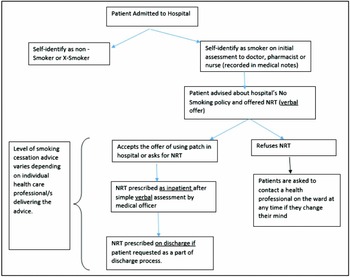
In July 2006, our hospital implemented a smoke free policy whereby NRT in the form of patches (21 mg/24 hour patches) and gum (2 mg and 4 mg gum) were made available for all nicotine dependent inpatients during their hospital stay. However, this approach is often unstructured and provided on an ad-hoc basis (See figure 1 for the usual care process), though all staff are expected to assess and provide a brief intervention to patients who smoke prior to hospital admission. Patients are offered NRT (a regular patch and when required gum) if appropriate and advice about quitting. A referral to the State-wide telephone support service “Quitline” is also recommended for further information and counselling while continuing NRT following discharge. At discharge patients are advised to purchase nicotine patches plus an intermittent nicotine product such as gum, lozenges or mist spray.
Routine care process.

A recent audit of NRT use in our hospital concluded that although 32% of hospitalised smokers were prescribed NRT (patch or gum) in hospital, the majority of these (91%) were not prescribed NRT on discharge (Gupta, Ross, & Michael, Reference Gupta, Ross and Michael2012). This highlighted the need to improve prescribing of NRT both for inpatients and at discharge. Hospital pharmacists possess a good knowledge of pharmacotherapies and are highly appropriate clinicians to promote smoking-cessation. This study was set up to examine the potential role of hospital pharmacists in a multidisciplinary approach to smoking-cessation strategies in hospital, while utilising NRT.
In the current environment, hospital pharmacists do very little to assess smoking status or initiate smoking-cessation advice (Gupta, Ross, & Michael, Reference Gupta, Ross and Michael2012). After conducting a series of surveys on smoking care provision in Australian hospitals, Freund and colleagues (Reference Freund, Campbell, Paul, Wiggers, Knight and Mitchell2008) also suggested that recording of smoking status in the patient's progress notes is conducted more as an administrative task, rather than to trigger appropriate care (Freund et al., Reference Freund, Campbell, Paul, Wiggers, Knight and Mitchell2008).
There is emerging evidence that community pharmacists’ involvement in SCI can have substantial benefits. Whether this is translatable to the hospital pharmacy environment is currently unclear. Hospital pharmacists’ increasing presence in hospital wards, good understanding of patients’ medical situation and pharmacotherapy and the possibility to acquire specific smoking-cessation training places them in an ideal position to provide smoking-cessation counselling in hospitalised patients (Dobrinas et al., Reference Dobrinas, Blanc, Rouiller, Christen, Coronado and Tagan2014). Hospital pharmacists also have the potential to proactively collaborate with medical prescribers, nurses and other health professionals, to enhance NRT prescribing and smoking-cessation in the hospital. However, more real world studies are needed to evaluate the effectiveness of pharmacist's involvement in smoking-cessation programmes and NRT prescription in hospital.
Thus, a pragmatic randomised trial was designed to examine whether hospital pharmacists can play an active role in increasing NRT prescription rates for inpatients. The primary outcome chosen was prescription and uptake of NRT. The secondary outcomes of this study were to determine the usage of NRT after discharge and to assess self-reported abstinence rates at three-months.
Methods
This study was conducted in a major tertiary teaching hospital (780 beds) in Brisbane, Australia. Potential candidates were acute adult inpatients of selected medical and surgical wards who met the following inclusion criteria:
-
1. Self-identified as a current smoker to doctor, nurse or pharmacist on admission (usually documented in patient's medical record).
-
2. Ability to give consent.
Participant Identification and Enrolment
Potential candidates were identified by the RP between 2013 May 28 and 2013 June 27 via a pre-screening process using a centralised patient database which records patient's current smoking status on an ad-hoc basis. Mental health and oncology wards were excluded due to the complexity of the patients in these wards, while respiratory and cardiology wards were excluded as these wards already have a pre-existing structured smoking-cessation programme. Potential candidates were contacted by the RP at their bedside to assess their eligibility to participate, and to provide information about the study. The main exclusion criteria were: (1) non-English speaking, (2) <18 years of age, (3) already on other treatments for smoking-cessation, (4) no home or mobile telephone, (5) smoking less than four cigarettes per day (6) inability to provide written consent, (7) already hospitalised for over two weeks, (8) relative contraindications to the use of NRT example, pregnant women, those with acute myocardial infarction or stroke in the last 48 hours. All participants provided written informed consent.
Randomisation
Consenting participants were randomised using stratified block randomisation (Beller, Gebski, & Keech, Reference Beller, Gebski and Keech2002) into one of the two arms: usual care arm and RP initiated SCI arm. Age and clinical setting (i.e. medical or surgical wards) were chosen as the two most important variables and were used to stratify participants in this study. It was expected that smoking-cessation practice under usual care might differ in medical and surgical settings based on the type of illness and training of health professionals in those areas, hence clinical setting or treating ward was chosen as one stratifier. Age was chosen as a second stratifier because of the strong evidence that those who try to quit without medication are more likely to be younger (Kasza et al., Reference Kasza, Hyland, Borland, McNeill, Bansal-Travers and Fix2013), and because subjects aged less than 45 years are more likely to successfully quit (Garcia-Rodriguez et al., Reference Garcia-Rodriguez, Secades-Villa, Florez-Salamanca, Okuda, Liu and Blanco2013).
Procedures
Ethics approval for the study was obtained from local Human Research and Ethics Committee.
Recruitment of Participants
All participants were asked to complete a basic smoking assessment clinical questionnaire (Table S1 Online) which included:
-
a. motivation and confidence to quit (on a scale from 1 to 10; 1 being lowest and 10 being highest);
-
b. age when smoking started, previous quit attempts, whether participants live with a smoker, family history of smoking and the number of caffeine drinks per day;
-
c. two key questions based on the Fagerstrom Questionnaire (Fagerstrom & Schneider, Reference Fagerstrom and Schneider1989) and Heaviness of Smoking Index (HSI) (Chabrol, Niezborala, Chastan, & de Leon, Reference Chabrol, Niezborala, Chastan and de Leon2005; Kozlowski, Porter, Orleans, Pope, & Heatherton, Reference Kozlowski, Porter, Orleans, Pope and Heatherton1994).
The responses were used: (1) to drive the intervention made by the RP in the intervention arm, for example what aspects require emphasis during counselling, (2) to assess the nicotine dependence (HSI score) in both arms and (3) to collect other baseline demographic data in both arms. Although blinding in this study was not possible, participants were not actively informed as to which arm they were enrolled in.
Usual Care
“Usual care” at the time of the study consisted of an ad-hoc smoking assessment by a doctor or nurse on admission with the offer of NRT, though this offer is not formally recorded unless it leads to prescribing of NRT. Nicotine patches and gum were freely available in most hospital wards. Participants assigned to the usual care arm, continued to receive “Usual care” after recruitment. They were asked to complete the basic smoking assessment form with minimal help from the RP. If they enquired about smoking-cessation during this process, they were referred to the treating nurse or doctor. At no point were participants denied access to treatment. In addition to routine care, an insert was placed in the front of the medical notes specifying that “This participant has been enrolled in a research study. He/She should be treated under usual care according to Hospital Policy for Smoking Management”. Under usual care, the onus is on the treating team to initiate NRT in form of patches and gum in the hospital and to prescribe on discharge to continue therapy.
Intervention Care
Participants allocated to the pharmacist initiated SCI arm were counselled by the RP (Table S2 Online). If the participant agreed to use NRT and was not receiving this therapy, stat order for a nicotine patch (21 mg/24 hours) was prescribed by the RP. If at the same time the participant expressed symptoms of nicotine withdrawal or cravings, a stat order of nicotine gum (2 mg or 4 mg) was also offered and prescribed by the RP. Each time this happened, the treating doctor was contacted by the RP and requested to prescribe a regular order for the patch (once daily) and nicotine gum (when required every two hourly). The RP ensured NRT was available on the ward and that it was administered in a timely manner. The RP reviewed participant specific drug and smoking interactions and significant interactions were reported to the doctor. When participants agreed, they were referred to Quitline.
Discharge Processes in Routine Care
On discharge, the hospital pharmacist reviews current medications and facilitates the continuation of therapy by organising prescriptions from a medical officer. It is the patient's choice whether they have these prescriptions filled in the hospital pharmacy or in their local community pharmacy, there is no difference in cost. Patients are not discharged home with any free medication. Nicotine patches are available on prescription via a Government subsidised scheme for up to 12 weeks for patients who are enrolled in a counselling program such as Quitline.
The Following Steps were Taken by the RP to Facilitate Prescribing of NRT on Discharge in Intervention Arm
-
1. For participants wanting to continue NRT on discharge, a progress note was written in the patient's medical records stating that “This patient wishes to continue nicotine patches commenced in the hospital and has been referred to a counselling program (details). Please prescribe Nicotine patches on discharge”.
-
2. The RP also informed the ward pharmacist of this action to ensure that NRT was prescribed for that participant on discharge.
Record of NRT on Discharge
The RP reviewed the progress notes of all participants under the usual and intervention arms to establish whether a discharge script was written for NRT or not. A copy of an NRT prescription found in the participant discharge notes implied that “NRT was continued on discharge”. If no NRT prescription was found, the patient's hospital discharge summary was checked for any instructions on continuing NRT post-discharge. If no instructions on continuing NRT were found, this implied that “NRT was not continued on discharge”.
Three Months Follow-up
All participants were required to undertake a short (<5 minutes) follow-up interview via telephone approximately three months after the enrolment to establish the following:
-
1. Current smoking status (seven-day point prevalence of abstinence) at the time of interview: Current smoking was defined as having smoked cigarettes during the seven days preceding the interview. The RP asked two main questions on the phone to determine current usage: “Have you smoked a cigarette in the last seven days?”; “When was your last cigarette?” Those participants who reported that they had smoked cigarette/s in the past seven days were regarded as current smokers.
-
2. Duration and use of NRT post-discharge: The RP also determined whether NRT was used post-discharge by asking: “Did you use nicotine products for example patches or gum post-discharge from hospital?” If yes, which product was used; and for how long. The duration of patch use was recorded as “less than 4 weeks”; “4–8 weeks” or “more than 8 weeks”.
All phone calls were made by the RP and an attempt was made to contact all participants between 80 to 90 days from the date of enrolment.
Statistical Analysis
Baseline characteristics of the two groups are reported as either means (standard deviations) or percentages depending upon the type of variable. Statistical Package for the Social Sciences software version 20.0 (SPSS Inc., Chicago, Ill, USA, 2011) was used for all significance analyses.
Primary and secondary outcomes were analysed using a chi-square test or Fisher exact test where appropriate. Intention-to-treat (ITT) analysis was applied to all data for assessing the primary outcome of NRT use in hospital. There was no missing data for the primary outcome. Analysis per protocol was used to assess the secondary outcomes of abstinence and NRT use post-discharge i.e. the dropouts (not contactable at three months) were excluded from final analysis instead of assuming that they had quit smoking. ITT analysis can potentially provide a positive bias when complete outcome data is not available for all randomised subjects i.e. dropped out intervention patients are assumed to still be taking NRT and not smoking, thus ITT analysis was not used. Results are presented following the CONSORT (Schulz, Altman, Moher, & Group, Reference Schulz, Altman, Moher and Group2010) statement recommendations where possible.
An Odds Ratio (OR) and 95% Confidence Interval (CI) for the effect of the intervention is reported. OR was simply calculated using 2×2 contingency table (Table S3 Online). A two-sided p-value of 0.05 or less was considered statistically significant.
Results
Participants
A total of 210 inpatients were identified as potential candidates from 2013 May 23 to 2013 June 27; 110 subjects were excluded from the study leaving a total of 100 enrolled participants. The reasons for excluding participants are explained in the participant recruitment summary available in the supplementary material.
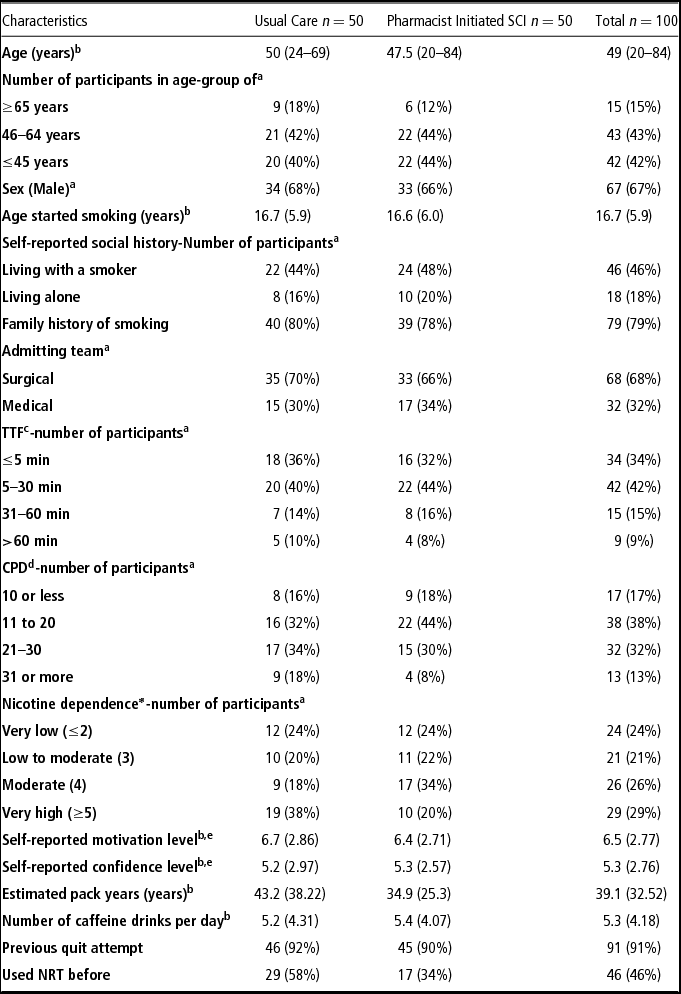
Of the 100 participants (67 males and 33 females) enrolled in the study, 50 were randomised to the usual care arm and 50 to the intervention arm. Participants were recruited from 17 surgical and medical wards. The majority of participants (69%) were from the surgical wards. The mean age was 49 years; there was no major difference in the demographic characteristics seen between two groups. Baseline characteristics of enrolled participants are shown in Table 1.
Demographic and clinical characteristics of participants

Data are anumbers (%) or bmean(standard deviation) *Based on Fagerstrom/HSI score, cTTF- Time to first cigarette; dCPD- Number of cigarettes per day; eOn a scale of 1 to 10 where 10 is very high and 1 is very low.
On average, each RP initiated SCI was completed within 10 to 20 minutes. This was based on the estimated time spent by the RP with a convenience sample of 18 participants in the intervention arm, and was recorded in a diary log.”
Uptake of NRT
Inpatients
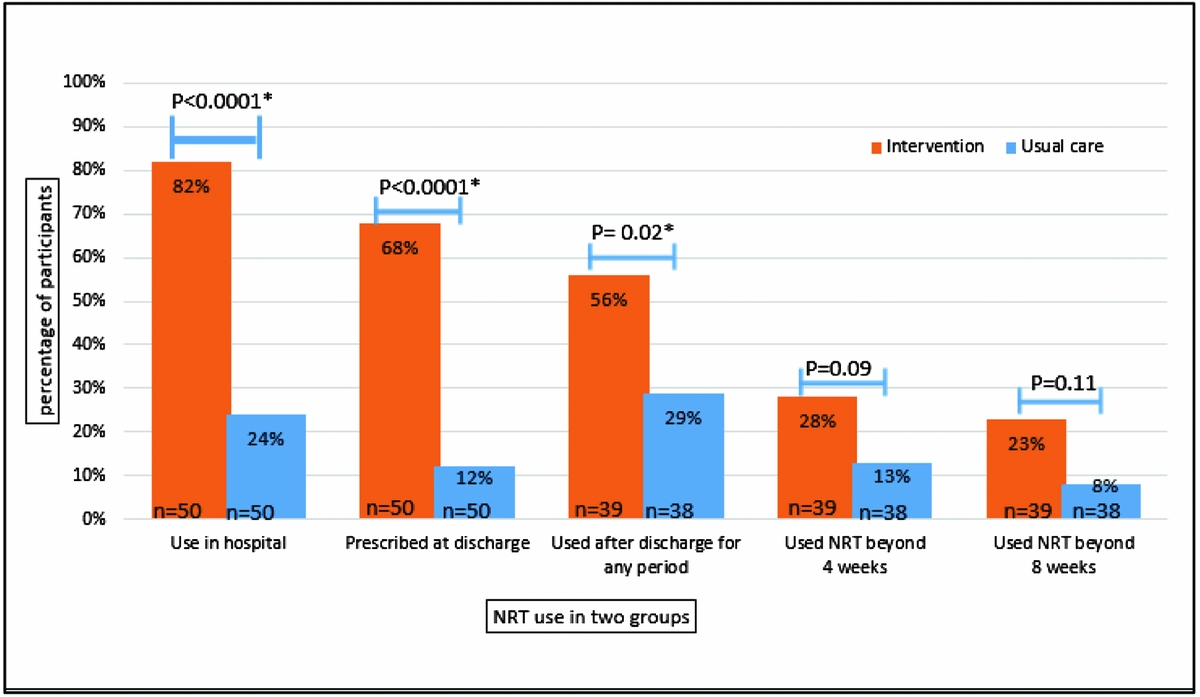
A significantly higher proportion of participants in the intervention arm were prescribed NRT in the hospital during admission 41/50 (82%) vs. 12/50 (24%) (Χ 2 = 33.76, df = 1, p < 0.0001) as compared to those in the usual care arm. The RP initiated NRT in 32 (64%) patients in the intervention arm who were not previously on NRT.
At discharge
At discharge, 34/50 (68%) patients in the intervention arm had NRT prescribed compared with 6/50 (12%) (Χ 2 = 32.7, df = 1, p < 0.0001) in the control arm. In the intervention arm, a total of 16/50 (32%) participants were not prescribed NRT on discharge: nine refused to use NRT, one did not qualify for NRT due to low nicotine dependence and the other six participants were not prescribed NRT on discharge (because they were either discharged on a weekend, discharged from another ward or self-discharged without a prescription). (see Figure 2 below)
Percentage of participants reported use of NRT in hospital and at discharge (primary end points) and post-discharge (secondary end points); n = number of participants; *Statistically significant (p < 0.05).

Phone Contact at Three Months
Successful phone contact was made with 77 out of 100 participants (38 or 76% in the usual care group and 39 or 78% in the intervention group) at three months, and the data collected was analysed for the secondary endpoints. The main reason for participants not being included in the secondary end point analysis were: (1) inability to contact by phone despite numerous attempts (18 participants; 8 in the usual care arm and 10 in the intervention arm); (2) three participants were deceased (n = 2 in the usual care and n = 1 in the intervention arm); (3) two participants refused (both in the usual care arm) to continue the interview.
Abstinence post-discharge
Seven day PPA at three months was generally low in all the participants. A similar number of patients in both groups i.e. 7/38 or 18% in the usual care group and 6/39 or 15% in the intervention group claimed seven-day PPA. This difference was not statistically significant (Χ 2 = 0.13, df = 1, p = 0.72) (OR 0.8, CI 0.24 to 2.67).
NRT use post-discharge
Six participants in the usual care group reported that they self-initiated NRT post-discharge from hospital. Five of the six participants (one lost to follow-up) who were initially discharged home on NRT in usual care group also reported that they had used NRT post-discharge. Thus, a total of 11/38 (28%) participants reported that they had used NRT post-discharge in the usual care group.
No one reported self-initiating NRT post-discharge in the intervention group and 22/39 (56%) participants reported continuing NRT after being first prescribed in the hospital. The remaining 17/39 (44%) participants chose not to use NRT post-discharge, eight of these participants were prescribed NRT at discharge.
A significantly higher proportion of participants (56% vs. 28%, Χ 2 = 5.93, df = 1, p = 0.02) (OR-3.2CI-1.2, 8.2) reported that they had used NRT post-discharge for any period in the intervention group as compared to the usual care group.
Quitline Contact in the Intervention Arm
In the intervention arm, 39/41 (95%) participants who accepted NRT in the hospital also agreed to be referred to Quitline; 5/39 (13%) declined communication when actually contacted by the Quitline counsellor, 13/39 (33%) were not reachable; a successful contact was made with 21/39 (54%). At three months, 3/21 (14%) who had successful contact with Quitline in the intervention arm reported abstinence from smoking. This represents half of all the participants in the intervention arm who stopped smoking at three months (data not shown). The proportion of patient in the usual care group who were referred to Quitline is not known, as there is no standard approach to collect this data.
Discussion
This study demonstrates that pharmacist initiated SCI significantly increases the uptake of NRT in hospitalised smokers by up to five fold. Previous studies have indicated that the uptake of SCI is highest when treatment is readily accessible (Fiore et al., Reference Fiore, McCarthy, Jackson, Zehner, Jorenby and Mielke2004), but very poor when treatment is delayed to a separate encounter with the health care system (Lichtenstein & Hollis, Reference Lichtenstein and Hollis1992). Hospital pharmacists are well placed to motivate patients for smoking-cessation. They are often the main link during the patient's journey (transition between different wards and from admission to discharge) in the hospital and also the last person to see them before discharge. Because hospital pharmacists have multiple tasks and limited time, a strong evidence base is required in order to decide which tasks are given a high priority. Before SCI is implemented into the hospital pharmacist's routine practice, it is important to establish the effectiveness of such an intervention.
Past reviews have suggested that implementing routine SCI in hospitals requires executive support and the development of supportive cessation systems (Wolfenden, Campbell, Walsh, & Wiggers, Reference Wolfenden, Campbell, Walsh and Wiggers2003). Our comprehensive literature review concluded that there is a lack of high quality, published studies that address the involvement and role of hospital pharmacists in smoking-cessation.
This study demonstrates that the intervention was effective in increasing the uptake of NRT and promotion of smoking-cessation, supporting the two most important SCI components initiated in hospital (Bowman & Stockings, Reference Bowman and Stockings2012; Prochaska, Fletcher, Hall, & Hall, Reference Prochaska, Fletcher, Hall and Hall2006; Wolfenden et al., Reference Wolfenden, Campbell, Walsh and Wiggers2003).
The higher level of uptake of NRT in the intervention arm may be explained by either fewer offers of NRT under usual care or by lower acceptance of these offers due to a less effective approach routinely used by staff. In routine care, there is no standard approach to initiation and prescribing of NRT in many hospitals, and pharmacists traditionally have not played an active role in this area. Overall, initiation of NRT seems to be a time limiting step if the treating doctor is not present on the ward at the time smoking-cessation is discussed between pharmacist and patient. This step was easily overcome in the current study due to the ability of the RP to prescribe a stat order of NRT thus making this intervention more feasible.
Almost one quarter of the participants were lost to follow-up at three-months for reasons that were out of the researchers’ control. Of those contacted, a significantly higher proportion (56%) of participants in the intervention arm used NRT at home post-discharge, compared with the usual care group (29%). This finding reflects the higher uptake of NRT from patients, and a commitment to use NRT to quit, showing a positive impact made by the RP. Patients are required to purchase NRT at discharge and only those who request NRT are supplied this at the point of discharge in usual care. The uptake of NRT is an important marker in terms of an individual's decision to quit smoking. Although fewer patients received brief SCI and NRT in the usual care; the likely reason behind similar quit rates between usual care and intervention, is the pragmatic follow-up process post-discharge. Implementing a structured assessment and care plan in usual care for all inpatient smokers has the potential to increase the number of patients receiving SCI and the offer of NRT. Smoking-cessation often requires multiple attempts; brief interventions that move a patient closer to quitting are relevant and important, and can help determine where future efforts should be directed. For example, if more patients can be encouraged to accept NRT in the hospital and at discharge, it then becomes important to focus on continuation of NRT and long term smoking-cessation. How best to achieve this goal warrants further research.
This study demonstrates that SCI with the promotion of NRT can be effectively delivered by hospital pharmacists to enhance the uptake of NRT in hospital and on discharge under routine care, even though this has traditionally not been integrated into their routine practice. This study prompted the development of a structured pathway in the hospital to train pharmacists in SCI. Pharmacists will be helpful in raising the awareness in their clinical areas for all health care professionals to be more vigilant in encouraging patients to quit smoking, while working together in the multidisciplinary team. Structured training of health professionals is known to help reduce the knowledge gaps and dispel the myths that act as a barrier in the promotion of smoking-cessation therapies (Saba, Bittoun, Kritikos, & Saini, Reference Saba, Bittoun, Kritikos and Saini2013).
This study utilised the vision of Australia's National Tobacco Strategy of providing evidence based care and services to all smokers. However, to improve quit rates, a coordinated, structured, multidisciplinary approach to smoking-cessation, with post-discharge follow-up, is also required. A structured follow-up post-discharge is a key component for increasing the quit rates post-discharge (Bowman & Stockings, Reference Bowman and Stockings2012; Prochaska et al., Reference Prochaska, Fletcher, Hall and Hall2006; Rigotti, Clair, Munafo, & Stead, Reference Rigotti, Clair, Munafo and Stead2012; Wolfenden et al., Reference Wolfenden, Campbell, Walsh and Wiggers2003). The project has led to discussions with Quitline and proposed changes in the referral process for hospitalised smokers. This study also proposes that a change in organisational structure is required in order to include post-discharge follow-up for smoking-cessation in routine care.
There are a number of limitations of this study. (1) This study involved only one pharmacist, and one hospital. (2) The RP in this study was trained in SCI, and the findings may thus be not applicable to hospital pharmacists who have not received any training. (3) The intervention was limited to one type of pharmacotherapy, a limited range of outcomes and a limited duration of follow-up leading to a loss of rigour. This study design was however chosen to test the feasibility of the proposed intervention while utilising the available resources.
Future studies should be designed with consideration of the above factors in order to improve methodological rigour, for example with multiple longer follow-up assessments included biochemical evaluation to objectively confirm PPA. Future studies should also aim to explore other important outcomes like changes in smoking, quit attempts, duration of abstinence and latency to relapse upon discharge etc. Further research is required in how to best achieve continuation of NRT and smoking-cessation post-hospital discharge.
Conclusion
This study demonstrates that brief smoking-cessation interventions by pharmacists can be effective and can improve the uptake of NRT significantly both during hospital admission and on discharge. As a result of this study, a protocol has been developed and approved at our institution allowing the trained hospital pharmacists and nurses to initiate an order of NRT in eligible nicotine dependent patients in a timely manner. A series of education and training sessions for the pharmacists and other health care staff has been planned to facilitate the implementation of a multidisciplinary approach to smoking-cessation in the hospital. Follow-up audits will be scheduled to monitor the outcomes of the initiative. Further collaboration with Quitline is scheduled to streamline the referral process and develop new strategies for patients referred from hospital. A role for a smoking-cessation co-ordinator has also been proposed.
Whilst enhancing NRT use is one step towards smoking-cessation, in addition to planned initiatives within the hospital, a service that extends beyond the hospital may be required to realise the goals of the National Tobacco strategy. Further research is required on how to best achieve continuation of NRT and smoking-cessation post-discharge.
Acknowledgements
The authors are grateful to the Respiratory and Pharmacy teams of Princess Alexandra Hospital for their collaboration, and to the patients participated in this study. The authors are thankful to Prof. Renee Bittoun for providing guidance on ethics clearance and study design, however, she has no direct involvement in the study procedures and publication. We thank Mr David McDougall for his assistance with statistical analysis.
Financial Support
This work was supported by the Princess Alexandra Hospital Private Practice Trust Fund.
Conflict of Interest
None.
Ethical Standards
Not applicable.
Supplementary Material
To view supplementary material for this article, please visit http://dx.doi.org/10.1017/jsc.2015.14.