

Introduction
Melanocytes are the cells responsible for generating hair colour. They reside within the follicle and synthesise two types of melanin pigments, black eumelanin and reddish-brown pheomelanin. A study by Ito (Reference Ito1993) showed that, in animals, the relative proportions of these two pigments molecules in the hair are determined by tyrosinase activity in melanocytes. Low tyrosinase activity results in higher proportions of pheomelanin synthesis, while higher activity dictates elevated eumelanin production. Tyrosinase activity is known to be stimulated by tyrosine (Tyr) concentration resulting in a greater synthesis of eumelanin, as shown by Slominski in Reference Slominski1989. In addition, Morris et al. (Reference Morris, Yu and Rogers2002) illustrated, using a cat model, that the tyrosine requirement can be derived directly from the diet or by the hydroxylation of the essential amino acid phenylalanine (Phe).
Coat reddening in cats and dogs is a phenomenon which is capricious and poorly characterised. Yu et al. (Reference Yu, Rogers and Morris2001), and subsequently Morris et al. (Reference Morris, Yu and Rogers2002), demonstrated that if black cats were provided with diets containing reduced levels of Tyr and Phe, red coats were observed, and also that these could be reverted to black when cats were returned to their original commercial pet food diet. Anderson et al. (Reference Anderson, Rogers and Morris2002) subsequently confirmed that eumelanin production in black kittens could be compromised by a lack of Tyr and Phe in the diet. It was estimated that the amount of these 2 amino acids required to produce a black coat was twice as high as that required for normal growth.
The National Research Council (NRC, 2006) recommend dietary levels of Tyr and Phe combined for growing dogs are 3.25 g/MCal and 2.50 g/Mcal before and after 3 months of age, respectively. However, no data has been published evaluating the dietary Tyr and Phe requirements in growing dogs with respect to coat colour.
The aim of this pilot study, therefore, was to investigate how dietary levels of Tyr can affect coat colour of growing black dogs.
Materials and Methods
Animals
The study involved 12 puppies; six female Newfoundlands (NFL), 3 male and 3 female black Labrador retrievers. At the beginning of the study the NFL were 3 months old and had an average weight of 13.1 ± 0.9 kg (Mean, +/−SD). The male LR were on average 2.5 months old and weighed 8.0 ± 1.0 kg; the females were on average 3.5 months old and also weighed 8.0 ± 0.9 kg. All of the puppies were healthy and had homogeneous black coats. Before entering the study, all dogs were fed with the same commercial diet for growth of large breed puppies (Royal Canin, Maxi Junior, Aimargues, France). For the period of the study, all puppies were housed in the same well-ventilated, temperature controlled indoor facility, with daily exercise regimes.
Diets
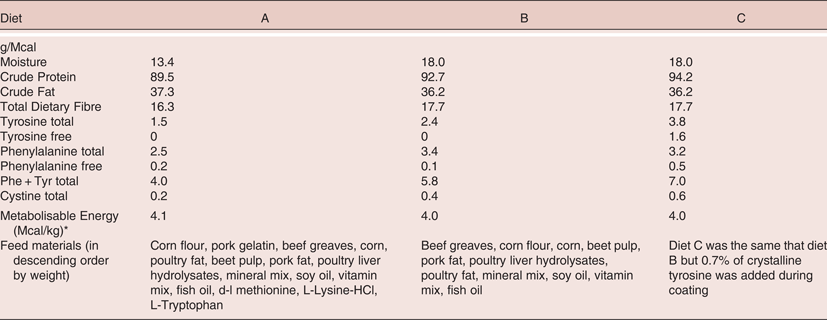
The dogs were provided with one of three experimental diets which varied in their Tyr and Phe content (labelled Diets A, B and C; Table 1). Diet B was a standard Royal Canin Maxi Junior (Aimargues, France). Diets were nutritionally complete and balanced for growth (according NRC recommended allowances, NRC, 2006). Initial energy requirements were calculated based on NRC (2006). Table 1 shows proximal analyses, total Tyr, Cys and Phe content, as well as ingredient lists for the three diets. Other dietary amino acid contents were in excess of NRC recommended RA for growing puppies.
Composition of 3 diets provided to dogs in order to evaluate the effect of tyrosine intake on coat colour.

*Calculated based on Total Dietary Fiber (NRC, 2006)
Experimental design
The 12 dogs were divided into 3 groups balanced with respect to breed and sex, whereby each contained 2 NFL, 1 male LR and 1 female LR. Each group was maintained on one of the three experimental diets chosen at random and fed twice per day. The amount of diet consumed by each dog was recorded daily and all dogs were weighed weekly. Food intake was regulated such that maximum weight gain was 0.7 kg/week for LR and 1.2 kg/week for NFL.
A heparinised blood sample was collected from each dog 5 hours after feeding at time zero, 3 and 6 months. Tubes were centrifuged for 15 minutes at 2000 rpm and the plasma transferred into separate tubes. At time zero, 4 months and 6 months an 8 × 8 cm square of hair was shaved on the right lateral area of the abdomen of all Labrador retrievers for spectrophotometry (each time at the same location).
Analytical methods
Plasma was mixed with an equal volume of 0.28 mol/l sulfosalicylic acid. The resulting precipitate was removed by centrifugation at 16,000 g. Lithium hydroxide was added to the supernatant to adjust pH to 2.2. Plasma amino acid concentrations were determined by Ion Exchange Column Chromatography (7300 Beckman Amino Acid Analyser, Beckman Instruments, Palo Alto, CA) on a 0.4 × 10 cm column packed with spherical cation exchange resin. An equivalent of 20 µl of plasma was injected onto the analysis column.
For the quantitative assessment of hair colour, hair samples were analysed with a spectrocolourimeter (Spectro-guide® 45/0, gloss, BYK Gardner, Brant Industries, Germany) according to the CIE Lab colour measurement system (Hunter Associates Laboratory, Inc. Reston, VA, USA). Colour is determined as a numeric value of a* (red to green axis) and b* (yellow to blue axis). Lightness is determined as L* on a numerical scale (from black = 0 to white = 100).
Statistics
Data were analysed using GLMs through the MIXED procedure of SAS v9.1.3 (SAS Institute Inc., Cary, NC, USA). Differences were considered significant at p ≤ 0.05.
Ethical Statement
The experimental protocol used in this study adhered to European Union Guidelines (Official Journal of the European Communities L 358, 18/12/1986). The study was also approved by the Royal Canin Ethics Committee (RC90).
Results and Discussion
During the study puppies gained appropriate weight and growth/development occurred as expected for breed norms (data not shown). There was no difference in weight gain between dietary groups. Average daily food intakes (+/−SD) for NFL and LR were 593 ± 86 and 452 ± 60 g /dog /day respectively. No differences were observed in the food intake between diet groups (p > 0.05).
Levels of Tyr, Phe and Cys in the blood of the puppies on each diet are summarized in Table 2. There was no difference in the levels of each amino acid between the NFL and LR within diet groups (p > 0.05). There were no significant differences in plasma Cys and Phe between diet groups. No changes were observed in the plasma Phe or Cys between the different sampling points (p > 0.05). Plasma Tyr concentrations at 3 and 6 months were significantly higher in the diet C group than the diet B and A groups (p < 0.05). In addition, dogs fed diet B had a higher Tyr concentration than those fed diet A (p < 0.05).
Plasma levels of tyrosine (Tyr) and cystine (Cys) of dogs consuming 3 diets with increasing Phe+Tyr content (A: 4 g/Mcal; B: 5.8 g/Mcal; C: 7 g/Mcal) after time zero, 3 and 6 months of diet consumption. Averages are shown (± standard error) for 4 puppies.
abcdifferent superscripts indicate significant differences of the values within a row, among groups (p < 0.05); xydifferent superscripts indicate significant differences of the values within a column, over time (p < 0.05).
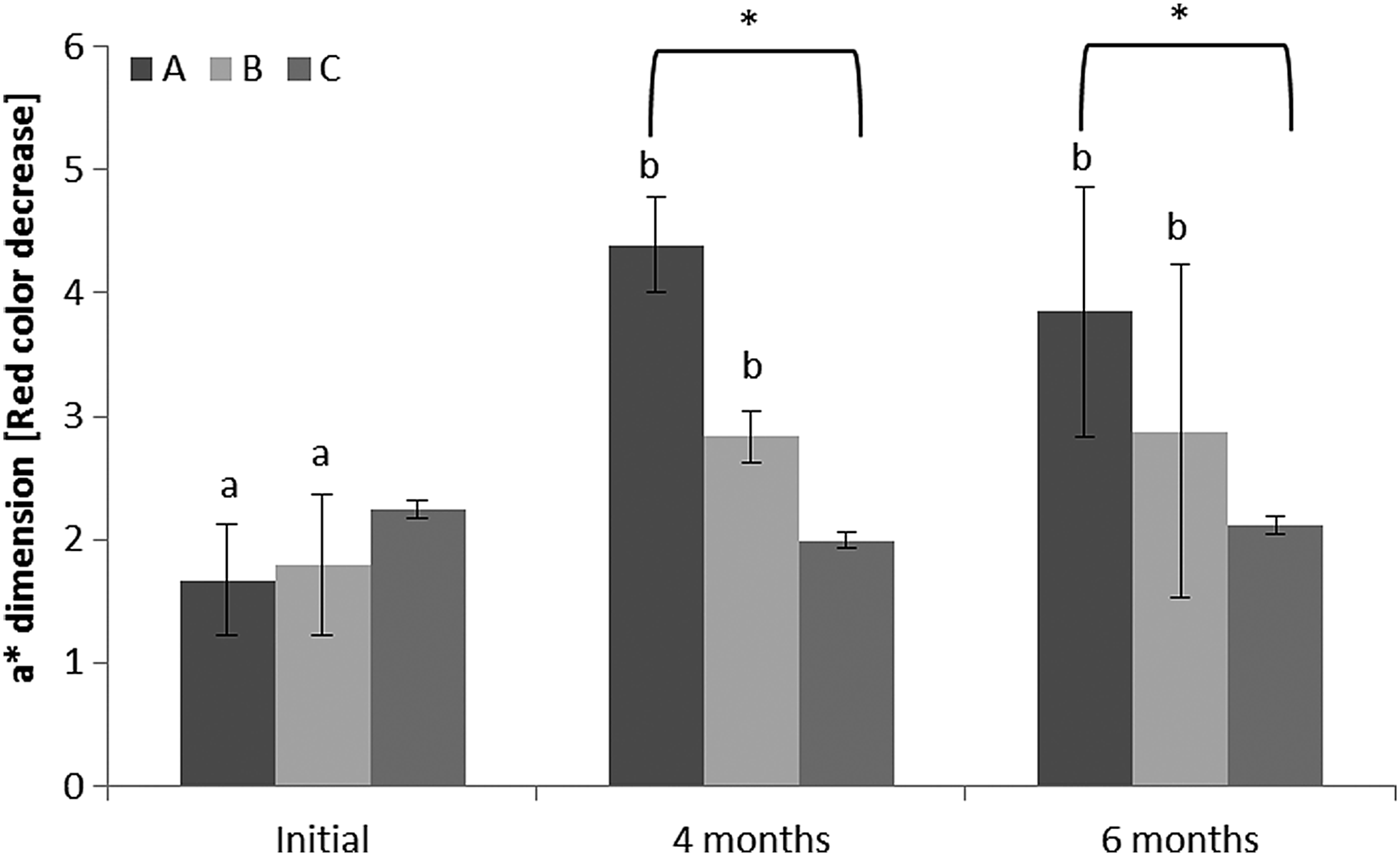
Spectrophotometric hair analysis showed no differences between groups with respect to L* and b* dimensions at any of the three sampling points. There was no difference in a* values between groups at the start of the study and those of the Labrador puppies fed Diet C did not change during the study. However, the a* values of Labrador puppies fed Diets A and B had increased significantly after 4 months and did not change thereafter (p < 0.05; Figure 1).
Changes in the a* dimension of CIE Lab index over time; three diets with increasing Phe+Tyr (A: 4 g/Mcal; B: 5.8 g/Mcal; C: 7 g/Mcal) assessed at time zero, 4 and 6 months of diet consumption (n = 2/diet group). Letters over the bars denote significant differences (p < 0.05) within the same diet group over time; *indicate significant differences among diet groups at the same sampling point (p > 0.05).
There was evidence of an association between plasma Tyr concentration and the a* dimension in the Labrador puppies. In particular, a* decreased significantly in association with the increased plasma Tyr seen for the group B dogs vs group A dogs. The decrease in a* was greater for the dogs in group C, although there was no significance between groups B and C. The CIE Lab method was used by Busch-Kschiewan et al. (Reference Busch-Kschiewan, Zentek, Wortmann and Biourge2004) in a study on white dogs and permitted corroboration of what was determined visually. In humans, spectrophotometric measures have been described as an alternative to chemical methods of assessing hair eumelanin and pheomelanin variation. Shekar et al. (Reference Shekar, Duffy, Frudakis, Montgomery, James, Sturm and Martin2008) showed that dimension a* of CIE Lab spectrocolourimetic index is a good approximation of pheomelanin concentration in hair, as it measures a continuum of the red-green spectra. A lower a* value therefore reflects a lower hair pheomelanin concentration, manifesting as a less reddened hair shaft.
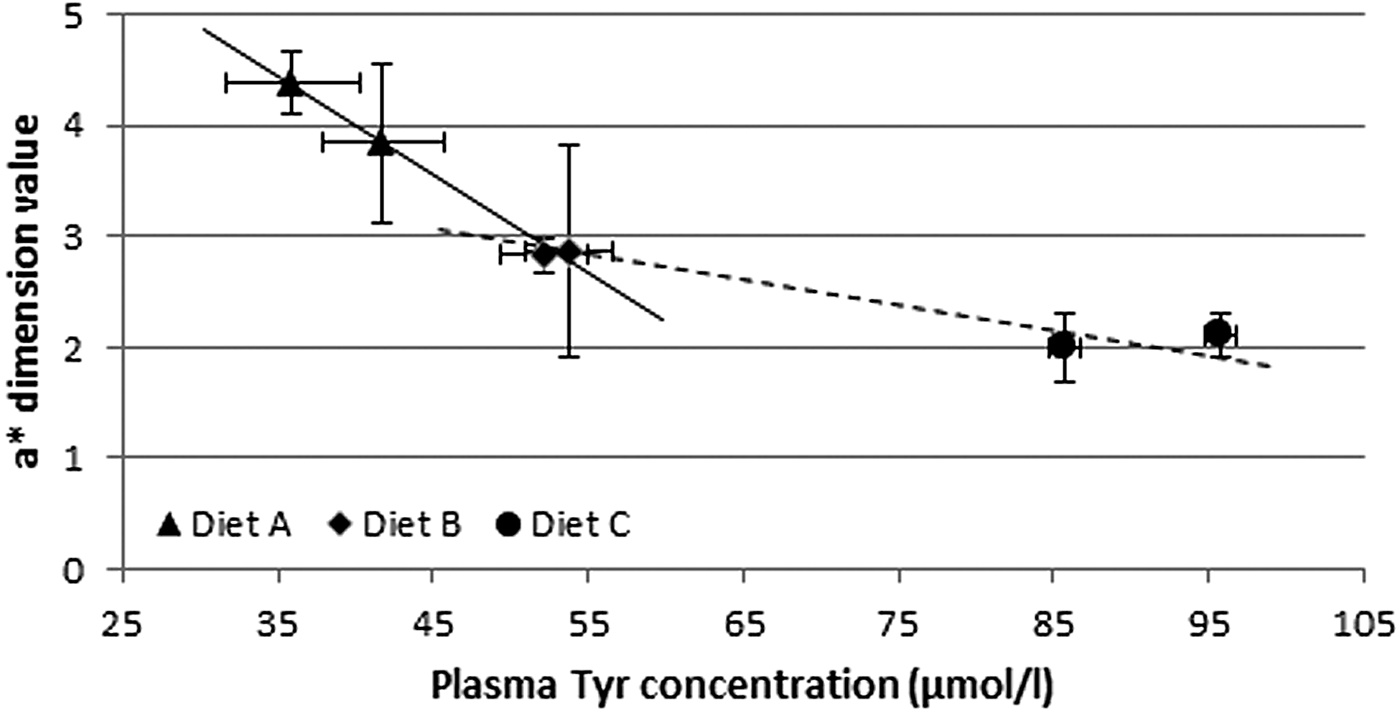
Plasma Tyr levels were negatively correlated with a* values in the dogs fed diets A and B (Figure 2) suggesting a relationship between higher plasma Tyr levels and higher eumelanin contents in the hair of black coat puppies. The results agree with those found in kittens by Anderson et al. (Reference Anderson, Rogers and Morris2002), where a positive correlation between plasma Tyr levels and pyrrole-2,3,5-tricarboxylic acid was reported, with the latter used as an indicator of eumelanin concentration in the hair of cats. Raising plasma Tyr concentration from 40 to 54 μmol/L effected the most significant reduction in the a* dimension (Figure 2), which is similar to previous data from cats. Increased plasma Tyr levels in the puppies in group C did not result in a further increase in a* values over and above group B, possibly reflecting that a point exists beyond which increasing dietary tyrosine has no effect, or could indeed be an artefact of our relatively small sample sizes.
Relationship between plasma tyrosine (Tyr) levels and a* dimension spectrocolourimetric values for the hair coat of puppies consuming 3 different diets (A: 4 g/Mcal; B: 5.8 g/Mcal; C: 7 g/Mcal). Values of animals fed A and B (solid line; a* = 7.6-0.09 × Tyr (μmol/l); r2 = 0.98) and B and C diets showed a closer relationship (dashed line; a* = 3.9-0.02 × Tyr (μmol/l); r2 = 0.91). Each value is the mean of two animals.
Conclusion
In summary, young black dogs maintained on a diet of 4 g/Mcal Phe+Tyr (diet A) showed reduced levels of black pigmentation, even though they maintained the normal growth trajectory and appeared healthy. Black pigmentation was restored by increasing the Tyr content of the diet. These initial results suggest that the nutritional requirements for growth are insufficient to also meet the demands of regular melanin synthesis, as highlighted previously by Anderson et al. (Reference Anderson, Rogers and Morris2002) for cats. Normally, growth is the most nutritionally demanding life stage. Thus, a greater need for Phe+Tyr for other physiological processes, such as hair pigmentation, may have to be considered. Further studies to understand this relationship better would be merited.
Declaration of interest
Eric Servet, Adrian Watson and Vincent Biourge are all employees of Royal Canin SAS, Aimargues, France.