Children with congenital heart disease (CHD), especially single ventricle patients, are at risk of malnutrition secondary to several factors including increased metabolic demand, feeding intolerance, and increased caloric expenditure.Reference Jenkins1–Reference Wong, Cheifetz and Ong4 Up to 89% of single ventricle patients fail to meet the Centers for Disease Control and Prevention standards for adequate growth and 50% are considered underweight at admission for bidirectional Glenn.Reference Anderson, Beekman and Border5, Reference Kelleher, Laussen and Teixeira-Pinto6 Single ventricle patients are at increased risk for both acute and chronic malnutrition resulting in a low weight-for-age z score,Reference Kelleher, Laussen and Teixeira-Pinto6, Reference Schwalbe-Terilli, Hartman and Nagle7 which is associated with increased mortalityReference Ross, Latham and Joffe8, Reference Eskedal, Hagemo and Seem9 and has also been found to be directly associated with morbidities such as increased length of stay and worse neurodevelopmental outcomes after neonatal cardiac surgery.Reference Owens and Musa3, Reference Eskedal, Hagemo and Seem9–Reference del Castillo, McCulley and Khemani12 Due to these well-known risks of poor growth, feeding protocols have been created with the goal of enhancing the delivery of nutrition.Reference Goldberg, Lu and Sleeper10–Reference Mehta, Bechard and Cahill13
Based on this knowledge, in 2012, the Joint Council on Congenital Heart Disease National Pediatric Cardiology Quality Improvement Collaborative recommended an evidence-based standardised feeding approach for infants with single ventricle physiology.Reference Slicker, Hehir and Horsley14 Prior to this initiative and subsequently, many high-risk feeding protocols have been proposed in neonates with single ventricles or similarly tenuous circulations.Reference Mehta, Bechard and Cahill13, Reference Hamilton, McAleer and Ariagno15–Reference Yoshimura, Miyazu and Yoshizawa19 In a review of hospital feeding practices across 16 different surgical centres, centres with a standardised high-risk feeding protocol had improved the change in weight-for-age z score during the initial palliation time period despite wide practice variation in nutritional delivery.Reference Anderson, Iyer and Schidlow20
Even in centres that have standardised feeding protocols, knowledge gaps still exist. To confidently report a protocol’s direct effect on outcomes, it is also important to ensure that adherence and compliance to the protocol was explicitly followed. It is important to specifically define protocol adherence and deviation to conclude true outcome association and identify practice variation.
We are limited in our current understanding of feeding protocols’ influences on patient outcomes between birth and discharge as well as how protocol adherence and deviation influences changes in weight-for-age z scores. We also do not have clear definitions of patient adherence and how to monitor adherence to protocols. Without understanding these concepts, we are unable to delineate which elements or instructions in feeding protocols are most important for achieving weight gain and which instructions are potentially harmful.
Our aim was to address these gaps by describing protocol adherence and deviations and determining their association with change in weight-for-age z score from birth to ICU and hospital discharge in cardiac surgical neonates who are placed on a high-risk feeding protocol.
Materials and methods
Protocol development and definitions
A local high-risk feeding protocol was developed and implemented at Primary Children’s Hospital for patients >36 weeks gestation and >2.2 kg anticipated to undergo single ventricle palliation (see Supplementary Figure 1). At our institution, in addition to infants with functional single ventricles, we also used this feeding protocol in those with a two-ventricular circulation who were deemed fragile enough prior to surgery to warrant follow-up in our high-risk clinic.
An inter-professional feeding taskforce developed this protocol with representation from paediatric critical care, paediatric cardiology, paediatric cardiothoracic surgery, nutrition, and speech therapy. The protocol content was based on the National Pediatric Cardiology Quality Improvement Collaborative recommendations for nutritional caloric goals, feeding initiation and feeding advancement, and the supplemental use of total parenteral nutrition.Reference Slicker, Hehir and Horsley14 The protocol was initially implemented in May 2013, and the patients were retrospectively tracked from 2013 to 2015 and then prospectively tracked beginning in late 2015.
Speech therapy and lactation were consulted on admission. Pre-operative skin-to skin contact and oral readiness were addressed in conjunction with a developmental evaluation using the Neonatal Intensive Care Unit Network Neurobehavioral Scale (NNNS).Reference Tronick and Lester21 When a patient was cleared medically for enteral feeding per protocol (see Supplementary Figure 1), the mothers preferred method was offered, limited to the pre-operative enteral max. If not taken by mouth, it was then given via feeding tube. Ranitidine was used a first-line therapy to treat reflux for all patients taking nasojejunal feeds and secondary reflux medications were only used if there were persistent reflux symptoms. A multivitamin was started when patients were tolerating full volume feeds. Patients who were required to have a modified barium swallow study (MBSS) demonstrated oral readiness (coordinated sucking and endurance of 5 minutes, but not a volume minimum) before a MBSS. Patients who did not require a MBSS, but demonstrated clinical need, had to demonstrate the ability to take 5–30 ml before MBSS. No flexible endoscopic examinations of swallowing were performed.
To accurately track whether patients followed the protocol, the local task force identified 17 discrete instructions within the protocol that could be prospectively measured. Adherence definitions were explicitly defined for each of the 17 instructions and were available for immediate reference at the bedside (see Supplementary Table 1). Patients received a single point for each instruction followed, and the total number was tallied to provide a patient specific adherence score. For example, if a patient followed 10 of the 17 instructions, they would receive a patient-specific adherence score of 10.
Some of the 17 instructions were not followed because the protocol instructed to omit or skip an instruction based on the severity of illness. In these circumstances, to differentiate patients who did not follow an instruction because of illness severity from those who did not follow an instruction because of provider’s discretion to deviate we created a deviation percentage. To determine if a deviation occurred we categorised each instruction as “patient eligible to follow the instruction” or “patient ineligible to follow the instruction”. Eligibility to follow an instruction was pre-defined in the protocol using features of illness severity such as hemodynamic instability or increasing respiratory support. For example, if a patient had a lactic acid level >2 mmol/L or was on an epinephrine drip of ≥0.05 mcg/kg/minute, the patient’s illness severity precluded eligibility for the instruction to “advance feeds” and the patient was categorised as ineligible for that instruction. (See Box B on pages 1–3 on Supplementary Figure 1).
A deviation percentage to the entire protocol (e.g., 17 instructions) was created by using the equation:  $[1\, - \,{{{\rm{Patient\ specific\ adherence\ score}}} \over {{\rm{No}}{\rm{.\ of\ eligible\ instructions\ for\ each\ subject}}}}] \times 100$. For example, if a patient followed 3 instructions but was only eligible for 4 of the 17 total instructions, they would receive a low patient-specific adherence score of 3 (3 of 17) but also a low deviation percentage of 25% ([1–3/4] x 100). It is therefore possible to follow very few instructions without being a high deviator. For categorical analysis, we a priori determined that patients whose deviation score was ≤25% were “low deviators” and whose deviation score was >25% were “high deviators”. It is therefore possible to follow very few instructions without being a high deviator. For categorical analysis, we a priori determined that patients whose deviation score was ≤25% were “low deviators” and whose deviation score was >25% were “high deviators”. Protocol deviations were validated and recorded in real time by our cardiac ICU dietician using a bedside paper checklist and protocol deviation form (Supplementary Figure 1).
Patient selection
We prospectively followed and analysed patients who met inclusion criteria for the high-risk feeding protocol between December 2015 and March 2017. For analysis, we excluded all patients who died or received extracorporeal membrane oxygenation within 30 days of surgery, as these outcomes precluded analysis of weight gain and were unlikely to be directly related to use of the protocol. Patient demographics, clinical characteristics, and adverse events were analysed. We defined adverse events as central line-associated bacterial infection, necrotising enterocolitis, and chylothorax. Necrotising enterocolitis was defined in our study as stage IIA or greater (proven necrotising enterocolitis) using the predefined modified Bell’s criteria that uses clinical and radiographic data to describe stages of necrotising enterocolitis.Reference Neu22 All patients were monitored routinely for feeding tolerance with every 6 hour abdominal circumference checks and for occurrence of bloody stools.
Statistical analysis
Descriptive statistics were generated for demographic and clinical variables and are reported as medians and interquartile ranges for continuous variables. Categorical variables were reported as frequencies and proportions. For categorical variables, Chi square or Fisher’s exact test was used depending on the nature of the data. For continuous variables, the two-sided Wilcoxon rank-sum test was performed. Statistical significance was defined as a p value < 0.05.
Simple linear regression models were constructed to evaluate the relationship between adherence and deviations and the primary outcome, change in weight-for-age z score at different time intervals. The change in weight-for-age z score between time intervals was defined as the weight-for-age z score at one time period minus weight-for-age z score at a previous time period. The correlation coefficient is used to assess the strength of the linear relationship in these univariate models.
To determine what specific clinical variables were most associated with weight-for-age z score change from birth to ICU discharge and hospital discharge, we used multiple linear regression models. Stepwise model selection was performed with a significance level of 0.10 set for predictor models to enter and stay in the model. The following variables deemed clinically important were considered for the final multiple linear regression models: length of stay, birth weight-for-age z score, male gender, duration of open chest, highest pH, peak lactate, cumulative fluid balance at the end of day 3, fundamental procedure, incidence of pre-operative feeding, incidence of necrotising enterocolitis, and percentage of rules followed.
Results
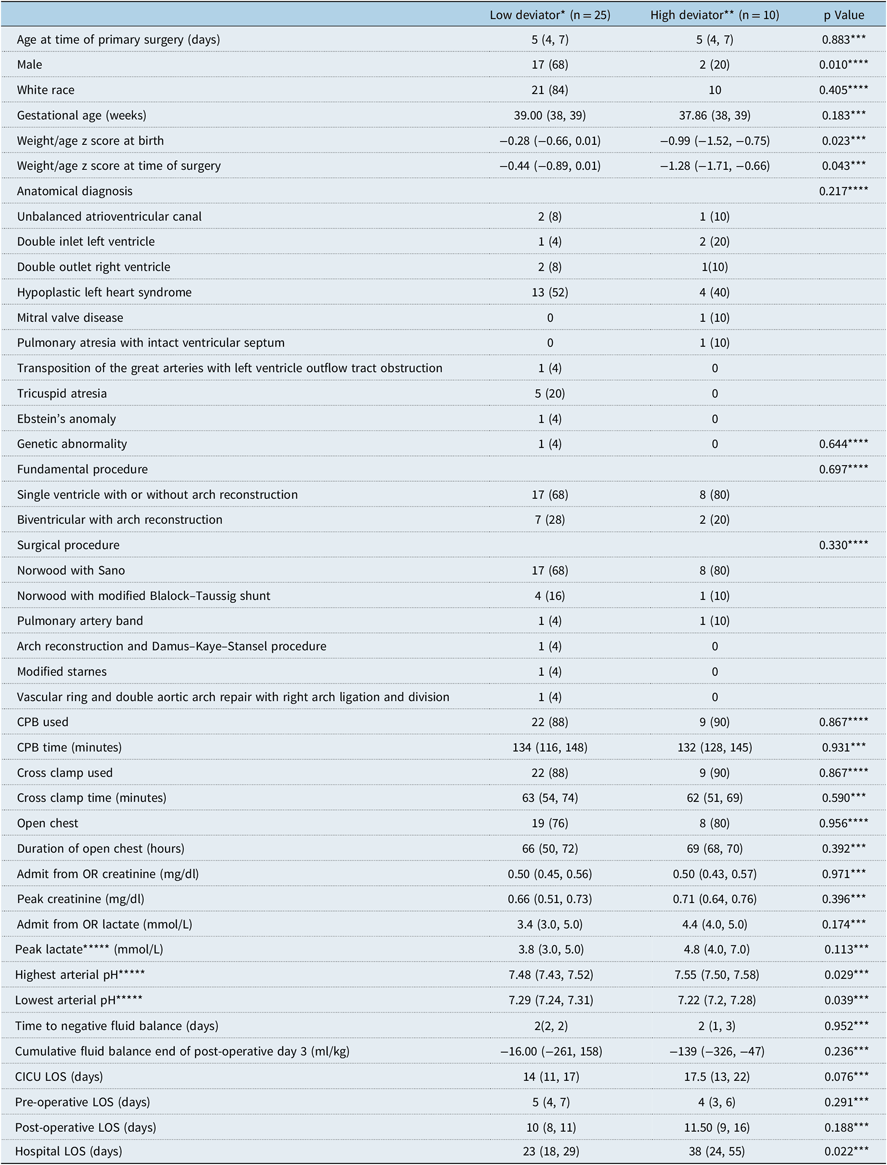
Of the 35 patients analysed, 25 (71%) were categorised as “low deviators” (deviation score ≤ 25%) (see Table 1). Comparison of the “low” versus “high” deviators showed that the two groups were similar with regards to age at the time of surgery, gestational age, procedure, as well as surgical and most laboratory characteristics. The “high deviator” group differed in regards to male gender predominance, a smaller weight-for-age z score at birth, and lowest arterial pH. Genetic abnormalities were present in only one “low deviator” infant with Turner syndrome.
Patient characteristics and demographics.

CICU = cardiac intensive care unit; CPB = cardiopulmonary bypass; LOS = length of stay; NEC = Necrotising enterocolitis; OR = operating room
Data are number (%) or median (IQR).
* Low deviator: patients whose deviation percentage score was ≤25.
** High deviator: patients whose deviation percentage score was >25.
*** Two-sided Wilcoxon rank-sum with normal approximation and continuity correction.
**** Chi-squared test of no association.
***** Time period from post-operatively to cardiac intensive care unit discharge.
Patient-specific adherence scores and deviation percentages reported at the subject level show how often and how strictly the protocol was followed. A higher patient specific adherence score was associated with improved weight-for-age z score trajectories between birth and ICU discharge (p = 0.02) and birth and hospital discharge (p = 0.03). Deviation percentage at the subject level ranged from 0 to 49%. A lower deviation percentage was associated with improved primary outcome of weight-for-age z score change between the intervals of birth and ICU discharge (p = 0.01) and birth and hospital discharge (p = 0.03).
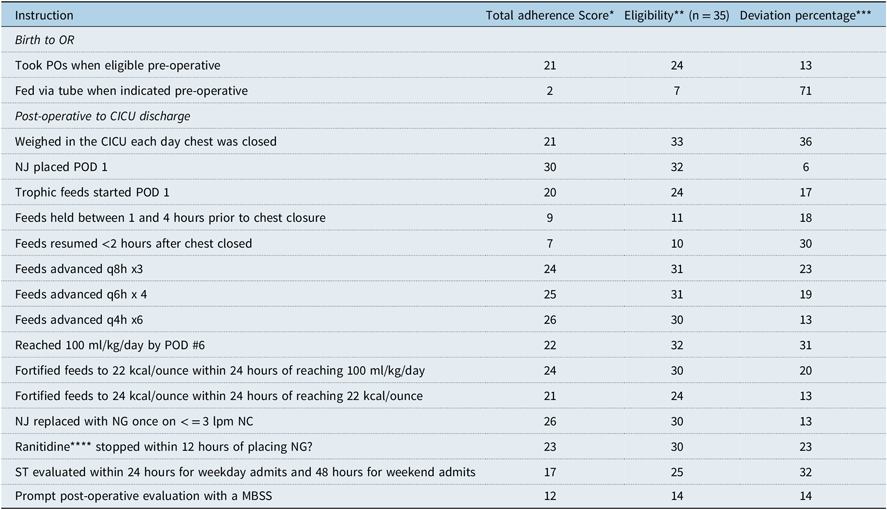
Total number of patients who followed an individual instruction (total adherence scores) and deviation percentages for all 35 patients to each of the 17 instructions were also calculated (Table 2) and shows which instructions of the protocol were most followed. All subjects were ineligible for at least one instruction, and there were four instructions for which >50% of patients were ineligible to follow. Total adherence scores ranged from 2 to 30 and deviation percentages ranged from 6 to 71, with the highest and lowest deviation percentages occurring for the instruction to “feed via tube pre-operatively” and “place a nasojejunal tube on post-operative day 1”, respectively. Only seven patients were eligible to adhere to the instruction to place a pre-operative feeding tube indicating that that the stringency of protocol itself precluded pre-operative oral feeds in the majority of patients.
Instruction level adherence and deviations across all patients.

CICU = cardiac intensive care unit; MBSS = modified barium swallow study; NC = nasal cannula; NG = nasogastric; NJ = Nasojejunal; PO = per os (by mouth); POD = post-operative day; ST = speech therapy;
* Total adherence score: total number of patients who followed an individual instruction.
** Eligibility: number of patients eligible to follow the individual instruction based on pre-defined criteria.
*** Deviation percentage:  $\Big[1\, - \,{{{\rm{Total\ adherence\ score}}} \over {{\rm{No}} {\rm{.\ of\ eligible\ instructions\ for\ each\ subject}}}}\Big] \times 100$.
**** TPN.
Reasons for protocol deviations are displayed in Supplementary Table 2. Deviations were most often secondary to errors in advancement from nursing non-adherence or missing orders. Orders were not correctly written or missed most commonly over the weekend when the registered dietician was not present during rounds. The second most common deviation was due to physician or provider non-adherence due to concerns for feeding tolerance or hemodynamic stability.
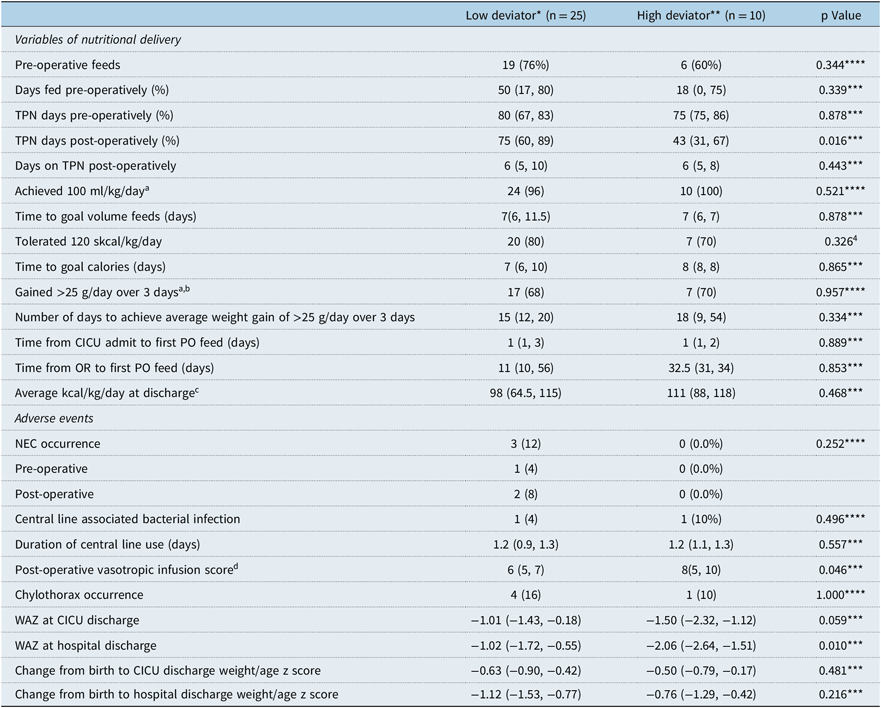
No statistical differences were found between the low and high deviator groups with regards to variables of nutritional delivery (Table 3). Only two patients were discharged on full per os feeds. Most patients were discharged on a combination of oral with some form of tube feeds (n = 13) or all nasogastric feeds (n = 14). The actual weight-for-age z score at three discrete time points (birth, cardiac ICU discharge, and hospital discharge) was only different between the two groups at hospital discharge (−1.02 versus −2.06, p = 0.01) and was more favourable in the “low deviator” group (Table 3).
Clinical outcomes.

Data are number (%) or median (IQR).
CICU = cardiac intensive care unit; NEC = necrotising enterocolitits; OR = operating room; PO = by mouth; WAZ = weight-for-age z score.
a This clinical marker served as a surrogate for caloric delivery since all patients received a 20 kcal formula or unfortified human milk up to this point.
b Once tolerating 100 ml/kg/day.
c Patients were discharged on 22–24 kcal feeds, 2 patients were discharged on 26 kcal feeds.
d Vasotropic infusion score calculation: (Dopamine x 1) + (Dobutamine x 1) + (Epinephrine x 100) + Norepinephrine x 100) + (Vasopressin x 1000).
* Low deviator: patients whose deviation percentage score was ≤ 25.
** High deviator: patients whose deviation percentage score was >25.
** Two-sided Wilcoxon rank-sum with normal approximation and continuity correction.
**** Chi-squared test of no association.
Adverse event frequencies did not statistically differ by deviation groups. All three occurrences of necrotising enterocolitis occurred in the “low deviator” group but was not statistically significant likely due to small numbers. The “low deviator” cohort had decreased post-operative vasoactive inotropic scores (6 versus 8) and hospital length of stay (23 versus 38 days) compared to the “high deviator” group (Table 3).
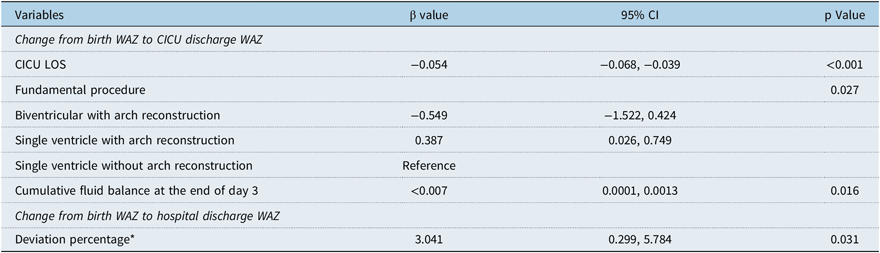
Patients with a longer cardiac ICU length of stay were found to have a decrease in weight-for-age z score from birth to ICU discharge (p = <0.001). Patients who had a biventricular palliation also had a decrease in weight-for-age z score from birth to ICU discharge, while patients who had the fundamental procedure of single ventricle with arch reconstruction had an increased weight-for-age z score change, compared to single ventricle without arch reconstruction (p = 0.027). Similarly, patients with an increased cumulative fluid balance on post-operative day 3 had an increase in weight-for-age z score change from birth to ICU discharge (p = 0.016) (Table 4). Patients with a lower protocol deviation percentage had an increased change in weight-for-age z score from birth to hospital discharge (p = 0.03).
Linear regression model to determine association of variables with change in weight at discharge.

β = regression coefficient; CI = confidence interval; CICU = cardiac intensive care unit; LOS = length of stay; NEC = necrotising entercolitis; WAZ = weight-for-age z score
Dependent variable: weight-for-age z score at cardiac intensive care unit discharge.
Model controlled for: LOS, birth WAZ, male gender, duration of open chest, pH, peak lactate, cumulative fluid balance at the end of day 3, incidence of pre-operative feeding, incidence of necrotising enterocolitis (NEC) and % of rules followed
*
 ${\rm{Deviation\ percentage}} = \Big[1\, - \,{{{\rm{Subject\ level\ adherence\ score}}} \over {{\rm{No}}{\rm{.\ of\ eligible\ instructions\ for\ each\ subject}}}}\Big] \times 100$
To better delineate the influence of individual instructions on weight-for-age z score, we analysed adherence in the lowest and highest quartiles (n = 9 each) of weight-for-age z score change from birth to hospital discharge (see Supplementary Table 3). For those with the most weight-for-age z score improvement, the three instructions followed most often were as follows: holding feeds 1–4 hours prior to chest closure (44%), re-starting feeds within 2 hours after chest closure (43%), and prompt evaluation with a modified barium swallow once eligible (42%). For those who had the least weight-for-age z score change, the instruction followed most often was “Fed via tube when indicated pre-op” (50%) compared to 0% in those who gained the most weight and the instruction followed least was “prompt evaluation with a modified barium swallow”.
Discussion
Our aim was to determine the association of protocol adherence and deviations on weight-for-age z score trajectory from birth to cardiac ICU and hospital discharge for infants using a feeding protocol. To our knowledge, this is the first study to measure protocol adherence and deviations at the level of singular instructions in this population. We found that increased adherence and decreased deviations were associated with an improved change in weight-for-age z score from birth to ICU and from birth to hospital discharge. We found no association between change in weight-for-age z score and adherence to instructions directly related to caloric delivery. By evaluating each element of the protocol, we determined a various individual elements that may have greatest influence on weight gain, some of which have been previously discussed in literature such as pre-operative feedingReference Anderson, Iyer and Schidlow20 and speech therapy involvementReference Hehir, Cooper and Walters23 but have not distinctly been associated with change in weight-for-age z score.
We anticipated being able to correlate an improved weight-for-age z score in subjects who were more adherent and deviated less with adherence to the specific instructions related to caloric delivery (e.g., days on Total Peripheral Nutrition (TPN) and time to goal feeds). Surprisingly, this was not the case. Furthermore, patients who were fed pre-operatively via feeding tube (n = 2) were among the patients with the least favourable change in weight-for-age z score while those with the most favourable weight-for-age z score change were instead fed orally suggesting that weight change is more heavily influenced by protocol elements apart from caloric delivery such as methods of delivery. Although tube feeding may be a marker for pre-operative severity of illness, no other clinical marker of illness measured varied between the groups. For example, we also found that timely modified barium swallow and early resumption of feeds after chest closure were instructions commonly followed in those who had an improved change in weight-for-age z score when compared with those who did not. Prior literature suggests that enteral nutrition decreases comorbiditiesReference Rice, Mogan and Hays24 and that early speech therapy affects long-term neurocognitive and oral skills of high-risk neonates but the clear association with weight gain has not been previously demonstrated.
Our study was uniquely designed to measure the difference between patients who were eligible to follow an instruction but still deviated from patients who deviated secondary to ineligibility for an instruction based on a priori protocol standards such as lactate and inotropic medication dosage. Patients who were subjected to deviations did not have fewer adverse events suggesting that clinician judgment was not protective against adverse events but those deviations may have unfavourably influenced weight-for-age z score. Deviations were by definition a provider choosing not to follow an instruction for which the patient was eligible. Importantly, deviations could have been driven by clinician interpreted markers of illness severity such as low regional perfusion saturations or other markers not included in our study but that may be clinically important and those markers may be the drivers of poor weight gain.
Adjusting for illness severity as it relates to feeding protocols is complicated by the need for longitudinal corrections throughout the duration of the protocol and such models do not exist. We attempted to adjust for patient severity by regressing on traditional markers, such as lactate, pH, vasoactive inotropic score, and others at two different time intervals, namely, birth to ICU discharge and birth to hospital discharge, and found that only cardiac ICU length of stay and having a biventricular repair with arch reconstruction were detrimental to change in weight-for-age z score from birth to ICU discharge. Furthermore, by hospital discharge only, the deviation percentage significantly influenced weight gain suggesting again that minimising protocol deviations even when the instruction is not specifically related to caloric delivery is important. We suggest that near real-time measurement of protocol deviations may be important to improving our understanding and ability to achieve the desired clinical outcomes of the protocol.
Our cohort’s weight-for-age z score trajectory from birth to hospital discharge was −0.74 when compared with 0.28 as reported by Anderson et al across 16 sites.Reference Anderson, Iyer and Schidlow20 However, each site had different protocols and the change in weight-for-age z score from birth to hospital discharge ranged from −4.3 to 1.5 across all sites. The hospital length of stays also greatly varied between sites further highlighting that while protocols as a whole have been shown to improve patient related outcomes, the specific elements that are most influential have not been clearly elucidated.
Limitations
Our study has several limitations. First, analysis is limited by a small sample size of a rare condition. For example, not all patients had the same underlying anatomy, which could influence weight gain, but our enrolment was insufficient to further sub-divide based on anatomy. Second, the generalisability of this single centre study may be difficult at centres with different infrastructure and care teams. Third, it was not feasible to measure adherence to every instruction in the protocol, and thus, our findings may be influenced by variables not measured or the ones measured may have co-linearity with other unmeasured variables. Examples include additional comorbidities, genetics, epigenetics, foetal programming, and differences in patient’s metabolic demands as related to overall illness severity may all be important variables not captured by the protocol. Some of elements of the protocol were too subjective to objectively measure for compliance (e.g., concern for feeding intolerance) but may also influence clinical outcomes. Although the “low” and “high” deviator groups were similar, we were not able to adjust for every variable that could indicate illness severity.
We are limited in our ability to know if decreased deviation to each of the individual 17 instructions impacted outcomes uniquely and which rule may hold more value.
Conclusions
High protocol adherence and low deviation rates positively influenced weight gain in infants using a high-risk feeding protocol. Adherence and deviation, however, were not associated with caloric delivery, suggesting that feeding protocol elements not directly associated with calories also had an important role in hospital weight gain in this population. Future studies utilising techniques to measure protocol adherence and deviations are needed to better understand which elements of feeding protocols are most beneficial.
Author ORCIDs
Jamie M. Furlong-Dillard 0000-0003-1659-6884
Supplementary Material
To view supplementary material for this article, please visit https://doi.org/10.1017/S1047951119000222.
Acknowledgements
None.
Financial Support
This research received NIH LRP grant and a PCH early career award.
Conflicts of Interest
Dr. David K. Bailly is a consultant for Orca health.
Ethical Standards
The authors assert that all procedures contributing to this work comply with the ethical standards of the relevant national guidelines on human experimentation Department of Health and Human Services Code of Federal Regulations (45 CFR 46) Policy for Protection of Human Research Subjects and with the Helsinki Declaration of 1975, as revised in 2008, and has been approved by the respective institutional review boards or research ethics boards of Primary Children’s Hospital and the University of Utah.