Introduction
Advances in the surgical and medical management of congenital heart disease (CHD) have made great strides towards improving survival for patients with operated structural heart defects. Reference Erikssen, Liestøl and Seem1–Reference Marelli, Ionescu-Ittu, Mackie, Guo, Dendukuri and Kaouache3 The improved life expectancy of many CHD patients has revealed an increased need to understand and address the accrual of morbidity and early mortality as this population ages. Prior studies have shown that the long-term survival of patients with operated CHD is less than the general population, regardless of the form of CHD. Reference Diller, Kempny and Alonso-Gonzalez4 These data show the need for studies to elucidate the cause of death in this vulnerable population that might be mitigated or prevented. Reference McCracken, Spector and Menk5–Reference Oechslin, Harrison, Connelly, Webb and Siu7 Sudden cardiac death due to cardiac arrest, ventricular fibrillation, or other arrhythmia is a well-recognised cause of mortality for patients with operated CHD and is higher in this group than the general population. Reference Khairy, Silka and Moore8,Reference Moore, Yu, Kotchetkova, Cordina and Celermajer9
Multiple groups have published reports assessing risk factors for sudden cardiac death in an effort to identify preventative measures that could avoid this outcome. Reference Moore, Yu, Kotchetkova, Cordina and Celermajer9–Reference Stout, Daniels and Aboulhosn14 Many approaches thus far have focused on sudden cardiac death within disease subgroups such as Eisenmenger syndrome, single-ventricle physiology, tetralogy of Fallot, atrioventricular canal defects, or transposition of the great arteries. Reference Pundi, Pundi and Johnson15–Reference Kharbanda, Blom and Hazekamp21 Sudden cardiac death, however, remains a significant issue for all CHD patients and is estimated to account for 20–25% of late mortality. Reference Khairy, Van Hare and Balaji22 Few studies have published estimates regarding the broader risk of sudden cardiac death and are based on data from European or single-site registries, which may limit their generalisability. Reference Oechslin, Harrison, Connelly, Webb and Siu7,Reference Engelings, Helm and Abdul-Khaliq23–Reference Barcella, Christensen and Idorn27 Database linkage between clinical and event registries represents an avenue to investigate this important issue related to late outcomes for patients with operated CHD in the United States. Reference Pasquali, Jacobs and Farber28,Reference Oster, Riehle-Colarusso and Simeone29
Linking the Pediatric Cardiac Care Consortium, a US-based clinical registry of interventions for paediatric heart diseases, and the US National Death Index, we have previously described the long-term trends in cardiac mortality in this population and within specific disease categories as well as overall causes of death. Reference McCracken, Spector and Menk5,Reference Wright, Knight, Thomas, Oster, St Louis and Kochilas30–Reference Pyles, Hills, Larson and Moller34 Additionally, we reported long-term outcomes within specific disease categories. Reference Engelings, Helm and Abdul-Khaliq23,Reference Pasquali, Jacobs and Farber28–Reference Wright, Knight, Thomas, Oster, St Louis and Kochilas30 Using this methodology, we aim to define the long-term incidence and important associations of sudden cardiac death after congenital heart surgeries including cardiac arrest and ventricular fibrillation in a large North American cohort of patients.
Materials and method
This is a retrospective cohort study using the Pediatric Cardiac Care Consortium registry data and deaths ascertained through data linkage to the National Death Index through 31 December 2019. Details regarding the Pediatric Cardiac Care Consortium have been published before. Reference Pyles, Hills, Larson and Moller34 We included all patients who underwent their first congenital heart surgery at a US Pediatric Cardiac Care Consortium centre member between 1 January 1982 and 15 April 2003 (date of implementation of stricter Health Insurance Portability and Accountability Act rules), had a US residence at the time of the congenital heart surgery, were less than 21 years of age, and survived to discharge after the first congenital heart surgery. Patients were excluded if they had known chromosomal defects or did not have adequate identifiers for linkage with the National Death Index. Demographic and clinical variables regarding sex, age at surgery, year of surgery, and CHD diagnosis were collected.
Patients were classified by major underlying pathophysiology, severity, and surgical era by approximate tertiles (early: 1982–1992, middle: 1993–1997, or late: 1998–2003) as previously reported. Reference Spector, Menk and Knight2 Additional subclassification was used for lesions treated with various surgical approaches that affect risk for long-term morbidities, such as atrial and arterial switch for d-transposed great arteries. In addition, we separately reported event rates for lesions with right (d) or left (l) looping due to the strong association of sidedness of looping with conduction abnormalities.
Death ascertainment
Deaths and cause of death classifications were ascertained by linkage to the National Death Index through 31 December 2019. Cause of death details are provided as International Classification of Diseases, 9th or 10th revision codes. Deaths were classified (1) as sudden cardiac death when there was at least one International Classification of Disease code related to cardiac arrest or ventricular fibrillation; (2) as non-sudden cardiac death when there was no International Classification of Disease code related to cardiac arrest or ventricular fibrillation, but at least one other International Classification of Disease code related to cardiovascular death; or (3) as non-cardiac death when there were no codes related to any cardiovascular condition. For the primary endpoint of sudden cardiac death, we identified all patients with an underlying or contributing cause of death that was coded as cardiac arrest or ventricular fibrillation using International Classification of Diseases, 9th revision codes 427.5 and 427.4 and International Classification of Diseases, 10th revision codes I46 and I49.0.
US mortality data
We downloaded mortality data for the US population for the years 1982–2019 from the National Center for Health Statistics (1982–1998) and the Centers for Disease Control and Prevention “Wonder” website (1999–2019). 35,36 We then used these data to compute sudden cardiac death-specific age, sex, and year of death standardised mortality ratios.
Statistical analysis
Descriptive statistics were used to summarise the demographic and clinical characteristics of patients according to their event status (sudden cardiac death, non-sudden cardiac death, non-cardiac death, or alive). Continuous variables are presented as median with interquartile range (Q1–Q3), and categorical variables are presented as counts and percentages.
The detailed cause of death classification was examined among patients who had one of the International Classification of Disease codes considered as sudden cardiac death (cardiac arrest or ventricular fibrillation). Time of sudden cardiac death from congenital heart surgery was categorised as <1 year, 1–5 years, and >5 years. Associations between demographic and clinical characteristics as well as time from congenital heart surgery were examined using a chi-square test or Fisher exact test as appropriate.
Follow-up time was calculated from the date of first congenital heart surgery until death or 31 December 2019, whichever occurred first. Incidence is reported for each event status and by major underlying pathophysiology for those with the primary endpoint of sudden cardiac death. The cumulative incidence of each mutually exclusive outcome was calculated using cause-specific Cox models where alternative outcomes were treated as competing risks. The cumulative incidence of sudden cardiac death was compared between disease severity using the Fine and Gray method considering death from non-sudden cardiac death and non-cardiac causes as competing risks.
Standardised mortality ratios were used to quantify the cause-specific rate of mortality in this CHD population compared to the age, sex, and calendar-year matched general US population and are presented stratified by era. Reference Spector, Menk and Knight2,Reference McCracken, Spector and Menk5,Reference Wright, Zmora and Huang37 Deaths occurring after 20 years of follow-up were not included in the standardised mortality ratio calculations for era. This truncation was necessary for making follow-up time comparable among eras. Standardised mortality ratios were obtained by dividing the observed number of deaths by the expected number of deaths based on the US mortality rates matched to the Pediatric Cardiac Care Consortium cohort.
All analyses were performed in SAS version 9.4 (SAS Institute Inc., Cary, NC). Statistical significance was assessed at the 0.05 level unless otherwise noted. The study was approved by the Institutional Review Board of Emory University.
Results
We identified 30,566 patients meeting inclusion criteria who were discharged alive after their initial surgery for CHD. A total of 2,718 deaths occurred over a median period of 23 years (IQR 19–27). Among them, we identified 463 patients with codes consistent with sudden cardiac death (cardiac arrest and/or ventricular fibrillation) (Table 1). The detailed characteristics of patients experiencing sudden cardiac death, non-sudden cardiac death, or non-cardiac death are listed in Supplemental Table 1. The median age at first surgery in years in the sudden cardiac death group was 0.2 years (IQR 0.0–1.1), while the median age at sudden cardiac death was 1.7 years (IQR 0.5–16.5). The majority of patients with sudden cardiac death were males (61%) and had two-ventricle physiology (73%). The lesions were classified by severity as mild or moderate in 35.2%, severe two ventricles in 27%, and as single ventricle in 27% of the patients. Of the 126 patients with single-ventricle physiology, single right ventricle was the most common subtype with reported sudden cardiac death (44%).
Incidence of codes consistent with sudden cardiac death by major physiology group in the study cohort

SCD = sudden cardiac death defined as the sum of sudden cardiac arrest/ventricular fibrillation; non-SCD = non-sudden cardiac death; APVR = anomalous pulmonary venous return; TAC = truncus arteriosus communis; LHOL = left heart obstructive lesions; L–R= left to right; RVOTO = right ventricular outflow tract obstruction; d-TGA = dextro-transposed great arteries.
* Under parenthesis incidence per 10,000 patient-years.
Comparing the patients by cause of death, most death events in this cohort were due to a non-sudden cardiac death (63%), followed by a non-cardiac cause (20%). As the severity of heart disease increased, the fraction of patients in the sudden cardiac death and non-sudden cardiac death groups increased as well. The single-ventricle patients had a disproportionately greater number of cardiac-related events either due to sudden cardiac death (27.2%) or non-sudden cardiac death (35.7%), highlighting the high incidence of cardiac-driven morbidity in this group.
The overall incidence of sudden cardiac death in this cohort is 7 per 10,000 patient-years (95% CI: 0.64–0.77) (Table 1) among a total of 694,880 patient-years of follow-up. The highest incidence of sudden cardiac death was in the single-ventricle group (37 per 10,000 patient-years) followed by the truncus arteriosus group (25 per 10,000 patient-years). The lowest incidence was found in the left-to-right shunt group (2.7 per 10,000 patient-years). In the overall cohort, the incidence of sudden cardiac death was lower than the incidence of non-sudden cardiac death (24.6 per 10,000 patient-years) and non-cardiac death (7.8 per 10,000 patient-years).
All patients who experienced sudden cardiac death had at least one additional underlying or contributing cardiovascular cause of death, and 69% had CHD listed in the chain of conditions leading to death (Supplemental Table 2). Notable extracardiac contributors were respiratory conditions (12.7%), other congenital anomalies (11%), and “external causes of injury and poisoning” (11.5%). The cardiovascular conditions most commonly coexisting with sudden cardiac death were congestive heart failure (13.6%) and arrhythmias or conduction disorders (7.1%) (Supplemental Table 3).
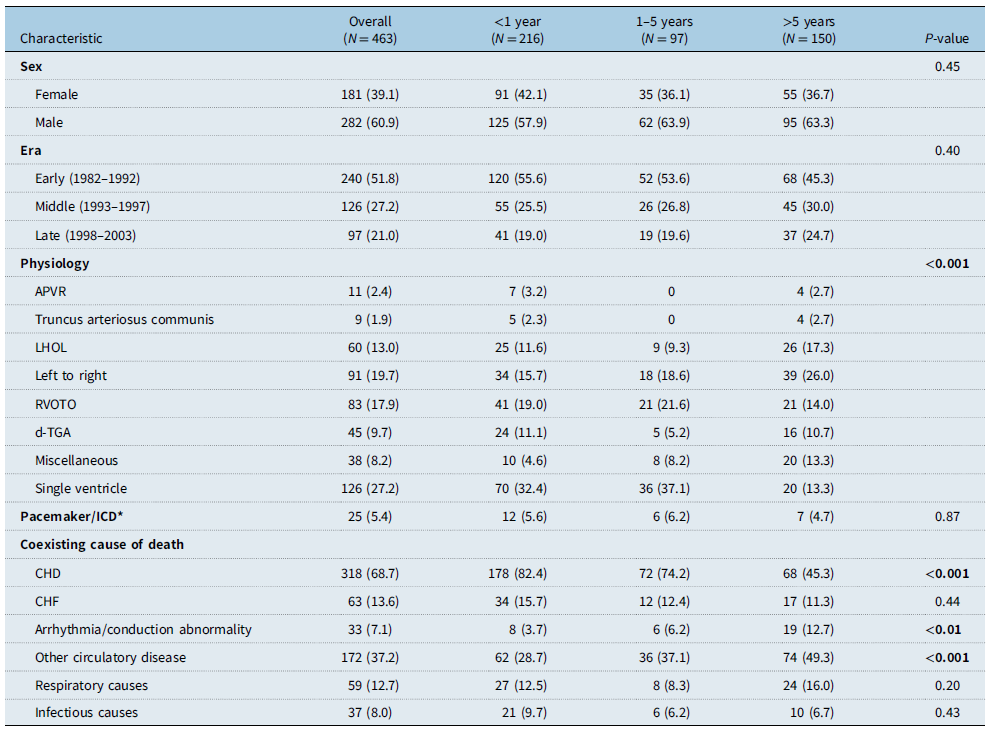
The timing of sudden cardiac death in relation to the first surgery was variable based on the type of heart disease (Table 2) but overall more likely to occur early, with 47% of the sudden cardiac death events taking place in the first postoperative year. Physiology was significantly associated with the timing of sudden cardiac death (p= 0.0001), with single-ventricle patients more likely to experience sudden cardiac death in the first year (32.4%) or the first 1–5 years (37.1%) after their index surgery. The timing of sudden cardiac death did not significantly vary based on sex (p= 0.45), the presence of a pacemaker/implantable cardioverter defibrillator (p= 0.87), or surgical era (p= 0.4) in this cohort. The presence of cardiac comorbidities varied by time from the index surgery, with data showing a higher percentage of patients experiencing sudden cardiac death with arrhythmia or conduction disorders >5 years after their index surgery (p= 0.004). Circulatory disease, another comorbidity group that includes valve disease and endocarditis, was more frequently present in later occurrences of sudden cardiac death (p= 0.0003).
Characteristics of patients in the Pediatric Cardiac Care Consortium with deaths identified with codes consistent with sudden cardiac death

Values in parentheses represent % by columns for each characteristic. Bold fonts indicate statistical significance.
APVR = anomalous pulmonary venous return; LHOL = left heart obstructive lesion; RVOTO = right ventricular outflow tract obstruction; d-TGA = dextro-transposed great arteries; ICD = implantable defibrillator; CHD = congenital heart disease; CHF = congestive heart failure.
* Distribution based on whether the patient is ever known to have pacemaker/ICD placement as retrieved by the Pediatric Cardiac Care Consortium or the information on the death certificate.
Cause-specific standardised mortality ratios for sudden cardiac death demonstrated a heightened risk for sudden cardiac death across all types of CHD over the general US population. Standardized mortality ratios ranged from 8.0 (95% CI: 6.3–9.6) for left-to-right shunts to 107.7 (95% CI: 88.9–126.5) for single-ventricle disease (Figure 1a). The sudden cardiac death-specific standardised mortality ratio decreased steadily over the patient’s life course, ranging from 65.5 (95% CI 55.9–77.9) at <1 year old of age to 5.9 (95% CI: 3.0–8.8) for patients 35–44 years old (Figure 1b). Although there was a gradual decrease in the sudden cardiac death-specific standardised mortality ratio in the more recent surgical eras, this did not reach statistical significance (Figure 1c). The cumulative incidence of sudden cardiac death initially surpasses that of non-cardiac death but exhibits a rapid plateauing, and non-cardiac death becomes more frequent approximately two decades post-congenital heart surgery (Figure 2a). The high incidence of sudden cardiac death is particularly notable in the severe two-ventricle and single-ventricle groups (Figure 2b).
Sudden cardiac death-specific standardised mortality ratio in the Pediatric Cardiac Care Consortium cohort (a) by underlying physiology. d-TGA = dextro-transposition of the great arteries; RVOTO = right ventricular outflow tract obstruction; LHOL = left heart obstructive lesion; APVR = anomalous pulmonary venous return; (b) by age groups; (c) by surgical era. Deaths occurring after 20 years of follow-up were not included in the standardised mortality ratio calculations for surgical eras. This truncation was necessary for making follow-up time comparable among eras.

Cumulative incidence of deaths in the Pediatric Cardiac Care Consortium (a) by death subtype and time since first congenital heart surgery and (b) by severity of congenital heart disease (2V = two ventricles).

Discussion
In this multicentre cohort study of patients with a history of congenital heart surgery in the Pediatric Cardiac Care Consortium, to our knowledge the largest study to date of sudden cardiac death after congenital heart surgery, we found an overall incidence of sudden cardiac death of 7 events per 10,000 patient-years. This rate is comparable to published reports from adult cohorts with CHD Reference Khairy, Silka and Moore8 and higher than what is expected in the general population across all levels of severity of CHD and all age groups examined. Cardiac comorbidities such as heart failure and arrhythmias, which are recognised as independent risk factors for all-cause mortality in CHD patients, Reference Arnaert, De Meester and Troost38 are prevalent among those experiencing sudden cardiac death. Reference Moore, Yu, Kotchetkova, Cordina and Celermajer9
The study shares the limitations typical of any registry-based study, notably the inability to access details beyond what is captured in the registry. As a result, we cannot account for other variables such as social determinants of health that may have contributed to sudden cardiac death in this cohort. Furthermore, inaccuracies in the coding for various causes of death are an inherent challenge, due in part to the generalisable nature of codes capturing sudden cardiac death. Nevertheless, the codes identifying cardiac arrest and ventricular fibrillation are expected to perform similarly in the general population and should therefore be considered valid for comparison purposes between patients with a history of congenital heart surgery and those in the general population. A prior study validated the International Classification of Diseases, 9th revision 427.5 code for cardiac arrest, reporting a sensitivity of 86.5%, specificity of 99.4%, and a positive predictive value of 92% among patients treated in emergency departments after suffering out-of-hospital cardiac arrest. Reference Shelton, Chukwulebe, Gaieski, Abella, Carr and Perman39 Finally, the incidence rates detected in this study align with those described in smaller previous reports, reinforcing the study’s generalisability across a larger population from multiple centres. Reference Oechslin, Harrison, Connelly, Webb and Siu7,Reference Engelings, Helm and Abdul-Khaliq23–Reference Barcella, Christensen and Idorn27
This study overall highlights the strong association between heart failure, cardiac rhythm disorders, and another circulatory disease such as valve dysfunction with the risk of sudden cardiac death. Furthermore, this is the first study to report an increased risk for sudden cardiac death across all CHD severity levels compared to the general population, emphasising the necessity for long-term follow-up for all patients. These results can offer guidance on how to potentially counsel, monitor, and care for patients with all forms of cardiac lesions after surgical repair. These results also show the necessity for cardiologists and cardiac surgeons to pursue lifelong follow-up care with this patient population regardless of their cardiac lesion.
Supplementary material
The supplementary material for this article can be found at https://doi.org/10.1017/S1047951125000277.
Acknowledgements
Data were obtained from Centers for Disease Control and Prevention (CDC) WONDER and National Center for Health Statistics (NCHS). The CDC and NCHS are responsible only for the initial data. The author is responsible for the analysis, interpretation, and conclusion of this manuscript. Graphs were created using Plotly Technologies Inc.
Financial support
The study was supported by the National Heart, Lung, and Blood Institute R01 (HL122392) and the Department of Defense (PR180683).
Competing interests
None of the authors have relevant disclosures or conflicts of interest.