INTRODUCTION
In this paper I will argue that the Peripatos, the pathway that leads around the slopes of the Athenian Akropolis, was not a simple promenade but a distinct cult road, which was re-established as an important cultic path under the aegis of Lykourgos. The pathway unites several smaller sanctuaries on the slopes of the Akropolis and was an integral part of Lykourgos’ programme of construction and renovation. Thanks to restoration work on the Akropolis during the last 30 years, the Peripatos has again become accessible for visitors as well as for archaeologists. It was a long time before anyone reconsidered this ancient path, which belongs to the second half of the fourth century bc (all historical dates mentioned here are, unless otherwise stated, bc), and asked after its true purpose. Is it just a ‘promenade’ that fits well into the general urban plan of the time, or can we identify a specific purpose for the construction of this circuit, in keeping with the politics of the later fourth century? Wolfram Hoepfner, the well-known German architect and archaeologist, has recently published a stimulating and richly illustrated book on this subject (Hoepfner Reference Hoepfner2018). It is to his credit that the pathway around the Akropolis has received renewed attention, since both its purpose and the circumstances of its (re-)construction have been woefully neglected in archaeological and historical research until now. Hoepfner's thesis links the typical ambulatory teaching of Greek philosophers, who often taught their students while walking together, with the arrangement or renovation of places that enabled this form of teaching in the second half of the fourth century (for such ‘ambulatory teaching’, see Hoepfner Reference Hoepfner2018; Montiglio Reference Montiglio2000). In addition to stoai in public squares and the construction of gymnasia (e.g. the Lykeion, to be discussed below), the construction of a circuit on the slope of the Akropolis, the Peripatos, is, in Hoepfner's opinion, to be connected with the philosopher Aristotle, who returned to Athens in 335 to found his school, the famous Aristotelian ‘Peripatos’ (Hoepfner Reference Hoepfner2018, esp. 65–73). Hoepfner accurately dates the Peripatos around the Akropolis to the time of Lykourgos, who, as treasurer of Athens from 338 until his death in 324, had a decisive influence on Athenian politics, and implemented an ambitious programme of construction and renovation.Footnote 1
THE PERIPATOS AND ITS CONTEXT
The original name of the Peripatos and its length are known from an inscription (IG II2 2639), dated to the second half of the fourth century on the basis of the style of letter carving. Today it is barely readable (but see a reproduction by Broneer Reference Broneer1933, fig. 19; cf. also his detailed discussion of the inscription pp. 347–9). It reads:
[τ]οῦ περιπάτο
περίοδος
π(έντε) σ(τάδια) πόδες
ΔΓΙIΙ.
Length of the Peripatos: five stadia and eighteen feet
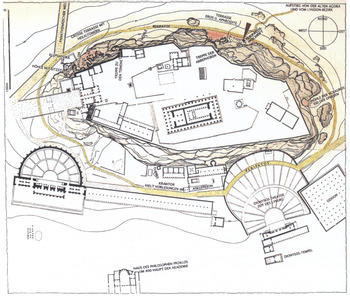
It was discovered in situ on the northern slope, near the junction of the path from the ancient Agora with the Peripatos, close to the sanctuary of Aphrodite and Eros (see Fig. 1). The inscription is cut on the face of a large piece of rock broken away from the Akropolis. It tells us that this pathway, leading around the Akropolis is five stadia and 18 feet long, which is a little over one kilometre. That this enlarged pathway and its inscription belongs to the time of Lykourgos is also suggested by its connection with the Theatre of Dionysos. The earlier theatre evidently had wooden spectator stands, and one of the main tasks of the renovation during the second half of the fourth century was the execution of the koilon in stone. This major building had been renovated and redesigned in the times of Euboulos and Lykourgos, and the latter saw the construction works coming to an end as he held the office of treasurer (until 324). Construction probably began already under Euboulos, probably in the 340s.Footnote 2 This is mentioned in several sources and fits with the archaeological record, since the monument of Thrasyllos, which marks the end of the upper auditorium (epitheatron), is dated to the year 320/19 and marks the terminus ante quem for the completion of building works (IG II3 4, 468). Ps.-Plutarch and Pausanias report that Lykourgos finished the construction of the famous theatre: “καὶ τὸ ἐν Διονύσου θέατρον ἐπιστατῶν [Λυκοῦργος] ἐτελεύτησε” ([Plutarch] Moralia 841c: ‘being made surveyor of the theatre of Dionysos, he finished this building’); “οἰκοδομήματα δὲ ἐπετέλεσε μὲν τὸ θέατρον ἡτέρων ὑπαρξαμένων” (Pausanias 1.29.16: ‘as for buildings, he completed the theatre that others had begun’). This is confirmed by the decree on behalf of Stratocles of 307/6 (IG II2 457, in connection with 3207) honouring Lykourgos, which says of the theatre that the honorand ‘brought it to completion’: “[ … τὸ θέατρον τὸ] Διονυσιακὸν ἐξηργάσα[το]”. The pathway was modified (at least 8m higher than the old path) and integrated into the new construction of the spectator stands. Thus, the Peripatos became an important part of the theatre forming the upper (or, after Papastamati-von Moock Reference Papastamati-von Moock, Csapo, Goette, Green and Wilson2014, the sole) diazoma. Probably an earlier pathway, a kind of ‘pre-Peripatos’, did exist – at least on the southern slope, as Dörpfeld already suggested. But this pathway had not been part of a loop road around the Akropolis, but simply the main public access way to the Akropolis ‘for those people who lived in the eastern quarters of the city’ (Dörpfeld and Reisch Reference Dörpfeld and Reisch1896, 41). During the construction of the new theatre under Lykourgos, the earlier, smaller pathway had been abandoned, and the new Peripatos – now leading all the way round the Akropolis – was prominently integrated into the koilon (see Fig. 1).Footnote 3
The Akropolis with the Peripatos (drawing by H. Hoepfner after J. Travlos).

Thus, it is above all the context of the Theatre of Dionysos on the south-eastern slope of the Akropolis, the construction of which represented one of Lykourgos’ outstanding contributions to the structural renewal of the city, which Hoepfner uses as a convincing argument for associating the inauguration of the circular path with Lykourgos, as have many others, following Dörpfeld. Since the Peripatos is integrated into the theatre building, it must have been planned and built at the same time as the theatre, or at least as its auditorium. Thus, the construction of the Peripatos can be dated safely to the time of Lykourgos (Hoepfner Reference Hoepfner2018, 67).Footnote 4 The important in situ inscription which determines the length of the path (“[τ]οῡ περιπάτο περίοδος”) provides the passer-by with the somewhat redundant formula that this ‘circular path called Peripatos’ must have had a special function. In this context, Hoepfner associates the Peripatos with the philosophers of the time and especially with Aristotle, since references to Peripatoi, walkways and galleries (cf. LSJ s.v.), nearly always suggest a close connection with the philosophical doctrines of Aristotle (Hoepfner Reference Hoepfner2018, 66). The remark by Diogenes Laertius on Aristotle's way of ‘ambulant’ teaching is a famous one: ‘[Aristotle] made choice of a public walk in the Lyceum where he would walk up and down discussing philosophy with his pupils until it was time to rub themselves with oil. Hence the name “Peripatetic”.’ And Apollonios of Tyana Philostratus (Vita Apollonii 1.17) tells us that he deliberately declined to teach in a ‘Socratic way’, i.e. with ironic words, while walking around and arguing: “οὐδὲ εἰρωνευομένου τις ἤκουσεν ἢ περιπατοῦντος ἐς τοὺς ἀκροωμένους”. Accordingly, Hoepfner supposes that the Peripatos around the Akropolis was commissioned to set up a ‘philosophers’ path’ for Aristotle and his students for their ambulatory schooling. In other words, the city as patron provided the infrastructure for academic teaching. But here he is probably wrong. In accordance with Hoepfner, LSJ s.v. translates περιπατέω with ‘walk up and down’ (as in a cloister) in the first place and second ‘walk about while teaching’. But the peri- prefix in the Peripatos of the Akropolis is more appropriate for walking ‘around’ the hill in this context, rather than for the aspect of ambulant teaching. It can hardly have anything to do with Aristotle's Peripatos, which is definitely linked to the Lykeion. As the inscription states, it is just the walkway that leads ‘around’ the Akropolis. Thus, Hoepfner's idea that Antipater, the administrator of the Macedonian Empire (and friend of Aristotle) would have been the one who pulled the strings here and ordered that a philosopher's path should be built for Aristotle is more than far-fetched (Hoepfner Reference Hoepfner2018, 71–2). It is rather difficult to imagine the Imperial Administrator in Pella as the source of ideas for parts of Lykourgos’ ambitious building projects in Athens. Even after the battle of Chaeronea, Athens remained a free city, the institutions of Athenian democracy continued to function in the usual way, and all administrative and internal affairs involving state expenditure, including building projects, were regulated by the Assembly (Zimmermann Reference Zimmermann2010, 18).
THE PURPOSE AND FUNCTION OF THE PERIPATOS IN THE CONTEXT OF LYKOURGOS’ POLITICS
The philosopher's path?
The purpose of this paper is to suggest an alternative interpretation of the circular route, a feature long neglected by archaeology and which, thanks to Wolfram Hoepfner, has been returned to the centre of academic interest. In fact, his book is the first and only treatise on the Peripatos at all. The pathway is rarely treated by scholars, and if it is, the pathway is mentioned only parenthetically. But as it is – at least since the time of Lykourgos – the ‘sole means of access’ to the sanctuaries above the road, as Travlos (Reference Travlos1971, 54) remarks in passing, it should receive closer attention.Footnote 5 The construction of the Peripatos is, in my opinion, a most important project in the context of Lykourgos’ building programme. Even if this path was used by Aristotle and his colleagues and successors after it was set up (e.g. Theophrastus, whose teaching methods were similar), it would have been too by many other Athenians, perhaps for less philosophical and more trivial strolls. Importantly, the Peripatos was not in the first place designed for philosophers.
It may be argued that Lykourgos had a fundamentally positive attitude towards philosophers. He had been a pupil of Plato and had listened to the lectures of Isocrates ([Plutarch] Moralia 841b; Diogenes Laertius 3.46); that there was a ‘mental proximity between Lykourgos and Plato’ was moreover quite recognisable (Engels Reference Engels2008, 18: ‘gedankliche Nähe zwischen Lykurg und Platon’). Accordingly, Hoepfner suggests that the Athenian politician had supported Aristotle on his return in 335 and had acted as his patron to enable the metic to use a plot of land in the Lykeion for his school, writing: ‘the leader of the state, Lykourgos, who attached importance to a comprehensive education of the young, had to have the greatest interest in keeping a famous philosopher like Aristotle in Athens’.Footnote 6 But the property in question would have not been the famous gymnasium-complex in the Lykeion, but a certain ‘Garden of the Muses’, according to Hoepfner. This garden would also be situated in the area of the Lykeion, and it would have contained the famous eponymous Peripatos, that Aristotle ‘chose in the Lykeion’ (Diogenes Laertius 5.2; cf. Hoepfner Reference Hoepfner2018, 60–3). Most scholars, however, identify the Peripatos with the walkway covered with colonnades in the gymnasium of the Lykeion in which the ‘Peripatetics’ taught.Footnote 7 The location of the Lykeion district with its famous gymnasium and palaestra had been, according to the literary sources, outside the city walls, to the east (Strabo 9.1.24; Cleidemus, BNJ 323 F 18; Pausanias 1.19.3 – the latter without any geographical indication, mentioning it together with the Kynosarges gymnasium). The gymnasium must have been situated relatively close to the walls, as Xenophon reports that in 404 the pro-Spartan party gathered, coming from the Piraeus, in the Lykeion and installed catapults on the dromos of the gymnasium in order to crack the city walls (Xenophon Hellenika 2.4.27). This suggests that the dromos could not have been farther than 400 m away from the walls as even most powerful catapults would not be effective over a larger distance (Hoepfner Reference Hoepfner2018, 62). Strabo gives further details, as he mentions an ancient well in front of the gate of Diochares, ‘close to the Lykeion’ (“πλησίον τοῦ Λυκείου”, Strabo 9.1.19). After recent excavations, which uncovered a palaestra, the Lykeion is located near modern Rigillis Street (Knell Reference Knell2000, 182; Lygouri-Tolia Reference Lygouri-Tolia, Stamatopoulou and Yeroulanou2002, esp. 211). The ancient literary, epigraphic, and archaeological evidence indicates that the district of the Lykeion probably covered a large area to the east of the ancient city wall but was not immediately adjacent to the wall. But it is precisely this gymnasium that Lykourgos had rebuilt with a new palaestra in the park-like Lykeion district (Pausanias 1.29.16; [Plutarch] Moralia 841c–d). And this, and not the pathway at the slopes, is where Aristotle's Peripatos is to be located.
Moreover, the Peripatos in the Lykeion was not intended to serve the needs of the famous philosopher in the first place: it was first and foremost connected with the reorganisation (or perhaps the introduction) of the Ephebeia, which was the core of Lykourgos’ political programme. He had introduced a two-year civic service for all young men who had reached the age of eighteen to familiarise them with the political and religious life of the city and to prepare them for their role as citizens. He probably drew on a rather scanty ‘proto-Ephebeia’, which lacked regularity and clear rules, but most scholars agree, that the Ephebeia was introduced in the Lykourgan Age.Footnote 8 The new facility therefore served to train the ephebes, who exercised there during their ‘military service’. ‘Parallel to this development of the Lykeion, there was also the development of the domicile of Aristotle's School of Philosophy’ (Hintzen-Bohlen Reference Hintzen-Bohlen1997, 127), which could use the new infrastructure for its own purposes and thus at least benefit from the renovation, even if Lykourgos had not primarily thought of Aristotle and his school during the planning. The aim of this reform was to integrate the lower classes as recruits and hoplites into a new and more effective system of defence, as Lykourgos was preparing from the beginning for an – inevitable – confrontation with the Macedonians (Habicht Reference Habicht1995, 28–9). In addition, the new institution was intended to foster traditional religious ties to the gods and heroes of Athens (Henderson Reference Henderson2020, 140–68).
Philosophers, however, were generally not very popular in Athens. They had often been outsiders, mostly foreigners, and from the late fifth century onwards they were regularly brought to court on a charge of ‘asebeia’.Footnote 9 In 307/6 a law was brought before the people's assembly that provided for the expulsion of philosophers and the closure of their schools.Footnote 10 Since the time of the Sophists and Socrates they had been regarded as unreliable people, hostile to democracy, despised as ‘spin-doctors’ of oligarchic activities. As Dreßler insinuated in the title of his book, they were ‘word twisters, eccentrics, godless’ and as such always suspect to the people. So it should be asked from the outset whether the ‘building permit’ and financing for a ‘philosophical path’, which was primarily to serve the purpose of promoting philosophical instruction, would have met with approval in the people's assembly that was dominated by the lower classes, regardless of whether Lykourgos, acting as patron of the Stagirian, or even at the behest of Antipater, had planned the circular path for Aristotle.
Just as Aristotle in all probability had only incidentally become a beneficiary of the new building in the Lykeion, which had in fact been built for the training of the ephebes, so he, his successors and philosopher colleagues, as all other citizens of Athens, also benefitted incidentally from the Peripatos on the slope of the Akropolis, which, due to its shady walkway, was ideal for the purpose of ambulatory teaching (Hoepfner Reference Hoepfner2018, 71), but also attractive for promenaders of all kinds.
The Peripatos as cult road
It remains therefore to ask whether the construction of the Peripatos had a different objective. In what follows I would like to suggest that the Peripatos was built as a cult road intended to make the smaller sanctuaries and the shrines in the grottos on the northern slope easily accessible, so that this building measure can be coherently placed in the context of the politics of Lykourgos’ religious innovation programme. With his building programme the Athenian leader gave expression to a ‘religiously founded, militant patriotism’.Footnote 11 The comparatively modest construction of the path on the slope of the Akropolis is not one of the building measures of Lykourgos documented in the sources, but the Peripatos can be conclusively dated to the time of Lykourgos by employing Hoepfner's arguments, namely the Peripatos inscription and the integration of the circular path into the new construction of the auditorium of the Theatre of Dionysos, a structure that had been demonstrably initiated by Lykourgos.
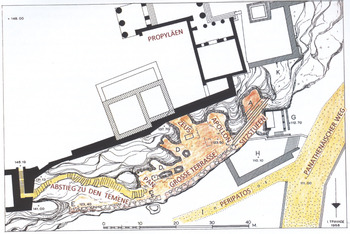
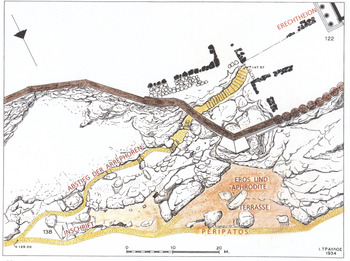
The Peripatos connects a number of places of worship, especially along its northern course, access to which had been much more difficult prior to its establishment (see Fig. 1). The possibility that there might be a connection between these important places of worship – some of them of a certain antiquity – and the Peripatos within the framework of the conservative renewal policy of Lykourgos was neglected by Hoepfner, but it might perhaps be useful in determining the purpose of the Peripatos. On the south side, the Peripatos leads past the shrine of Themis (Pausanias 1.22.1) and the sanctuary of Asklepios, founded after 420 and which was redesigned and extended in the fourth century.Footnote 12 Then it uses the older slope road and continues through the spectator stands of the Theatre of Dionysos in the east. These southern sanctuaries were already quite accessible before the construction of the circular route. The large terrace on the north-western slope, where the Peripatos branches off from the Panathenaic Way, housed several sanctuaries from ancient times, and before the construction of the circuit they were only accessible from within the Akropolis precinct by means of a walkway that led down from the House of the Arrhephoroi. On this plateau there are to be found (from west to east) the cave sanctuaries of Apollo Hypoakraios (Apollo beneath the long rocks), from which Pausanias tells us that the god had intercourse with Kreusa precisely in that cave (B) on the northern slope, Zeus Olympios (probably) and Pan (Pausanias 1.28.4; Fig. 2). The assignments of the deities to the individual grottos (A–D) are largely attested by consecrated reliefs and inscriptions.Footnote 13 Altars in front of the caves are also evidence of intensive cult practice on this terrace. It was only with the construction of the Peripatos that access was facilitated to all of these ancient cult sites. This gave a special advantage to the cult of Pan, which had been established in Athens in 490 after the battle of Marathon (Herodotus 6.105.3; Pausanias 1.28.4). The traditional torchlight procession on the occasion of the annual festival for the shepherd god, that in all likelihood had the sanctuary as its destination (Parke Reference Parke1987, 263), could now use the Peripatos as the route for the procession. Further to the east, near the site of the Peripatos inscription, and near the access to the Peripatos from the old Agora, there is another terrace which, once O. Broneer found an inscription associating the relevant deities with this terrace (IG I3 1382), was identified as the site of the sanctuary of Aphrodite ‘in the gardens’ and of her ‘mate’ Eros.Footnote 14 With this discovery, an enigmatic passage in Pausanias made sense for the first time. This reports that the Arrhephoroi descended, while carrying two unspecified objects, by a natural secret passage from the Akropolis plateau on the occasion of a mysterious ritual, to the sanctuary of ‘Aphrodite in the Gardens’ (1.27.2–3), which, according to the periegetes, was nearby. The passage from the Akropolis leading down east of the Erechtheion had already been discovered in 1897 by P. Kavvadias, and identified with the ‘descent’ mentioned in Pausanias (Fig. 3).Footnote 15 The location of the sanctuary of Aphrodite had, however, been controversial. It was at first located in the distant Ilissos valley, contrary to the statements of Pausanias. It was only the discovery of the inscription IG I3 1382 and votive offerings on the terrace during the American excavations in the 1930s that made it possible to identify the sanctuary mentioned in Pausanias without any doubt (cf. Morgan Reference Morgan1935). Judging by the letter forms, the inscription belongs to the middle of the fifth century, and thus distinguishes the cult as old and rich in tradition. For this important sanctuary, which was associated with the Arrhephoroi, who played an important role in the cult of Athena, it was only the Peripatos that provided comfortable access. However, the only access to these minor sanctuaries was via the staircase of the Arrhephoroi towards the sanctuary of Aphrodite and Eros, and via the staircase leading from the terrace with the caves of Apollo and Pan to a fortified gate in the Akropolis wall. Since traces of an earlier access way to the slopes had been found only at the southern part of the Akropolis (limiting the koilon of the ancient wooden Theatre of Dionysos; cf. Dörpfeld and Reisch Reference Dörpfeld and Reisch1896, 41; Papastamati-von Moock Reference Papastamati-von Moock, Frederiksen, Gebhard and Sokolicek2015), the assumption that there could have been a ‘pre-Peripatos’ also along the northern slope remains speculative. Until the construction of the Peripatos, these sanctuaries could be accessed only from the Akropolis.Footnote 16
The terrace with sanctuaries on the north-eastern slope of the Akropolis (drawing by H. Hoepfner).

The sanctuaries of Eros and Aphrodite with the descent of the Arrhephoroi on the northern slope of the Akropolis (drawing by H. Hoepfner after J. Travlos).

The Aglaureion and the ephebes
Decisive for the argument, however, is the importance of the Aglaureion on the eastern slope, also made accessible by the Peripatos (Pausanias 1.18.2; see Fig. 1).Footnote 17 In the grotto sanctuary of Aglauros, the daughter of Kekrops, the ephebes solemnly swore their annual oath (Demosthenes 19.303; Pollux 8.105–6). If we now consider the importance that the Ephebeia had in Lykourgos’ renewal programme, it becomes clear that comfortable and safe access – especially of processions on holidays – to the hillside shrines, and especially the facilitation of the procession of ephebes to the place where they swore their oath, must have been the reason for the construction of the Peripatos. Before the construction of the Peripatos, the Aglaureion could be reached only by a path leading down from the Akropolis. This steep connection between the Aglaureion and the Akropolis – at that time only an abrupt path – was used by the Persian invaders to enter the Akropolis during the night (Pausanias 1.18.2; Herodotus 8.53.1). But it seems that there had been also another, easier access: Peisistratos’ men, gathered for his coup d’état, advanced – presumably – from the ‘Old Agora’ at the still unidentified sanctuary of the Dioskouroi (the Anakaion), where they secretly took the arms of the citizens and then headed to the Aglaureion to hide the arms there.Footnote 18
The introduction of a military civilian service, the Ephebeia, was at the heart of the policy of renewal that Lykourgos pursued after 338.Footnote 19 As the highest financial administrator, Lykourgos had succeeded in pooling enormous resources and generating an additional income of 1200 talents per year, so that between 14,000 and nearly 19,000 talents flowed through his hands during his terms of office ([Plutarch] Moralia 841b). The surpluses, which were also generated by involving private individuals in public financing plans, could be incorporated into a programme of measures which, in addition to extensive construction work, including monuments, also included the strengthening of democratic institutions and the reorganisation of religious festivals. These might include the financing and reorganisation of the Lesser Panathenaia (IG II3 1, 447), as well as the introduction of the institutionalised Ephebeia. Even when inflation is taken into account, Lykourgos may have had more funds at his disposal than had Perikles, whom he emulated in his construction programme (Hurwit Reference Hurwit1999, 253). His politics can be understood as a planned interlocking of conservative renewal measures. They appear to be ‘a programme which, taken as a whole, was well thought out and consistently implemented, and which, in a return to the Athens of the Pentecontaetia, should ensure greater participation by citizens in public life’ (Will Reference Will1983, 94–5).
The Ephebeia played a central role especially in the context of a policy of citizen participation and the reactivation of a patriotic public spirit. During their two-year service, the young Athenians had to complete an educational programme consisting of military exercises and historical-political instruction, as well as practice in the cult festivals of the polis. The introduction to public cult practice was of great importance: ‘In their role as initiates who were introduced to the social and religious life of the polis, practicing fundamental social activities, and learning ritualised modes of behaviour, the ephebes took part in a broad spectrum of cult festivals, holding processions or torchlight processions, making sacrifices, organizing competitions, and performing weapon dances …’ (Beck Reference Beck, Beck and Wiemer2009, 55–6).
A particularly important moment was the taking of the oath, which after Lykourgos’ reform all young men had to swear solemnly every year on the eastern slope of the Akropolis, in the sanctuary of Aglauros (Demosthenes 19.303; Pollux 8.105–6). The Athenaion Politeia mentions a tour of several sanctuaries at the beginning of ephebic service, immediately after the candidates had been registered in the citizen lists.Footnote 20 At the Aglaureion, possibly the first station of this tour,Footnote 21 all newly registered citizens had to swear an oath of allegiance under arms (Pausanias 1.18.2; Demosthenes 19.303 [with scholion]; Lykourgos 1.76). Aglauros is also the first deity in a whole series who were to be invoked as guarantors of the oath (SEG XXI 519). This cult of the daughter of Kekrops, who threw herself from the Akropolis into the depths and sought self-sacrificial death to save the Polis (Philochoros BNJ 328 F 105), corresponded symbolically with the demands on the ephebes, who in turn were enrolled every year to save the city and defend it (Rhodes and Osborne Reference Rhodes and Osborne2003, 446). Accordingly, the oath was taken every year in the sanctuary of Aglauros, and the myth of the rescue of Athens through the supreme sacrifice was celebrated with this act as an ideal bridge between the ephebes and the cult of Aglauros.Footnote 22 Thus Aglauros became the ‘chief divine patroness of the ephebes’ (Parker Reference Parker2005, 434), the ‘special goddess of the ephebes’ (Merkelbach Reference Merkelbach1972, 279: ‘Sondergöttin der Epheben’) and the mythological exemplar of the male youth: ‘Aglauros, then, who as a heroine continued to have a special interest in victory, had given her life for the city; the ephebes, young and unmarried like her, had to be prepared to do the same’ (Kearns Reference Kearns, Murray and Price1990, 330).
Lykourgos himself regarded the oath of the ephebes as the basis and guarantor of democracy (Lykourgos 1.79). The Ephebeia as the central institution for education and training was the core of his political programme, as can be seen from the fact that at the end of his political career he had an account exhibited on a stele in front of the palaestra in the Lykeion, where the ephebes trained ([Plutarch] Moralia 843f; Mitchel Reference Mitchel1970, 38–9; Will Reference Will1983, 87; Hintzen-Bohlen Reference Hintzen-Bohlen1997, 127). In order to make the Aglaureion a fit venue for this solemn oath for a complete annual cohort of ephebes, which must have included several hundred young men,Footnote 23 the construction of the new Peripatos was, so to speak, a pre-condition. Their march together after their entry into the citizen lists in the company of their elected leaders to the Aglaureion could only take place using the new Peripatos ([Aristotle] Athenaion Politeia 42). This makes the new cult road essential for a core feature of Lykourgos’ new, ‘patriotic’ renewal policy, which began right at the start of the Lykourgan Age in 336 with the introduction of the Ephebeia. The Ephebeia was created as a system of paideia for new citizens, which they acquired through military training and service. Besides the genuine military aspect and the anti-Macedonian stance of the new institution, this system of a complex system of training fits into the overall project of civic renewal that characterised the Lykourgan Age (Henderson Reference Henderson2020, 56). At the same time, by making access easier or even possible at all, the construction of the road allowed the older cults on the slope of the Akropolis to achieve new prominence, as an increase in consecrations in the sanctuary of Aphrodite and Eros is particularly noticeable for the third century (Broneer Reference Broneer1933; Reference Broneer1935; cf. Morgan Reference Morgan1935). This measure was also decisive for the choreography of the processions associated with the cults, which naturally had to use roads and paths. The circular route, which in the western part led to the famous (and wider) Panathenaic Way, had become an important cult route from which the sanctuaries on the slope were served. The torchlight procession to the Pan Sanctuary no longer had to go in single file along the steep and narrow stairs from the Akropolis plateau, and could be arranged into a coherent formation. With the concept of a ring-road which facilitated access to very ancient sanctuaries and cults, Lykourgos also managed to implement another important aspect of his renewal policy: the revival of traditional cults and state religion.
CONCLUSION
Under the leadership of Lykourgos, Athens experienced a civic, military, educational and economic revival. The Athenians devoted considerable attention and money to equipping ancient cults, including the building of sanctuaries and reorganising the financing of many festivals and cult centres. Thus ‘the rebuilding of the religious infrastructure was considered no less important than rebuilding the walls, the ships, and the national economy. State religion was still vital to Athenian society’ (Mikalson Reference Mikalson1998, 44). Against this background, the building of the Peripatos around the slopes of the Akropolis could be sensibly integrated into the renewal policy by Lykourgos. The Peripatos was conceived as an access and processional route for the sanctuaries located along its course, the most important of which was the Lykourgan Aglaureion, where the ephebes gathered every year to swear their oath of allegiance to the city. Aristotle and the ‘Peripatetics’, like many other Athenians, probably liked to use the shady environment for their ambulatory conversations or just for a stroll, but the Peripatos was originally designed in the interests of the gods and not in the interests of philosophy.
ACKNOWLEDGEMENTS
I would like to thank Michael Vickers (Oxford) and Robin P. Symonds (Brăila) for their useful comments on the paper, for their friendship and for their joint efforts to improve my English.