Introduction
The family Allocreadiidae comprises 16 genera with a worldwide distribution (Montes et al. Reference Montes, Arredondo, Croci, Barneche, Reshaid, Ibañez Shimabukuro and Pérez-Ponce de León2025; Solórzano-García et al. 2024). Within the Nearctic and Palearctic regions, allocreadiid diversity is represented by the genera Acrolichanus, Allocreadium, Bunodera, Bunoderella, Crepidostomum, Creptotrema, Megalogonia, Margotrema, and Stephanophiala (Vainutis et al. Reference Vainutis, Voronova and Urabe2021; Mendoza-Garfias et al. Reference Mendoza-Garfias, García-The, Caspeta-Mandujano, Vidal-Martínez and Hernández-Mena2022; Montes et al. Reference Montes, Arredondo, Croci, Barneche, Reshaid, Ibañez Shimabukuro and Pérez-Ponce de León2025). Although Stephanophiala has been revalidated in recent classifications (Vainutis et al. Reference Vainutis, Voronova and Urabe2021), its taxonomic status remains controversial and has not been universally accepted (Atopkin et al. Reference Atopkin2022), requiring further morphological and molecular evidence.
Molecular analyses have significantly advanced the resolution of phylogenetic relationships among several allocreadiid genera, including Crepidostomum and Allocreadium, and have led to the recognition of new genera. Similar taxonomic rearrangements have also occurred in the Neotropical region, where genera such as Allocreadium, Creptotrema, Creptotrematina, Martorellia, Mesoamericatrema, Paracreptotrema, Paracreptotrematoides, Pseudoparacreptotrema, and Wallinia have been recorded (Atopkin et al. Reference Atopkin, Sokolov, Vainutis, Voropaeva, Shedko and Choudhury2020; Aydogdu et al. Reference Aydogdu, Vainutis, Voronova and Aydogdu2023; Dos Santos et al. Reference Dos Santos, Gilbert, Avenant-Oldewage and Dumbo2021; Mendoza-Garfias et al. Reference Mendoza-Garfias, García-The, Caspeta-Mandujano, Vidal-Martínez and Hernández-Mena2022; Pérez-Ponce de León et al. Reference de León G, Pinacho-Pinacho, Mendoza-Garfias, Choudhury and García-Varela2016; Vainutis Reference Vainutis2024; Vainutis et al. Reference Vainutis, Voronova and Urabe2021, Reference Vainutis, Voronova, Urabe and Kazarin2022). The description of new species, the erection of new genera, and recent phylogenetic analyses have clarified the relationships among these taxa, particularly those involving Auriculostoma and Creptotrema (Alves Dias et al. Reference Alves Dias, Pérez-Ponce de León, de Almeida Camargo, Müller, da Silva, Kozlowiski de Azevedo and Abdallah2020; Da silva et al. Reference Da Silva, Dias, Da Silva and Yamada2021; Dias et al. Reference Dias, Müller, De Almeida, Da Silva, De Azevedo, Pérez-Ponce De León and Abdallah2018; Ebert et al. Reference Ebert, Hernández-Mena, Pérez Ponce de León and da Silva2024; Franceschini et al. Reference Franceschini, Aguiar, Zago, Yamada, Ebert and Silva2021; Montes et al. Reference Montes, Arredondo, Croci, Barneche, Reshaid, Ibañez Shimabukuro and Pérez-Ponce de León2025). Several species have been described within Creptotrema, and recent molecular studies including multiple species of the genus have improved our understanding of its phylogenetic relationships within the allocreadiid clade (Aguiar et al. Reference Aguiar, Ebert, Gomes, Teixeira, de Souza and da Silva2024; Alcantara et al. Reference Alcantara, Ebert, Ferreira-Silva, Forti, Morais, Pérez-Ponce de León and Silva2024; Franceschini et al. Reference Franceschini, Aguiar, Zago, Yamada, Ebert and Silva2021; Liquin et al. Reference Liquin, Gilardoni, Cremonte, Saravia, Cristóbal and Davies2022; Montes et al. Reference Montes, Barneche, Croci, Balcazar, Almirón, Martorelli and Pérez-Ponce de León2021). However, these studies consistently indicate that Creptotrema funduli Mueller, Reference Mueller1934, does not belong to that genus. It is currently regarded as a species inquirenda in the World Register of Marine Species (WoRMS 2026).
Creptotrema funduli was originally described by Mueller (Reference Mueller1934) as a parasite of Fundulus diaphanus menona (Jordan and Copeland 1877) from Oneida Lake (New York, USA). Later, Curran et al. (Reference Curran, Pulis, Hugg, Brown, Manuel and Overstreet2012) described and compared specimens assigned to this species from Fundulus notatus (Rafinesque, 1820) collected in the Biloxi River, Harrison County, Mississippi, and provided the first molecular sequence data for the species, which at that time also represented the first sequence available for Creptotrema. Earlier records of the species were reported by Dechtiar and Christie (Reference Dechtiar, Christie and Nepszy1988) and Dechtiar et al. (Reference Dechtiar, Collins, Reckahn and Nepszy1988), who deposited voucher material in museum collections. Additional reports without associated voucher specimens include those of Bangham (Reference Bangham1937, Reference Bangham1940, Reference Bangham1955), Wiles (Reference Wiles1975), and Szalai and Dick (Reference Szalai and Dick1991).
Given the uncertainty regarding the phylogenetic placement of this species, the aim of the present study is to examine voucher material deposited in collections together with the molecular sequences published by Curran et al. (Reference Curran, Pulis, Hugg, Brown, Manuel and Overstreet2012) in order to reassess its systematic position and evaluate its relationships with other allocreadiid genera established since the original description by Mueller (Reference Mueller1934).
Materials and methods
Images were obtained from the seven syntypes specimens deposited by Mueller (Reference Mueller1934) (USNM No. 32543) in the Helminthological Collections of the National Museum of Natural History, Smithsonian Institution (formerly the United States National Parasite Collection), from five voucher specimens deposited by Curran et al. (Reference Curran, Pulis, Hugg, Brown, Manuel and Overstreet2012) in the United States National Parasite Collection, Beltsville, Maryland (USNPC Nos. 105238–105241), and from five voucher specimens deposited in the Gulf Coast Research Laboratory Museum, The University of Southern Mississippi’s, Ocean Springs, Mississippi (GCRL Nos. 3069–3073). Specimens deposited by Dechtiar and Christie (Reference Dechtiar, Christie and Nepszy1988) and Dechtiar et al. (Reference Dechtiar, Collins, Reckahn and Nepszy1988) in the Canadian Museum of Natural Sciences, Ottawa, Canada, could not be located during the present study.
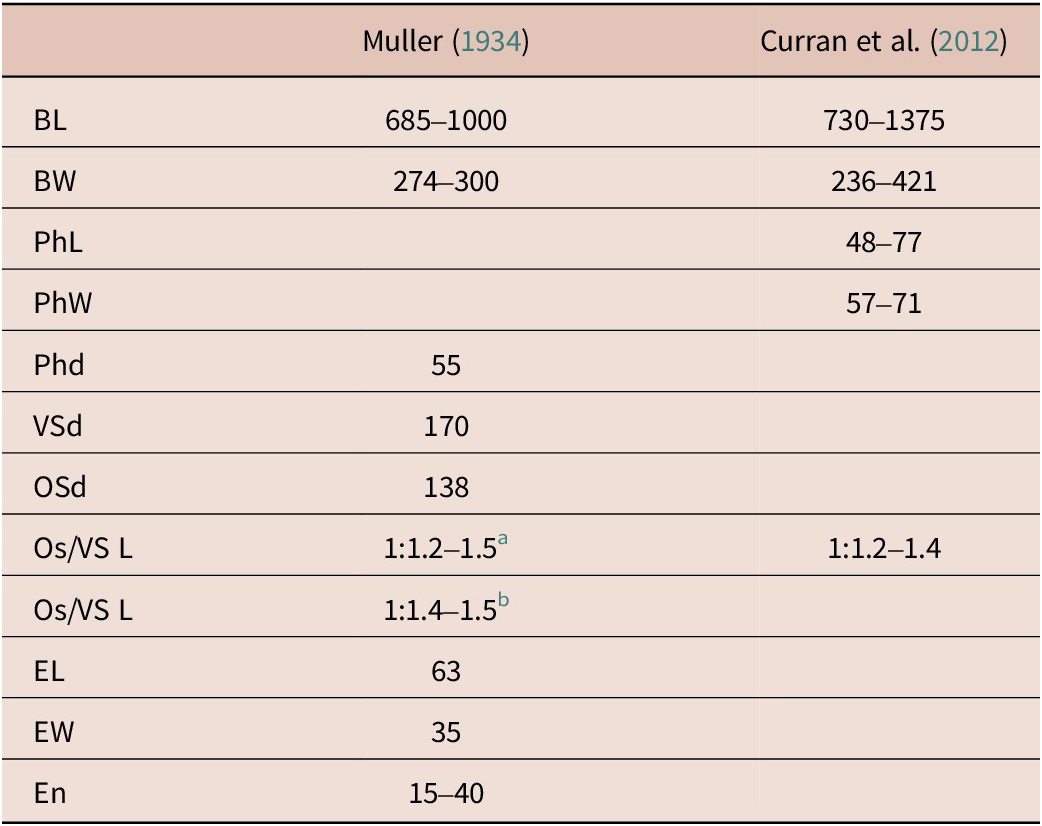
These images were provided by the curators Sara LeCroy (Gulf Coast Research Laboratory Museum) and Anna J. Phillips and Yolanda Villacampa (National Museum of Natural History). Morphometric data for C. funduli were compiled from the original description by Mueller (Reference Mueller1934) and the subsequent redescription by Curran et al. (Reference Curran, Pulis, Hugg, Brown, Manuel and Overstreet2012). Measurements presented in Table 1 correspond to those reported in the original sources. Digital images of type material were examined for general morphological assessment but were not used for morphometric analyses.
Morphometric data of Chuvella funduli comb. nov., reported by Muller (Reference Mueller1934) and Curran et al. (Reference Curran, Pulis, Hugg, Brown, Manuel and Overstreet2012)

Table 1. Long description
The table compares morphometric data from Muller 1934 and Curran et al. 2012.
* B L (body length): Muller reports 685 to 1000; Curran et al. report 730 to 1375.
* B W (body width): Muller reports 274 to 300; Curran et al. report 236 to 421.
* Ph L (pharynx length): Muller has no data; Curran et al. report 48 to 77.
* Ph W (pharynx width): Muller has no data; Curran et al. report 57 to 71.
* Ph d (pharynx diameter): Muller reports 55; Curran et al. have no data.
* V S d (ventral sucker diameter): Muller reports 170; Curran et al. have no data.
* O S d (oral sucker diameter): Muller reports 138; Curran et al. have no data.
* O s / V S L (oral sucker to ventral sucker length ratio): Muller reports 1 to 1.2 through 1.5 (calculated by Curran et al. for syntypes) and 1 to 1.4 through 1.5 (calculated from Muller drawings); Curran et al. report 1 to 1.2 through 1.4.
* E L (egg length): Muller reports 1.4 to 1.5; Curran et al. have no data.
* E W (egg width): Muller reports 35; Curran et al. have no data.
* E n (egg number): Muller reports 15 to 40; Curran et al. have no data.
Abbreviations: BL = body length, BW = body width, EL = egg length, EW = egg width, En = egg number, OSd = oral sucker diameter, PhL = pharynx length, PhW = pharynx width, Phd = pharynx diameter, VSd = ventral sucker diameter.
a Calculated by Curran et al. (Reference Curran, Pulis, Hugg, Brown, Manuel and Overstreet2012) for the syntypes;
b calculated by Curran et al. (Reference Curran, Pulis, Hugg, Brown, Manuel and Overstreet2012) from the Muller drawings.
Phylogenetic analysis
Sequences of the 28S rDNA gene from allocreadiids were retrieved from GenBank and alignments were performed using the online version of MAFFT v.7 (Katoh et al. Reference Katoh, Rozewicki and Yamada2019). The online program Gblocks v.0.91 (Talavera and Castresana Reference Talavera and Castresana2007) was applied with relaxed selection parameters (allowing smaller final blocks, gap positions within the final blocks, and less strict flanking positions) to remove ambiguously aligned and hypervariable regions in the 28S rDNA dataset.
The best-fit nucleotide substitution model was selected using the Bayesian Information Criterion (BIC, Schwarz, Reference Schwarz1978), as implemented in MEGA X (Kumar et al. Reference Kumar, Stecher, Li, Knyaz and Tamura2018), resulting in the GTR+G+I model.
Phylogenetic reconstruction was performed using Bayesian Inference (BI) implemented in MrBayes v.3.2.3 (Ronquist et al. Reference Ronquist, Teslenko, van der Mark, Ayres, Darling, Höhna, Larget, Liu, Suchard and Huelsenbeck2012). Analyses were run using two independent, parallel Metropolis-coupled Markov chain Monte Carlo (MCMC) for 20 million generations each. Topologies were sampled every 1,000 generations, and convergence was assessed by monitoring the average standard deviation of split frequencies until values fell below 0.01. A majority-rule consensus tree was generated after discarding the first 25% of trees as burn-in. Clade support was evaluated using posterior probabilities (PP), with values >0.90 considered strongly supported. The phylogenetic tree was visualised using FigTree v1.4.4 (Rambaut, Reference Rambaut2018) and edited using Adobe Photoshop CS6.
Additionally, uncorrected pairwise p-distances (Nei and Kumar Reference Nei and Kumar2000) were calculated to estimate genetic divergence among lineages using MEGA X.
Results
Chuvella Montes gen. nov.
ZooBank: urn:lsid:zoobank.org:pub:ECF0DBC1-09D3-4189-B9F5-801329711C57
Diagnosis. Body aspinose, oval, widest at midbody at level of ventral sucker, tapering posteriorly. Oral sucker with one pair of muscular lobes. Scattered eyespot remnants present in forebody from below pharynx to level of intestinal bifurcation. Oral sucker smaller than ventral sucker. Pharynx well developed. Prepharynx absent. Oesophagus relatively long and straight. Caeca extending to the level of the posterior testis. Testes slightly irregular or weakly lobed, arranged in tandem. Cirrus sac long, extending from posterior margin of pharynx at level of intestinal bifurcation to posterior margin of ventral sucker, containing a bipartite seminal vesicle; ejaculatory duct unarmed, long and tubular, surrounded by a weakly developed pars prostatica. Genital pore at level of intestinal bifurcation. Ovary globular, entire, dextral or sinistral, posterolateral to ventral sucker. Seminal receptacle postovarian. Laurer’s canal present. Vitelline follicles extending from the level of the pharynx to the posterior margin of the posterior testis, not reaching the posterior end of the body. Uterus mostly limited to the space between the ventral sucker and the anterior testis; in larger worms uterine coils extend to the anterior margin of the posterior testis. Eggs few. Excretory bladder I-shaped. Parasites of the intestine of fundulids (Cyprinodontiformes: Fundulidae), gasterosteids, percids, and umbrids in North America.
Type species. Chuvella funduli (Mueller, Reference Mueller1934) comb. nov.
Type host. Fundulus diaphanus menona Jordan & Copeland, 1877 (Cyprinodontiformes)
Other host. Culea inconstans (Kirtland, 1840) (Gasterosteiformes), Fundulus notatus (Rafinesque, 1820), Fundulus chrysotus (Günther, 1866) (Cyprinodontiformes), Perca flavescens (Mitchill, 1814) (Perciformes), Umbra limi (Kirtland, 1840) (Esociformes)
Type locality. Oneida Lake (New York, USA)
Other locality. Biloxi River (Harrison County, Mississippi), Wayne County (Ohio), Lake Huron, Nova Scotia, Ontario, Manitoba (Canada)
Type material. Seven syntypes deposited in the National Museum of Natural History, Smithsonian Institution (formerly the United States National Parasite Collection) (No. 32543).
Other material. Five specimens deposited in the United States National Parasite Collection, Beltsville, Maryland (USNPC Nos. 105238–105241), and five specimens deposited in the Gulf Coast Research Laboratory Museum, The University of Southern Mississippi, Ocean Springs, Mississippi (GCRL Nos. 3069–3073)
Etymology. The generic name Chuv ella is derived from the prefix ‘Chuv-’, taken from the Klingon term chuv, meaning ‘left behind’ or ‘abandoned’, in reference to the long-standing taxonomic uncertainty surrounding this lineage. The suffix ‘-ella’ is a Latin diminutive ending commonly used in zoological nomenclature to form generic names, added here to conform to the standard latinised generic endings.
Remarks
The combination of characters observed in the examined specimens – particularly the presence of a single pair of muscular lobes on the oral sucker, tandem testes, and the restricted posterior extent of the uterus, caecum, and vitelline follicles (Supplementary Material S1) – does not correspond to any previously recognised genus of Allocreadiidae and justifies the establishment of Chuvella gen. nov. Some features reported by Curran et al. (Reference Curran, Pulis, Hugg, Brown, Manuel and Overstreet2012), including Laurer’s canal and the bipartite seminal vesicle, with its associated ejaculatory duct and pars prostatica, could not be confidently observed in the available images. However, the original description and the redescription provided by Curran et al. (Reference Curran, Pulis, Hugg, Brown, Manuel and Overstreet2012) adequately document these structures and support their inclusion in the generic diagnosis.
The new genus should be compared with allocreadiid genera possessing a single pair of muscular lobes on the oral sucker. This character excludes genera consistently lacking oral sucker lobes, such as Mesoamericatrema, Wallinia, Allocreadium, Margotrema, Paracreptotrematoides, and Paracreptotrema, as well as genera possessing more than one pair of lobes, such as Bunoderella, Crepidostomum, Bunodera, Megalogonia, Acrolichanus, and the controversial Stephanophiala. The genera Bunodera and Pseudoparacreptotrema include species with and without oral sucker lobes; therefore, only those species bearing a single pair of lobes are relevant for comparison with Chuvella gen. nov. Accordingly, the new genus should be compared with Martorellia, Creptotrematina, Creptotrema, and Pseudoparacreptotrema.
The principal character distinguishing Martorellia from Chuvella gen. nov. is the configuration of the vitellarium. In Martorellia, the vitelline follicles form two distinct, non-confluent fields (one anterior and one posterior) whereas in Chuvella gen. nov. the vitelline fields extend from the level of the pharynx to the posterior margin of the posterior testis and do not reach the posterior extremity of the body.
Creptotrematina and Martorellia further differ from Chuvella gen. nov. in having a uterus that extends well posterior to the testes, reaching the posterior end of the body, whereas in Chuvella gen. nov. the uterine coils do not extend beyond the anterior margin of the posterior testis.
In Pseudoparacreptotrema, the testes are symmetrical or opposite, whereas in Chuvella gen. nov. they are arranged in tandem.
Among Creptotrema species possessing tandem testes, the vitelline follicles extend well beyond the testes, reaching the posterior end of the body, whereas in Chuvella gen. nov. they terminate at the level of the posterior testis. Similarly, the intestinal ceca extend beyond the posterior testis in these Creptotrema species, whereas in Chuvella gen. nov. they do not surpass this level.
In both Pseudoparacreptotrema and Creptotrema, the uterus is entirely pretesticular, whereas in larger specimens of Chuvella gen. nov. the uterine coils extend beyond the anterior testis, reaching the anterior margin of the posterior testis (Supplementary Material S2).
Molecular analysis
The 28S dataset comprised 1334 bp and 126 sequences, including allocreadiid sequences available in GenBank from both Old and New World taxa. Owing to the size of the dataset, the resulting topology is presented as Supplementary Material S3. A reduced dataset including only the species most closely related to Chuvella funduli (Mueller, Reference Mueller1934) comb. nov. was constructed, comprising 1264 bp and 57 sequences (Fig. 1).
Phylogram resulting from Bayesian inference (20 million generations) based on partial 28S rDNA sequences, showing the relationships of the Chuvella gen. nov. (represented by its type species Chuvella funduli comb. nov.; shown in bold) with the closest species retrieved from GenBank. Branch support values indicate posterior probabilities (>0.90).

Figure 1. Long description
A rectangular phylogram with branch support values indicated at nodes. The tree is rooted at the bottom by Prosthenhystera gattii (M F 6 6 4 2 2 3).
Moving from top to bottom, the major clades include:
- A large cluster of Creptotrema species, including C. creptotrema, C. guacurarii, C. schubarti, C. tica, C. totonacapanense, C. stenopteri, C. megacetabulare, C. lobata, C. astyanace, C. cruste, C. conconae, and C. ocloya.
- A clade containing Wallinia species: W. anindoi, W. brasiliensis, W. caririensis, W. mexicana, and W. chavarriae.
- A clade containing Creptotrematina species (C. batalhensis, C. saltograndensis, C. aguirrepequenoi) and Martorellia liciae.
- A clade with Mesoamericatrema magnisacculus.
- A clade containing Paracreptotrema species: P. blancoi, P. rosthali, and P. heterandriae.
- A clade containing Pseudoparacreptotrema species: P. axtlaensis, P. yaguezani, P. falciformis, P. macroacetabulatum, and P. pacificum.
- Near the base of the tree, Chuvella funduli comb. nov. (J Q 4 2 5 2 5 6) is shown in bold, positioned as a sister taxon to a clade containing Margotrema (K T 8 3 3 2 7 2) and Megalogonia ictaluri (E F 0 3 2 6 9 4).
Branch support values (posterior probabilities) are frequently 1.00 or above 0.90. A scale bar at the bottom indicates 0.02 substitutions per site. Two horizontal branches near the root contain double slash marks indicating branch shortening.
In the large and reduced analyses, the phylogenetic position of Chuvella funduli (Mueller, Reference Mueller1934) comb. nov. within Allocreadiidae remains weakly supported. In Fig. 1 it clusters with Margotrema (PP = 0.86), and both taxa form a group with Megalogonia ictaluri Surber, 1928 (PP = 0.77). The next closest lineage corresponds to species of Pseudoparacreptotrema (PP = 0.79).
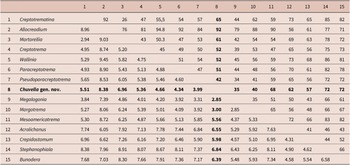
The genetic distance analysis between the new genus and the other allocreadiid genera ranged from 2.85% to 6.96%. The smallest distances were observed with Megalogonia (2.85%, 35 bp), Margotrema spp. (3.00%, 40 bp), Pseudoparacreptotrema (3.99%, 42 bp), and with Creptotrema showed larger distances with 5.36% (52 bp) (Table 2).
Intergeneric genetic distances among all genera included in the phylogenetic analyses. 28S rDNA distances are expressed as percentages below the diagonal and as numbers of nucleotide differences above the diagonal. Sequences of Chuvella gen. nov. are shown in bold.

Table 2. Long description
The table compares 15 genera: 1 Creptotrematina, 2 Allocreadium, 3 Martorellia, 4 Creptotrema, 5 Wallinia, 6 Paracreptotrema, 7 Pseudoparacreptotrema, 8 Chuvella gen. nov., 9 Megalogonia, 10 Margotrema, 11 Mesoamericatrema, 12 Acrolichanus, 13 Crepidostomum, 14 Stephanophiala, and 15 Bunodera.
Nucleotide differences (above diagonal):
- Chuvella (8) shows differences ranging from 35 (with Megalogonia) to 92 (with Allocreadium).
- Other notable differences include Creptotrematina (1) and Martorellia (3) at 26, and Acrolichanus (12) and Crepidostomum (13) at 41.
Percentage distances (below diagonal):
- Chuvella (8) distances range from 2.85 percent (with Megalogonia) to 8.38 percent (with Allocreadium).
- The highest distance recorded is 9.45 percent between Allocreadium (2) and Wallinia (5).
- The lowest distance recorded is 2.85 percent between Chuvella (8) and Megalogonia (9), and between Megalogonia (9) and Margotrema (10).
Discussion
The anatomical characters analysed here, together with the available genetic information, confirm that this taxon belongs to the family Allocreadiidae. When this species was originally described by Mueller (Reference Mueller1934), it represented the second species recognised within the genus Creptotrema after Creptotrema creptotrema Travassos, Artigas, & Pereira, 1928. Later, Curran et al. (Reference Curran, Pulis, Hugg, Brown, Manuel and Overstreet2012) redescribed the species and provided the first – and to date the only – molecular sequence data. These authors reported that specimens collected in Mississippi largely conformed to the generic diagnosis and to the measurements given in the original description. The slight morphometric differences observed between the Mississippi specimens and the type series were attributed to the relatively small sample sizes available for the species. Curran et al. (Reference Curran, Pulis, Hugg, Brown, Manuel and Overstreet2012) also examined the material reported by Dechtiar and Christie (Reference Dechtiar, Christie and Nepszy1988) and Dechtiar et al. (Reference Dechtiar, Collins, Reckahn and Nepszy1988); however, according to the museum curator, this material was never deposited in the collection. Furthermore, although the species has been reported from several hosts and localities, no additional voucher specimens have been deposited in recognised scientific collections.
In the phylogenetic analysis conducted by Curran et al. (Reference Curran, Pulis, Hugg, Brown, Manuel and Overstreet2012), C. funduli appeared clearly separated from what was then identified as Auriculostoma astyanace Scholz, Aguirre-Macedo, & Choudhury, Reference Scholz, Aguirre-Macedo and Choudhury2004. At the time of that study, the genus Auriculostoma had been erected by Scholz et al. (Reference Scholz, Aguirre-Macedo and Choudhury2004) based on differences in the shape and arrangement of the oral sucker lobes. More recently, this genus was synonymised with Creptotrema by Franceschini et al. (Reference Franceschini, Aguiar, Zago, Yamada, Ebert and Silva2021). Subsequent studies that included the sequence published by Curran et al. (Reference Curran, Pulis, Hugg, Brown, Manuel and Overstreet2012) have consistently shown that, particularly after the addition of sequences from confirmed species of Creptotrema, this taxon represents a distinct lineage outside the genus. Consequently, it was suggested that it should be treated as a species inquirenda (WoRMS 2026). However, following the detailed redescription by Curran et al. (Reference Curran, Pulis, Hugg, Brown, Manuel and Overstreet2012), the species is more appropriately regarded as ‘incertae sedis’, as its identity was not in doubt, but its phylogenetic relationships and generic placement within Allocreadiidae remained uncertain. This situation motivated the present study, which re-examined the type material to evaluate the species’s true affinities within the family and determine whether it can be reliably distinguished from other allocreadiid genera.
Although the precise phylogenetic position of Chuvella gen. nov. remains unresolved because its placement receives low posterior probability, the congruence between morphological characters and the observed genetic distances (2.85% to 6.96%) supports its recognition as a distinct genus (Table 2, Supplementary Material S4). These values fall within the range observed among currently recognised allocreadiid genera, which varies from 2.85% (between Megalogonia and Margotrema) to more than 9% in some pairwise comparisons. Although no universal divergence threshold exists for generic delimitation in the Digenea and the 28S rDNA marker is relatively conserved, the observed divergence is consistent with levels of differentiation typically found between genera of Allocreadiidae. The recognition of Chuvella gen. nov. is based primarily on its unique combination of morphological features, with molecular data providing independent support for its distinctiveness.
As knowledge of allocreadiid diversity expands and additional molecular data become available, a clearer understanding of generic boundaries and evolutionary relationships within the family is expected to emerge. In particular, it will be important to analyse specimens currently assigned to Allocreadium from southern South America using molecular methods to determine whether they are correctly assigned to the genus. The establishment of Chuvella gen. nov. highlights the need for a comprehensive reassessment of generic boundaries within Allocreadiidae using integrated morphological and molecular approaches.
Supplementary material
The supplementary material for this article can be found at http://doi.org/10.1017/S0022149X26101904.
Acknowledgements
We are grateful to the Consejo Nacional de Investigaciones Científicas y Técnicas (CONICET) and to CEPAVE for providing facilities and equipment.
We thank the Gulf Coast Research Laboratory Museum, The University of Southern Mississippi, Ocean Springs, and especially Sara E. LeCroy for providing photographs of the material deposited under the numbers Nos. 3069–3073.
We also thank the Smithsonian Institution, National Museum of Natural History, and especially Anna Phillips for her diligence in responding to our inquiries, and Yolanda Villacampa for providing information on the material deposited under the catalogue numbers USNPC Nos. 105238–105241 and USNPC No. 32543.
We are also grateful to Jean-Marc Gagnon, Director of the Beaty Centre for Species Discovery and Curator of the Invertebrate Collection, for the information provided about the samples deposited by Dechtiar and Christie (Reference Dechtiar, Christie and Nepszy1988) and Dechtiar et al. (Reference Dechtiar, Collins, Reckahn and Nepszy1988).
Finally, we thank the reviewers and Editor for their valuable comments and suggestions, which greatly improved the manuscript.
Availability of data and material
The type material is deposited in museum collections, and the associated sequences are available in GenBank.
Author contribution
Martin M. Montes: conceptualization and writing original draft
German Reig Cardarella: Conceptualization, review, and editing
Financial support
This work received no specific grant from any funding agency.
Competing interests
On behalf of all authors, the corresponding author states that there is no conflict of interest.
Ethical standards
The authors assert that all procedures contributing to this work comply with the ethical standards of the relevant national and institutional guides on the care and use of laboratory animals.
Consent to participate
All the authors give their consent to participate in this work.
Consent for publication
All the authors give their consent to the publication of this work.
Code availability
Not applicable.
Use of artificial intelligence
We used AI tools during the preparation of this manuscript exclusively for English language correction. This use has been transparently declared in accordance with the journal’s policy and ethical requirements.