Implications
In wine production areas, great quantities of residues are generated. These materials, particularly rich in a wide range of polyphenols, are used for composing, or discarded in open areas potentially causing environmental and economical problems. A revaluation of these residues is achieved by extracting its bioactive compounds producing grape seed extracts (GSEs), which are important sources of antioxidants. These extracts could be used as natural additives in animal feeds. However, the level up to which GSEs can be included in broiler chicken diets has not hitherto been assessed. This study demonstrates that the inclusion rate of GSEs could amount up to 2.5 g/kg without any adverse effects on growth performance or on protein and amino acid digestibility.
Introduction
Polyphenols were often described in the past as antinutritional factors because they can impact negatively on animal production. However, many in vivo and in vitro studies showed that the intake of proanthocyanidins has many beneficial effects mainly due to their antioxidant and metal-chelating properties (Scalbert and Williamson, Reference Scalbert and Williamson2000). By-products of wine/grape juice processing provide an abundant source of flavonoid compounds. Grape seeds from grape juice and wine processing can be separated, extracted and purified into grape seed extract (GSE), which contains high levels of phenolic compounds (Waterhouse and Walzem, Reference Waterhouse and Walzem1998). A multitude of flavonoids are contained in GSE. The most abundant of these are the proanthocyanidins, which are oligomers of monomeric flavan-3-ol units linked by carbon–carbon bonds. The major flavan-3-ols identified in GSE are (+)-catechin, (−)-epicatechin and epicatechin-3-O-gallate (Santos-Buelga et al., Reference Santos-Buelga, Francia-Aricha and Escribano-Bailón1995). The oligomeric and polymeric proanthocyanidins are commonly known as condensed tannins. During the last decade, experimental and clinical studies demonstrated that proanthocyanidins have variable pharmacological and nutraceutical benefits including improvement of ischaemic cardiovascular disease, prevention of atherosclerosis, anticancer effects, as well as antibacterial, antiviral and antifungal activities (Yamakoshi et al., Reference Yamakoshi, Kataoka, Koga and Ariga1999; Cos et al., Reference Cos, De Bruyne, Hermans, Apers, Berghe and Vlietink2003). Antioxidant effect of grape pomace concentrate and grape seed polyphenolic extract has recently been demonstrated in chickens. Previous experiments in our laboratory (Goñi et al., Reference Goñi, Brenes, Centeno, Viveros, Saura-Calixto, Rebolé, Arija and Esteve2007; Brenes et al., Reference Brenes, Viveros, Goñi, Centeno, Sáyago-Ayerdi, Arija and Saura-Calixto2008, Reference Brenes, Viveros, Goñi, Centeno, Saura-Calixto and Arija2010) reported that the intake of grape by-products increased the antioxidant activity in diet, excreta and meat.
Although nutritional interest in polyphenolic compounds has increased greatly, there is a paucity of information regarding the mechanisms through which these compounds act. The beneficial effects of proanthocyanidins were considered to be due to their free radical scavenging capability and metal-chelating activities (Galati et al., Reference Galati, Lin, Sultan and O'Brien2006; Kim et al., Reference Kim, Ham, Shigenaga and Han2008). Grape seed proanthocyanidins have also been shown to have hypocholesterolemic, antiatherosclerotic and antioxidant effects in rats receiving diets with supplemental cholesterol (Tebib et al., Reference Tebib, Besancon and Rouanet1994; Yamakoshi et al., Reference Yamakoshi, Kataoka, Koga and Ariga1999). Nonetheless, proanthocyanidins have also been reported to be responsible for decreases in growth and nutrient digestibility in humans and rats (Butler and Rogler, Reference Butler and Rogler1992; Chung et al., Reference Chung, Wong, Wei, Huang and Lin1998). Polyphenols, specially condensed tannins, have the ability to aggregate and precipitate proteins and have been shown to impair macronutrient utilisation by forming tannin–protein complexes with both dietary and endogenous proteins (Hagerman and Butler, Reference Hagerman and Butler1980; Jansman et al., Reference Jansman, Frohlich and Marquardt1994).
Because of the increasing interest in the use of natural antioxidant products rich in polyphenols as dietary supplement, the present study was designed to assess the highest concentration of GSE that could be included in chickens’ diets without negatively affecting growth performance and nutrient digestibility. No evidence is available on the potential anticholesterolemic and metal-chelating properties of GSE in chickens. Hence, the aim of the present study was to study the effect of a sustained consumption of a commercial GSE at different concentrations on growth performance, protein and amino acid (AA) digestibility and on plasma lipids and mineral concentrations in chickens.
Material and methods
Tested product
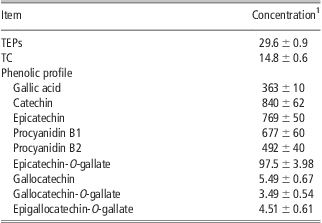
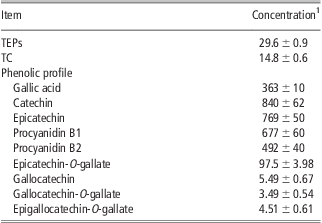
GSE was extracted from grape seed with water and was purchased from Nor-Feed Sud, Angers (France). The composition of phenolic compounds, total extractable polyphenols (TEPs) and tannin content (TC) in GSE are reported in Table 1.
Concentrations of TEPs (g GAE/100 g DM), TC (g cyanidin equivalent/100 g DM) and phenolic profile (mg/100 g DM) in GSE
TEPs = total extractable polyphenols; GAE = gallic acid equivalent; DM = dry matter; TC = tannin content; GSE = grape seed extract.
1Data are the mean of four determinations ± standard deviation.
Birds and diets
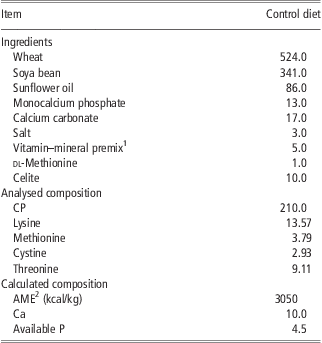
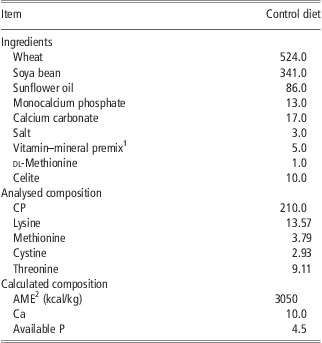
A total of 175 1-day-old male broiler Cobb chicks were housed in electrically heated starter batteries in an environmentally controlled room. The chicks were allocated to 35 pens, each pen containing five chicks, to receive five dietary treatments with seven replicates per treatment for 21 days. Diets in mash form and water were provided ad libitum. Celite, a source of acid insoluble ash (AIA), was added at 10 g/kg to all diets as an indigestible marker. All diets were formulated to meet or exceed the minimum National Research Council (1994) requirements for broiler chickens. At the end of the experimental period, birds were weighed and feed consumption was recorded for feed conversion computation. Experimental procedures were approved by the University Complutense of Madrid Animal Care and Ethics Committee in compliance with the Ministry of Agriculture, Fishery and Food for the Care and Use of Animals for Scientific Purposes. Ingredients and nutrient composition of diets are shown in Table 2. Experimental diets were as follows: (1) Control wheat soya bean diet (C); (2) C + 0.025 g/kg GSE; (3) C + 0.25 g/kg GSE; (4) C + 2.5 g/kg GSE and (5) C + 5 g/kg GSE.
Ingredients and nutrient composition of the control diet (g/kg as fed)
AME = apparent metabolisable energy.
1Vitamin and mineral mix supplied the following per kilogram of diet: vitamin A, 8250 IU; cholecalciferol, 1000 IU; vitamin E, 11 IU; vitamin K, 1.1 mg; vitamin B12, 12.5 μg; riboflavin, 5.5 mg; Ca pantothenate, 11 mg; niacin, 53.3 mg; choline chloride, 1020 mg; folic acid, 0.75 mg; biotin, 0.25 mg; ethoxiquin, 125 mg; dl-methionine, 500 mg; amprol, 1 g; Mn, 55 mg; Zn, 50 mg; Fe, 80 mg; Cu, 5 mg; Se, 0.1 mg; I, 0.18 mg; NaCl, 2500 mg.
2Calculated values (FEDNA Tables, 2003).
Collection of samples and measurements
At 21 days of age, one chick from each replicate was randomly selected after an overnight fast. Plasma was prepared from blood obtained by cardiac puncture for subsequent determination of cholesterol, triglycerides and lipoprotein profile and plasma Cu, Fe and Zn concentrations. Blood was collected in ethylenediaminetetraacetic acid (EDTA) Vacutainer tubes on ice. Tubes were centrifuged at 2500 × g for 15 min at 4°C to obtain plasma. Plasma samples were stored at −20°C until analysed. Thereafter, from five replicates of each treatment, 75 birds (3 birds per replicate) were killed by cervical dislocation and the ileum was excised. For determination of CP and AA digestibility, the ileum was quickly dissected out and the content removed by gentle manipulation into a plastic container and stored at −20°C. Digesta were pooled from the three birds of each replicate. Ileal contents (five replicates per treatment) were freeze-dried and ground (1 mm screen) and subsequently analysed for CP, AAs and Celite.
Chemical analysis
TEPs
TEPs were determined in methanol/acetone/water extracts obtained from GSE. Sample (0.50 g) was placed in a capped centrifuge tube; 20 ml of acidic methanol/water (50 : 50 v/v, pH = 2) was added and the tube was thoroughly shaken at room temperature for 1 h. Thereafter, the tube was centrifuged at 3000 × g for 15 min and the supernatant was separated and kept aside. Twenty millilitres of acetone/water (70 : 30 v/v) was added to the residue, and shaking and centrifugation were repeated. The methanol and acetone extracts were combined and used for determination of polyphenolic content. TEPs were determined following Folin–Ciocalteu procedure (Montreau, Reference Montreau1972), using gallic acid as standard. A mixture of 0.5 ml of extract, 0.5 ml of Folin–Ciocalteu reagent and 10 ml of Na2CO3 1 M was introduced in a 25 ml volumetric flask. After reacting for 1 h, absorbance was measured at 750 nm using an ultraviolet-visible spectrophotometer Hitachi U-2000 (Hitachi, Ltd, Tokyo, Japan). Results were expressed as grams of gallic acid equivalents (GAE) per 100 g of GSE dry matter (DM).
TC
The acidic butanol technique was used to quantify the TC of the extracts (Waterman and Mole, Reference Waterman and Mole1994). A stock solution of 0.07% (w/v) FeSO4.7 H2O dissolved in 95 : 5 (v/v) 1-butanol/HCl was prepared. In a test tube, 7 ml of the stock solution and 0.5 ml of the diluted sample were mixed and heated for 50 min at 95°C. The mixtures were cooled in an ice bath, and the absorbance was measured at 550 nm using an ultraviolet-visible spectrophotometer Hitachi U-2000 (Hitachi, Ltd). The TC was expressed as cyanidin-3-O-glucoside equivalent after the preparation of a standard curve of cyanidin ranging from 0 to 333 mg/l (r 2 = 0.999).
Phenolic profile
Polyphenolic content analyses were performed using an Agilent 1100 series LC (Agilent Technologies, Waldbronn, Germany), comprising quaternary pump with integrated degasser, autosampler, thermostated column compartment and diode array detector, coupled with an Agilent G1946D Quadrupole mass spectrometer (Agilent Technologies, Waldbroon, Germany). Ten microlitres of filtered samples were separated in Gemini C18 5 μm 250 mm × 4.6 mm i.d. column, (Phenomenex Inc., Torrance, CA, USA), eluted with a mobile phase made of a mixture of deionised water and acetonitrile, both containing 0.1% formic acid, at a flow rate of 1 ml/min. Ionisation was achieved by atmospheric pressure electrospray ionisation source, operated in negative ion mode. Selected ion monitoring scan type was used for quantification. Data aquisition and analysis were carried out with an Agilent ChemStation Software. Phenolic yields were expressed as mg per 100 g of GSE DM.
Protein and AAs
CP (method 976.05) was analysed according to the methods of the Association of Official Analytical Chemists International (1995). The AIA content in diets and ileal digesta were measured after ashing the samples and treating the ash with boiling 4 M HCL (Siriwan et al., Reference Siriwan, Bryden, Mollah and Annison1993). AAs were separated using a Beckman Model 6300 autoanalyzer (Beckman Coulter, Monheim, Germany). Detection was carried out at 570 and 440 nm after post-column derivatisation of the AAs with ninhydrin. Three replicates of all analyses were performed. The concentrate samples (100 mg) were hydrolysed with 6 M HCl at 110°C in nitrogen atmosphere for 24 h. The proportion of HCl was 1 ml/mg of protein in the sample. The hydrolysate was filtered through Whatman No. 541 paper and the volume adjusted to 100 ml of solution with Milli-Q water. An amount of 2 ml of the solution was evaporated to dryness in a rotary evaporator at 40°C. The hydrolysate residue was redissolved in 200 μl of 0.2 M citrate buffer (pH 2.2) containing norleucine as internal standard and diluted to 1000 μl with the aforementioned buffer, and 50 μl were injected into the autoanalyser. Tryptophan determination was not possible under the conditions of the analysis used.
Plasma lipids and mineral content
Total cholesterol, cholesterol fractions and triglycerides were measured by a colorimetric enzymatic method (Bayer ADVIA) with the Bayer ADVIA 1650 clinical chemistry analyzer (Bayer Corporation, Tarrytown, NY, USA). Inductively coupled plasma optical emission spectroscopy was used for the measurement of the elements copper (Cu), iron (Fe) and zinc (Zn) in plasma samples (Model JY-24, Jobin Yvon, Longjumeau, Cedex, France). Calibrations for mineral assays were carried out with a series of mixtures containing graded concentrations of standard solutions of each element (Junsei Chemical Co. Ltd, Tokyo, Japan).
Calculations and statistical analysis
Apparent ileal digestibility (AID) of CP and AAs was determined by using the AIA content and calculated by the following formula:
 $$100\% \:{\rm{ - }}\:\left[ {{\rm{100}}\:\times \:\left( {\frac{{{\rm{AIA}}\,{\rm{in}}\,{\rm{feed}}}}{{{\rm{AIA}}\,{\rm{in}}\,{\rm{digesta}}}}\:\times \:\frac{{{\rm{CP}}\,{\rm{or}}\,{\rm{AA}}\,{\rm{in}}\,{\rm{digesta}}}}{{{\rm{CP}}\,{\rm{or}}\,{\rm{AA}}\,{\rm{in}}\,{\rm{feed}}}}} \right)} \right]$$
Data were analysed as a one-way ANOVA using the GLM procedure of SAS (SAS Institute, 2003). Linear and quadratic effects were also analysed. Significant differences among treatment means were determined at P < 0.05 by Duncan's multiple-range test. Pen served as experimental unit for performance and digestibility values, whereas for plasma lipid and mineral concentrations the experimental unit used was the bird.
Results
Characterisation of GSE
The extractable polyphenols, TC and concentration of individual phenolic compounds identified by HPLC in GSE are reported in Table 1. Among the identified polyphenols, catechin was the most abundant compound followed by epicatechin, procyanidins B1 and B2, gallic acid and epicatechin-O-gallate. Gallocatechin, gallocatechin-O-gallate and epigallocatechin-O-gallate were present at lower concentrations.
Performance
The effects of dietary supplementation of GSE on performance are shown in Table 3. Performance was not affected by dietary treatment except in the case of birds fed the highest GSE concentrations, which showed a reduction in BW gain (up to 5.7%; P < 0.05; quadratic effect, P = 0.05) and an increase of feed conversion (up to 5.5%; P < 0.01; quadratic, P = 0.01) compared with the control diet.
Effect of dietary GSE on the performance of broiler chickens at 21 days of age

GSE = grape seed extract.
a,bMeans in a row with different superscripts differ significantly (P < 0.05).
1Each value represents the mean of seven replicates (five birds per replicate).
2Type of response because of dietary percentage of GSE; ns, no significant effect (P > 0.05).
Protein and AA digestibility
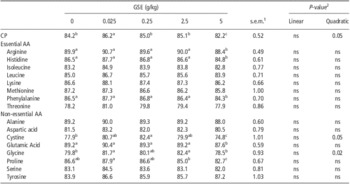
Apparent ileal protein and AA digestibility are reported in Table 4. Birds fed 0.025 g/kg GSE diets had higher (P < 0.05) protein AID than those fed the control diet. However, a reduction (P < 0.05) in protein AID was observed in birds fed 5 g/kg GSE as compared with those birds fed the control diet. Similarly, a negative quadratic effect (P = 0.05) was observed in protein AID with increasing dietary GSE.
AID (%) of protein and essential and non-essential AA of broiler chicks fed grape seed extract from 1 to 21 days of age

AID = apparent ileal digestibility; AA = amino acid; GSE = grape seed extract.
a,b,cMeans in a row with different superscripts differ significantly (P < 0.05).
1Each value represents the mean of five replicates (three birds per replicate).
2Type of response because of dietary percentage of GSE; ns, no significant effect (P > 0.05).
The inclusion of the highest concentration (5 g/kg of GSE) in the chicken diets caused a significant reduction (P < 0.05) on the AID of arginine, histidine, phenylalanine, cystine, glutamic acid and proline compared with the control diet. A quadratic response was observed in cystine and glycine AID with increasing dietary GSE (P < 0.05).
Plasma lipids and mineral content
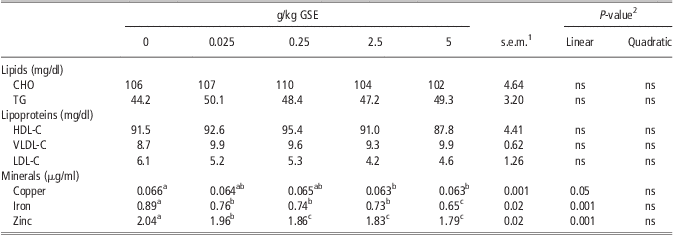
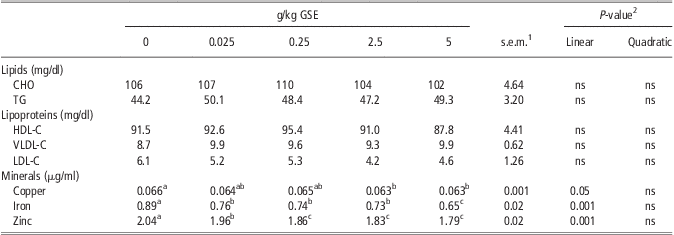
The effect of GSE dietary inclusion on plasma cholesterol, triglycerides and lipoprotein profiles is reported in Table 5. The addition of increasing levels of GSE in the chicken diets did not change the plasma parameters analysed.
Effect of dietary GSE on plasma parameters in broiler chicks at 21 days of age.
GSE = grape seed extract; CHO = cholesterol; TG = triglycerides; HDL = high-density lipoprotein cholesterol; VLDL = very-low-density lipoprotein cholesterol; LDL = low-density lipoprotein cholesterol.
a,b,cMeans in a row with different superscripts differ significantly (P < 0.05).
1Data are means of seven chicks for each treatment.
2Type of response because of percentage of GSE in diet; ns, no significant effect (P > 0.05).
The effects of dietary supplementation of GSE on plasma mineral content are summarised in Table 5. The inclusion of graded concentrations of GSE in the chicken diets caused a significant decrease in the concentrations of plasma copper (up to 4.5%; P < 0.05; linear, P = 0.05), iron (up to 27%; P < 0.001; linear, P = 0.001) and zinc (up to 12.3%; P < 0.01; linear, P = 0.001) at 21 days of age compared with animals fed the control diet.
Discussion
Extractable polyphenols, TC and the phenolic profile of the GSE used in the present study were similar to those obtained by other authors (Davidov-Pardo et al., Reference Davidov-Pardo, Arozarena and Marín-Arroyo2011) who analysed different GSEs by spectrophotometry and HPLC. Among the quantified phenolic compounds present in GSE, monomers (catechin and epicatechin) were the most abundant, followed by dimers (procyanidin B1 and B2). The compounds that showed the lowest amounts were the galloylated group (gallocatechin, gallocatechin-O-gallate and epigallocatechin-O-gallate), except the epicatechin-O-gallate, which was also predominant in grape seed, as it has been previously reported (Santos-Buelga et al., Reference Santos-Buelga, Francia-Aricha and Escribano-Bailón1995).
Few data are available in the literature in relation to the use of grape polyphenol extracts in chicken feeding. Lau and King (Reference Lau and King2003) reported growth depression in chickens fed high dietary concentrations (up to 10 g/kg) of GSE containing a polyphenolic amount of 85.4 g GAE/100 g and resulting in a dietary concentration of 8.5 g GAE/kg. Nevertheless, Hughes et al. (Reference Hughes, Brooker and Smyl2005) reported that dietary levels of GSE up to 10 g/kg did not affect chick performance. Differences in the polyphenolic content of GSE may explain these contradictory results. In the current experiment, dietary concentration of GSE as low as 5 g/kg also caused a detrimental effect on growth performance. The total polyphenolic content in 5 g/kg GSE diet resulted in a dietary concentration of 1.5 g GAE/kg because GSE only contained 29.6 g GAE/100 g (Table 1). However, previous data obtained by the authors (Brenes et al., Reference Brenes, Viveros, Goñi, Centeno, Saura-Calixto and Arija2010), using the same dietary concentration of g GAE/kg with a different commercial GSE (45.5 g GAE/100 g), did not affect growth performance. In addition to the total polyphenolic concentration in the diet, differences in the dietary polyphenolic profile among the different GSEs used in the latter experiments may explain these differences. Results of the present study also indicated that concentrations of polyphenols up to 0.75 g GAE/kg (2.5 g/kg of GSE) did not affect growth performance. In order to recommend an inclusion level of GSE in chicken diets, it is important to characterise the polyphenolic profile of the different commercial GSEs. Vinification processes, extraction methods, grape variety, agronomic and environmental factors affect the concentrations and proportions of various polyphenols present in GSEs.
The dietary effect of polyphenols has also been studied in chickens using ingredients like sorghum and faba bean. In general, relatively high dietary concentrations of polyphenols obtained with the supplementation of these ingredients reduced the performance of chickens, as well as that of other livestock (Jansman et al., Reference Jansman, Huisman and van der Poel1989; Nyachotti et al., Reference Nyachotti, Atkinson and Leeson1997).
The presence of polyphenolic compounds in the diet may have some adverse effects mainly associated with lower efficiency of nutrients, particularly protein and AAs, inhibition of digestive enzymes and increased excretion of endogenous protein (Butler and Rogler, Reference Butler and Rogler1992; Jansman et al., Reference Jansman, Frohlich and Marquardt1994). Polyphenols bind to protein because of the interaction of their reactive hydroxyl groups with the carbonyl groups of protein. As a consequence of this complexation, protein and AA digestibility were reduced by the inclusion in chickens’ and pigs’ diets of sorghum and faba bean polyphenols (Jansman et al., Reference Jansman, Huisman and van der Poel1989; Ortiz et al., Reference Ortiz, Centeno and Treviño1993). In the present experiment, inclusion levels of GSE up to 2.5 g/kg did not affect the AID of protein or AAs negatively. However, in parallel with the worsening observed in growth performance, the highest level of dietary inclusion of GSE reduced the AID of CP and that of some essential (arginine, histidine, phenylalanine) and non-essential (cystine, glutamic acid and proline) AAs. This reduction was particularly marked for proline. These results are in accordance with those reported in rats by Jansman et al. (Reference Jansman, Frohlich and Marquardt1994), using faba bean with high content of condensed tannins. Tannins from faba bean increase the secretion of proline-rich proteins by the rat parotid gland that results in a decrease in the apparent caecal digestibility of the non-essential AAs, proline, glycine and glutamic acid.
Because dietary polyphenolic compounds present metal-chelating activities, a high intake of these bioactive substances may have consequences on iron status and other metals that could interact with iron as zinc and copper. Our results showed a significant reduction in plasma iron with dietary GSE supplementation. These results were consistent with the studies of Cook et al. (Reference Cook, Reddy and Hurrell1995) and Marouani et al. (Reference Marouani, Chahed, Hedhili and Hamdaoui2007) that showed that red wine, tea and other beverages rich in polyphenolic compounds inhibited the absorption of non-heme iron. In addition, in line with our results, supplementation of tannic acid (gallotannin) in the diets of weanling pigs and rats induced the formation of stable polyphenol/iron complexes in the gut having a negative impact on plasma iron concentration (Afsana et al., Reference Afsana, Shiga, Ishizuka and Hara2004; Lee et al., Reference Lee, Shinde, Choi, Kwon, Lee, Pak, Cho and Chae2010). Nevertheless, the precise mechanism by which bioactive dietary polyphenolic compounds inhibit iron metabolism has not been delineated. Recently, Kim et al. (Reference Kim, Ham, Shigenaga and Han2008) and Ma et al. (Reference Ma, Eun-Young and Okhee2010) showed an inhibition in the non-heme iron absorption by reducing the basolateral iron exit rather than decreasing apical iron import in intestinal cells. Although the polyphenols have a negative effect on iron status, evidence suggests that the reduction of iron absorption may protect tissues against damage caused by oxygen free radicals and ion-dependent metal lipid peroxidation. It has been demonstrated that extract procyanidins may have biological effects protecting biomolecules from possible oxidative damage during digestion, sparing other antioxidants (vitamin E) and enhancing the overall antioxidant status of tissue (Frank, Reference Frank2005; Goñi et al., Reference Goñi, Brenes, Centeno, Viveros, Saura-Calixto, Rebolé, Arija and Esteve2007; Brenes et al., Reference Brenes, Viveros, Goñi, Centeno, Sáyago-Ayerdi, Arija and Saura-Calixto2008).
The influence of proanthocyanidins and other polyphenols on the gut absorption of metal ions other than Fe is less documented, although the available information suggests that polyphenols can chelate other oligoelements and may affect their availability for absorption (Coudray et al., Reference Coudray, Bousset, Pepin, Tressol, Bellanger and Rayssiguier1998). In the current experiment, a reduction of Cu and Zn in plasma was observed in birds fed GSE diets. The influence of tea polyphenols on copper absorption has been studied in rats (Greger and Lyle, Reference Greger and Lyle1988), reporting different results depending on the polyphenol compounds used. It is not clear whether dietary polyphenols affect zinc status. Greger and Lyle (Reference Greger and Lyle1988) and Zeyuan et al. (Reference Zeyuan, Bingying, Xiaolin, Jinming and Yifeng1998) reported a decrease in zinc absorption in rats fed tea. By contrast, a lack of effect on Zn bioavailabilty was reported in humans after tea, wine and beer consumption (Ganji and Kies, Reference Ganji and Kies1994).
The inclusion of graded concentrations of GSE did not affect the concentration of plasma cholesterol, triglycerides or cholesterol fractions. Several studies developed in hypercholesterolemic animal models and human subjects have reported a significant reduction in plasma total cholesterol and in low-density lipoprotein cholesterol, and an improvement in the endothelial function after supplementation with proanthocyanidins (Tebib et al., Reference Tebib, Besancon and Rouanet1994; Stein et al., Reference Stein, Keevil, Wiebe, Aeschlimann and Folts1999; Bladé et al., Reference Bladé, Arola and Salvadó2010). The fact that the present experiment was conducted in normocholesterolemic chicks, and that 21-day-old birds present a lower cholesterol circulating levels than 40-day-old birds (Jin et al., Reference Jin, Ho, Abdullah and Jalaludin1998), might contribute to explain the lack of effect on plasma lipids obtained with dietary GSE addition. A laying hen or a cholesterol-fed chick would be a better avian model to assess a putative hypocholesterolemic agent.
In conclusion, the results presented in the current study demonstrated that incorporation of GSE in chicken diets up to 2.5 g/kg (0.75 g GAE/kg) had no adverse effect on growth performance or on protein and AA digestibility. Feed conversion was reduced, and growth rate was retarded, when chickens were fed 5 g/kg of GSE. This study also indicated that grape polyphenols reduce free plasma mineral concentrations. The reduction on iron plasma content may partially explain the antioxidant activity of this extract.
Acknowledgements
The authors wish to thank the Spanish Ministry of Science and Innovation (MICINN, Spain) and Comunidad Autónoma de Madrid (CAM) for financial support of this investigation, Projects AGL2009-07417/GAN and S2009/AGR-1704 (NEWGAN), respectively. S. Chamorro was supported by a post-doctoral contract (JAE-Doc) from the Spanish Research Council (CSIC).