1 Introduction
The winds of plasma from astrophysical objects attract the attention of researchers because the winds produce a rather wide spectrum of the exotic phenomena observed in the Universe. The physics of the winds is not clear in many respects. One of the mysterious objects in this regard is the wind of relativistic plasma from pulsars. These winds carry out almost all the rotational energy from pulsars and produce pulsar nebulae at the interaction of the winds with the interstellar medium (Goldreich & Julian Reference Goldreich and Julian1969; Michel Reference Michel1969; Rees & Gunn Reference Rees and Gunn1974; Kennel & Coroniti Reference Kennel and Coroniti1984). One of the unsolved problems is that of the transformation of the magnetic field energy into the energy of bulk motion of the winds. This is the so-called
 ${\it\sigma}$
problem (Arons Reference Arons2004; Kirk, Lyubarsky & Petri Reference Kirk, Luybarsky and Petri2009). In recent years all attempts to solve this problem have been focused on the current sheets, because they are sites where an intensive dissipative process could take place. It is widely believed that the rest of the flow can be considered in the ideal magnetohydrodynamics (MHD) approximation. However, it is not evident that the ideal MHD can be applied to describe cold relativistic pulsar winds everywhere. To our knowledge, analysis of the applicability of the ideal MHD approximation to the physics of cold pulsar winds has been performed in Ardavan (Reference Ardavan1976), Melatos & Melrose (Reference Melatos and Melrose1996), Koide (Reference Koide2009) and to some extent in Beskin & Rafikov (Reference Beskin and Rafikov2000). In this work we return to the problem of the applicability of the one fluid MHD approximation to the pulsar winds and focus attention on the problem of the excitation of the electric currents in the collisionless plasma.
The conventional approach for the derivation of equations for the dynamics of plasma in the ideal MHD approximation is based on the consideration of the plasma with finite electric conductivity in the limit when the conductivity goes to zero (Ahiezer, Ahiezer & Polovin Reference Ahiezer, Ahiezer, Polovin, Sitenko and Stepanov1974; Plovin & Demutskii Reference Polovin and Demutskii1990). In this approach the electric currents in the plasma are excited by extremely small electric fields. In other words a small deviation
 ${\it\delta}\boldsymbol{E}$
of the electric fields from
 $\boldsymbol{E}=-[\boldsymbol{v}\times \boldsymbol{B}]$
(from perfect frozen-in condition) results in electric currents sufficient to produce the magnetic field. This deviation of the electric field is not usually taken into account in the equations due to its smallness.
In this work we consider the problem of the basics of ideal MHD from another starting point. We assume collisionless plasma from the very beginning. The motion of the charged particles is considered in the so-called drift approximation. We show that the ideal MHD dynamics of the plasma is exactly equivalent to the drift motion of the charged particles in the crossed electromagnetic field. The frozen-in condition is fulfilled perfectly in the collisionless case provided that the frequency of variation of the fields is much less than the plasma frequency. This approach is similar to the approach used for the derivation of equations of MHD in a force-free limit (Beskin, Gurevich & Istomin Reference Beskin, Gurevich and Istomin1983). However, we take into consideration the inertial drift of the particles. It appears that the inertial drift is responsible for the excitation of the electric currents in the plasma.
This conclusion makes us consider the physics of the cold relativistic winds from pulsars from another point of view. The very existence of the electric currents in the winds draws us to conclude that the plasma must move with acceleration. In particular, the poloidal electric currents in the model of the aligned split monopole are excited due to the collimation of the plasma to the axis of rotation. The collimation is very weak in the limit of highly relativistic plasma
 ${\it\Gamma}\gg 1$
irrespective of the value of the Poynting flux. Nevertheless, this collimation is enough to provide the volume densities of the electric currents following from the MHD solution to this problem.
2 Drift approximation
The drift approximation for the motion of charged particles in magnetic fields has attracted the attention of theoreticians in connection with the development of technology for the magnetic trapping of plasma for nuclear fusion. The motion of the particles is presented as a sum of the slow drift of the leading centre of the particles and the fast rotation of the particles in the magnetic field. A specific method of averaging of the fast rotation of particles was developed which resulted in the equations of motion of the leading centre of the particles (Morozov & Solov’ev Reference Morozov, Solov’ev and Leontovich1963; Sivukhin Reference Sivukhin and Leontovich1963; Bogolubov & Mitropolsky Reference Bogolubov and Mitropolsky1974). In the present work a limiting case of a cold plasma is considered. This means that the fast cyclotron rotation of the particles can be neglected and the motion of the particles can be presented only as the drift motion. The analysis of the drift approximation becomes especially simple in this case. Here we will consider only electron–positron plasma. All the results obtained in the work can be extended easily to the electron–ion plasma without any problems.
It is convenient to separate the drift motion of the particles into charge-dependent and charge-independent parts. The motion of the particles in the crossed electric
 $E$
and magnetic
 $B$
fields can be considered as the charge-independent drift with the velocity
 $$\begin{eqnarray}\boldsymbol{V}=\boldsymbol{v}_{b}+\boldsymbol{v}_{d},\end{eqnarray}$$
where
 $\boldsymbol{v}_{b}$
is the velocity of motion of the particle along a field line and
 $\boldsymbol{v}_{d}$
is the velocity of drift across the magnetic field in the crossed electric and magnetic fields. The velocity
 $\boldsymbol{v}_{d}$
can be comparable with the velocity
 $\boldsymbol{v}_{b}$
and we cannot neglect it. The velocity of the electric drift is defined by the equation
 $$\begin{eqnarray}\boldsymbol{v}_{d}=\frac{[\boldsymbol{E}\times \boldsymbol{B}]}{\boldsymbol{B}^{2}}.\end{eqnarray}$$
Hereafter we measure velocity in the units of light velocity. This velocity does not depend on the electric charge of the particle. Of course this type of dynamics of the particles, which looks similar to Aristotelian mechanics, takes place only if the temporal variation of the electric and magnetic fields is relatively slow. The condition when the electric drift takes place is evident. The frequency of the field variation
 ${\it\omega}_{field}$
should be much less the frequency of the Larmour rotation
 ${\it\omega}_{b}=e\boldsymbol{B}/mc{\it\gamma}$
.
According to (2.1) the motion of the particles in this approximation satisfies the equation
 $$\begin{eqnarray}\boldsymbol{E}+[\boldsymbol{V}\times \boldsymbol{B}]=0,\end{eqnarray}$$
which coincides with the so-called frozen-in condition in ideal MHD. Velocity
 $\boldsymbol{V}$
does not coincide with the total velocity of plasma
 $\boldsymbol{v}_{t}$
. According to the equation of motion
 $$\begin{eqnarray}mc\frac{\text{d}{\it\gamma}\boldsymbol{v}_{t}}{\text{d}t}=e(\boldsymbol{E}+[\boldsymbol{v}_{t}\times \boldsymbol{B}]),\end{eqnarray}$$
no forces affect the particles if
 $\boldsymbol{v}_{t}=\boldsymbol{V}$
. At the same time the particles move with acceleration in the non-uniform electromagnetic field (see (2.2)). This means that along with the electric drift there should exist so-called inertial drift, and the total velocity of the particle equals
 $$\begin{eqnarray}\boldsymbol{v}_{t}=\boldsymbol{V}+\boldsymbol{v}_{in},\end{eqnarray}$$
where
 $\boldsymbol{v}_{in}$
is the velocity of the inertial drift. The equation for the inertial drift velocity has the form
 $$\begin{eqnarray}mc\frac{\text{d}{\it\gamma}^{\pm }\boldsymbol{v}_{in}^{\pm }}{\text{d}t}=\pm e[\boldsymbol{v}_{in}^{\pm }\times \boldsymbol{B}]-mc\frac{\text{d}{\it\gamma}^{\pm }\boldsymbol{V}}{\text{d}t}.\end{eqnarray}$$
Here the upper index
 $+$
refers to positrons and
 $-$
to electrons;
 ${\it\gamma}$
is the Lorentz factor of the particles. The solution of (2.6) can be expanded on the parameter
 $R_{b}/R_{c}$
, where
 $R_{b}=mc^{2}\boldsymbol{U}/e\boldsymbol{B}$
is the Larmour radius of the particle and
 $R_{c}$
is the curvature radius of the trajectory of the particle. The first term in the expansion equals
 $$\begin{eqnarray}\boldsymbol{v}_{in}^{0}=\frac{mc}{e\boldsymbol{B}^{2}}\left[\boldsymbol{B}\times \frac{\text{d}\boldsymbol{U}}{\text{d}t}\right].\end{eqnarray}$$
Here we have replaced the Lorentz factor of the particles
 ${\it\gamma}^{\pm }$
with the Lorentz factor of the drift motion
 ${\it\Gamma}=1/\sqrt{(1-\boldsymbol{ V}^{2})}$
which is charge-independent. Then
 $\boldsymbol{U}={\it\Gamma}\boldsymbol{V}$
. The conditions when this is allowed are discussed in the next section. The ratio of the velocity of the inertial drift to the velocity of the particles is
 $$\begin{eqnarray}\frac{\boldsymbol{v}_{in}^{0}}{\boldsymbol{V}}=\frac{R_{b}}{R_{c}}=1.7\times 10^{-8}\left(\frac{{\it\Gamma}}{10^{3}}\right)\left(\frac{10^{6}\,G}{\boldsymbol{B}}\right)\left(\frac{10^{8}\,\mathit{cm}}{R_{c}}\right).\end{eqnarray}$$
This ratio is rather small in the conditions of pulsar winds. For the wind from the Crab pulsar this ratio is of the order of
 $10^{-8}$
and does not change with distance provided that
 ${\it\Gamma}\sim 10^{3}$
and if
 $R_{c}\sim r$
, where
 $r$
is the distance to the pulsar. Therefore, the condition of the drift motion
 $R_{b}\ll R_{c}$
is fulfilled in the pulsar magnetosphere very well.
The equation for the first correction to the velocity of the inertial drift has the form
 $$\begin{eqnarray}mc\frac{\text{d}\boldsymbol{U}}{\text{d}t}=e[\boldsymbol{v}_{in}^{0}\times \boldsymbol{B}].\end{eqnarray}$$
Equation (2.7) is evidently the solution of this equation. It can be rewritten in the form
 $$\begin{eqnarray}mc\frac{\text{d}\boldsymbol{U}}{\text{d}t}=\pm e(\boldsymbol{E}+[\boldsymbol{v}_{t}^{\pm ,0}\times \boldsymbol{B}]),\end{eqnarray}$$
where now
 $\boldsymbol{v}_{t}^{0}=\boldsymbol{V}+\boldsymbol{v}_{in}^{\pm ,0}$
.
Let us define the volume density of the electric charge of the plasma as
 $$\begin{eqnarray}q=e(n^{+}-n^{-}),\end{eqnarray}$$
where
 $n^{+}$
and
 $n^{-}$
are the densities of the positively and negatively charged particles. The density of the electric current is defined as
 $$\begin{eqnarray}\boldsymbol{j}=e(n^{+}\boldsymbol{v}_{t}^{+,0}-n^{-}\boldsymbol{v}_{t}^{-,0}).\end{eqnarray}$$
This expression can be presented in another form:
 $$\begin{eqnarray}\boldsymbol{j}=q\boldsymbol{V}+e(n^{+}\boldsymbol{v}_{in}^{+,0}-n^{-}\boldsymbol{v}_{in}^{-,0}).\end{eqnarray}$$
The electric current consists of the trivial part
 $q\boldsymbol{V}$
connected with the convection of the volume charge density with the plasma velocity and non-trivial part connected with the inertial drift of the particles.
In the case of the electron–positron plasma all the particles have mass
 $m$
and
 $\boldsymbol{v}_{in}^{-,0}=-\boldsymbol{v}_{in}^{+,0}$
. Then the electric current density takes the form
 $$\begin{eqnarray}\boldsymbol{j}=q\boldsymbol{V}+e\boldsymbol{v}_{in}^{+,0}N,\end{eqnarray}$$
where
 $N$
is the total density of the particles of the plasma.
Equations of ideal MHD can be obtained from (2.10). After multiplication of this equation on
 $n^{+}$
and on
 $n^{-}$
and summation of the equations for different charges we obtain
 $$\begin{eqnarray}mcN\frac{\text{d}\boldsymbol{U}}{\text{d}t}=q\boldsymbol{E}+[\,\boldsymbol{j}\times \boldsymbol{B}],\end{eqnarray}$$
which coincides formally with the conventional equation of the ideal MHD.
It is important to clarify the physical sense of this equation. It has been obtained from the drift approximation for the motion in the fixed crossed electric and magnetic fields. In the limit of the cold ideal plasma the velocity of the plasma coincides with the velocity along the magnetic field plus the drift of particles in the crossed electric and magnetic fields. The electric currents are excited by the inertia of plasma. The electric field is always perpendicular to the magnetic field in this analysis and does not excite currents.
3 The limits of applicability of the MHD approximation
3.1 Equation of motion in one fluid approximation
Equation (2.15) follows from the drift equations for the positive and negative components of plasma. The exact equation of motion has the form
 $$\begin{eqnarray}\frac{\text{d}(m^{+}n^{+}\boldsymbol{U}^{+}+m^{-}n^{-}\boldsymbol{U}^{-})}{\text{d}t}=q\boldsymbol{E}+[\boldsymbol{j}\times \boldsymbol{B}].\end{eqnarray}$$
Here
 $\boldsymbol{U}^{+}={\it\gamma}^{+}\boldsymbol{v}^{+}$
and
 $\boldsymbol{U}^{-}={\it\gamma}^{-}\boldsymbol{v}^{-}$
are the four velocities of every component. It is evident that this equation can be replaced by (2.15) provided that
 $\boldsymbol{U}^{+}\approx \boldsymbol{U}$
and
 $\boldsymbol{U}^{-}\approx U$
. The conventional conditions of drift approximation
 $\boldsymbol{v}_{i}^{+}\ll \boldsymbol{V}$
and
 $\boldsymbol{v}_{i}^{-}\ll \boldsymbol{V}$
are not sufficient for this. A new additional condition follows from the conditions
 $|{\it\gamma}^{+}-{\it\Gamma}|\ll {\it\Gamma}$
and
 $|{\it\gamma}^{-}-{\it\Gamma}|\ll {\it\Gamma}$
. These conditions are fulfilled if
 $$\begin{eqnarray}2\boldsymbol{V}\boldsymbol{v}_{in}^{\pm }\ll \frac{1}{{\it\gamma}^{2}}.\end{eqnarray}$$
Taking into account that
 $\boldsymbol{v}_{in}^{\pm }\approx (R_{b}^{\pm }/R_{c})\boldsymbol{V}$
we obtain finally that
 $$\begin{eqnarray}2\boldsymbol{V}^{2}\frac{R_{b}^{\pm }}{R_{c}}\ll \frac{1}{{\it\gamma}^{2}}.\end{eqnarray}$$
Physically this condition shows when the one fluid approximation can be used. At high Lorentz factor this condition is much more severe than the conventional condition
 $R_{b}^{\pm }/R_{c}\ll 1$
. For the conditions at the light cylinder of the Crab pulsar this gives the condition
 $$\begin{eqnarray}3.4\times 10^{-2}\left(\frac{{\it\Gamma}}{10^{3}}\right)^{3}\left(\frac{10^{6}\,G}{B}\right)\left(\frac{10^{8}\,\mathit{cm}}{R_{c}}\right)\ll 1,\end{eqnarray}$$
which can be violated already at the Lorentz factor of the plasma
 ${\it\Gamma}\sim 10^{4}$
.
3.2 Frozen-in condition
It is assumed everywhere that the frozen-in condition (2.3) is fulfilled. Let us determine the conditions when this is valid. For this it is convenient to sum the equations for the positive and negative components of the plasma multiplied by their charges. We obtain
 $$\begin{eqnarray}\frac{em}{2}\frac{\text{d}(\boldsymbol{u}^{+}-\boldsymbol{u}^{-})}{\text{d}t}=e^{2}\left(\boldsymbol{E}+\frac{1}{2}[(\boldsymbol{v}^{+}+\boldsymbol{v}^{-})\times \boldsymbol{B}]\right),\end{eqnarray}$$
assuming that the plasma consists of electrons and positrons with mass
 $m$
. In the frameworks of the drift approximation
 $(\boldsymbol{v}^{+}+\boldsymbol{v}^{-})/2=\boldsymbol{V}$
. The difference
 $u^{+}-u^{-}$
can be presented in the form
 $$\begin{eqnarray}u^{+}-u^{-}=({\it\gamma}^{+}-{\it\gamma}^{-})\boldsymbol{V}+{\it\Gamma}(\boldsymbol{v}^{+}-\boldsymbol{v}^{-}).\end{eqnarray}$$
In the drift approximation
 $\boldsymbol{v}^{+}-\boldsymbol{v}^{-}=2\boldsymbol{v}_{in}^{0}$
, while
 $$\begin{eqnarray}{\it\gamma}^{\pm }=\frac{1}{\sqrt{1-v^{\pm 2}}}\approx {\it\Gamma}(1\pm (\boldsymbol{V}\boldsymbol{v}_{in}){\it\Gamma}^{2}).\end{eqnarray}$$
Therefore,
 $$\begin{eqnarray}(u^{+}-u^{-})_{i}={\it\Gamma}^{3}2\boldsymbol{V}_{i}(\boldsymbol{V}\boldsymbol{v}_{in})+{\it\Gamma}2v_{in,i}=2{\it\Gamma}({\it\Gamma}^{2}\boldsymbol{V}_{i}(\boldsymbol{V}\boldsymbol{v}_{in})+v_{in,i})=2{\it\Gamma}v_{in,k}(U_{i}U_{k}+{\it\delta}_{ik}).\end{eqnarray}$$
According to (2.14)
 $\boldsymbol{v}_{in}$
can be presented as
 $$\begin{eqnarray}\boldsymbol{v}_{in}=\frac{(\,\boldsymbol{j}-\boldsymbol{V}q)}{eN}.\end{eqnarray}$$
Therefore, (3.5) takes the form
 $$\begin{eqnarray}m\frac{\text{d}}{\text{d}t}\frac{{\it\Gamma}(j-q\boldsymbol{V})_{k}(U_{i}U_{k}+{\it\delta}_{ik})}{eN}=e(\boldsymbol{E}+[\boldsymbol{V}\times \boldsymbol{B}])_{i}.\end{eqnarray}$$
This equation reduces to the conventional frozen-in condition provided that
 $$\begin{eqnarray}m\frac{\text{d}}{\text{d}t}\frac{{\it\Gamma}(j-q\boldsymbol{V})_{k}(U_{i}U_{k}+{\it\delta}_{ik})}{eN}\ll eE_{i}.\end{eqnarray}$$
Let us consider this condition on the example of the radially expanding wind. At large distance from the source the wind has a rather simple structure. In the case of the non-axisymmetric magnetosphere the source (pulsar) generates Alfvénic and fast magnetosonic waves propagating radially. In the laboratory frame system these waves have the frequency of rotation of the pulsar
 ${\it\Omega}$
and wave vector
 $\boldsymbol{k}$
. The full time derivative
 $\text{d}/\text{d}t$
has the following form
 $$\begin{eqnarray}\frac{\text{d}}{\text{d}t}=\frac{\partial }{\partial t}+\boldsymbol{V}\frac{\partial }{\partial \boldsymbol{r}}.\end{eqnarray}$$
Taking into account that the wave propagates along the wind flow we obtain that inequality (3.11) is fulfilled if
 $$\begin{eqnarray}m({\it\Omega}-(\boldsymbol{k}\boldsymbol{V}))\frac{{\it\Gamma}^{3}(\,\boldsymbol{j}\boldsymbol{k}-\boldsymbol{V}\boldsymbol{k}q)}{eN}\ll e(\boldsymbol{E}\boldsymbol{k}).\end{eqnarray}$$
The Coulomb law gives that
 $\boldsymbol{E}\boldsymbol{k}=4{\rm\pi}q$
and charge conservation law
 $$\begin{eqnarray}\frac{\partial q}{\partial t}+\text{di}\boldsymbol{v}\boldsymbol{j}=0\end{eqnarray}$$
gives that
 ${\it\Omega}q-\boldsymbol{k}\boldsymbol{j}=0$
. Using these relationships we obtain that condition (3.13) reduces to
 $$\begin{eqnarray}m({\it\Omega}-(\boldsymbol{k}\boldsymbol{V}))^{2}{\it\Gamma}^{3}\ll 4{\rm\pi}e^{2}N.\end{eqnarray}$$
This condition has a rather simple physical sense. The value
 ${\it\Gamma}({\it\Omega}-(\boldsymbol{k}\boldsymbol{V}))={\it\Omega}_{0}$
equals the frequency of the wave in the comoving frame system with the plasma. The value
 $N/{\it\Gamma}=N_{0}$
is the density of the plasma in the comoving frame system. Therefore this condition means that
 $$\begin{eqnarray}{\it\Omega}_{0}^{2}\ll \frac{4{\rm\pi}e^{2}N}{m}={\it\omega}_{p}^{2},\end{eqnarray}$$
where
 ${\it\omega}_{p}$
is the plasma frequency in the comoving frame system. So, this condition means that the time variation of the field in the comoving frame system should be slow enough to provide screening of the electric field.
The wave is generated by the central source. It propagates along the flow and the wave vector is parallel to the velocity of the plasma. The frequency of the wave in the laboratory frame system is equal to
 $$\begin{eqnarray}{\it\Omega}={\it\Gamma}({\it\Omega}_{0}+\boldsymbol{k}_{0}\boldsymbol{V}).\end{eqnarray}$$
In the comoving frame system the frequency of the wave
 ${\it\Omega}_{0}$
and wave vector
 $\boldsymbol{k}_{0}$
are connected by the dispersion equation
 ${\it\Omega}_{0}=C_{w}\boldsymbol{k}_{0}$
. Then the frequency in the laboratory frame system equals
 $$\begin{eqnarray}{\it\Omega}_{0}=\frac{{\it\Omega}C_{w}}{{\it\Gamma}(C_{w}+\boldsymbol{V})}.\end{eqnarray}$$
Let us firstly consider the Alfvén waves. For them
 $C_{w}=B_{p}/\sqrt{4{\rm\pi}n_{0}mc^{2}}$
, where
 $B_{p}$
is the poloidal magnetic field, which does not change at transformation from the laboratory frame system to the comoving frame system.
 $B_{p}$
falls down with distance as
 $r^{-2}$
. Therefore, at large distance from the central source the condition takes the form
 $$\begin{eqnarray}\left(\frac{{\it\Omega}B_{p}}{4{\rm\pi}enc}\right)^{2}\ll 1.\end{eqnarray}$$
The ratio
 $(4{\rm\pi}enc)/({\it\Omega}B_{p})={\it\lambda}$
, where
 ${\it\lambda}$
is the so-called multiplication factor of the pair plasma in the pulsar magnetosphere. Therefore, this condition means that the frozen-in condition is valid in relation to the Alfvénic waves everywhere in the magnetosphere provided that
 $$\begin{eqnarray}{\it\lambda}^{2}\gg 1.\end{eqnarray}$$
On different estimates
 ${\it\lambda}\sim 10^{3-5}$
(Gurevich & Istomin Reference Gurevich and Istomin1985; Cheng, Ho & Ruderman Reference Cheng, Ho and Ruderman1986; Daugherty & Harding Reference Daugherty and Harding1994; Romani Reference Romani1996; Medin & Lai Reference Medin and Lai2010; Istomin & Sob’yanin Reference Istomin and Sob’yanin2011; Timokhin & Arons Reference Timokhin and Arons2013; Chen & Beloborodov Reference Chen and Beloborodov2014; Timokhin & Harding Reference Timokhin and Harding2015). Therefore, inequality (3.20) is fulfilled. Another case takes place in regard of fast magnetosonic waves.
The velocity of the fast magnetosonic waves in the comoving frame system equals
 $$\begin{eqnarray}C_{w}=\frac{B_{0}}{\sqrt{4{\rm\pi}mn_{0}c^{2}+B_{0}^{2}}}.\end{eqnarray}$$
The toroidal magnetic field dominates the poloidal magnetic field at large distance from the source because
 $B_{{\it\varphi}}$
fall down as
 $r^{-1}$
with
 $r$
. Therefore
 $C_{w}\sim 1$
as well as
 $\boldsymbol{V}\sim 1$
. Condition (3.16) takes the following form in this case
 $$\begin{eqnarray}{\it\Omega}^{2}\ll 4{\it\omega}_{p}^{2}{\it\Gamma}^{2}.\end{eqnarray}$$
It is evident that this condition will be violated at some distance. Simple transformations give an estimate of distance where the frozen-in condition will be violated
 $$\begin{eqnarray}r>2\sqrt{2{\it\lambda}{\it\Gamma}\frac{eB_{L}}{mc{\it\Omega}}}R_{L},\end{eqnarray}$$
where the lower index
 $L$
gives the value at the light cylinder. In the case of the Crab pulsar this distance well exceeds the distance from the pulsar to the termination shock wave. Practically this condition does not limit application of the ideal MHD approximation to the pulsar winds.
4 Energy of the particles in the drift approximation
The velocity of the particles and plasma consists of the velocity along the magnetic field and the electric drift velocity as it follows from (2.1). The velocity of the electric drift
 $\boldsymbol{v}_{d}$
is defined by the electric and magnetic fields and is well specified. As far as the velocity along the magnetic field
 $v_{b}$
is concerned, there is rather general misunderstanding of the variation of this velocity. It is often believed that this velocity does not change at the motion of the particle. But this is valid only if
 $E=0$
everywhere. In the crossed electric and magnetic field velocity
 $v_{b}$
changes with time and coordinate. It is interesting to know what the equation that defines the variation of this velocity is. It is more convenient to consider the equation for full velocity
 $\boldsymbol{V}$
instead of the equation for
 $v_{b}$
only. This equation can be obtained from any of (2.9) or (2.15) by multiplying these equations by the vector
 $\boldsymbol{B}$
. Then we obtain that
 $$\begin{eqnarray}\boldsymbol{B}\frac{\text{d}\boldsymbol{U}}{\text{d}t}=0.\end{eqnarray}$$
This equation tells us that
 $\boldsymbol{U}$
is constant if only this vector is directed along the magnetic field. In the presence of the electric drift this is not the case and the kinetic energy of the particles varies with time. The dynamics of the particles in the rotating magnetosphere with the prescribed magnetic field has been considered recently in Bogovalov (Reference Bogovalov2014).
5 Exciting of the electric currents in the split-monopole-like pulsar wind
The electric currents are excited by the inertia of plasma in ideal MHD because the electric currents are produced by the inertial drift of electrons and positrons in the electron–positron plasma. It is interesting to consider in this regard the case of the relativistic wind from the axisymmetrically rotating split monopole. According to Bogovalov (Reference Bogovalov2001) the plasma outflows practically radially without any remarkable collimation and constant Lorentz factor
 ${\it\Gamma}$
provided that
 $U^{2}\gg 1$
. At the same time the toroidal magnetic field in the wind is defined by the equation
 $$\begin{eqnarray}B_{{\it\varphi}}=\frac{B_{p}x}{\boldsymbol{V}},\end{eqnarray}$$
where
 $x=(r{\it\Omega}/c)\sin {\it\theta}$
and
 ${\it\theta}$
is the polar angle. The electric field in the wind equals
 $$\begin{eqnarray}E=B_{p}x,\end{eqnarray}$$
while the poloidal magnetic field is purely radial and equals
 $$\begin{eqnarray}B_{p}=B_{L}\left(\frac{R_{L}}{r}\right)^{2}.\end{eqnarray}$$
Plasma flows radially along the poloidal magnetic field lines.
In this wind the poloidal electric current produces the toroidal magnetic field. The
 $r$
component of the current density
 $\boldsymbol{j}=(c/4{\rm\pi})[\boldsymbol{{\rm\nabla}}\boldsymbol{B}]$
is equal to
 $$\begin{eqnarray}\boldsymbol{j}_{r}=\frac{{\it\Omega}}{2{\rm\pi}\boldsymbol{V}}\cos {\it\theta}B_{p}.\end{eqnarray}$$
The electric charge density
 $q=(1/4{\rm\pi})(\boldsymbol{{\rm\nabla}}\boldsymbol{E})$
equals to
 $$\begin{eqnarray}q=\frac{{\it\Omega}}{2{\rm\pi}c}\cos {\it\theta}B_{p}.\end{eqnarray}$$
It is important to point out that the electric charge density
 $q_{0}$
in the comoving system of coordinates defined as
 $$\begin{eqnarray}q_{0}={\it\Gamma}(q-\boldsymbol{j}\boldsymbol{V})\end{eqnarray}$$
is equal to zero. In the comoving coordinate system the plasma is neutral. Therefore, the electric current density in the comoving frame system is equal to
 $$\begin{eqnarray}\boldsymbol{j}_{0}={\it\Gamma}(\,\boldsymbol{j}-q\boldsymbol{V})=\frac{\boldsymbol{j}_{r}}{{\it\Gamma}}.\end{eqnarray}$$
The toroidal magnetic field and poloidal electric field define the Poynting flux which can greatly exceed the flux of the kinetic energy,
 ${\it\sigma}\gg 1$
. It was argued in Bogovalov (Reference Bogovalov2001) that the magnetic collimation of plasma will be very small if
 $U^{2}\gg 1$
. The plasma flows almost exactly along straight radial lines. A question arises: How are the poloidal electric currents excited in this case? It seems that this case contradicts our conclusion that the electric currents in the cold ideal plasma are excited due to the inertia of plasma because there is almost no inertia at flow along the straight lines. Nevertheless, below we will show that the very small collimation which happens in the relativistic plasma is sufficient to excite the electric current defined by (5.4). If
 $R_{c}$
is the curvature radius of the flow line of the plasma which coincides with the curvature radius of the trajectories of the electrons, then the inertial velocities are defined by the equation (see (2.9))
 $$\begin{eqnarray}\frac{mc^{2}VU}{R_{c}}=ev_{in}B,\end{eqnarray}$$
written for every electron or positron. We consider the simplified case of the wind at large distance from the source when
 $B_{p}^{2}\ll B_{{\it\varphi}}^{2}-E^{2}$
. In this case the poloidal magnetic field can be neglected and
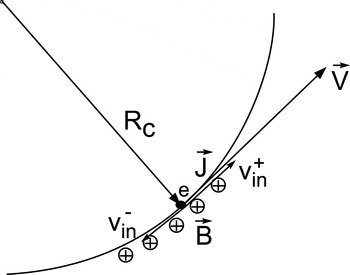
 $\boldsymbol{v}_{in}$
is parallel to
 $\boldsymbol{V}$
as shown in figure 1. Then
 $$\begin{eqnarray}v_{in}=\frac{mc^{2}VU}{eBR_{c}}.\end{eqnarray}$$
A scheme of the generation of the poloidal electric current in the plasma wind at large distance from the source where the poloidal magnetic field can be neglected. Motion along the curved flow line with curvature radius
 $R_{c}$
results in inertial drift motion of the particles of opposite sign with velocities
 $\boldsymbol{v}_{in}^{+}$
and
 $\boldsymbol{v}_{in}^{-}$
. These velocities produce the poloidal electric current which generates the toroidal magnetic field.

The electric field in the wind lies in the poloidal plane. The electric charge density is defined from the Coulomb law as follows
 $$\begin{eqnarray}q=\frac{1}{4{\rm\pi}r}\frac{\partial Er}{\partial l}+\frac{E}{4{\rm\pi}R_{c}},\end{eqnarray}$$
where the derivative
 $\partial /\partial l$
is derivative along the electric field. Substitution of these expressions into (2.14) gives
 $$\begin{eqnarray}j=\frac{1}{4{\rm\pi}r}\frac{E\partial Er}{\partial l}+\frac{E^{2}}{4{\rm\pi}R_{c}}+\frac{mVUN}{BR_{c}}.\end{eqnarray}$$
After a simple transformation we obtain
 $$\begin{eqnarray}jB-\frac{1}{8{\rm\pi}r^{2}}\frac{\partial (Er)^{2}}{\partial l}=\frac{1}{R_{c}}\left(\frac{E^{2}}{4{\rm\pi}}+mVUN\right).\end{eqnarray}$$
Taking into account that the magnetic field is fully toroidal we obtain finally that
 $$\begin{eqnarray}\frac{1}{8{\rm\pi}r^{2}}\frac{\partial r^{2}(B_{{\it\varphi}}^{2}-E^{2})}{\partial l}=\frac{1}{R_{c}}\left(\frac{E^{2}}{4{\rm\pi}}+mVUN\right).\end{eqnarray}$$
This equation allows us to define the curvature radius of the trajectories of electrons. It is important that this curvature radius exactly coincides with the curvature radius following directly from the equations of ideal MHD. It appears that the small deviation of the flow lines from the straight lines with the curvature radius
 $$\begin{eqnarray}\frac{1}{R_{c}}=\frac{1}{8{\rm\pi}r^{2}}\frac{\partial r^{2}(B_{{\it\varphi}}^{2}-E^{2})}{\partial l}\left/\left(\frac{E^{2}}{4{\rm\pi}}+mVUN\right)\right.\end{eqnarray}$$
results in excitation of the electric current. Substitution of (5.1) and (5.2) into this expression gives
 $$\begin{eqnarray}\frac{1}{R_{c}}=\frac{{\it\sigma}\sin 2{\it\theta}}{U^{2}r({\it\sigma}\sin ^{2}{\it\theta}+1)},\end{eqnarray}$$
which shows that the collimation of plasma is always very weak provided that
 $U^{2}\gg 1$
. This was first demonstrated in the work Bogovalov (Reference Bogovalov2001) and later confirmed in the works Beskin, Zakamska & Sol (Reference Beskin, Zakamska and Sol2004), Tchekhovskoy, McKinney & Narayan (Reference Tchekhovskoy, McKinney and Narayan2008) and Lyubarsky (Reference Luybarsky2009). This result shows that this very slow collimation is responsible for the excitation of the poloidal electric currents which produce the toroidal magnetic field defined by (5.1).
Substitution of this expression in (3.3) gives that this condition is valid everywhere in the wind at any magnetization because
 $$\begin{eqnarray}2\frac{R_{b}}{r}\frac{{\it\sigma}\sin 2{\it\theta}}{({\it\sigma}\sin ^{2}{\it\theta}+1)}\ll 1.\end{eqnarray}$$
Inertial drift velocity is equal to
 $$\begin{eqnarray}\boldsymbol{v}_{in}=\frac{R_{b}}{{\it\Gamma}Ur}\frac{{\it\sigma}\sin 2{\it\theta}}{({\it\sigma}\sin ^{2}{\it\theta}+1)}\ll 1.\end{eqnarray}$$
This velocity remains almost constant in all the wind and does not violate the ideal MHD conditions.
6 Conclusion
It follows from our analysis that the ideal MHD approximation for cold relativistic plasma is equivalent to the drift approximation for description of the motion of particles in the electromagnetic fields. The electric currents in the plasma are excited due to the inertial drift of particles at the motion of the plasma in the fields. The ideal MHD approximation is valid under the following conditions.
-
(i) The frequency of variations of the fields and flow should be much lower than the Larmour frequency of rotation of particles in the magnetic field.
-
(ii) Most important is that the one fluid ideal MHD can be applied only at the condition
 $2{\it\Gamma}^{2}R_{b}/R_{c}\ll 1$
, which is more severe than another conventional condition of application of the drift approximation
$R_{b}/R_{c}\ll 1$
. This condition can be violated in the conditions of the Crab pulsar at
${\it\Gamma}>10^{4}$
if
$R_{c}$
is of the order of the cylindrical radius.
-
(iii) The frequency of variations of the fields and flow should be much less than the plasma frequency in the comoving frame system. Only under this condition is the frozen-in condition fulfilled.
-
(iv) The violation of the last condition in the pulsar wind can occur at very large distance which strongly exceeds the distance to the termination shock produced at the interaction of the wind with the interstellar medium or at the local sites of the pulsar magnetosphere, where the electric and magnetic fields vary very fast.


One interesting question arises from the present work. Electric currents in the cold plasma are produced due to the inertial drift of charged particles. What is the nature of the electric currents in the plasma with finite temperature? Perhaps all the electric currents in the collisionless plasma have a drift origin? According to Frank-Kamenetsky (Reference Frank-Kamenetsky1968) all the electric currents in the collisionless plasma are indeed due to different types of drift motion of the charged particles. This opens new interesting perspectives in consideration of the current sheets in the pulsar winds in ideal MHD approximation. The work Kocharovsky, Kocharovsky & Martyanov (Reference Kocharovsky, Kocharovsky and Martyanov2010) is especially interesting in this regard. In this work self-consistent solutions for the current sheets have been obtained in the collisionless approximation exploring the kinetic approach.
Acknowledgements
The work has been performed under the support of grant of the Russian science foundation (project N 16-12-10443). I am grateful to I. Contopoulos who convinced me that this work would be interesting.