The study of slavery in the Ottoman Empire has so far followed primarily three courses. One of these involves slaveholding by sultans, the royal household, and the official elite, and emphasizes institutional aspects of the practice, military slavery, household-building, and the harem.Footnote 2 Another line of research focuses on the nineteenth century and examines both the last surge and the abolition of slavery in Ottoman lands.Footnote 3 A third and more recent group of works provides a bottom-up perspective exploring the culture of the slaves, micro histories, and the experience of slavery beyond the elite households.Footnote 4 Often implicit in the three clusters of research is the assumption of a backbone narrative about the long-term demise of slavery, which rests on a supply-side story, i.e., the number of slaves available. The first key element in this story is wars, successful in the early centuries and yielding ample numbers of slaves. The turn of the tide in the battle field against the Ottomans from the seventeenth century onward reduced slave inflows considerably. Occasional successes in later wars brought in new captives, but with the beginning of a new war diplomacy involving the exchange of prisoners in the eighteenth century, starting with Russo-Ottoman relations and feeding into a new international legal regime, trade became the main source of supply.Footnote 5 That, too, was hampered, however, when Russia expanded and came to control the northern routes. The consequent decline in slave supply caused an increase in prices, turning slaveholding into a luxury that was less and less affordable by or profitable for those outside the top economic elite and, geographically, outside the capital or large provincial centers.Footnote 6 The trend is thought to have been reversed in the nineteenth century due to a number of factors, including the Greek Revolution (1821–1830), which generated large numbers of captives, the Circassian immigration, involving some 150,000 slaves brought along with their masters in the 1860s, and the possibility of better access to areas of supply in Africa, as the global traffic shifted from the Atlantic to the East. This shift was also matched by rising demand for labor in Egypt and Western Anatolia (as in Iran and further east in central Asia) in response to commercial agriculture destined for global markets, especially during the American Civil War. Ottoman government's policy changes toward equal subjecthood inclusive of the legal status of slaves starting in 1840, and attempts to curtail slave trade in line with international pressures in 1847, were staged against this backdrop and took several decades to get results.Footnote 7 Thus, the narrative ends where European abolitionism takes up the center stage as the main agent of change imposed on a reluctant Ottoman elite.
Causal assumptions underlying this long term narrative have not been questioned so far because studies on quantifiable aspects of slavery, such as prices, the extent or intensity of slaveholding, size and characteristics of the slave population, and different types of employment, are limited to detached snapshots or short-term surveys of a single region, with the exception of Austen's studies on trade. Also limited are studies on the link between slavery and labor history, the main reason being that slavery in Ottoman lands, as in Islamicate lands more generally, was characterized primarily by urban domestic (female) servitude and, secondarily, by military/administrative servitude—which declined in importance in the central lands from the seventeenth century onward.Footnote 8 In terms of sectoral concentration, in other words, Ottoman slavery was akin to contemporary Eurasian slaveries and different from Atlantic slavery and its Iberian precursors—except, briefly, in the nineteenth century in Egypt and parts of Anatolia.
From the perspective of history writing, prominence of household slavery, military/administrative, or domestic puts the spotlight on integrative processes that assimilated the slave into the master's domain and society at large and can obfuscate subjugation, labor relations, and the economics of slavery. Although new research promises to highlight the labor process anew,Footnote 9 as in Mediterranean historiography,Footnote 10 and add novel instances to the better known cases of agricultural state slaves (ortakçı kullar) and slave weavers and commercial agents of the early period, the view that non-domestic and non-military/administrative slavery was of limited and localized scale, and became rarer from the late sixteenth century onward stands.Footnote 11 We do not disagree with this view but propose a revision. First, ongoing research suggests that regional diversity in patterns of slave employment may turn out to be considerable, and more slaves can be “discovered” in the countryside if we stop looking for large estates as markers of agricultural slavery.Footnote 12 Second, “domestic servitude” is a highly problematic characterization because it conceals as much it reveals. On the one hand, the line between in-house chores and marketable production of various scale in and around the early-modern house, such as gardening, husbandry, dairying, brewing, and a multitude of cottage crafts, must have been often flimsy.Footnote 13 On the other hand, even if it was possible to distinguish between market and non-market activities, the economic importance of home services and production, i.e., of goods for household consumption, has been acknowledged as an important element in value creation for a long time.Footnote 14 In other words, domestic slaves, especially handmaids, but also concubines, to the extent that the two were separable, were laborers. Therefore, to posit an economic distinction between Middle Eastern slavery as luxury or conspicuous consumption and, for example, Atlantic slavery as capital investmentFootnote 15 is, at best, misleading. Ottoman non-military slaves performed all that Antebellum field slaves did and vice versa—though functions were fluid and their primacy different.Footnote 16
In this study, we seek to contribute toward filling some of these lacunae through a long-term study of slaveholding in the region of Bursa. We trace the incidence of slaveholding and prices from 1460 to 1880 using probate inventories. Inventories list slaves of the decedents among other capital goods and personal belongings but do not allow one to identify with any certainty how the owners employed their slaves. Therefore, the analysis proceeds in relation to hypothetical slaves with no sectoral specialization. We then work our way backward from prices, gender, and origin of the slaves toward identifying likely areas of employment. Section one briefly introduces Bursa and our sources. Section two presents descriptive statistics of ownership tracing the incidence of slaveholding among different groups of decedents. Section three examines the prices and explores the pattern of demand in connection with purchasing power, consumption/investment preferences, and alternative labor costs, i.e., wages. Section four concludes.
The setting and the sources
The sub-province of Bursa was one of the most important regions in the Ottoman Empire in a number of ways, particularly in the earlier part of the early modern era. Its administrative center, the city of Bursa, was the first capital of the nascent Ottoman state (1326–1402). With a population fluctuating between twenty-seven thousand and one hundred thousand from the fifteenth to the nineteenth century, the city became and remained a cultural and economic center throughout Ottoman rule.Footnote 17 In addition to its role in long-distance trade, it had a sizeable silk weaving sector, producing especially more expensive types destined for European markets and the upper end domestic consumers. Like most other parts of the empire, Bursa experienced growth from 1460 to 1600 and from about the mid-seventeenth century to the 1770s, with a crisis in between. Due to the large share of exports in its economy and the possibility of easy access to sea routes, Bursa's economy was open to vicissitudes of the world market and relative strength of the Ottoman economy. Therefore, it faced early deindustrialization, probably starting in the eighteenth century, as well as reindustrialization in the mid-nineteenth century. Interrupted by the Long Depression of 1873–1896, the latter process was accompanied by agricultural growth and continued until World War I.
This study loosely refers to the “region of Bursa” with a heavy focus on the urban center of the sub-province (sancak). Overrepresentation of urban Bursa in the study is not by choice but reflects respective shares of the rural and urban decedents in the registers. The choice of Bursa for this study is due, above all, to the availability of an uninterrupted series of probate inventories spanning nearly five centuries. Second, Bursa offers multiple perspectives on slavery in Ottoman lands. On the one hand, the city had a major slave market where war captives from the west as well as imports from the southern and the Black Sea routes were gathered, and some of these were employed in silk manufacture in the fifteenth and sixteenth centuries. Both the labor supply and demand for products of the sector over the centuries were tied to a matrix of international and domestic factors. On the other hand, as far as long-term patterns of slaveholding and slave prices are concerned, preliminary findings on central lands of the empire indicate that Bursa was not unique—despite its significance in the history of slavery.Footnote 18
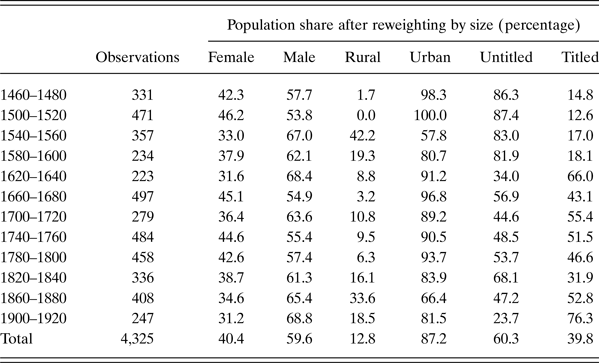
Database and the probate inventories
The study is based on 4,325 randomly sampled probate inventories that belong to Muslim decedents (see below regarding the exclusion of the non-Muslims). The sample is organized into eleven subperiods, each twenty years long with twenty-year intervals. It starts with the earliest probate records available (1460–1480) and ends in 1860–1880, after which date slaves cease to appear in the sample (Table 1).Footnote 19 All monetary values presented are real values adjusted for inflation using the Istanbul Consumer Price Index, the only long-term index currently available for the Ottoman Empire.Footnote 20 We take 1740 as the base year.
The sample

We use the raw sample as is and make no attempt to eliminate the demographic biases typically associated with probate inventories or possible long-term changes in the composition of the decedent population. Such biases, best studied so far in European and North American historiography, impair the value of the probates as quantitative indices for the actual population.Footnote 21 Ottoman probate records are no exception in that regard. Demographic biases would affect the study of slavery in a number of ways.
One of the limitations of the Ottoman probate records is the underrepresentation of non-Muslims in most places, Bursa being one of them, in most periods. At the same time, Ottomans followed diverse policies regarding slaveholding by non-Muslims,Footnote 22 and neither these policies nor their actual implementation have been studied in any detail. Finally, although sources other than probate inventories indicate the presence of non-Muslim slave owners in Bursa, at least in the fifteenth and sixteenth centuries,Footnote 23 they must have been much fewer in number. Indeed, we have encountered only one such decedent in the sample of inventories. Therefore, non-Muslims have been excluded in the present study. This implies that our findings overrepresent slave-ownership in Bursa as a whole.
Common to all post-mortem inventory traditions is a male-upper class/status bias in the probate population. To the extent it prevails in Bursa data as well, our estimates, again, overrepresent slaveholding. Similarly, the urban bias among the registered decedents in Bursa registers inflates the incidence of slaveholding as rural slavery in this region was rather limited. Counteracting these upward biases is the absence of centrally appointed top dignitaries, i.e., the largest slave owners, in the probate population. These were kept in Istanbul in registers that belonged to the state elite (Askeri Kassam Defterleri) or together with other financial records.Footnote 24 This situation significantly suppresses the number of slaves one observes in provincial samples, but not the rate of slaveholding since the population share of these dignitaries was negligible. In order to partially remedy these problems, we present separate ownership statistics for identifiable groups of owners, such as males, females, urbanites, rural decedents, people of status (identified by the presence of socio-occupational/honorific titles), and commoners (identified by the absence of the former).
Age bias in probate records is another potential problem that can affect the estimates of slaveholding and the direction of its effect cannot be easily predicted. On the one hand, older people tend to be wealthier and are more likely to own slaves; this skews the incidence of slaveholding upward among the decedents. On the other hand, this is counteracted by manumission. Per religious and ethical stipulations of Islam, not only were non-Muslim slave owners expected/obliged to give up/sell their slaves if the latter converted to Islam, Muslims, too, were encouraged to free theirs on various occasions, especially if the slave converted to Islam. Therefore, an unidentifiable number of slaves escape the purview of the probate records, giving us lower rates of slave-ownership than among the actual population. Two caveats are in order, however. First, low life expectancy in the period studied alleviates the problem. Second, manumission during owners’ lifetime may not have been as common as is assumed.Footnote 25 That all the slaves identified by religion in the Bursa sample (and in many case studies) are Muslim indicates that conversion hardly guaranteed liberation. We assume that the “customary” term of servitude and manumission must have changed over time, like ownership itself, in response to a calculus of charity and economic value. As the payback time of a slave got shorter, as was the case for most slaves in the eighteenth and nineteenth centuries, ceteris paribus, manumission must have become more common.
A parallel mechanism that ended in manumission, and hence curtailed visibility of the slaves in probates, was mükatebe, contracts stipulating manumission after a set term of servitude or payment of a set amount in cash or kind by the slave.Footnote 26 These are also relevant because they involved an intermediate mode of labor between bondage and freedom, and not only because it set a defined term of bondage but it also imparted legal personality to the slave the moment the contract was made, and hence suspended slave status. It is noteworthy that these contracts were the only government recommendation, short of abolishing slavery, to solve the Circassian problem in the second half of the nineteenth century.Footnote 27 It is not clear, nonetheless, if this was a case of “tradition rediscovered” from within the Islamic legal repertoire of slavery in order to tackle the novel challenge of conflicts of unprecedented scale between masters and slaves and mass demand for freedom against the backdrop of authoritarian modernization synthesized with liberal notions of property, citizenship, and freedom, not necessarily of European descent.Footnote 28 The few slaves-on-contract we have encountered in the probates are all from early periods. Other studies, too, suggest that the practice may have become marginal after the sixteenth century.Footnote 29
Slave-ownership
Long-term trend
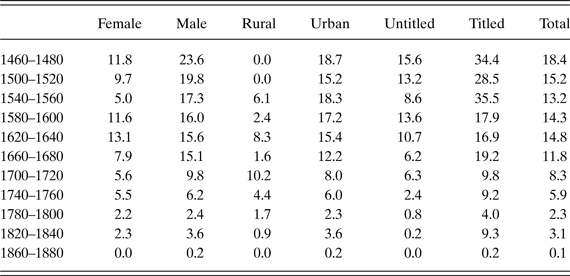
Probate data point to a high incidence of slave-ownership in Bursa in the early part of the period examined. The peak in slaveholding is the fifteenth century, with an ownership rate of 18.4 percent in 1460–1480 (Table 2a). In the sixteenth century, the overall rate of ownership steadily declines to 14.3 percent by 1600. Following a minor reversal in the seventeenth century—possibly resulting from a change in the composition of the sample—ownership continues to decline until 1820–1840. The eighteenth-century average is 5.5 percent, dropping to 0.1 percent by 1860–1880. The small increase in the rate of ownership observed in 1820–1840 agrees with the existing literature and consists primarily of resurgence in white male slavery. It is plausible that after prohibition of the African slave trade in 1857, slave-owning families became more reserved about their human property and preferred to present them as servants or household dependentsFootnote 30 in which case, one might argue that shrinkage in slave population in 1860–1880 is partly spurious. It may also be spurious to the extent that composition of the decedent population, too, may have changed in the nineteenth century.Footnote 31 Yet, the long-term character of the decline in slaveholding marginalizes the significance of this possibility.
Rate of slave-ownership among different groups of decedents
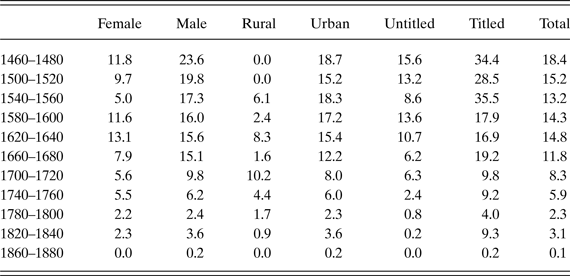
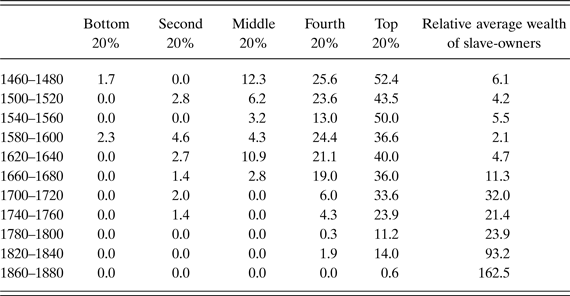
As to be expected, the wealthier a person was, the likelier it was that s/he owned a slave, and that meant, in general, women were less likely to have slaves than men and commoners than people of status. However, the incidence of slave-ownership declined across all levels of wealth and status (Table 2a and 2b). Thus, the top quintile of wealth, for example, had the highest rate of slaveholding in 1460–1480 (52.5 percent), dropping steadily to 36 percent in 1660–1680 and 0.6 percent in 1860–1880. As for the rest of the decedents, the average rate of ownership was less than 1 percent in the lower two-thirds from the turn of the eighteenth century onwards, and the same is true of those below the top quintile in the following century. Similarly for status: The incidence of slave-ownership among the titleholders was 27.3 percent on average in the sixteenth century, dropped to 18.1 percent in the seventeenth century, and 7.7 percent in the eighteenth century. The revival in slaveholding observed in 1820–1840 is limited to this group only. Among the commoners, only 3.2 percent owned slaves in the eighteenth century and 0.1 percent in the nineteenth century—or none, if we exclude untitled members of important families. It should be reiterated that all these figures overrepresent actual slave-ownership. Reweighting probate population by adding non-Muslims and reducing urban and upper class/status bias would pull them down. It seems important, therefore, to introduce at least a time dimension to sweeping arguments that posit slaveholding as “thoroughly integrated into both middle and upper class households throughout the empire, from Istanbul to Cairo.”Footnote 32
Rate of slave-ownership by quintiles of wealth

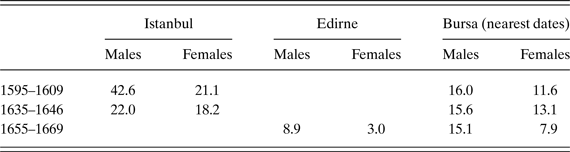
Since it is the long-term pattern of change in slave-holding that primarily concerns us in this study, we shall cite a few findings about the incidence of slaveholding in other locations just to present a comparative snapshot. For all the prominence of slavery in its early history, the rate of ownership in Bursa in 1660–1680 (15.1 percent among males and 7.9 percent among females) appears lower than in Trabzon, a major center of slave trade on the Black Sea coast (32 percent among males),Footnote 33 but it is higher than in Manisa, an agricultural region in western Anatolia (14.5 percent among males and 1.3 percent among females). The pattern of decline is shared by all, and the rates of ownership come to converge in three locations around the mid-eighteenth century. There is also sporadic information on the incidence of slavery in some other locations. Pending standardization in sampling criteria and method, Istanbul stands higher than Bursa in the mid-seventeenth century but not Trabzon (two decades later) (22 percent among males and 18 percent among females)Footnote 34 while Edirne, the capital of the Ottoman state after Bursa and before Istanbul, has the lowest incidence of slaveholding among the regions cited (9 percent among males and 3 percent among females) around the same period (Table 3).Footnote 35
Slave-ownership in Bursa: comparison with later capitals

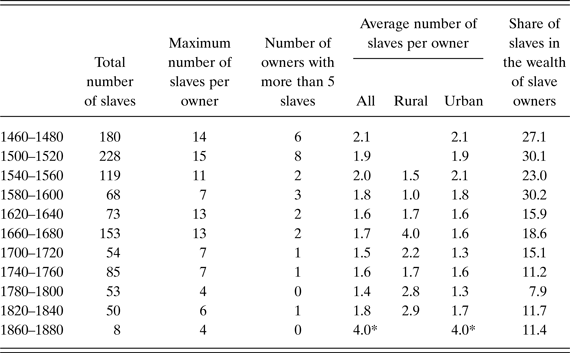
The rate of slave-ownership is paralleled by related changes, such as the average number of slaves per owner, maximum number of slaves held by a single owner, and the share of wealth invested in slaves by slave owners (Table 4). The latter is 27.6 percent from 1460 to 1600. In the following two centuries, this figure is halved, dropping to an average rate of 13.7 percent, with the last decades of the eighteenth century witnessing the lowest figure (7.9 percent) in the whole period examined. In 1820–1840, there is a remarkable increase in the share of the wealth owners invested in their slaves (11.7 percent). However, the sharp reversal here is partly related to the reduction in average wealth in connection with the crisis of the late eighteenth and early nineteenth century. In other words, title-holders, though poorer, held on to their slaves.Footnote 36 In 1860–1880, there are too few incidents of slaveholding for the observations to make statistical sense in this regard.
Intensity of slaveholding

* Based on two observations
Slaves in different sectors
In 1460–1480 when the incidence of ownership is at its highest, all owners are city-dwellers. This may be because the rural sample is rather small in this period. However, even in our best data points for rural observations (1540–1560, 1820–1840, and 1860–1880) (Table 1), slaveholding appears as a heavily urban phenomenon in the region of Bursa. In 1540–1560, the rate of ownership in rural probates is a third of the urban probates (6.1 percent as opposed to 18.3 percent). In the early nineteenth century, the discrepancy is even larger (0.9 percent to 3.6 percent), and finally, in 1860–1880, both of the two slave owners observed are city dwellers (Table 2). As for the average number of slaves per owner, it is lower in the countryside in 1540–1560 (1.5 as opposed 2.1), but higher in 1820–1840 (2.9 as opposed to 1.7)—as is the case with the three intervening centuries. We cannot tell at the moment whether at issue here is a changing trend in labor use in the countryside.
The long-run trend is the same in rural inventories as well, and there is no sign of a revival anytime in the nineteenth century. Agricultural commercialization in the nineteenth century, involving grapes, tobacco, olives, and mulberries in this region, appears to have rested more heavily on free labor supplied by small producers and semi-nomadic seasonal workers coming from nearby regions.Footnote 37 Yet, Circassian immigrants’ slaves are known to have been employed in agriculture in the larger sub-province of Hüdavendigar, encompassing also the district of Bursa, even though they are not visible in our sample.Footnote 38 As Bursa was also among regions where sharecropper slaves were employed in the early centuries of Ottoman rule, further investigation is called for into the interplay between Ottoman laws and variable land-labor ratios and its impact on large estate formation and slave labor.
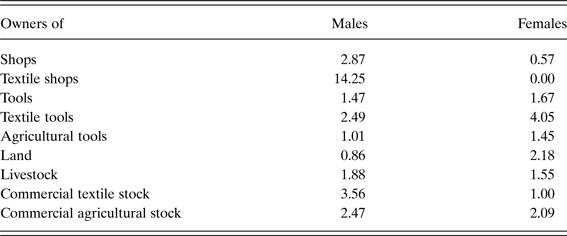
Preliminary comparison of the components of wealth held by slave owners to those of decedents with no slaves provides further insight into the sectors or lines of activity where slaves may have been used in primary or by employment. According to this, ownership of resources related to textiles appears at least twice as common among slave owners as among the rest (Table 5). The largest discrepancy between slave-owning and non–slave-owning decedents is observed in ownership of textile shops (14.3 fold more common among male slave owners) followed by ownership of textile tools (four fold more common among female slave owners) and ownership of commercial textile stockFootnote 39 (3.6 fold more common among male slave owners). Notably, the difference between slave-owning inventories and those that do not is small in wealth categories “agricultural tools” and “livestock” for both men and women and in category “landownership” for men (but not women who might need extra hands for help with land). While in need of further analysis controlling for wealth and other variables, these findings confirm and add to the foregoing. They suggest that slaveholding was not associated with agricultural activity in Bursa but the presence of some association between agricultural commercial stock and slaveholding calls for more detailed analysis. Association between slaveholding and textile production or trade appears clear. Further research is needed to clarify whether this association rests on direct employment of slaves in the sector, as in the fifteenth and sixteenth centuries, or by-employment of domestic slaves, which is more likely to be the case with female decedents who did not own shops but tools and slaves. The observation that half of the three hundred spinning wheels in Bursa were operated by women in 1678 further supports this.Footnote 40
Ownership of means of production

Slave prices
Long-term trends
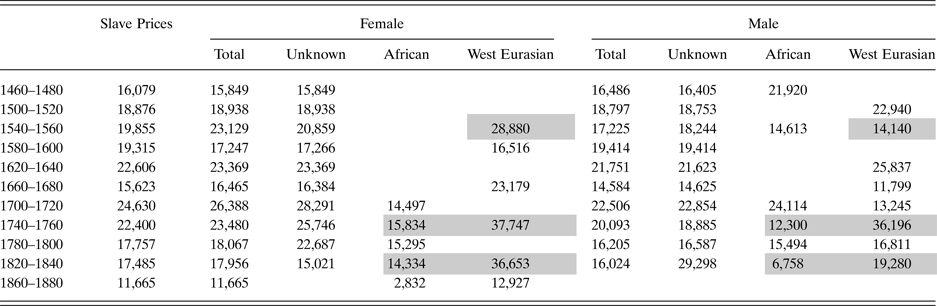
Contrary to received wisdom about slavery in the Ottoman Empire, the very long-term trend in average slave prices is downward, reaching its lowest in 1860–1880. The latter should be regarded cautiously as there are only eight slaves in probates from 1860–1880 but, it conforms to the pattern of decline that had started already in the mid-eighteenth century. On closer look, one observes two distinct phases in prices from 1460 to 1880. Until the early eighteenth century, prices are on the rise, and afterward, they begin to decline (Table 6). Our preliminary examination of the prices in six other locations in central lands confirms this pattern.Footnote 41 While an upward price trend is expected due to an increasingly restricted inflow of slaves, its reversal after 1720 is not. Two factors may be at work here: a decline in the demand for slaves and/or oversupply of slaves through trade. The only substantial traffic that could affect the market in the eighteenth century was from Africa. The identity of the slaves in the sample confirms.
Slave prices and wages, akçe, 1740 = 1

* Strong data points are shaded.
A supply-side approach: Gendering and coloring the decline in slave prices
The least common piece of information about the characteristics of the slaves in Bursa probate inventories is their age. Less than a tenth of the slaves in the sample are identified as children, youth, or elderly, and presumably the rest are adults. While the price of child slaves can be as low as a third of the adult prices and the price of the elderly can be much lower, they do not affect the average price levels much as they are few in number.
A nearly universal identity detail about the slaves is their gender. Until the seventeenth century, relative female/male slave prices are erratic, females being 25 percent more expensive in 1540–1560 but 12 percent cheaper in the following period. From the early seventeenth century onward, female slave prices are consistently higher, stabilizing at 10–14 percent difference in the early eighteenth century (Table 6). Thus, gender appears as a relevant price factor but not a very strong one. When the origin of the slaves is juxtaposed onto the gender matrix, a much bigger difference is obtained than between genders alone. A probable increase in the number and/or share of the African slaves correlates with the downward trend in average prices.Footnote 42
In all periods for which we have a reasonable number of observations, the price of African slaves is lower than that of the northern slaves from different parts of Eurasia.Footnote 43 Our highest price observation for an African slave, one of the two so identified before 1700, is in 1460–1480 (21,900 akçe with 1740 as the base period) and may reflect the prices in the exotic slave market at this date. Our best data point to compare the relevance of origins is 1740–1760, where we have forty-three African, twenty west Eurasian slaves, and twenty-two others with unidentified origins. Here, west Eurasian slaves are valued more than double the price of their African counterparts (Table 6). The same is true of 1820–1840, where the sample is slightly weaker. Proximity to places of origin and trade routes obviously mattered, but Bursa was about equidistant from both slave zones (northern/west Eurasian/white, southern/African/black slaves), hence location is an unlikely factor in relative prices.
Price discrepancy between slaves of different origin has been noted in earlier studies as well—though not in comparative light or in terms of its long-term implications for accessibility of slave labor. The discrepancy may have emerged or increased over time. For example, Jennings reports no difference in Cyprus in 1590–1640 while Sak's study suggests that Africans fetched only slightly lower prices in seventeenth-century Konya in central Anatolia. Wilkins finds a similar pattern in contemporary Aleppo while the difference seems larger (64 percent) at the turn of the eighteenth century in Damascus and even larger in Cairo a little later. It was two-to-three fold in Istanbul in the 1850s and 1860s, and could be as high as tenfold.Footnote 44 Still, what looks like a time trend indicating increasing price discrepancy cannot be properly understood without considering specific labor needs in each region.
In view of the foregoing, the onset of a decline in average prices in the eighteenth century begins to make sense. Since it was the west Eurasian supply that shrank, particularly after the Russian expansion in the north, the price of west Eurasian slaves continued rising, and that of women peaked in 1820–1840, when Russia captured Georgia and Circassia and came to control all traffic from Circassia. It must have been this trend that occasioned a ban on slave exports to Egypt in 1786.Footnote 45 Therefore, one has to turn to the relative size of the African population among slaves to understand the decline in average prices.Footnote 46
Ethnic origin is rarely stated in the probates before the eighteenth century, but studies based on other sources indicate that grand majority of the slaves in Bursa in the fifteenth and sixteenth centuries were from the north, i.e., war captives from Eastern Europe or people trafficked from northern Black Sea Region and the Caucasus. African slaves began to arrive in central lands of the empire already in the sixteenth century but appear heavily outnumbered by northern slaves at this time.Footnote 47 The African traffic is noted to have increased in the eighteenth centuryFootnote 48 but there is little quantitative detail available on this matter. In fact, estimates of the volume of traffic toward the Ottoman lands from the seventeenth century to the last quarter of the eighteenth century may be taken to indicate stability in absolute figures, a matter in need of further investigation.Footnote 49 Be that as it may, geo-ethnic origin gets recorded in more than half of the cases from the mid-eighteenth century onward while the total number of slaves in the probate inventories continually shrinks. This may be an indication of increased diversity within the slave population as well as vigilance about slaves’ origin, lest war-time prisoners get lost in a web of old style slavery, contrary to new rules of international law of war and ideas of subjecthood in sovereign states.Footnote 50
While changes in the volume of traffic from the two supply zones must have fostered the opposite movement of the prices of African and Caucasian slaves, the presence of price differentials in the first place is where demand begins to enter the picture. These differences reflected long established patterns of employment, Africans in menial jobs and domestic service as opposed to west Eurasian slaves in military, administrative jobs, and domestic partnership (concubinage) as well as domestic service. These patterns drew on a cultural system that attributed different qualities and aptitudes, and thus labor roles and market value to slaves of different gender and origin.Footnote 51 Hence the higher value of fair-skinned slaves and desirability of such women all the way from the Indian Ocean to the Mediterranean and colonial America.Footnote 52 As there was no legal boundary between domestic and sexual service for an unmarried female slave in Islamic law; one might speculate that all things being equal, Africans would have been unfavorably priced even as household slaves as they were less versatile. Educated expressions of such cultural preferences can be found in Ottoman physiognomy, an heir to its Islamic precursor, itself an heir to Greek scholarship. While currently there is no comparative account of the scholarly views on and popular perceptions of color and ethnic origin in different parts of the Ottoman world, it is conceivable that less than gracious views of the notable bureaucrat/scholar Mustafa Ali (1541–1600) of Africans were not uncommon.Footnote 53
A demand-side approach: Slave prices as labor cost
While a shift from a predominantly white body of slaves to a predominantly African body of slaves may account for the unexpected downturn in average slave prices in the eighteenth century, the drop in the price of Caucasian slaves, too, in 1860–1880 is noteworthy. Further research is needed to verify whether this decline is related to a short-term supply boom due to Circassian immigration and Russia's relaxation of controls over the traffic routes or a decline in the demand for domestic slaves or concubines as well.Footnote 54 In this section, we investigate the possibility of a decline in demand for slaves in general, not particular types of slaves, as the areas of employment cannot be identified with any certainty. For this purpose, first, the connection between slave prices and alternative labor costs will be considered, and then, investment preferences of the wealthiest group of probates will be examined.
An early insight into the question of alternative labor costs can be found in Baer (1967), who argues that the emergence of a cheap and free labor market as a result of proletarianization in the last decades of the nineteenth century were factors without which top-down measures to end slavery in Egypt would have failed.Footnote 55 To proletarianization proper, of both men and women, one should add the likely emergence of other labor forms, for example, semi-free labor of debt peons or, even more pertinent, child domestics.Footnote 56 Corvée and sharecropping arrangements resulting from indebtedness in the countryside are observed in various regions in Anatolia and the Balkans in the nineteenth century but the topic has been understudied as peasant alienation is thought to be limited due to high land-labor ratio.Footnote 57 As for female labor, it is known to be quite common in important textile centers like Bursa and Ankara, at least, in the seventeenth century, and the number of non-domestic female laborers as well as domestics may have further increased in the nineteenth century, if not before.Footnote 58 Finally, a better alternative to unskilled adult domestics were children, and studies on nineteenth-century Istanbul indicate that first, foster/maid children kept in wealthy and middle class households gradually became wage laborers and, second, their numbers kept increasing and, third, so did their wages.Footnote 59 All these processes can be associated with the decline in slave prices if one can demonstrate them to be at work in Bursa from the eighteenth century onwards, i.e., when prices took a downturn. In the absence of quantitative information about any of them, especially before the nineteenth century, we turn below to adult male wages to consider the relationship between free and bonded labor, assuming long-term agreement in the labor market.
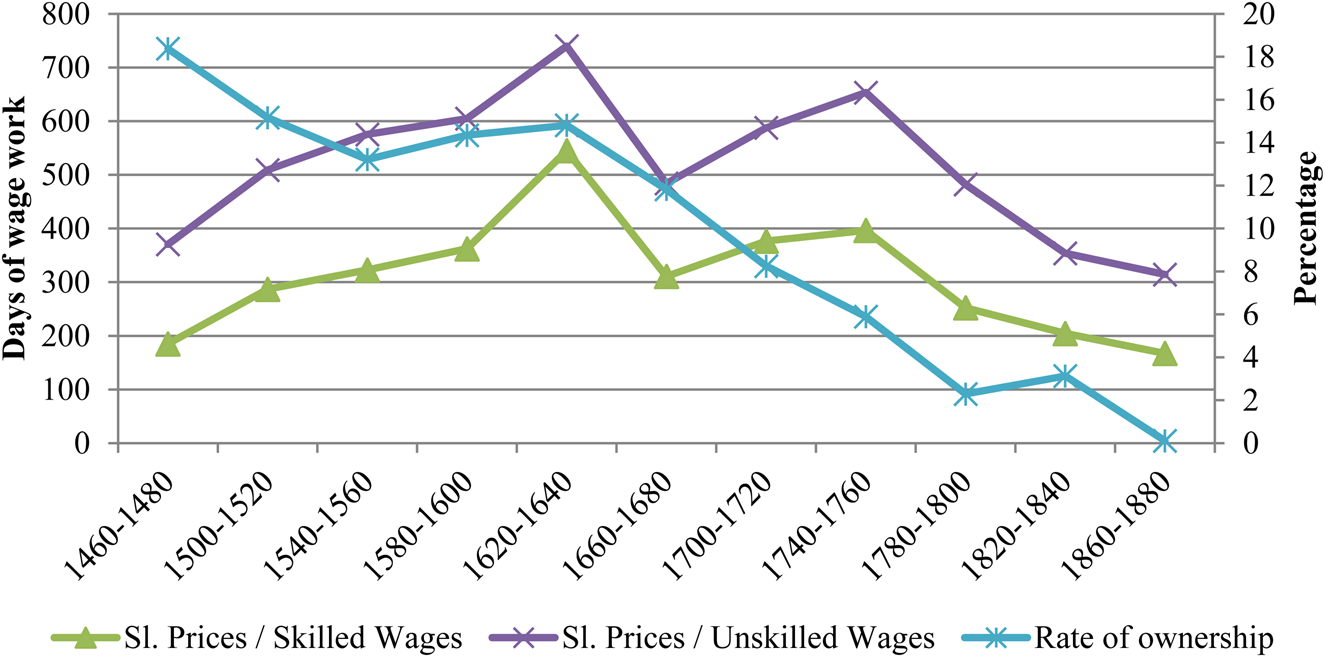
Throughout the period studied, slave prices and wages move incrementally in the same direction but diverge in the very long run. Unlike absolute prices, which peaked in the early eighteenth century, slave prices relative to wages peaked about a century earlier, measuring 545 days of skilled labor and 740 days of unskilled labor in 1620–1640 (Figure 1). From then on, they declined steadily going below the fifteenth-century level by 1860–1880. Adding the cost of feeding, clothing, and lodging a slave would raise the workday equivalent of the slave prices perhaps by a factor of 1.75 (assuming that three fourths of the daily wages were physical reproduction costs). Thus, in 1820–1840, for example, anyone who anticipated to employ the same (unskilled) laborer for a year and had ready cash for advance payment would have been better off buying a slave as the workday equivalent of the average slave price was 354 at the time, and with the living expenses added, it amounted to less than two years of unskilled wages.Footnote 60 There is also some evidence indicating that wages in Bursa were lower than Istanbul,Footnote 61 which would raise the relative slave prices some more and the workday equivalent up to two full years perhaps. From an economic point of view, this may still seem rather appealing but increasingly favorable relative costs do not trigger an increase in slave-ownership.
Slave prices relative to wages

One may argue that this is to be expected if slave prices were already far beyond the means of all but the few wealthiest as indicated by the increasing discrepancy of wealth between slave owners and the rest (Table 2b). Further, “wealth elasticity” of the demand for slaves might be limited—unless new venues of employment emerged. Looking closer at the purchasing power of the wealthiest would, thus, be revealing.
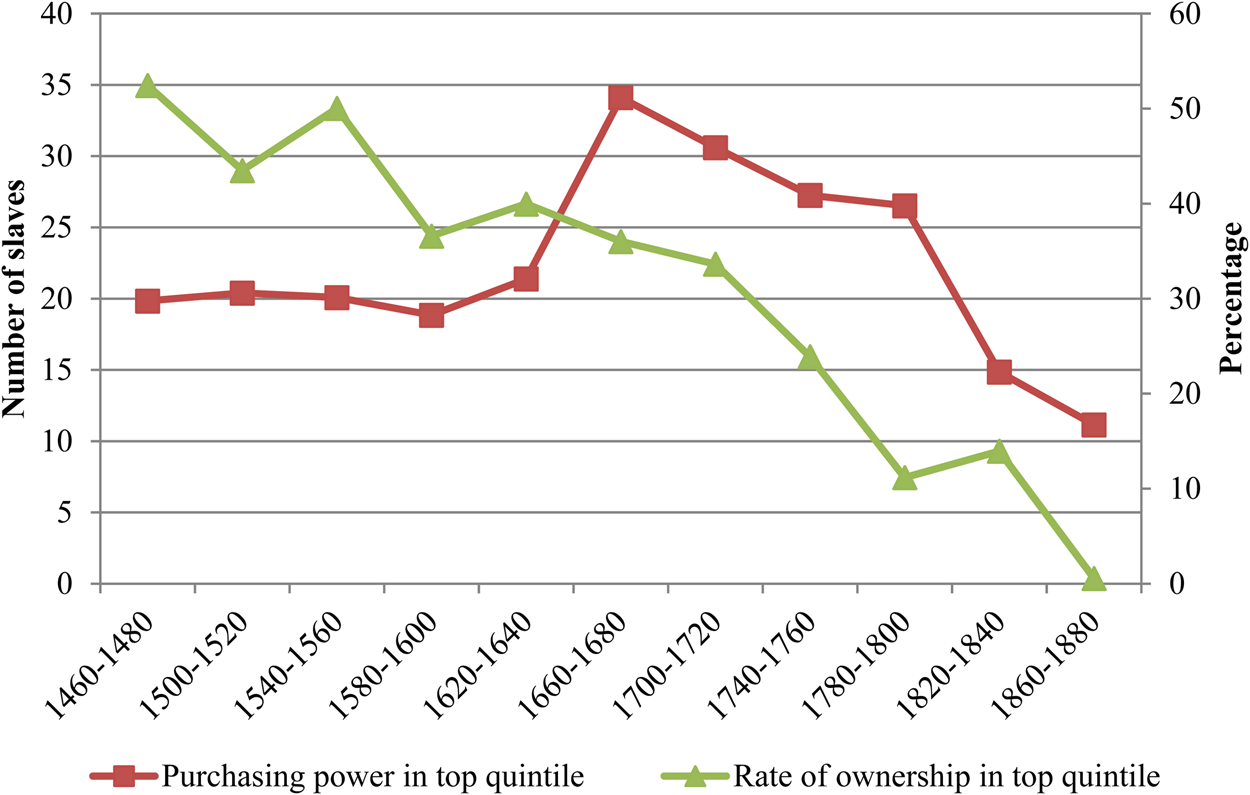
Slave purchasing power of the top quintile in the probate population, i.e., the number of slaves an average estate could buy in 1460–1480 was 19.5 slaves and the rate of ownership was 52.4 percent. Two centuries later, in 1660–1680, when their purchasing power was up by a third (33 slaves), the rate of ownership was down by a third (36 percent) (Figure 2). Starting in the early eighteenth century, mean wealth in the top quintile steadily declined as did its slave equivalent. Still, the eighteenth-century purchasing power average was 26.6 slaves, i.e., higher than in 1460–1460 while the incidence of ownership was half of what it had been then (22.9 percent). The divergence between the purchasing power and actual ownership continued in the nineteenth century. In other words, the relationship between the two changed over time, and more slave purchasing power did not automatically lead to a higher incidence of slaveholding. This raises the possibility that the decline in slave prices was also related to withering demand as well as an increase in the slave labor supply.
Slave purchasing power and ownership in top quintile of wealth

Conclusion
This study confirms received knowledge about a steady decline in slave-ownership in the Ottoman Empire, long preceding the first government attempts to curb slave trade in the nineteenth century. The decline is observed across all economic and social strata with a minor revival in the early nineteenth century among title-holders. However, unlike what is commonly assumed in the relevant literature, rising prices may not have been the only factor in this process. That they increased parallel to shrinkage in slave supply is validated up to the first quarter of the eighteenth century but not thereafter. After 1700–1720, prices and slaveholding both decline.
These observations call for a revision of the narrative about the decline of slavery in the Ottoman Empire, at least, in the region of Bursa and, possibly, the rest of the central lands. Price variation among slaves of different origin and increasing preponderance of African slaves appear instrumental in the decline of the average prices. Therefore, changes in the volume of African traffic, a factor underestimated in the study of slavery in central lands before the nineteenth century, emerge as a key element to be studied further, and inextricably link the history of slavery in this zone to globalization—which set the direction of the African traffic and created pockets of export-oriented production where slave labor proved profitable. The latter was not the case in the region of Bursa.
Decline in slave-ownership despite declining prices calls for an investigation of the demand factor. For this purpose, we have examined slave prices in connection with wages and found that after 1700–1720, slave prices declined relative to wages, too. Thus if withering of slaveholding signals a switch to alternative forms of labor, it does not appear economically rational if we consider male wage-earners alone. While female and child labor may have been more competitive—and needs to be investigated—it is not likely that their wages moved differently from male wages, hence increasing divergence with slave prices is expected to prevail.
The main axis of further research into why demand for slaves may have changed would involve labor needs of regional economies responding to domestic or global demand (expanding, but rather domestic in the case of Bursa after the seventeenth century) and effects of wars, epidemics, and immigration on regional demography. Labor demand and supply, free or bonded, for domestic or other employment, must have varied considerably in Ottoman lands from 1740 to 1880, a period that saw consecutive episodes of growth and crisis. In global perspective, however, the long run of early modernity was marked by demographic and economic growth—which Stanziani further characterizes as a “common wave of capitalism,” arguing that labor institutions interacted across Eurasia and despite demographic growth, labor processes, and coercion intensified.Footnote 62 As the historiography of the global turn has placed the Ottoman lands ever more firmly in Eurasian patterns of change, there is basis for asking how the interplay between the increase in African slave population and little known processes of free and intermediate forms of dependent labor were regional manifestations of this broad trend.
Finally, all of the above concerns slaves as laborers, domestic or otherwise, whose possession and employment rested on considerations of profitability. Yet, the value of slaves did not derive solely from the economic value they produced. First, slaves were also prestige goods whose possession alone generated utility in the form of power and reputation accorded to an ideal lifestyle—of which an ideal household and sheer display of wealth were a part. Concern for prestige cut across slave systems, domestic and plantation slavery alike, but mattered for the wealthiest and the noblest above all.Footnote 63 Looking at the Bursa sample from this perspective would point to socio-cultural change affecting conspicuous consumption preferences of those who could afford to buy slaves but no longer did. Such change needs to be explored in connection with new expressions of distinction that the eighteenth century may have brought as well as patterns of household formation—not only among the grandees of the land mimicking the sovereign but also humbler folk whose notions of respectability may have involved or come to involve different ideals.Footnote 64 Therefore, it may be more appropriate to speak of the decline of slavery in the plural to mark different the dynamics among different classes.
Second, labor process, too, was culturally defined and built on ideas about entitlements, human nature, and servitude. One cannot rule out, in view of the foregoing, that a climate ill-disposed to slaveholding emerged several decades earlier than is commonly presumed—except among the top elite and the bureaucracy, the bulwark of resistance to abolitionism,Footnote 65 and suppressed slave purchases and shortened the “customary” term of service before manumission. As far as state policy is concerned, Smiley insinuates a trickle-down effect from war diplomacy concerning the captives to slavery at large, reflection of a shared new turn in state-making, and the global order in the eighteenth century. Similarly, Clarence-Smith's reference to possible “undercurrents” of antislavery sentiments and ideas that may have survived the mainstream approval of slavery in Islamic historyFootnote 66 is relevant for eighteenth-century thought, an important component of which was rereading orthodoxy in diverse ways.Footnote 67 This is not to suggest that cultural change was the driving force but, rather, to recognize that profitability considerations alone may have been nowhere sufficient to end slavery.Footnote 68 It may turn out that even the cultural demise of slavery was a “connected” process and not because of imperialist abolitionism alone but of deeper parallels.