

In the spring of the year 2000, with interest rates low and mortgages cheaper than they had been for forty years, millions of Americans leapt into the housing market. Borrowing against the rising value of their property, they began “us[ing] their homes as ATMs.”Footnote 1 The subprime mortgage market exploded, and huge sums were loaned to homeowners with low incomes and tarnished credit. Then, in the spring of 2006, the Federal Reserve began to raise interest rates in an effort to damp down inflation. A wave of foreclosures began in low-income African American and Hispanic communities, where subprime lenders had rushed to include borrowers discriminated against by mainstream banks at punitive rates.Footnote 2 The crisis deepened as increasing numbers of homeowners in white middle-class areas began to default on their mortgages.
Since the late 1960s, US homeowners’ debt had been parcelled up and sold to investors around the world in the form of mortgage-backed securities.Footnote 3 But now the bad debts were so widely dispersed in a variety of complex financial instruments – including collateralized debt obligations and credit default swaps – that no one knew precisely where the most “toxic” risks were located. In the summer of 2007, panic gripped the money markets. Banks stopped lending to each other, and their share prices plummeted as investors worried about exposure to mortgage losses. On 15 September 2008, one of the largest subprime mortgage issuers, Lehman Brothers, went bankrupt, the largest corporate failure in American history. As credit markets dried up, consumer spending fell. Rising unemployment triggered more defaults and foreclosures.Footnote 4 In the Great Recession of 2007–9, four million low- and middle-income families lost their homes.Footnote 5 A wave of foreclosures turned working-class neighborhoods in cities like Cleveland and Detroit into “deteriorating ghetto[es],” and created “ghost subdivisions” across the sand states of California, Arizona, and Florida.Footnote 6 The Wall Street banks were bailed out by the US Department of the Treasury under the Troubled Assets Recovery Program (TARP) at an estimated net cost of $32 billion.Footnote 7
Robert Shiller describes the housing boom as a form of “social contagion,” in which stories about rising home prices fed the expectation that the boom would continue.Footnote 8 Stories have helped to explain the bust as well, constructing links between cause and effect, identifying villains, and laying blame. The narratives I examine in this article derive from a range of genres – reportage, documentary film, and the novel. They attempt to contextualize the human beings caught in the center of the subprime storm, but in the process run up against a kind of opacity or obscurity, a crisis of representation. At the center of the financial crisis lies an inability to recognize and comprehend deeply embedded structures of inequality, a failure common to both the financial system and the wider culture. But in order to understand the origins of the crisis, we first have to grasp the ways in which the subprime borrower was drawn into complex, global networks of indebtedness and financial intermediation.
CONSTRUCTING THE SUBPRIME SUBJECT
Although “subprime” is not an official designation used by any regulatory authority or credit-rating agency, the Federal Deposit Insurance Corporation issued a statement in 2001 summarizing the credit-risk characteristics displayed by subprime borrowers. These included two or more thirty-day delinquencies in the last twelve months, a foreclosure within the last two years, and bankruptcy within the last five years. Subprime borrowers had a high probability of default, as well as limited ability to cover living expenses from their monthly income after deductions for debt repayments.Footnote 9 The risks involved in extending credit to these borrowers could have been priced by setting a sufficiently high interest rate. But this would have defeated the object by making the mortgage unaffordable. The commercial solution, first introduced in the early 1980s, was to lend for an initial period at an affordable “teaser” rate, before arranging a new loan.Footnote 10
Subprime loans were typically hybrid Adjustable Rate Mortgages (ARMs), known as “2/28s.” An affordable fixed rate was offered over the first two years, which would “reset” to a higher, adjustable rate for the remaining twenty-eight years of the mortgage. The idea was that, with house prices rising at 10 percent a year, borrowers would have built up equity of 20 percent after two years. They would be able to refinance, beginning a new mortgage at a lower interest rate.Footnote 11 Hybrid ARMs were based on the assumption that rising home prices would provide borrowers with a source of new wealth and creditworthiness. “[N]o other consumer loan,” Gary Gorton observes, “has the design feature in which the borrower's ability to repay is so sensitively linked to appreciation of an underlying asset.”Footnote 12
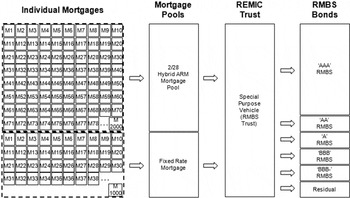
Consumers with low incomes and weak credit histories were being encouraged to borrow large sums to buy houses. But subprime lenders like New Century Financial, Countrywide, and Ameriquest did not actually have any money. These companies borrowed the money they needed in order to originate the mortgages, then sold the mortgages on to other financial institutions, which turned them into residential mortgage-backed securities (RMBSs). Figure 1 shows an example of a mortgage-backed security structure. The mortgage originators stockpile or “warehouse” thousands of individual loans before passing them on to an arranger or issuer. The issuer conducts due diligence on the loans and divides them into two “pools,” one for 2/28s and a smaller pool of fixed-rate mortgages. The mortgage pools are then sold to a trust, or real estate mortgage investment conduit (REMIC), set up for the purpose of selling bonds to investors entitling them to the principle and interest payments on the loans. The bonds are sold to investors in a series of six “tranches.” The first or most “senior” tranche is made up of claims to principal and interest on the least-risky mortgages, rated AAA. The tranches are subordinated in increasing order of risk, with the most likely to experience default or nonpayment placed in the lowest or “residual” tranche.Footnote 13
Sample mortgage-backed security structure. Source: Kevin Kendra, “Tranche ABX and Basis Risk in Subprime RMBS Structured Portfolios,” Fitch (Feb. 2007), available at www.fitchratings.com/web_content/sectors/subprime/Basis_in_ABX_TABX_Bespoke_SF_CDOs.ppt.

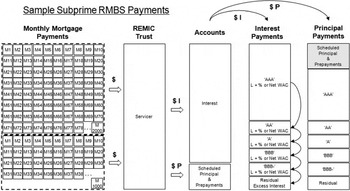
The REMIC trust is a company with no location and no employees, established in order to protect investors from the bankruptcy of the originator or issuer. The trust appoints a servicer to collect payments from borrowers, remit them to investors, and administer the legal aspects of the loans. Figure 2 shows how principal cash payments flow from borrowers to investors sequentially in “waterfalls,” first to holders of the most senior tranche until they were paid in full, then to the next-senior bondholder, and so on. Interest payments are also paid sequentially, and capped at the weighted average of interest paid on all the mortgages in the tranche. Excess interest, or cash left over once all bondholders have been paid, is used first to recover losses, then to make up shortfalls in cash flows, and finally to pay bondholders with residual claims.Footnote 14
Sample subprime RMBS payments. Source: Kendra, “Tranche ABX and Basis Risk.”

Pooling and subordination were techniques used to control for credit risk. The theory was that mixing individual mortgages from different cities, regions, and types of borrower would prevent a single event such as a factory closure affecting every borrower in the pool. Arranging bonds in tranches allowed risk to be controlled and priced, with senior bonds receiving more certain payments at a lower interest rate, and subordinate bonds receiving less-certain payments, but at a higher rate. The deals were overcollateralized, meaning they were structured so that their assets exceeded their liabilities. More mortgages were put into the pools than were needed to cover the payments to bondholders, in the expectation that some of them would default.Footnote 15 The riskiest mortgages in the lowest or “equity” tranches provided a protective wall, absorbing losses so that the senior tranches could continue to pay out.
Wall Street generated more ethereal profits from the mortgage market. Investment banks purchased the lower, BBB-rated tranches from a range of mortgage-backed securities, and created a structured investment vehicle (SIV) issuing collateralized debt obligations (CDOs): a new pool of securities “backed by securities that were themselves backed by mortgages.”Footnote 16 The banks also allowed investors to place bets on the performance of their securities by issuing synthetic CDOs made up of credit default swaps (CDS), insurance contracts which each “referenced” a particular security and mimicked its losses or returns.Footnote 17 The total value of mortgage-backed securities issued between 2001 and 2006 was $13.4 trillion, meaning that over a period of five years the financial sector had created out of the housing market notional wealth roughly equivalent to the gross domestic product of the United States.Footnote 18
OPACITY, CONTAGION, RISK
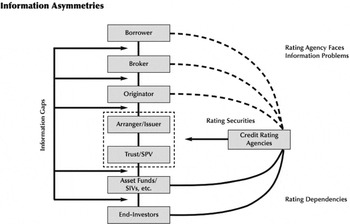
Gorton asks the key question: “How could a bursting of the house price bubble result in a systemic crisis?”Footnote 19 His answer is that the problem “at root” was “a lack of information,” which was lost as the links in the subprime chain binding borrower, mortgage originator, and investor were pulled further apart (Figure 3).Footnote 20 The interlinking “enabled the risk to be spread among many capital market participants,” but there was “a loss of transparency as to where these risks ultimately ended up.”Footnote 21 The sellers in the market – the dealer banks and the CDO and SIV managers – grasped the complexity of the subprime chain; the buyers in the market – the institutional investors – did not. Neither group knew where the risks were located because “the chain made valuation opaque; information was lost as risk moved through the chain.”Footnote 22
Information gaps in the mortgage chain. Source: Bank of England Stability Report, October 2007.

But how much did mortgage originators at the start of the subprime chain know about the people they were lending to? The FICO® scoring system developed by Fair Issac's and Company tags the individual on a linear scale of 300 to 850, with the lower end of the scale representing the highest risk. When the FICO® system was adopted by two government-sponsored enterprises, Freddie Mac and Fannie Mae, their interpretation of credit risk became standardized across the mortgage lending and securitization industries, with a score of 660 established as “the eyeball threshold for their definition of loans eligible for the prime investment.”Footnote 23 Anything below 660 was “subprime.” Mortgage originators embraced the system because, “Armed with a gradated sliding scale, people all along a spectrum of risk [could] be offered specially designed producers at alternative terms and prices,” with interest rates rising as the scores decreased.Footnote 24 Risk-based pricing meant that “individuals who were formally excluded for being unacceptably risky” were now “included at a higher price.”Footnote 25 At the same time, FICO® provided the underwriters of mortgage-backed securities with a tool for describing “entire portfolios of loans encompassing multitudes of consumers and credit arrangements,” together with a means of estimating the revenue streams which would make their way from those consumers to investors around the world.Footnote 26
Credit bureau scores are calculated “in the absence of input on income, occupation, or socio-demographic characteristics.”Footnote 27 Up until the early 1990s, mortgage lending was based on the four Cs: “credit (quantity, quality, and duration of the borrower's credit obligations), capacity (amount and stability of income), capital (sufficient liquid funds to cover down payments, closing costs, and reserves), and collateral (value and condition of the property).” Mortgage originators “screened” individual borrowers, underwriting loans “one at a time, out of local offices.”Footnote 28 With the adoption of the FICO® scoring system, subprime lending became “an exercise in risk management within a newly created space of calculative possibility.”Footnote 29 The new system was based not on knowledge of specific individuals, but on “quantitative expectations.”Footnote 30 The borrower became a “limited array of attributes, bureaucratically accumulated over time and assessed with reference to the distribution of those attributes across the population of customers.”Footnote 31
FICO® scores, like the bond-rating symbols produced by the credit-ratings agencies, refer to “a well-understood or transparent set of norms.” As such, they form “key benchmarks in the cognitive life of [capital] markets.”Footnote 32 But they also reproduce the particular form of instrumental knowledge characteristic of finance capitalism: synchronic, ahistorical, limited to the here and now. As Paul Langley observes, credit-scoring and risk-based pricing accomplished the “sorting, targeting, pricing, and governing” of individual borrowers on a case-by-case basis.Footnote 33 But what “escaped calculation” was the “collective future uncertainties” of the mortgagors.Footnote 34 Default rates were estimated only for individuals within a “thin” set of risk profiles. As the subprime mortgage machine churned out loans of ever-lower credit quality the possibility of widespread or correlated defaults increased. The ultimate default correlation risk was that subprime borrowers belonged to a social class characterized by high levels of economic vulnerability. The risk managers were blind to the extent of the structural inequalities they were attempting to integrate into “transnational circuits of capital flow.”Footnote 35
These techniques – FICO® scoring, the pooling and tranching of subprime mortgages – together with euphemisms like “cash-strapped borrowers at the margin” and “low- to moderate-income households,” were attempts not to see the poor: to pretend that they did not exist except as some obsolete cultural category which had now been sublated, cancelled, and preserved at a higher level by the miracle of financial engineering.Footnote 36 The resistance to naming, knowing, and recognizing the poor produced an opacity which at first enabled expansion of the financial sector, then crippled it. Stories about the foreclosure crisis attempt to read character, narrative, and meaning back into the abstract, disembodied world of financial engineering and risk management, to contextualize the individual within an explicatory framework. But the opacity which disabled the working of the subprime market and the financial system also haunts these discursive and visual representations of the subprime borrower.
A BLIND SPOT IN THE BROADER CULTURE
According to Robert Shiller, subprime borrowers slid into foreclosure as result of their own naivety, ignorance, and desperation:
Subprime borrowers wanted these mortgages in disproportionate numbers both because they were less quantitatively sophisticated and because they were consumed by the mere thought of somehow gaining a foothold in the housing market … One might say that the fundamental cause of the subprime crisis was that many people simply did not pay attention. They fell into traps of one sort or another because they did not know or understand what was happening in the marketplace.Footnote 37
In other words, subprime borrowers were either greedy or stupid. As such, they provide candidates for courses in the “financial literacy” often touted, along with increased regulation, as a solution to the ills of finance capitalism. But either blaming or educating the victim involves a willful blindness to the limits imposed on individual choices by the economic structures I have been describing.
As Gavin Jones points out, there is a long tradition of “rationalizing poverty by describing the poor as inherently disordered and degraded,” and so in large measure responsible for their own fate.Footnote 38 This discourse is reinforced, in the United States, by a commitment to ideas of social mobility, equality of opportunity, and individualism so intense as to make poverty almost unthinkable, a “partial blind spot in the broader culture, unable to be seen directly or for long.”Footnote 39 The poor occupy a cultural space in which suffering is explained by “cultural pathology and moral failure.”Footnote 40 But poverty, Jones points out, is “primarily material and economic,” defined by “a network of shifting factors such as income level, unemployment, homelessness, hunger, and access to educational and health-care facilities.”Footnote 41 “Socioeconomic suffering” is an effect of a social structure designed to produce differential levels of wealth, welfare, and status, and to perpetuate them.
From the antebellum period of recurrent financial panics, through the long economic downturn of the 1890s, to the Great Depression of the 1930s, writers have attempted to respond to and understand the suffering of the poor, without being able to locate that suffering as a problem of “social structural position.”Footnote 42 The favored trope involves the descent of the middle-class observer into the abyss, an engulfing and perplexing space made up of “sloughs, chasms, and spatial voids,” along with images of pollution and contamination, of “residue and waste.”Footnote 43 The locus classicus is Jacob Riis's How the Other Half Lives (1890). If the poor lack a language in which to express their plight, this lack infects the middle-class observer. Unable to comprehend, communicate, or sympathize, his own “expressive mechanisms” are left in “tatters.”Footnote 44 This failure of optics, of a mechanism for surveying and ordering social space, also marks more recent representations of subprime borrowers.
Journalist Paul Reyes worked for his father, a realtor based in Tampa, Florida, in the spring of 2008, “trashing out” foreclosed homes, which were then being lost at the rate of five thousand a month. Presented with an opportunity to examine “a national crisis up close,” Reyes found himself gripped by a compulsion to “read a narrative in what has been discarded,” to “confront the individuality being purged from a place.”Footnote 45 But the lives of the foreclosed resist ready interpretation: there is an opacity to their experience that even a skilled and empathetic writer like Reyes cannot quite penetrate.
Reyes has trouble deciphering the puzzle of foreclosure, when he joins his father's Puerto Rican employees, Hector and Ismael, on a job in the black Hispanic neighborhood of Sulphur Springs. The main street, Nebraska Avenue, is “a hodgepodge of car dealerships and carpet warehouses and diners, and billboards promising loans and mortgages to practically anyone with the power to call” (14). The houses are “starter kits to the [American] dream,” “a mash of hasty, low architecture, single-story, pale cinder-block jobs squatting under live oaks sagging with Spanish moss” (17, 14). The procedure is that the bank asks the realtor to prepare the foreclosed property for the market; the realtor offers a “cash-for-keys” payment to induce the occupant to leave; if they refuse, the county sheriff evicts them. The former owner of the house in Sulphur Springs has spurned all inducements. On the morning of the eviction, Reyes follows the sheriff inside:
The deeper we waded toward the back, the more rancid the air became. There were boxes everywhere, half-packed – in the bedrooms, amid standing fans and clothes and papers on the floor; amid unshaded lamps; flanked by giant stuffed tigers and framed photos of babies and other loved ones; amid lightbulbs, stuffed sheep, Bibles, mothballs, red high heels, portraits of panthers, and a typewriter stuffed with neckties. It was as if, in that preparation for escape, thoughts had piled up and suffocated the mind. (60)
These are nineteenth-century tropes. Poverty is wretchedness, but the wretched of the earth are wholly other, located in a space of darkness, mystery, and confusion, sealed off from comprehension.
A point of maximum opacity and contradiction is reached with the story of Eddie and Gwen, who occupy a house near an interstate highway, “a neighborhood of cruddy single stories with gutted cars in the yard” (91). Gwen earns $1,400 a month as a hospital nurse, while Eddie has suffered an illness that appears to be “the cause of his predicament” (92). Reyes recaps Shiller's critique of the subprime borrower as economically illiterate and incompetent:
Eddie had tried to cover the risk of an adjustable-rate loan through refinancing that finally caught up with him. He was vague with the numbers and spat out the names of the banks he'd dealt with – Ameriquest, Wells Fargo, et al. (92)
Mena explains that “the bank is the owner now,” that Eddie and Gwen's credit score has automatically dropped two hundred points as a result of the foreclosure (93). The best they can hope for appears to be the cash-for-keys offer, provided they leave the house “free of all debris” (93). Then Mena realizes that Gwen's name appears on none of the financial paperwork and that she could, “technically,” apply for a loan, albeit with a $1,000 per month payment. “Yes, ma'am, we'll do it!” Mena exclaims. “The bank will get their thousand dollars every month. On time” (94, emphasis in original).
Reyes knows that this is futile, that “there wasn't a single institution that would lend her a cent for that shabby house” (94). But this “panicked voice” from the depths of the abyss affords a moment of insight for the relatively privileged observer: “I began to understand the depth and pain of the crisis in a way that burned a hole through all the financial analysis, a voice and emotion that often remained conveniently muted behind the junk” (94). Any sympathy for Gwen and Eddie is short-lived, however. Seen momentarily as individuals, they rejoin a subprime nation of risk-takers “prepared to take the financial hit and walk away,” and “others scrambling to protect what they could through the maddening paperwork of bureaucracy, sniffing for loopholes” (94). To Reyes, Gwen and Eddie seem “trapped in pathetic confusion, having been misled by their own desire, taught as a tenet of good citizenship in America, to own something permanent; in this case, a house that was now practically worthless” (95; my emphasis). Reyes is deeply touched and troubled by the stories he hears. But he cannot shift from a judgmental stance that holds the foreclosed responsible for their own plight.
Foreclosure victims form a key narrative thread in Michael Moore's documentary film Capitalism: A Love Story (2009), but they remain similarly opaque. Identifying a mood of anger and impatience for change ushered in with the election of Barack Obama in November 2008, Moore interviews Detroit police chief Warren C. Evans, one of at least three law-enforcement officials who ordered the suspension of evictions pending federal government measures to assist homeowners faced with foreclosure. “The free market's failed the country,” Evans tells Moore. Things have got so bad that “people can do nothing but protest,” and “those people are called revolutionaries.” As the film cuts to a battered blue and white van parked under what appear to be the lights of a supermarket car park, Moore's voice-over continues, “and sometimes revolutions begin in unlikely places. The Trody family of Miami, with the help of their neighbors, took matters into their own hands.”
We then see the cluttered interior of the van, where the evicted family is just waking up from a night's sleep on their mattress, then cut to a crowd gathered outside the house, with a banner held by supporters of LIFFT (Low-Income Families Fighting Together) prominent in foreground. An unnamed community activist, a young Hispanic man, declares that “on behalf of this family and this community we liberate this home, for this family,” before instructing the volunteers to take down the realtor's sign. To shouts of “community!” and “power!” the Trodys’ possessions are moved back inside the house. The “Man from the Bank” arrives, and tells the cameraman to take a picture of the sheriff's notice of eviction on the door, before calling for police assistance. In the following passage of the film, two of the Trody children, a young boy and girl, are sitting on the ground by a fence, explaining to camera that “we don't have nowhere else to go,” and that this is their “plan B.” The girl adds plaintively, “we don't have a plan C.” Next, we see another family member, a young woman, berating the Man from the Bank: “that is our grandma, and it's not right that she's been in this house for twenty-two years, and y'all gonna put her out.” The crowd joins in the harangue as the Man stares impassively. The crowd continues to chant as the police confer until, as Moore intones on the voice-over, the Miami police and the “man from the bank” are “sent packing.” The final shot is of the crowd punching the air in celebration, chanting “ain't no power like the power of the people.”
The action is skillfully shot and edited, compressing a complex series of events into a compelling sequence. But Moore's focus is on the Trodys as the focal point of a community action, rather than on the family members themselves. The family act as catalysts for a collective defiance of authority, with the community coming together to stand up to the banks and the police. But the film is, finally, sentimental, confused, and inaccurate about the extent to which the Trodys and their supporters are “revolutionaries.” Their single demand – that they be allowed to stay in their home since they otherwise face homelessness – appears eminently reasonable rather than revolutionary; it is the Man from the Bank who appears doctrinaire and uncompromising. The film also obscures the background to the Trodys’ act of reclaiming their former home – apart from the shot of the LIFFT banner, we are given little information about the group or groups that have organized the action on the Trodys’ behalf. As a testament to the power of the people to effect change, the sequence is curiously perfunctory, manipulative, and unconvincing. The starkest lacuna in the sequence is the lack of engagement with the details of the Trody family's experience: the story of how they came to be in this situation, the details of their life stories, the socioeconomic conditions of their existence.
The protagonist of Paul Auster's novel Sunset Park (2010), Miles Heller, is a twenty-eight-year-old college dropout who has “spurned the trappings of his once privileged life.”Footnote 46 His father owns a small publishing firm in New York and an apartment in the West Village. Miles's education at Stuyvesant, a “gold-medal” public high school, takes him to Brown University and the precincts of the Ivy League. But, stricken with guilt after causing the death of his stepbrother in a traffic accident, Miles breaks off contact with his family and takes a series of odd jobs across the country in restaurants, hotels, and warehouses. The winter of 2007 finds him working, like Reyes, on a crew trashing out foreclosed homes in Florida.
In south Florida, Miles takes photographs of “abandoned things” in foreclosed homes, the “innumerable cast-off things left behind by the departed families” that have fled “in haste, in shame, in confusion” (3). He is fascinated by the “lingering traces” of “scattered lives,” by those vanished persons still somehow present in the “discarded things” left “strewn about their empty houses” – “books, shoes, and oil paintings, pianos and toasters, dolls, tea sets, and dirty socks” (3, 5). Miles senses that “the things are calling out to him, speaking to him in the voices of the people who are no longer there” (5). He thinks of the foreclosed properties as “orphaned structures,” and of himself as an orphan (4).
Miles begins a romance with Pilar Sanchez, a seventeen-year-old girl from a Mexican American family. Pilar dreams of becoming a registered nurse, but Miles knows the SAT drills and encourages her to try for college. These aspirations create tensions with Pilar's older sister, Angela. When he refuses to steal luxury goods from the foreclosed homes, Angela threatens Miles with mob violence. He flees to Sunset Park in Brooklyn, where an old school friend, Bing Nathan, has set up a squat together with three others, “all in their late twenties, all poor and struggling, all with talent and intelligence” (38, 39): Ellen Brice, a would-be artist who works for the rental division of a Brooklyn real estate agent; Alice Bergstrom, a graduate student at Columbia who is living on the proceeds of a part-time job at PEN American Center; and Alice's boyfriend, Jake Baum, a fiction writer who has given up trying to scrape by on his salary as a part-time teacher at LaGuardia community college in Queens. Underemployed and ill at ease, these characters share Miles's dilemma: they have “no clear idea of what building a plausible future might entail” (6). In terms of economic security and prospects, little differentiates the occupants of the Brooklyn squat from the Sanchez family in south Florida.
Sunset Park charts a newly revealed landscape of class, where a precariously located middle class begin to sense their own economic vulnerability and structural affinity with the working class. But the poor are still not accurately seen, contextualized, or regarded for very long. The Sanchez family are sketched rather than convincingly drawn, hazy approximations of a racially marked lower class. Pilar's youngest sister, Maria, is “enrolled in a community college” and “studying to be a beautician”, Teresa works as “a teller at a local bank”, Angela is a “hostess in a cocktail lounge” who “sometimes sleeps with the customers for money” (9). The working class are intuited as way markers in socioeconomic space, harbingers of a dimly intuited and deeply feared future. At the end of the novel, when the squatters are evicted by the police, Miles realizes that they are all homeless, just as “the people in Florida who lived in the houses he trashed out are homeless” (307). But by now those people are only absences, as deliquescent as the real estate they began the novel by haunting with their spectral presence.
In these narratives, the poor are seen and unseen, known and unknown, euphemistically named and not named. They haunt the margins, absorbed into the signifying and quantifying system as individual risk profiles, and arraigned as opportunities for profit, the capturing of payments, the generation of yields. But the embedded place the poor occupy in the social structure by virtue of systemic inequality is pushed to the edges of the optical system used to survey them. We are in a twilight zone of half-knowledge, a vision at once sharpened and obscured by ideological blockage and resistance. The subprime borrower occupies a partial blind spot in the culture, a wavering and unstable space generative of epistemological and economic uncertainty.
NEOLIBERAL SUFFERING
Foreclosure stories are tales of what Anna McCarthy calls “neoliberal suffering”; that is to say, suffering caused by the structures of inequality and disadvantage particular to a social order based the power of finance capital.Footnote 47 Subprime mortgage securitization follows the remorseless logic of neoliberalism, described by Gérard Duménil and Dominique Lévy as “an aggressive and violent form of capitalism, searching for efficiency from an appetite for profit.”Footnote 48 Neoliberalism's modus operandi is what David Harvey terms “accumulation by dispossession,” transferring assets from public to private hands, creating opportunities for “speculation, predation, fraud, and thievery,” and dismantling the welfare state, so that access to health, education, and pensions are no longer public goods but a matter of “individual choice tied to the affordability of financial products embedded in risky financial markets.”Footnote 49
Subprime mortgage lending is the latest manifestation of what Harvey identifies as “class-monopoly rent,” a “transfer payment realized through the monopoly power over land and resources conferred by the institution of private property.”Footnote 50 Flows of interest-bearing capital circulate the globe in search of higher returns.Footnote 51 Because of its monopoly power, finance capital is able to dictate the terms of access to land and property, exacting tribute in fees, interest, and principal payments. Elvin K. Wyly develops Harvey's analysis, pointing out that “for a growing share of the working class,” the slum landlord has been replaced by “a national subprime lender who gets investment capital from Wall Street and the global financial markets.”Footnote 52 Homeownership rates may be at record highs in the US, “but this ownership is mostly mortgage-encumbered, and thus debt-leveraged ‘owners’ are simply renting capital. Capital is the Landlord.”Footnote 53
The roots of subprime lending extend back to the mid-1980s and the growth of a “poverty industry” based on predatory lending, transactions “specifically crafted to result in substantial net losses for the borrower.”Footnote 54 The subprime demographic originally comprised the working poor: waitresses, store clerks, and home health-care workers struggling by on $20,000 or $25,000, or $30,000, wage-earners who might not make much individually, but could, in the aggregate, mean “big bucks” for pawnbrokers, rent-to-own furniture and appliance companies, check-cashers, payday loan companies, and auto title lenders.Footnote 55 These are people who, in Gary Rivlin's words, “earn too much to qualify for government entitlements but who earn so little there's no hope they'll ever save much money given the rising cost of housing [and] health care.”Footnote 56 Decades of squeezed incomes, precarious employment, and eroded welfare entitlements have pushed increasing numbers of middle-class Americans closer to the working poor.
Gérard Duménil and Dominique Lévy point out the stark economic fact that, since 1979, real income for 90 percent of the US population has stagnated. The income of the top 10 percent of earners has grown slightly, while the top 1 percent has enjoyed significant gains, receiving higher capital income in dividends, rents, and interest, and paying lower taxes. In 1973, the top 1 per cent received 8.4 per cent of total US household income, including capital gains; in 2001, this had “soared” to 19.6 per cent.Footnote 57 In 2008, the average income of the bottom 99 per cent was just over $40,000; the average income of the top 1 per cent was just over $900,000.Footnote 58 Neoliberalism has produced what Duménil and Lévy call “two-tier capitalism,” the “capitalist and upper-salaried classes versus the rest.”Footnote 59
Upper-class domination was secured in traditional fashion by the exploitation of workers through the payment of a wage. But neoliberalism opened up another channel, identified by Costas Lapavistas as “direct exploitation,” the “appropriation of income … by way of an interest payment.”Footnote 60 The subprime mortgage market was made possible by a key piece of neoliberal legislation, the Depository Institutions Deregulation and Monetary Control Act of 1980, which “effectively ended state usury laws and made it possible for originators to make a profit” by “charging a high enough interest rate to offset the costs of the inevitable defaults and foreclosures.”Footnote 61 In the 1990s, the commercial banks woke up to the lucrative potential of subprime lending and moved aggressively into the market. In the year 2000, Citigroup bought subprime mortgage lender Associates First Capital, telling analysts that the company would be able to “squeeze more profit per customer” as part of the new giant conglomerate.Footnote 62 This was the cue for a new group of non-bank lenders like Ameriquest, New Century, and Countrywide to start buying and securitizing subprime mortgages, turning loans made to the working poor into opportunities for institutional investors around the world to harvest rents on their capital, and for financial intermediaries to extract fees or place bets.Footnote 63
Squeezing profits from subprime borrowers exposed them to significant risks. Penalties of thousands of dollars were chargeable if the mortgage was paid off before the agreed term date, locking the borrower into the terms of the loan. The “reset” at the end of the two-year period exposed borrowers to the risk of higher interest rates and a heavier repayment burden. If borrowers encountered difficulties in repayment, they were at the mercy of the lender, who could decide whether to extend the mortgage or force the borrower into default, recovering the loan by selling the property.Footnote 64 Refinancing did not necessarily mean that a “traditional” mortgage would be offered; borrowers might receive instead a sequence of subprime loans, forcing them to claw their way up the property ladder. Gary Gorton comments that “this may be viewed as ‘predatory’ lending; the borrower is attracted to borrow, but may not understand that effectively it is the lender who makes the choice to refinance or not.”Footnote 65 Marx named the process by which industrial capitalism turned living labour into surplus value “exploitation,” “an economic relationship of subordination and domination.”Footnote 66 Subprime mortgage lending constituted a new, intensified form of exploitation, forcing individual workers to meet a basic need through “the mechanisms of the financial system.”Footnote 67 But the “boundless expansion of the demands of the upper classes” pushed these economic mechanisms “beyond the frontier of sustainability.”Footnote 68
In 2006, 78 percent of subprime mortgages were 2/28 ARMs, worth a total of one trillion dollars.Footnote 69 The typical subprime household comprised a couple in their early thirties with a low credit score, and a high debt-to-income ratio, with approximately $37,000 per annum in disposable income after taxes. As latecomers to the market, they paid a relatively high price for their homes, borrowing $200,000 on average. Like millions of other homeowners in the bottom half of the income distribution, subprime borrowers were already paying more than half of their income on housing.Footnote 70 They were gambling that “continuously rising housing prices would bail them out of their subprime ARMs at the first reset.”Footnote 71 But there were two problems. The wages of subprime borrowers were being steadily driven down by the “offshoring of labor-intensive production to Asia,” and house prices were falling.Footnote 72 In 2007, subprime ARMs were resetting from a 7 percent annual interest rate to a 10.5 percent rate, inducing what became known as “payment shock.”Footnote 73 With home prices leveling off, subprime borrowers had not built up enough equity to refinance, and they could not afford the new, higher rates.Footnote 74 Increasing numbers of them began to miss their monthly payments.
The aim of subprime mortgage servicers was to minimize losses to investors. Once a delinquent loan was deemed uncollectible, the servicer was incentivized to begin foreclosure proceedings on a property, rather than incur the costs of unpaid taxes, insurance premiums, and loss of value due to poor maintenance.Footnote 75 But since no one had predicted the bursting of the housing bubble, no one expected so many mortgages to reset, or foresaw the tidal wave of defaults and foreclosures that began to ripple across the country. Subprime securities depended on the waterfall of cash flowing into the tranches from prepayments, as borrowers paid off their mortgages before refinancing.Footnote 76 As the waterfalls began to dry up, gold-plated AAA-rated assets turned into dross.Footnote 77
The collapse of the subprime mortgage market marks the point at which the contradictions of the new financial capitalism came home to roost. For a while, the bottom 99 per cent had managed to sustain their living standards through cheap imports and extended borrowing, while paying rent to the top 1 percent.Footnote 78 If working-class wage-earners were forced to secure access to housing and consumer credit through subprime loans, middle-class households sustained consumption levels via home equity loans and bought bigger houses with high-risk, Alt-A mortgages.Footnote 79 The social surplus was redirected towards profits and dividend payments and away from ordinary wage-earners, with economic growth focussed on the dominant fraction of the upper class, the capital owners and upper managers who constitute the “working rich.”Footnote 80 Mortgage-backed securities pooled half the income of the lowest-paid, and transformed it into flows of revenue for pension funds and insurance companies, hedge funds, sovereign wealth funds, and banks. Having exhausted all other opportunities, finance capital turned to the high-risk borrower as a new source of income, in sublime ignorance of that borrower's structural class position and the perils this posed to the financial system as a whole. Everything was staked on a logical aporia or contradiction. Consumers were driven to borrow more because their wages were flat, but the asset backing their loan was really their own earnings capacity.Footnote 81 In Robin Blackburn's words, the subprime market was an attempt to deny the “real problem, which is the true extent of poverty in the United States,” a demonstration of the folly of imagining that poverty could be banished “by waving the magic wand of debt creation.”Footnote 82 “Financial engineering” was magical thinking. The only way it could be sustained was through a willful blindness, or at least a studied indifference, to neoliberal suffering. The repressed returned, as it always does, from the outside, in the specter of the subprime borrower.
AMERICA OCCUPIED
Sunset Park's Bing Nathan has no belief in political action and no desire to “lead angry hordes into the streets” (72). But in the autumn of 2011 public spaces began to be filled with protesting bodies. On 17 September 2011, two thousand people marched on the Financial District, chanting “Wall Street is our street” and “power to the people, not to the banks.” Inspired by sober analysis of neoliberal income trends as well as the popular uprisings of the Arab Spring, the Occupy movement had prepared a resonant slogan: “we are the 99 per cent.” Starting on 8 September, the “We Are the 99 Percent” tumblr published a scrollable gallery of neoliberal suffering: the unemployed, the homeless, and the uninsured photographed with notices outlining their plight, along with myriad young professionals “making less than 30K a year,” perpetually “one pay check from disaster.”Footnote 83 This was, in Marco Roth's words, “a portrait in aggregate” of a self-declared majority “clinging precariously to an idea of middle-classness that seems more and more to be a chimera of the past.”Footnote 84
But the Occupy movement did more than add to the swelling chorus of laments over the squeezed middle: it seized on the foreclosure crisis as one means of articulating a new form of solidarity.Footnote 85 On 17 September, an Occupy Wall Street blog post called for “the seizure and use of abandoned buildings, of abandoned land, of every property seized and abandoned by speculators.”Footnote 86 On 29 October, Occupiers marched on foreclosed homes in Jamaica, Queens, “visually reclaim[ing] them with banners and signs,” and “tracing a map of the foreclosed homes of Jamaica, Queens using our bodies.”Footnote 87 Reflecting on the autumn's events, Christopher Herring and Zoltán Glück conclude that “a common logic underlies the mass foreclosures, the expulsion of low- and middle-income earners from their homes,” and “the emergence of an indebted and seemingly economically redundant generation of students” – “[w]e have arrived together at this juncture of precariousness, insecurity, and exclusion.”Footnote 88
As Christian Marazzi notes, the “anger, disenchantment, distrust, and protest” provoked by the financial crisis are such that there is now a widespread questioning of “the very limits of capitalism.”Footnote 89 The financial crisis has made it clear that whether a borrower is middle-class or working-class, Alt-A or subprime, capital is the landlord. Finance capital engineered a range of new techniques that, in essence, involved “force, fraud, predation, and the looting of assets.”Footnote 90 The “fundamental social use values,” those of “home, security and community,” are in even more urgent need of protection now that the bubble has burst.Footnote 91