Introduction
Children of mothers with depressive symptoms appear to have more emotional and behavioral problems, with meta-study correlation estimates of 0.23 and 0.21, respectively (Goodman et al., Reference Goodman, Rouse, Connell, Broth, Hall and Heyward2011; Netsi et al., Reference Netsi, Pearson, Murray, Cooper, Craske and Stein2018). Such associations are often interpreted to be causal, in that the child is assumed to be exposed to the mother's symptoms via social mechanisms, such as withdrawn or harsh parenting (Lovejoy, Graczyk, O'Hare, & Neuman, Reference Lovejoy, Graczyk, O'Hare and Neuman2000), modeling processes (Cummings & Davies, Reference Cummings and Davies1994) or disrupted attachment (Cummings & Davies, Reference Cummings and Davies1994). Exposure to maternal symptoms can also happen during pregnancy. The fetal programming hypothesis, which has found support from both human (e.g. Davis et al., Reference Davis, Glynn, Schetter, Hobel, Chicz-Demet and Sandman2007) and animal research (e.g. Golub et al., Reference Golub, Canneva, Funke, Frey, Distler, von Hörsten and Solati2016), posits that physiological consequences of maternal prenatal depressive symptoms can directly impact the development of the fetus, manifesting later as emotional or behavioral problems. However, adult depression (Sullivan, Neale, & Kendler, Reference Sullivan, Neale and Kendler2000) and child emotional (Rice, Harold, & Thapar, Reference Rice, Harold and Thapar2002) and behavioral problems (Young, Stallings, Corley, Krauter, & Hewitt, Reference Young, Stallings, Corley, Krauter and Hewitt2000) are heritable, and parents and children share both their environment and half of their genetic material. If there is an overlap in genes influencing the risk for maternal depressive symptoms and child mental health problems, then at least part of the mother–child association can be attributed to genetic confounding.
Traditional observational designs cannot account for genetic confounding in mother–offspring associations, but genetically informative designs such as the sibling, adoption, and Children-of-Twins (CoT) design can isolate the potential, remaining environmental effect. Overall, there is evidence for a remaining environmental effect of maternal depressive symptoms on child emotional and behavioral problems (Gjerde et al., Reference Gjerde, Eilertsen, Reichborn-Kjennerud, McAdams, Zachrisson, Zambrana and Ystrøm2017; Kendler, Ohlsson, Sundquist, & Sundquist, Reference Kendler, Ohlsson, Sundquist and Sundquist2018; Natsuaki et al., Reference Natsuaki, Shaw, Neiderhiser, Ganiban, Harold, Reiss and Leve2014), but when exposure happens during pregnancy, the association appears to be confounded by genes shared between mother and child (Gjerde et al., Reference Gjerde, Eilertsen, Reichborn-Kjennerud, McAdams, Zachrisson, Zambrana and Ystrøm2017; Hannigan et al., Reference Hannigan, Eilertsen, Gjerde, Reichborn-Kjennerud, Eley, Rijsdijk and McAdams2018), leaving the fetal programming hypothesis less likely to explain mother–child associations.
Early childhood is a sensitive period in life, characterized by rapid changes and numerous developmental milestones. A previous sibling comparison study conducted by our group indicated that the environmental effect might become more important as the children grow older (Gjerde et al., Reference Gjerde, Eilertsen, Reichborn-Kjennerud, McAdams, Zachrisson, Zambrana and Ystrøm2017). For the purpose of understanding the nature of parent–offspring associations, the CoT design may be the most optimal, as this method can quantify the importance of passive genetic transmission v. environmental exposure by modeling separate genetic and environmental routes that account for intergenerational covariation (McAdams et al., Reference McAdams, Hannigan, Eilertsen, Gjerde, Ystrom and Rijsdijk2018). The genetic route is due to passive genetic transmission – i.e. that mothers have passed on risk genes which explain variance both in the maternal and offspring phenotype. The environmental route of transmission is interpreted to be due to exposure to symptoms through various types of behavior, and can be referred to as direct environmental exposure (Silberg, Maes, & Eaves, Reference Silberg, Maes and Eaves2010). To date, no CoT studies have investigated early childhood. We therefore lack knowledge on the nature of intergenerational associations between maternal depressive symptoms and offspring's emotional and behavioral problems during this developmentally important period.
The first aim of the current investigation was to estimate the relative importance of passive genetic and/or direct environmental exposure for the association between maternal depressive symptoms and offspring concurrent emotional and behavioral problems at three developmental periods (age 1.5, 3, and 5 years). Second, we aimed to clarify whether direct environmental exposure becomes more important for the mother–offspring association across these developmental periods.
Methods
Participants
The present study is part of the Norwegian Mother and Child Cohort Study (MoBa), conducted by the Norwegian Institute of Public Health (NIPH). MoBa is a prospective, ongoing, pregnancy cohort study (Magnus et al., Reference Magnus, Birke, Vejrup, Haugan, Alsaker, Daltveit and Stoltenberg2016). Participants were recruited from 1999 to 2008 at a routine ultrasound examination offered to all pregnant women in Norway at gestational week 17–18. The total sample includes >114 500 children, >95 000 mothers and >75 000 fathers. In total, 41% of eligible women participated. The current study is based on the Intergeneration Transmission of Risk (ITOR) subproject, in which kinship between participants in the parent and child generation has been identified through linkage with the Norwegian Twin Registry (NTR) (Nilsen et al., Reference Nilsen, Knudsen, Gervin, Brandt, Roysamb, Tambs and Harris2013) and population data from Statistics Norway. Twin zygosity was determined using questionnaire items and logistic regression (see online Supplementary eAppendix 1). The current sample comprised maternal twins/sisters and their offspring. One study unit consists of up to six individuals: a mother and her twin/sister, as well as up to two children per mother. In the mother generation, the sample consisted of 22 316 individuals: 89 monozygotic (MZ) and 52 dizygotic (DZ) twin pairs, 5262 full sibling pairs (FS), 169 maternal half sibling pairs (MHS), 230 paternal half sibling pairs (PHS), and 16 514 were singletons. In the child generation, the sample comprised 35 589 individuals: 370 MZ and 1229 DZ twin pairs, 11 546 FS and 128 MHS pairs, and 22 316 singletons.
Version 9 of the quality-assured MoBa data files were used, released in 2015. Written informed consent was obtained from all participants upon recruitment. The establishment and data collection in MoBa was previously based on a license from the Norwegian Data protection agency and approval from The Regional Committee for Medical Research Ethics, and it is now based on regulations related to the Norwegian Health Registry Act. The current study was approved by The Regional Committee for Medical Research Ethics. In the current study, we use information obtained at 1.5, 3, and 5 years after birth.
Measures
Symptoms of maternal depression were assessed by self-report at 1.5, 3, and 5 years after birth, using the eight-item version (Tambs & Røysamb, Reference Tambs and Røysamb2014) of the short form of the Symptom Checklist (SCL; Hesbacher, Rickels, Morris, Newman, & Rosenfeld, Reference Hesbacher, Rickels, Morris, Newman and Rosenfeld1980), originally designed to measure symptoms of depression and anxiety. The mothers answered to what extent the eight statements, covering the last 2 weeks, were true on a 1 (‘not bothered’) to 4 (‘very bothered’) scale. We created composite scores of the scale items for each of the three time points [ordinal Cronbach's αs (Gadermann, Guhn, & Zumbo, Reference Gadermann, Guhn and Zumbo2012) = 0.92, 0.94, and 0.93, respectively]. The SCL-8 correlate highly with the SCL depression dimension (Tambs & Røysamb, Reference Tambs and Røysamb2014), and a five-item version of this scale has been found to have a genetic correlation close to unity with mood disorders measured by the Composite International Diagnostic Interview (Gjerde et al., Reference Gjerde, Roysamb, Czajkowski, Reichborn-Kjennerud, Orstavik, Kendler and Tambs2011). The SCL-8 is therefore suitable for capturing genetic risk for depression.
Emotional and behavioral problems were measured using items from the Child Behavior Checklist (CBCL) for preschool children (Achenbach, Reference Achenbach1992). In the questionnaires covering age 1.5, 3, and 5 years after birth, there are in total 13 items covering emotional problems, and 11 covering behavioral problems. For each item, mothers reported agreement on a three-point Likert scale: 1 = ‘not true’, 2 = ‘somewhat true’, 3 = ‘very true or often true’. We created composite scores for emotional and behavioral problems separately at all three occasions. Ordinal Cronbach's α (Gadermann et al., Reference Gadermann, Guhn and Zumbo2012) were 0.65, 0.69, and 0.74 for emotional problems, and 0.70, 0.77, and 0.81 for behavioral problems, respectively. Correlations between the short scales at 1.5, 3, and 5 years and the full CBCL scale for emotional problems measured when the children were 6 years old have been found to be 0.71, 0.79, and 0.87, respectively (Helland, Røysamb, Wang, & Gustavson, Reference Helland, Røysamb, Wang and Gustavson2017).
Statistical analyses
The Multiple-Children-of-Twins-and-Siblings (MCoTS) is an extension of the CoT design (McAdams et al., Reference McAdams, Neiderhiser, Rijsdijk, Narusyte, Lichtenstein and Eley2014), where multiple children per mother are included. In addition to twin sisters in the mother generation, sisters and half-sisters are also included. Both the CoT and MCoTS designs are extensions of the classical twin design (Jinks & Fulker, Reference Jinks and Fulker1970), in which structural equation modeling is used to divide individual differences in a trait into genetic and environmental sources. Typically, three sources of variance are specified. Additive genetic variance (A) reflects the average influence of each allele on a trait, and would tend to make MZ twin pairs correlate twice as high as DZ twin pairs, and full siblings twice as much as half siblings. Shared environmental variance (C) reflects all environmental influences that make pairs of relatives more similar to each other (such as socioeconomic status). Unique environmental variance (E) reflects environmental influences that make relatives more different from each other. This component also includes potential measurement error. The importance of each of these sources of variance is usually expressed as a percentage of the total variance in a trait, and is determined by comparing correlations between different types of relatives. For instance, if monozygotic twin sisters (who share all their genetic material, and also all of their family environment) are on average more similar to each other than dizygotic twin sisters (who share on average 50% of their segregating genes, and also all family environment) then this greater similarity can only be explained by the monozygotic sisters sharing more of their genes. The CoT and MCoTS designs [described elsewhere (McAdams et al., Reference McAdams, Hannigan, Eilertsen, Gjerde, Ystrom and Rijsdijk2018)] extend this logic to decompose variance in traits in both the mother and offspring generation.
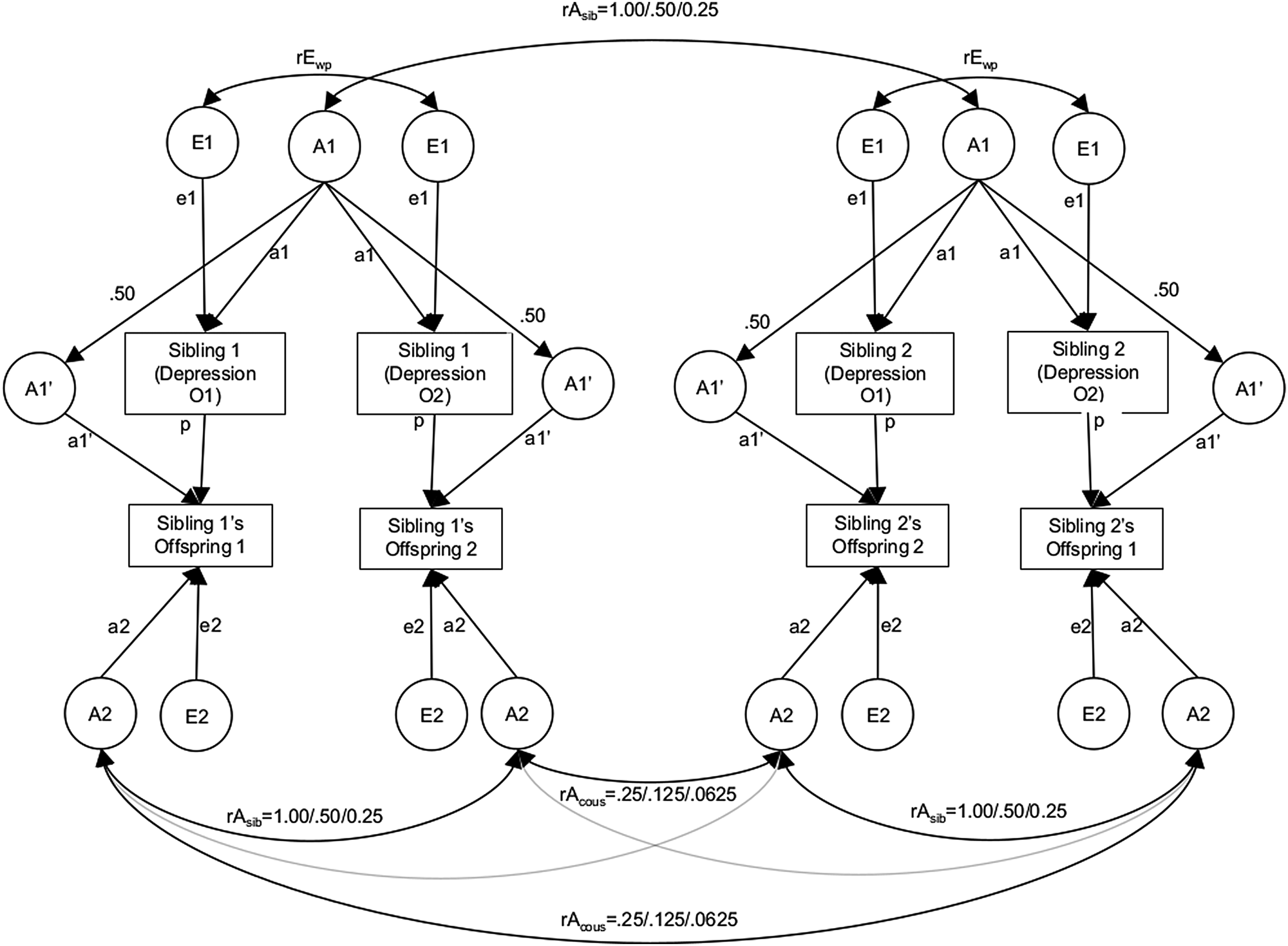
The models can be used to divide variance in the parental exposure into additive genetic (A1), shared environmental (C1), and unique environmental (E1) components (Figs 1 and 2a). As each mother can have up to two offspring in these models, any differences between those pregnancies are captured by the E1 parameter. Included in the model is also a freely estimated within-parent correlation parameter; rEwp. This parameter will be estimated >0 if the phenotype correlates more strongly within the parent than between the parent and her twin or sibling.
Path diagram of the full multiple children of twins and siblings structural equation model.

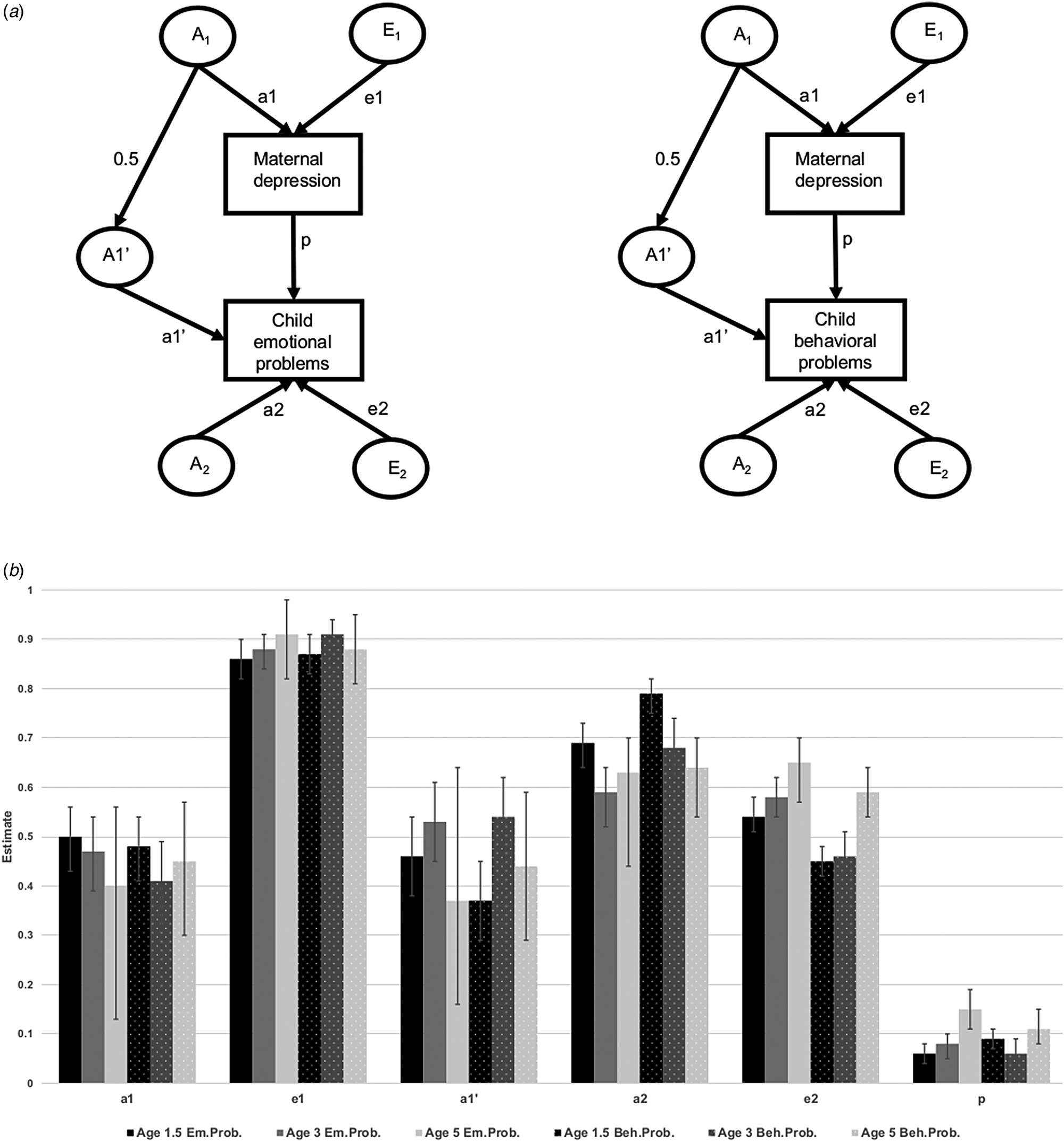
(a) Parameters. (b) Estimated parameters from best-fitting models.

Variance in the child outcomes can be separated into A2, C2, and E2 components (Figs 1 and 2a), that are not shared with the mother. To investigate mechanisms of transmission of risk, the covariance between the maternal and child phenotype is decomposed into a direct environmental exposure path (p) indexing direct environmental exposure, and a genetic path (A1′), indexing genetic transmission (Fig. 1). The importance of the intergenerational parameters can be determined by looking at avuncular correlations, namely the correlations between aunts and their nephews or nieces. Offspring of MZ twins will share as much genetic material with their aunt as with their mother, whereas offspring of DZ twins will share 25% of their genetic material with their aunt. Further, it is assumed that offspring and their aunts share none of the family environment (C). Hence, if offspring resembles their mothers more than their aunts, this has to be due to environmental influences, and hence the p path must be >0. Likewise, if the offspring is correlated >0 with their aunt, genetic influences must play a role in this covariation and A1′ >0. The genetic route of transmission is calculated by dividing the joint influence from all the genetic paths (a1 × 0.5 × a1′) on the phenotypic correlation between the mother and child phenotypes. The remaining part is accounted for by behavioral exposure (p).
Model fitting involves constructing one or several models that attempt to describe the data as closely but also as parsimonious as possible. A model can be simplified by dropping one or more parameters. The simpler model is often preferred if it does not fit the data significantly worse than the model where the parameter was retained.
We ran six MCoTS models on maternal depressive symptoms and concurrent child emotional and behavioral outcomes (two outcomes, each at three occasions). In addition, each of the six models included two nested submodels in which (1) the genetic transmission (A1′), or (2) direct environmental exposure (p) was dropped. The fit of these models was compared to the full model. We did not estimate the influence of shared environment (C) in the parent or child generation as separating genetic influences (A) from shared environmental influences (C) reliably in these models requires very large sample sizes. Also, the focus of this study was the intergenerational mode of transmission, rather than how much of the variance in the parent and child traits was explained by genetic v. environmental influences. We have included supplementary sensitivity analyses (online Supplementary Table S1 and Fig. S1) where C was included to investigate whether the exclusion of C could have affected the estimates of A1′ and p (the conclusions drawn from these models remained unchanged whether or not C was estimated). All models were fitted using full information maximum likelihood applied to raw data and compared using the χ2 distribution of the −2 log likelihood model fit statistic and Akaikes Information Criterion (AIC; Akaike, Reference Akaike1987). Child sex and maternal age where included as covariates.
To investigate whether the importance of direct environmental exposure changed over time, we fixed the p parameter post hoc to be identical to the estimate in the previous model, and checked for significant deterioration in fit. The full model at the same age period (with a freely estimated p parameter) was the reference for comparison. The modeling procedures were conducted in R, using the open source package OpenMx v2.3.1 (Neale et al., Reference Neale, Hunter, Pritikin, Zahery, Brick, Kirkpatrick and Boker2016).
Results
Correlations were 0.17, 0.20, and 0.22 between maternal depressive symptoms and concurrent child emotional problems when children were 1.5, 3, and 5 years old, and 0.18, 0.17, and 0.21 for behavioral problems, respectively. The parameters for the two child outcomes are presented in a path diagram for a single mother–child dyad in Fig. 2a, along with the parameter estimates from the best-fitting models in Fig. 2b.
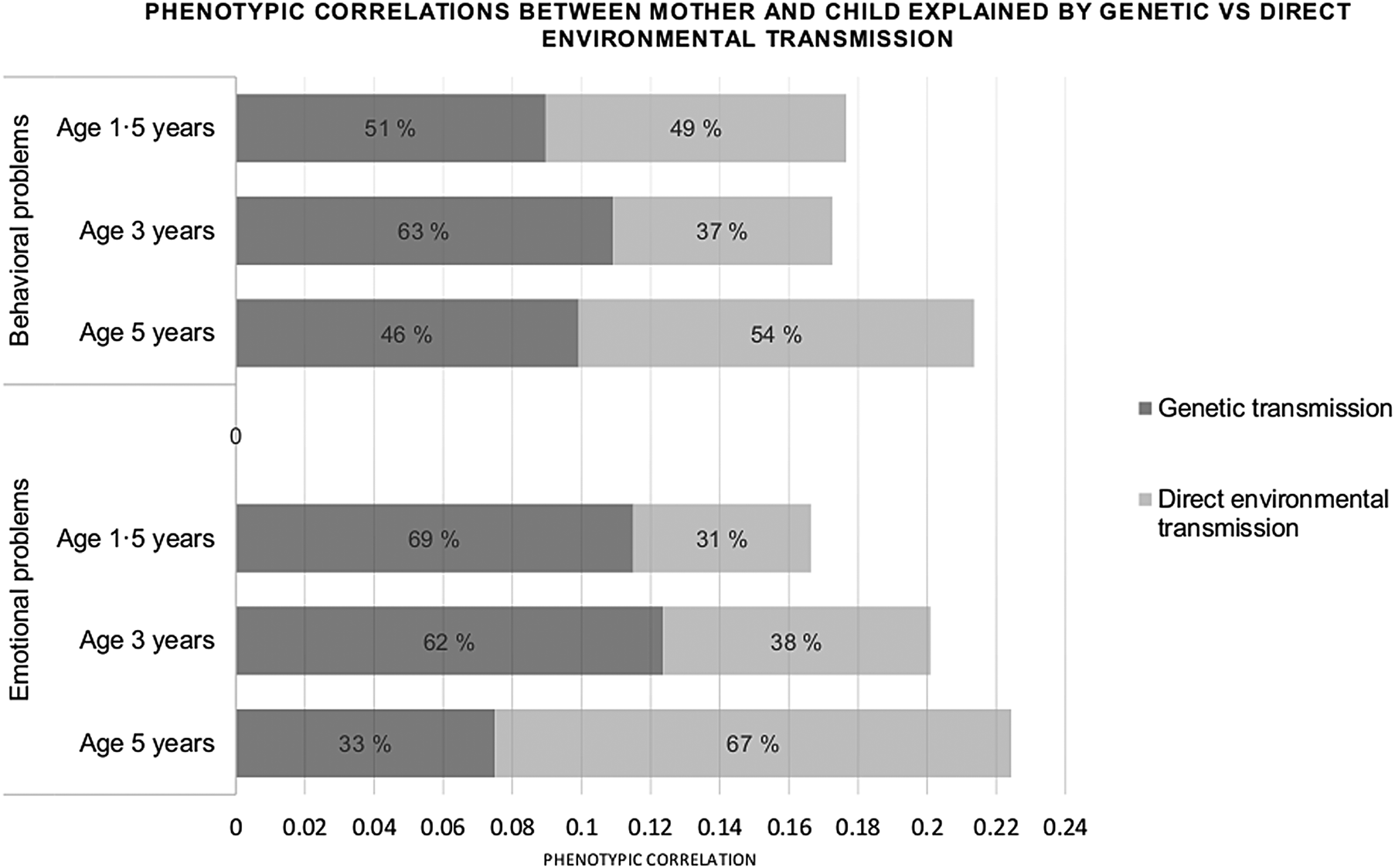
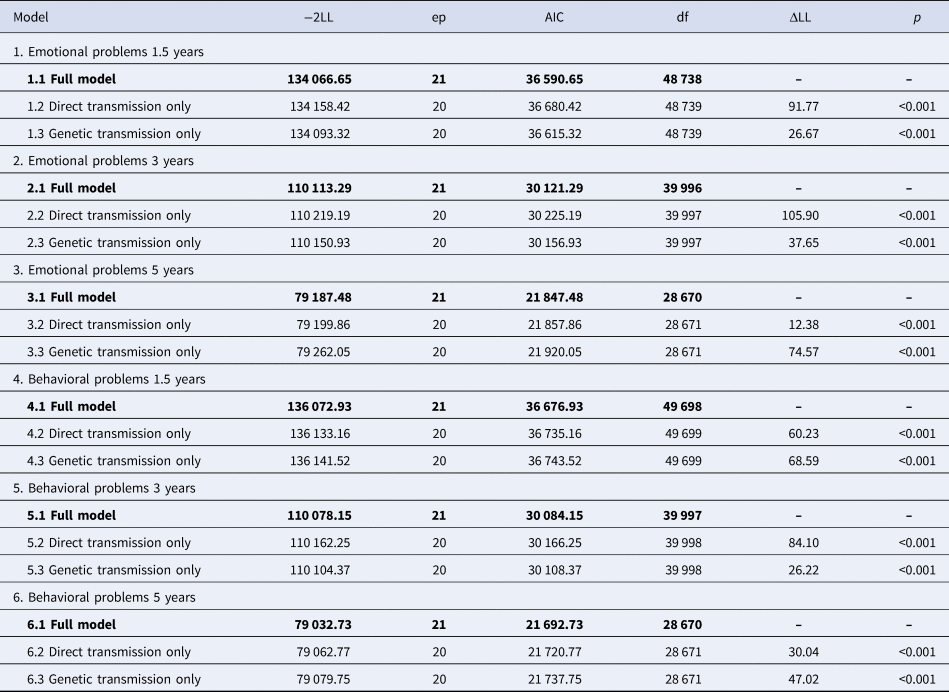
For both outcomes at all three occasions, we found that neither the genetic nor the direct environmental route of transmission could be dropped without significant deterioration in model fit (Table 1). The best-fitting model was therefore always the full model. For emotional problems, passive genetic transmission dominated when the children were 1.5 and 3 years old, explaining 69% and 62% of the correlations between the mother and child phenotypes, respectively. In terms of effect sizes, this means that of the total variance in child emotional problems, passive genetic transmission explained 21.1% at age 1.5 and 28.5% at age 3, whereas exposure to maternal symptoms through the direct transmission path (p) explained only 0.3% at age 1.5 and 0.6% at age 3. At age 5, however, the pattern appeared to change in favor of direct environmental exposure, accounting for 67% of the correlation (but only 2.2% of the variation in child emotional problems). For the second outcome, child behavioral problems, the association between mother and child was equally attributable to genetic transmission (51%) and direct environmental exposure (49%) at age 1.5 years (effect sizes on child phenotype were 14.2% and 0.8%, respectively). At age 3, the genetic transmission accounted for 63% of the total correlation, and direct environmental exposure explained 37% (29.3% and 0.4% of the variation in the child phenotype, respectively). At age 5, the genetic transmission explained 46% of the total correlation, and the direct exposure path 54% (19.7% and 1.3% of the child phenotype, respectively). The effect sizes, or the extent to which genetic and environmental influences included in the best-fitting models could explain variance in the child outcomes is summarized in online Supplementary Table S2, whereas the relative importance of genetic transmission v. direct environmental exposure for explaining the total correlation between mother and offspring is indexed in Fig. 3.
Correlations between mother and child explained by genetic v. direct environmental transmission.

Model fit statistics for each age within the two outcomes

Model comparisons for the two outcomes (emotional and behavioral problems), each at three separate age periods. For each model, the fit of the reduced version of the model, where either the genetic intergenerational path, or the environmental intergenerational path is dropped, is compared to the full model where all these parameters are retained. Best-fitting models are shown in bold. −2LL, two times the negative log likelihood – an estimate of how well the model fits the data; ep, number of estimated parameters included in the model; AIC, Akaike's Information Criterion – an indicator of how well the model fits the data that also penalizes complex models; df, degrees of freedom; ΔLL, the difference in log likelihood compared to the full model; p, probability value for rejecting the null hypothesis.
To clarify whether direct environmental exposure becomes more important as the children grow older, we fixed the p path to be the same value as it was estimated to be at a previous developmental period. The reference models were the full models at age 3 and 5, of which fit statistics are presented in Table 1. For emotional problems, the direct transmission (i.e. p path) was not significantly different at child age 1.5 (0.06, 95% CI 0.04–0.08) and 3 years [0.08 (0.05–0.10); Δχ2 = 2.25, Δdf = 1, ΔAIC = 0.25). However, there was a significant deterioration in fit when fixing the p at age 5 [0.15 (0.11–0.19)] to the same value as at age 1.5 (Δχ2 = 27.3, Δdf = 1, ΔAIC = 25.3) and at age 3 (Δχ2 = 16.99, Δdf = 1, ΔAIC = 14.99). The direct transmission of risk was therefore stronger at age 5 compared to age 1.5 and 3. Likewise, for behavioral problems, fixing the p path at age 3 [0.06 (0.04–0.09)] to the same value as at age 1.5 [0.09 (0.07–0.11)] did not result in a significantly worse fit (Δχ2 = 3.5, Δdf = 1, ΔAIC = 1.47). Nor did fixing the p path at age 5 [0.11 (0.08–0.15)] to the same estimate as at age 1.5 (Δχ2 = 2.64, Δdf = 1, ΔAIC = 0.64). There was, however, a difference in the importance of the p path from age 3 to 5 (Δχ2 = 9.19, Δdf = 1, ΔAIC = 7.19). Overall, the evidence for developmental change was therefore less compelling for behavioral than for emotional problems.
Discussion
The main goal of our study was to investigate mechanisms underlying the association between maternal depressive symptoms and early-life offspring psychopathology. We found that children of mothers with more depressive symptoms are at increased risk for emotional and behavioral symptoms both through a shared genetic liability with their mothers, and through direct environmental exposure. However, the relative importance of each was not the same across the two outcomes, nor were they always the same at different ages.
Many studies have found associations between maternal depression and psychopathology in offspring (Goodman et al., Reference Goodman, Rouse, Connell, Broth, Hall and Heyward2011; Netsi et al., Reference Netsi, Pearson, Murray, Cooper, Craske and Stein2018), but few have utilized designs that can parcel out and quantify the importance of familial confounding from these associations (Kendler et al., Reference Kendler, Ohlsson, Sundquist and Sundquist2018; McAdams et al., Reference McAdams, Rijsdijk, Neiderhiser, Narusyte, Shaw, Natsuaki and Eley2015; Silberg et al., Reference Silberg, Maes and Eaves2010; Singh et al., Reference Singh, D'Onofrio, Slutske, Turkheimer, Emery, Harden and Martin2011). Using an extended version of the CoT design (McAdams et al., Reference McAdams, Hannigan, Eilertsen, Gjerde, Ystrom and Rijsdijk2018), applied to data at three age periods, our study is the first to quantify the contribution from two different routes of transmission of risk from maternal depressive symptoms to offspring concurrent early-life psychopathology.
For emotional problems, the association with maternal depressive symptoms was primarily explained by genetic transmission at age 1.5 and 3, but by age 5, direct environmental exposure explained two-thirds of the association. That the mother–child association was environmental, and not merely a consequence of familial confounding stemming from shared genes is in line with the finding from a previous paper by our group that utilized a sibling comparison approach (Gjerde et al., Reference Gjerde, Eilertsen, Reichborn-Kjennerud, McAdams, Zachrisson, Zambrana and Ystrøm2017), and also with previous CoT studies (McAdams et al., Reference McAdams, Rijsdijk, Neiderhiser, Narusyte, Shaw, Natsuaki and Eley2015; Silberg et al., Reference Silberg, Maes and Eaves2010; Singh et al., Reference Singh, D'Onofrio, Slutske, Turkheimer, Emery, Harden and Martin2011). Although our study cannot conclude why direct environmental exposure appears to become more important over time, we can think of several possible explanations. As children grow older and their ability to think about other people's thoughts and feelings (theory of mind) becomes more sophisticated (Wellman, Cross, & Watson, Reference Wellman, Cross and Watson2001), they may become more affected by their mother's depressive symptoms. Five-year olds may also demand a different type of attention, which could be disturbed by depressive symptoms. Further, 5-year olds have been exposed to their mother's depressive symptoms longer. Research on cumulative exposure suggests that the persistency of maternal depressive symptoms is associated with increased risk for psychopathology (Netsi et al., Reference Netsi, Pearson, Murray, Cooper, Craske and Stein2018). Although we have modeled the hypothesis that the effect goes from the mother to the offspring, we cannot exclude the possibility that the association is child driven; i.e. that an emotional child could elicit depressive symptoms in a mother.
For behavioral problems, there was no net increase in the importance of direct environmental exposure across occasions, and the importance of each source of the intergenerational association was more similar than for emotional problems. Previous CoT studies of externalizing outcomes on teenage children of depressed mothers also present a mixed picture. One study finds evidence for both routes of transmission, a second finds evidence for intergenerationally shared genetic factors (Singh et al., Reference Singh, D'Onofrio, Slutske, Turkheimer, Emery, Harden and Martin2011) and a third for direct environmental exposure (McAdams et al., Reference McAdams, Rijsdijk, Neiderhiser, Narusyte, Shaw, Natsuaki and Eley2015). Overall, ours and previous findings indicate the importance of both family environment and genetic transmission in understanding the links between maternal depression and offspring behavior problems.
The US Preventive Task Force have recommended screening for depression in all pregnant women (Siu & USPST, Reference Siu2016). However, as indicated by the present study and others (Gjerde et al., Reference Gjerde, Eilertsen, Reichborn-Kjennerud, McAdams, Zachrisson, Zambrana and Ystrøm2017; Netsi et al., Reference Netsi, Pearson, Murray, Cooper, Craske and Stein2018), depression in mothers when children are in preschool age can negatively affect children's mental health. It is therefore reasonable to discuss whether this recommendation should be extended to also include screening of mothers in the first few years after pregnancy, as suggested in a recent editorial in JAMA Psychiatry (Weissman, Reference Weissman2018).
Some limitations need mentioning. First, shared method variance (mothers reporting on both their own and their children's symptoms) may have artificially increased associations between symptoms in mothers and their children. A meta-analysis found that the discrepancy between the mother–offspring correlations when teachers were the raters of the child outcomes v. when the mothers were the raters was 0.1 for internalizing problems and 0.09 for externalizing problems, or 40% for both outcomes (Goodman et al., Reference Goodman, Rouse, Connell, Broth, Hall and Heyward2011). To date, true effects cannot be disentangled from the effect of shared method variance in MoBa, but efforts are being made to collect data to do so in the future. We can therefore only speculate on what consequences the findings from this meta-analysis may have for the estimates presented in the present study. Four possible scenarios stand out: (1) If the difference in correlations between maternal symptoms and child symptoms between teachers and mothers is entirely due to depressed mothers overrating their children's symptoms because of the depression, we would expect that the bias will go into the estimate of direct environmental transmission (p). Our estimate of p would under this scenario be artificially high. (2) It is also possible that the discrepancy between the teacher rating and mother rating is due to a rating bias tendency that is inherent in mothers' personality. If this tendency is not heritable, the bias would also upwardly bias the estimate of the p parameter. (3) However, if this rating bias tendency is heritable, as almost all human behavioral traits are (Polderman et al., Reference Polderman, Benyamin, de Leeuw, Sullivan, van Bochoven, Visscher and Posthuma2015), this will upwardly bias the estimate of the passive genetic transmission (a1′). (4) The bias could also come from the child's behavior. Having a depressed mother could make the child act differently at home, but not at school. A scenario like this would also imply that our p estimate is too high. On the positive side, an alternative explanation to these scenarios is that the discrepancy in ratings could simply be due to the fact that mothers see their children in more settings, making their assessments of their children more valid than that of the teachers. Second, we have made the assumption that the environmental mode of transmission moves from mothers to their children. However, it is not implausible that the transmission moves both ways, or that it is offspring behavior that influences maternal symptoms. For instance, it is easy to imagine that fussy or difficult children could induce feelings of hopelessness or other depressive symptoms in their parents. Third, due to limited statistical power, we could not investigate potential sex differences in mechanisms of transmission of risk. However, such differences are not unlikely, as there is evidence that boys and girls differ in their susceptibility to negative consequences of maternal depressive symptoms, both when the exposure happens prenatally (Sandman, Glynn, & Davis, Reference Sandman, Glynn and Davis2013) and postnatally (McGinnis, Bocknek, Beeghly, Rosenblum, & Muzik, Reference McGinnis, Bocknek, Beeghly, Rosenblum and Muzik2015; Quarini et al., Reference Quarini, Pearson, Stein, Ramchandani, Lewis and Evans2016). Fourth, it is possible that the associations between maternal depressive symptoms and child emotional and behavioral problems could be partly explained by various prenatal influences, such as maternal prenatal depressive symptoms (Barker, Jaffee, Uher, & Maughan, Reference Barker, Jaffee, Uher and Maughan2011; Kerr et al., Reference Kerr, Leve, Harold, Natsuaki, Neiderhiser, Shaw and Reiss2013) or obstetric complications (Kerr et al., Reference Kerr, Leve, Harold, Natsuaki, Neiderhiser, Shaw and Reiss2013). However, associations between prenatal maternal depressive symptoms and child emotional and behavioral problems are found to be genetically confounded (Gjerde et al., Reference Gjerde, Eilertsen, Eley, McAdams, Reichborn-Kjennerud, Roysamb and Ystrom2018; Hannigan et al., Reference Hannigan, Eilertsen, Gjerde, Reichborn-Kjennerud, Eley, Rijsdijk and McAdams2018), and the genetics of depressive symptoms is rather stable (Nes, Roysamb, Reichborn-Kjennerud, Harris, & Tambs, Reference Nes, Roysamb, Reichborn-Kjennerud, Harris and Tambs2007). We can therefore assume that most of the potential prenatal influence is controlled for by the postnatal depressive symptoms included in the present study. However, future studies should strive to include prenatal factors such as obstetric complications as potential confounders. Fifth, the significant attrition in MoBa could have yielded a sample in which severely depressed mothers are under-represented. The possibility therefore remains that mechanisms of transmission are qualitatively different in severely depressed mothers, and this should be tested in clinical samples.
Conclusion
Children of mothers with depressive symptoms have more early-life psychopathology symptoms than can be expected from passive genetic transmission alone. Although our results suggest that treating depressive symptoms in mothers could decrease their children's risk for developing symptoms of psychopathology, the non-negligible genetic transmission implies that children of mothers with depressive symptoms would also be at risk even if they had grown up in an environment free of depressive symptoms.
Supplementary material
The supplementary material for this article can be found at https://doi.org/10.1017/S0033291719003301.
Acknowledgements
The work was supported by a grant from the Medicine, Health Sciences and Biology Programme at the Norwegian Research Council (Grant Numbers 231105 and 262177). TE is part-funded by a program grant from the UK Medical Research Council (MR/M021475/1), and by the National Institute for Health Research (NIHR), the Biomedical Research Centre at South London, Maudsley NHS Foundation Trust and King's College London. The views expressed are those of the author(s) and not necessarily those of the NHS, the NIHR, or the Department of Health. TAM is supported by a Sir Henry Dale Fellowship jointly funded by the Wellcome Trust and the Royal Society (Grant Number 107706/Z/15/Z). The Norwegian Mother and Child Cohort Study is supported by the Norwegian Ministry of Health and Care Services and the Ministry of Education and Research. We are grateful to all the participating families in Norway who take part in this on-going cohort study.
Conflict of interest
The authors declare no conflicts of interests.