EMOTIONS IN INCIDENTAL LANGUAGE LEARNING: AN INDIVIDUAL DIFFERENCES APPROACH
The role of emotions in second language (L2) learning is a wholly recognized, yet understudied phenomenon in the field of second language acquisition (SLA) (Dörnyei, Reference Dörnyei2009; MacIntyre, Reference MacIntyre and Robinson2002; Swain, Reference Swain2013). While many researchers know that emotions can impact complex cognitive abilities (Storbeck & Maswood, Reference Storbeck and Maswood2016) and learning (Dewaele, Witney, Saito, & Dewaele, Reference Dewaele, Witney, Saito and Dewaele2018; Khajavy, MacIntyre, & Barabadi, Reference Khajavy, MacIntyre and Barabadi2018; MacIntyre & Gregersen, Reference MacIntyre and Gregersen2012; MacIntyre & Vincze, Reference MacIntyre and Vincze2017), studies directly measuring how affect influences L2 acquisition are limited. This is particularly true in the area of implicit L2 learning research, which is devoted to understanding the cognitive basis of L2 acquisition. In this study, we investigated the effects of positive, negative, and neutral emotions in the implicit and explicit learning of L2 syntax under meaning-focused conditions. We also explored the relationships between individual differences (i.e., personality characteristics) and task performance in both neutral and emotionally loaded settings. With this empirical work, we hope to lay a solid foundation on which additional inquiry into the function of affect in SLA may be built (see MacIntyre, Gregersen, & Mercer, Reference MacIntyre, Gregersen and Mercer2016).
EMOTIONS AND SLA
The relevance of emotions and their impact on SLA has long been recognized within the field of L2 studies (MacIntyre, Reference MacIntyre and Robinson2002; Swain, Reference Swain2013). Even so, specific research in this area has been limited and “emotions have, in general, been neglected in SLA literature” (Swain, Reference Swain2013, p. 195). Typically, inquiry into affect and L2 acquisition has been relegated to one of three categories: (a) foreign language anxiety (FLA), (b) acquisition of emotional vocabulary, and (c) the role of affect within the L2 classroom. With respect to “primary” emotions (e.g., joy, interest, sadness; see Reeve, Reference Reeve1997), MacIntyre (Reference MacIntyre and Robinson2002) observed that, “the only emotion … to be studied in detail in the language learning area is anxiety, a variant of fear” (p. 64). FLA, as defined by Horwitz, Horwitz, and Cope (Reference Horwitz, Horwitz and Cope1986), reflects a type of situation-specific anxiety caused by negative reactions to L2 learning. Horwitz et al. developed a popular instrument for measuring FLA, (appropriately) named the Foreign Language Classroom Anxiety Scale (FLCAS). Extensive research on FLA has shown that FLA generally hinders L2 acquisition efforts (Horwitz, Reference Horwitz2001; Horwitz et al., Reference Horwitz, Horwitz and Cope1986). While FLA is indeed an affective component of L2 learning (MacIntyre, Reference MacIntyre and Robinson2002), it only represents one specific emotion that students may experience in the classroom.
A second area of emotion-related research is the mental representation of emotion words in bilinguals and L2 learners (Sutton, Altarriba, Gianico, & Basnight-Brown, 2007; Winskel, 2013). Affective vocabulary normally examined in this line of inquiry includes taboo and swearwords, insults, reprimands, endearments, and aversions (see Pavlenko, Reference Pavlenko2008). Generally speaking, an individual’s L1 is viewed as more emotional than subsequent languages (LX) learned (Dewaele, Reference Dewaele2004). In this case, age of LX acquisition matters, as earlier bilinguals appear to process language to greater affective depths than later bilinguals or foreign language learners (Pavlenko, Reference Pavlenko2012; Ponari et al., Reference Ponari, Rodríguez-Cuadrado, Vinson, Fox, Costa and Vigliocco2015).
The emotional interplay between L2 learning and teaching within the classroom is yet another category of affect research in SLA. Researchers generally discovered that strong, negative emotions detract from the overall acquisition process (Arnold, Reference Arnold2011; Khajavy et al., Reference Khajavy, MacIntyre and Barabadi2018; MacIntyre & Gregersen, Reference MacIntyre and Gregersen2012). In response to such findings, Arnold (Reference Arnold2011) suggested that language instructors be concerned with their students’, as well as their own, affective side to promote L2 development and assessment. The aforementioned studies, however, primarily focused on specific negative emotions generated within the context of the L2 classroom, such as fear and anxiety, and related them back to FLA (Horwitz et al., Reference Horwitz, Horwitz and Cope1986; MacIntyre, Reference MacIntyre and Robinson2002) or L2 motivation (Dörnyei, Reference Dörnyei2009). This leaves the role of positive emotions largely unexplored (see MacIntyre et al., Reference MacIntyre, Gregersen and Mercer2016; MacIntyre & Vincze, Reference MacIntyre and Vincze2017).
In an attempt to evaluate the role of emotions in SLA directly, Miller, Fox, Moser, and Godfroid (Reference Miller, Fox, Moser and Godfroid2018) measured the impact of affect in an explicit, L2 vocabulary acquisition task. In the study, two groups of 35 adult language learners were exposed to either negative or neutral stimuli (film clips) and subsequently participated in paired-associates, vocabulary learning of 24 Indonesian terms. Analysis of posttest scores (i.e., L1 to L2 translation, L2 to L1 translation, and free recall of the L1 words) revealed that the negative group learned fewer words than the neutral group. Interestingly, group differences only reached significance during activities that involved L2-L1 translation or retrieval of L1 words. The researchers attributed the diverging group performances to disembodied cognition, or the inability of learners to assign an affective status to newly acquired L2 forms (in contrast to well-known L1 meanings). From an SLA perspective, the findings revealed that negative emotional states may encumber students’ abilities to establish L2-L1 form-meaning connections by disrupting the semantic activation of L1 translation equivalents.
The Miller et al. (Reference Miller, Fox, Moser and Godfroid2018) study opened up several avenues for further research that will be explored in the current project. First, although the study already revealed an effect of negative emotions, more intense and sustained mood states (e.g., prolonged bouts of excitement or anxiety) may be needed to impact cognitive functioning in a laboratory setting and better mirror the reality of classroom-based learning. Second, positive, as well as negative, emotions should be investigated. Lastly, Miller et al.’s vocabulary experiment established that emotions can interfere with conscious and intentional L2 learning, brought about by explicit instruction. Less well known is whether the results generalize to other domains of L2 acquisition, such as the learning of grammar, and to incidental (meaning-focused) conditions. The present research is designed to address these issues.
EMOTIONS AND IMPLICIT LEARNING
Within SLA, implicit learning has been defined as learning without awareness and learning under incidental (meaning-focused) conditions (e.g., see Williams, Reference Williams, Ritchie and Bhatia2009).Footnote 1 To our knowledge, there is no literature in SLA that details the effects of emotional states on implicit learning. Limited to the domain of psychology, few researchers (Braverman, Reference Braverman2005; Naismith, Hickie, Ward, Scott, & Little, Reference Naismith, Hickie, Ward, Scott and Little2006; Pretz, Totz, & Kaufman, Reference Pretz, Totz and Kaufman2010) have made specific inquiries into the area of emotions in implicit learning. Braverman (Reference Braverman2005), for instance, tested the effects of different moods on the detection of covariation of visual information in the input. Ninety-seven undergraduates were subjected to either a happy, neutral, or sad emotional manipulation using four-minute, mood-inducing, video clips. Immediately following, the participants saw a series of faces, accompanied by math and verbal scores. The researchers correlated the nose sizes of the faces with either higher math or verbal scores, establishing a strong covariation among the variables. Results indicated that individuals from the sad group learned the covariation significantly better than the happy group, but only slightly better than the neutral group.
Findings from Naismith et al. (Reference Naismith, Hickie, Ward, Scott and Little2006), however, suggest these results may not extend to clinical populations. In their study, 21 subjects with moderate to severe unipolar depression and 21 matched “healthy” adults completed a serial reaction time (SRT) task to measure implicit learning. Stimuli in an SRT task (e.g., a cued marker in one of four positions on the screen) appear seemingly randomly on the screen, yet they follow a certain sequence that may lend itself to implicit learning (faster participant responses over time). The researchers discovered that participants suffering from depression performed significantly worse than those in the control group. While no group was explicitly induced for emotionality, the study did find that lower valence (i.e., sadness) impeded attempts at successful implicit learning.
In a more recent study, Pretz et al. (Reference Pretz, Totz and Kaufman2010) examined emotional effects on two implicit learning measures: an artificial grammar learning (AGL) task and an SRT task. The researchers initially divided undergraduates (N = 109) into three groups (positive, negative, and neutral) and utilized images from the International Affective Picture Database (Lang, Bradley, & Cuthbert, Reference Lang, Bradley and Cuthbert2008) to induce a desired mood state. Subsequently, the students completed the AGL task, which consisted of first memorizing, then identifying, letter strings that either did or did not conform to a specific grammar. For the SRT task, individuals pressed a button corresponding to the location of a stimulus appearing on the screen that, unbeknownst to participants, followed a probabilistic pattern. Results for the two tasks were mixed. The researchers found that mood had a significant effect on AGL learning (but not the SRT task), with the negative group performing significantly better than both the neutral and positive groups. As one anonymous reviewer noted, negative mood in this study may have served as a proxy for anxiety, leading to greater vigilance and arousal, more attention, and therefore learning. Pretz and colleagues concluded that negative mood facilitated certain aspects of implicit learning.
While these studies hint at the possibility of improved implicit learning in comparatively sad, but healthy adults, none of the performance tasks relate to the acquisition of a second language per se. That is, the lexical or grammatical structures that characterize natural language have yet to be tested in concert with mood induction. To accomplish this endeavor, we attempted to facilitate implicit learning (through an incidental learning task) of a semiartificial language under a variety of emotional stressors. Within SLA research, the use of training tasks that create incidental learning conditions has provided a window into unconscious L2 processing (Ender, Reference Ender2014; Godfroid, Reference Godfroid2016; Rebuschat & Williams, Reference Rebuschat and Williams2012). Simply stated, incidental learning is learning without intent (Rogers, Révész, & Rebuschat, 2016). In the context of L2 acquisition, Hulstijn (Reference Hulstijn and Chapelle2013) informally described this process as “‘picking up’ an unknown word [or expression] from listening to someone or from reading a text” (p. 2632), without a conscious effort to do so. This type of learning process is often contrasted with intentional learning, which involves a deliberate attempt to learn or memorize target material (Rogers et al., 2016). At a cognitive level, however, the distinction between incidental and intentional learning may not be so straightforward because incidental learning also involves a degree of intentionality (Godfroid, Boers, & Housen, Reference Godfroid, Boers and Housen2013; Godfroid et al., Reference Godfroid, Ahn, Choi, Ballard, Cui, Johnston, Lee, Sarkar and Yoon2018). In this study, therefore, incidental learning is operationalized as learning that takes place under meaning-focused conditions.
Within L2 experimental designs, incidental learning has been operationalized in training tasks so that “subjects should not know that they are going to be tested, nor should they be informed about the nature of the rule system” (Rebuschat, Reference Rebuschat2013, p. 615). According to Rogers et al. (2016), researchers interested in facilitating incidental learning often devise a “‘cover story’ or task in their training conditions that is designed to orient participants’ attention on the meaning of the input, rather than toward the grammatical features that will later be tested” (p. 782). Subjective source attributions may discern what types of knowledge (implicit, explicit, or both) are attained, especially in concert with AGL (Dienes, Reference Dienes2008). During grammaticality judgment tests (GJTs), for example, participants are given the opportunity to indicate what their decisions were based on (e.g., guess, intuition, recollection, or rule knowledge). Implicit knowledge is evident when participants report they are either guessing or using intuition and perform above chance on a GJT. Explicit knowledge is linked to recollection and rule knowledge and above-chance performance (see Dienes & Scott, Reference Dienes and Scott2005; Rebuschat, Reference Rebuschat2013). In the current research, we utilized retrospective subjective source attributions to explore what knowledge is developed from incidental learning conditions.
IMPLICIT LEARNING AND INDIVIDUAL DIFFERENCES
Research into the role of individual differences on implicit learning or incidental learning is on the rise (Faretta-Stutenberg & Morgan-Short, Reference Faretta-Stutenberg and Morgan-Short2018; Granena, Reference Granena2016; Grey et al., Reference Grey, Williams and Rebuschat2015; Hamrick, Reference Hamrick2015; Kaufman et al., Reference Kaufman, DeYoung, Gray, Jiménez, Brown and Mackintosh2010; Morgan-Short, Faretta-Stutenberg, Brill-Schuetz, Carpenter, & Wong, Reference Morgan-Short, Faretta-Stutenberg, Brill-Schuetz, Carpenter and Wong2014; Tagarelli, Ruiz, Moreno Vega, & Rebuschat, Reference Tagarelli, Ruiz, Moreno Vega and Rebuschat2016; Xie, Gao, & King, Reference Xie, Gao and King2013). Findings of previous studies indicate some individual components are more related to implicit learning performance than others. Self-reported personality aspects, for example, may be among the best predictors in this area. In a study of 153 participants, Kaufman et al. (Reference Kaufman, DeYoung, Gray, Jiménez, Brown and Mackintosh2010) correlated implicit learning performance on an SRT task with a variety of individual measures, ranging from psychometric intelligence to intuition. The researchers found significant relationships between implicit learning and the personality characteristics of impulsivity, intuition, and openness to experience. Among 43 participants, Woolhouse and Bayne (Reference Woolhouse and Bayne2000) also found strong correlations between implicit learning and intuition. They noted that intuitive individuals tended to better utilize unconscious knowledge. It could be, as one anonymous reviewer noted, that these individuals are more able to “break set” (i.e., “breaking from a pattern which has been intentionally established through a set of activities or experiences” [McGaughey, Reference McGaughey, Shaughnessy, Veenman and Kleyn-Kennedy2008, p. 85]) and apply alternative problem-solving strategies (see Sternberg, Reference Sternberg, Irvine and Berry1988) to accomplish implicit learning tasks (i.e., judging job suitability from personality profiles). Given that openness, intuition, and impulsivity are facets of personality that concern the regulation and expression of emotion, and given their attested relationship with implicit learning (but see Grey et al., Reference Grey, Williams and Rebuschat2015), these traits represent good candidates for further inquiry in the context of implicit learning.
Researchers have also explored the relationships between implicit learning and both intelligence (Gebauer & Mackintosh, Reference Gebauer and Mackintosh2007; Kaufman et al., Reference Kaufman, DeYoung, Gray, Jiménez, Brown and Mackintosh2010; Xie et al., Reference Xie, Gao and King2013) and working memory capacity (WMC) (Grey et al., Reference Grey, Williams and Rebuschat2015; Kaufman et al., Reference Kaufman, DeYoung, Gray, Jiménez, Brown and Mackintosh2010; Robinson, Reference Robinson2005; Tagarelli, Borges Mota, & Rebuschat, Reference Tagarelli, Borges Mota, Rebuschat, Carlson, Holscher and Shipley2011). Gebauer and Mackintosh (Reference Gebauer and Mackintosh2007), for instance, correlated the results of three implicit instructional treatments with a battery of intelligence tests in a large number of German students (n = 401). The researchers failed to find strong links between implicit learning performance and measures of fluid intelligence, crystallized intelligence, and memory. Related to intelligence and cognitive ability, Xie et al. (Reference Xie, Gao and King2013) found no relationships between implicit learning and the 13 thinking styles as described by Sternberg (Reference Sternberg1997) (categorized into Type 1, creativity and cognitive complexity; Type 2, preference for norms and cognitive simplicity; and Type 3, value differentiated). Their study, involving Chinese undergraduates (n = 87), correlated scores from the Thinking Styles Inventory-Revised II survey (Sternberg, Wagner, & Zhang, Reference Sternberg, Wagner and Zhang2007) with scores on an AGL task. The researchers measured no significant correlations between any of the thinking styles and performance under implicit instruction. WMC has also been shown to have a weak relationship with implicit artificial grammar learning. Both Kaufman et al. (Reference Kaufman, DeYoung, Gray, Jiménez, Brown and Mackintosh2010) and Tagarelli et al. (Reference Tagarelli, Borges Mota, Rebuschat, Carlson, Holscher and Shipley2011) reported no significant correlations with operation span tasks and implicit learning performance. Recently, Grey et al. (Reference Grey, Williams and Rebuschat2015) tested 36 undergraduates and compared phonological working memory, using non-word repetition tasks, with implicit learning and found no significant correlations between the variables.
In addition to openness, intuition, and impulsivity, we also examined emotional intelligence (EI), or the “competence in perceiving emotions (both in oneself and others)” (Zeidner, Matthews, & Roberts, Reference Zeidner, Matthews and Roberts2009, p. 3), and FLA as characteristics that potentially mediate implicit learning. Less is known about how these two variables interact with implicit performance. Fiori (Reference Fiori2009) described how EI as a trait may be linked with unconscious processing and automaticity, possibly facilitating the development of implicit knowledge. From an SLA perspective, Dewaele, Petrides, and Furnham (Reference Dewaele, Petrides and Furnham2008) discovered that multilinguals (n = 464) with high trait EI possessed lower levels of FLA across languages learned, although implicit learning was not looked at in the study. The finding, at a minimum, provides evidence of a possible, positive connection between EI and language learning, though more research into this area is needed (Zeidner et al., Reference Zeidner, Matthews and Roberts2009). Regarding FLA, no studies to our knowledge have examined the role of this variable in implicit learning specifically. Given the state of current knowledge, we decided to investigate the role of FLA, EI, openness, intuition, and impulsivity in performance on an incidental, L2 task in both a neutral state and under emotional strain.
PRESENT STUDY
In this study, we sought to better understand how emotions influence aspects of SLA under incidental exposure. Our research questions (RQs) were as follows:
1. What is the role of L2 learners’ positive, negative, and neutral emotions in developing implicit and explicit knowledge of L2 syntax?
2. How do individual differences in openness, intuition, EI, FLA, and impulsivity influence emotionally induced L2 learning performance? How do these same traits relate to the development of implicit and explicit L2 knowledge?
PARTICIPANTS
One hundred and twenty (N = 120) undergraduates from a major Midwestern university in the United States participated in this study. We randomly assigned individuals to a Comparison group (n = 30) or one of three experimental groups: the Positive emotional group (n = 30), the Negative emotional group (n = 30), or the Neutral emotional group (n = 30). All participants were (a) between the ages of 18 and 30 (M = 21.3 years, SD = 2.68), (b) native speakers of English, (c) not heritage speakers of German or any other verb-second (V2) language, (d) not regularly exposed to V2 languages, and (e) emotionally fit to view violent, disturbing, or sexually explicit material (determined through prescreening). Out of the 120 participants, 37 were male and 83 were female (distributed equally between conditions). We conducted this study with approval from the Institutional Review Board.
MATERIALS
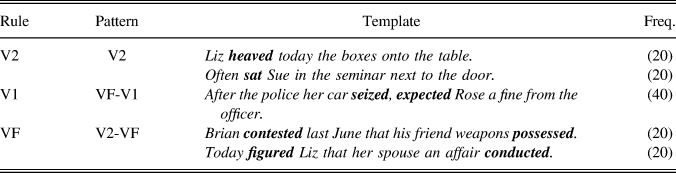
For the L2 exposure and testing tasks, we adapted the sentences from Rebuschat and Williams (Reference Rebuschat and Williams2012). All belonged to a semiartificial language that blended English words with German syntax. The sentences were recorded by a female, native speaker of American English, and presented aurally. The exposure set consisted of 120 past-tense sentences (plus four practice items) that followed one of the three target verb placement rules (see Table 1). The number of sentences per verb rule equaled 40, half of which were semantically plausible and half of which were implausible. The items were designed so that participants needed to process the entire auditory string before judging for plausibility. Table 1 provides the syntactic patterns, templates, and frequency counts for all items in the exposure set.
Syntactic templates for the three verb placement rules in the exposure set

Note: V1 = verb first position; V2 = verb second position; VF = verb final position. The sample sentences are in italics.
The testing set included 60 different, past-tense sentences (plus four practice items), which were all semantically plausible. Half the sentences were grammatical and followed the verb patterns of V2, VF-V1, or V2-VF. The other half were ungrammatical and utilized one of the following verb placement patterns: *VF, *VF-V2, *V1-VF, *V1, *V3, or *V4.
Emotional stimuli
We utilized a combination of film clips and photographic imagery to facilitate emotional induction in participants. All movie clips were from the Emotional Movie Database (EMDB) (Carvalho, Leite, Galdo-Álvarez, & Gonçalves, Reference Carvalho, Leite, Galdo-Álvarez and Gonçalves2012). We selected film clips for each treatment group based on the films’ specific measured valence and arousal levels, as measured on a 9-point Likert scale by Carvalho and her colleagues. For the purposes of this study, we defined valence as a positive (e.g., happy, pleasant) or negative (e.g., sad, unpleasant) emotional state, and arousal as a high (e.g., excited) or low (e.g., calm) level of stimulation. All film clips were 40 seconds in length and soundless. The Positive group watched erotic film excerpts known to stimulate high valence (M = 6.53, SD = .27) and high arousal (M = 5.89, SD = .19) in self-reports. The Negative group viewed horror film excerpts known to stimulate low valence (M = 2.01, SD = .36) and high arousal (M = 7.04, SD = .43) in self-reports. Finally, the Neutral group watched scenery film clips that registered mid-range valence (M = 6.02, SD = .40) and low arousal (M = 2.90, SD = .29) in self-reports. One-sample t test results indicated that the valence ratings for the positive, negative, and neutral movie clips were significantly different from the neutral value of the Likert scale (all ps < .001).Footnote 2
The emotionally charged images shown to participants came from the International Affective Picture System (IAPS) (Lang et al., Reference Lang, Bradley and Cuthbert2008). We chose all pictures from the IAPS database with specific valence and arousal ratings (from a 9-point Likert scale) in mind. The Positive group viewed images with high valence (M = 6.86, SD = .50) and arousal (M = 6.10, SD = .66) levels (e.g., erotica, extreme sports, food). The Negative group watched images that registered low valence (M = 1.94, SD = .36) but high arousal (M = 6.44, SD = .51) (e.g., mutilations, aimed guns, attacks). Lastly, the Neutral group saw images associated with mid-range valence (M = 4.96, SD = .33) and low arousal (M = 3.13, SD = .62) (e.g., tools, furniture).
Subjective affective ratings
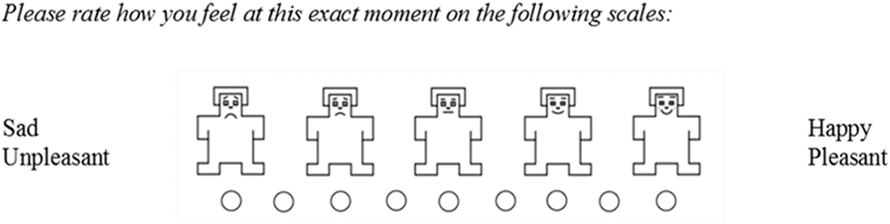
To measure participants’ subjective emotionality (i.e., self-reports), we utilized four self-assessment manikins (SAMs), depicted in Figure 1, at various points throughout the experiment. The SAMs evaluated participants’ valence levels on a nine-point Likert scale.
Self-assessment manikin (SAM) for valence rating.

Personality questionnaires
The following five questionnaires, all constructed on a 9-point Likert scale, gauged individual participants’ trait characteristics at the beginning of the study.
Big Five Aspect Scale
While the Big Five Aspect Scale (BFAS) (DeYoung, Quilty, & Peterson, Reference DeYoung, Quilty and Peterson2007) measures five components of individual personality, we only administered items from the Openness/Intellect aspect. Within our study, the subfactors intellect and openness maintained good internal reliabilities (.78 and .79, respectively), on a par with the reliabilities reported in two large-scale studies by DeYoung et al. (Reference DeYoung, Quilty and Peterson2007). According to DeYoung and colleagues, a high intellect score represents a disposition toward ingenuity and ideas, which has been correlated with fluid intelligence and working memory (DeYoung, Peterson, & Higgins, Reference DeYoung, Peterson and Higgins2005). A high openness score is associated with feelings and aesthetics.
Rational Experiential Inventory
The Rational Experiential Inventory (REI) (Pacini & Epstein, Reference Pacini and Epstein1999) measures a preference to engage in either rational or experiential processing. In this study, we only used the experiential component for gauging intuitiveness. According to Pacini and Epstein, experiential thinkers are more open-minded and rely on intuition and affect when processing information. Cronbach’s alpha for this scale was high, at α = .90, and comparable to the reliability in Pacini and Epstein’s study.
Trait Emotional Intelligence Questionnaire-Short Form
The Trait Emotional Intelligence Questionnaire-Short Form (TEIQue-SF) (Cooper & Petrides, Reference Cooper and Petrides2010) provides a quick assessment of global trait emotional intelligence. Trait EI encapsulates a variety of emotional dispositions and self-perceptions (Petrides, Pita, & Kokkinaki, Reference Petrides, Pita and Kokkinaki2007) and has been linked with reduced FLA in multilinguals (Dewaele et al., Reference Dewaele, Petrides and Furnham2008). We obtained a high Cronbach’s alpha, at α = .86, which was nearly identical to Cooper and Petrides’s.
Foreign Language Classroom Anxiety Scale
The FLCAS (Horwitz et al., Reference Horwitz, Horwitz and Cope1986) is an oft-used tool in SLA research to measure individual FLA in the L2 classroom. It reflects anxiety in the following three domains: communication apprehension, test anxiety, and fear of negative evaluation. Our results indicated high internal reliability (α = .95) for this survey.
Urgency, Premeditation (lack of), Perseverance (lack of), Sensation Seeking (UPPS) impulsivity behavior scale
The Urgency, Premeditation (lack of), Perseverance (lack of), Sensation Seeking (UPPS) impulsivity behavior scale (Whiteside & Lynam, Reference Whiteside and Lynam2001) combines four personality facets—(lack of) premeditation, urgency, sensation seeking, and (lack of) perseverance—to measure individual impulsivity. Our internal consistency coefficients were high for each scale (.88, .87, .86, and .83, respectively), mirroring the reliabilities from Whiteside and Lynam’s (Reference Whiteside and Lynam2001) study. Scale interpretations, as explained by Whiteside, Lynam, Miller, and Reynolds (2005, p. 561), are as follows: (a) a (lack of) premeditation indicates a “difficulty in thinking and reflecting on the consequences of an act before engaging in that act”; (b) high urgency shows a “difficulty resisting cravings and temptations”; (c) high sensation seeking signifies a “tendency to enjoy and pursue activities that are exciting” or even dangerous; and (d) a (lack of) perseverance highlights a “difficulty completing projects and working under conditions that require resistance to distracting stimuli.”
PROCEDURE
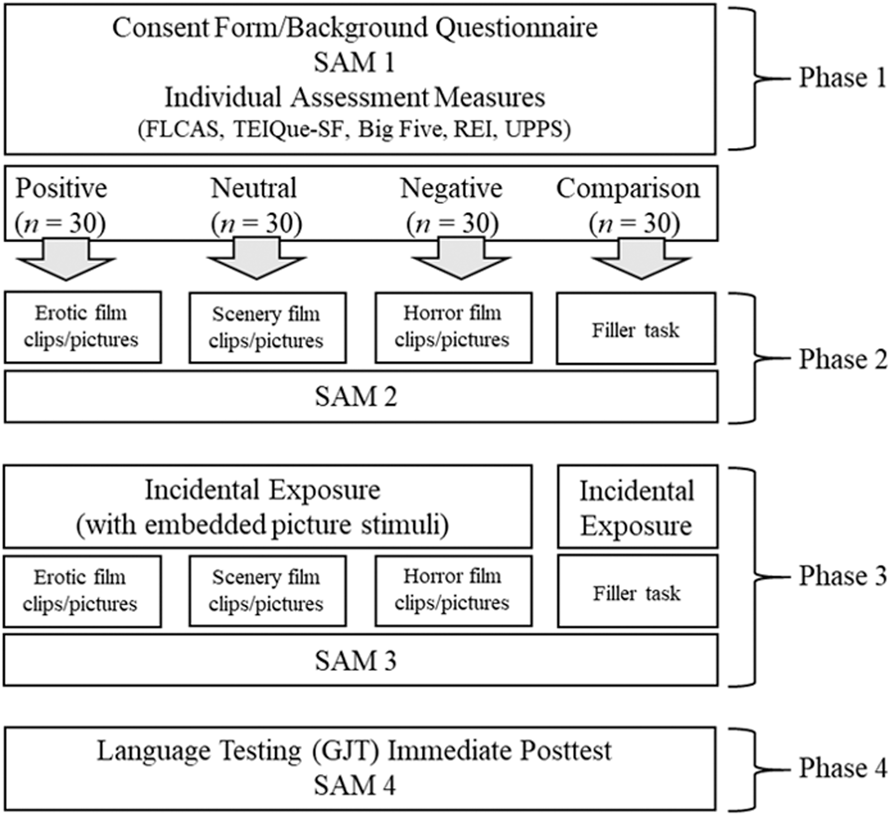
This study consisted of four phases (see Figure 2): (a) pre-experimental measures, (b) initial emotional induction, (c) incidental exposure and secondary emotional induction, and (d) immediate language testing.
A graphic representation of the study protocol.

After completing an initial SAM, participants filled out the five personality characteristics questionnaires in a counterbalanced order. Subsequently, participants were randomly assigned to one of the treatment groups and took a seat in front of a computer monitor. This is when their initial emotional induction began on the SuperLab 5 platform. After a brief preparatory session, participants viewed a series of five clips from the EMDB, intermixed with 20 images from the IAPS (3 seconds per image), for a total induction time of 4 minutes and 20 seconds. After watching all visual stimuli, participants completed a second SAM to record their emotional well-being. As a substitute task, individuals assigned to the Comparison group surfed the Internet for 6 minutes prior to SAM 2.
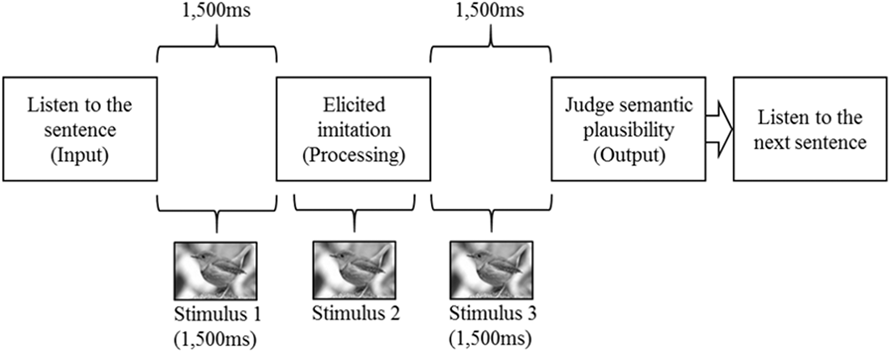
Immediately after the first round of mood induction, we exposed participants to the semiartificial language, instructing individuals to: (a) listen to each sentence of the exposure set; (b) repeat the sentence aloud; (c) and judge whether the sentence was semantically plausible or implausible. We did not inform participants that the sentences belonged to a new language system, nor that they were to be subsequently tested on the material. All sentences were presented in a random order. For the three treatment groups, 30 new images from the IAPS were flashed onto the computer screen (10 pictures at each one of the three pseudo-randomized points; see Figure 3): preprocessing (i.e., before elicited imitation), during processing (during elicited imitation), and after processing (after elicited imitation and before plausibility judgment). The placement of picture stimuli was informed by Tobias’s (Reference Tobias and Schwarzer1986) model of where anxiety may most directly affect learning from instruction. Because pictorial stimuli may impose an additional cognitive load on participants, we wanted to make sure we isolated the effects of the mood induction from that of the pictures. To this end, we also included a Comparison group. Unlike the three treatment groups, the Comparison group did not experience any visual stimuli during the exposure phase. Hence, in what follows, the Comparison-Neutral comparison will reveal any potential effects of video and pictorial interference (evidenced in the Neutral group), while the Positive-Neutral and Negative-Neutral comparisons will uncover the effects of a positive and negative mood, respectively.
A learning trial for the Positive, Negative, and Neutral treatment groups. The Comparison group did not experience any visual stimuli during the experiment.

After finishing the exposure task, participants again viewed a series of five different film clips, intermixed with 20 different images, for a total presentation time of 4 minutes and 20 seconds. Lastly, participants completed a third SAM to gauge their emotional bearings. As in Phase 1, Comparison group participants surfed the Internet prior to SAM 3.
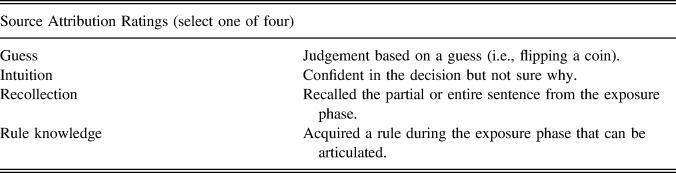
Upon completion of the final emotional induction, we informed participants from all four groups that the sentences presented in the exposure set represented a new, complex language system instead of an arbitrary pattern of words. We then asked them to listen to 60 more sentences and answer the following questions for each item: (a) “is the sentence grammatical (in accordance with the new language system presented in the exposure set)?” and (b) “what is the basis of your judgment?” Table 2 provides the guidelines for using source attributions to determine one’s basis of judgment (see Dienes & Scott, Reference Dienes and Scott2005; Rebuschat, Reference Rebuschat2008). Here, correct responses attributed to guess and intuition suggested the presence of implicit, unconscious knowledge, whereas correct recollection and rule-based responses implied the presence of explicit, or conscious, knowledge. Upon completion of the GJT, a fourth SAM measured participants’ final emotional state.
Guidelines for source attribution ratings of test item grammaticality

RESULTS
EFFECTIVENESS OF TREATMENT
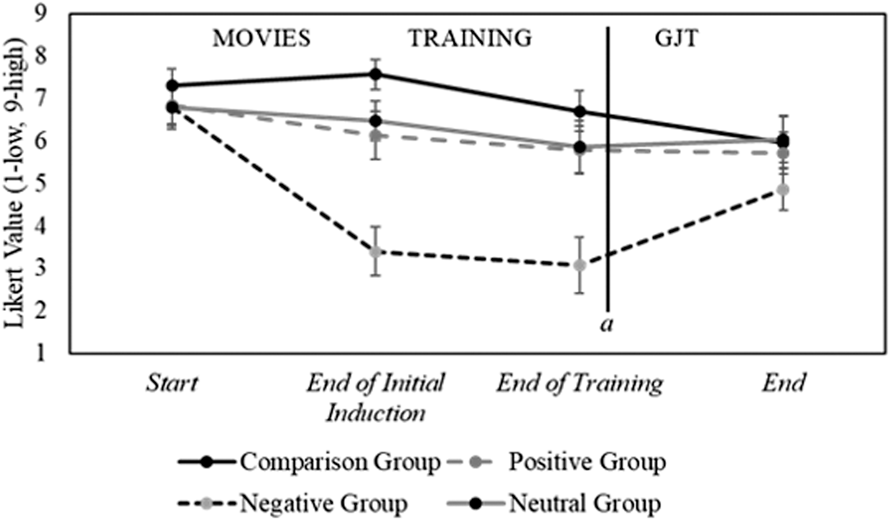
Figure 4 shows the effects from the emotional induction throughout the experiment. Based upon the ordinal nature and lack of normality of the data (confirmed by Kolmogorov-Smirnov normality testing), we utilized nonparametric analyses. Kruskal-Wallis testing indicated there were no significant differences between groups at their initial affective states, H(3) = 4.26, p = .235. However, Friedman’s tests revealed significant emotional changes for all groups over the course of the study (all ps < .001).
Valence ratings for each group over the course of the experiment.
Note: The vertical line a denotes the start of the immediate posttest. Error bars represent the 95% CIs for the mean values.

For post-hoc analysis, we used Wilcoxon signed-rank tests, with α = .013 to adjust for multiple testing. For the Comparison group, we recorded a significant decrease in valence between the end of surfing the Internet (initial induction) and End of Training, z = –3.00, p = .003, r = –.32, indicating the Comparison group felt somewhat less pleasant after completing the training. This drop likely resulted from experimental fatigue. Individuals from the Positive group registered no significant changes in mood between the data collection points (all ps > .013), suggesting that the film clips and images helped to sustain a fairly consistent emotionality throughout the experiment. Participants in the Negative group measured a significant decrease in mood from Start to End of Initial Induction, z = –4.64, p < .001, r = –.49, which remained steady through Training. Here, the induction material successfully depressed valence levels over multiple SAM points and led to a generally sad or unpleasant emotional status both during training and prior to the immediate posttest. Lastly, participants from the Neutral group behaved similarly to those from the Comparison group, registering a significant drop in emotionality only over the Training phase, z = –2.88, p =.004, r = –.30.
DEVELOPMENT OF EXPLICIT, BUT NOT IMPLICIT KNOWLEDGE IN ALL GROUPS (RQ1)
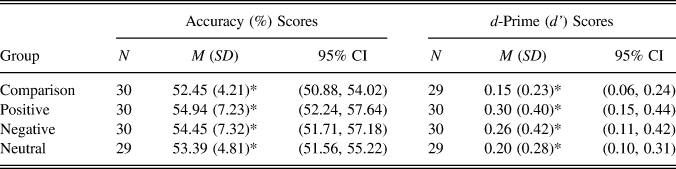
To determine how positive, negative, or neutral mood states affected the implicit and explicit learning of an L2 syntax (RQ1), we first analyzed data from the GJT to ascertain whether L2 learning occurred. Accuracy and d-prime scores ±3 standard deviations from the group mean were removed prior to analysis. This resulted in the exclusion of one participant in the Neutral group and one participant in the Comparison group (d-prime score only). The descriptive statistics are presented in Table 3. Participants in the Positive, Negative, and Neutral groups performed numerically higher than those from the Comparison group. Higher standard deviations within the Positive and Negative treatment groups (more than 1.5 times greater than the Comparison group) suggest that the mood induction may have affected these participants’ learning differently. Further analysis, using one-sample t tests, revealed that all groups performed significantly better than chance. We also measured no differences between the four groups in terms of overall accuracy, Welch’s F(3, 62.44) = 1.14, p = .339, ω 2 = 0.00 (no effect). This means that participants generally learned parts of the L2 syntax immediately after exposure, regardless of the presence of emotional influencers.
GJT Accuracies and d-prime scores, immediate posttest

Note: * = significant at p < .05.
We also converted the accuracy scores into d-prime scores to measure how well participants discriminated the grammatically correct sentences from the ungrammatical ones. A d-prime score of 0 indicates chance performance, whereas higher d-prime scores reflect better discrimination ability of grammatical and ungrammatical sentences. Descriptive statistics from Table 3 show that all groups achieved positive d-prime scores and performed significantly above chance. Differences did emerge, however, between the Comparison group and both the Positive and Negative groups. Besides registering lower d-prime scores, the Comparison group’s 95% CI only contained the mean of the Neutral group, and not those of the two emotionally colored groups. These results signal a significant separation in performance (Cumming & Calin-Jageman, Reference Cumming and Calin-Jageman2017) and suggest that mood state influencers may have played a meaningful role in learning.
To determine what type of learning occurred during incidental exposure, we evaluated the source attributions, combining guess/intuition to represent implicit knowledge and recollection/rule knowledge to signify explicit knowledge. Throughout the GJT, the Comparison and Neutral groups utilized implicit source attributions 39% of the time, whereas the Positive and Negative groups either guessed or used intuition at slightly higher rates (46% and 45%, respectively). Using this proportion data, we developed an explicit-to-implicit knowledge ratio for each participant. This ratio captured the relative incidence of explicit over implicit knowledge responses. For instance, a ratio of 1 signals that participants drew on explicit and implicit knowledge sources equally frequently. The calculated means of the four experimental groups were: (a) Comparison group, M = 5.19 (SD = 10.84); (b) Positive group, M = 1.76 (SD = 1.74); (c) Negative group, M = 3.19 (SD = 6.19); and (d) Neutral group, M = 3.87 (SD = 6.13). One-sample Wilcoxon signed rank tests (with a test value of 1) indicated nuances in how each group relied on the two source attribution types. Here, the ratios of the Comparison group (p = .001) and Neutral group (p = .003) were significantly higher than the test value. These participants, then, relied more on their explicit knowledge of the L2 syntax to navigate the immediate posttest. The Positive group (p = .074) and the Negative group (p = .082) ratios, however, were not significantly different from the test value, suggesting a comparable use of explicit and implicit attributions when determining the grammaticality of each sentence. Between-group differences among the ratios were not significant, Kruskal-Wallis test, H(3) = 3.72, p = .294.
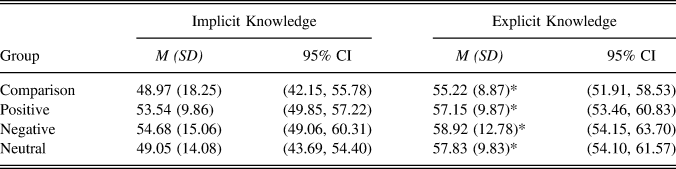
Table 4 provides group accuracy rates for the two categories of source attributions during the posttest. According to one-sample Wilcoxon signed rank tests, all groups performed significantly above chance when utilizing explicit source attributions, meaning that all groups acquired explicit knowledge of the L2 grammar system. For implicit knowledge, we found a two-way distinction, with the Positive and Negative groups performing above 50% accuracy and the Comparison and Neutral groups below. No differences were statistically significant. These findings suggest that none of the groups, regardless of mood state, acquired implicit knowledge of the L2 syntax.
Grammaticality judgment accuracies per source attribution, immediate posttest

Note: Guess and intuition reflect implicit knowledge, whereas recollection and rule knowledge reflect explicit knowledge. Chance is 50%. For the Comparison, Positive, and Negative groups, n = 30; for the Neutral group, n = 29. * significant at p < .05.
INFLUENCE FROM PARTICIPANTS’ INTELLECT, STRESS MANAGEMENT, AND PREMEDITATION (RQ2)
RQ2 examined the links between five individual differences (openness, intuition, EI, FLA, and impulsivity) and L2 performance under an affective status, as well as the relationship between these same traits and the formation of implicit/explicit knowledge. To answer the RQ, we conducted exploratory factor analysis for each individual survey and examined the scores by principal axis factoring with an oblique rotation (direct oblimin). The following 14 factors emerged (see Appendix A): openness, intellect, and escapism (BFAS); intuitive ability and general intuition (REI); emotional self-regulation, emotionality toward others, and stress management (TEIQue-SF); FLA and general academic anxiety (FLCAS); and premeditation, sensation seeking, urgency, and (lack of) perseverance (UPPS).
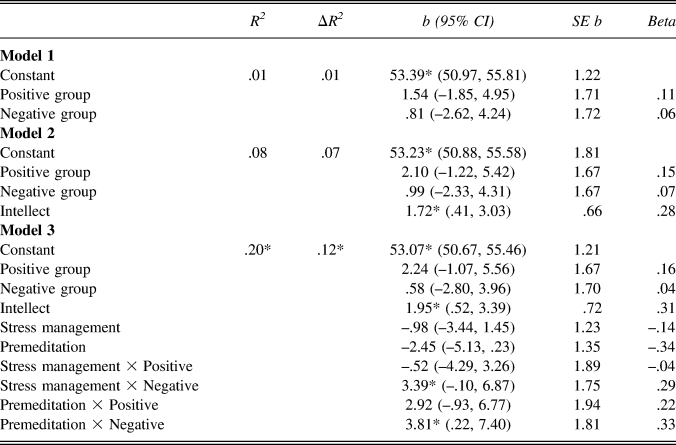
Next, we conducted multiple linear regression using the factor scores from the exploratory factor analysis and mood to predict the GJT scores. We examined whether individual differences interacted with mood in shaping performance; that is, do positive or negative emotions influence learning differently depending on the individual? To limit the possible number of predictors in the final model, we ran two preliminary analyses. We first visualized relationships between variables using scatterplots. Then, we performed separate forced entry regressions for each factor individually. Per our findings, we selected four factors for the final multiple linear regression: intellect, stress management, premeditation, and (lack of) perseverance. Because we wanted to isolate the effects of mood induction from that of the pictures and videos, we designated the Neutral group as the reference category. The Positive and Negative groups were represented through dummy variables (treatment coding).Footnote 3 Using the forced entry method, we built the model in three steps: dummy variables for treatment groups in Step 1, any significant main effects in Step 2 (i.e., intellect), and any significant interaction variables (i.e., stress management × Positive/Negative Emotions and premeditation × Positive/Negative Emotions) with their main effects in Step 3 (see Appendix B). Our final model accounted for 20% of the variance (R 2 = .20) in posttest performance and was statistically significant F(9, 78) = 2.22, p = .029. This R 2 value is likely a function of both the number of variables in our model, as well as the use of nonlinguistic (as opposed to linguistic) predictors, namely emotions and trait characteristics. The R 2 value is consistent with results from other L2 studies where researchers examined nonlinguistic predictor variable types in multiple regression analysis (Plonsky & Ghanbar, Reference Plonsky and Ghanbar2018). To correct for the number of predictors in our model and the study’s sample size, we calculated the adjusted R 2 at .11.
The present multivariate analysis confirmed the overall benefits of intellect for learning, b = 1.95, SE = 0.72, p = .008. Furthermore, two interactions emerged as significant or near significant: (a) premeditation × Negative, b = 3.81, SE = 1.81, p = .016, and (b) stress management × Negative, b = 3.39, SE = 1.75, p = .057.
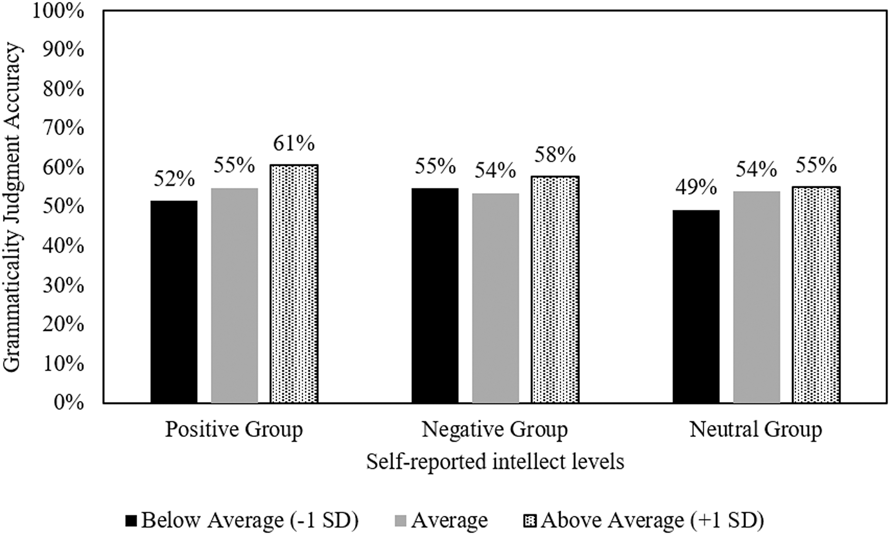
The factor of intellect was derived from BFAS items such as, “I am quick to understand things” and “I like to solve complex problems.” In past research, intellect has been associated with a proclivity for explicit learning (Kaufman et al., Reference Kaufman, DeYoung, Gray, Jiménez, Brown and Mackintosh2010; Xie et al., Reference Xie, Gao and King2013). In our regression model, intellect emerged as a robust main effect (see Figure 5).
Role of intellect in immediate posttest performance by group.

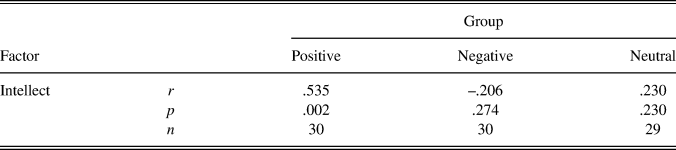
The positive association between intellect and test performance is consistent with our findings that learning was mostly explicit (Table 4). As a secondary analysis, we correlated the intellect trait with the rates at which participants from each group based their judgments on explicit knowledge sources (i.e., recollection or rule knowledge). The findings, presented in Table 5, show that individuals from the Positive group with higher reported levels of intellect were more likely to utilize explicit source attributions during the GJT.
Correlations of intellect with proportion of explicit source attributions by group

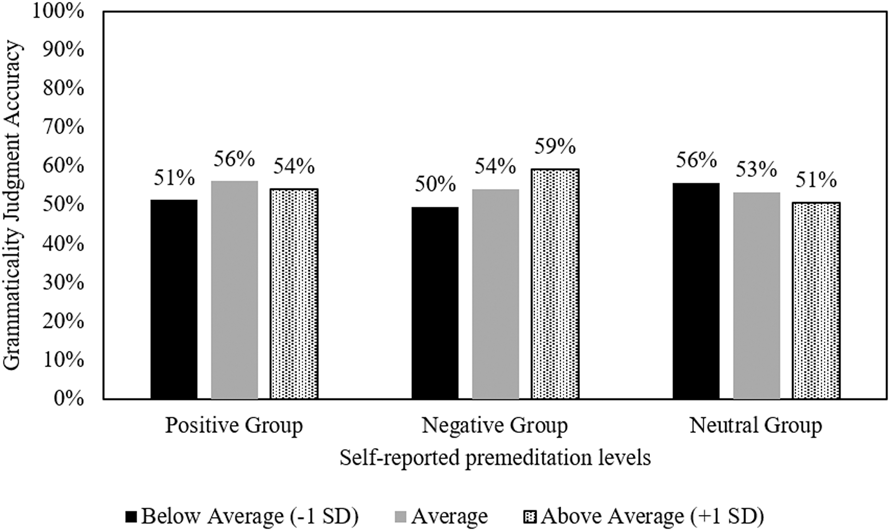
Results from the premeditation interactions are graphed in Figure 6. Example items from the UPPS questionnaire for this factor included “my thinking is usually careful and purposeful” and “I am a cautious person.” Here, participants from the Negative group who reported higher levels of premeditation performed 9% better than those with lower rates. The same trend was not found in the other two groups; on the contrary, Neutral study participants with higher levels of premeditation scored 5% lower than more impulsive participants, suggesting premeditation may have opposite effects on learning, depending on the learner’s mood (negative or neutral).
Role of premeditation in immediate posttest performance by group.

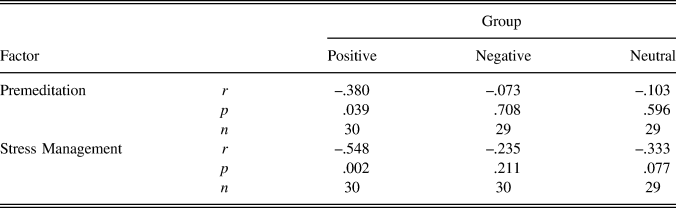
As a proxy for impulsivity, a lack of premeditation has also been linked to implicit learning (Kaufman et al., Reference Kaufman, DeYoung, Gray, Jiménez, Brown and Mackintosh2010). To follow up on this potential relationship, we correlated premeditation with the rates at which each group based their judgments on implicit source attributions (Table 6). In agreement with the previously mentioned literature, those with lower reported levels of premeditation selected implicit source attributions more often than their counterparts, regardless of group. The results reached statistical significance in the Positive group only.
Correlations of stress management, premeditation, and perseverance with proportion of implicit source attributions by group

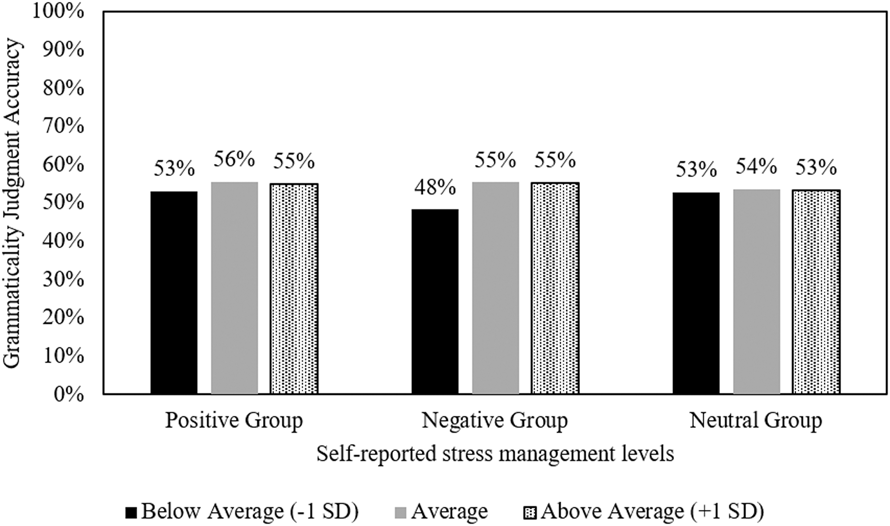
Finally, we graphed the stress management interactions, which are found in Figure 7. This factor was composed of TEIQue-SF items such as, “on the whole, I’m able to deal with stress” and “generally, I’m able to adapt to new environments.” Within the Negative group, participants who rated themselves with average or higher stress management levels performed the best overall, whereas those with lower levels performed 7% worse. This trend was not found within the other two groups. The finding suggests that negative emotions may enhance L2 learning but only among those with average or above-average stress management ability.
Role of stress management in immediate posttest performance by group.

Stress management, which is a component of EI, may have properties beneficial for implicit learning (Fiori, Reference Fiori2009; Zeidner et al., Reference Zeidner, Matthews and Roberts2009). To test this hypothesis, we correlated the trait with the rates at which participants from each group based their judgments on implicit knowledge source (i.e., guess or intuition). The findings, presented in Table 6, indicate that individuals with higher levels of stress management were less inclined to select implicit source attributions overall. In particular, individuals who were more stress resistant responded more “rationally” (i.e., through recollection or rule knowledge) to the test items, thus failing to support an EI-implicit learning link.
DISCUSSION
ON THE ROLE OF EMOTIONS IN L2 LEARNING
In this study, four groups (three emotionally induced and one comparison) received meaning-focused exposure to a variety of verb placement rules from a V2 language. Our first research question asked whether mood would influence the amount of learning that took place. As an initial analysis, we examined the overall learning effect from incidental exposure. We discovered that participants in all three treatment groups successfully acquired aspects of the key verb placement structures (i.e., V2, V2-VF, VF-V1) as per their above-chance accuracy rates and d-prime scores on the GJT (Table 3). Therefore, emotional induction did not restrict L2 grammar learning under incidental conditions.
The present results highlight the general hardiness of incidental learning. In this study, we replicated findings of incidental learning (e.g., Grey, Williams, & Rebuschat, Reference Grey, Williams and Rebuschat2015; Rebuschat & Williams, Reference Rebuschat and Williams2012) in the presence of affective disruptions. Qualifying the results from Braverman (Reference Braverman2005) and Pretz et al. (Reference Pretz, Totz and Kaufman2010), who found enhanced implicit learning under a negative mood, we found effects of mood depended crucially on participant profiles (see below). Our findings also differed from Miller and colleagues (2018), who reported lower vocabulary gains for a negatively induced group, using an intentional vocabulary learning paradigm. Individual differences, the domain of learning (linguistic vs. nonlinguistic, vocabulary vs. syntax), and the type of learning (intentional vs. incidental) thus all appear to play a role in shaping emotionally colored L2 acquisition. As a first step toward disentangling these various factors, future researchers could extend the current study to an intentional grammar learning paradigm (see Tagarelli et al., 2016).
With respect to knowledge acquisition, the explicit-to-implicit knowledge ratios hinted at a greater reliance on intuition in the Positive and Negative groups. Participants from the Positive and Negative groups exhibited a greater predisposition to implicit knowledge acquisition directly after emotional induction. This was shown in their nearly even selection of intuition and guess responses as compared to participants from the Neutral and Comparison groups, who relied significantly on recollection and rule knowledge. The Positive and Negative participants also performed more accurately on guesses and intuitions (Table 4), although they did not perform significantly better than chance. While these findings are worth further exploration, any evidence for implicit knowledge in the present study was weak. Indeed, source attribution and accuracy data from the posttest (Table 4) provided no evidence that participants developed implicit knowledge. The significant learning advantage for participants with higher levels of self-reported intellect further supported the view that learning in this study was chiefly explicit in nature.
The lack of evidence for implicit knowledge aligns with recent findings from Kim and Godfroid (2019), who similarly obtained evidence for explicit knowledge only, using the same semiartificial language and a similar training procedure. The results run counter to previous research by Rebuschat and Williams (Reference Rebuschat and Williams2012), who originally developed the paradigm and did report evidence of implicit knowledge formation. Of note, the original instructions, reported in Rebuschat (Reference Rebuschat2008), said “rely on your intuition when judging the well-formedness of the sentences” (p. 189, our emphasis). Judgments based on intuition were later found to be better than chance in two experiments, and interpreted as evidence of implicit knowledge, but perhaps the instruction had an influence on participants’ response behavior. Although Rebuschat’s paradigm has proven productive for L2 researchers, there is a need to replicate findings of implicit learning independently and across a range of different labs, perhaps as part of a multisite replication (cf. Morgan-Short et al., Reference Faretta-Stutenberg and Morgan-Short2018).
One explanation for why participants did not acquire implicit knowledge of the L2 syntax in this study may lie with how adults learn, and ultimately acquire, second languages. Our participants, all of whom were over the age of 18, relied more on their conscious knowledge of the novel language to navigate the GJT. Results from the individual differences analyses further revealed a greater predisposition toward conscious knowledge use with higher stress management, premeditation, and intellect, especially in the Positive group. This may suggest participants developed an awareness of certain syntactic features of the L2 or tended toward explicit processing strategies, consistent with the nature of the academic training they were receiving at the time of the study. Even when proportion data skewed in favor of implicit source attributions, as we found in the Positive and Negative groups, participants were still not accurate in their grammaticality judgments. Therefore, we believe that any guesses or intuition-based responses did not reflect robust unconscious cognitive representations (compare Reference Kim and GodfroidKim & Godfroid, 2019). For adult learners to legitimately manifest unconscious knowledge, they would have likely needed much more L2 input over an extensive period (e.g., akin to a study abroad or immersion program), rather than a one-shot, 30-minute training procedure (DeKeyser, Reference DeKeyser2000; Loewen, Reference Loewen2015).
INDIVIDUAL DIFFERENCES INTERACT WITH DIFFERENT MOOD STATES
The second research question centered on whether openness, intuition, EI, FLA, and impulsivity impacted emotionally induced L2 learning, as well as implicit/explicit knowledge formation. Linear regression revealed that two specific traits (i.e., stress management and premeditation) were influential in learners who experienced a negative mood state. For example, we found better learning in the Negative group, but only among those with higher stress management. In the context of the current study (exposure to unfamiliar syntax combined with high arousal and negative emotional distractors), this outcome makes sense. As a component of EI, stress management is linked with how one reacts to and regulates emotional stressors (Petrides, Reference Petrides, Stough, Saklofske and Parker2009). Here, participants with average or greater than average stress management skills were more likely to successfully manage any debilitating emotional effects from the negative film clips and images, freeing up additional processing resources for L2 learning (see Fiori, Reference Fiori2009). As such, competition between the negative stimuli and the incidental exposure requirements may have contributed to GJT underperformance for those with lower stress management levels.
The effects of premeditation on learning performance went in opposite directions, depending on the learners’ mood. On the surface, it would seem that participants with higher levels of trait impulsivity (i.e., a lack of premeditation) might uniformly underperform complex learning assessments (like the GJT from this study) due to a reliance on gut responses over thoughtful contemplation. Grey et al. (Reference Grey, Williams and Rebuschat2015) found this to be the case in their study of individual differences and L2 learning. In that study, performance on Japlish acceptability judgment tasks correlated negatively with impulsivity. It is worth noting, however, that these results were achieved using cold cognition (no mood induction). With the introduction of affective interference, trait impulsivity appears much more reactive. For example, while we too discovered that impulsivity, as conveyed through low levels of premeditation, was disadvantageous to GJT performance, the findings were only true for Positive or Negative participants. In fact, higher levels of premeditation played a significant facilitative role for participants in the Negative group. Unlike the Grey et al. study, the more impulsive participants in the present study’s Neutral group outperformed the less impulsive ones. This suggests that under Neutral conditions, impulsivity may in fact be a benefit to learning.
In terms of how stress management and premeditation affected participants’ response behavior, results were mixed for implicit knowledge formation. For example, stress management (represented in this study as a factor of EI) has been linked with aspects of unconscious processing (Fiori, Reference Fiori2009; Zeidner et al., Reference Zeidner, Matthews and Roberts2009). This characteristic, however, correlated negatively with the use of implicit source attributions by all treatment groups in this study (Table 6). The relationship may be related to how participants with lower stress management abilities coped with the emotional distractions within this study. As previously discussed, processing competition from mood state interferences likely restricted these individuals’ ability to consciously search for grammatical patterns or regularities among the sentences from the exposure set, leading to an increased reliance on guessing and intuition to navigate the GJT. But, as noted, this did not result in any implicit knowledge. For impulsivity (Table 6), we discovered a positive relationship between impulsivity (specifically, a lack of premeditation) and the use of implicit source attributions by all treatment groups. This finding aligns with previous research (Kaufman et al., Reference Kaufman, DeYoung, Gray, Jiménez, Brown and Mackintosh2010) linking impulsivity with implicit learning. Here, less deliberate individuals, regardless of mood state influence, likely made their grammaticality assessments quickly and at the unconscious level. Those with higher levels of premeditation were more thoughtful in their decisions, relying instead on their explicit knowledge of the L2 syntax throughout the posttest.
Finally, it is important to address why openness, intuition, and FLA did not significantly influence learning performance in this study. As previously discussed, accuracy on the GJT was primarily driven by participants’ explicit knowledge of the L2 syntax. This may have limited the influence of openness and intuition in the task, which are strongly associated with implicit learning processes (Kaufman et al., Reference Kaufman, DeYoung, Gray, Jiménez, Brown and Mackintosh2010; Woolhouse & Bayne, Reference Woolhouse and Bayne2000). As for FLA, the design of this experiment, which included a semiartificial language with English vocabulary, may offer a plausible explanation for the lack of influence. Here, participants were not informed of their engagement with a novel language until after the incidental learning task. Any anxiety experienced during the exposure phase (i.e., accurately repeating aloud the scrambled English sentences) was likely regulated by the stress management trait rather than an ability to combat FLA.
LIMITATIONS
With respect to our findings for RQ2, two points merit further discussion. First, while statistically significant, the effect size from our regression analysis was fairly small (R 2 = .20, adjusted R 2 = .11). This may reflect the difficulty of identifying moderating factors for a learning effect that was fairly small to begin with (ca. 55% GJT accuracy, or 5% above chance). That said, the roles we found for intellect, stress management, and premeditation are interesting and should be further explored in an experimental design where learning outcomes are greater. Replication of this study with prolonged exposure to the training set, for instance, may yield confirmation of the present results.
Of note, we found no significant interactions with the Positive group. One possible explanation for this disparity lies in how men and women generally respond to visual, erotic stimuli. For example, Bradley, Codispoti, Sabatinelli, and Lang (Reference Bradley, Codispoti, Sabatinelli and Lang2001) found that after viewing erotic images of the opposite sex, females generally felt “amused” or “embarrassed,” rather than “sexy” or “excited.” Other sociocultural influences, such as perceived social expectations and cultural attitudes toward sexual expression, may also suppress positive emotionality (Rupp & Wallen, Reference Rupp and Wallen2008). Future studies may want to include low arousal, positive stimuli (e.g., romantic couples, cute animals) as a means of inducing positive affect.
CONCLUSION
This study demonstrated the important and complex role that mood states play in L2 acquisition under incidental learning conditions. Participants in different mindsets (positive, neutral, negative) were able to learn aspects of the L2 syntax from meaningful exposure and those that claimed higher levels of intellect showed the best results. These findings highlight the effectiveness of incidental learning conditions even in the face of emotional distractors. For this reason, L2 instructors would be remiss not to include incidental learning tasks (e.g., communicative activities or reading for content, where the L2 grammar is not the focus; see Loewen, Reference Loewen2015) within their curriculum. Even so, the knowledge acquired in this study was chiefly explicit. Further scrutiny and replication of findings of implicit learning in diverse participant samples are therefore needed.
Although negative emotions sometimes impede learning (Khajavy et al., Reference Khajavy, MacIntyre and Barabadi2018; MacIntyre & Gregersen, Reference MacIntyre and Gregersen2012; Miller et al., Reference Miller, Fox, Moser and Godfroid2018), we found that learners with high stress management and premeditation may benefit from a negative mood during learning. While current tendencies in SLA and emotional research lean toward positive psychology (Dewaele et al., Reference Dewaele, Witney, Saito and Dewaele2018), the evaluation of negative affect, in concert with specific individual traits, must not be abandoned. Our study highlights that in certain individuals, feelings of sadness or anxiety can enhance aspects of L2 acquisition. Moreover, negative emotions may invite greater vigilance and arousal, which in turn may lead to more attention, and therefore more learning. Future researchers could include psychophysiological measures, such as skin conductance and heart rate data, in their studies to examine this hypothesis (cf. Gregersen, Macintyre, & Meza, Reference Gregersen, Macintyre and Meza2014). The examination of personality characteristics and how they may predict L2 learning performance, particularly in the context of emotional settings, is vital for understanding the complexities of instructed SLA.
APPENDIX A
SUMMARY OF EXPLORATORY FACTOR ANALYSIS

APPENDIX B
LINEAR MODEL OF PREDICTORS OF IMMEDIATE GRAMMATICALITY JUDGMENT ACCURACY