Introduction
The World Health Organization estimated the total number of patients with dementia worldwide in 2010 at 35.6 million, and it is projected to be 65.7 million in 2030 and 115.4 million in 2050 (Batsch and Mittelman, Reference Batsch and Mittelman2012; Wortmann, Reference Wortmann2012). Dementia is a major cause of suffering and disability. It encompasses complex brain diseases that affect many aspects of life; causing problems with memory, thinking, and behavior which affects work, family, social relationships, and eventually the activities of daily living. Cognitive impairment is the clinical hallmark in dementia, regardless of the etiology. Nevertheless, the non-cognitive symptoms are more often associated with lowered functional abilities and poorer prognosis, an increased caregiver distress, and suffering for the patient because of the impact on the quality of life (Pearson et al., Reference Pearson, Teri, Reifler and Raskind1989; Black and Almeida, Reference Black and Almeida2004; Neri et al., Reference Neri, Bonati, Pinelli, Borella, Tolve and Nigro2007).
Non-cognitive symptoms, also known as neuropsychiatric symptoms (NPS), are for example agitation/aggression, depression, psychosis, and apathy. NPS are common among patients with dementia who live in institutions and over the course of the disease the prevalence universally increasing over time to 97% (Peters et al., Reference Peters2006; Zuidema et al., Reference Zuidema, Derksen, Verhey and Koopmans2007c; Wetzels et al., Reference Wetzels, Zuidema, de Jonghe, Verhey and Koopmans2010; Selbaek et al., Reference Selbaek, Engedal, Benth and Bergh2014). In the community, NPS and the associated burden for the caregiver is a risk factor for premature institutionalization, and institutionalized patients give an increased burden to the professionals(Rodney, Reference Rodney2000) and higher costs of care (Moore et al., Reference Moore, Zhu and Clipp2001).
Although NPS are considered a quite heterogeneous term for different symptoms, some symptoms differ according to type (Lyketsos et al., Reference Lyketsos, Steinberg, Tschanz, Norton, Steffens and Breitner2000; Rockwell et al., Reference Rockwell, Choure, Galasko, Olichney and Jeste2000; Kim et al., Reference Kim, Lyons, Shin and Yoon2003; Wetzels et al., Reference Wetzels, Zuidema, de Jonghe, Verhey and Koopmans2010) and stage (Aalten et al., Reference Aalten, de Vugt, Jaspers, Jolles and Verhey2005; Testad et al., Reference Testad, Aasland and Aarsland2007; Zuidema et al., Reference Zuidema, de Jonghe, Verhey and Koopmans2007b; Reference Zuidema, de Jonghe, Verhey and Koopmans2009) of dementia. In addition, gender influences the prevalence of symptoms in dementia according to several studies. For example, physically aggressive behavior (Lovheim et al., Reference Lovheim, Sandman, Karlsson and Gustafson2009; Zuidema et al., Reference Zuidema, de Jonghe, Verhey and Koopmans2009; Kitamura et al., Reference Kitamura, Kitamura, Hino, Tanaka and Kurata2012), repetitive physical movements (Buchanan et al., Reference Buchanan, Wang, Ju and Graber2004; Lovheim et al., Reference Lovheim, Sandman, Karlsson and Gustafson2009), and apathy (Zuidema et al., Reference Zuidema, de Jonghe, Verhey and Koopmans2009) were more common in male patients; depression (Lovheim et al., Reference Lovheim, Sandman, Karlsson and Gustafson2009; Zuidema et al., Reference Zuidema, de Jonghe, Verhey and Koopmans2009; Kitamura et al., Reference Kitamura, Kitamura, Hino, Tanaka and Kurata2012), anxiety (Lovheim et al., Reference Lovheim, Sandman, Karlsson and Gustafson2009; Zuidema et al., Reference Zuidema, de Jonghe, Verhey and Koopmans2009; Kitamura et al., Reference Kitamura, Kitamura, Hino, Tanaka and Kurata2012), apathy (Kitamura et al., Reference Kitamura, Kitamura, Hino, Tanaka and Kurata2012), sad expressions (Buchanan et al., Reference Buchanan, Wang, Ju and Graber2004; Lovheim et al., Reference Lovheim, Sandman, Karlsson and Gustafson2009), and crying (Buchanan et al., Reference Buchanan, Wang, Ju and Graber2004; Lovheim et al., Reference Lovheim, Sandman, Karlsson and Gustafson2009) were more frequent present in female patients.
Syndromes or clusters of NPS in patients with dementia are described in the literature using factor analysis and are performed in a community (Hope et al., Reference Hope, Keene, Fairburn, McShane and Jacoby1997; Aalten et al., Reference Aalten, de Vugt, Jaspers, Jolles and Verhey2005; Aalten et al., Reference Aalten2007), hospital setting (Frisoni et al., Reference Frisoni1999), or even a mixed population of community and nursing home patients (Hollingworth et al., Reference Hollingworth2006). The European Alzheimer's Disease Consortium (Aalten et al., Reference Aalten2007) has proposed grouping NPS into hyperactive (agitated) behavior, affective behavior, psychosis, and apathy. In addition, factor analysis studies also propose clusters within Cohen-Mansfield Agitation Inventory (CMAI) symptoms (Zuidema et al., Reference Zuidema, de Jonghe, Verhey and Koopmans2007a) (Cohen-Mansfield, Reference Cohen-Mansfield, Marx and Rosenthal1989), i.e. physically aggressive, physically non-aggressive, and verbally agitation behavior.
Clusters of NPS in nursing home patients are not often described. Only a study in Sweden (Lovheim et al., Reference Lovheim, Sandman, Kallin, Karlsson and Gustafson2006) found 11 clusters in institutionalized patients using the Multi-Dimensional Dementia Assessment Scale (MD-DAS) and a Dutch study (Zuidema et al., Reference Zuidema, de Jonghe, Verhey and Koopmans2007a; b) of nursing homes patients found five clusters using the Neuropsychiatric Inventory-nursing home version (NPI-NH) and for the CMAI six/three clusters. In these studies, the authors did not do a separate analysis by gender even though gender influences the relative prevalence of individual symptoms. It could be assumed that gender specific difference in prevalence of individual symptoms may also affect how symptoms cluster. Different clustering in male and female patients may underpin different syndromes, which may have consequences for treatment.
It is clinically important to study behavioral syndromes in dementia instead of individual symptoms because of a possible common neurobiological pathogenesis or possible reaction to the same treatment, whether physical, psychological, or social (Lawlor and Bhriain, Reference Lawlor and Bhriain2001; Kales et al., Reference Kales, Gitlin and Lyketsos2014). There are indications that men and women differ for neurochemical, biochemical, and psychosocial aspects but the underlying mechanisms are not fully understood/elucidated. For example, differences were found in the corticotropin-releasing factor (CRF) signaling in the cortex, which would translate to an enhanced sensitivity to acute stress and decreased ability to adapt to chronic stress in females, CRF also has an impact on mood and anxiety (Valentino et al., Reference Valentino, Bangasser and Van Bockstaele2013), endogenous pain inhibitory systems might be less efficient in female patients, and past history may influence pain sensitivity (Racine et al., Reference Racine, Tousignant-Laflamme, Kloda, Dion, Dupuis and Choiniere2012). These findings were found in the general population and we assume this also applies to the elderly population and dementia patients.
The hypothesis is that there are gender-related differences in clusters of NPS. The aim of this study is to investigate whether NPS clusters differently in male and female nursing home patients, which to our knowledge, this has not been studied before.
Methods
For this study, the databases of WAALBED I and WAALBED II were combined. WAALBED I and II were designed to study the prevalence and two-year course of NPS in nursing home residents in the Eastern, Northern, and Southern parts in the Netherlands with DSM-IV diagnosis of dementia, respectively. Both datasets included NPS, dementia stage, psychotropic drug use, age, and gender. Waalbed-II also included quality of life, ALD-function, cognition, and etiology. The studies were a cross-sectional and longitudinal cohort, data collection was performed by licensed vocational nurses. Exploratory factor analysis was used. More details of Waalbed I (Zuidema et al., Reference Zuidema, de Jonghe, Verhey and Koopmans2007a, b; Reference Zuidema, de Jonghe, Verhey and Koopmans2009) and Waalbed-II (Wetzels et al., Reference Wetzels, Zuidema, de Jonghe, Verhey and Koopmans2010) are published elsewhere.
NPS were assessed using the NPI-NH. The NPI-NH was originally developed by Cummings et al. (Cummings et al., Reference Cummings, Mega, Gray, Rosenberg-Thompson, Carusi and Gornbein1994). The nursing home version has been adapted for use by professional caregivers in nursing home facilities and has proven to be valid and reliable for use by trained nursing staff (Wood et al., Reference Wood2000; Zuidema et al., Reference Zuidema2011). A Dutch translation is reliable and valid (Kat et al., Reference Kat, de Jonghe, Aalten, Kalisvaart, Droes and Verhey2002). The NPI-NH includes 12 NPS: delusions, hallucinations, agitation, depression/dysphoria, anxiety, euphoria/elation, apathy/indifference, disinhibition, irritability/lability, aberrant motor behavior, sleep disturbances, and appetite/eating change. The frequency (F) and severity (S) of each symptom were rated on a five-point (0– 4) and four-point (0–3) Likert scale, respectively. A separate score was calculated for each symptom by multiplying the frequency and severity scores, resulting in values ranging from 0 to 12 for each symptom. Summing F x S scores reveals a total score that ranges from 0 to 144.
Agitation was measured with the 29-items CMAI Dutch version (CMAI-D). CMAI-D items were rated on a seven-point scale (1–7) ranging from “never” to “several times an hour.” The CMAI has a well-established (test–retest and inter-rater) reliability (Zuidema et al., Reference Zuidema2011) and concurrent validity (Zuidema et al., Reference Zuidema, de Jonghe, Verhey and Koopmans2007a) in both community samples (Koss et al., Reference Koss1997) and in nursing homes patients.
Clinically relevant NPS were defined as a “Frequency x Severity” score >= 4 for each individual symptom in the NPI-NH (Wood et al., Reference Wood2000; Margallo-Lana et al., Reference Margallo-Lana2001) and a score of “at least once a week” (frequency score > 2) in CMAI-items.
We used exploratory factor analysis (Principal Component Analysis) to assess the clustering of the items in the CMAI and the items in the NPI-NH into components, separately for both scales and gender. We analyzed whether the components differ between males and females. Different components in males and females indicate a different correlation between questionnaire items for male and female patients. The results were displayed in a pattern matrix.
Kaiser–Meyer–Olkin measure of sampling adequacy (whether the sample size is adequate) and Bartlett's test of sphericity (intercorrelation between the variables) were determined. In the factor analyses, all the items of CMAI (29 questions) and NPI-NH (12 F x S) were used for the analysis. We applied oblique rotation, which allows the components themselves to be correlated with one another. Components were retained using the Kaiser criteria (eigenvalues of component >1). Components consisting of just one variable were excluded. We characterized components based on loadings equal or greater than 0.4 in the pattern matrix (Stevens, Reference Stevens1992).
Differences in symptom clustering between male and female patients were assessed using a three-step procedure, displayed in a table for CMAI and NPI-NH separately:
-
1. We identified distinctive items per component, that is items clustering in males but not in females, or vice versa in components identifying similar traits.
-
2. We described the correlation coefficients between this distinctive item with the other items in this component for males and females separately.
-
3. We tested whether the correlation between a distinctive item and any another item in the component (which is present in both sexes) is different for males and females using an ANCOVA (analysis of covariance) with the distinctive item as dependent variable, any other item as independent variable, and an interaction term between gender and independent variable added to the model.
Example
For example, in female patients, a component consists of ITEMS X1, X2, X3, and X4, whereas in males a component consists of ITEMS X2, X3, and X4. The item X1 is identified as a distinctive item, indicating a different (cor)relation for male and female patients with the other items. The correlations between X1 and X2, X1and X3, and X1 and X4 are calculated separately for males and females. Difference in correlation of X1 and X2 between males and females is examined using a general linear model assessing the interaction between X1 and gender (step 3), depicted as X2=b0+b1xX1 + b2xGENDER + b3xX1xGENDER. A significant interaction (b3) indicates a different correlation between item X1 and X2 for male and female patients. Similar models are tested for X1and X3, and for X1 and X4.
All statistical analyses were conducted using SPSS statistics version 20.
Results
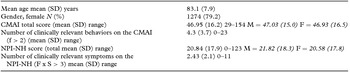
Baseline – Data on a total of 1,609 patients in nursing homes with dementia (WAALBED I N = 1322, WAALBED II N = 287) was available (see Table 1). The mean age was 83.1 years, almost 80% of the patients were female. In the database, the mean number of clinically relevant items of CMAI and NPI are 4.3 and 2.4, respectively. The number of patients with clinical relevant behavior was 80% in the NPI and 61% for the CMAI. The mean total score of CMAI and NPI was 46.9 and 20.8, respectively.
Description of nursing home patients (N = 1609)

N Number, SD standard deviation
Factor analysis NPI-NH
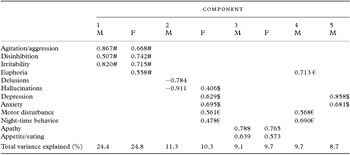
FACTOR LOADING: The results of the factor analysis are shown in Table 2. In the male patients, five clusters were retained consisting of two to three items. The five clusters explained 63.1% of the variance in the data. The first cluster could be described as “frontal/agitation” which has high loadings on agitation, disinhibition, and irritability. The second cluster is “psychosis” with high loadings on delusions and hallucinations. The third cluster is “physical disturbance/hyperactivity” consisting euphoria, motor disturbance, and night-time behavior. Cluster four is “apathy” with high loadings on apathy and appetite/eating, and the last cluster is “affect/mood” with loadings on depression and anxiety.
Clusters NPS – NPI-NH factor loading (Pattern matrix)

Symbols indicate a clustering of symptoms in both male and female patients and correlate with the clusters in Table 3 (correlation coefficients)/€ in F motor disturbance, night-time behavior is a cluster, in M same items with euphoria added.
$ in M depression, anxiety is a cluster, in F same items with hallucinations added.
# in M agitation, disinhibition, irritability is a cluster, in F same items with euphoria added.
In the female patients, only three clusters were retained consisting of two to five items. The clusters explained 44.7% of the variance of the data. The first cluster is “frontal/agitation” with high loadings on agitation, disinhibition, irritability, and euphoria. This cluster is comparable to the male cluster, except the item euphoria. The second cluster is a combination of psychosis, affect, and physical disturbance/hyperactivity when comparing with the male clusters on the NPI. The third and last cluster is “apathy” with high loadings on apathy and appetite/eating, which is the same as the male cluster of apathy.
In the female patients, the item delusions is not included in all the clusters due to the loading less than 0.4.
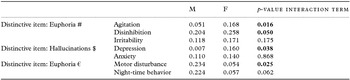
INTERACTION TERM (Table 3): Three distinctive items were identified. In the male population, a different relation can be seen between euphoria and motor disturbance (symbol €) compared to the female sample.
Correlation coefficients distinctive items with other group items

M Male, F Female, Symbols correlate with the clusters in Table 2 (factor loading).
In the female sample, there is a different relation between euphoria and agitation and disinhibition, but not in males, displayed as a p-value with the symbol #. Furthermore, there is a different relation between euphoria and hallucinations and depression in the female population but not in the male population (symbol $).
Factor analysis CMAI
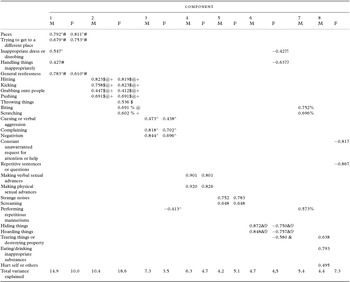
FACTOR LOADING: The results of the factor analysis of the CMAI variables are shown in Table 4. In the male patients, eight clusters were retained consisting of two to five items. These clusters explained 57.6% of the variance of the data. The first cluster represented “physically non-aggressive behavior” and has high loadings on paces, trying to get into a different place, general restlessness, inappropriate dress or disrobing, and handling things inappropriately. The second cluster is “physically aggressive behavior” with high loadings on hitting, kicking, grabbing onto people, pushing. The third cluster is “verbally (non-)aggressive behavior” consisting of cursing or verbal aggression, complaining, and negativism. The fourth cluster is “sexual behavior” with the variables making verbal sexual advances and making physical sexual advances. The fifth cluster represents “vocal agitation” with strange noises and screaming. The sixth cluster is “hiding/hoarding objects” and consists hiding things and hoarding things. The seventh cluster represents “physically aggressive behavior” with high loading on biting and scratching. The last cluster is “inappropriate handling of objects” and has high loadings on tearing things or destroying property, eating/drinking inappropriate substances, and hurt self or others.
Cluster NPS – CMAI factor loading (Pattern matrix)

M male, F female, Symbols indicate a clustering of symptoms in both male and female patients and correlate with the clusters in Table 5 (correlation coefficients with p-value).
* in F paces, trying to get to a different place, general restlessness is a cluster, in M same items with inappropriate dress or disrobing added.
# in F paces, trying to get to a different place, general restlessness is a cluster, in M same items with handling things inappropriately added.
$ in M hitting, kicking, grabbing onto people, pushing is a cluster, in F same items with throwing things added.
@ in M hitting, kicking, grabbing onto people, pushing is a cluster, in F same items with biting added.
+ in M hitting, kicking, grabbing onto people, pushing is a cluster, in F same items with scratching added.
% in F biting, scratching is a cluster, in M same items with performing repetitious mannerisms added.
^ in M cursing, complaining, negativism is a cluster, in F same items with performing repetitious mannerisms added.
& in M hiding things, hoarding things is a cluster, in F same items with tearing things or destroying property added.
! in M hiding things, hoarding things is a cluster, in F same items with inappropriate dress or disrobing added.
? in M hiding things, hoarding things is a cluster, in F same items with handling things inappropriately added.
In the female patients, seven clusters were retained consisting of two to seven items. These clusters explained 53.9% of the variance of the data. The first cluster represents “physically non-aggressive behavior” and has high loadings on paces, trying to get into a different place, and general restlessness. The second cluster is “physically aggressive behavior” with high loadings on hitting, kicking, grabbing onto people, pushing, throwing things, biting, and scratching. The third cluster represents “verbally (non-)aggressive behavior” consisting of cursing or verbal aggression, complaining, negativism, and performing repetitious mannerisms. These three clusters are comparable with the male patients. The fourth cluster represents “sexual behavior” with the variables making verbal sexual advances and making physical sexual advances, identical to the male patients. The fifth cluster is “vocal agitation” with strange noises and screaming, also identical to the male patients. The sixth cluster is a combination of “hiding/hoarding objects” and “inappropriate handling of objects” and has high loadings on inappropriate dress or disrobing, handling things inappropriately, tearing things or destroying property, hiding things and hoarding things, partly comparable with the male patients. The last cluster is “verbally repetitive behavior” with high loadings on constant unwarranted request of attention or help and repetitive sentences or questions. This is a cluster not seen in the male patients.
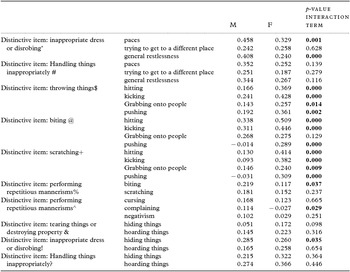
INTERACTION TERM (Table 5): A total of ten distinctive items were identified. In the male population, there is a different relation between inappropriate dress or disrobing and paces and general restlessness (symbol *) compared to the female population.
Correlation coefficients distinctive items with other group items

M male, F female, Symbols correlate with the cluster in Table 4 (factor loading).
In the female patients, a different relation is present between throwing things and hitting, kicking, grabbing, and pushing (symbol $), between performing repetitious mannerisms and biting and scratching (symbol %), between biting and hitting, kicking and pushing (symbol @), between scratching and hitting, kicking, grabbing, and pushing (symbol +), between performing repetitious mannerisms and complaining (symbol ^), between inappropriate dress or disrobing and hiding things (symbol !), compared to the male patients.
Discussion
This study examined the differences in gender in clustering of NPS in the nursing home patients with dementia using factor analysis. We found differences in the clusters of NPS between gender. There is no homogenous clustering in both male and female patients. Some clusters appear in both male as female patients, some are only seen in male and not in female and vice versa, and last, there are clusters which have partly the same variables. In some of these clusters of NPS, there are different correlations between the items for male and female patients. In our interaction term analysis, there are more different relations in the female patients, compared to the males. Some correlations are based on coincidence.
We are aware that the found distinctive items can be tested in different combinations of independent variable, making it even possible that a distinctive item is tested as an independent variable. In our analysis, we did not explore all the combinations.
The clusters found in this study are partly consistent with those found in other studies in nursing home patients; Waalbed-I found four to five clusters in the NPI, our clusters frontal, psychosis, apathy, and mood are similar. These are comparable due to the fact that our database is largely composed by the Waalbed 1-database. The CMAI was also studied and found six clusters, where we found seven to eight clusters. This could be explained by the exclusion of low frequency questionnaire items (nine items). Physically aggressive, verbally agitated behavior, and hiding/hoarding are mostly comparable, and physically non-aggressive behavior and vocal agitation were identical clusters. In comparison with the study from Sweden, more clusters are described, using a different questionnaire than us, the MDDAS with 39 items (25 behavioral, 14 psychological). The Swedish study found six behavioral clusters (aggressive, restless, wandering, escape, verbally disruptive, regressive) and five psychological clusters (depressive, paranoid, hallucinatory, hyperactive, passiveness).
In the community-dwelling patients, the clusters were comparable with those in our study (Aalten et al., Reference Aalten2003), the clusters in the combined community and nursing home patients were less comparable (Hollingworth et al., Reference Hollingworth2006).
Our study extends previous analysis due to the dimension of gender; it shows extra clusters or splits clusters of previous studies.
Our findings combined with the results of other studies implicate a clinical relevance of the dimension gender in dementia, especially with respect to differences in clusters of NPS. The differences due to gender could be explained in many ways, like anatomic, biochemical, neurochemical, and psychosocial. Several studies have tried to explain the gender differences in behavior but most were inconclusive. Certain trends can be observed. For example, male patients are less likely to have problems in mood and anxiety due to neurochemical mechanisms, and tend to have a different pain tolerance than females (Racine et al., Reference Racine, Tousignant-Laflamme, Kloda, Dion, Dupuis and Choiniere2012). Female patients are more aware of their physical changes due to puberty, pregnancy and menopause, and express problems more often due to the social role (mother, caregiver) (Kamath, Reference Kamath2011).
There is no clear explanation for the found differences. We expect other studies to corroborate our findings.
The uniqueness of this study is that it shows the importance of the dimension of gender in NPS. Significant differences can be seen in several clusters. Our data consists of a large nursing home population, to our knowledge, the only and largest on which a factor analysis has been performed differentiated by gender. We used the NPI-NH and CMAI, which are well-validated instruments and universally accepted.
Our study also had some limitations. First, the database had no etiology of dementia in a large proportion of patients, due to the methodology of Waalbed 1. Second, we have a low percentage of male patients in the study.
Considering the clinical relevance, we did not exclude low prevalence items in view of the large patient population (for example, 10% in our database are 160 patients, and 5% are 80). These are relatively large numbers.
Conclusion
Our study found differences in clusters of NPS between gender using factor analyses. These clusters are partly comparable with previous studies and affirm the clinical differences seen in practice. Male and female patients differ from each other in terms of symptoms expressed.
The results of our study should be interpreted with care, since this is the first factor analysis between gender in clusters of NPS. There is a great need for exploration in other large nursing home populations. If our results are confirmed by others, it might improve our understanding of the behavior in patients with dementia and help clarify the role of neurochemical, biological, and psychosocial aspects. This might lead to a more rational pharmacologic and non-pharmacologic choice of treatment. Although the prevalence of NPS differ from country to country, the different behavioral dimensions that underly the different NPS is probably more robust across different countries and cultures. Therefore, we think, that although only Dutch data are used in this study, the results are generalizable to other countries.
Further research is needed to clarify the biological, social, and chemical role in NPS in patients with dementia: How are cause and effect really related to each other?
Our findings implicate that gender does make a difference in the clusters of NPS in dementia. This might require a different approach in treatment that takes into account the influence of neurochemical, biochemical, and psychosocial aspects. This also means that the sex-specific clustering of these NPS may reflect different underlying (behavioral) syndromes with different anatomical and neurochemical background, which should also be treated differently.
Conflict of interest
None.
Description of authors’ roles
All authors participated in study concept and design, RBW and SUZ participated in acquisition of subjects and/or data, all authors participated in analysis and interpretation of data, and preparation of paper.
Acknowledgments
None.