1. INTRODUCTION
Since Western tape recording systems opened the door to electroacoustic music in the late 1940s, composers – native, foreign or integrated into Japanese culture to varying degrees – have been influenced by traditional Japanese aesthetics. The period 1953–67 saw the first electroacoustic works by Japanese composers shaped by these aesthetics, with diverse methods, compositional goals and technologies (Shibata Reference Shibata1971: 78).
Whether or not one is from Japan, individuals can engage with Japanese aesthetics, and their way of engaging will differ. Mari Kawamura, a Japanese pianist working in the West,Footnote 1 characterises ma as a ‘universal language’, a ‘charged stillness’ also employed by non-Japanese composers including Joseph Haydn (Kawamura Reference Kawamura2022: 28–9). In Japan, the composer Jōji Yuasa (1929–2024) wrote that John Cage ‘was trained in Zen Buddhism more than is the ordinary Japanese’ (Yuasa Reference Yuasa1993a: 184). Kaija Saariaho, Michael Fowler and Jim Franklin are also composers of Western origin – of varying degrees of engagement with Japanese culture – who have explored ma in spatial music and sonic art.Footnote 2 Conversely, Yuasa, Midori Takada and Akiko Hatakeyama are Japanese composers who worked in the West. Although not exhaustive, by selecting composers at this intersection of Japanese and Western cultureFootnote 3 we can explore different ways of working creatively with ma in spatial music and sonic art – and with the view of applying this knowledge to works more broadly through certain methods. These six composers were explicit about their engagement with ma in these works.Footnote 4 This survey is not a secondary interpretation of works through the lens of ma, but connects to the broader discussion of how composers can creatively engage with ma in spatial music and sonic art through different methods, techniques and technologies.
2. MA: DEFINITIONS AND DIMENSIONS
Ma. The ideogram (間) depicts sunlight seeping through the crevice of a door. Space, gap, silence, interval and pause are common English translations. Ma is ubiquitous in Japan, ‘used in daily life so often … so many idioms that center around the term … all somehow associated with “space” or “intervals”’ (Kawamura Reference Kawamura2022: 3–4). In Japan, temporal and physical space is moreover experienced as being inseparable (Morioka Reference Morioka2015: 84). But what of the actual aesthetic experience of ma? Lauren Prusinski ascribes a non-Japaneseness to ma, describing the experience as follows:
Ma represents a beauty in emptiness or formlessness … ma’s ambiguity gives it its beauty and timeless quality, allowing it to transcend cultural and spatial boundaries … [ma] cannot be captured in a single moment but must be followed through a span of time, so ma creates a boundless feeling that must be traced in relation to the environment in which it lies. Rather, the observer must observe all aspects of the surroundings and feel the beauty that lies in the spaces that are unoccupied by material objects or living things … these aesthetics, these discreet concepts of beauty in nature, rely on the observers’ keen sense of their surroundings and perception. (Prusinski Reference Prusinski2012: 29)
Whether an art has a predominantly temporal nature (e.g., music) or physical nature (e.g., a building), ma is experienced when one perceives the relationships between the parts of a whole; the pleasure comes from actually feeling ‘the beauty that lies in the spaces’ that allows something to breathe. To Westerners, ‘emptiness’ carries a negative connotation; to Zen Buddhists, the term has various meanings – here, the ‘quality of all things being empty of inherent, independent, enduring self-essence’ (Burk Reference Burk2023). This is what Jōji Yuasa means when he says: ‘space is not a vacantness, but a substance containing emptiness’ (Yuasa Reference Yuasa1993c: 187) and ‘the hayashikata [Nō drummer] nails each beat to an endless cosmic expanse’ (Yuasa Reference Yuasa1993c: 190). This act of perceiving is a spiritual experience, as in Daoist and Ch’an (Zen) meditation, a freeing from the self-absorbed process of thought that one mistakes as enduring or separate to dwell instead with the cosmological (Hinton Reference Hinton2020: 4–5).
The perception-based concept of ma in nō theatre by its literary and theoretical genius Zeami has entered the social sciences by way of psychotherapy, with Morioka Masayashi defining ma as a ‘meaning-generating space’ (Morioka Reference Morioka2015: 84; Morioka’s concepts are referenced at various points in this article). From temporal space to physical space to spiritual space to the semantic space thus described, we begin to ponder overlapping dimensions of ma and their correspondences with spatial music and sonic art. Jim Franklin (1959–) – composer, music technologist and shakuhachi master (with a focus on honkyoku)Footnote 5 – says as much:
A key concept within the shakuhachi honkyoku, and indeed within virtually all traditional Japanese art forms, musical or otherwise, is ma. This word may be translated as ‘interval’ when stated superficially, and can refer to intervals of any kind: temporal, spatial, musical (between pitches) and so forth. (Franklin Reference Franklin2024: 39)
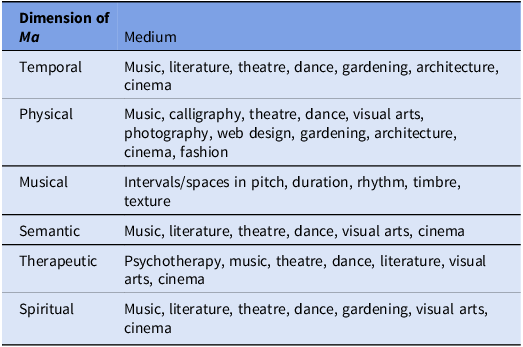
Franklin’s description of three ‘kind[s]’ of ma[s] – temporal, spatial (i.e., physical space) and musical – was the starting point for this framework. I also propose three other dimensions: semantic, therapeutic and spiritual. By using the term ‘dimension’ instead of ‘kind’, however, I view these dimensions as being intrinsic to the aesthetic experience of ma. As discussed, ma is an aesthetic and spiritual experience in the freeing from the self-absorbed process of thought (Hinton Reference Hinton2020: 4–5); this is the very basis on which I delineate ma’s semantic and therapeutic dimensions. In Buddhist terms, this is grasped through the marriage of the relative and the absolute (Burk Reference Burk2023); and in philosophical terms, through the ‘pure experience’ of Nishida Kitarō (1870–1945), an enveloping of the semantic by the foundational and non-conceptual – as when experiencing a sound before we identify it as a sparrow’s call (Nishida Reference Nishida1990: 3–4).
Boundlessness is experienced in the diminishing presence of boundaries, including those of language. I consider the shifting between conceptual and non-conceptual space as the therapeutic dimension of ma, aligning with Morioka’s definition of ma as a ‘meaning-generating space’ (Morioka Reference Morioka2015: 84). This is the ‘emptiness’ of Zen that is ‘charged with possibilities … [that] come forth into being and then pass away’ (Aitken Reference Aitken1984: 80). The semantic, therapeutic and musical dimensions of ma manifest out of the temporal dimension because they are only experienced through a passage of time. The musical dimension manifests through the interplay of sound and silence in a passage of time.
All kinds of ma – as an aesthetic experience – thus possesses temporal, physical, semantic, therapeutic and spiritual dimensions. All kinds of music have temporal and physical dimensions, but not necessarily semantic, therapeutic or spiritual dimensions. There are different kinds of music therapy and different convergences of music and spirituality. The physical dimension of ma in spatial music and sonic art is observed in three senses: space between performers, listeners, microphones and sound sources; space created by panning or speaker placements; and space created with mixing and audio processing techniques. Table 1 constitutes my current thinking about their manifestations across various arts and social sciences.
Six interlinking dimensions of ma and manifestations in the arts and social sciences

Further to this discussion, I will also consider the notion of ‘broadening the concept of ma’ that Franklin describes with regards to the temporal and musical dimensions of ma in shakuhachi performance (Franklin Reference Franklin2024: 116). Tanizaki Jun’ichirō called ma the ‘most important’ feature of Japanese music (Tanizaki Reference Tanizaki, Harper and Seidensticker1997: 9). In spatial music and sonic art, the temporal (e.g., phasing, latency) and physical dimensions (e.g., speaker placements) of ma are more pronounced than in other forms, opening the door to interplay with the conventional musical dimension: ‘[the] space around the notes that define what the note is and how it sounds and feels’ (Asai Reference Asai2005: 102). To understand what this can entail for Japanese aesthetics in spatial music and sonic art, let us consider a set of discernable characteristics.
2.1. The seven characteristics of Zen art
Because of Japan’s isolation from external influences over many periods, the ‘Japanese-ness’ of its aesthetics was grounded in its indigenous Shinto religion (Prusinski Reference Prusinski2012: 26–7). Shinto cultivated aesthetic and spiritual consciousness of nature, which remains central to Japanese arts and culture.Footnote 6 The Heian period (794–1185) brought into this Shinto sensibility a taste for courtly wealth, refinement and sophistication, an ideal depicted in The Tale of Genji and The Tales of Ise (Prusinski Reference Prusinski2012: 31–2). Zen, established in Japan in 1228 by Dōgen Zenji after practising Ch’an Buddhism in China, ‘overthrew these refined [Heian period] aesthetics, bringing instead a more rustic ideology’ (ibid.: 34).
Zen heightened Shinto’s religious celebration of nature and dissolved the Heian distinction between the extravagant and the common, cultivating an appreciation instead for the crude and ascetic (ibid.: 34). Hisamatsu Shin’ichi (1889–1980), Nishida’s student and a Kyoto University philosopher, Zen scholar and tea ceremony master, identified seven interrelated characteristics of Zen art: Asymmetry, Simplicity, Austere Sublimity/Lofty Dryness, Naturalness, Subtle Profundity/Deep Reserve, Freedom from Attachment, and Tranquility (Hisamatsu Reference Hisamatsu and Tokiwa1971: 28–38). Asymmetry is not just asymmetry, but contains Simplicity, Sublime Austerity, Naturalness, and so on. Wabi (simple, austere beauty), sabi (a veil of antiquity), ma and other well-known terms are contained within these seven; their common source is Zen Activity, which is before and beyond art, and something that art should aim towards. Of the seven, perhaps most pertinent to ma is Subtle Profundity/Deep Reserve: ‘implication rather than the naked exposure of the whole … massive stability … true stability deriving from nonattachment … endless reverberation … bottomless depth’ (Hisamatsu Reference Hisamatsu and Tokiwa1971: 34). As such, I will conclude my analysis of each work with a brief, somewhat subjective overview of its resonance with these seven characteristics.
3. MA IN SPATIAL MUSIC AND SONIC ART
In this survey, two works by Jōji Yuasa and Jim FranklinFootnote 7 are discussed, compared to one work by each of the other composers because they are the only two with years of training under an official school or master of a traditional Japanese performing art and to have had that art’s approach to specific dimensions of ma shape their oeuvre. Including Yuasa and Franklin, as I have mentioned, these six composers were explicit about their creative engagements with ma, sometimes a specific dimension. Suffice it to say, the intended performance or installation context of their work, such as a concert hall, determines whether their audience can experience ma while listening to it (e.g., in Hatakeyama’s work, the therapeutic dimension of ma can only be experienced by her while performing, not by her audience).
3.1. Jōji Yuasa: Aoi no Ue for voice and tape (1961)
Aoi no Ue, created at the experimental Sōgetsu Art Center in Tokyo over six months with the latest technologies of 1960–1, is Yuasa’s first major electroacoustic work and an adaptation of the classic nō play of the same name attributed to Zeami.Footnote 8 Although other prominent Japanese composers have worked with nō and electronics, including Toshiro Mayuzumi (1929–97) and Tōshiō Hosokawa (1955–), Yuasa is the only one who formally trained in nō and performed it with an official school (Hōshō).Footnote 9 Yuasa’s adaptation also features eminent nō actors – the Kanze school brothers Hisao, Hideo and Shizuo – who were descendants of Zeami and immersed in his rigorous training programme since childhood.Footnote 10
The technologies and systems that Yuasa used:
-
1. Tape recording system.
-
2. Pen with a recording head invented by the sound engineer Zyunosuke OkuyamaFootnote 11 (Chabade Reference Chadabe1997: 44).
In 1961, tape music was ‘completely unknown for most people’ (Galliano Reference Galliano2012: 53), and together with Okuyama’s pen, Aoi no Ue was thus created using novel and cutting-edge technologies (Chabade Reference Chadabe1997: 44). Yuasa’s use of the pen is intriguing. Consider Tanizaki’s statement about the effect of Western technologies on the sound of Japanese music:
had we invented the phonograph and the radio, how much more faithfully they would reproduce the special character of our voices and our music …. These machines are the inventions of Westerners, and are, as we might expect, well suited to the Western arts. But precisely on this account they put our own arts at a great disadvantage. (Tanizaki Reference Tanizaki, Harper and Seidensticker1997: 9)
As a nō-trained composer, unlike his contemporaries including Mayuzumi (Shibata Reference Shibata1971: 178–9), Yuasa’s use of Japanese technology (Okuyama’s pen) might be viewed as a response to Tanizaki’s concerns.Footnote 12 Moreover, Yuasa diverged from Mayuzumi’s approach to technology in his 1957 electroacoustic adaptation of the same nō play. As Yuasa explained:
Zyunosuke Okuyama, technician, invented a pen with a recording head such that signals could be written by hand directly onto tape. Yuasa used the pen to create a piece called Aoi no Ue (1961) – he explains, ‘Same name as Mayuzumi’s piece, different music’. (Chabade Reference Chadabe1997: 44)
Ma is experienced in nō across its music, stage, dances, gestures and text. Yuasa’s engagement with the semantic and spiritual dimensions of ma requires study of the nō text.Footnote 13 When experiencing a nō performance, however, ‘seeing and hearing are more important than reading’ (Bethe and Emmert Reference Bethe and Emmert1997: 19). In the physical dimension, Yuasa conveys the ma of the nō stage by mixing the shite’s opening song with an extremely slow crescendo from near silence.Footnote 14 During a nō performance, the shite (main soloist) approaches the stage slowly via the Bridgeway (diagonally behind the stage), which Yuasa captures sonically. In the temporal and musical dimensions, a defining example of ma in nō music is the hiranori rhythm: a ‘metered text-centered rhythm’ or ‘metered music-centered rhythm’ that is created by the actors singing alongside the drum strikes and non-verbal calls of the drummers (Emmert Reference Emmert1980: 101). The spacings between the sung text, non-verbal drum calls and drum strikes are dynamically lengthened and compressed.
Although Yuasa worked with nō vocalists, he all but omitted the drums. This juxtaposed Mayuzumi’s adaptation of the same play, which prominently featured drums processed with unchanging linear delay that detracts from the temporal and musical ma of nō. Yuasa thus engages with the temporal and musical ma of nō through the vocals only. He used extensive audio effects on the voices in such a way that corresponds with what Jim Franklin calls a ‘broadening of the concept of ma’, with the electronics layer sounding on after the natural pause of the acoustic layer, where ‘the line of connection between phrases dips below the level of perception … before reemerging’ (Franklin Reference Franklin2024: 116). Yuasa processed his nō voices so that the electronics layer is constantly changing in pitch, dynamics and timbre – contrasting the unchanging linear delay of Mayuzumi’s nō drums and pitch shifting of nō voices that, once shifted, remains at that pitch.
Of the seven characteristics of Zen art, Freedom from Attachment is palpable as this work was highly unorthodox for integrating electronics into nō’s vocal practice. Austere Sublimity/Lofty Dryness is also apparent, as Hisamatsu highlighted the ‘Dried Loftiness of Nō songs’ (Hisamatsu Reference Hisamatsu and Tokiwa1971: 31–2). Yuasa’s juxtaposition of dry and heavily processed voices enhances this with Asymmetry. As Earl Miner relates: ‘a given state is most like itself and most appealing when modified by something else’ (Miner Reference Miner1979: 46). Just as the roundness of a bowl’s rim is all the more round with the presence of a naturally occurring dent, Yuasa enhances the Lofty Dryness of the nō song by juxtaposing dry and heavily processed voices across asymmetrically shifting pitches, dynamics and timbres.
3.2. Jōji Yuasa: Icon – On the Source of White Noise for tape and five speakers (1967)
Icon – On the Source of White Noise, created at the NHK Electronic Music Studio in Tokyo from 1966 to 1967, is Yuasa’s most famous multichannel work and of his explorations with white noise since Projection Esemplastic for White Noise (1964). He selected white noise (which contains all audible frequencies) because it manifests the Buddhist precept isshokuta, tasunawachiichi, which he translates as ‘one is many and many are one’ (Yuasa Reference Yuasa1987: 64). Beyond this Zen context, this work is important for its exploration of physical ma because Yuasa applies principles of topology to spatial diffusion (Marin Reference Marin2022: 80) – and he found topology particularly congenial to white noise.
The technologies and systems that Yuasa used:
-
1. Six-track tape recorder (five active tracks) using pre-cut blank tapes.
-
2. Five speakers arranged in a pentagon shape.
-
3. White noise (oscillator-generated).
-
4. Filters on the white noise (especially pitchbands).
This work was highlighted by Shibata Minao, Yuasa’s contemporary and a professor at the National Art University of Tokyo, among early Japanese electroacoustic works for its particularly refined expression of Japanese aesthetics:
in Icon by Yuasa, 25 very narrow bands of white noise are recorded in five channels (five bands for each channel) which fly around along the five speakers like a spider’s web; and this kind of Japanese technique must be unique – a delicate and refined manipulation of sounds very much in the spirit of traditional Japanese art, and something we should preserve and cherish. (Shibata Reference Shibata1971: 179)
With the five speakers arranged in a pentagon, the listener in the middle, and topological spaces projected across the five channels through various rotational movements, the experience of physical ma that Yuasa intended can only be experienced in this setting.Footnote 15 Research into spatial audio perception has found that listeners can usually hear only ‘one [sound] object in detail and two or three objects with adequate acuity’ while being moved across the speakers (e.g., left, right, up, down, diagonally, closer and farther away) (Brümmer Reference Brümmer2017: 58). By using white noise only, which has a ‘highly perceptible sense of spatial directionality’ (Marin Reference Marin2022: 84), and careful combinations of narrow and wide pitchbands of white noise (Yuasa Reference Yuasa1993d: 197), Yuasa crafted precise topological spaces. Shibata’s ‘spider’s web’ is a fitting analogy; as Yuasa explains, ‘topology is the geometry of continuity … one can transform a ball into a plate in a plastic and continuous fashion without changing its topological character’ (Yuasa Reference Yuasa1993b: 222). In addition to pitchband filtering and varying tape speeds to create rhythmic and spatial forms, echo, vibrato, wow, distortion, modulation, feedback, collage, and manipulations of attack and decay were other effects and techniques that Yuasa utilised (Yuasa Reference Yuasa1987: 55–9). This exploration of musical ma through white noise is evident is Yuasa’s use of the term ‘timbral space’, which he refers to as ‘reverberation that provides listeners with the feeling of spatial distance … [and] difference in timbral intensity that exists between coarse and fine textures’ (ibid.: 70).
To Yuasa, however, the phenomenon of phase cancellation experienced in the last section was this work’s most novel exploration of the physical dimension of ma. By converging or crossing frequency content between opposing pairs of speakers in the pentagon until they ‘became identical or nearly so, the composite sound was “pulled”, flowing towards the member of the pair which had a stronger dynamic level’ (Yuasa Reference Yuasa1993d: 202). Yuasa called this ‘soundspace’, which he characterised as ‘a qualitative advance by adding to the traditional, more delimited spaces such as the studio or theater, a new kinetic space created only by sounds’ (ibid.: 203). He also alluded to exploring spiritual ma by framing his work alongside the theatre as ‘a place for religious and societal ceremony … an entranceway into unlimited time and space’ (ibid.: 192–3). Of the seven characteristics of Zen art, Asymmetry is particularly evident: ‘the reason I chose five channels … was to achieve a nonsymmetrical form’ (ibid.: 194), and reflected in his asymmetrical sound layering and spatialisation. Sublime Austerity, Simplicity, Subtle Profundity/Deep Reserve, and Freedom from Attachment are also apparent in using white noise only, and in a novel way.
3.3. Midori Takada: Through the Looking Glass for percussion, woodwind and tape (1983)
Through the Looking Glass is an album recorded by Midori Takada (1951–) at Victor Aoyama Studio in Tokyo. Overlooked in 1983, it was rediscovered and reissued by RCA Japan in 2017.Footnote 16 A graduate of Tokyo University of the Arts, Takada left the Berlin Radio Symphony Orchestra to undertake self-study in African drumming using field recordings from Tanzania and Zimbabwe (Beta Reference Beta2018), Indonesian gamelan, and jazz, and collaborated in the short-lived Mkwaju Ensemble (Koyama-Daniels Reference Koyama-Daniels2023). She performed, produced and recorded this album in two days. Naming it after Alice in Wonderland (1865) by Lewis Caroll, she conceived the work ‘as a perspective of sounds’ (Beta Reference Beta2018).
The technologies and systems that Takada used:
-
1. Tape recording system.
-
2. Condenser/capacitor microphones.
The first piece of the album, ‘Mr Henri Rousseau’s Dream’, named after Rousseau’s painting, is of particular interest. The technologies that Takada used were not novel during her time, but the way that she used them was original: ‘the staff at the studio couldn’t understand it’ (Beta Reference Beta2018). Working with Rousseau’s painting and accompanying poem, she created an ‘immersive three-dimensional sound structure’ by ‘varying the distances of the microphones as the instruments were recorded individually’ (guillame 2018). By shifting the microphone placements at precise distances from the percussion instruments during this intensive overdubbing of marimba, gong, cowbell, recorder, wood bell, ocarina and tam-tam, she created spatial music in two channels in a creative act of dynamically evolving, multilayered world-building. Takada thus intentionally explored the physical dimension of ma during the overdubbing stage instead of the post-production mixing stage in Yuasa’s work. Of the seven interrelated characteristics of Zen art, Simplicity, Naturalness and Freedom from Attachment (i.e., conventions of recording) are evident.
3.4. Michael Fowler: Sesshutei as a Spatial Model for field recordings and eight-channel system (2011)
Influenced by John Cage’s work Ryoanji (1985–6), Michael Fowler created Sesshutei as a Spatial Model as a multichannel sound installation/performance at the Akiyoshidai International Art Village (AIAV) in Yamaguchi.Footnote 17 Cage based his work on the karesansui (rock garden) at the famous Ryōan-ji Rinzai Zen temple in Kyoto; Fowler’s was derived from the Sesshutei rock garden at the nearby Joei-ji temple, designed by the Rinzai Zen monk and scroll painter Sesshū Tōyō (1420–1506) (Figure 1; Fowler Reference Fowler2011: 44). Sesshū’s approach to the physical spaces in his rock garden and in his scroll painting winter landscape, alongside Cage’s work, shaped Fowler’s creative engagement with the physical dimension of ma in this multichannel work.
Spatial schema of Sesshutei garden with eight auditory zones.

The technologies and systems that Fowler used:
-
1. Pure Data (Pd) with Graphics Environment for Multimedia (GEM) plugin.
-
2. Spatial recordings using an ambisonic B-format microphone.
-
3. Voronoi tessellation.
-
4. Multichannel setup of eight speakers.
Fowler characterises his approach as ‘particularly influenced by Marjorie Siegel’s concept of transmediation, which she defines as when a sign system in one media is reappropriated into another’ (ibid.: 42). He appreciated the rigor of Cage’s transmediation of the Ryōan-ji rock spacings into musical composition across its semiotic and sensory aspects; the former via the physical ma between the rocks being translated into musical ma in the intervallic pitch-distances between glissandi, and the latter via the sound of the rock garden translated into two ‘slightly resonant instruments of different material … the “raked sand” of the garden’ (ibid.: 42). As for Sesshū, who was primarily a scroll painter, Fowler was influenced by his ‘[juxtaposition] of vastly different scales within the picture space … not unlike a use of forced perspective’ (ibid.: 44). This ‘forced perspective’ is also found in Sesshū’s rock garden, for instance, his use of ‘sawatari (stepping stones) that start at human scale and quickly become much smaller … a path into the mythical landscape that seems to magically diminish’ (ibid.: 45).
Sesshū’s approach to physical ma across both mediums of scroll painting and rock garden highlights the physical and semantic dimensions of ma underpinning Fowler’s multichannel work. To sonically convey Sesshū’s juxtaposition of scales, Fowler used Pure Data, GEM, Voronoi tessellation (designed by the Russian mathematician Georgy Voronoi), and a command line interface to ‘transmediate the site into auditory zones or channel groupings for spatialization strategies’ (ibid.: 45–6). The eight speakers were also placed based on the rock spacings. Spatial audio files recorded with an ambisonic B-format microphone at Sesshū’s garden captured sounds from a nearby pond, human visitors, birds and occasional sounds of Buddhist rin (singing bowl), mokugyo (woodblock) and daiko (drum) at the temple, and were played in the 60-minute performance/installation (ibid.: 46–8). Panning occurred horizontally and vertically across the varying scales of auditory zones, the latter taking advantage of the irregular two levels of balconies as a prominent feature of the sound spatialisation across the 8-channel 3-tiered environment (Fowler Reference Fowler2008).
Fowler termed this oto wo tsueru (sound planting) and his practice as an otoniwashi (sound garden artisan), which ‘extends the concept of the Japanese garden as an evolving entity’ and ‘consider[s] site as an integrated system’ (Fowler Reference Fowler2011: 47–9). Of the seven characteristics of Zen art, Fowler highlighted the ‘angular asymmetry’ experienced inside the AIAV Hall versus the ‘seamless simplicity’ of the lawn (ibid.: 49; Figure 2).
AIAV Concert Hall set-up (Fowler Reference Fowler2011: 47).

3.5. Akiko Hatakeyama: Blind | The World Where I Can’t Be But You Live In for custom-made controller and video (2013)
Unlike the other composers in this survey, Akiko Hatakeyama engages with the therapeutic dimension of ma as her primary objective through intermedia performance. Other musical effects, in her words, are produced as ‘the outcomes of creative arts therapies’ (Hatakeyama Reference Hatakeyama2014: 26). The discussion of therapeutic and spiritual dimensions of ma are our focus here. For Hatakeyama, these two are closely aligned, as seen in her description of the first section of this work, Kemuri:
There were differences in spatial depths that surrounded the death, and I sensed the birth of a time gap between him and I since his time had stopped.Footnote 18 The video represents these depths and a combination of motion and stillness (the time gap). I kept the visibility of the content of the video very low. This was a reflection of my mental state that I was not entirely ready to show what I was going through, and a reflection of the image that I received imagining what his world was like. (ibid.: 27)
In her exploration of temporal and spiritual ma through the combination of sound and image – the ‘spatial depths’ of life and death, the ‘time gap’ and the mental space – Hatakeyama creates and enters a space for her deepening experience of varying shades of presence, absence and meaning. She describes this as a performance space where ‘my past and present, and my consciousness and unconsciousness meet’ and uses further psychological language to describe her intermedia performance practice as a ‘process of discovering defense mechanisms that may live inside of me’ (ibid.: 26). Her description of this performance space corresponds substantially with the Japanese psychologist Morioka’s ‘landscape of the mind’ – which he defines as the ‘dialogical space of the mind’ (Morioka Reference Morioka2015: 83). As I have discussed earlier, Morioka adopted Zeami’s concept of ma in nō theatre, specifically the ‘moment of senu-hima (‘no-action’) in nō’, in his psychotherapeutic practice (ibid.: 81). While performing, Hatakeyama enters into this ‘meaning-generating space’ wherein ‘one may create meaning, even for unbearable life events’ (ibid.: 83–4). This therapeutic dimension of ma, as I have mentioned, is experienced by Hatakeyama alone (not the audience) while she is performing.
The technologies and systems that Hatakeyama used:
-
1. Max patch.
-
2. Hako (box) with magnet and thread.
-
3. DMX light dimmer via LanBox (DMX controller).
-
4. Digital video.
-
5. Custom-made controller.
In the second last section, Michi ni niji, shown in Figure 3, Hatakeyama pulls thread from the hako (box) as a metaphor of recalling hidden childhood memories (Hatakeyama Reference Hatakeyama2024).Footnote 19 This physical motion generates tempo changes in the music, which is ‘a ritualistic act to protect the lost ones in the past’ (ibid.: 28). The tempo changes were generated via a Max patch with glockenspiel samples that were synchronised to four equidistant magnets on a spinning dowel over a Hall effect sensor. Of the seven characteristics of Zen art, Freedom from Convention, Simplicity and Tranquility (‘of being inwardly oriented’) are prominent (Hisamatsu Reference Hisamatsu and Tokiwa1971: 36). Pulling thread to recall memories is a metaphor also found in the worlds of nō Footnote 20 and Zen (Suzuki Reference Suzuki1970: 33).
Performance with the thread being pulled from the hako.

3.6. Kaija Saariaho: Only the Sound Remains for opera and live electronics (2015)
One decade after 6 Japanese Gardens, Kaija Saariaho (1952–2023) premiered her opera with live electronics Only the Sound Remains (2015) at the Dutch National Opera in 2016. Her work was based on English adaptations of the nō plays Tsunemasa and Hagoromo by Ezra Pound, which Pound created from Ernest Fenollosa’s translations: ‘[Like Pound] my way of thinking is also western, at no point did I plan to imitate the Noh tradition’ (Saariaho Reference Saariaho2021). Saariaho’s migration of nō elements into a foreign context – here, Western opera with live electronics – also highlights the trend of nō-inspired Western operas (e.g., Matsukaze (2011) by Tōshiō Hosokawa).
The technologies and systems that Saariaho used:
-
1. Macintosh computer running Max.
-
2. MIDI keyboard.
-
3. Microphones for the baritone and counter tenor (preferably DPA headsets)
-
4. Four to six speakers depending on performance venue.
For this survey, I contacted the Kaija Saariaho Estate via the Paul Sacher Foundation in Basel. Gratitude is also extended to Saariaho’s husband Jean-Baptiste Barrière who provided the Max patch for this research. In her use of live electronics, Saariaho sought to engage the temporal and physical dimensions of ma in nō performance:
The extremely slow pace [of nō] is striking, and the sense of time is of course remarkable. Western music always measures time … Noh brings the audience in the same timeless space with the performers, and we can enter into this special place and contemplate it in all details with no hurry. This aspect of Noh inspired me to create here electronics that accentuate the spatial experience, and invite the listener concretely in the same room with the performers. (Ibid.)
The ‘spatial experience’ of nō that Saariaho wished to accentuate with regards to the ‘timeless space’ that the audience and nō ensemble enter into together in the same room aligns with ‘the dynamism inherent in space and time’s non-separation’ in Japanese culture (Morioka Reference Morioka2015: 84). Every nō performance is different; this is ensured by various strategies; for example, a nō ensemble swaps roles while touring to retain their ‘edge’ and they undergo minimal condensed rehearsals called a mōshiawase (speak through) to facilitate spontaneous responsiveness to each other and the audience while performing (Har Reference Har2023: 9). This corresponds with the Japanese concept of ichi-go ichi-e (one time, one meeting), which highlights the unrepeatability of any moment. Saariaho’s cognisance of this dynamic, unrepeatable nature of each performance is seen in the customised versions of the Max patch that were realised by Christophe Lebreton for each venue.Footnote 21 As Saariaho explains, the baritone and countertenor are the two voices processed in real-time with effects that extend their sound while being moved across the speakers in the hall in an ‘immersive’ and ‘very refined’ manner.Footnote 22 These movements, while pre-arranged, were customised for each concert hall’s set-up (4–6 speakers) and acoustics, allowing the space of the hall itself to perform.
Seen in Figure 4, Saariaho employed live audio effects including: harmoniser, two reverbs, delay and granular synthesis. In addition to the ensemble, 9–12 processed samples of a bell were triggered and spatially manipulated in real-time. The IRCAM spatialisateur (Spat∼) Max program simulated virtual acoustic reverbation spaces and tracked movements of sound sources (the vocalists captured in real-time via microphone and the bell samples) for each multichannel setup. Beyond Saariaho’s inspiration in the physical and temporal dimensions of ma in nō performance, conceptually she ‘had always been interested in the spatialization of sound, not as a simple movement of sound sources in space but as a form of musical scenography or as a means of creating virtual spaces’ (Saariaho Reference Saariaho2021). Of the seven characteristics of Zen art, Naturalness is observed because her approach to spatialisation in this opera as ‘musical scenography’ mirrors that in her earlier spatial works Jardin Secret II (1984–6) and Io (1986–7).
Patch for live spatial diffusion and cue triggering.

3.7. Jim Franklin: Songs from the Lake for shakuhachi and live electronics (2020)
From 1992 to 2020, Jim Franklin created a singular oeuvre for shakuhachi and live electronics (Franklin Reference Franklin2024: 88). A certified master in honkyoku, the traditional shakuhachi practice of Rinzai Zen that fuses composition, performance and meditation (ibid.: 31), he initially collaborated with Riley Lee who performed the shakuhachi part while he performed the electronic parts, before developing various novel interfaces that enabled him to perform both parts. The latter – performing shakuhachi and live electronics together by himself – culminated in his 2020 album, Songs from the Lake. Although this album is the subject of our survey, let us consider an important statement from the start of his journey in 1992, to ‘avoid a sense in which the shakuhachi was forced into a Western paradigm, so its sound world remains fairly close to that of honkyoku’ (ibid.: 88). This intention remained throughout his journey, contrasting the approaches of all the composers in this survey except for Yuasa.
The technologies and systems that Franklin used:
-
1. Pure Data.
-
2. Theremin.
-
3. Haken ContinuuMini (connected to shakuhachi).Footnote 23
-
4. FM and analogue synthesisers (under keyboard and/or sequencer control, with real-time manipulation).
Franklin’s approach aligns with Yuasa’s integration of electronics into classical nō vocal performance in Aoi no Ue (1961), but with the added element of being performed live. Neither transmediation nor inspiration, this is an expansion of honkyoku performance practice and aesthetics (including ma) through the integration of live electronics to a high degree of faithfulness to honkyoku’s tradition.
Figure 5 comes from Franklin’s 2024 book, Densokugaku (Figure 5; ibid.: 106). Techniques that Franklin utilised in Songs from the Lake included: ‘variable reverberation, including with very long sustain times; ring modulation, including with complex, shifting modulation oscillators; pitch shifting; filtering; [and] delays’ (ibid.: 105). He highlights the third movement, ‘Fluid Convex’, as being representative of his integration of live electronics into honkyoku (ibid.: 109).Footnote 24 Expanding the musical dimension of ma of honkyoku performance practice, this work utilises complex ring modulation and delays working together to create ‘an electronic textural layer which is entirely dependent on the shakuhachi’ (ibid.: 110). While this use of the electronics layer as a ‘shadow’ of the shakuhachi signal was explored in his earlier work Shadows of the Wind (1992) (ibid.: 88), in ‘Fluid Convex’ Franklin engages with the musical and temporal dimensions of ma of this movement in newer ways. Without corresponding to the harmonic series, Franklin’s use of ring modulation in ‘Fluid Convex’ generates partials that correspond to the musical ma of honkyoku’s natural microtonal pitch intervals, a perception which has been confirmed by Riley Lee, another shakuhachi master (ibid.: 115). Franklin also ‘broadens’ the temporal and musical dimensions by ensuring that the electronics layer is constantly changing dynamically and timbrally.
Structure and electronics used in Songs from the Lake (Franklin Reference Franklin2024: 106).

In the fifth movement, ‘Surface Trace,’ Franklin further engages with temporal ma through the jo-ha-kyū of honkyokyu (ibid.: 116–17). Jo-ha-kyū is a temporal structure where things begin slowly, then they speed up, then they finish quickly. This structure is found in all traditional Japanese arts in their own ways, and Franklin engages with the jo-ha-kyū of honkyoku specifically by spacing tones and phrases:
the shakuhachi phrases are frequently interrupted by a short, bell-like tone with sharp attack and rapid decay, derived from the processing of the shakuhachi through a ring modulator. This always occurs at the end of an established (jo) shakuhachi tone or phrase, breaking it or cutting it off (ha). The flow of tones (kyū) following this, however, does not occur in the shakuhachi tone itself but in a series of repetitions of the bell-like tone. (Franklin Reference Franklin2024: 116)
All Zen seven characteristics of Zen art are found in Franklin’s work. Asymmetry and Subtle Profundity/Deep Reserve (i.e., the electronic layers’ asymmetrical evolutions from and away from the shakuhachi layer), Freedom from Attachment (i.e., the novelty of this work) and Austere Sublimity/Lofty Dryness (i.e., ‘penetration to the essence by a master’) are prominent (Hisamatsu Reference Hisamatsu and Tokiwa1971: 31). Moreover, Franklin engages with the spiritual dimension of ma through honkyoku as a meditation practice (Franklin Reference Franklin2024: 31).
4. POSSIBLE FUTURES
In the survey, three methods of exploring ma in spatial music and sonic art became apparent: Inspiration, Transmediation and Expansion. These methods exist across the spectrum represented in Figure 6. Taken forward, I propose that their creative outcomes be explored in spatial music and sonic art through other dimensions of ma, and other techniques and technologies not included in the survey.
Schema of Inspiration, Transmediation and Expansion.

As seen in Figure 6, Expansion operates on fundamentally different laws than Inspiration and Transmediation. Because technology is integrated into an established way of expressing a specific dimension of ma within a traditional Japanese art form, Expansion can only be achieved through practice-based collaboration and years of study with a certified instructor or school. This is exemplified in Franklin’s expansion of the temporal and musical dimensions of ma in honkyoku performance practice with live electronics. How the seven interrelated characteristics of Zen art are manifested are contingent upon their traditional modes of expression within the Japanese art that is being expanded. In contrast, Inspiration and Transmediation migrate a traditional expression of a dimension of ma into a foreign form and/or medium, whether established (e.g., Western opera) or novel (e.g., Hatakeyama’s intermedia practice). While Inspiration overlaps with Transmediation, the latter adheres to both the original Japanese art form’s traditional expression of specific dimensions of ma and the seven interrelated characteristics of Zen art with greater precision, as exemplified in Fowler’s transmediation of the physical dimension of ma in the Sesshutei rock garden and with attention to Asymmetry and Simplicity (Fowler Reference Fowler2011: 49). Although adherence to specific dimensions of ma and characteristics of Zen art are not essential for Inspiration, Saariaho was careful in wording her Western opera as being ‘inspired’ by the temporal and physical dimensions of ma in nō theatre (Saariaho Reference Saariaho2021). This transparency should be encouraged in all engagements with Japanese aesthetics.
These three methods produce significantly different creative outcomes. I have utilised these methods in my own works. Two questions arise:
-
1. How might we apply these three methods to spatial music, sonic art and other works more broadly?
-
2. How might we explore other dimensions of ma from other Japanese arts through these three methods and their respective limits?
For Inspiration and Transmediation, one can reappropriate dimensions of ma from any traditional Japanese art into spatial music, sonic art and other works. Through Transmediation, in my collaboration with Kurt Mikolajczyk, we are reappropriating the semantic and temporal dimensions of the ma of renga poetry into an algorithmic compositional framework for white noise music.Footnote 25 The technologies include: Max, Javascript, a new white noise instrument for musical expression (NIME), local and telematic performance systems, and a gesture-based artificial intelligence involving evolutionary algorithms. Our transmediation incorporates renga’s alternating verse/phrase lengths and two topics, and its conceptual framework for collaborative improvisation (Miner Reference Miner1979: 72), focusing on Zen art’s Asymmetry (in the evolving links between phrases), Naturalness (in improvisation), Subtle Profundity/Deep Reserve, Simplicity and Austerity (in using white noise only).
Following this, for Inspiration and Transmediation I suggest looking beyond the obvious of reappropriating the physical dimension of ma from a Japanese art with a predominantly physical nature (e.g., a rock garden). Interesting spatial works could be created by reappopriating the physical dimensions of ma from a Japanese tea ceremony, temples, bridges, and so on – and with wide variations through the use of different techniques and technologies – but compelling works can also be created by exploring other dimensions of ma, such as the semantic and temporal. On the other hand, the physical dimension of ma can be expanded alongside its temporal dimension. Via the internet and radio waves, telematic dimension-spaces connect two or more overseas locations in real-time with little delay. In the future, interplanetary and interstellar telematic performances involving people distributed across multiple locations (e.g., different planets, moons, spacecrafts) will be possible. Such works will be entangled with varying experiences of time dilation.Footnote 26 To integrate Japanese aesthetics into these works, cosmic law should be interpreted through the lenses of not just physics and biology, but also Zen Buddhism.
Also, I suggest investigating the Western world’s historical borrowings of Japanese aesthetics in late nineteenth-century FranceFootnote 27 and its echoes today (Gould and Miller Reference Gould and Miller2013). Conversely, I suggest studying non-Japanese influences upon Japanese artists. The influence of French aesthetics is seen upon Japan’s leading composers (e.g., Yuasa, Takemitsu and their artist collective Jikken Kōbō). The Japanese audio-visual artist Ryoji Ikeda (1966–) lives and works between France and Japan, and is part of the artist collective Dumb Type that had ‘most of their development in France’ (Hood and Gendrich Reference Hood and Gendrich2003: 8). Spectral music as envisioned by the French composer Gérard Grisey (1946–98) (Grisey and Fineberg Reference Grisey and Fineberg2000: 1–3) has influenced my own work (Har Reference Har2019: 39–46), with its focus on phenomenology aligning with the aesthetic experience of ma, as well as its distinction between ‘music as a discourse’ (i.e., music with a semantic dimension, consisting of language, declamation, rhetoric) and ‘music as a state of sound’ (i.e., music which says, ‘this is the world … [like] Xenakis’) (Har Reference Har2019: 39–42). Transitioning between semantic and non-semantic dimensions of music was central to my Greek tragedy-inspired opera The Ghost (Har Reference Har2021: 76–102) and its performance with live electronics,Footnote 28 which drew inspiration from nō theatre (Mikolajczyk et al. Reference Mikolajczyk, Har, Wachsmann, Bown and Ferguson2024: 149). Compositionally, an example of this transition is establishing a harmonic progression of secondary dominant sevenths through arpeggios then breaking that grammar with atonal block chords. In spatial music, this can be analogously achieved by establishing then breaking out of a grammar of sound-object positions/referrents (e.g., panning sounds quickly across many speakers, then having a sound emanating from one speaker).
Lastly, Expansion as discussed requires years of study and practice-based collaboration with a certified instructor or school of that traditional Japanese art. Like Franklin’s expansion of the temporal and musical dimensions of ma in honkyoku with live electronics, dimensions of ma from other Japanese arts involving sound/music (e.g., bunraku, kabuki and koto) could be similarly expanded. Through such collaborations with Emmert and Franklin, I am exploring possible expansions of the temporal, physical, musical and semantic dimensions of ma of nō theatre with live computer tools (Har Reference Har2023).
Japan has always integrated its traditional aesthetics into contemporary life, beyond the arts and social sciences in this survey, including diverse expressions of ma in architecture, fashion, and web design (Prusinski Reference Prusinski2012: 40–4). Spatial music and sonic art extends the experience of the musical dimension of ma: ‘[the] space around the notes that define what the note is and how it sounds and feels’ (Asai Reference Asai2005: 102), with the physical (e.g., speaker placements, distance between sound sources and audiences) and the temporal (e.g., latency, phasing) dimensions being more pronounced; however, we should not overlook their interplay with the other dimensions of ma (semantic, therapeutic and spiritual). Engaging with Japanese aesthetics through new technologies demands collaboration with cultural bearers and Zen art’s seven interrelated characteristics. And while creating through these three methods of Inspiration, Transmediation and Expansion, we should also consider novel ways of using existing technologies and utilise technologies designed by or in close collaboration with Japanese cultural bearers and artist-technologists.