Introduction
Drosophila suzukii Matsumura (Spotted Wing Drosophila [SWD]) is a recent invader to the USA, Canada, and Europe where it has become a serious economic pest of a variety of soft-skinned fruit crops, leading to substantial yearly crop losses that are in the tens of millions of dollars annually while increasing production costs (Hauser, Reference Hauser2011; Lee et al., Reference Lee, Bruck, Curry, Edwards, Haviland, Van Steenwyk and Yorgey2011; Walsh et al., Reference Walsh, Bolda, Goodhue, Dreves, Lee, Bruck, Walton, O'Neal and Zalom2011; Calabria et al., Reference Calabria, Maca, Bachli, Serra and Pascual2012; Cini et al., Reference Cini, Ioraitti and Anfora2012). Unlike other cosmopolitan Drosophilids that oviposit in overripe and blemished fruits with no commercial value, the SWD female has evolved a serrated ovipositor that enables it to oviposit in ripe or ripening berries, e.g., caneberry and blueberry, and soft-skinned fruits, e.g., cherry, thus allowing the larvae to develop within the fruit. Adult SWD flies have distinct morphological characters, i.e., serrated ovipositors in females and spotted wings in males, which facilitate identification and differentiation from other non-pest Drosophilids that co-inhabit the same agricultural settings and geographical regions. However, identification of SWD from larval stages or from poorly preserved specimens is difficult (Hauser, Reference Hauser2011 and M. Hauser, personal communication). Identification of SWD larvae requires researchers or fruit inspectors to rear the larvae to adulthood. This may require a week or more and such delays can result in substantial economic losses for exporters of these perishable fruits as well as delays to research on this important pest. Australia and New Zealand currently have a quarantine to safeguard against entry of SWD-infested fruits and related quarantines may be erected by other countries. Shipment delays due to the need for identification can reduce fruit quality and increase handling costs. A more efficient method to differentiate immature stages of D. suzukii from other non-pest Drosophilids is therefore warranted.
There are a number of commonly used polymerase chain reaction (PCR)-based molecular diagnostics that have been used for species identification, but these approaches often vary in complexity to obtain the results (Behura, Reference Behura2006; Gariepy et al., Reference Gariepy, Kuhlmann, Gillott and Erlandson2007). DNA barcoding methods rely on the PCR amplification and subsequent sequencing of COI cytochrome c oxidase subunit I (COI) gene sequences to reveal species-specific polymorphisms (Hebert et al., Reference Hebert, Cywinska, Ball and deWaard2003). Sequencing reactions may need to be outsourced to sequencing facilities, thereby adding cost and processing time, i.e., days. Alternatively, PCR-restriction fragment length polymorphism (RFLP), which involves PCR amplification of a specific gene fragment followed by restriction enzyme digestion, will yield species-specific restriction digestion patterns (Wyman & White, Reference Wyman and White1980). PCR-RFLP is a less costly method than the DNA barcoding approach since DNA sequencing is not necessary, but it still requires the extra cost of restriction enzymes as well as processing time of a day or more. A PCR-RFLP diagnostic for SWD has recently been developed (Kim et al., Reference Kim, Tripodi, Johnson and Szalanski2014), however, this diagnostic does not have the species level resolution required to distinguish between D. suzukii and the closely related Drosophila subpulchrella. Females of D. subpulchrella also have serrated ovipositors (Atallah et al., Reference Atallah, Teixeira, Salazar, Zaragoza and Kopp2014) and have been shown to be a fruit pest in Asia (Atallah et al., Reference Atallah, Teixeira, Salazar, Zaragoza and Kopp2014; Dhami & Kumarasinghe, Reference Dhami and Kumarasinghe2014). It is therefore important to have a diagnostic marker that can differentiate between these two species to detect any future invasions of D. subpulchrella. Random amplified polymorphic DNA (RAPD) is another PCR-based approach for species identification, and can be designed without any prior knowledge of the genome sequence for the species of interest (Williams et al., Reference Williams, Kybelik and Livak1990). Short random DNA primers are used to amplify genomic DNA, and can result in species-specific differences in amplification patterns due to polymorphisms between different genomes. Although RAPD is an easy one-step PCR method, the use of random primers can sometimes lead to complicated banding patterns that are difficult to interpret, and is generally considered to have lower resolving power (Gariepy et al., Reference Gariepy, Kuhlmann, Gillott and Erlandson2007). A better one-step PCR approach is the design of specific primer pair(s) that amplifies only the target species of concern. This approach can be used for diagnosis of a single key pest or multiple unique primers can be used for several pest species in a complex (Hebert et al., Reference Hebert, Cywinska, Ball and deWaard2003). Finally, in addition to conventional PCR, fluorescence-based quantitative real-time PCR (Heid et al., Reference Heid, Stevens, Livak and Williams1996) has also been used for species diagnostic (Walsh et al., Reference Walsh, Boonham, Barker and Collins2005). In fact, such an assay has recently been developed for SWD (Dhami & Kumarasinghe, Reference Dhami and Kumarasinghe2014). It relies on high-resolution melt (HRM) analysis to detect sequence polymorphism between SWD and other Drosophila species within the COI gene sequence, and does not require gel electrophoresis for result readout. However, this type of assay requires a quantitative real-time PCR apparatus that is more expensive than conventional PCR machine and is generally not available in common laboratories or export sorting facilities.
Here, we describe an efficient PCR-based molecular diagnostic test that can be used to quickly (i.e., 1–2 h) identify all of the life stages of SWD and differentiate them from other common Drosophilids. Our molecular diagnostic test relies on a one-step PCR amplification using SWD-specific primers that were designed using the recently sequenced SWD genome (Chiu et al., Reference Chiu, Jiang, Zhao, Hamm, Cridland, Saelao, Hamby, Lee, Kwok, Zhang, Zalom, Walton and Begun2013) and is not dependent on sequencing, e.g., as in DNA barcoding, restriction enzyme digestion, or the use of quantitative real-time PCR apparatus. In addition, we have optimized our assay to be compatible with the use of crude larval extract without genomic DNA extraction to increase efficiency and ease of use.
Materials and methods
Fly strains and rearing
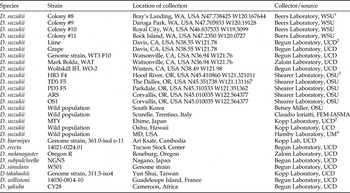
All Drosophila species and strains tested in our studies as well as their sources and original collection sites are listed in table 1. For collections in CA, OR, WA, and MD, flies were either collected at locations (public land) for which specific permission was not required; or they were collected on private grower properties for which permission was obtained. Identities of growers were omitted as a courtesy. Fly collections did not involve endangered or protected species. All lines, once obtained from the sources, were maintained in Fisherbrand square, polyethylene, 6 oz. stock bottles (Fisher Scientific, Pittsburgh, PA) containing 50 ml of Bloomington stock center fly food recipe. Colonies were kept between 22 and 25°C in a cabinet incubation chamber (Percival Scientific, Inc., Perry, IA) with a 12:12 h light:dark cycle.
Identification of conserved and diverged genes through comparative genomic analysis of Drosophilids for the design of diagnostic primers
The most conserved and diverged Drosophila genes were determined by comparative genomic analysis of D. suzukii and 14 other Drosophila species spanning multiple groups in the subgenus Sophophora (Drosophila melanogaster, Drosophila simulans, Drosophila sechellia, Drosophila yakuba, Drosophila erecta, Drosophila ananassae, Drosophila pseudoobscura, Drosophila persimilis, Drosophila willistoni, Drosophila takahashii, and Drosophila biarmipes) and subgenus Drosophila (Drosophila virilis, Drosophila mojavensis, and Drosophila grimshawi). Sequence data to establish orthology using OrthologID (Chiu et al., Reference Chiu, Lee, Egan, Sakar, Coruzzi and DeSalle2006), a phylogenomic tool developed to identify orthologous genes from whole genomes, was originally retrieved from SpottedWingFlybase (Chiu et al., Reference Chiu, Jiang, Zhao, Hamm, Cridland, Saelao, Hamby, Lee, Kwok, Zhang, Zalom, Walton and Begun2013) (D. suzukii), FlyBase (Marygold et al., Reference Marygold, Leyland, Seal, Goodman, Thurmond, Strelets and Wilson2013) (all species except D. suzukii, D. takahashii, D. biarmipes), and the Drosophila modENCODE Project (modENCODE Consortium, Reference Roy, Ernst, Kharchenko, Kheradpour, Negre, Eaton, Landolin, Bristow, Ma, Lin, Washietl, Arshinoff, Ay, Meyer, Robine, Washington, Di Stefano, Berezikov, Brown, Candeias, Carlson, Carr, Jungreis, Marbach, Sealfon, Tolstorukov, Will, Alekseyenko, Artieri, Booth, Brooks, Dai, Davis, Duff, Feng, Gorchakov, Gu, Henikoff, Kapranov, Li, MacAlpine, Malone, Minoda, Nordman, Okamura, Perry, Powell, Riddle, Sakai, Samsonova, Sandler, Schwartz, Sher, Spokony, Sturgill, van Baren, Wan, Yang, Yu, Feingold, Good, Guyer, Lowdon, Ahmad, Andrews, Berger, Brenner, Brent, Cherbas, Elgin, Gingeras, Grossman, Hoskins, Kaufman, Kent, Kuroda, Orr-Weaver, Perrimon, Pirrotta, Posakony, Ren, Russell, Cherbas, Graveley, Lewis, Micklem, Oliver, Park, Celniker, Henikoff, Karpen, Lai, MacAlpine, Stein, White and Kellis2010) (D. takahashii and D. biarmipes). Whereas complete gene sets (amino acid sequences) can be retrieved for most species, they were not available for D. takahashii and D. biarmipes, the two species that are most closely related to D. suzukii as compared to the other Drosophila species included in our comparative genomics analysis. As part of a previous comparative analysis to examine the genomes of D. suzukii and all the aforementioned Drosophila species (Chiu et al., Reference Chiu, Jiang, Zhao, Hamm, Cridland, Saelao, Hamby, Lee, Kwok, Zhang, Zalom, Walton and Begun2013), we annotated the complete gene sets for D. takahashii and D. biarmipes. The procedures for annotation and comparative genomic analysis using OrthologID (Chiu et al., Reference Chiu, Lee, Egan, Sakar, Coruzzi and DeSalle2006) have been described previously in Chiu et al. (Reference Chiu, Jiang, Zhao, Hamm, Cridland, Saelao, Hamby, Lee, Kwok, Zhang, Zalom, Walton and Begun2013).
For the identification of conserved genes, 2661 single copy orthologous gene sets present across all 15 Drosophila species were extracted from the entire collection of gene families generated by OrthologID using custom scripts. Maximum likelihood (ML) inference of the gene tree was performed for each orthologous set using RAxML version 7.4.2 (Stamatakis, Reference Stamatakis2006, Reference Stamatakis2012). The best of 36 protein substitution models under Γ-distributed rate heterogeneity was determined using the ‘ProteinModelSelection.pl’ script (Stamatakis, Reference Stamatakis2012) for each ortholog set. The average branch length was computed for each ML tree, and genes with shorter tree lengths were inferred as more conserved. This entire gene list, including average branch lengths, FlyBase annotation for D. melanogaster orthologs, and SpottedWingFlybase (http://spottedwingflybase.oregonstate.edu/) annotation for D. suzukii orthologs, is presented in Supplementary Table 1.
We used a similar approach to identify diverged genes. A total of 4781 orthologous gene sets present in single copies in both the melanogaster subgroup (D. simulans, D. sechellia, D. yakuba, D. erecta, and D. melanogaster ) and the suzukii-takahashii subgroup (D. suzukii, D. biarmipes, and D. takahashii) were identified. These gene sets may include zero or multiple copies of orthologs from the other seven Drosophila species. This selection criterion was designed to be more relaxed than in the identification of conserved genes as the divergence of a gene in D. suzukii from its close relatives is more relevant than its overall divergence across all Drosophila species. ML phylogenetic inference was performed as above for each set of orthologs. To enable the calculation of average branch lengths for gene trees in the melanogaster and the suzukii-takahashii subgroups both independently and as a combined dataset, only gene sets with trees containing monophyletic melanogaster and suzukii-takahashii subgroups were retained. To reduce the chance of including inaccurately annotated genes or misidentified orthologs, which may lead to excessively long branches, we also heuristically excluded trees with a branch longer than the sum of all other branches in the same tree. Average branch lengths for the melanogaster and suzukii-takahashii clades of the resulting list of 2815 orthologous gene sets were calculated. Genes with longer lengths were identified as more diverged (Supplementary Table 2).
Primer design for multiplex PCR
The multiplex PCR diagnostic test relies on the use of two primer sets in a multiplex PCR reaction. The first set of primers was designed to amplify a product from any Drosophilid to confirm the presence of good quality DNA in the reaction and to verify the success of the PCR reaction. This internal control primer pair was designed from the coding region of a gene (D. suzukii ortholog [SpottedWingFlybase ID: DS10_00001395] of sec61alpha in D. melanogaster [FlyBase ID: FBgn0086357 and FBpp0078896]) that is highly conserved among the 15 Drosophila species we used for our comparative genomic analysis (Supplementary Table 1) to yield a 1248 base pair (bp) product (forward primer: 5′- ATCCCTTCTACTGGATCCGTG-3′ and reverse primer: 5′- ACAGCAGCGTGCCCATG-3′) (fig. 1a).
Alignments for the gene regions in which the conserved and diverged primer sets are located. (a) Alignment of D. suzukii sec61alpha (DS10_00001395; annotation of SpottedWingFlybase (Chiu et al., Reference Chiu, Jiang, Zhao, Hamm, Cridland, Saelao, Hamby, Lee, Kwok, Zhang, Zalom, Walton and Begun2013)) to orthologs from 14 other Drosophila species spanning multiple groups in the subgenus Sophophora (D. melanogaster (FBgn0086357), D. simulans (FBgn0193973), D. sechellia (FBgn0172841), D. yakuba (FBgn0235854), D. erecta (FBgn0115759), D. ananassae (FBgn0092730), D. pseudoobscura (FBgn0081850), D. persimilis (FBgn0163685), D. willistoni (FBgn0220690), D. takahashii (KB461656.1), D. biarmipes (KB462833.1)) and subgenus Drosophila (D. virilis (FBgn0205065), D. mojavensis (FBgn0140032), D. grimshawi (FBgn0120726)). Only the gene sequences corresponding to the location of the forward and reverse primers were shown, and sequence polymorphisms as compared to D. suzukii sec61alpha were indicated in red. D. suzukii primer sequences are highlighted in blue. (b) Alignment of D. suzukii DS10_00004458 (annotation in SpottedWingFlybase (Chiu et al., Reference Chiu, Jiang, Zhao, Hamm, Cridland, Saelao, Hamby, Lee, Kwok, Zhang, Zalom, Walton and Begun2013)) to orthologs from 10 other Drosophila species: D. melanogaster (FBgn0035268), D. simulans (FBgn0185353), D. sechellia (FBgn0169366), D. ananassae (FBgn0101826), D. yakuba (FBgn0238459), D. erecta (FBgn0107076), D. takahashii (KB461143.1), D. biarmipes (KB462838.1), D. willistoni (FBgn0218640), and D. subpulchrella (KM208658). Drosophila species including D. grimshawi, D. virilis, D. mojavensis, and D. persimilis have a larger and more diverged intron and were excluded from this figure. 66-bp are shown upstream of the forward primer and 52-bp are shown downstream to anchor the alignment and indicate the polymorphic nature of the intronic region used for the forward primer. Vertical lines mark exon–intron boundaries. The eight dashes immediately before the reverse primer sequence indicate the portion of the sequence that is not shown in the alignment. Red color highlights polymorphic base pairs or deletions in the other Drosophila sequences as compared to D. suzukii primer sequences, which are highlighted in blue.

The second set of primers was designed from a gene (D. suzukii ortholog [SpottedWingFlybase ID: DS10_00004458] of D. melanogaster FBgn0035268 and FBpp0072657) that is more divergent (Supplementary Table 2). Since there is currently no publicly available genome or transcriptome data available for the closely related species D. subpulchrella, for which females also have serrated ovipositors (Atallah et al., Reference Atallah, Teixeira, Salazar, Zaragoza and Kopp2014), we sequenced a gene region within the D. subpulchrella ortholog of D. suzukii DS10_00004458 (D. melanogaster FBgn0035268) to locate primer sequences that are sufficiently diverged between D. suzukii and D. subpulchrella to differentiate these two species in addition to the other Drosophila species included in our comparative genomics analysis. To obtain the sequence for the D. subpulchrella ortholog of D. suzukii DS10_00004458, PCR was performed using D. subpulchrella genomic DNA as a template with forward primer 5′-AGTTTTGCGTCAGCGGATCC -3′ and reverse primer 5′-TCGTCGTCGGAGCTGTTG -3′. These primer sequences were designed based on D. suzukii sequences, but were sufficiently similar to amplify D. subpulchrella genomic DNA. Genomic DNA extraction and amplification conditions are described below. Amplified PCR products were purified using the PCR Purification Kit (Qiagen, Valencia, CA) following manufacturer's instructions. Sanger sequencing of the amplified gene region was performed by the UC Davis sequencing facility using the same set of primers (NCBI GenBank KM208658). Alignment of the resulting D. subpulchrella gene region with its orthologs from other Drosophila species were performed using MAFFT (Katoh & Standley, Reference Katoh and Standley2013) to identify primer sequences with sufficient sequence polymorphisms to yield a species-specific primer set (fig. 1b). We settled on a primer pair that amplifies a 263 bp product. The forward primer (5′-ACTTGTGTCTTGTCCCTCACATAC-3′) is located within an intron and the reverse primer (5′-TCCAGATCTTTACGTCATGCTCC-3′) is located within the coding region. All primers were ordered as desalted oligonucleotides from Integrated DNA Technologies (Coralville, IA).
Direct larval tissue PCR without genomic DNA extraction
Individual larvae were separated from the fly food media, wiped clean, and cut in half with a sterile razor blade. Immediately after cutting, a small portion of larval tissue was placed into a 1.5 ml microcentrifuge tube on ice prefilled with 19.5 μl of dilution buffer and 0.5 μl of DNARelease Additive from the Phire Animal Tissue Direct PCR Kit (Fisher Scientific, Pittsburgh, PA). The samples were vortexed briefly and incubated at room temperature for 5 min, placed on a 98°C heat block for 2 min, then kept on ice. PCR was prepared in a 50 μl reaction volume on ice as follows: 1 μl of diluted tissue mixture, 5 μl of 10× AccuPrime Taq DNA Polymerase Buffer 1 (Life Technologies, Grand Island, NY), 1 μl of each of the 2 primer pairs (10 μM), 0.5 μl of AccuPrime Taq DNA Polymerase, and 39.5 μl of nuclease free water. PCR was performed in a 96-well Mastercycler Pro (Eppendorf, Hauppauge, NY) and was carried out with an initial 2-min denaturation step at 95°C, followed by 35 cycles consisting of 15 s at 95°C, 30 s at 55°C, and 1 min and 30 s at 68°C. A final elongation step of 68°C for 5 min was included in the program. The amplified products were resolved on 1% TBE agarose gel for 60 min at 100 V in 1× TBE buffer (0.089 M Tris, 0.089 M boric acid and 0.002 M EDTA) and DNA was visualized under UV light using GelStar™ Nucleic Acid Gel Stain at 0.7× (Lonza, Switzerland) and the Alpha-imager mini (Protein Simple, Santa Clara, CA). The 1 kb DNA ladder (Promega, Madison, WI) was used to determine the size of the bands.
Genomic DNA extraction
Ten adult flies were used for each genomic DNA extraction. Flies were homogenized by motorized pestle in 250 μl of extraction buffer (80 mM NaCl, 160 mM sucrose, 50 mM EDTA, 125 mM,Tris-HCl (pH8.5), 0.5% SDS) in a 1.5 ml microcentrifuge tube at room temperature. The samples were incubated at 65°C for 30 min, followed by a 35-min incubation on ice. 40 μl of 8 M potassium acetate was added to the reaction and the homogenate was briefly vortexed and subsequently centrifuged at 13,000 rpm for 10 min at 4°C. The supernatant was removed and aliquoted into clean microcentrifuge tubes and centrifuged again to remove remaining debris. The supernatant was transferred to a new microcentrifuge tube and an equal volume of Phenol:Chloroform:Isoamyl Alcohol 25:24:1 (Sigma Aldrich, St Louis, MO) was added to the supernatant and vortexed before spinning at 13,000 rpm for 15 min. The top layer containing the genomic DNA was removed, mixed with a 2× volume of 100% ethanol, and left overnight to precipitate at −20°C. The precipitated DNA was pelleted by spinning at 13,000 rpm for 15 min. The pellet was washed with 70% ethanol and the ethanol was removed after a 5-min centrifugation step at 4°C. The pellet was allowed to dry before resuspending in 50 μl of nuclease free water. DNA concentrations were quantified using a Biophotometer (Eppendorf, Hauppauge, NY). The DNA was diluted to 50 ng μl−1 and stored at −20°C prior to use.
PCR conditions using genomic DNA as template
PCR was prepared in a 50 μl volume on ice as follows: 2 μl of genomic DNA (100 ng total), 5 μl of 10× AccuPrime Taq DNA Polymerase Buffer 1 (Life Technologies, Grand Island, NY), 1 μl of each of the 4 primers (10 μM), 0.5 μl of AccuPrime Taq DNA Polymerase, and 38.5 μl of nuclease free water. The cycling conditions and visualization methods were the same as described above.
Tissue PCR with ethanol or RNAlater-preserved specimens
Live larvae, pupae, and adult flies were placed into 95% ethanol and stored at room temperature, or in the case of the D. suzukii from South Korea, placed into RNAlater (Sigma Aldrich, St Louis, MO) and stored based on manufacturer's instructions before use. The specimens were removed from the solution and dried on a clean sterile surface for 5 min. Larvae and pupae were cut in half with a sterile razor blade, while adult flies were lightly crushed and kept whole. The PCR reactions were prepared as described above in direct PCR without genomic DNA extraction.
Results and discussion
Comparative genomic analysis facilities primer design
To select the appropriate primer sequences for the D. suzukii molecular diagnostic, we used a comparative genomics approach to identify candidate genes by examining the most conserved and diverged genes across 15 species in the subgenus Sophophora and the subgenus Drosophila. Average branch lengths of gene trees of orthologs were used to measure the degree of conservation and divergence. Primer sequences that can potentially amplify across all Drosophila were designed from conserved regions in one of the genes with the shortest branch lengths. Sec61alpha is the fourth most conserved in 2661 single copy ortholog groups present across the 15 Drosophila species we included in our comparative genomic analysis (Supplementary Table 1; highlighted in yellow). Alignment of D. suzukii Sec61alpha gene regions representing the forward and reverse primer sequences to corresponding regions for 14 other Drosophila species indicates high level of conservation with either no mismatches in most primer sequences to two mismatches in the case of D. pseudoobscura (fig. 1a). Since there is currently no genome or transcriptome available for D. subpulchrella, it was not included in our sequence analysis for Sec61alpha. However, since Sec61alpha is one of the most conserved single copy Drosophila genes and the Sec61alpha primer pair was able to amplify a gene fragment of predicted size, we assumed that the conservation of Sec61alpha is maintained in D. subpulchrella. Theoretically, primers can also be designed from many other conserved genes listed in Supplementary Table 1, but the Sec61alpha primers were validated in our studies presented here.
While sequences from the most diverged genes may be good candidates for designing primers that would only amplify from D. suzukii DNA, we initially tested a number of primers generated from D. suzukii genes that are in ortholog sets with gene trees that have the longest branch lengths, but found that they did not amplify consistently across D. suzukii populations collected from different geographical sites in the USA (data not shown). This is likely due to high levels of sequence polymorphisms. This suggests that the most divergent genes may be inappropriate as diagnostic marker as they have the potential to produce false negative test results. We then tested a candidate marker that is relatively less divergent, but still in the top 15% among the 2515 single copy genes in the melanogaster and the suzukii-takahashii subgroups, D. suzukii DS10_00004458 (D. melanogaster FBgn0035268 and FBpp0072657) (Supplementary Table 2; highlighted in yellow). We deemed this D. suzukii gene a suitable candidate for testing as it shows high divergence as compared to orthologs from species within the suzukii-takahashii as well as the melanogaster subgroups based on branch lengths (Supplementary Table 2; row 350 highlighted in yellow). On the other hand, although other genes, e.g., DS10_00003207 and DS10_00002465 (Supplementary Table 2; rows 345 and 347 highlighted in blue), have overall average branch lengths that are comparable to D. suzukii DS10_00004458 (around 0.068) when the calculation were performed using D. suzukii and species from both the suzukii-takahashii and melanogaster subgroups, they are not predicted to be effective as species-specific diagnostic due to the short branch lengths when computed using specific Drosophila subgroups. This suggests high sequence conservation between these D. suzukii genes to specific Drosophila subgroups. For example, the branch length of the gene tree comprising D. suzukii DS10_00003207 and orthologs in the melanogaster subgroup is only 0.028 (Supplementary Table 2; row 345 highlighted in blue), indicating high conservation. Similarly, the branch length of the gene tree comprising D. suzukii DS10_00002465 and orthologs in the melanogaster subgroup is only 0.01455 (Supplementary Table 2; row 347 highlighted in blue), suggesting high sequence conservation as well.
Based on multiple sequence alignment, D. suzukii DS10_00004458 contains variable exonic regions that are appropriate as interspecies diagnostic between D. suzukii and the fourteen Drosophila species included in our comparative genomic analysis (fig. 1b). To verify that this gene contains diagnostic sequences that can effectively differentiate between D. suzukii and the closely related D. subpulchrella, for which genome and transcriptome data are not available and is therefore not included in our bioinformatic analysis, we used Sanger sequencing to generate sequence data for the D. subpulchrella ortholog of D. suzukii DS10_00004458. As we were restricted by the limited amount of D. subpulchrella sequence we generated specifically for this study, we designed our forward diagnostic primer to be located within an intron, whereas the reverse primer is located within an exon. To ensure that species diagnostic primers have widespread utility and can amplify successfully across specimens from different populations, the use of exonic sequences for primer design is highly recommended because the rate of divergence in exons is generally lower as compared to that for introns and intergenic sequences due to constraints imposed by selection against deleterious mutations. There is a delicate balance between choosing diagnostic primer sequence that is sufficiently divergent between different Drosophila species, but yet retained appropriate level of conservation within species to ensure utility across D. suzukii populations. Nevertheless, subsequent PCR validation (see below) indicated that SWD-specific primers that were designed based on our bioinformatic analysis retained sufficient conservation across D. suzukii from different geographical regions to enable amplification in all D. suzukii populations tested.
Comparative genomic analysis provides a more robust framework for primer design and the theoretical foundation for the reliability of our PCR test. More importantly, since fly populations are continuously evolving, our comprehensive analysis provides the basis for the design of additional diagnostic markers in the case that DNA sequence changes render our diagnostic marker ineffective for specific fly populations. SpottedWingFlybase IDs for D. suzukii genes as well as FlyBase IDs for their D. melanogaster orthologs are provided in Supplementary Tables 1 and 2 to facilitate the retrieval of appropriate Drosophila sequences for sequence alignment and primer design. In fact, by entering the SpottedWingFlybase ID, e.g., DS10_00004458, into the ‘Gene Query’ search box on SpottedWingFlybase (http://spottedwingflybase.oregonstate.edu/) (Chiu et al., Reference Chiu, Jiang, Zhao, Hamm, Cridland, Saelao, Hamby, Lee, Kwok, Zhang, Zalom, Walton and Begun2013), users will be able to identify the gene family a particular gene belongs to and retrieve the FlyBase IDs (FBpp numbers) of corresponding orthologs from other Drosophila species in addition to D. melanogaster.
Multiplex PCR diagnostic differentiates D. suzukii from other Drosophila species
The internal control primer pair amplifies a 1248 bp product that is conserved in all Drosophilids for quality control purposes. The presence of the control band in non-SWD samples signals that DNA quality and amplification condition are acceptable, and the lack of amplification for the species-specific primers is not due to suboptimal PCR conditions. The SWD species-specific primer pair amplifies a 263 bp product. Thus, a positive test should result in the amplification of two DNA fragments, one at 263 bp, and another at 1248 bp, visible upon DNA gel electrophoresis.
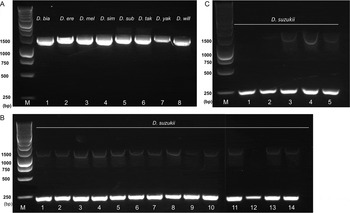
As we aim to develop an efficient assay that can be performed using limited starting materials, we tested our PCR diagnostic using crude extract isolated from either single larva or preserved adult specimen (when larva is not available) without any prior genomic extraction steps. To ensure reproducibility, at least five biological replicates were performed for each SWD and non-SWD population. A total of eight non-SWD Drosophila species were tested (fig. 2a and table 1). There were no false positives in that all non-SWD larvae showed robust amplification only for the control 1248 bp product. The size of the internal control band in the different species showed slight variation indicating possible in/del within the regions spanned by the control primer set. As sequence polymorphisms might have accumulated over time as D. suzukii populations spread, we tested the utility of our PCR diagnostic using larvae or preserved adult specimens from nineteen D. suzukii populations (fig. 2b, c, table 1). Freshly sacrificed larvae were used to assay D. suzukii populations from the continental USA. including California, Oregon, Washington and Maryland, as well as populations from Hawaii and Japan, as live cultures of these populations were available. On the other hand, preserved adult specimens were used to assay D. suzukii populations from Italy and South Korea because we only have access to RNAlater-preserved specimens for these sites. All of the D. suzukii larvae originated from different geographical regions in the USA as well as from Hawaii and Japan tested positive and showed amplification at the 263 bp (SWD-specific band) (fig. 2b, c). Moreover, adult D. suzukii specimens collected in South Korea and Italy and preserved in RNAlater also tested positive (fig. 2c). This represents a 100% success rate.
DNA agarose gel electrophoresis showing results of multiplex PCR. Multiplex PCR was performed using (a) multiple Drosophila species (see table 1 for strain information) and (b) D. suzukii collected from different regions in the Western USA (lanes 1–14: genome strain WT3 F10, lime, grape, Mark Bolda WAT, Wolfskill IFL WO-2 [from CA], HR3 F4, TD3 F5, PD3 F5, ARS, OS1 [from OR], colony #8, colony #9, colony #10, and colony #11 [from WA]). PCR amplification for (a) and (b) was performed using crude larval extract isolated from a single larva that was freshly sacrificed. All crude DNA extractions and corresponding PCR reactions for (a) and (b) were repeated at least five times using biological replicate samples. Representative results are shown here. (c) Multiplex PCR was performed using crude extract from D. suzukii specimens collected from regions outside of the western United States. Adult flies were collected in South Korea and Italy (table 1) and preserved in RNAlater for storage (lane 1: South Korea, lane 2: Italy). Freshly sacrificed larva from strains collected in Japan, Hawaii, and Maryland, USA (lane 1: MTY3, Japan, lane 2: Oahu, Hawaii, lane 5: Maryland).

Species and strains used for testing the D. suzukii molecular diagnostic.

1 Washington State University.
2 University of California, Davis.
3 Oregon State University.
4 University of Maryland.
As our diagnostic relies on multiplex PCR, there is competition between the primer sets for reaction components such as ATP and deoxynucleotide triphosphates (dNTPs). When one product is favored, it can outcompete the other reaction resulting in uneven amplification of the two products. Short amplicons, e.g., the 263 bp SWD-specific products, are often amplified with higher efficiency than long amplicons, e.g., the 1248 bp control product, because the polymerase is more likely to fully extend a larger percentage of the short products as the reaction proceeds. Thus, we designed the control primers to produce a longer amplicon than the SWD-specific primers so that when D. suzukii DNA is provided as the template, the SWD-specific product will be favored. This design increases the sensitivity of our assay, yet retains the advantage of having an internal control to illustrate the difference between robust vs. weak non-specific amplification. As shown in fig. 2b, the SWD-specific 263 bp product is clearly more robust than the 1248 bp control amplified fragment in all SWD samples. In a few of our test samples, the SWD-specific primers even outcompete the internal control primers, resulting in a single band at 263 bp (e.g., fig. 2b, lane 12; fig. 2c, lane 1). When the 263 bp SWD-specific product is present and 1248 bp control product is absent, a single band at 263 bp can be interpreted as a positive test result.
This assay was also performed using crude extract from ethanol preserved larvae, pupae, and adult samples because this is a common collection and storage condition and produced amplification results and conclusions identical to those in reactions using live samples (data not shown). This direct larval tissue PCR method is economical and practical for rapid identification of single larva because the PCR reaction can be assembled in minutes, while the use of extracted genomic DNA typically requires at least an hour as well as additional equipment and reagents. Finally, we verified that our multiplex PCR diagnostic assay also performs well with genomic DNA extracted from all nine Drosophila species and observed that the SWD-specific primers only amplified D. suzukii DNA (data not shown).
Conclusion
We have designed an accurate PCR diagnostic that can unambiguously differentiate D. suzukii from other common Drosophila species using the crude homogenate of a single larva as the DNA source without the need for additional steps such as genomic DNA extraction, sequencing, or restriction digestion. The use of the recently sequenced D. suzukii genome and a comparative genomic approach facilitated the discovery of the diagnostic marker we presented here. In addition, our genomic analysis generated many other candidate genes that can be used for species-specific diagnostics as well as examination of trait evolution in Drosophilids.
Supplementary material
The supplementary material for this article can be found at http://www.journals.cambridge.org/BER
Acknowledgements
We thank the laboratories of David Begun (UC Davis Department of Evolution and Ecology), Artyom Kopp (UC Davis Department of Evolution and Ecology), and Kelly Hamby (University of Maryland) for sharing Drosophila strains. D. suzukii from Watsonville, CA, USA. were collected with permission by Garroutte Farms, Inc. (Watsonville, CA). We also thank Claudio loriatti from the Center for Technology Transfer, FEM-IASMA for D. suzukii collected from Italy. We thank Ernest K. Lee (AMNH, New York, NY) as well as the editor and reviewers for their valuable input into this manuscript. This project is supported by a Washington Tree Fruit Research Commission grant awarded to JCC and UC Davis Provost's Undergraduate Fellowship and McBeth Memorial Fellowship awarded to KAM.