Introduction
Taking saliva cortisol samples to assess stress is a non-invasive and an in itself stress-free method compared with taking blood samples, and it has been shown that cortisol levels in saliva and plasma correlate well (Cook et al., Reference Cook, Schaefer, Lepage and Morgan Jones1996; Schönreiter and Zanella, Reference Schönreiter and Zanella2000; Negrao et al., Reference Negrao, Porcionato, De Passille and Rushen2004). This method is popular in pigs, because they react strongly to handling and fixation, which are often necessary for taking blood samples.
Several studies have dealt with basal levels of concentration of salivary cortisol in pigs and its circadian rhythm (e.g. Ekkel et al., Reference Ekkel, Dieleman, Schouten, Portela, Cornelissen, Tielen and Halberg1996; Ruis et al., Reference Ruis, Te Brake, Engel, Ekkel, Buist, Blokhuis and Koolhaas1997; De Jong et al., Reference De Jong, Prelle, van de Burgwal, Lambooij, Korte, Blokhuis and Koolhaas2000). The circadian rhythms of cortisol in these studies show either one (Bate and Hacker, Reference Bate and Hacker1985; Griffith and Minton, Reference Griffith and Minton1991; Ekkel et al., Reference Ekkel, Dieleman, Schouten, Portela, Cornelissen, Tielen and Halberg1996) or two peaks per day (Ruis et al., Reference Ruis, Te Brake, Engel, Ekkel, Buist, Blokhuis and Koolhaas1997; De Jong et al., Reference De Jong, Prelle, van de Burgwal, Lambooij, Korte, Blokhuis and Koolhaas2000; Geverink et al., Reference Geverink, Schouten, Gort and Wiegant2003; De Leeuw and Ekkel, Reference De Leeuw and Ekkel2004). The common finding is that baseline levels of cortisol in blood and saliva are higher in the morning than in the evening.
The absolute cortisol level and its circadian pattern may be further influenced by a combined effect of ambient temperature, thermoregulatory behaviour and age, which is highly correlated with weight. More detailed studies even restricted to a subset of these variables are scarce. For example, Ruis et al. (Reference Ruis, Te Brake, Engel, Ekkel, Buist, Blokhuis and Koolhaas1997) showed a decrease in absolute salivary cortisol levels from 12 to 20 weeks of age, whereas De Jong et al. (Reference De Jong, Prelle, van de Burgwal, Lambooij, Korte, Blokhuis and Koolhaas2000) found an increase at a similar age-span. Long-term effects of housing conditions assumed to compromise the animals’ welfare seem to coincide with a flattened circadian pattern of cortisol (single v. group housing, Geverink et al., Reference Geverink, Schouten, Gort and Wiegant2003; substrate v. no substrate to manipulate, De Leeuw and Ekkel, Reference De Leeuw and Ekkel2004; barren v. enriched pens, De Jong et al., Reference De Jong, Prelle, van de Burgwal, Lambooij, Korte, Blokhuis and Koolhaas2000). As pigs are susceptible to ambient temperatures (e.g. Ekkel et al., Reference Ekkel, Spoolder, Hulsegge and Hopster2003; Hillmann et al., Reference Hillmann, Mayer and Schrader2004), temperature and the pigs’ thermoregulatory reactions allowed for by the housing system are potentially strong influencing factors and might even overshadow the effects of, e.g. the tested housing conditions. Extreme ambient temperatures have been found to distort the circadian rhythm of cortisol in pigs (Bate and Hacker, Reference Bate and Hacker1985) or not (Klemcke et al., Reference Klemcke, Nienaber and Hahn1989).
The aim of this study was therefore to examine the effects of ambient temperature, age (weight) and thermoregulatory behaviour (lying in the dung area and huddling, Hillmann et al., Reference Hillmann, Mayer and Schrader2004; Huynh et al., Reference Huynh, Aarnink, Gerrits, Heetkamp, Canh, Spoolder, Kemp and Verstegen2005) on the absolute salivary cortisol level of fattening pigs and its circadian rhythm.
Material and methods
All procedures involving animal handling and treatment were approved by the Swiss Federal Committee for Animal Testing.
Animals and housing
Experiments were performed at the Agroscope Reckenholz-Tänikon Research Station ART (Tänikon, Switzerland). A total of 348 cycles of 24 h (two to four cycles per animal) from 30 animals kept in six groups (four in winter and two in summer) were observed. Temperature during observations varied from about 5°C to 25°C and animal weight from 55 to 105 kg.
Subjects were kept in constant groups balanced for age, weight, sex (gilts and barrows) and litters between the weight of 20 and 100 kg (slaughter). The pigs were kept in an uninsulated building in pens with partly slatted floors (solid concrete lying area: 0.67 m2, plus slatted dung area: 0.33 m2 per pig). The lying area was slightly littered (100 g per pig per day). Pigs were fed with a commercial liquid diet at 0630 and 1630 h according to their weight, and had free access to water and a straw rack. Feed components and feeding levels in the experimental periods and seasons were the same. Pens were cleaned at least once a day, usually during the morning feeding. The ambient temperature and relative humidity were recorded every 5 min with data loggers (HOTDOG©; Elpro, Merstham, Redhill, UK) fixed on the wall 1 m above the floor, in both the lying and dung area.
Saliva sampling and analysis of cortisol
Saliva samples were collected every 2 h over a period of 24 h, beginning at 1200 h (winter experiments) and 0900 h (summer experiments). Pigs were habituated to the procedure. The pigs were allowed to chew individually on a cotton pad, fixed with a gripper, for approximately 30 s. Collecting saliva samples from all pigs of one group took less than 20 min and pigs were not restrained. Immediately after collection, the pads were stored in plastic tubes and frozen at −21°C. Prior to analysis, the cotton pads were thawed and centrifuged (3000 r.p.m. at 4°C) to separate the saliva from the pad. Cortisol concentration was analysed using a double-antibody radioimmunoassay for quantitative measurement of cortisol in serum and urine (EURO/DPC®, Gwynedd, UK), which was adapted to the analysis of cortisol in saliva in our laboratory. The samples (150 μl each) were eluted with 150 μl cortisol antiserum. After incubation for 1 h at 37°C, 160 μl of I125-labelled cortisol were added. After a second incubation (3 h at 37°C), the second antibody was added and the samples were incubated at 20°C for 10 min and then centrifuged for 30 min at 4200 r.p.m. and 4°C. The supernatant was removed by suction cleaning, and the radioactivity in the tubes was counted for 1 min (Cobra II; Canberra Packard SA, Zurich, Switzerland). All samples were run in duplicate and their mean was analysed.
Behaviour
Thermoregulatory behaviour (i.e. huddling and lying in the dung area) of each individual subject was continuously recorded. Huddling was defined as lying in a heap, i.e. animals were lying on top of each other and did not just have body contact. This behaviour is suggested to serve thermoregulatory rather than purely social functions (Boon, Reference Boon1981). Lying in the dung area was recorded when a pig was lying with at least 50% of its body on the slatted part of the pen floor. This behaviour is well known to be shown by pigs to increase evaporation (Hillmann et al., Reference Hillmann, Mayer, Gygax and Schrader2005; Huynh et al., Reference Huynh, Aarnink, Gerrits, Heetkamp, Canh, Spoolder, Kemp and Verstegen2005). For the statistical analysis, the occurrence of huddling or lying in the dung area for more than 15 min within the 30 min preceding saliva sampling was used as an indicator for thermoregulatory activity.
Statistical analysis
The relationship between the logarithm of the cortisol concentration and the time of day, the temperature, the weight (all treated as continuous explanatory variables) and the lying behaviour (occurrence of huddling and lying in the dung area) was investigated using linear mixed-effects models (Pinheiro and Bates, Reference Pinheiro and Bates2000). The random effects described the repeated measurements (observational day nested within individuals nested in housing groups).
Temperature varied over a wide range between observational days (5.4°C to 27.7°C) but did much less so within the days. Relative humidity was 59.5 ± 2.6% in summer and 73.1 ± 1.6% in winter and was highly correlated with ambient temperature. For evaluation, an average temperature value per day was thus used. To allow an a priori unrestricted smooth shape of the daily pattern of the cortisol concentration, natural splines with six knots were used for the effect of time of day (Venables and Ripley, Reference Venables and Ripley2002). The necessary number of knots in the spline was found by increasing the number of knots as long as the increase resulted in a statistically significant improvement of the model. A term was included in the model, which allowed for an exponential increase in the variability of the residuals with increasing daily temperature (Pinheiro and Bates, Reference Pinheiro and Bates2000) and thus corrected for heteroscedasticity, i.e. the log-concentration of cortisol varied more widely at higher temperatures and this was accounted for.
A full model was calculated, which was then reduced in a stepwise backward manner (using type III sums of squares). The stepwise backward procedure started out with a model including the fixed effects time of day, daily temperature, weight, occurrence of huddling and lying in the dung area. All two-way interactions between time of day, daily temperature, and weight were included. Based on sample size considerations, the two-way interactions between time of day, daily temperature and weight with the occurrence of lying in the dung area and huddling were considered.
We used P < 0.01 as the criterion in model reduction because a series of different models was calculated in this explorative analysis. When the model was reduced, (1) time of day, (2) weight, (3) lying in the dung area and (4) huddling remained as main effects. In addition, the interactions between (5) time of day and lying in the dung area as well as (6) huddling, and (7) between time of day and weight also remained in the model.
Model assumptions, i.e. the distribution of the residuals and random effects, were checked graphically for normality and homoscedasticity of the residuals in relation to the estimates and to the explanatory variables, and concentration of cortisol was log-transformed.
Results
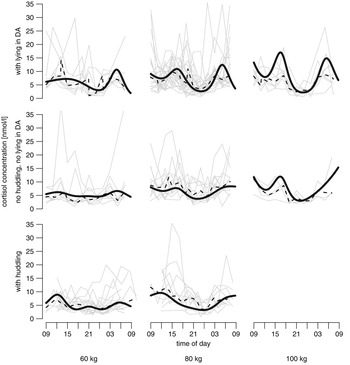
The cortisol levels depended on time of the day, and with increasing body weight, average cortisol concentration increased and the circadian pattern became more pronounced (time of day × weight: F 6,885 = 6.6, P < 0.001; Figure 1). In general, two peaks were found per day (Figure 1). These peaks were visible at about 1200 and 0500 h (60 kg), at 1200 to 1500 h and 0600 to 900 h (80 kg), and at 1600 and 0600 h (100 kg). Lowest cortisol levels were measured in the late evening between 2100 and 2400 h.
Circadian profile for the model estimates of cortisol levels (black line), the original data (grey lines) and lowess smoother of this original data (robust locally weighted regression; dotted line) for fattening pigs of different body weight at days with (a) lying in the dung area (DA; mean ambient temperature 24.1°C), (b) without huddling and without lying in dung area (mean ambient temperature 20.0°C) and (c) with huddling (mean ambient temperature 11.8°C). For the graphical display (but not for the statistical analysis), each observation day was defined as ‘day with huddling’ (occurrence of huddling in more than 10% of the half-hours preceding saliva sampling), ‘day with lying in DA’ (occurrence of lying in the dung area in more than 10% of the half-hours preceding saliva sampling) or ‘day without huddling nor lying in DA.’

The circadian pattern of cortisol was significantly affected on days when lying in the dung area or huddling occurred (time of day × lying in the dung area: F 6,885 = 3.9, P < 0.001, time of day × huddling: F 6,885 = 3.1, P < 0.01). Compared with days where neither lying in the dung area nor huddling was observed, the circadian pattern was more pronounced on days with lying in the dung area and days with huddling, respectively (Figure 1).
Discussion
As expected, we found a strong relationship between the concentration of cortisol in the saliva of fattening pigs and the time of day. More precisely, we found a two-peak circadian pattern of cortisol, which confirms the findings of other studies (De Jong et al., Reference De Jong, Prelle, van de Burgwal, Lambooij, Korte, Blokhuis and Koolhaas2000; De Leeuw and Ekkel, Reference De Leeuw and Ekkel2004). The peaks that we found were at about 1600 and 0600 h and may have been amplified by the feeding time at 1630 and 0630 h. If the cortisol concentration was increased due to the expectation of feeding, this could also explain the increase of the amplitude of cortisol peaks with increasing weight (and age) because the pigs may have learnt to expect food at these times. However, a cortisol peak both in the early morning and in the afternoon is shown in many studies (Ruis et al., Reference Ruis, Te Brake, Engel, Ekkel, Buist, Blokhuis and Koolhaas1997; De Jong et al., Reference De Jong, Prelle, van de Burgwal, Lambooij, Korte, Blokhuis and Koolhaas2000; Geverink et al., Reference Geverink, Schouten, Gort and Wiegant2003), which could be explained by enhanced gluconeogenesis during fasting periods, i.e. during nighttime and between morning and afternoon feeding. No effect of the feeding method (restricted or ad libitum) was found on the cortisol concentrations in gilts (De Leeuw and Ekkel, Reference De Leeuw and Ekkel2004). Also, in some of the weight classes, cortisol peaks were visible 4 h before or 2 h after feeding time in our study. In contrast to our results, Griffith and Minton (Reference Griffith and Minton1991) and Ruis et al. (Reference Ruis, Te Brake, Engel, Ekkel, Buist, Blokhuis and Koolhaas1997) found only one peak. However, in the study of Griffith and Minton (Reference Griffith and Minton1991), the pigs were tethered in environmentally controlled rooms after having been kept in outdoor lots until 100 kg live weight. This drastic change of the housing condition may have contributed to alterations in the circadian profile of cortisol. Ruis et al. (Reference Ruis, Te Brake, Engel, Ekkel, Buist, Blokhuis and Koolhaas1997) conclude from the fitted cosine curves that there was one peak only, but the figure of original data seems to indicate two peaks, which their modelling method was not able to pick up. Taken together, the rhythm of basal salivary cortisol levels seems to reveal a two-peak pattern rather than one peak, no matter whether the pigs were fed ad libitum (Ruis et al., Reference Ruis, Te Brake, Engel, Ekkel, Buist, Blokhuis and Koolhaas1997) or rationed (Ruis et al., Reference Ruis, Te Brake, Engel, Ekkel, Buist, Blokhuis and Koolhaas1997; De Leeuw and Ekkel, Reference De Leeuw and Ekkel2004; this study). Nevertheless, in order to control for possible effects of feeding time, in future studies on circadian cortisol patterns, pigs should be fed ad libitum, with a feeder refilled at random times each day.
The age of the pigs in our study ranged from 13 to 17 weeks of age. Despite this relatively short time-span, the average level of cortisol increased with increasing weight (60 to 100 kg, Figure 1), and the circadian pattern became more pronounced. This is in line with the results of De Jong et al. (Reference De Jong, Prelle, van de Burgwal, Lambooij, Korte, Blokhuis and Koolhaas2000), who found a similar development between 9- and 20-weeks-old pigs. When long-term measurements of cortisol in fattening pigs are conducted, it should therefore be considered that long-term variations in cortisol may be caused by increasing age and weight more than by the respective experimental situation.
In contrast to our hypothesis, neither the average cortisol levels increased with increasing or decreasing temperatures, nor was the circadian pattern flattened. The ambient temperatures in our study (5.4 to 27.7°C) may not have been extreme enough to provoke a response of the HPA axis in the pigs although the temperatures fell below or exceeded the thermoneutral range of fattening pigs on several days. Alternatively, the pigs were able to compensate the effects of ambient temperature by lying in the dung area or huddling, and our finding that the circadian pattern of cortisol was more pronounced on days where the pigs showed thermoregulatory behaviour indicates a relationship between thermoregulatory behaviour and stress response. The question of whether the cortisol pattern would have changed more drastically when behavioural thermoregulation had not been sufficient to prevent severe heat or cold stress remains unanswered.
Conclusions
Cortisol levels in saliva of restrictedly fed growing pigs showed a two-peak circadian pattern. The amplitude as well as the circadian pattern of cortisol levels was more affected by weight and behaviour than the average levels of cortisol. Thus, in studies on long-term effects on salivary cortisol, the circadian profile rather than only one measurement per day should be considered.
Acknowledgements
We thank B. Horat for taking care for the animals, C. Loretz, H. Schulze Westerath and D. Rasmussen for their help in taking saliva samples and M. Arnold for her help with the cortisol analyses.