Introduction
Strangely enough, in the early 1990s a teaching staple of one of this article's co-authorsFootnote 1 was the Grand Funk Railroad track ‘Paranoid’. The starting point for this article, in effect, was the moment when an undergraduate studentFootnote 2 asked why the instrumental layout on the track was strange; specifically, why was it that the drum kit was situated far to one side of the stereo spectrum? A contemporary live recording of the same track situates the drum kit in the centre, and so curiosity was aroused. A year or two later, a then colleagueFootnote 3 was intrigued by another track being used for teaching – a mid-1980s remix of Amen Corner's ‘Bend Me, Shape Me’ – and, through contacting the band's then keyboard player, Blue Weaver, was able to determine something of the track's production history. From such serendipitous moments can interesting discoveries come.
The research which forms the bulk of this paper was undertakenFootnote 4 on an AHRC-funded project in 2006/2007. The broad aim of the project was to map the process of achievement of the production norm which has dominated most popular genres since the early 1970s, and which we shall analyse below as the ‘diagonal mix’. The process of learning how to frame such a project so as to secure Research Council funding, while probably instructive, is really outside our purposes here. Suffice it to say that the chief compromise made over the course of successive attempts was to remove, on the advice of independent reviewers, any attempt at ethnographic confirmation (or underpinning) of the results we will present. As a result, the project became indisputably one of empirical music analysis, valuable in its own right but leading to certain interesting consequences which we will address in the conclusion.
Although not a central issue for popular musicology, other writers have addressed the ‘sound-box’, the use of a four-dimensional heuristic model (consisting of the dimensions laterality, register, prominence and temporal continuity) for the discussion of the apparent locations of sound sources within recordings. Theodore Gracyk (Reference Gracyk1996) and Albin Zak (Reference Zak2001), for example, approach the issue of stereo placement from an aesthetic point of view, concentrating on aspects such as the frequency and prominence of the sound sources which form the stereo image of a track. Zak, in particular, details specific spatial and stereophonic changes that may occur across the duration of a track and how this may compare to tracks that produce a static stereo image. While the notion of the development of the ‘diagonal’ or normative mix is not accounted for, Zak (Reference Zak2001, p. 45) does allude to the ‘conventional stereo mix of a rock band’, which he sees as a recreation of the live set-up of the band or, as David Morton (Reference Morton2000, p. 43) describes it, a ‘by-product of a performance’. While the contemporary stereo mix tends to match that of a live performance set-up, that was by no means regularly the case in the period in question. The move from ‘live’ placement to ‘recorded’ stereo placement is thus not straight forward, particularly in the quest to map out the development of the normative stereo mix. Both Gracyk and Zak emphasise the notion of the virtual performance and the fact that the arrangement of sounds exist only on the record. Mark Katz describes the recorded artefact as ‘a musical space unique to the work, one with no physical counterpart’ (Katz Reference Katz2004, p. 42), and it is this paradigm which underpins the research reported here.
The recorded track is viewed by many as a shaping of ‘sonic events, mixed to produce an experience’ (Morton Reference Morton2000, p. 43), with a strong gestural component; Richard Middleton highlights the affective, cognitive and kinetic elements of performance which take place within, and emanate from, the sound-box. The significance of the sound-box in terms of the sense of physical placement has ‘enormous potential on the power and types of gestural resonance’. Middleton also refers to the listener's involvement as ‘a gestural subject, who is assimilated into the textural space, as a participating actor’ (Middleton Reference Middleton1993, p. 179). This notion finds ready application in the act of listening through headphones, which isolates the ‘listener in a private acoustic space’ (Schafer Reference Schafer2006, p. 35) as opposed to listening through loudspeakers, which offer a ‘blended textural space for the assimilation of mastery, by the detached listener-subject’ (Middleton Reference Middleton1993, p. 179).
William Moylan, conversely, presents the issue of stereo imaging from a technical perspective, referring to ‘the perception of the spatial characteristics of a sound’ that result in the perception ‘of the physical location of sound source in an environment’ (Moylan Reference Moylan2007, p. 223). The perceived location of sounds within the sound-box is discussed in much of the literature regarding stereo imaging, but the majority of the technical literature that deals with aspects of sound production, with mixing and with stereo imaging, is written from the perspective of the engineer or sound recordist. That is to say, references to sound placement are limited to lateral placement (controlled by panning devices such as pan pots), depth (varying levels of volume and reverb can alter the perceived distances of sounds in relation to other sounds within the sound-box and the listener's perception) and time. Vertical placement, one of the four dimensions of the sound-box, is an aspect of stereo imaging that is not considered significant by most audio engineers. The vertical placement of a sound cannot be controlled in the same way as depth or lateral placement. The frequency of a sound determines its placement on the vertical plane, with higher frequencies perceived to be placed in the upper zone of the sound-box and lower frequencies occupying the lower section. Among engineers and producers who accept the perceived vertical placement of sounds to be an important aspect of the overall stereo image are George Martin (Reference Martin and PearsonMartin with Pearson 1994, p. 75) and engineer/producer/writer David Gibson. Gibson's Art of Mixing (Gibson Reference Gibson2005) offers a visual approach to mixing and the sonic placement of various songs within the sound-box. Gibson's visuals, unlike Moylan's diagrams, include the perceived vertical placement of a sound to show how the mix of each sonic event occupies the space within the sound-box. Production norms, however, remain his main focus and reference to the establishment of this normative mix is absent.
Indeed, one of this article's co-authors has addressed this on more than one occasion, most particularly in Rock: The Primary Text (Moore Reference Moore2001, pp. 120–126) which discusses how the sound-box appears for some dozen tracks spread over a period of 25 years. However, two particular aspects are missing both from that initial exploration and from other discussions of the sound-box. The first is its status as normative. Not only production manuals, but also academic writing, treat the normative layout (what we are calling the ‘diagonal mix’) as inevitable, and not contingent. One of the aims of our project was – through the analysis of a large number of tracks – to enable the description of a historicised achievement of this mix from a range of other possibilities which existed during the early years of stereo, i.e. prior to the early 1970s. The second is to answer the ‘so what’ question. What part does the sound-box play in the signification of particular tracks? That particular question, while outside the topic of this particular project, needs to be the culmination of this avenue of research, and pointers in this direction will be made in the conclusion.
Outline of the project
The study involved the transcription of 1,000 tracks, 14 per cent of which were chosen by a process of random sampling from the UK and US singles charts from the same month in each of the years 1966–1972.Footnote 5 The remaining tracks comprise singles and album tracks of both popular and cult status, and a small number of non-UK/US-produced tracks (namely Italian and French).Footnote 6 Samples were taken from the Top 40 Charts, compiled from the BPI, CIN, US Billboard and Music Week charts (Gambaccini et al. Reference Gambaccini, Rice and Rice1996; Whitburn Reference Whitburn2004). In order to produce sound-box transcriptions of each track, 25 per cent of the tracks from 1966 to 1972 were subject to both loudspeaker and headphone analysis, while the remaining tracks were subject to headphone analysis alone. It was important to obtain transcriptions of analyses from both media in order to make comparisons between the perceived stereo image heard over loudspeakers and headphones. Moylan (Reference Moylan2007, p. 23) points out that ‘loudspeakers themselves are placed in, and interact with, a playback environment’, whereas headphones remove the environmental influence of the spatial characteristics of sounds during playback and provide a consistency in listening conditions. The choice to undertake the majority of the listening over headphones was largely due to the fact that headphones produce a clearer stereo image than loudspeakers. The sharper stereo image is primarily a result of the ‘in-the-head’ effect produced by headphones, which can direct ‘the listeners’ attention to different zones of interior space' (Eisenberg Reference Eisenberg2005, p. 53), rendering sound localisation and the transcription of sonic placement with more precision. Experiencing the music ‘in-the-head’ is described by Steve Jones as giving one a ‘feeling of immediate intimacy’ (Jones Reference Jones1992, p. 59). Changes in stereo positioning and sonic panning are perhaps best experienced through headphones as heard in tracks such as Jimi Hendrix's ‘Purple Haze’ for example, which Jones refers to as ‘headphone music’ (Reference Jones1992, p. 61).
It is noted that listening through headphones does not fully represent the normative listening conditions of the mid to late 1960s, but the adoption of a uniform means of analytical listening does enable the comparison of like with like, with the greatest possible attention being paid to locational placement. Playback devices of the time were by no means uniform and varied from cabinet-style players to stereo system separates that were predominantly owned by audiophiles (Crabbe Reference Crabbe1968). In many instances, the stereo image and panning techniques employed were lost on playback equipment, particularly if the stereo vinyl was played using a mono pick-up; therefore the stereophonic effects are best experienced when listening over headphones. Our methodology, in reflecting recent ways of experiencing music and concentrating on the use of headphones with portable devices such as mp3 players and iPods, is not subject to the same problems.
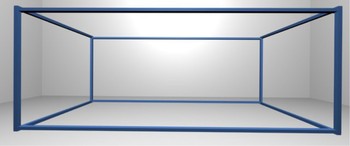
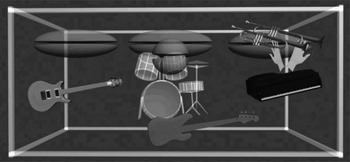
The aural analysis and subsequent production of a visual transcription of a track is fundamental to the investigation of certain popular song characteristics which would ordinarily be omitted from standard transcriptions and notation. As the main focus of the project deals with stereo imaging and the perceived location of sound sources, a visual means of structuring and documenting specific aspects of the aural experience was required. Taking into consideration the fact that aural analysis draws upon the link between auditory and visual perception, a template that visually represented the heuristic sound-box was developed, shown below in Figure 1.
Sound-box template.

During aural analysis, the sounds were plotted within the template to visualise the stereo image being heard. The use of the sound-box template enabled consistent and economical transcriptions of the sound-source placement in each track. As this is an analytical investigation, the template allows for consistency in terms of the graphic representation of sound-source placement, and provides a standard sound-box with which the relative degrees of stereo width can be plotted.Footnote 7 In certain instances, a song's stereo image may appear to go beyond the fixed sound-box template, an observation illustrated by the placement of instruments beyond the visual boundaries. Because the stereo positioning of sounds may alter significantly across the duration of certain tracks, rather than creating multiple transcriptions that show each of these changes, the final sound-box transcription for an individual song is a cumulative visual representation of the sonic events occurring throughout the duration of the song. Indeed, ‘snapshot’ transcriptions that show sonic placement at a particular point in the song will be employed later in this article to clarify particular points.
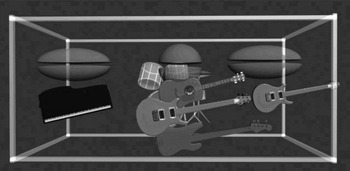
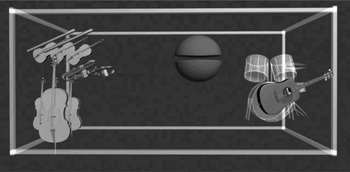
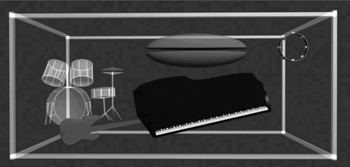
This visual approach can be regarded as a variation on the visual guide used in Gibson (Reference Gibson2005, pp. xxxiv–v), as opposed to the illustrations used by Moylan (Reference Moylan2007, pp. 180–181), for example, which only deal with depth and lateral placement. For the purpose of this project, the sound-box transcriptions originally consisted of simple circular shapes that plotted the perceived placement of the sound source within the sound-box. Each circle represented the point source of a sound, ‘a phantom image that occupies a focused, precise point in the sound stage’ (Moylan Reference Moylan2007, p. 375). Where sounds were difficult to locate accurately, larger circles were used to indicate spread images, ‘a phantom image that has a size that extends between 2 audible boundaries’ (Moylan Reference Moylan2007, p. 378). For the purposes of presentation in this paper, we have replaced these sources with iconic representations of the sound sources concerned. Most are self-evident, although we represent the voice with an idealised mouth – an open ball, foregrounded for lead voice, deeper for backing vocals (see subsequent figures). While the transcriptions offer a guide to where the sounds appear to be positioned within the sound-box, these are representative less of the actual space than of the virtual space. Indeed, a guitar playing across several octaves will appear to move vertically within the space occupied; the frequencies of the notes corresponding to the upper and lower part of the space within which the guitar is placed. The icon in such a case represents the virtual space within the sound-box that identifies where the guitar appears to be placed. The main aim of the transcriptions is to illustrate the development of the normative mix from an aesthetic point of view, and in terms of the technological change concurrent with sound-source stereo placement trends.
Taxonomy of mixes
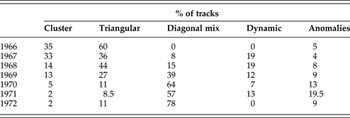
The transcriptions resulting from the aural analysis highlighted several well defined sound-box configurations from which the development of the normative mix can be traced. These categories and sub-categories form what we identify as a taxonomy of mixes. The taxonomy comprises four main mix types: clustered, triangular, diagonal and dynamic. Table 1 shows the percentage of mix type in each of the seven years, and clearly identifies an overall trend towards the normative diagonal mix by the early 1970s.
Percentage of mixes by calendar year.

Each specific mix is constructed in terms of the relative placement of three key elements: lead vocals, bass guitar and snare drum. The decision to measure the mix in terms of these elements is far from arbitrary, but rather arises from observation of the fixed elements in the post-1970 normative mix (where these three sound sources lie on a slight diagonal).
The clustered mix describes the narrow stereo image created by the central placement of the key sound sources within the sound-box. There are variations of the cluster, which include a favouring of sides (where the cluster appear to be placed towards either the left or the right) and clusters that include an isolated instrument detached from the main cluster of instruments.
The triangular mix, by contrast, describes a triangular configuration between the vocals, snare and bass. The configuration can vary from centralised vocals and off-centred snare and bass, to off-centred vocals and centralised bass and snare. By applying the terminology used by audio engineers to describe spatial attributes of a virtual image, the main difference between clustered and triangular mixes can be explained in terms of the overall width of the group or ‘ensemble’ of sound sources, also referred to as the ‘macro scene element’ (Rumsey Reference Rumsey2002, p. 657). The macro width is different from the width of the overall size of the perceived environment within which it is contained. One way of making apparent the varying widths of the macro elements is through consideration of the overall sound-box as a constant, fixed framework, as we have suggested. The individual source widths, or ‘micro attributes’ tend to be more localised in triangular mixes, and span the width of the sound-box, creating a wider macro scene element or rather stereo image.
The dynamic mix refers to tracks where there is some level of movement within the sound-box. This can be created through the use of pan pot devices where a sound source moves laterally; it can correspondingly be created through movement in depth, where a sound becomes softer or changes its reverberation level or treatment. Sometimes sound sources are repositioned in separate takes and these takes are spliced together in the final mix (as in the Hollies' example, below). The category includes this sort of instance.
The diagonal mix is the normative layout that provides the paradigm for subsequent record production. This mix identifies the vocals, bass and snare as being on a slight diagonal line in a linear configuration (relative to the vertical axis), with other instruments placed to either side (exemplified in Figure 8, below). It can also be subcategorised to include mixes where the vocals and bass appear to be in a perpendicular configuration. The normative mix is taken as understood, with many studio recording handbooks specifying the layout as being ‘typically the bass, snare, kick drum, and vocals go to centre; keyboards and guitars can be panned left and right’ (Bartlett and Bartlett Reference Bartlett and Bartlett2002, p. 289). This ‘accepted wisdom’ of stereo mixing is detailed in production journals such as Sound on Sound (White Reference White2000).
During most of the mid to late 1960s, stereo mixes of albums were considered to be a minor adjunct to the dominant mono version. Mono was considered to be the only significant format, a notion supported by the fact that most pop music was played back on mono equipment in the home. Moreover, ‘radio was the desired outlet for any popular music of the day’; therefore a substantial amount of music was experienced in mono. The mono transmission influenced many producers who ‘feared the resulting changes in sound if a stereo record were played on a mono station’ (Kehew and Ryan Reference Kehew and Ryan2006, p. 364). Despite this, producers adapted to the gradual importance of stereo, which can be examined through the various sound-box configurations and the percentage changes of each mix-type over the years.
Beginning with 1966, the predominant sound-box configurations are the clustered and triangular mixes, in particular those triangular mixes that emphasise the left and right channels. Sixty per cent of the tracks in our sample from 1966 are triangular and 35 per cent are centrally clustered mixes. Songs from 1966 and 1967 consist of mixes where the vocals were panned, either with other instruments, or solely with the drums and bass panned together on the opposite side (as in the case of Cher's 1966 track ‘Bang Bang’), or panned together with the drums and bass on one side. One reason for placing sounds off-centre was to avoid centre build-up of sounds, a result commonly experienced when a stereo record is played back on mono equipment. ‘When you monitor the mix in mono, you'll likely hear the centre channel build-up. Instruments in the centre of the stereo stage will sound louder in mono than they did in stereo, so the mix balance will change in mono’ (Bartlett and Bartlett Reference Bartlett and Bartlett2002, p. 289).
A vital change in terms of sonic placement takes place between 1966 and 1969, during which there was a clear shift towards placing the vocals in the centre of the sound-box. The variety of panning configurations at this time highlights the uncertainty many producers were facing in terms of how to mix in stereo. Stereo mix configurations include centralised vocals with either the drums and bass panned together or panned in opposite channels, with both variations of this triangular configuration including sparse central zones below the vocals, or a dense central zone, where other instruments are placed centrally along with the vocals. It seems to be the case that, in the contemporaneous absence of a normative mix, the movement of the vocal to the centre calls for a listener's greater attention, identifies the listener as the personal recipient of the singer's expression, and even facilitates the identification with the singer which some songs seek.
Another configuration that forms the triangular mix occurs with the eventual central placement of the drum kit and vocals with panned bass. This centralised placement of the drums signposts the formation of the diagonal or normative mixes. Early variations of this mix include centrally placed drums and bass, with two lead vocals panned to either side. Additionally, certain early clustered mixes could be viewed as an early development of the diagonal mix, spreading in width to utilise more of the sound-box.
The eventual central placement of the bass occurs mainly between 1967 and 1969, with the off-centred bass in many mid-1960s tracks being the result of technical limitations. During playback, the combined signal is the result of each stereo channel driving the stylus at a 45° angle to the vertical, so that the inner side of the groove is read by the left channel coil and the outer side of the groove is read by the right channel coil. An over-prominent bass would result in too much movement for the stylus, making it tend to leave the groove; therefore the level of bass on a track would impact on the way the track was cut to vinyl.Footnote 8 To avoid this, many producers balanced an off-centred bass with instruments in the opposite channel. Notwithstanding this, Zak regards the central placement of the bass as a result of its sonic function ‘as anchor of both groove and chord changes’ (Zak Reference Zak2001, p. 145).
Development of the normative mix: easy listening
By comparing several different genres, we are able to illustrate the different approaches to sonic placement within the sound-box, and the change towards a normative mix within each genre. Each genre adopts a different approach to the way sounds are placed within the sound-box, creating certain identifiable sound-box configurations.
Our first group of sound-box transcriptions features ‘easy listening’ tracks, a category including artists such as Cliff Richard, Tom Jones, Engelbert Humperdinck and Neil Diamond. The most identifiable feature of the easy listening tracks is the use of orchestral instruments in addition to the standard drums, bass and lead guitar. The treatment of the lead vocals, orchestral groups and backing band in spatial terms is subject to a significant change across the seven-year span.
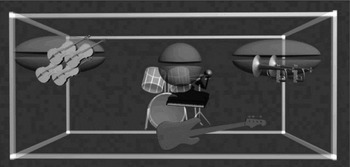
Engelbert Humperdinck's ‘There Goes My Everything’, from 1967, shows a clear demarcation between the backing group and the orchestral group. Figure 2 illustrates the separation of the two groups as heard in the chorus: the guitars, drums and bass are panned mid to hard-left, with the orchestral instruments (prominent violins and trombones) panned mid- to hard-right of the sound-box. The vocals and backing vocals remain the focal point in the centre of the stereo image, and the only sound sources to emanate from the central zone. There are other tracks that demonstrate this configuration of sound sources (drums and bass placed on the opposite side to the orchestral instruments), such as David McWilliams' ‘Days of Pearly Spencer’, which was also released in 1967, and Neil Diamond's ‘Cracklin’ Rosie', a later release from 1970, which features the bass and drums on opposite sides of the sound-box. The Bee Gees' ‘World’ is slightly different in terms of its sound-box configuration. The piano and synthesiser are located on the right side of the sound-box and detached from the rest of the group, while a dense left zone (occupied by the remainder of the sonic elements including drums, harp, guitar, strings and horns) creates a lopsided use of the sound-box. The vocals are centrally placed, with the bass slightly off-centre, and the guitar is alone in occupying the centre-right zone. The sonic placements create a rather unbalanced sound-box configuration.
Engelbert Humperdinck: ‘There Goes My Everything’.

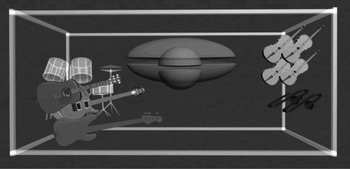
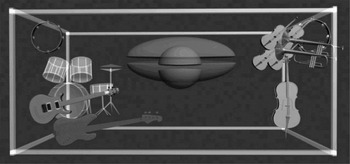
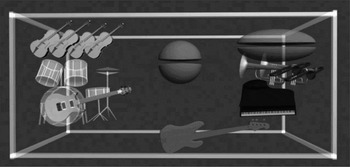
Figures 3 and 4 demonstrate a change in approach to the mixing of tracks from a single artist. The earlier track, ‘Congratulations’ by Cliff Richard, shows clear separation of the backing band from the orchestral group. The lead vocals are centralised, as are the backing vocals. Two years later, in 1970, the configuration of sounds within the sound-box is markedly different. The diagonal mix is in evidence, balanced by piano and handclaps, and guitar, to either side, while the backing vocals are spread across the upper zones of the sound-box. The brass is more prominent and brought forward in the mix. ‘Goodbye Sam, Hello Samantha’ illustrates the shift towards a less segregated treatment of the two backing groups, which by the early 1970s has become the normative layout.
Cliff Richard: ‘Congratulations’.

Cliff Richard: ‘Goodbye Sam, Hello Samantha’.

Another example of the spreading and balancing of instruments within the sound-box can be seen in the transcription of ‘Dick-a-dum-dum (King's Road)’. Figure 5 shows the centralisation of the main elements (bass, snare and vocals) and the spreading of the orchestral instruments across the upper zone with the backing vocals. Compared to previous examples, there are sparse zones within the sound-box, particularly in the lower zones of each side. The lack of mid-frequency sounds such as the guitar creates more space within the overall mix.Footnote 9 As the appropriation of the diagonal mix increases by the late 1960s, the placement of the kit and treatment of the orchestral sounds change. The orchestral element becomes part of the overall texture, blending with the rhythm section, and spreading to encompass the entire stereo field rather than being an isolated sound source in opposition.
Des O'Connor: ‘Dick-a-Dum-Dum (King's Road)’.

The previous examples have been from British-produced easy listening tracks which, although they demonstrate the move towards the normative mix, establish the norm slightly later than US-produced tracks. Taking examples from US-produced soul/funk records, Brenda Holloway's ‘You've Made Me So Very Happy’ shows the US approach to producing that moved far more quickly towards the normative mix than that of UK producers. Figure 6 shows the splitting of the orchestral instruments across the sound-box: strings on the left; flutes on the right. More important, however, is the shift of the bass guitar to the centre, to create a clear triangular mix configuration between the vocals, bass and snare. While UK tracks from this year still present an off-centred bass, US-produced tracks lead the way towards a normative mix.
Brenda Holloway: ‘You've Made Me So Very Happy’.

Although US producers generally had access to more advanced recording studios and more advanced technology, it was the prominent ‘fat’ sounding bass, an identifiable feature of soul and funk records, which intrigued many British producers and engineers. Engineer Geoff Emerick recalls that ‘we were listening to these records, like the ones from Tamla, and there was all that extra bass end’ (quoted in Droney Reference Droney2003, p. 181). While the limitations of bass level were in part restricted due to the way vinyl was cut, US-produced records succeeded in creating a significant bass sound, achieved by bringing the bass to the fore in the mix, having been recorded on its own track, rather than simultaneously with the kit. To match the level of bass heard on American records Emerick used ‘more aggressive dynamic processing and filtering’ (Kehew and Ryan Reference Kehew and Ryan2006, p. 415), and moved the bass to the centre. Technical details aside, many of the American soul/funk tracks feature a centralised bass, with the exception of certain tracks such as Aretha Franklin's ‘Think’, where the bass is up front in the mix and placed off-centre, balanced by backing vocals and rhythm guitar on the opposite side. Isaac Hayes' ‘Walk On By’, from 1969, exemplifies the arrival of the diagonal mix much earlier than contemporaneous British tracks (at the time, of course, this mix was not yet normative). The vocals, snare and bass are centralised, with the remaining sound sources placed to either side to create a wide stereo width and an overall balance of sounds. The result is a mix of greater clarity, and a fully utilised sound-box.
Development of the normative mix: psychedelia
The next tracks are taken from the psychedelic genre. ‘Psychedelic tracks were influential in establishing the notion that recordings and performances were separate entities’ (Borthwick and Moy Reference Borthwick and Moy2004, p. 42). In view of this assertion, it would seem fair to assume that tracks demonstrating psychedelic awareness would utilise the sound-box with the same avoidance of norms as seen in other musical elements, such as lyrics, harmony and performance practice. Interestingly, our analysis demonstrates quite the opposite. While an initial assumption was that the establishment of the normative mix would develop from psychedelic (presumably the most ‘forward-looking’) tracks, it seems that psychedelic tracks had little influence with regard to establishing the normative mix. Our results revealed that the general configuration of psychedelic tracks was in terms of centralised clusters. Indeed, the majority of the tracks in our sample between 1967 and 1969 that displayed central clusters were psychedelic tracks.
A large number of psychedelic tracks were originally mixed in mono, with many subsequent stereo re-mixes considered to exhibit ‘fake stereo’ (Anon Reference Anon2003). For example, Pink Floyd's ‘See Emily Play’, which subsequently appeared on the compilation album Relics, was reprocessed in order to give the impression of a wider-sounding stereo image. The stereo version of Tomorrow's ‘My White Bicycle’ is another example of a fake stereo mix, where the mono signal is shifted from one side of the sound-box to the other. This panning effect moves sound sources as an entity, rather than moving specific sound sources. This results in the mix using the sounds to reveal the lateral extremes of the sound-box, as opposed to expanding the overall width. This ‘switching of sides’ through the use of pan pots is an attempt to enhance the overall psychedelic style of the track. Although panning is a technique that may be used to show the overall perceived size of the sound-box, it is surprisingly not as prevalent in psychedelic tracks as we had initially assumed with, perhaps, the exception of tracks by Jimi Hendrix.
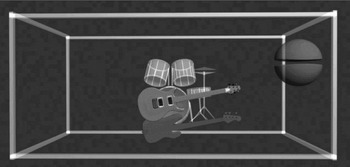
While the development of studio equipment enabled sound experimentation through the use of effects such as phasing, backwards tape and distortion, psychedelic coding in tracks seems to be limited to techniques such as flanging and phasing. The Small Faces' ‘Itchycoo Park’ demonstrates the use of phasing on the recurring drum roll/fill, while the overall image within the sound-box is static and centred. Examples of other psychedelic tracks that display a centralised clustered mix, utilising the central zone of the sound-box, with a narrow stereo width include Julie Driscoll, Brian Auger and the Trinity's ‘This Wheel's on Fire’, The Creation's ‘Nightmares’ and Strawberry Alarm Clock's ‘Incense and Peppermints’. Psychedelic tracks by Jimi Hendrix do, however, afford an interesting deviation from the stylistic norms of his contemporaries, and we might argue that his sound-box usage seems congruent to the coding of other musical domains. If, according to Sheila Whiteley, Hendrix's treatment of pitches and use of glissandi and distortion suggest flight and space travel (Whiteley Reference Whiteley1990, p. 52), then the exploration of space within the sound-box further emphasises this aspect of his music, and expands the dimensions of the overall experience. The placement of the backing band in ‘Purple Haze’ is representative of the centralised cluster prevalent with psychedelic tracks, but it is the isolated vocals of Hendrix, panned to the extreme right of the sound-box and forming a triangular mix configuration, that indicate a deviation from genre norms.
As can be seen in Figure 7, the detached vocal becomes a focal point, and its volume level creates the sensation of Hendrix singing at close proximity, invading the listener's space from the side and exemplifying Jay Hodgson's point that the mix ‘models a metaphor for proximity and encroachment’ (Hodgson Reference Hodgson2007, p. 16). Similarly, the manipulation of sound sources to create dynamic mixes, such as the guitar and vocal movement in ‘Voodoo Chile (Slight Return)’ reflect the psychedelic state and epitomise Whiteley's notion of flight and ‘hallucinogenic space exploration’ (Whiteley Reference Whiteley1992, p. 25). Other dynamic tracks by Hendrix that provide a sense of the overall perceived width of the sound-box through the movement of the guitar include ‘Spanish Castle Magic’ and ‘Crosstown Traffic’.
Jimi Hendrix Experience: ‘Purple Haze’.

The observation that Hendrix's psychedelically coded songs are atypical of psychedelic mixes raises interesting points. One point to note is the surprisingly small number of psychedelic tracks that demonstrate the technological developments available at the time, and the capabilities to sonically enhance the overall psychedelic experience of the listener. Another point is the extent to which the collaborative role of the producer and artist influences the creative process through the exploration of various engineering techniques. Hendrix's collaborative role as producer and performer allowed him to use the studio as an experimental tool, which resulted in varied and interesting uses of the stereo sound-box and marked his departure from the typical clustered mixes that are prevalent for psychedelic tracks. As Chanan notes, ‘authorship became diffused, and uncertainty in the relations of production led to power struggles for aesthetic control of the finished product’ (Chanan Reference Chanan1995, p. 145). It seems that, despite this growing trend toward collaboration in the studio, a musician like Jimi Hendrix acted as arbiter of the final product, using his role as producer and musician to realise creative ideas.
Bands that incorporated psychedelic coding in their tracks, such as the Grateful Dead, The Beatles and Kinks, and who continued to release albums and singles beyond the demise of psychedelia as a movement, had adopted the diagonal mix by 1970. The centred clustered mix had rapidly diminished in prominence, and the full stereo width was being utilised. The Kinks' track ‘Lola’ exemplifies this move towards the normative mix and reflects the attempt to create a balanced stereo picture, as in Figure 8. The key elements (vocals, snare and bass) are placed in the central zone of the sound-box, with other sonic events placed either side. The lead guitar can be heard slightly out in front in the centre of the sound-box.Footnote 10
The Kinks: ‘Lola’.

Dealing with anomalies
There is a small sub-section of our entire sample of transcribed tracks that omit one or more of the key elements: bass, drums and lead vocals. In a few of the examples, the transcriptions show an absent lead vocal. ‘What Now My Love’ and ‘Casino Royale’ by Herb Alpert are good cases in point. It is fair to assume that Alpert's solo cornet in both tracks functions as a vocal substitute and carries the main melodic line. We note that it is placed within the sound-box (centrally) where the vocals would expect to be positioned, and that when Alpert performs as a singer on other tracks, he is positioned in the centre of the sound-box. Tracks of this kind can simply be analysed along the lines we have already discussed. Indeed, the treatment of this solo cornet as a vocal replacement is a point reinforced in Moore (Reference Moore2005), in a discussion of the relationship between lyrics/melody and accompaniment in song. If ‘a vocal line gets taken over by part of the accompaniment’, effectively passing over the role, then there is no reason to suggest that the interchangeability of sound sources associated with the lead melody cannot occur during a track. That example of ‘Goodbye to Love’ by the Carpenters, demonstrates the effective interchangeability of melody from lead vocals to lead guitar. In both instances, each sound source assumes the role of the ‘persona’, highlighting its position as distinct from the accompaniment through its central placement in the sound-box (Moore Reference Moore2005, p. 25). This observation of the interchangeability of sound sources is useful, particularly when dealing with anomalous tracks where the vocals are absent, and in the attempt to categorise various sound-box configurations whereby other sound sources can be considered as a replacement for the lead vocals.
We can further clarify this point through comparison of Roger Williams' and Matt Monro's versions of ‘Born Free’. In both of these 1966 versions, the positioning of the sounds within the sound-box reflects the main melodic interest or ‘persona’. The vocals in Matt Monro's ‘Born Free’, shown in Figure 9, sonically situate the persona, whereas in Roger Williams's version, the persona is clearly represented by his piano. Figure 10 shows the instrumental configuration from 0′17″ to 0′50″, during which the piano spans the central zone of the sound-box. Note, however, that the main melody is played in the upper register of the piano and therefore it appears, sonically, slightly off-centre, with the lower notes appearing in the centre-left zone. Lead keyboards are often mixed in this way, across the stereo spread, such that when this does not occur (on Argent's ‘Celebration’, for instance), the effect can be somewhat claustrophobic. In each instance here, the ‘persona’, the main carrier of the melody, is placed slightly off-centre towards the right side of the sound-box. While there is no lead vocal as such in Williams' version, but rather a backing chorus that sings the main chorus section towards the latter half of the track, the piano can be regarded as the vocal's replacement, acting as persona and for the purpose of this study, regarded as one of the key elements in the configuration that determines the sound-box mix-type. Although these examples of anomalies highlight mixes that deviate from the norm, they do in fact support, rather than contradict, the overall development and move towards the central placement of the key elements, identified as the normative mix. The separation of the orchestral and backing groups to either side of the sound-box, evident in both versions of ‘Born Free’, is common for 1966; however, both transcriptions show the move towards the central placement of the vocals, or rather, the persona.
Matt Monro: ‘Born Free’.

Roger Williams: ‘Born Free’.

In a few other cases, where a kit is missing, for example, it can be inferred (from the percussive attack on a strummed guitar, or in its replacement simply by a tambourine, perhaps). Where a bass is missing, its absent position can likewise be inferred from the bass register of a piano. Where possible, we have made these inferences (this covers some 5 per cent of our sample). Where it has not been possible to make such an inference, we have noted these simply as anomalies in Table 1. This is not to suggest that there is something strange, or wrong, in these particular mixes, but simply that they do not play any significant part in the story we have endeavoured to tell here. Their story is more properly part of the move towards a hegemonic position for rock and pop styles by the early 1970s, a story parallel to, but distinct from, that which we address here.
Conclusion
The challenge to empirically mark the development and establishment of the normative mix goes some long way toward providing an insight into the changing use of stereo space and the variety of sonic placement within the sound-box. We have outlined a number of distinct configurations, observed their changing usage across this closely delimited period, and laid the basis for further work both on the relationship between particular mix patterns and specific genres (an issue addressed in Gibson, Reference Gibson2005), and also on the potential significance of such variety. This latter question is one we have addressed in a subsequent AHRC-funded project.Footnote 11 However, to our chagrin, we have within the confines of this project been unable to address the key question of whether these configurations were consciously chosen, or whether they were contingently arrived at (or any combination of the two). Some few of the individuals involved are still working, and some few more are still alive. We earnestly hope that these results are of sufficient interest for someone else swiftly to take up the challenge of discovering the degree of intentionality which lies behind the adoption of the diagonal mix.