Introduction
Food addition (FA) remains a controversial topic throughout the literature, and it has gained increasing acceptance over the past decade. As discussed by Gearhardt, Corbin, and Brownell (Reference Gearhardt, Corbin and Brownell2009a), FA in humans is conceptualised as a form of pathological and compulsive eating, which extends beyond normal psychophysiological drives for food. The consumption of hyperpalatable, energy-dense foods with addictive properties is hypothesised to over-stimulate key reward regions of the brain in an analogous, albeit less intensive, manner to that observed with common drugs of abuse (Gearhardt et al., Reference Gearhardt, Corbin and Brownell2009a). Given that humans evolved preference for foods high in calories, sugar, fat, and salt, such modern processed/refined foods are suggested to be hyperpalatable owing to their high concentrations of such substances relative to traditional unprocessed/unrefined ‘natural’ foods (Gearhardt, Davis, Kuschner, & Brownell, Reference Gearhardt, Davis, Kuschner and D Brownell2011). Animal studies offer evidence to support the addictive potential of hyperpalatable sugar-laden foods within various feeding paradigms, including binge eating (Avena, Bocarsly, Rada, Kim, & Hoebel, Reference Avena, Bocarsly, Rada, Kim and Hoebel2008), withdrawal (Le Magnen, Reference Le Magnen, Capaldi and Powley1990), and a type of ‘addiction transfer’ in which prior exposure to addictive substances can foster consumption of other addictive substances (Avena, Carrillo, Needham, Leibowitz, & Hoebel, Reference Avena, Carrillo, Needham, Leibowitz and Hoebel2004). Such animal feeding paradigms typically allow for precise dietary control and detailed investigation of molecular mechanisms, though they fail to capture the complexities of the human experience (Parylak, Koob, & Zorrilla, Reference Parylak, Koob and Zorrilla2011). Despite this, a recent FA review by Gordon, Ariel-Donges, Bauman, and Merlo (Reference Gordon, Ariel-Donges, Bauman and Merlo2018) offers support for the validity of FA in both humans and animals across a range of well-known addiction characteristics, including brain reward changes, impaired control, substance sensitisation, and impulsivity. The review also demonstrates that foods high in fat and refined carbohydrate such as sugars are most commonly associated with addictive symptoms observed throughout FA studies (Gordon et al., Reference Gordon, Ariel-Donges, Bauman and Merlo2018). This sweet/fat focus is consistent with that taken in the Yale Food Addiction Scale (YFAS), which is the first self-report measure for assessing FA in humans (Gearhardt, Corbin, & Brownell, Reference Gearhardt, Corbin and Brownell2009b). The YFAS is based on analogues to criteria for drug dependence in the DSM- IV (Gearhardt et al., Reference Gearhardt, Corbin and Brownell2009b). To meet YFAS criteria for FA, an individual's eating behaviour must be associated with a minimum of three symptoms of FA (e.g., tolerance/withdrawal) of a possible maximum of seven, as well as self-reported, clinically significant distress or significant impairment in functioning (e.g., in health or work). We refer to scoring FA with the YFAS by this method as standard scoring. Although the concept of FA is not yet universally accepted, self-reported symptoms of tolerance and withdrawal have been observed in self-identified ‘food addicts’ (Ifland et al., Reference Ifland, Preuss, Marcus, Rourke, Taylor, Burau, Jacobs, Kadish and Manso2009), and support for the validity of YFAS-diagnosed FA in humans has been established by means of functional brain imaging differences (Gearhardt, Yokum, et al., Reference Gearhardt, Yokum, Orr, Stice, Corbin and Brownell2011) and elevated dopamine signalling (Davis et al., Reference Davis, Loxton, Levitan, Kaplan, Carter and Kennedy2013). Compared to age- and weight-matched controls, individuals with obesity and YFAS-diagnosed FA had significantly higher rates of eating disturbances and psychological difficulties, including depression, attention deficit hyperactivity disorder, impulsivity, increased susceptibility to stress and emotional reactivity (Davis et al., Reference Davis, Curtis, Levitan, Carter, Kaplan and Kennedy2011).
Rates of FA prevalence assessed using the YFAS have been reported at 7.8% in an online sample of normal weight/non-clinical subjects (Meule & Kübler, Reference Meule and Kübler2012), 11.4% in a student sample (Gearhardt et al., Reference Gearhardt, Corbin and Brownell2009b), 25% in a sample of individuals with obesity (Davis et al., Reference Davis, Curtis, Levitan, Carter, Kaplan and Kennedy2011), and 57% in subjects with concomitant obesity and binge eating disorder (BED) (Gearhardt et al., Reference Gearhardt, White, Masheb, Morgan, Crosby and Grilo2012). Recent research with sufferers of BED and bulimia nervosa (BN) has revealed rates as high as 87% (Romero et al., Reference Romero, Agüera, Granero, Sánchez, Riesco, Jiménez- Murcia, Gisbert-Rodriguez, Sánchez‐González, Casalé, Baenas, Valenciano‐Mendoza, JM, AN, Dieguez and Fernández‐Aranda2019). High prevalence rates have also been confirmed for women with anorexia nervosa (AN) binge-eating/purging type (87.9%), BED (93.3%), and BN (97.6%) (Fauconnier et al., Reference Fauconnier, Rousselet, Brunault, Thiabaud, Lambert, Rocher, Challet-Bouju and Grall-Bronnec2020). Meule (Reference Meule2012), based on a sample of 1499 participants, reported FA rates between 7.4 and 14.6% in underweight to Obese I (BMI of 30–34.9 kg/m2) categories and rates of 40.7–43.5% in obesity II (BMI of 35–39.9 kg/m2) and obesity III (BMI ≥ 40 kg/m2) categories. More recently, the conclusion of a systematic review and meta-analysis of studies of FA were consistent with those of both Davis et al. (Reference Davis, Curtis, Levitan, Carter, Kaplan and Kennedy2011) and Meule (Reference Meule2012), demonstrating higher rates of FA for those who are overweight/obese, particularly for those with psychopathology (de Sousa Fernandes et al., Reference de Sousa Fernandes, Santos, dos Santos, de Oliveira, da Costa Ribeiro, e Silva, Cabral de Mello, da Silva, Martins, Rodrigues, Calazans, Barbosa and Nobre2020). Taken together, higher rates of obesity and mood disturbance (Davis et al., Reference Davis, Curtis, Levitan, Carter, Kaplan and Kennedy2011) and disordered eating (Davis et al., Reference Davis, Curtis, Levitan, Carter, Kaplan and Kennedy2011; Fauconnier et al., Reference Fauconnier, Rousselet, Brunault, Thiabaud, Lambert, Rocher, Challet-Bouju and Grall-Bronnec2020; Romero et al., Reference Romero, Agüera, Granero, Sánchez, Riesco, Jiménez- Murcia, Gisbert-Rodriguez, Sánchez‐González, Casalé, Baenas, Valenciano‐Mendoza, JM, AN, Dieguez and Fernández‐Aranda2019) are associated with higher rates of FA. Such characteristics also prominently feature within populations of subjects who seek bariatric surgery (Duarte-Guerra, Coêlho, Santo, Lotufo-Neto, & Wang, Reference Duarte-Guerra, Coêlho, Santo, Lotufo-Neto and Wang2017; Malik, Mitchell, Engel, Crosby, & Wonderlich, Reference Malik, Mitchell, Engel, Crosby and Wonderlich2014).
Bariatric surgery is the most durable and effective intervention for achieving sustained weight loss and resolution of obesity-related comorbidities (Corcelles, Daigle, & Schauer, Reference Corcelles, Daigle and Schauer2016; Musella et al., Reference Musella, Apers, Rheinwalt, Ribeiro, Manno, Greco, Stefano, Guler, IM, Guerra, MN, Bonfanti, Novotna, Coretti and Piazza2016). According to the guidelines of the American Society for Metabolic and Bariatric Surgery (ASMBS), bariatric surgery is indicated for those individuals with BMI ≥ 40 kg/m2, BMI ≥ 35 kg/m2 and at least one obesity-related comorbidity, or BMI of 30–34.9 kg/m2 with diabetes or metabolic syndrome (Mechanick et al., Reference Mechanick, Youdim, Jones, Garvey, Hurley, McMahon, Heinberg, Kushner, Adams, Shikora, Dixon and Brethauer2013). Surgery has been increasingly pursued by the public, with worldwide estimates for the number of international procedures performed in 2016 at 634,897 (Welbourn et al., Reference Welbourn, Hollyman, Kinsman, Dixon, Liem, Ottosson, Ramos, Våge, Al-Sabah, Brown, Cohen, Walton and Himpens2019). Approximately 90% of all bariatric weight loss procedures are performed laparoscopically (Buchwald & Oien, Reference Buchwald and Oien2009). The laparoscopy or keyhole procedure is an alternative to open surgery which utilises a small incision (0.5–1 cm) near the navel to insert a thin tube with camera and light (a laparoscope), allowing visualisation of the pelvic and abdominal organs (Ahmad, Baker, Finnerty, Phillips, & Watson, Reference Ahmad, Baker, Finnerty, Phillips and Watson2019). Relatively small surgical tools are inserted through several small incisions, and the abdomen is gently inflated with gas to increase the workspace for tools and cameras (Ahmad et al., Reference Ahmad, Baker, Finnerty, Phillips and Watson2019). The development of laparoscopic techniques as an alternative to open surgery has simplified surgical practices, decreased post-surgical pain, reduced patient morbidity, hastened recovery, and increased patient consent to undergo surgical procedures (Georgiadou et al., Reference Georgiadou, Sergentanis, Nixon, Diamantis, Tsigris and Psaltopoulou2014; Nguyen et al., Reference Nguyen, Goldman, Rosenquist, Arango, Cole, Lee and Wolfe2001; Nguyen & Varela, Reference Nguyen and Varela2017). Although there are many types of different bariatric weight loss surgeries, those utilised by the current research include sleeve gastrectomy (SG), Roux-en-Y gastric bypass (RYGB), and biliopancreatic diversion/duodenal switch (BPD/DS), which are briefly outlined below.
SG is considered a ‘restrictive’ surgery as it limits the amount of food entering the stomach by approximately 80%, due to the stomach being resected longitudinally along the fundus, corpus, and antrum resulting in a remaining capacity typically greater than 100 ml (Benaiges et al., Reference Benaiges, Más-Lorenzo, Goday, Ramon, Chillarón, Pedro-Botet and Flores-Le Roux2015; Wolfe, Kvach, & Eckel, Reference Wolfe, Kvach and Eckel2016). This preserves a tubular section along the lesser curvature that does not require a gastrointestinal to small intestine anastomosis (i.e., surgical connection between two structures) (Benaiges et al., Reference Benaiges, Más-Lorenzo, Goday, Ramon, Chillarón, Pedro-Botet and Flores-Le Roux2015; Mulla, Middelbeek, & Patti, Reference Mulla, Middelbeek and Patti2018; Wolfe et al., Reference Wolfe, Kvach and Eckel2016).
RYGB is classified as both restrictive and ‘malabsorptive’ because it permanently reduces stomach size and shortens bowel length to decrease absorption (DeMaria, Reference DeMaria2007; Ochner, Gibson, Carnell, Dambkowski, & Geliebter, Reference Ochner, Gibson, Carnell, Dambkowski and Geliebter2010). In RYGB, the upper stomach is divided to create a small gastric pouch of approximately 20–30 ml (Dunn et al., Reference Dunn, Cowan, Volkow, Feurer, Li, Williams, Kessler and Abumrad2010; Pucci & Batterham, Reference Pucci and Batterham2019). The small intestine is then divided, with the distal end connected to the gastric pouch via anastomosis (Dunn et al., Reference Dunn, Cowan, Volkow, Feurer, Li, Williams, Kessler and Abumrad2010). The proximal end (with the remainder of the stomach and the duodenum, the hepatobiliary tree, pancreas, liver, and gall bladder attached) is then reattached distally via another anastomosis, thereby creating a Roux or alimentary limb of approximately 100−150 cm (based on the patients’ BMI, surgeon preference, and required weight loss) (Dunn et al., Reference Dunn, Cowan, Volkow, Feurer, Li, Williams, Kessler and Abumrad2010; Khwaja & Bonanomi, Reference Khwaja and Bonanomi2010; Pucci & Batterham, Reference Pucci and Batterham2019). The absence of gastric reservoir function or sphincter control allows for rapid transfer of ingested nutrients to the small intestine (Al-Najim, Docherty, & le Roux, Reference Al-Najim, Docherty and le Roux2018). Although nutrients bypass the majority of the stomach, duodenum, and proximal jejunum, the anastomosis of the biliopancreatic limb allows for drainage of bile acids and pancreatic secretions which combine with nutrients further down in the jejunum (Pucci & Batterham, Reference Pucci and Batterham2019).
BPD/DS is a combination of a restrictive SG as well as a malabsorptive BPD component in which a Roux-en-Y gastroenterostomy connects the gastric pouch to a distal bowel loop (Scopinaro, Gianetta, Civalleri, Bonalumi, & Bachi, Reference Scopinaro, Gianetta, Civalleri, Bonalumi and Bachi1979). In BPD/DS, the common channel typically approximates 100 cm, whereas the alimentary channel averages 250 cm (Biertho et al., Reference Biertho, Simon-Hould, Marceau, Lebel, Lescelleur and Biron2016). Despite its effectiveness, BPD/DS is regarded as one of the highest risks and most complicated bariatric weight loss surgeries still used today (Anderson, Gill, de Gara, Karmali, & Gagner, Reference Anderson, Gill, de Gara, Karmali and Gagner2013).
In addition to increased body weight, an emerging set of features also characterises individuals who present for bariatric surgery. Bariatric patients exhibit significantly diminished physical and mental quality of life (QOL) compared to population norms at initial evaluation (Martinelli et al., Reference Martinelli, Cappa, Zugnoni, Cappello, Masi, Klersy, Pellegrino, Muggia, Cavallotto, Politi, Bruno, Mineo, Peri, Lobascio, Chiappedi, Dakanalis, Pietrabissa and Caccialanza2021). Compared to psychotherapy inpatients, they have relatively lower physical QOL and equally high rates of depression (Osterhues, von Lengerke, Mall, de Zwaan, & Müller, Reference Osterhues, von Lengerke, Mall, de Zwaan and Müller2017). Psychiatric disorders were observed in a majority of pre-surgery patients assessed by Structured Clinical Interview for DSM-IV (Diagnostic and Statistical Manual of Mental Disorders, Fourth Edition) (SCID-I); the most common conditions being anxiety (46.3%), mood (21.6%), and eating disorders (20.1%), with current and lifetime estimates for BED of 16.5 and 29.8%, respectively (Duarte-Guerra et al., Reference Duarte-Guerra, Coêlho, Santo, Lotufo-Neto and Wang2017). These results are consistent with an earlier review by Malik et al. (Reference Malik, Mitchell, Engel, Crosby and Wonderlich2014) who found higher rates of psychopathology in bariatric (surgery) candidates, relative to non-treatment-seeking individuals with obesity. Collectively, these findings suggest that on average, prior to surgery, bariatric candidates with obesity exhibit certain commonalities including significant mental distress, disordered eating, and impairment in physical and mental functioning. Given that these characteristics have been established as prominent for those with YFAS-diagnosed FA, the observed variability of FA prevalence rates across studies of candidates for bariatric surgery is intriguing.
The reported prevalence of YFAS-assessed FA amongst cross-cultural bariatric surgery samples ranges from 13.7 to 57.8% across Caucasian, African-American, Canadian, French, German, Chilean, Hispanic, Italian, and Turkish samples (Ames et al., Reference Ames, Heckman, Diehl, Shepherd, Holgerson, Grothe, Kellogg, Bowers and Clark2017; Bianciardi et al., Reference Bianciardi, Fabbricatore, Di Lorenzo, Innamorati, Tomassini, Gentileschi, Niolu, Siracusano and Imperatori2019; Brunault et al., Reference Brunault, Ducluzeau, Bourbao-Tournois, Delbachian, Couet, Réveillère and Ballon2016; Clark & Saules, Reference Clark and Saules2013; Eichen, Lent, Goldbacher, & Foster, Reference Eichen, Lent, Goldbacher and Foster2013; Fuentes, Gabler, Silva, Olguin, & Rodriguez, Reference Fuentes, Gabler, Silva, Olguin and Rodriguez2017; Gabler, Fuentes, Rodríguez, Barbosa, & Zarazua, Reference Gabler, Fuentes, Rodríguez, Barbosa and Zarazua2015; Koball et al., Reference Koball, Clark, Collazo-Clavell, Kellogg, Ames, Ebbert and Grothe2016; Lawson et al., Reference Lawson, Goldman, Swencionis, Wien, Persaud and Parikh2019; Meule, Heckel, & Kübler, Reference Meule, Heckel and Kübler2012; Miller-Matero et al., Reference Miller-Matero, Armstrong, McCulloch, Hyde-Nolan, Eshelman and Genaw2014; Ouellette et al., Reference Ouellette, Rodrigue, Lemieux, Tchernof, Biertho and Bégin2017; Pepino, Stein, Eagon, & Klein, Reference Pepino, Stein, Eagon and Klein2014; Sevinçer, Konuk, Bozkurt, & Coşkun, Reference Sevinçer, Konuk, Bozkurt and Coşkun2016). After a review of the literature, the reason for the variability remains unclear. The precise breakdown of cross-cultural samples is beyond the scope of the current research, though one plausible explanation for variability may be due to a discrepancy between YFAS symptom endorsement and the self-reported D/I criterion (Ouellette et al., Reference Ouellette, Rodrigue, Lemieux, Tchernof, Biertho and Bégin2018). For example, in a bariatric sample, Miller-Matero et al. (Reference Miller-Matero, Armstrong, McCulloch, Hyde-Nolan, Eshelman and Genaw2014) observed a 16.9% YFAS-diagnosed FA prevalence rate using standard scoring, whereas it was 43% when the D/I criterion was omitted.
Although the YFAS has been based on DSM-IV criteria for addiction to assess clinically significant D/I (Gearhardt et al., Reference Gearhardt, Corbin and Brownell2009b), reliance on self-identification of FA symptoms and impairment has been suggested to be a possible limitation of the YFAS (Brownell & Gold, Reference Brownell and Gold2012). Indeed, other self-report instruments commonly used in the assessment of eating disorders, such as the Binge Eating Scale (BES), do not require the endorsement of a D/I criterion (Gormally, Black, Daston, & Rardin, Reference Gormally, Black, Daston and Rardin1982). Consequently, it has been suggested that individuals who might otherwise meet the criteria for food addiction (FA) may fail to be identified as food-addicted, due to their lack of awareness of significant distress or impaired functioning as a consequence of their eating behaviour (Ouellette et al., Reference Ouellette, Rodrigue, Lemieux, Tchernof, Biertho and Bégin2018). Despite these concerns, alternative perspectives have been gleaned from meta-analytic research on FA prevalence by Pursey, Stanwell, Gearhardt, Collins, and Burrows (Reference Pursey, Stanwell, Gearhardt, Collins and Burrows2014) who questioned the potential for inflated symptom endorsement in clinical, relative to non-clinical, settings. The researchers suggested that within clinical settings, omitting the D/I criterion could provide relatively more valuable information regarding FA (Pursey et al., Reference Pursey, Stanwell, Gearhardt, Collins and Burrows2014). Accordingly, they recommended a comprehensive investigation of differences between those with high symptom scores, including and excluding the D/I criterion, to determine the most meaningful scoring method for FA. To date, we are aware of only one study that sought to investigate this directly.
Research by Ouellette et al. (Reference Ouellette, Rodrigue, Lemieux, Tchernof, Biertho and Bégin2018) investigated FA prevalence rates and profile differences in a pre-surgical bariatric sample between those classified as food addicted, using standard YFAS scoring, compared to those classified as food addicted when the D/I criterion was removed. They observed a prevalence rate of 16% for FA + D/I and 35% for FA − D/I. Participants completed self-report measures known to be markers of psychological distress related to eating, psychopathology, and QOL. FA profiles were similar with respect to FA symptoms and eating behaviour, with the exception of significantly more symptoms of FA, greater hedonic hunger, and withdrawal symptoms in the FA + D/I group. An unexpected finding was that despite the FA + D/I group endorsing distress or impairment on the YFAS, the method failed to significantly differentiate expected markers of distress and impairment (depressive symptoms and QOL) when compared to FA − D/I. The researchers concluded it was unclear why the presence of the YFAS D/I did not result in profiles with more severe psychopathology and eating behaviour and called for further consideration of the YFAS D/I criterion in clinical and research settings. Despite the progress represented by this study, a key question is how either scoring method would differentiate those with or without FA in clinical settings.
The current research investigated YFAS-scored FA prevalence and profile differences in pre-bariatric surgery samples across the USA and Australia. As alluded to, a key difference from research by Ouellette et al. (Reference Ouellette, Rodrigue, Lemieux, Tchernof, Biertho and Bégin2018) was our comparison of profiles for those with FA using each scoring method, against profiles for those ‘without’ FA who did not meet a minimum of at least three YFAS symptoms (non-FA ≤ 2). In this way, our design aims to evaluate both YFAS diagnostic scoring methods, as they would be used in practice (i.e., to differentiate those with and without FA). Profile differences were based on an extensive number of D/I measures related to eating, psychopathology, and QOL, also including quantitative dietary assessment to further identify and profile foods commonly associated with FA (Pursey et al., Reference Pursey, Stanwell, Gearhardt, Collins and Burrows2014). The array of measures chosen in the current research, though by no means exhaustive, are commonly employed throughout the FA literature, with several being pivotal to prior research concerning the validity and distinguishability of the FA construct (e.g., Davis et al., Reference Davis, Curtis, Levitan, Carter, Kaplan and Kennedy2011). We expected to find significantly higher prevalence rates using alternate FA − D/I rather than standard FA + D/I YFAS scoring. We further hypothesised that compared to non-food-addicted individuals (non-FA ≤ 2 in our study), either YFAS-scoring method would significantly differentiate individuals on a range of addictive traits, maladaptive eating behaviour, and ‘hyperpalatable/refined’ food consumption, though only the standard YFAS will differentiate expected markers of distress (i.e., anxiety, depression, and QOL).
Materials and Method
Participants and Procedure
The present study is a pre-surgery only, between-subjects assessment of FA and related variables which is part of a larger prospective repeated measures study into FA and bariatric surgery outcomes over time. For the current study, data were collected between January 2015 and March 2017. Participants voluntarily completed a pre-surgery self-report battery, and body weights were recorded in clinics at two locations, a major metropolitan hospital (Australian sample) and a weight management centre (USA sample) during pre-operative psychological screening appointments. Patients at the Australian site were limited to undergoing gastric sleeve surgeries, whereas those in the USA underwent either gastric sleeve, RYGB, or duodenal switch surgeries. Table 1 displays participant demographics.
Participant Demographics

Study inclusion criteria were age 18+ and BMI > 30 with related metabolic comorbidities (e.g., Type 2 diabetes, sleep apnoea, hypertension, and hyperlipidaemia). Exclusion criteria were BMI < 30, addiction to alcohol, tobacco or illicit drugs, recent suicide attempts, recent cancer diagnosis, pregnancy, and clinically significant medical or psychiatric conditions that would be considered an unacceptable risk to surgery or would jeopardise pre- or post-surgical care or weight loss. Psychologists conducted pre-surgery interviews with all patients to advise multidisciplinary teams regarding each individual's anticipated psychological suitability for surgery, to be performed at a later time. An individual's suitability was considered by the team who also weighed factors such as medical necessity. Consequently, the presence of eating disorders and/or psychopathology were not firm exclusion criteria. Overarching ethical clearance for the project was obtained through the appropriate Human Research Ethics Committees (HREC) for the Australian site, as well as the appropriate Institutional Review Board for the USA site. The authors assert that all procedures contributing to this work comply with the ethical standards of the relevant national and institutional committees on human experimentation and with the Helsinki Declaration of 1975, as revised in 2008. Informed consent information was either read by participants or read aloud to them. It was explained that all personal information would remain confidential and would only be used for the purposes of the research. Participants then voluntarily completed the written self-report battery comprised of the measures described below. Completion took approximately 40 min.
Measures
Addictive Personality Traits: The Addiction Scale of the Eysenck Personality Questionnaire – Revised (EPQR-A) (Eysenck & Eysenck, Reference Eysenck and Eysenck1975)
The EPQR-A contains 32 yes/no items and was constructed to measure trait-based susceptibility to addiction by identifying items of the EPQR-A which differentiated individuals with drug addictions from those controls without at the .001 level of significance (Gossop & Eysenck, Reference Gossop and Eysenck1980). The scale has demonstrated both acceptable internal consistency and test–retest reliabilities (Eysenck, Reference Eysenck1991). Additionally, Davis et al. (Reference Davis, Curtis, Levitan, Carter, Kaplan and Kennedy2011) have demonstrated that the scale is suitable for use with individuals with obesity and FA, as it is both internally consistent (α = .74) and capable of differentiating those with higher FA scores from those without FA. A 1-month test–retest of the scale using a sample of 109 males and 120 females was .75 and .8, respectively (Eysenck & Eysenck, Reference Eysenck and Eysenck1975). Examples of respective regular scored and reversed scored items are: ‘Does your mood often go up and down?’ and ‘Do you enjoy meeting new people?’. Each endorsed dichotomous item in the direction of addiction is scored one point, and those not in the direction of addiction are scored zero points. Total addiction scores of between 0 and 32 are possible.
FA: The YFAS
The YFAS is a 25-item measure of addictive eating behaviours regarding consumption of certain foods (e.g., sweets, starches, salty snacks, fatty foods, and sugary drinks) over the past 12 months (Gearhardt et al., Reference Gearhardt, Corbin and Brownell2009b). It is based on DSM-IV criteria for substance dependence and has both a symptom count, indicating the number of dependence symptoms reported, and a diagnostic threshold, which is met when three or more symptoms and clinically significant distress or impairment are present in the last year. Scores (i.e., symptom counts) range from zero to seven. The measure has adequate internal reliability, convergent validity, discriminant validity, and incremental validity and has been shown to be predictive of binge eating behaviour above and beyond existing measures (Gearhardt et al., Reference Gearhardt, Corbin and Brownell2009b). Internal consistency of the YFAS has been shown to be marginal to good at α = .63–.84, whereas test–retest for FA diagnosis was demonstrated to be substantial, κ = .73 (Lemeshow, Gearhardt, Genkinger, & Corbin, Reference Lemeshow, Gearhardt, Genkinger and Corbin2016).
Binge Eating: The BES
The BES is a 16-item measure comprised of four-point scales that index both binge behaviours (e.g., eating large amounts of food) and feelings/cognitions related to binge episodes (e.g., guilt and fear of uncontrolled overeating via scores ranging from 0 to 46 (Gormally et al., Reference Gormally, Black, Daston and Rardin1982). No established cut-off scores were provided by Gormally et al. (Reference Gormally, Black, Daston and Rardin1982) to define binge eating severity; however, later research by Marcus, Wing, and Hopkins (Reference Marcus, Wing and Hopkins1988) categorised scores of 17 or below indicating little or no problem, 18–26 moderate problem, and 27 or greater serious problem. The BES has good test–retest reliability (r = .87) and moderate associations with binge eating severity as indexed by food records (Timmerman, Reference Timmerman1999). The measure was shown to be internally consistent at α = .84 (Burmeister, Hinman, Koball, Hoffmann, & Carels, Reference Burmeister, Hinman, Koball, Hoffmann and Carels2013). Research by Celio, Wilfley, Crow, Mitchell, and Walsh (Reference Celio, Wilfley, Crow, Mitchell and Walsh2004) demonstrates that the BES can perform satisfactorily as an initial screening test for the diagnosis of BED compared to other scales for maladaptive eating.
Food Consumption (Type): Healthy/Unhealthy Food Consumption – Food Frequency Questionnaire
Food Frequency Questionnaire (FFQ) is a commonly used instrument with multiple variations. A standard FFQ was adapted from Ernst, Thurnheer, Wilms, and Schultes (Reference Ernst, Thurnheer, Wilms and Schultes2009) to include a total of 39 ‘healthy’ and ‘unhealthy’ foods and beverages. It is important to note that the terms ‘healthy’ and ‘unhealthy’ are applied in a general sense, and it is recognised that this is a highly complex and debated topic which is also dependent on individual and/or other factors such as specific dietary requirements, medical issues, intolerances, and/or dietary guidelines. Our categorisations are based on consensus among governmental and intergovernmental organisations established to evaluate nutritional guidelines, such as the World Health Organization, https://www.who.int/news-room/fact-sheets/detail/healthy-diet. For example, foods we would consider healthy or unhealthy under most circumstances include cooked vegetables, fresh fruits, and water in the former category and candy, fried potatoes, and sweetened breakfast cereals in the latter. The frequency of food intake is assessed for each food category using a six-point scale: 1 = never, 2 = once per month or less, 3 = several times per month, 4 = once per week, 5 = several times per week, and 6 = almost every day. Although empirical validation of the original 24-item FFQ was not a focus of Ernst et al. (Reference Ernst, Thurnheer, Wilms and Schultes2009), the measure was utilised for bariatric surgery patients. Reliability coefficients were not available.
Dutch Eating Behaviour Questionnaire
The Dutch Eating Behaviour Questionnaire (DEBQ) is a 33-item measure of eating behaviours which assessed restrained eating, external eating, and emotional eating by means of three subscales (Van Strien, Frijters, Bergers, & Defares, Reference Van Strien, Frijters, Bergers and Defares1986). Items are rated on a five-point Likert scale ranging from: never (1) to very often (5). Each of the DEBQ scales has been shown to be internally consistent for individuals with obesity, those of normal weight, and combined samples of individuals of normal weight and with obesity (α = .79–.85). Individuals with obesity and FA have been shown to score significantly higher on DEBQ indexes of emotional eating than those without (Davis et al., Reference Davis, Curtis, Levitan, Carter, Kaplan and Kennedy2011).
Physical Activity
To assess levels of physical activity, two questions were utilised from Ball, Brown, and Crawford (Reference Ball, Brown and Crawford2002):
(1) ‘In a typical week, how many times do you engage in vigorous exercise lasting for 20 minutes or more? (specifically, exercise which makes you breathe harder or puff and pant, such as netball, squash, jogging, aerobics, vigorous swimming, etc.).’
(2) ‘In a typical week, how many times do you engage in less vigorous exercise lasting for 20 minutes or more? (specifically, exercise which does not make you breathe harder or puff and pant, like walking, gardening, swimming and lawn bowls).’
Responses to both questions are made in six frequency categories: 1 = Never; 2 = Once per week; 3 = Two or three times per week; 4 = Four, five, or six times per week; 5 = Once every day; and 6 = More than once every day. Reliability coefficients were not available.
Alcohol Dependence/Severity
The Alcohol Use Disorders Identification Test (AUDIT) is a 10-item screening instrument for hazardous and harmful alcohol consumption which covers four conceptual domains, including alcohol consumption, drinking behaviour, adverse reactions, and alcohol-related problems (Saunders, Aasland, Babor, & Grant, Reference Saunders, Aasland, Babor and Grant1993). Items are scored according to either a frequency scale ranging from 0 = never, 4 = daily, or a bimodal response (0 = yes, 1 = no) (Saunders et al., Reference Saunders, Aasland, Babor and Grant1993). The AUDIT is scored by adding each of the 10 items, with scores of 10 or above being suggestive of alcohol problems and scores of 13 or above likely indicating alcohol dependence (Dawe & Mattick, Reference Dawe and Mattick1997). The adequacy of the AUDIT's psychometric properties has been established by Saunders et al. (Reference Saunders, Aasland, Babor and Grant1993). The instrument was shown to be internally consistent across cultures (α = .64–.90) (Saunders et al., Reference Saunders, Aasland, Babor and Grant1993).
Impact of Weight on QOL: The Impact of Weight on QOL Questionnaire
The Impact of Weight on QOL Questionnaire (IWQOL-Lite) is a 31-item self-report measure that assesses health-related QOL for populations of individuals with obesity (Kolotkin, Head, Hamilton, & Tse, Reference Kolotkin, Head, Hamilton and Tse1995). It is comprised of scores for each of five separate scales (physical function, self-esteem, sexual life, public distress, and work) as well as a total score. Questions assess the applicability of items to individuals over the past week by means of five-point Likert scales ranging from 1 (never true) to 5 (always true). Higher scores are indicative of poorer QOL. The instrument has been shown to possess adequate psychometric properties with an internal consistency of .87 and test–retest reliabilities for single items of .75 and .89 for scales (Kolotkin et al., Reference Kolotkin, Head, Hamilton and Tse1995).
Disordered Eating: The Eating Attitudes Test
The Eating Attitudes Test (Eat-26) is a 26-item self-report measure created by Garner, Olmsted, Bohr, and Garfinkel (Reference Garner, Olmsted, Bohr and Garfinkel1982) which assesses disordered eating. The measure utilises Likert scale responses ranging from 1 (never) to 6 (always) and provides a total score as well as scores for each of three scales: dieting, bulimia/food preoccupation, and oral control. The internal consistency of the measure has been shown to be adequate at α = .80 (Garfinkel & Newman, Reference Garfinkel and Newman2001), with test–retest reliability of Eat-26 being very good (r = .84 (Carter & Moss, Reference Carter and Moss1984).
Anxiety: The State-Trait Anxiety Inventory
The State-Trait Anxiety Inventory (STAI) created by Spielberger, Gorsuch, and Lushene (Reference Spielberger, Gorsuch and Lushene1970) is a commonly used measure of anxiety which assesses state and trait anxiety using two separate corresponding 20-item, four-point Likert scales, which range from ‘not at all’ to ‘very much so’. The STAI scales have demonstrated good–excellent internal consistency (trait α = .89, state α = .91), test–retest reliability (trait r = .88, state r = .7) (Barnes, Harp, & Jung, Reference Barnes, Harp and Jung2002), as well as adequate convergent and discriminant validity (Barnes et al., Reference Barnes, Harp and Jung2002; Grös, Antony, Simms, & McCabe, Reference Grös, Antony, Simms and McCabe2007; Kabacoff, Segal, Hersen, & Van Hasselt, Reference Kabacoff, Segal, Hersen and Van Hasselt1997).
Food Grazing: The Grazing Questionnaire
The Grazing Questionnaire (GQ) is a 7-item measure created by Lane and Szabó (Reference Lane and Szabó2013) to assess grazing behaviour, or atypical eating of repetitive small amounts of food. Items (e.g., ‘Do you find yourself picking at or nibbling food continuously?’) are rated on five-point Likert scales ranging from ‘never’ (0) to ‘all of the time’ (4) with scores summed to form a total score (range: 0–28) where higher scores are indicative of increased grazing. The GQ has demonstrated excellent internal consistency (α = .82) and acceptable test–retest reliability (r = .71), as well as convergent validity with other types of disordered eating (such as binge eating, emotional eating, external eating, and night eating) (Lane & Szabó, Reference Lane and Szabó2013).
Depression: The Beck Depression Inventory
The Beck Depression Inventory (BDI-II) created by Beck, Steer, and Brown (Reference Beck, Steer and Brown1996) is a widely used 21-item measure of depressive symptomatology. The measure uses four-point 0–3 Likert scales to assess an individual's level of depression over the past 2 weeks. The BDI-II has demonstrated high internal consistency in both college students (α = .93) and outpatients (α = .92), as well as adequate factor, content, and discriminant validity (Dozois, Dobson, & Ahnberg, Reference Dozois, Dobson and Ahnberg1998). Concurrent validity with other measures of depression has been shown to be adequate (r = .71), with high test–retest reliability coefficients (r = .93) (Beck et al., Reference Beck, Steer and Brown1996).
Addictive Behaviour
A 7-item measure of addictions was created by the authors which assessed addictions to substances/behaviours over the past 12 months. Items included: prescription drugs, recreational drugs, gambling, compulsive buying, internet usage, computer games, and sexual activity. Five-point Likert scales assessed the extent to which an individual's usage of these substances/behaviours had changed, corresponding to 1 = large decrease, 2 = decrease, 3 = neither increase nor decrease, 4 = increase, and 5 = large increase. Additionally, each item required completion of a corresponding ‘yes’ or ‘no’ criterion to indicate whether one perceived they had difficulties controlling their usage of the substance/behaviour. Reliability coefficients were not provided.
Data Analytic Plan
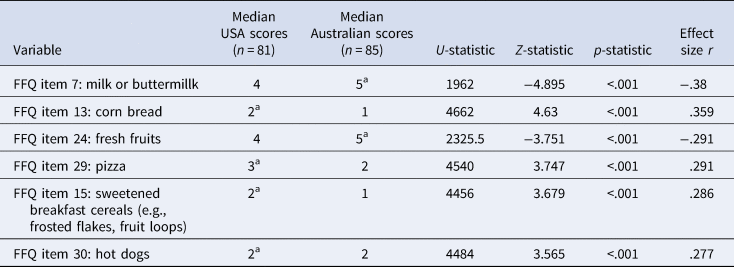
Data were analysed using SPSS version 20 via a series of between-groups analyses performed on pre-surgery data only. A low prevalence of FA was observed which resulted in large discrepancies in sample sizes when comparing subjects with FA versus those without. Given this, and the extensive number of dependent variables (DVs) and associated non-normal distributions of interest, non-parametric analyses were exclusively employed. An advantage of non-parametric tests over parametric tests is normality, and homogeneity of variance between distributions is not assumed (McHugh, Reference Mchugh2013). Moreover, in such circumstances the utilisation of unnecessary transformations is considered unsuitable (Pereira, Afonso & Medeiros, Reference Pereira, Afonso and Medeiros2015). Subject populations between the USA and Australia were first compared to rule out significant key differences in the range of DVs of interest. A series of χ2 analyses detected significant differences between categorical DVs, whereas a series of Mann–Whitney U tests with Holms Procedure (Holland & Copenhaver, Reference Holland and Copenhaver1988) to correct for possible Type I errors were utilised for continuous DVs. Given that the overall lack of significant differences on key variables and that only minimal significant differences were evident as per Table 2, the USA and Australian groups were combined for further analyses. However, any significant results that emerged for these items were further analysed for possible cultural differences.
Significant Mann–Whitney U Differences Between Subject Populations on Continuous DVs

Note. aIt indicates the direction of a statistically higher group.
Following samples being combined across locations, profiles for those with FA according to either standard (FA + D/I) or alternate (FA − D/I) YFAS scoring were separately compared to those without FA (non-FA ≤ 2) on the range of DVs.
Results
Across the entire patient population (n = 166), a total of 21 participants met criteria for standard-scored FA using the YFAS (12.7%), with symptoms (M = 4.81, SD = 1.44). A total of 62 participants met criteria for FA when the D/I criterion was omitted (37.3%), with symptoms (M = 3.84, SD = 1.16).
Categorical DVs
To detect significant differences across US and Australian samples, a series of χ2 analyses were employed for all categorical DVs of interest, including gender, FA, both standard (FA + D/I) and alternate (FA − D/I), and perceived yes/no problems with addictive behaviours (prescription medications, recreational drugs, gambling, shopping, internet usage, personal computer (PC) games, and sex). There was a significant association between perceived sexual problems and subject populations. Ten Australians (13.33%) and two Americans (2.53%) reported experiencing sexual problems: χ2(1) = 5.344, p = .021. There was also a significant association between perceived problems playing PC games and subject populations. Four Australians (4.94%) and no Americans said they were experiencing problems with PC games: χ2(1) = 3.906, p = .048. No other significant associations were identified in this initial set of categorical variables.
Continuous DVs
To detect significant differences across US and Australian samples, a series of Mann–Whitney U tests were utilised for all continuous DVs of interest. These included addictive personality traits, restrained/emotional/external eating, food grazing, binge eating, disordered eating, state and trait anxiety, depression, impact of weight on QOL, physical activity, alcohol consumption and use of addictive substances/behaviours (prescription drugs, recreational drugs, gambling, shopping, internet usage, PC games, and sexual activity) and a total of 39 food frequency items. Consistent with Holland and Copenhaver (Reference Holland and Copenhaver1988), only items that were significant, and where not considered possible Type I errors once Holm's procedure was applied, are presented in Table 2.
Standard-Scored FA (FA + D/I)
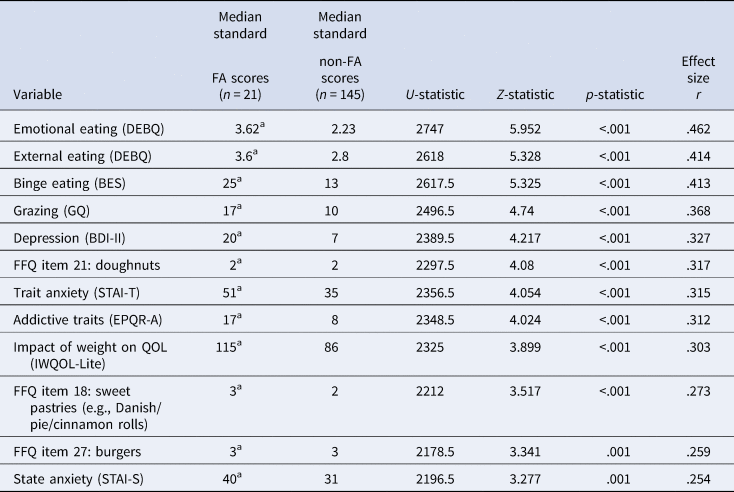
Mann–Whitney U tests were employed on the same set of continuous DVs of interest to compare those with standard-scored FA (FA + D/I) versus those without (non- FA ≤ 2). Holm's procedure was again applied to overcome the elevated possibility of Type I errors. Only reliably significant differences are presented in Table 3.
Significant Mann Whitney U Results for Combined Sample with Standard FA IV and Continuous DVs

Note. aIt Indicates the direction of a statistically higher group.
Alternate FA (FA – D/I)
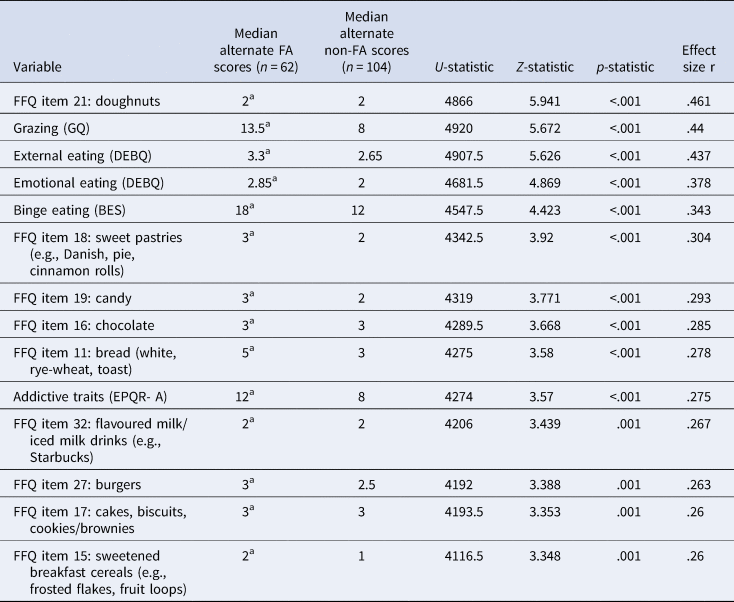
Mann–Whitney U tests were employed on the same set of continuous DVs of interest to compare those with alternate-scored FA (FA − D/I) versus those without (non-FA ≤ 2). Holm's procedure was again applied to overcome the elevated possibility of Type I errors. Only reliably significant differences are presented in Table 4.
Significant Mann Whitney U Results for Combined Sample with Alternate FA IV and Continuous DVs

Note. aIt Indicates the direction of a statistically higher group.
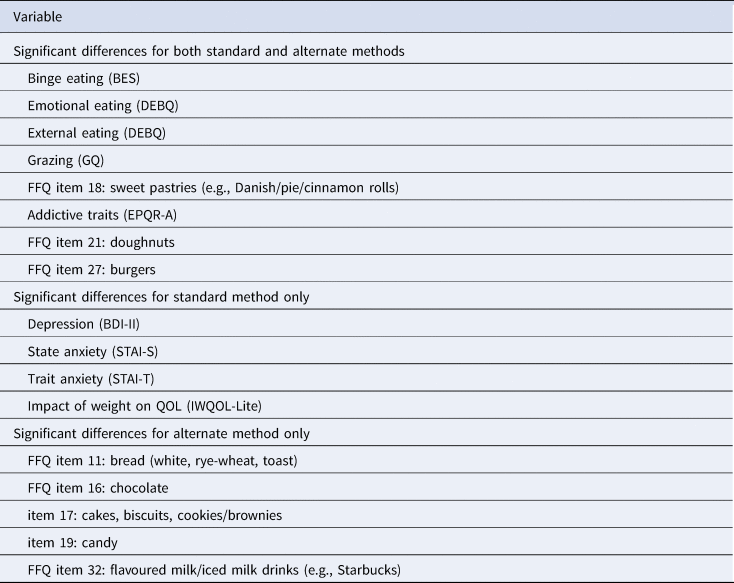
Food frequency item 15, having been previously identified as bearing an association due to subject populations, required further post hoc analyses to assess any impact this may have on the findings. Potential differences between those with and without alternate FA were reanalysed using Mann–Whitney U comparison for each subject population separately. No significant difference was observed. To more succinctly contrast the standard versus alternate FA profiles, Table 5 displays items which were significant for both standard and alternate methods in its upper section. Items that were only significant for either standard or alternate scoring, are displayed in its lower sections. It should be noted that the visual arrangement in Table 5 intentionally disregards the orders of significance displayed in Tables 3 and 4.
Comparison Table of Significant Commonalities and Differences Between Standard and Alternate FA Profiles

Discussion
The purpose of the current study was to investigate YFAS-scored FA prevalence and profile differences among candidate patients seeking bariatric weight loss surgery across the USA and Australia by comparing YFAS scoring including (standard) or excluding (alternate) the D/I criteria. Populations at each location were first compared with each other on a range of DVs. The prevalence rate of FA among patients presenting for bariatric surgery, as assessed by standard YFAS scoring (FA + D/I), was a relatively low 12.7%, which increased to 37.3% when alternate YFAS scoring was employed (FA − D/I). Given the documented, variable rates of FA in bariatric samples across the literature, this result is not unexpected. These prevalence rates are consistent (16 and 35%, respectively) with those recently reported by Ouelette et al. (Reference Ouellette, Rodrigue, Lemieux, Tchernof, Biertho and Bégin2018). The reason for this is not readily apparent, given that FA rates have been shown to be higher in individuals with higher levels of obesity, maladaptive eating, and related health impairments (e.g., Davis et al., Reference Davis, Curtis, Levitan, Carter, Kaplan and Kennedy2011; Gearhardt et al., Reference Gearhardt, White, Masheb, Morgan, Crosby and Grilo2012; Meule, Reference Meule2012) which are common characteristics in bariatric settings. This raises questions as to why this occurs, despite FA − D/I scoring offering a possible solution.
Although speculative, there may be several reasons for the marked variability in standard YFAS-assessed FA prevalence in prior bariatric samples. The YFAS is based on addiction criteria as per DSM-IV, which is a resource used by trained professionals to assess their patients. One explanation may be that patients are less adept at recognising and determining their own current level of D/I due to, for example, possible lack of insight, denial, or stigma. Goldstein et al. (Reference Goldstein, Bechara, Garavan, Childress, Paulus and Volkow2009) point out that over 80% of drug-addicted individuals fail to seek treatment and suggest that this may occur due to limited insight owing to denial or impaired awareness of addiction severity. Analogously, McLennan et al. (Reference McLennan, Shaw, Shema, Gardner, Pope and Kelleher1998) highlight that despite acknowledgement of negative consequences, only a minority of heavy drinkers consider their drinking to be problematic to the point of causing significant distress or impaired functioning. Heatherton and Baumeister (Reference Heatherton and Baumeister1991) assert that impaired self-awareness and uncritical acceptance of irrational beliefs around eating are prominent features of BED. Furthermore, Harrison and Hughes (Reference Harrison and Hughes1997) question the validity of self-reporting highly stigmatised addictive behaviours, such as disordered eating. For these reasons, bariatric patients may be relatively more likely to answer in socially desirable ways or less likely to perceive maladaptive eating as problematic, for example, if the act of seeking a surgical solution reduces distress.
As hypothesised, standard, and alternate scoring, both differentiated individuals with and without FA on a range of addictive traits, maladaptive eating behaviour, and hyperpalatable/refined food choices, whereas only standard YFAS scoring significantly differentiated psychological markers of D/I, including depression, anxiety, and impact of weight on QOL. Our findings appear somewhat discrepant from those offered by Ouellette et al. (Reference Ouellette, Rodrigue, Lemieux, Tchernof, Biertho and Bégin2018) who observed non-significant differences on markers of distress and impairment (depressive symptoms and QOL) between those with FA + D/I and those with FA − D/I. A potential reason for this point of difference may be that research by Ouellette et al. (Reference Ouellette, Rodrigue, Lemieux, Tchernof, Biertho and Bégin2018) compared standard and alternate-scored individuals with FA directly, whereas our research compared those with standard and alternate FA to non-food-addicted individuals according to either method (non-FA ≤ 2). This suggests that the sensitivity of alternate-scored FA for differentiating profiles may partially depend on comparisons to individuals without FA (non-FA ≤ 2). This may offer some initial support for the applicability of alternate-scored FA, as it would be utilised in practice, that is, to make diagnostic comparisons within clinical/bariatric settings.
A possible explanation for the significant elevations in related markers of distress for FA + D/I in the current research may be that those individuals endorsing perceived eating-related D/I on the YFAS may have been more aware, worried, or upset about the effect of their eating behaviour. However, the extent to which YFAS endorsement of D/I may be a necessary FA criterion within bariatric domains is unclear. For instance, it is plausible to suggest that the degree of eating-related health impairments and associated medical necessity for surgical intervention could be considered a form of eating-related impairment similar to the YFAS D/I criterion. Despite this line of reasoning, the observed relationship between standard YFAS-scored FA and expected markers of D/I is consistent with the vast array of clinical and non-clinical YFAS research throughout the literature (e.g., Davis et al., Reference Davis, Curtis, Levitan, Carter, Kaplan and Kennedy2011; Gearhardt et al., Reference Gearhardt, White, Masheb, Morgan, Crosby and Grilo2012).
Strengths and Limitations
Overall, there were only a minimal number of significant differences between the two subject populations across demographic, eating behaviour, and psychosocial variables, rendering it reasonable to combine US and Australian sample data. The differences were limited to more Australians reporting difficulties with sexual intimacy and PC games. However, this finding should be interpreted with caution given the limited numbers of individuals endorsing these criteria in the study. Minor anticipated differences on food frequency items (e.g., cornbread) were also observed, and these were addressed by means of post hoc analyses to remove items that were not significantly different for standard-scored and alternate-scored FA at both locations.
Precisely identifying foods that are addictive has remained a controversial topic throughout the FA literature. Although beyond the scope of the current research, it is also worth noting that there exists ongoing debate regarding the classification of FA more accurately as either behavioural or substance-based (see Hebebrand & Gearhardt, Reference Hebebrand and Gearhardt2021). Furthermore, there is very limited research evaluating the possibility of FA resulting in response to the consumption of unprocessed/unrefined ‘whole foods’ (Gordon et al., Reference Gordon, Ariel-Donges, Bauman and Merlo2018). For example, nuts (typically classified as a whole food lacking added sugars) have been previously rated more addictive on average compared to highly processed granola bars (typically with the addition of sugar/fat) (Schulte, Avena, & Gearhardt, Reference Schulte, Avena and Gearhardt2015). Consequently, a key strength of the current research was to include a comprehensive 39-item FFQ. The differentiability of standard and alternate scoring approaches revealed similar dietary profiles, and as expected, these overwhelmingly supported the concept of FA, with more frequent consumption of energy-dense, hyperpalatable foods, for those with either standard-scored or alternate-scored FA as evidenced in Tables 3–5. Another strength of the current investigation was that it was undertaken in both the USA and Australia and because samples showed minimal significant differences, this suggests that findings may be broadly applicable to Western populations. More detailed comparisons of location-specific sample characteristics were possible on the complete range of variables of interest.
The present study did not account for cultural factors or ethnicity beyond the USA and Australia. In consideration of the above-mentioned variation of FA prevalence rates across cultures and ethnicities, the generalizability of our findings may be limited to subjects/patients who seek bariatric surgery in the USA and Australia, with the applicability of our findings to other bariatric samples remaining unclear at this time. Another possible limitation was the relatively larger prevalence of females in our sample, thus limiting the generalizability of our findings predominantly to females. However, a large-scale meta-analysis conducted by Pursey et al. (Reference Pursey, Stanwell, Gearhardt, Collins and Burrows2014) demonstrated that FA prevalence rates are higher for those with overweight/body compositions compared to those with healthy weight (24.9 and 11.1%, respectively) and higher for females than males (12.2 and 6.4%, respectively). This suggests that our relatively low prevalence rate in a sample predominantly females with obesity is noteworthy. Additionally, typical bariatric samples are predominantly female which may point to the representativeness or ecological validity of our sample.
Lastly, although FA is not currently recognised as a disorder in any version of the DSM, our study utilised the original YFAS which draws comparisons to DSM-IV drug dependence criteria instead of the newer YFAS 2.0 which is based on DSM-5 and has been suggested to be psychometrically superior (Gearhardt, Corbin, & Brownell, Reference Gearhardt, Corbin and Brownell2016). For instance, to reflect changes from DSM-IV to DSM 5, YFAS 2.0 more accurately, developers merged substance dependence and substance abuse criteria and included both craving and a continuum of severity (Gearhardt et al., Reference Gearhardt, Corbin and Brownell2016). Despite this, it should be noted that the majority of research to date has been conducted with the original YFAS and that all versions of the YFAS require the D/I criterion to be met, which was the cornerstone of our investigation. For this reason, FA prevalence and correlates assessed by YFAS 2.0 were intentionally omitted from the current research.
Future research should further investigate the applicability and utility of standard and alternate YFAS-scored FA to bariatric settings. Such research may improve our understanding of specific FA-related factors in bariatric candidates and how these differ from characteristics held in common with non-surgical individuals with obesity and other clinical patients. To this aim, it may be beneficial to compare bariatric prevalence rates and related profiles of those with and without FA as determined by clinicians versus standard and alternate YFAS-scoring methods.
Conclusions
Overall, the present study offers support for the applicability of the FA construct in bariatric settings. Alternate YFAS scoring that removed the requirements for significant distress or impairment revealed a comparatively higher prevalence rate with similar profile differentiability. Despite the theoretical applicability of standard scoring for bariatric candidates, more research is required to investigate specific bariatric surgery-related factors and how they relate to the construct of FA. If we can improve the accuracy of assessing FA in the rapidly growing bariatric surgery domain, we may be able to draw firmer conclusions about our patients, which may inform individualised interventions and other novel treatments for obesity and FA.
Acknowledgements
The authors would like to acknowledge Jeff Patrick and Farlache Stanley for support, consultation, and guidance throughout this research project.
Funding
This research was not supported by grants and no aspects of the research have been presented or published previously.
Declaration of interest
We have no conflicts of interest to disclose.