INTRODUCTION
Parasites can regulate their host populations by reducing the fecundity or the survival of their host population, but our current knowledge of population regulation of hosts by parasites is still limited (see reviews in Møller, Reference Møller2005; Schmid-Hempel, Reference Schmid-Hempel2011). In the case of malaria and related haemosporidian parasites, most of the mortalities of infected birds normally occur during the acute phase of the parasite infection, which usually happens several days after the parasite transmission (Valkiūnas, Reference Valkiūnas2005). Juvenile birds are especially susceptible for infection because they are immunologically naïve, which may drive to population decline (Samuel et al. Reference Samuel, Hobbelen, Decastro, Ahumada, Lapointe, Atkinson, Woodworth, Hart and Duffy2011). However, the areas of transmission of these vector-borne diseases remain a key knowledge gap in our understanding of these pathogens. The use of new molecular tools could provide an essential knowledge to identify the regions where vector-borne diseases are transmitted in order to study the host population dynamics and to recognize future changes in environmental conditions that may potentially influence the transmission areas. Haemosporidians are among the most well studied blood parasites of reptiles, mammals and birds (Valkiūnas, Reference Valkiūnas2005). Avian Plasmodium species show a cosmopolitan distribution, being found in all continents except Antarctica (Valkiūnas, Reference Valkiūnas2005). To date, more than 50 morphospecies of avian malaria parasites of the genus Plasmodium have been described worldwide (Valkiūnas, Reference Valkiūnas2005; Palinauskas et al. Reference Palinauskas, Kosarev, Shapoval, Bensch and Valkiūnas2007). Plasmodium relictum is one of the most widespread and harmful parasite species of avian malaria, being responsible for mass mortality, population declines and even extinctions of many bird species (Van Riper III et al. Reference Van Riper III, Van Riper, Goff and Laird1986; Valkiūnas, Reference Valkiūnas2005). For all these reasons and due to its devastating effects, the International Union for Conservation of Nature classifies P. relictum as one of the worst invasive species in the world (Lowe et al. Reference Lowe, Browne, Boudjelas and De Poorter2000). Therefore, it becomes essential to identify the geographical distribution of P. relictum lineages and to assess their infection prevalence in birds in order to develop appropriate management strategies to promote biodiversity conservation policies worldwide.
With the use of mtDNA cytochrome b gene (cyt b) to barcode the parasites more than 500 avian Plasmodium parasite lineages have been identified (MalAvi database 2015-01-15) (Bensch et al. Reference Bensch, Hellgren and Pérez-Tris2009). Moreover, four different cyt b lineages have been described within the morphologically described species of P. relictum (Palinauskas et al. Reference Palinauskas, Kosarev, Shapoval, Bensch and Valkiūnas2007; Valkiūnas et al. Reference Valkiūnas, Zehtindjiev, Hellgren, Ilieva and Iezhova2007; Ilgunas et al. Reference Ilgunas, Palinauskas, Iezhova and Valkiunas2013; Kazlauskiene et al. Reference Kazlauskiene, Bernotiene, Palinauskas, Iezhova and Valkiunas2013). Two of the P. relictum cyt b lineages (SGS1 and GRW4) are some of the most abundant and geographically widespread of all bird Plasmodium lineages. Both lineages are host generalists infecting 95 species of 28 families (SGS1) and 60 species in 19 families (GRW4) (MalAvi database 2015-01-15) (Bensch et al. Reference Bensch, Hellgren and Pérez-Tris2009), respectively. The lineages SGS1 and GRW4 exhibit different transmission areas (Hellgren et al. Reference Hellgren, Waldenström, Peréz-Tris, Szöll Ösi, Hasselquist, Krizanauskiene, Ottosson and Bensch2007), with GRW4 being transmitted in New Zealand, Africa, Asia and America (Beadell et al. Reference Beadell, Ishtiaq, Covas, Melo, Warren, Atkinson, Bensch, Graves, Jhala, Peirce, Rahmani, Fonseca and Fleischer2006; Marzal et al. Reference Marzal, Ricklefs, Valkiūnas, Albayrak, Arriero, Bonneaud, Czirják, Ewen, Hellgren, Hořáková, Iezhova, Jensen, Križanauskienė, Lima, De Lope, Magnussen, Martin, Møller, Palinauskas, Pap, Pérez-Tris, Sehgal, Soler, Szöllősi, Westerdahl, Zetindjiev and Bensch2011), whereas SGS1 shows a widespread distribution in Europe, Africa and Asia (Palinauskas et al. Reference Palinauskas, Kosarev, Shapoval, Bensch and Valkiūnas2007). Recently, SGS1 was also detected in Oceania (Howe et al. Reference Howe, Castro, Schoener, Hunter, Barraclough and Alley2012) and South America (Marzal et al. Reference Marzal, García-Longoria, Cárdenas Callirgos and Sehgal2015). In consequence, SGS1 was suggested to be one of the few Plasmodium lineages with active transmission in both tropical Africa and temperate regions of Asia and Europe (Hellgren et al. Reference Hellgren, Waldenström, Peréz-Tris, Szöll Ösi, Hasselquist, Krizanauskiene, Ottosson and Bensch2007).
Investigations based on multiple nuclear loci of P.relictum have provided new insights into allelic variation, geographical structure and parasite transmission (Hellgren et al. Reference Hellgren, Kutzer, Bensch, Valkiunas and Palinauskas2013). The merozoite surface protein 1 (MSP1) is a gene which shows a high variability (Miller et al. Reference Miller, Roberts, Shahabuddin and McCutchan1993) and encodes a protein involved in the attachment of the malaria parasite to the red blood cell (Gerold et al. Reference Gerold, Schofieldb, Blackman, Holder and Schwarz1996). Because of its high variability, this gene is a good candidate for investigating population structure and phylogeography of malaria lineages. For example, the SGS1 lineage transmitted in tropical Africa has a different set of MSP1 alleles compared with those transmitted in Europe, suggesting the existence of separate SGS1 populations along the European-African migratory flyways (Hellgren et al. Reference Hellgren, Carter, Bensch, Albayrak, Dimitrov, Ewen, Kim, Lima, Lynn, Palinauskas, Ricklefs, Sehgal, Valkiūnas, Tsuda and Marzal2015). This pattern implies the existence of transmission barriers (e.g. vector communities or abiotic factors) limiting transmission between regions, but further studies are required to confirm this geographical distribution.
The house martin is a migratory species with a high fidelity to its area of hatching and nesting (Cramp and Perrins, Reference Cramp and Perrins1994; Lope and Silva, Reference Lope and Silva1998) and also to its wintering grounds (Ambrosini et al. Reference Ambrosini, Orioli, Massimino and Bani2011). This species migrates from Africa to Europe for breeding. Once the breeding is completed, adult house martins and new-born individuals migrate back to their African wintering quarters (Tumer and Rose, Reference Turner, Rose and Taylor1989; Cramp and Perrins, Reference Cramp and Perrins1994). Previous studies in different localities of Europe and Northern Africa have found haemosporidian infections in more than 70% of adults (Marzal et al. Reference Marzal, Bensch, Reviriego, Balbontin and De Lope2008, Reference Marzal, Reviriego, Hermosell, Balbontín, Bensch, Relinque, Rodríguez, Garcia-Longoria and de Lope2013a , Reference Marzal, Asghar, Rodríguez, Reviriego, Hermosell, Balbontín, Garcia-Longoria, de Lope and Bensch b ; Piersma and van der Velde, Reference Piersma and van der Velde2012; Van Rooyen et al. Reference Van Rooyen, Jenkins, Lahlah and Christe2014). Additionally, different P. relictum cyt b lineages such as SGS1, GRW4 and GRW11 have been found infecting adult house martins in these populations (Marzal et al. Reference Marzal, Bensch, Reviriego, Balbontin and De Lope2008, Reference Marzal, Asghar, Rodríguez, Reviriego, Hermosell, Balbontín, Garcia-Longoria, de Lope and Bensch2013b ; Piersma and van der Velde, Reference Piersma and van der Velde2012; van Rooyen et al. Reference Van Rooyen, Jenkins, Lahlah and Christe2014). These blood parasite infections are thought to be transmitted on the African wintering grounds or during migration. This assumption is based on the absence of haemosporidian infection in the single study analysing haemosporidian infections in 112 fledgling and juvenile house martins before their first migration (Piersma and van der Velde, Reference Piersma and van der Velde2012). However, the confirmation of transmission areas of haemosporidian parasites in house martins requires further investigation. Therefore, the first goal of our study was to determine whether haemosporidian transmission in house martins occurs at European sites by sampling juvenile birds. Additionally, the second objective of this study was to analyse the MSP1 alleles in P. relictum lineages infecting adult and juvenile house martins in order to identify their potential areas of transmission.
MATERIALS AND METHODS
Study site and collecting samples
The study was carried out in a colony of house martins in the surroundings of Badajoz (38° 50′ N, 6° 59′ W), southwest Spain, during a 6-year period (2006–2012) as part of a longer study. For the present study we captured 422 house martins, 310 of them were classified as juveniles according to the morphological characteristics established by Svensson et al. (Reference Svensson, Grant and Mullarney2009) and Lope (Reference Lope1986). Most of the individuals were caught in July, at the end of their breeding season (Pajuelo et al. Reference Pajuelo, de Lope and da Silva1992). Therefore, the all of the juveniles included in this study were between 2 and 3 months old. All birds were individually identified with numbered metal rings. One microcapillary of blood (70 μL) was obtained from the brachial vein of each individual and stored in 500 μL of SET buffer (0·15 M NaCl, 0·05 Tris, 0·001 M EDTA, pH 8·0) until DNA extraction.
Molecular detection of blood parasite infections
Haemosporidian parasites (Plasmodium spp.) were detected from blood samples using molecular methods (Bensch et al. Reference Bensch, Stjernman, Hasselquist, Ostman, Hansson, Westerdahl and Pinheiro2000; Waldenström et al. Reference Waldenström, Bensch, Hasselquist and Ostman2004). DNA from the avian blood samples were extracted in the laboratory using the standard phenol/chloroform/isoamylalcohol method (Sambrook et al. Reference Sambrook, Fritsch and Maniatis2002). Diluted genomic DNA (25 ng/μL) was used as a template in a polymerase chain reaction (PCR) assay for detection of the parasites using nested PCR-protocols described by Waldenström et al. (Reference Waldenström, Bensch, Hasselquist and Ostman2004). The amplification was evaluated by running 2·5 μL of the final PCR on a 2% agarose gel. All PCR experiments contained one negative control for every eight samples. In the very few cases of negative controls showing signs of amplification (never more than faint bands in agarose gels), the whole PCR-batch was run again to make sure that all positives were true. All positive amplifications were precipitated and sequenced in order to identify the species and lineage in each infection. The obtained sequences were edited, aligned and compared in a sequenced matrix using the program Bioedit (Hall, Reference Hall1999). We selected SGS1 and GRW4 infected house martins for further analyses of the MSP1 gene (270 nucleotides, block 14) and detect the MSP1 allele following the protocol described by Hellgren et al. (Reference Hellgren, Kutzer, Bensch, Valkiunas and Palinauskas2013) and using the primers MSP1_3F, MSP1_3R, MSP1_3FN and MSP1_3RN.
Phylogenetic reconstruction
The obtained sequences were edited, aligned against the SGS1_MSP1 gene (KC969175) and compared in a sequence identity matrix using the program BioEdit (Hall, Reference Hall1999). The quality of the alignment was checked by manual inspection. Genetic differences between the MSP1 alleles were calculated using a Jukes-Cantor model as implemented in MEGA 5·2. We used MEGA 5·2 for phylogenetic reconstruction of the MSP1 alleles where the homolog sequence of P. gallinaceum (AJ809338·1) was used as an out-group. The phylogenetic tree for all the alleles found was constructed in the programme MEGA 5·2 and using a Maximum Likelihood model. Bootstrap values were used in order to obtain a consensus phylogeny using 200 iterations.
RESULTS
Prevalence of infection and genetic parasite diversity (Cyt b gene analyses)
We analysed 422 blood samples from adult (N = 112) and juvenile (N = 310) house martins in search for haemosporidian parasites. Among adults 80 (71%) individuals were infected with haemosporidian parasites. In juveniles only three were found to be infected (0·96%).
Of the 80 infected adult birds, 20% were infected with Plasmodium spp. and 80% were infected with Haemoproteus spp. We found five different blood parasite lineages infecting adult house martins, of which three were of the genus Haemoproteus (DELURB1: 32 infected birds; DELURB2: 29 infected birds; DELURB3: 3 infected bird), and two of them from the genus Plasmodium (SGS1: 15 infected birds; GRW4: 1 infected bird). The three infected juveniles were all infected with the P. relictum lineage SGS1.
Genetic parasite diversity (MSP1 gene analyses)
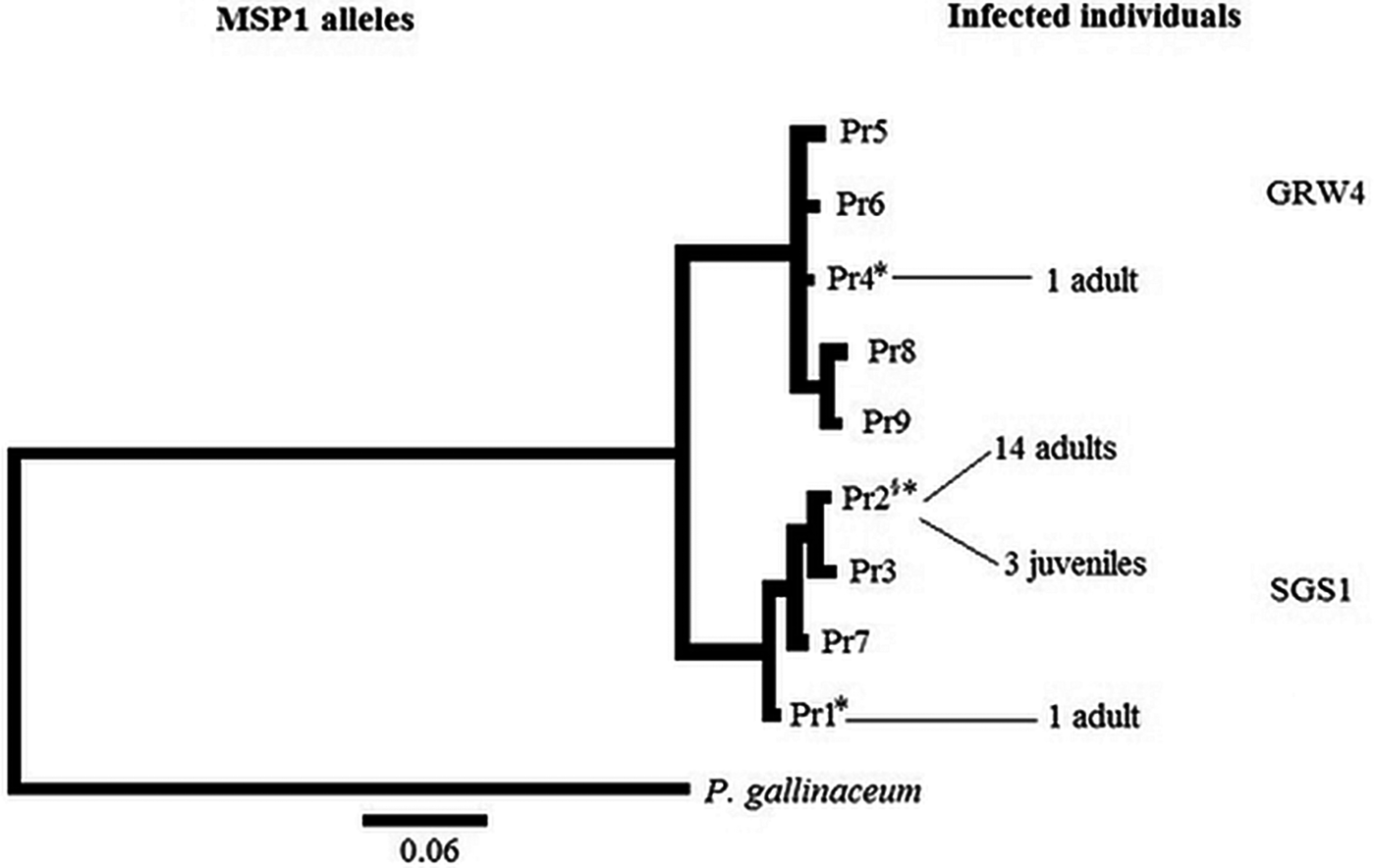
All the samples infected with P. relictum lineages (N = 19; 16 adults and 3 juveniles) were selected for further molecular analyses. From each sample, we obtained a 268 bp MSP1_ b14 fragment of high quality. We used a SGS1_MSP1 gene (KC969175) in order to confirm the amplification of the MSP1 block 14 (MSP1_b14). Within adults, 14 out of 16 individuals showed the allele Pr2 (SGS1), whereas one individual was infected with Pr1 (SGS1) and the other one was infected with Pr4 (GRW4) (Fig. 1). Moreover, we found the same allele (Pr2; SGS1) in all the juvenile house martins infected with malaria (Fig. 1).
Phylogenetic relationship between all the MSP1_b14 alleles detected to date (Hellgren et al. Reference Hellgren, Carter, Bensch, Albayrak, Dimitrov, Ewen, Kim, Lima, Lynn, Palinauskas, Ricklefs, Sehgal, Valkiūnas, Tsuda and Marzal2015) and number of individuals (adults or juveniles) infected by these alleles. * and § represent confirmed active transmission in Africa and Europe, respectively (Hellgren et al. Reference Hellgren, Carter, Bensch, Albayrak, Dimitrov, Ewen, Kim, Lima, Lynn, Palinauskas, Ricklefs, Sehgal, Valkiūnas, Tsuda and Marzal2015).

DISCUSSION
In this study we analysed blood samples from adult and juvenile house martins in search for haemosporidian parasites. We showed, for the first time, that juvenile house martins become infected with Plasmodium parasites already before their first migration to Africa, thus confirming that active transmission of Plasmodium spp. to house martins occur in Europe. By analysing the MSP1 alleles in P. relictum lineages, we were able to get a more detailed view of the likely transmission areas for the infections found in the adult birds. Below, we will discuss the biological meaning of these results in detail.
House martins have been used in several studies to analyse life-history consequences of haemosporidian infections (e.g. Piersma and van der Velde, Reference Piersma and van der Velde2012;Marzal et al. Reference Marzal, Reviriego, Hermosell, Balbontín, Bensch, Relinque, Rodríguez, Garcia-Longoria and de Lope2013a , Reference Marzal, Asghar, Rodríguez, Reviriego, Hermosell, Balbontín, Garcia-Longoria, de Lope and Bensch b ; Van Rooyen et al. Reference Van Rooyen, Jenkins, Lahlah and Christe2014). In our study, we show that 70% of adults were infected with haemosporidian parasites. This prevalence is similar to what has been reported from previous studies in this house martin population (Marzal et al. Reference Marzal, Bensch, Reviriego, Balbontin and De Lope2008, Reference Marzal, Reviriego, Hermosell, Balbontín, Bensch, Relinque, Rodríguez, Garcia-Longoria and de Lope2013a , Reference Marzal, Asghar, Rodríguez, Reviriego, Hermosell, Balbontín, Garcia-Longoria, de Lope and Bensch b ). Moreover, the prevalence of haemosporidian parasites among adult house martins greatly exceed the prevalence in juveniles. This difference may be explained by a higher mortality of young individuals during the infection, before being captured for sampling, due to their näive immune system (Sol et al. Reference Sol, Jovani and Torres2003) and/or the maintenance of haemosporidian infection in infected birds that survived the acute phase of infection (Valkiūnas, Reference Valkiūnas2005). Alternatively, the juveniles may not yet have been exposed to infections, or have only recently been infected and in the phase when Plasmodium cryptozoites are developing in reticuloendothelial cells, and therefore absent in the blood stream (Valkiūnas, Reference Valkiūnas2005).
Migratory birds are exposed to at least two different parasite communities during their annual cycle. Therefore, migratory species such as house martins could become infected by blood parasites during their breeding season in Europe and/or in their African winter quarters and at stop-over sites. Moreover, the parasites could be transported within the migratory bird and be able to infect resident birds in the new area. However, Hellgren et al. (Reference Hellgren, Waldenström, Peréz-Tris, Szöll Ösi, Hasselquist, Krizanauskiene, Ottosson and Bensch2007) investigated the degree of geographical shifts of transmission of 259 haemosporidian parasite lineages. They showed that most of the parasite lineages are restricted to a specific area and thus dispersing from one biogeographical zone to another is a rare and slow evolutionary process. In line with the data presented by Hellgren et al. (Reference Hellgren, Waldenström, Peréz-Tris, Szöll Ösi, Hasselquist, Krizanauskiene, Ottosson and Bensch2007), all the recent studies of haemosporidian parasites in house martins have assumed that these parasites are only actively transmitted on the African wintering grounds or during migration (Marzal et al. Reference Marzal, Bensch, Reviriego, Balbontin and De Lope2008, Reference Marzal, Reviriego, Hermosell, Balbontín, Bensch, Relinque, Rodríguez, Garcia-Longoria and de Lope2013a , Reference Marzal, Asghar, Rodríguez, Reviriego, Hermosell, Balbontín, Garcia-Longoria, de Lope and Bensch b ; Piersma and van der Velde, Reference Piersma and van der Velde2012; Van Rooyen et al. Reference Van Rooyen, Jenkins, Lahlah and Christe2014). This assumption was supported by Piersma and van der Velde (Reference Piersma and van der Velde2012) in a population of house martins in the Netherlands, where none of the analysed juveniles were infected with haemosporidian parasites. In contrast, we detected the presence of malaria parasites in juvenile house martins. As far as we know, this is the first documented case of active transmission of Plasmodium parasites in house martins in Europe. These findings give rise to new questions about the transmission areas of malaria parasites in this migratory bird species such as how many house martins can complete the migration despite the infection by malaria parasites.
The data on the distribution of nuclear MSP1 alleles across the cyt b lineages may facilitate the investigation on the distribution of these malaria parasites across geographical regions (Hellgren et al. Reference Hellgren, Kutzer, Bensch, Valkiunas and Palinauskas2013, Reference Hellgren, Carter, Bensch, Albayrak, Dimitrov, Ewen, Kim, Lima, Lynn, Palinauskas, Ricklefs, Sehgal, Valkiūnas, Tsuda and Marzal2015). A recent study has explored the global phylogeography of the P. relictum based on MSP1 allelic diversity, showing several different MSP1 alleles within the cyt b lineages of SGS1 and GRW4. In this study, we identified two MSP1 alleles from two cyt b lineages that are throught to be transmitted in Africa (allele Pr1 from lineage SGS1, and allele Pr4 from lineage GRW4), and one allele from a cyt b lineage thought to be confined to temperate regions (allele Pr2 from lineage SGS1) (Hellgren et al. Reference Hellgren, Carter, Bensch, Albayrak, Dimitrov, Ewen, Kim, Lima, Lynn, Palinauskas, Ricklefs, Sehgal, Valkiūnas, Tsuda and Marzal2015). This pattern suggests the existance of barriers limiting the tramission areas of these parasites. In the present study, we have shown that most of the adult birds infected with SGS1, as well as all the infected juveniles, carried the MSP1 allele with European transmission (Pr2) . Only one out of 15 adults was infected with a tropically transmitted SGS1 allele (MSP1 allele Pr1), while another one was infected with GRW4 (MSP1 allele Pr4) which is known to have transmission in the Afrotropics. These results indicate the existence of two different areas of transmission of malaria parasites for house martins population: one in the African winter range (Pr1 and Pr4), and the other in the European breeding range (Pr2). Moreover, the high number of house martins infected with the MSP1 allele Pr2 compared with the low number infected with the MSP1 African-transmitted alleles (Pr1 and Pr4) suggest that most of the malaria transmission takes place in Europe during the breeding season. This finding agrees with previous studies indicating that haemosporidian parasites are usually transmitted during the breeding season in temperate regions, because biotic and abiotic factors are optimal for the transmission of vector-borne diseases such as malaria (Githeko et al. Reference Githeko, Lindsay, Confalonieri and Patz2000; Valkiūnas, Reference Valkiūnas2005; Cosgrove et al. Reference Cosgrove, Wood, Day and Sheldon2008; but also see Dunn et al. Reference Dunn, Goodman, Benton and Hamer2014). However, we cannot exclude that house martins frequently become infected in tropical Africa during the winter or at stop-over sites, but that such infected individuals fail to reach their European breeding quarters because they die during migration. In support of this hypothesis, several studies have shown that blood parasites may increase mortality in their avian hosts during stressful and energy-demanding periods such as migration (Davidar and Morton, Reference Davidar and Morton1993; Valkiūnas, Reference Valkiūnas2005; Garvin et al. Reference Garvin, Szell and Moore2006).
In conclusion, we confirmed that active transmission of P. relictum (lineage SGS1) occurs in house martins in Europe. Additionally, we detected African and European MSP1 alleles in adult house martins, suggesting two different areas of transmission for the P. relictum SGS1 lineage in this migratory bird species. These findings emphasize the importance of using multiple independent loci of avian Plasmodium parasites to understand transmission areas of blood parasites. Further studies exploring the transmission and species limits of avian malaria parasites are needed to evaluate the importance of migratory birds in spreading haemosporidian infections.
ACKNOWLEDGEMENTS
We thank the numerous colleagues who contributed with the collection of the samples. In particular, we thank Maribel Reviriego, Carmen Relinque and Nacho García.
FINANCIAL SUPPORT
This study was funded by grants from the Spanish Ministry of Economy and Competition (A.M., F.D.L. and L.G.L., CGL2009-08976 and CGL2012-36665) and the Regional Government of Extremadura (A.M., F.D.L. and L.G.L., GRU: 10134). Luz Garcia-Longoria was supported by a PhD grant from Ministry of Economy and Competition of Spain. The Crafoord foundation (grant 20120630), and the Swedish research council (grant 621-2011-3548) to OH.