Introduction
When a person has a dementia disorder, non-cognitive behaviors and symptoms might constitute a greater problem than the cognitive decline itself. These behaviors and symptoms, such as aggression, wandering behavior, depression, hallucinations and delusions, are very common (Brodaty et al., Reference Brodaty2001; Pitkala et al., Reference Pitkälä, Laurila, Strandberg and Tilvis2004; Testad et al., Reference Testad, Aasland and Aarsland2007) and cause much suffering for both the persons with dementia and their relatives and caregivers (Black and Almeida, Reference Black and Almeida2004; Neri et al., Reference Neri, Bonati, Pinelli, Borella, Tolve and Nigro2007; Shin et al., Reference Shin, Carter, Masterman, Fairbanks and Cummings2005).
These behaviors and symptoms, which are often laconically summarized and labeled BPSD – Behavioral and Psychological Symptoms of Dementia – should not be treated as one entity (van Iersel et al., Reference van Iersel, Koopmans, Zuidema and Rikkert2004). On the contrary, the research goal should be to explore the spectrum of symptoms, determine predisposing and precipitating factors, and find non-pharmacological and pharmacological treatment strategies for each individual symptom.
Among many other factors, male or female sex might be one such predisposing factor for certain types of behaviors and symptoms. There is a well-known correlation between some psychiatric disorders, e.g. depression, anxiety and perhaps schizophrenia in younger ages, and sex (American Psychiatric Association, 2000).
There is also some evidence to support differences between the sexes concerning behavior and symptom profiles in dementia. Some previous studies have found men to be more likely to exhibit different aggressive behaviors (Cohen-Mansfield et al., Reference Cohen-Mansfield, Marx and Werner1992; Eastley and Wilcock, Reference Eastley and Wilcock1997; Menon et al., Reference Menon2001; Schreiner, Reference Schreiner2001; Matsuoka et al., Reference Matsuoka, Miyamoto, Ito and Kurita2003; Buchanan et al., Reference Buchanan, Wang, Ju and Graber2004; Hall and O'Connor, Reference Hall and O'Connor2004), even if there are partly contradictory results especially concerning verbal aggression (Eastley and Wilcock, Reference Eastley and Wilcock1997; Schreiner, Reference Schreiner2001; Cohen-Mansfield and Libin, Reference Cohen-Mansfield and Libin2005). Some previous studies have not differentiated between different behaviors, investigating solely agitation or disruptive behavior as a class. These studies have indicated a male preponderance (Lam et al., Reference Lam, Chan, Mok, Li and Lam2006; Neville and Byrne, Reference Neville and Byrne2006). A few studies have also investigated emotional or depressive symptoms and anxiety, with conflicting results (Brodaty et al., Reference Brodaty2001; Buchanan et al., Reference Buchanan, Wang, Ju and Graber2004; Ott et al., Reference Ott, Tate, Gordon and Heindel1996; Steinberg et al., Reference Steinberg2006). For psychosis among people with dementia, the results of 24 studies taken together indicate no difference between the sexes (Ropacki and Jeste, Reference Ropacki and Jeste2005).
The aim of the present analysis was to explore further the correlation between sex and the prevalence of different behavioral and psychological symptoms of dementia in a large sample of people with cognitive impairment living in institutional geriatric care.
Methods
Material
The analysis is based on two cross-sectional questionnaire surveys performed in 1982 and 2000 respectively, in the county of Västerbotten in northern Sweden. The two surveys used the same methodology and the same questionnaire.
When the first investigation was conducted, the population in the area was 245,000, of whom 38,000 (15.5%) were older than 65 years; by the time of the second investigation the population had increased to approximately 256,000 people, of whom 44,000 (17.2%) were aged 65 years or older (Statistics Sweden, 2007).
The number of people living in institutions providing geriatric care (nursing homes, residential care units, group dwellings for people with dementia, short-stay/rehabilitation units, somatic geriatric wards/somatic long-stay wards, psychogeriatric wards/long-stay wards, further described in Kallin et al. (Reference Kallin, Gustafson, Sandman and Karlsson2004)) was 3910 in 1982 and 4357 in 2000. The response rate was 92.3% and 87.3% respectively, rating 3607 and 3804 individuals respectively. Those who were younger than 65 years or for whom no age or sex was registered were excluded from the analysis. Out of 3163 people from 1982 and 3660 from 2000, those who had a score on Gottfries' cognitive scale that indicated cognitive impairment were selected (see assessments section for further details). Thus, 1365 persons were selected from the 1982 survey and 2030 from the 2000 survey, giving a total of 3395 people.
The study was approved by the Ethics Committee of the Faculty of Medicine at Umeå University (registration number 00-170).
Procedures
The survey form was sent to all the care settings and the staff were asked to complete and return it to the researchers. The staff were given written instructions about how to carry out the assessments and were informed that the members of the research team could be contacted by phone to answer questions or provide additional guidance. For each resident, the member of staff who knew the particular resident best was asked to complete the assessment scales. The staff were informed that their assessment should be based on observations of the resident's state during the preceding week.
Assessments
The assessments were made using the Multi-Dimensional Dementia Assessment Scale (MDDAS; Sandman et al., Reference Sandman, Adolfsson, Norberg, Nystrom and Winblad1988). The scale measures level of functioning in activities of daily living (ADL), cognition and behavioral and psychological symptoms, and it also includes a registration of current drug prescriptions. The MDDAS has good inter- and intra-rater reliability (Sandman et al., Reference Sandman, Adolfsson, Norberg, Nystrom and Winblad1988).
Cognitive impairment was measured using a scale developed by Gottfries and Gottfries (Adolfsson et al., Reference Adolfsson, Gottfries, Nyström and Winblad1981). The scale consists of 27 items measuring a person's level of cognitive functioning. A score of less than 24 is considered to indicate cognitive impairment, which correlates with a sensitivity of 90% and a specificity of 91% (Adolfsson et al., Reference Adolfsson, Gottfries, Nyström and Winblad1981) to the cut-off point 24/30 traditionally used in the Mini-mental State Examination (MMSE) (Folstein et al., Reference Folstein, Folstein and McHugh1975).
The MDDAS contains 25 behavioral items and 14 psychological symptom items. Each item is rated on a three-point scale, indicating whether the symptom or behavior occurs at least once a day, once a week or never during the observation period. The variables were dichotomized between at least once a week and less than once a week. The items were then grouped according to a rotated factor analysis as previously presented (Lövheim et al., Reference Lövheim, Sandman, Karlsson and Gustafson2008b). Each item is presented in Table 2, under the factor to which it loaded the most.
Statistics
Dichotomous variables were analyzed using the Pearson χ2 test and continuous variables using the independent variable T-test. Multiple logistic regression models were used to control for possible confounding factors. The regression models included the age, sex, level of cognitive impairment (divided into mild, moderate and severe cognitive impairment) and level of dependence in ADL (divided into high, medium or low dependence) and year of investigation (1982 or 2000). Statistical calculations were performed using the Statistical Package for Social Science SPSS® version 11.0 for Mac OS X.
Results
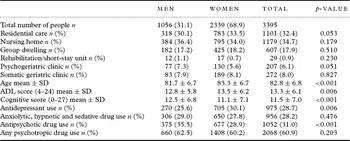
Some basic characteristics of the study population are presented in Table 1. Of the study population, 2339 (68.9%) were women and 1056 (31.1%) were men. The women were older and had on average a higher level of ADL functioning, despite a slightly worse average cognitive function. There were no sex differences concerning types of housing. Women used on average more antidepressant drugs (30.1% compared to 25.6%, p = 0.006) while men used more antipsychotics (35.5% compared to 28.9%, p < 0.001).
Characteristics of participants, comparison between men and women

SD = standard deviation, ADL = activities of daily living
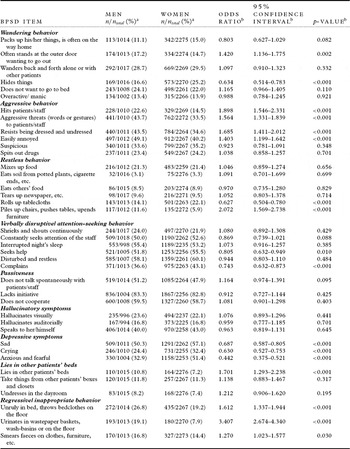
The one-week prevalence of the behavioral and psychological symptom items of the MDDAS are presented in Table 2, together with odds ratios, 95 % confidence intervals and p-values from a multiple logistic regression analysis conducted for each behavior and symptom.
Prevalence of behavioral and psychological symptoms

a For each item, the number of affirmative answers is given first, then the total number of answers to the specific question, then the percentage. Prevalence corresponds to people having exhibited the behavior or symptom at least once during the one-week observation time.
b Corrected for investigation year (1982 or 2000), age, ADL performance (high, medium or low dependency) and level of cognitive impairment (mild, moderate or severe cognitive impairment).
In 17 out of 39 behaviors and symptoms there were significant differences between men and women. In the cluster aggressive behaviors, men more often hit other patients or staff, more often made aggressive threats, resisted being dressed or undressed, and were more often easily annoyed.
Among restless behaviors, women more often rolled up tablecloths, while men more often piled up or overturned chairs or other furniture. Among wandering behaviors, men more often stood at the outer door wanting to go out while women more often hid things. Among symptoms of passiveness or hallucinations there were no differences between the sexes.
All depressive symptoms – being sad, crying, or anxious and fearful – were more common among women. Among verbally disruptive/attention-seeking behaviors women more often sought help and made complaints. Among regressive/inappropriate behavior, men were more often unruly in bed, smeared with faeces and more often urinated in the wrong place, such as in wastepaper baskets or on the floor. Finally, men were more often found lying in other patients' beds.
Discussion
This study supports the assumption that there are some differences between the sexes concerning the prevalence of behavioral and psychological symptoms of dementia. The previously reported finding that aggressive behavior is more common among men (Cohen-Mansfield et al., Reference Cohen-Mansfield, Marx and Werner1992; Eastley and Wilcock, Reference Eastley and Wilcock1997; Menon et al., Reference Menon2001; Schreiner, Reference Schreiner2001; Matsuoka et al., Reference Matsuoka, Miyamoto, Ito and Kurita2003; Buchanan et al., Reference Buchanan, Wang, Ju and Graber2004; Hall and O'Connor, Reference Hall and O'Connor2004) was replicated in this study. This study also showed very clearly that depressive symptoms seem to be more common among women, which corresponds to the higher prevalence of depressive disorders among women (American Psychiatric Association, 2000) and the results of some previous studies (Buchanan et al., Reference Buchanan, Wang, Ju and Graber2004; Steinberg et al., Reference Steinberg2006). Furthermore, we found that some attention-seeking behaviors (complaining, help-seeking) were more common among women, which might correspond to the higher prevalence of depressive symptoms.
Regressive or inappropriate behaviors showed a clear male preponderance, not previously reported. No sex differences were found with regard to hallucinations, in line with previous results (Ropacki and Jeste, Reference Ropacki and Jeste2005), nor in relation to passiveness. The small, but significant, sex differences found within the clusters of wandering behavior and restless behavior is of more doubtful clinical significance.
It is open to discussion whether it is genetic predisposition, hormonal levels or socially learnt behaviors that explain why men with a dementia disorder more often exhibit aggressive behavior. This matter of dispute is connected with the general discussion on male aggression. One interesting view is that frontal inhibition might become affected in people suffering from a dementia disorder thus revealing and enhancing underlying personality patterns which had been suppressed earlier in life. In this study we have simply concluded that aggressive behaviors seem to be more common among men; however, many women also expressed these behaviors.
These different symptom profiles between men and women might to some extent explain the variations found in pharmacological treatment, e.g. antipsychotics for men and antidepressants for women, even though it has previously been shown that they cannot fully explain the differing prevalence of antipsychotic prescribing (Lövheim et al., Reference Lövheim, Sandman, Kallin, Karlsson and Gustafson2006). Another possible interpretation is that the pharmacological treatment masks even greater differences between the sexes.
This study has some limitations. The results of Gottfries' cognitive scale were used to select people having cognitive impairment. Even though most of the people with cognitive impairment probably had a dementia disorder, this is a possible source of error. Regrettably, no registration of dementia diagnosis was made in the current studies. Men and women differed slightly regarding mean cognitive score; however, we judge that the difference found in behaviors and symptoms could not be explained by this difference, since level of cognitive impairment was included into the multivariate logistic regressions, and was therefore controlled for. It is not known whether behavioral and psychological symptoms of dementia affected the stage of the disorder at which men and women respectively entered into geriatric institutional care but this might possibly have affected the results to some degree. This has to be considered when interpreting the results.
The investigation used a combined sample from 1982 and 2000, the rationale being that an increased number of people increases the power of the study. The investigation year was included in the multivariate logistic analyses to control for its possible impact. Our previously published work contains a more thorough discussion on the differences between 1982 and 2000 (Lövheim et al., Reference Lövheim, Sandman, Kallin, Karlsson and Gustafson2008a). We estimate that the combination of two different cross-sectional materials does not significantly affect the main results.
The assessments on which this study is based were made by members of staff at geriatric care facilities. Most assessors were nursing assistants and most of them were probably female. It is possible that staff conceptions about “male” and “female” symptoms affected their assessments, and such conceptions are probably present among both male and female nursing staff. For example aggressive behavior might be more expected from male residents, and exactly the same expression might thus be assessed differently in male and female residents. This too implies the need for extra caution when interpreting the current findings.
In addition, the differences found between the sexes concerning the prevalence of certain symptoms, should not affect the interpretation of symptoms exhibited by any one individual. Every person deserves individualized assessment and treatment.
Conclusion
There are some differences between men and women regarding the prevalence of behavioral and psychological symptoms of dementia. Men seem to be more likely to exhibit aggressive behavior and regressive behaviors, and women seem to be more likely to exhibit depressive symptoms. Passiveness and hallucinations showed no sex differences. These different symptom profiles might partially explain the differences found in the pharmacological treatment of men and women suffering from a dementia disorder, e.g. the prescription of antipsychotics to men and antidepressants to women.
Conflict of interest
None.
Description of authors' roles
All authors were involved in the acquisition of data. H. Lövheim, Y. Gustafson and S. Karlsson analyzed and interpreted the data; H. Lövheim and Y. Gustafson also prepared the manuscript; and P.O. Sandman and S. Karlsson were also responsible for the study concept and design. All authors reviewed the manuscript, added their comments and approved the final version.
Acknowledgments
This study was supported financially by grants from the Umeå University Foundation for Medical Research, the Swedish Foundation for Healthcare Sciences and Allergy Research, the Field Research Centre for the Elderly in Västerbotten, the Swedish Research Council, the Swedish Dementia Association (Stiftelsen Demensfonden) and Erik and Anne-Marie Detlof's Foundation, Umeå University.