Greek ecclesiastical dress has only recently been brought into the art historical spotlight, with a definite focus on the refined artistry of embroidery.Footnote 1 However, this exclusive focus on embroidery falls short of giving us an overall assessment of the period's aesthetic. The almost monothematic treatment of the subject actually prevents us from understanding that Greek ecclesiastical dress in the sixteenth and seventeenth centuries was composite, employing various juxtaposed features. In this article I will attempt to illuminate an obscure corner of ecclesiastical material culture: the wide use of Ottoman woven textiles and its meaning within the specific context during the sixteenth and seventeenth centuries. Dress is undoubtedly one of the most immediate, non-verbal modes of communicating one's status. This point of view can be particularly useful in the specific case study, which focuses on the Greek Church's participation in Ottoman elite culture. The importance of the argument lies in the fact that it helps us to understand that ecclesiastical dress was constructed upon the interplay or confluence between the inherited Byzantine tradition and the Ottoman component, which has hitherto been neglected by scholarship.
My discussion will begin with an analysis of Greek textile terminology, which originates from the Ottoman, as a preparation for the analysis of objects. These terms, unlike their Byzantine counterparts, have hardly been discussed. The contextualization of these Ottoman loanwords will increase our understanding of the relevant vestments that survive in Greek sacristies today. This discussion does not need to be exhaustive, as its focus will be on the three main types of luxury textiles found in ecclesiastical inventories and sacristies: lampas, cloth of gold/silver and velvet.Footnote 2 The textiles to be analysed were worn by clerics either inside a church or in processions, which means they were visible to the wider society as well. In the second part I will open the discussion with some examples of luxurious aniconic textiles used by the Church. I will then continue by touching upon the figural production for the Ottoman Christian market. Finally, I will discuss the transfer of Ottoman motifs to the embroidery production of Greek workshops, as another aspect in this multi-faceted phenomenon.
Introduction: Greek textile terminology of Ottoman origin
Kamouchas, the Greek term for the Ottoman kemha, or higher-quality lampas silk, appears in ecclesiastical inventories even before the conquest of Constantinople.Footnote 3 In the 1396 Patriarchal inventory there are references to chamouchas (‘χαμουχᾶς’) in relation to a yellow-red tunic, a two-colour podea and two chalice covers (‘ποτηροκαλύμματα’).Footnote 4 This reads like an antiquated version of the Greek term kamouchas, which is the one usually found in Ottoman-period ecclesiastical inventories.Footnote 5 Although Greek linguists generally agree that this term derives from kemha, it might be the case that it did not always indicate Ottoman lampas.Footnote 6 Especially in comparison with the late Byzantine period, it is quite probable that a shift in the meaning of certain words took place. For example, the Byzantine courtier Theodore Hyrtakenos, who lived in Constantinople during the reign of Andronikos Palaiologos (r. 1282–1328), requested a cloth named kamkha, ‘in the language of the Persians’, from a Trapezuntine official. This type of luxurious silk produced in the Middle East and China during the late medieval period had reached Italy as well, and was called camoca in Italian.Footnote 7 Chamouchas was probably the Greek rendering of the Persian kamkha, the linguistic origin of kemha. This leaves space for interpretation as to whether the word kamouchas or chamouchas was used during this early period for silk brocades of Islamic or ‘Oriental’ origin in general, and not just Ottoman brocades.Footnote 8 In Ducas’ Historia byzantina there is a clearer reference in relation to Ottoman clothing: one of the writer's criticisms of the clergy on the eve of the fall of Constantinople was their habit of wearing the ‘barbarians’ vestments’ (‘. . .ἄμφια τῶν βαρβάρων τῷ σώματι περιφέρουσαν. . .’).Footnote 9 However, one cannot expect detachment and objectivity from a historical source of this nature, embellished with personal commentaries and views. There is also the well-known document prepared for the Council of Basel (1431-8), based on a report by European emissaries, which mentions that in many parts of Eastern Anatolia the clergy, bishops and archbishops wore the ‘clothes of the infidels’, most probably meaning the Turks.Footnote 10 This provides Ducas’ criticism with some credibility, pointing out that early Ottoman brocades had been used by the Church in the Byzantine capital before its conquest by Mehmed II. Certainly, the honorific exchange of textiles is nothing new within the context of the Eastern Mediterranean, including between Byzantines and Ottomans; some of these recorded acts mention kamouchas.Footnote 11 However, the Church's practices during the Palaiologan period need to be clarified, especially as to whether the antiquated term chamouchas denoted Ottoman or just Oriental brocades in general.
While more light should be shed upon textile consumption during the late Byzantine period, the archival sources matched with the remaining vestments confirm that the Greek Church widely used Ottoman textiles after the conquest of Constantinople. Kamouchas is one of the most popular types of textiles, as is attested to by the evidence of ecclesiastical inventories. The earliest reference I have managed to trace is in a monastic archive, dating to 1486.Footnote 12 By this time, kamouchas probably denoted silks of Ottoman manufacture, as is attested to by the presence of Ottoman kemhas in Greek sacristies. In Martin Crusius’ 1584 Turcograecia, it is mentioned that the Patriarch-elect received a head-dress made of kemha (‘μὲ τὸν καμουχὰν’) from the Byzantine emperor, a custom that Mehmed II was advised to continue by the Greek bishops immediately after the conquest of Constantinople.Footnote 13 The Patriarch's investiture ceremony was probably one of the main ways through which Ottoman brocades found their way into Greek sacristies. This also explains the number of vestments which appear to have been reused.Footnote 14 From the available Ottoman-period archival evidence it seems that by the sixteenth century kamouchas became a term which was far from generic, with the different qualities of silk being noted and understood by the clerics. For example, in the inventory list of Vatopediou Monastery, dating to 1596–8, there are at least five different terms related to silk:Footnote 15 ατλάζη, which probably derives from the Ottoman/Arabic atlas, for sleek satin, used in relation to two objects;Footnote 16 καμουχένιον in relation to more than twenty objects; μετaξοτὰ in relation to six objects;Footnote 17 βλατίου, only in relation to a red cover for a relic of Saint Niphon, Patriarch of Constantinople (in office 1486–8 and 1497–8);Footnote 18 and finally ταυτάς (taffeta), the plain, smooth, silk weave. Therefore, it is evident that the monks’ most preferred quality textile at that time was the kamouchas. As the inventory took place in the last decade of the sixteenth century, this sampling provides a clear view of the consumption practices up to that point.
It is indicative that kamouchas started to appear in eponymous ecclesiastical oblations. In 1574 the Patriarch of Constantinople, Jeremiah II (c. 1530–5), donated vestments to ‘his church’, probably meaning the church that served as the Patriarchate's seat at that time. Kamouchenia is mentioned in relation to two sticharia (tunic-shaped vestments) and five polystavria (dalmatic or chasuble-shaped vestments patterned with crosses).Footnote 19 The latter probably indicates patterned silks for the Christian market, many of which featured a blend of Ottoman motifs and crosses.Footnote 20 In a 1609 letter from the Patriarch of Jerusalem, Sophronius IV of Karkala (in office 1579–1608), accompanying his donation of vestments to the Archbishop of Dimitsana, kamouchas is again mentioned in relation to a sticharion. Sophronius donated the vestments in the hope that his family's name would be listed among the benefactors of the diocese of his origin.Footnote 21 This indicates that the kamouchas was understood to be of acceptable quality for functions including prestigious oblations, and for that reason it was duly noted in the letter.Footnote 22 Overall, the archival evidence matches the many remnants of kemha in Greek sacristies.Footnote 23 A question which naturally arises from the available archival evidence is why the epithet ‘Turkish’ does not appear in relation to kamouchas as often as one would expect, or even at all. This is particularly telling, especially given the popularity of Ottoman silks, as is attested to by their presence in Greek sacristies. My preliminary conclusion is that because these textiles were of a standard quality, they did not have to be noted. On the contrary, if kamouchas had a more generic use as well, provenance was noted – for example, when it was European.Footnote 24
The precious Ottoman cloth of gold, serâser, appears less frequently in ecclesiastical inventories but was certainly not a rarity. From Serres to Mount Athos and its dependencies in Romania, and from Sinai to Thessaly, serâser appears in relation to various vestments and ecclesiastical veils.Footnote 25 Some of the archival evidence is impressive and gives us a clear understanding of the wealth that Greek sacristies used to hoard in precious textiles. In the 1752 inventory list of the Church of the Virgin of the Visitation (Παναγία της Επισκέψεως) in Trikala there is a reference to two serâser sticharia and twelve phelonia made of golden serâser (‘φελόνια σε:/ρασέρια χρυσᾶ 12.’).Footnote 26 The areas of Trikala and Thessaly were prosperous during the Ottoman period but the number of listed vestments made of this extremely costly fabric is still impressive. In the sixteenth-century Ἱστορία τοῦ Ἀγίου Ὄρους Σινᾶ by Paisios, Bishop of Rhodes, there is also a mention of a festive serâser hanging adorned with a star motif in the middle.Footnote 27 Such serâser silks, patterned with large-scale motifs, were usually destined to be used for for ceremonial caftans.Footnote 28 Moreover, the relative popularity of the fabric probably explains how the word ‘σερασερτζής’ (serâserci), as a term used specifically for the seller of these textiles, entered the Greek lexicon at that time.Footnote 29 Serâser is related to the Ottoman sultans in Greek texts written by clerics. In the Ἐπιτομή της Ἱεροκοσμικῆς Ἱστορίας by the Patriarch of Jerusalem Nektarios the Cretan (1677), among the prestigious presents he mentions that Selim I received were serâser silks (‘σερασέρια’).Footnote 30 Wearing serâser as an honorific gesture for the reception of exalted guests was also noted in the narrative poem by Ioakeim Kyprios, which is another indication of the significance of this textile in Greek culture.Footnote 31
In relation to velvet, the two most frequently used terms are βελούδο(ν), from the Venetian veludo, and, more often, κατηφές/καντηφές, from the Turkish kadife.Footnote 32 It is unclear whether the linguistic origin of these terms always corresponded to the described object's provenance. For example, in the inventory of the sacristy at Vatopediou Monastery there is a reference to a phelonion and sticharia made of βελούδο(ν) but no Italian velvet survives.Footnote 33 Surprisingly, and despite its significant presence in Greek sacristies, çatma does not appear in inventory lists. The difference between kadife and çatma was quite important, the latter being rich in metallic threads and therefore more precious.Footnote 34 It seems that the Greek-language derivatives of kadife were generic terms for velvet, whether it was Ottoman or not. Overall, it can be concluded that while many Greek terms for textiles derived from Ottoman, their use in textual descriptions did not always denote an Ottoman provenance. However, the many Ottoman remnants in Greek sacristies potentially imply that these terms became generic precisely because of the popularity of these specific types of Ottoman textiles.
Aniconic silks and velvets: passive acceptance or active employment of Ottoman aesthetic?
Beyond the archival evidence, the many relevant, surviving remnants of aniconic Ottoman silks and velvets confirm that one of the most important changes in ecclesiastical material culture after the fall of Constantinople was their widespread use. This first point of close contact between the Ottoman aesthetic and Greek clerical costume raises the question as to whether this consumption practice constituted an acceptance of the period's aesthetic or an employment of elements from the government's public image. As historical background, the gradual integration of the Greek Church into the Ottoman bureaucracy, a slow process completed only in the eighteenth century, is certainly relevant.Footnote 35 Apart from official documents, art history can provide a supplementary insight into this process. Clerical vestments made of Ottoman textiles should be examined in light of the social symbolism they conveyed. For example, if holy figures are represented wearing garments made of Ottoman textiles in sixteenth- and seventeenth-century icons and church murals, one should reflect on the meaning of these representations.Footnote 36 Byzantinists have pointed out how the representation of angels wearing Byzantine imperial garments had a meaning related to political and religious metaphor.Footnote 37 Greek religious painting respected this convention by updating it: the dress of the Ottoman Christian elite became the new model, and Byzantine features were replaced by Ottoman ones in the depiction of the holy figures.Footnote 38 Within this framework, I would suggest that the Church's use of aniconic Ottoman textiles leaned more towards employment and less towards passive acceptance. The shape of the vestments sufficed to give them a ‘Christian’ appearance, while the social message conveyed by the Ottoman silk functioned on a different and more secular level. In this way, the figural narrative communicated by Christian iconography and shapes is complemented by a narrative of aniconic motifs. The aniconic visual language of the Ottoman classical style, as formed in the sixteenth century, was devoid of an immediate message that might infringe the dogma.Footnote 39 Nevertheless, it conveyed the social message of an alignment with the Ottoman court aesthetic.
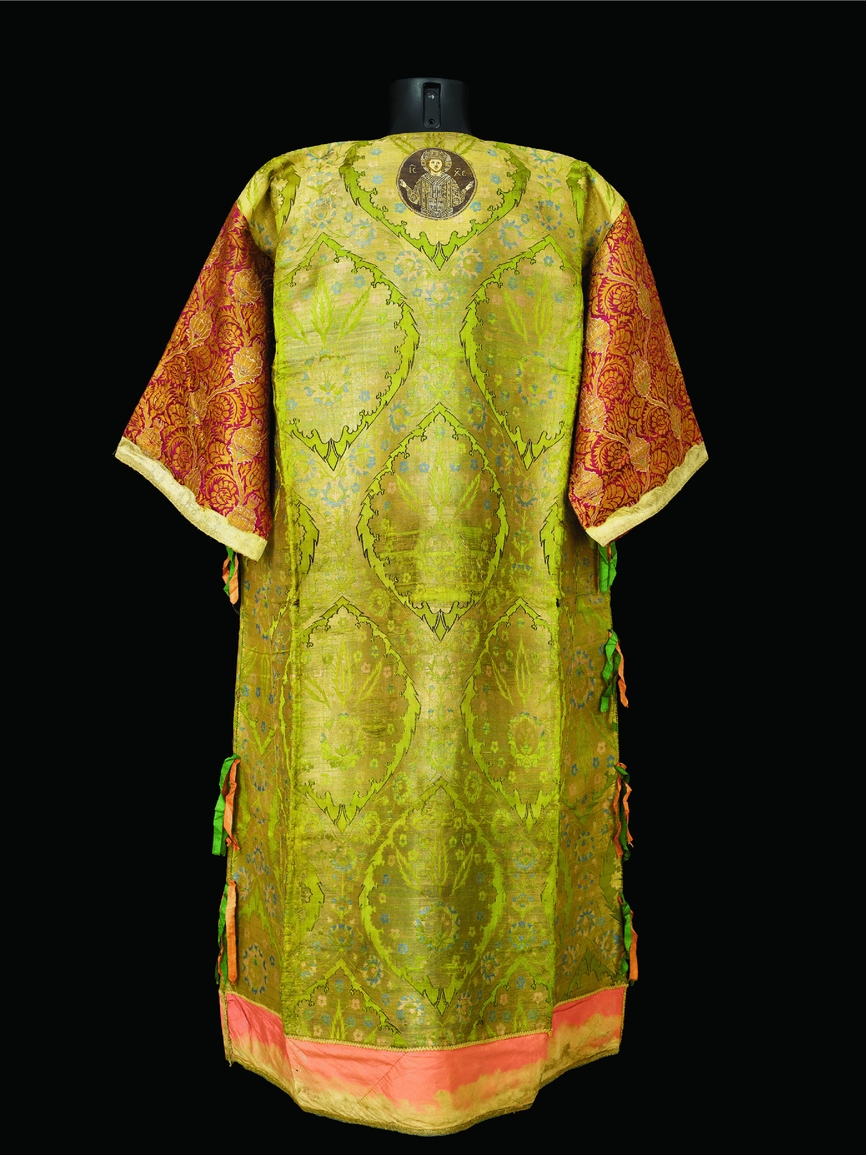
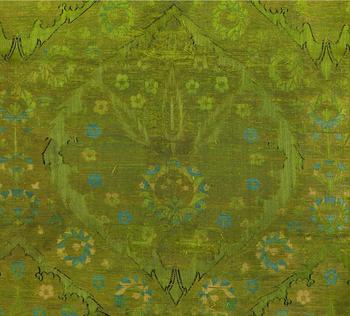
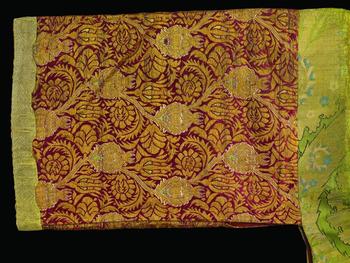
Turning now to discussing vestments, floral patterns, which exemplify the aniconicity desired by the Ottoman aesthetic, were among the most popular motifs.Footnote 40 At Iveron Monastery there is a sticharion, the main body of which is made of sixteenth-century green silver-thread kemha (Fig. 1).Footnote 41 In an unpublished note dating to 1595 (codex 240, f. 4r), I was able to identify a previously unknown but directly relevant donation: a cantor named Manuel donated a sticharion made of green kamoucha.Footnote 42 The style of the kemha is patterned with a central ogee, dominated by a sizeable lotus bud and triple cypresses above it, while the interstices are filled with graceful chains of smaller lotus buds (Fig. 2).Footnote 43 This style, based on floral and vegetal arabesque of ultimately Chinese origin, was known in Ottoman Turkish as hatayi and appears in Greek sacristy inventories as χεταΐ and χαταΐ.Footnote 44 This serves as proof, among much other evidence, that the Greek Church could distinguish not only between the quality of the textiles but also between the different motifs and styles. Relevant to the popularity of the hatayi motifs is a sakkos, which according to oral tradition is associated with the tenth-century Byzantine emperor Ioannis I Tzimiskes (c. 925–6). It is made of Italian velvet spolia and decorated with what might be embroidery, crafted by the monks themselves. The embroidered chains of floral motifs on the upper part of the garment are closely reminiscent of the lotus buds on the sticharion depicted in Figure 2, indicating how the dynamic of transfer functioned in relation to embroidery, an issue analysed later in this article.Footnote 45 The sleeves of the sticharion are made of a probably contemporary kemha silk, decorated with a wavy grid, densely filled with rosebuds, leaves and other floral motifs (Fig. 3). Using one textile as the primary constituent of the main body of the vestment, and another for the sleeves, was by no means exceptional; on the contrary, it was standard practice for the Greek Church.Footnote 46 This tailoring practice significantly contrasts with the way Ottoman court caftans were cut and tailored. To conclude the analysis of this piece, it is worth discussing its dominant colour: green. The fact that quite a few sixteenth- and seventeenth-century vestments were made of luxurious green silks, in theory related to notions of Islamic piety and supposedly forbidden for Christians, clearly puts this rule into question; at the very least it reveals its limitations.Footnote 47
Sticharion. Main body, sixteenth century or later, silver-thread kemha; sleeves, sixteenth century or later, silver-thread kemha. © Iveron Monastery (inv. no. 197; photograph: Thanos Kartsoglou). Unpublished.
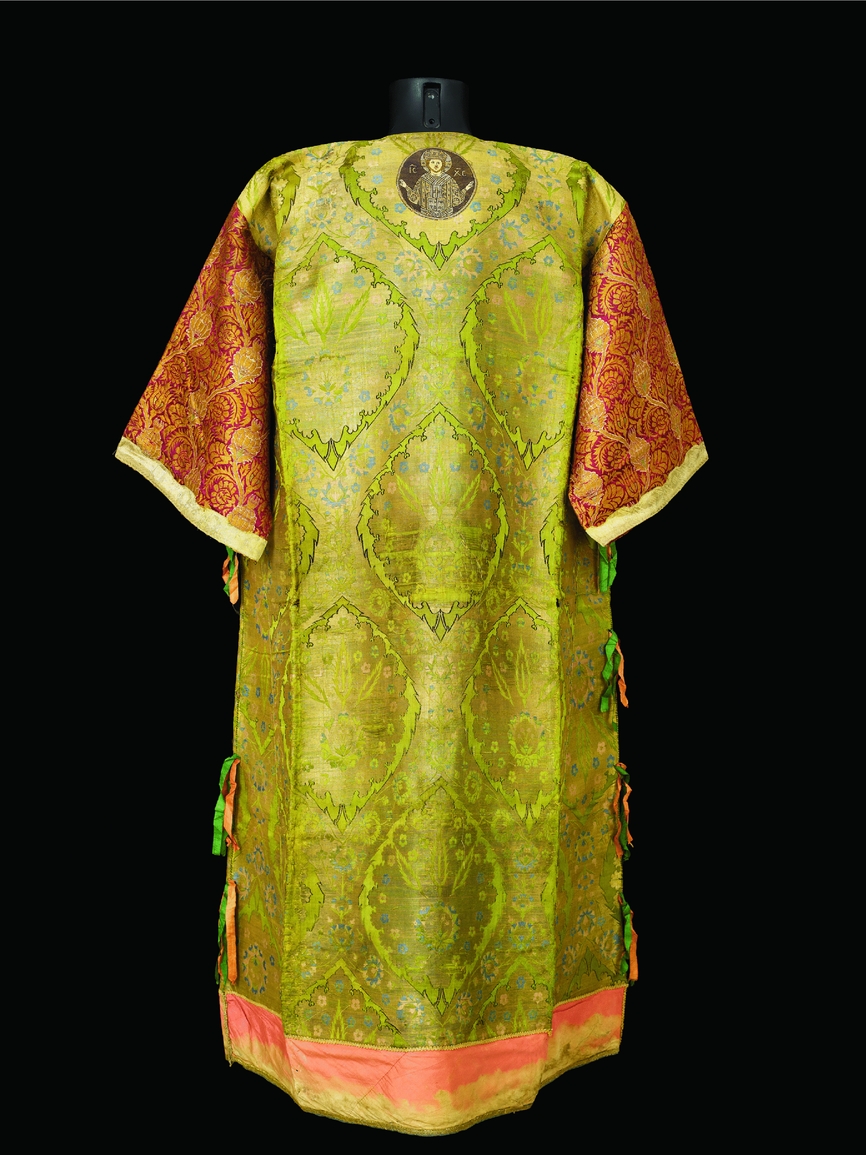
Detail of Fig. 1. © Iveron Monastery (inv. no. 197; photograph: Thanos Kartsoglou).

Detail of Fig. 1. © Iveron Monastery (inv. no. 197; photograph: Thanos Kartsoglou).

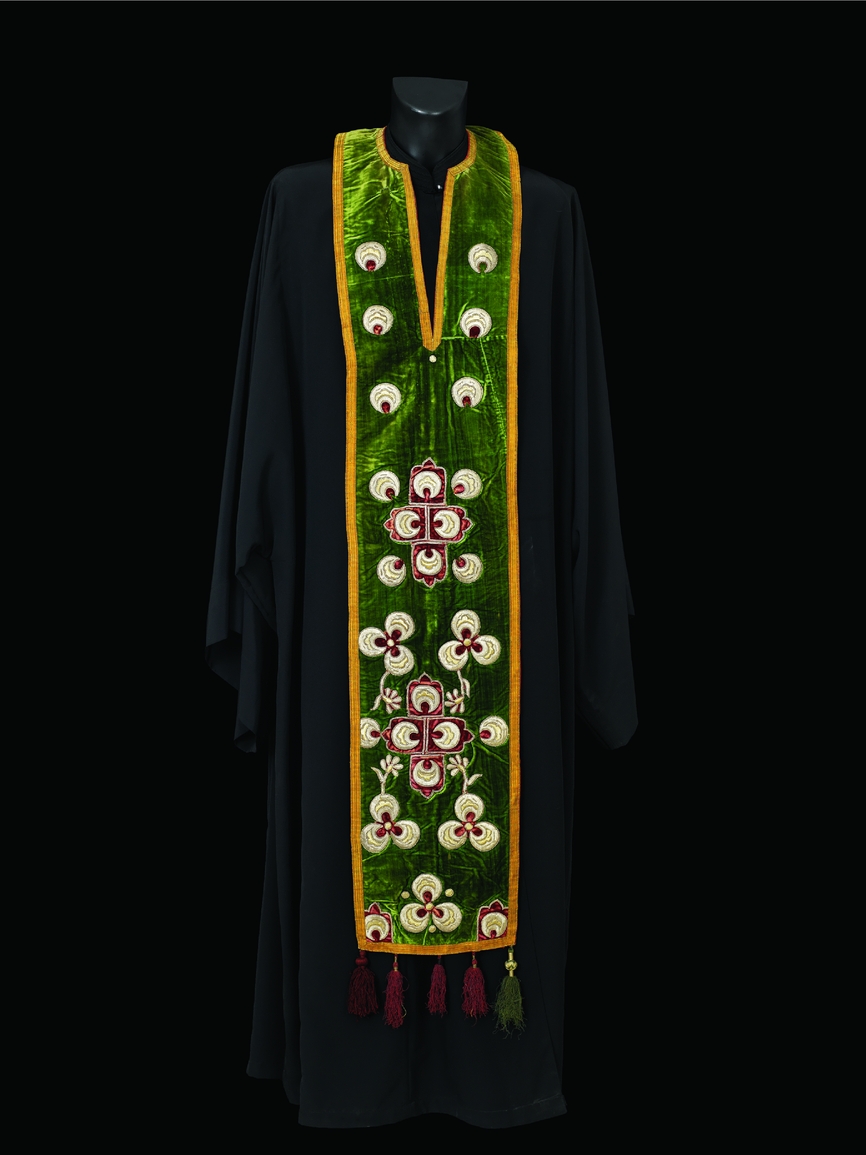
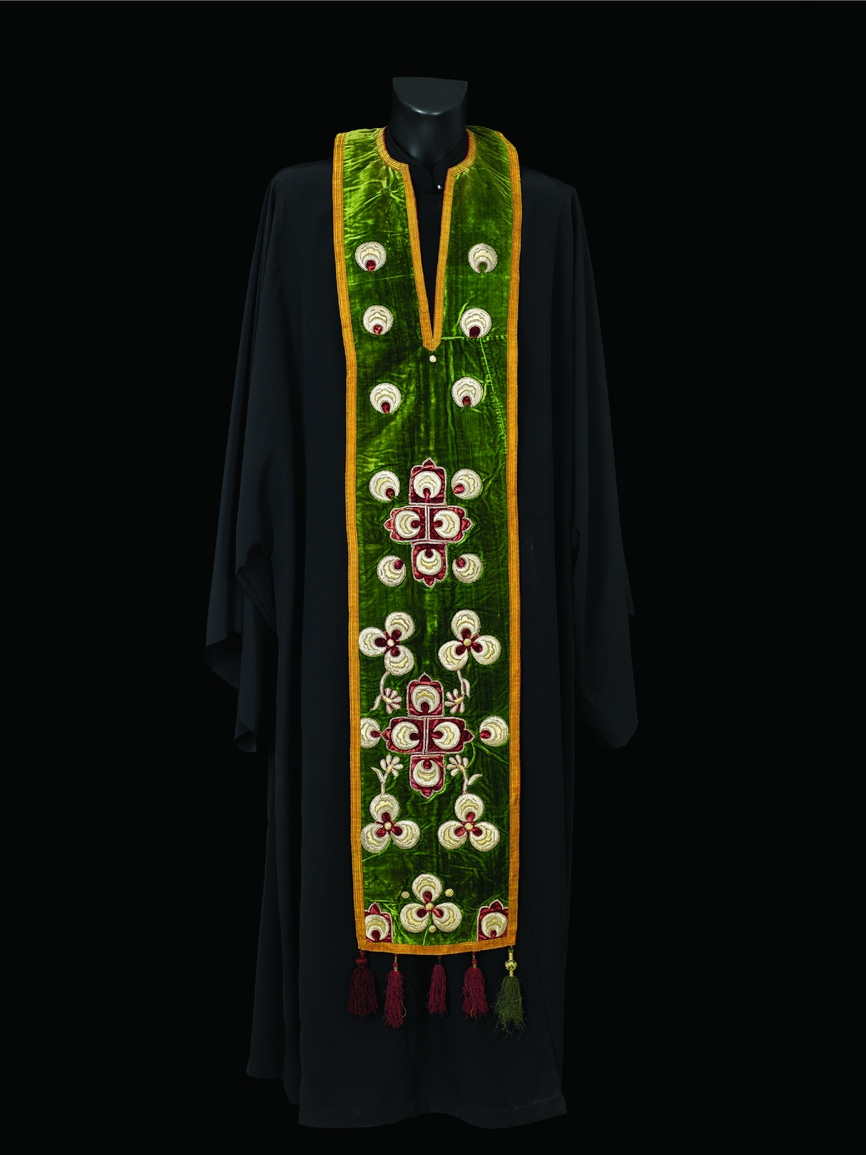
In the same monastery there is another vestment where green is again the dominant colour: a velvet epitrachelion, heavily embroidered with silver and gilded wire (Fig. 4).Footnote 48 The green velvet is a simple kadife, not çatma, which is rich in metallic threads. It is the heavy embroidery that increases its luxuriousness, making it a prestigious object. The large-scale, triple-spot motif is paired with crescents of a smaller scale than those usually found on kemha and serâser.Footnote 49 It can be safely stated that the triple-spot became one of the most celebrated motifs in Greek vestments and ecclesiastical fabrics after the fall of Constantinople.Footnote 50 Crescents, on the other hand, were not absent from the repertoire of Ottoman motifs employed by the Greek Church, but instead, from the published or known examples, it seems that they certainly did not surpass the triple-spots in popularity.Footnote 51 The simplicity of the embroidery's technique, without any indicative stitches or knots, does not provide much information regarding the workshop. It was probably preferred for its motif, which was such a central part of the Ottoman aesthetic of that period. This is especially true as the value of the triple-spots, with an almost ‘heraldic’ meaning for a dynasty that did not have blazons, was readily understood by all the echelons of Ottoman society.Footnote 52
Epitrachelion. Sixteenth century or later kadife velvet, heavily embroidered with silver and gilded wire. © Iveron Monastery (inv. no. 36; photograph: Thanos Kartsoglou). Unpublished.
Ottoman silks for the Christian market: Byzantine iconographic prototypes and Ottoman execution
Another point of contact is Ottoman production for the Christian market.Footnote 53 The range of textile qualities, from simple satins to costly serâser, and the amount of relevant remnants in sacristies betrays the success of the production and its penetration into the Greek cultural realm, apart from the Armenian and Eastern European spheres.Footnote 54 The best-known silks are kemha patterned with Christ as the High Priest within roundels. This flat motif has been rightly associated with the corresponding iconographic type that rose to prominence during the Palaiologan era, the time when Byzantium as a political entity was declining and the Patriarch of Constantinopole became an ecumenical symbol of Orthodox unity. This was most probably the meaning intended by representing the crowned Christ in Patriarchal attire on Ottoman patterned silks.Footnote 55 Undoubtedly, the need for Christian iconography was fulfilled in a very different way from that of the Byzantine system of symbolism, which favoured the uniqueness of holy figures and clear theological meaning via a very complex network of cross-references between a vestment's iconography and church interiors.Footnote 56 While the popularity of the High Priest motif is explained by the rise to prominence of the figure of the Patriarch, a question remains as to the way Christian iconography was reproduced when compared to embroidery of the Byzantine tradition.
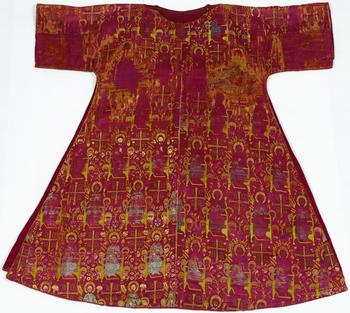
The RISD Museum sakkos may clarify our discussion (Fig. 5).Footnote 57 Its Ottoman silk is patterned with a representation of the enthroned Christ, flanked by symbols of the four evangelists, against a background of rich floral decoration. Not many sakkoi survive from the Byzantine period and this makes it difficult to trace their evolution during the Ottoman period.Footnote 58 However, there are references in Byzantine ecclesiastical inventories which can give us a view of this evolution – incomplete, yet sufficient for my analytical overview. In the aforementioned inventory of the Constantinopolitan Patriarchate, there is a reference to a sakkos decorated with ivy leaves and twelve figures of saints.Footnote 59 This description of a blend of floral motifs and Christian iconography calls to mind, to a certain extent, the silk of the Rhode Island sakkos, which could be interpreted as an evolution or updated version of the described composition.Footnote 60 The Ottoman floral motifs replace the ivy leaves in the role of the decorative background or frame, but the most fundamental change appears in the way that the iconographic prototype of the enthroned Christ, framed by symbols of the four evangelists, unfolds: as a repeating, medium-scale motif.Footnote 61 This practice recalls the way in which narrative evolved in other Middle Eastern figural productions, for instance in Persian examples.Footnote 62 We see that while the source of these patterns is Byzantine, a certain degree of liberation is achieved from the standard way iconography was reproduced on Christian vestments during the late Byzantine era. The result is reduced iconicity, thanks to the motif's repetition and the lack of framing around it. Beyond the religious symbolism that each and every Byzantine iconographic type of Ottoman production probably conveyed, their reduction to repeating motifs indicates their quality as markers of Christian identity. Just like the Ottomans, who did not have a blazon, but were associated with a distinctive visual language, the Greek clergy accepted designs which may have leaned upon Byzantine iconography, and simplified the process of communicating religious meaning. This was probably not the outcome of a conscious bypassing of traditional theology but instead the practical result of the Church's affiliation with Ottoman weaving workshops.
Sakkos. Sixteenth century or later kemha. © Rhode Island Museum of Art (inv. no. 28.008).

Ottoman motifs in ecclesiastical embroidery produced by Greek workshops
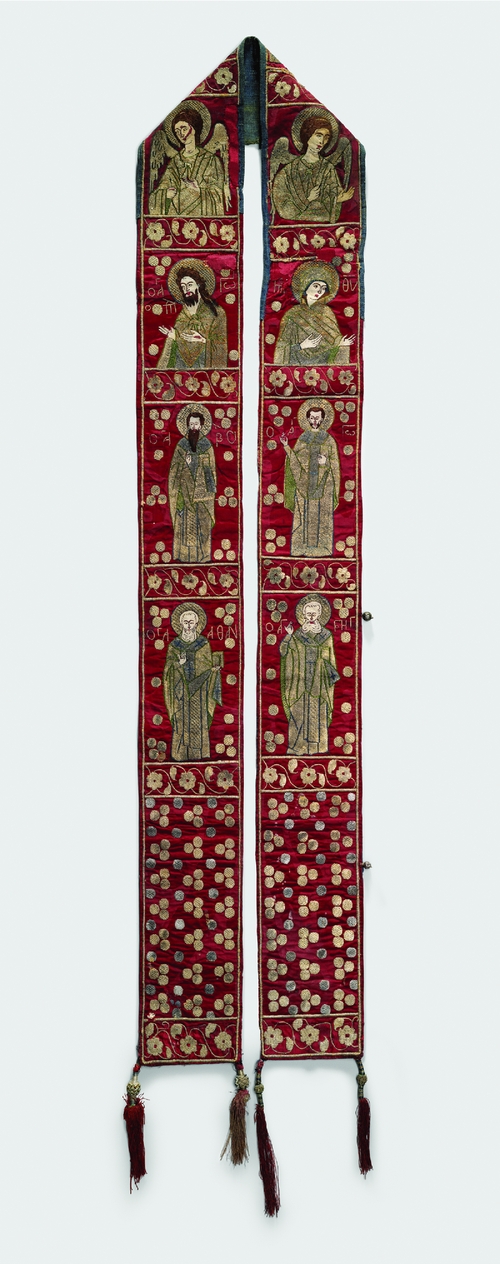
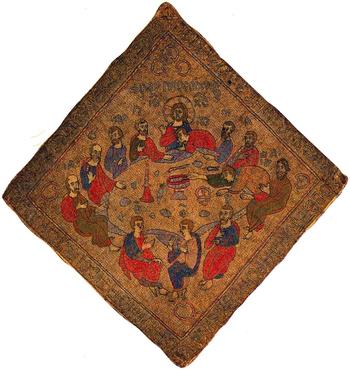
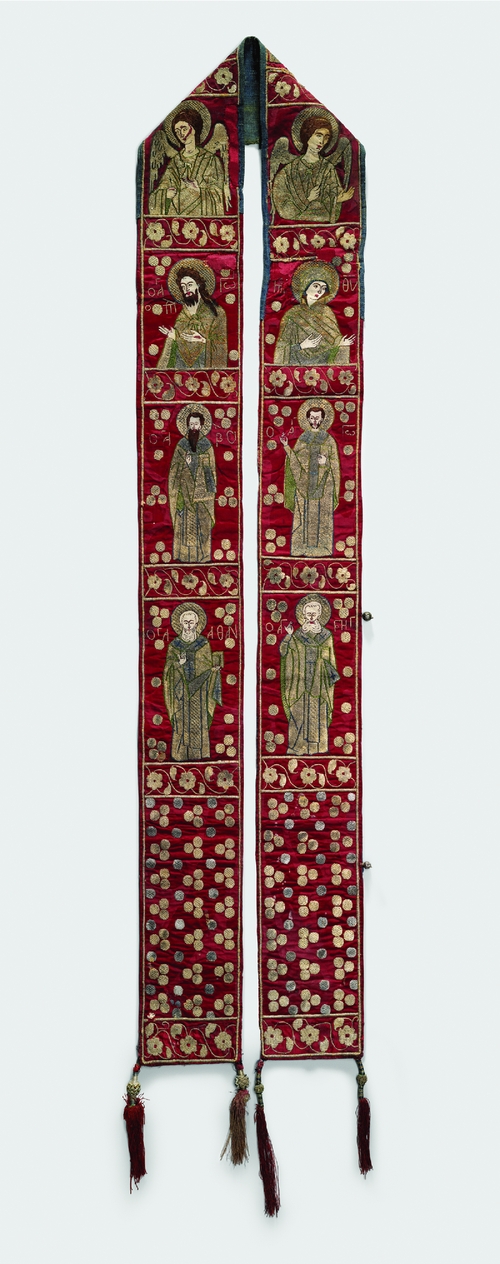
The final point of contact analysed here is the presence of Ottoman motifs in the works of Greek embroidery workshops. Ecclesiastical embroidery was a Byzantine craft which continued to flourish after the fall of Constantinople. Its receptivity allowed creative reworking of elements from other artistic traditions and the transfer or adaptation of motifs and iconography from both Western and Eastern sources. In the case of Ottoman motifs, it should be made clear that it is not a question of foreign loans but instead of an update to local fashions of the period under study. During the fifteenth and sixteenth centuries the compositions continued to present a Byzantine aesthetic;Footnote 63 loans from Italian and other European iconography are more apparent from the second half of the seventeenth century onwards.Footnote 64 By contrast, the incorporation of aniconic decoration with Ottoman motifs had already become common from the earlier period. The first point of artistic contact was that embroidered figural vestments were worn together with the woven silks analysed above. For example, an orarion should be imagined as being worn together with a sticharion made of a woven silk.Footnote 65 Many stole-like vestments, such as the orarion or the epitrachelion, were embroidered with figural representations of saints that followed a Byzantine system of symbolism. Generally speaking, in stole-like vestments Ottoman motifs appear in the lower part and as a frame around the holy figures. In an orarion in the Boston Museum of Arts, the dominant Ottoman motif is that of the triple-spot (Fig. 6).Footnote 66 The triple-spots appear prominently again above Christ on an epigonation, depicting the Last Supper, now in the Paul and Alexandra Kanellopoulos Museum in Athens (Fig. 7).Footnote 67
Epitrachelion. Sixteenth century, embroidery on red silk. © Boston Museum of Arts (inv. no. 43.337).
Epigonation. Sixteenth century, embroidery. © Kanellopoulos Museum (inv. no. ΔΑ2614; image courtesy of the Ephorate of Antiquities of Athens).

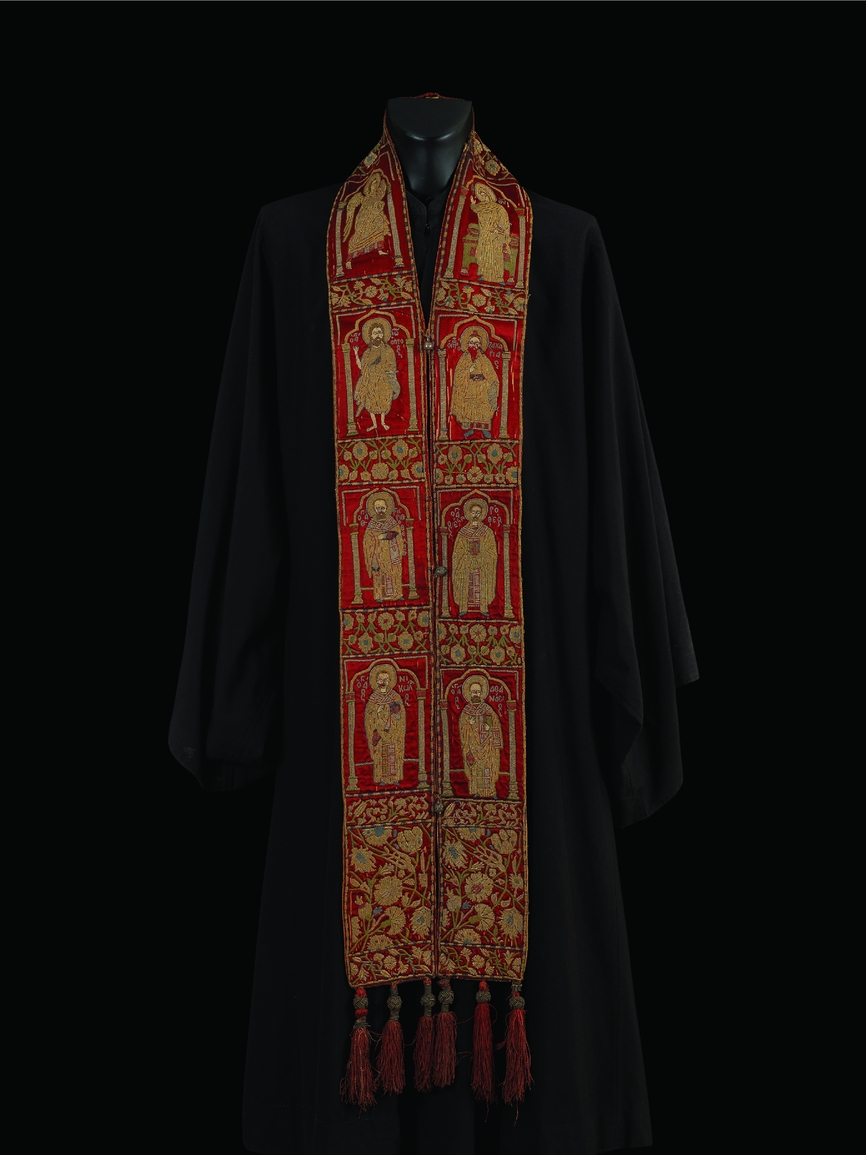
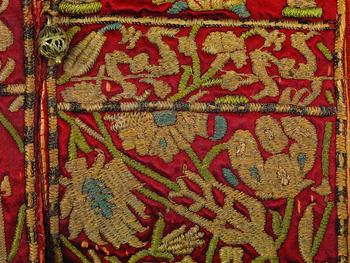
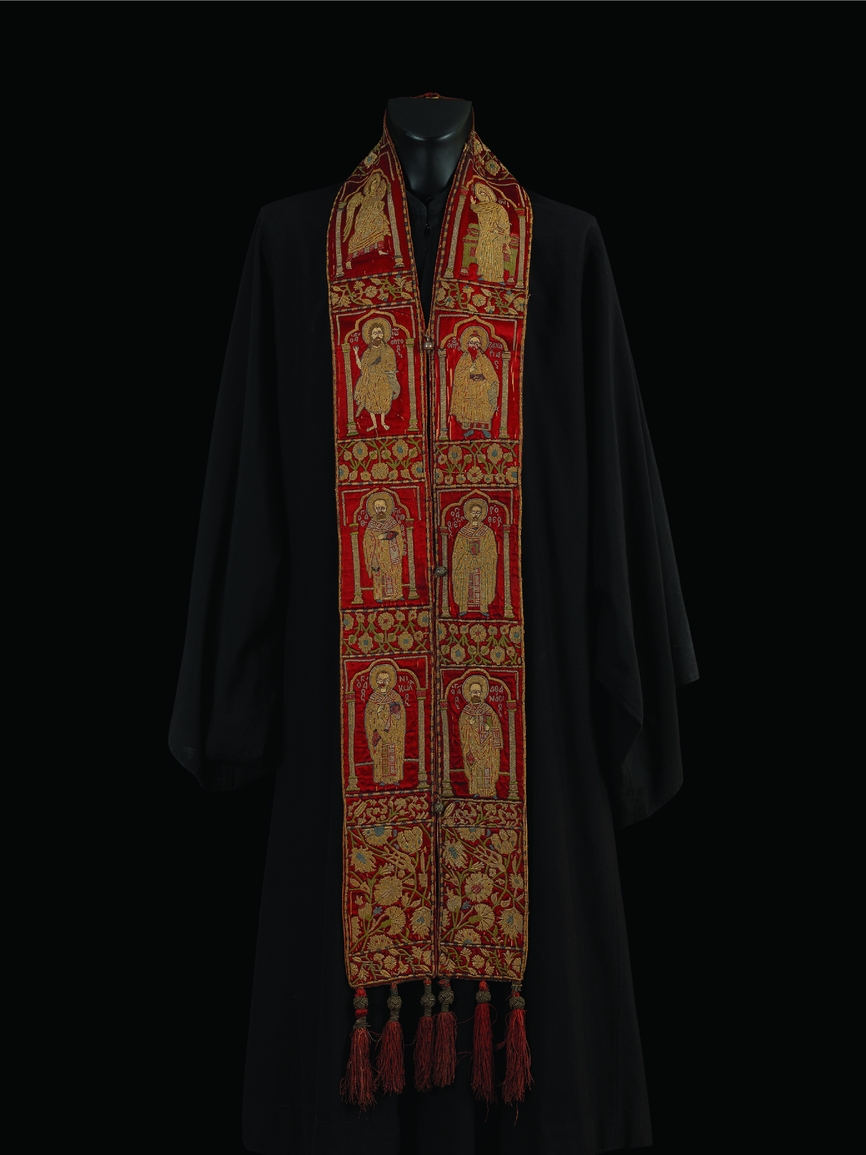
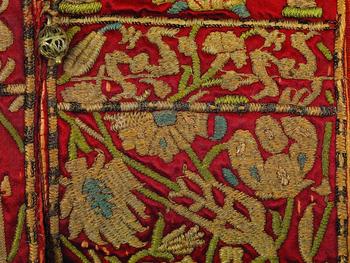
Apart from the creative aspect of the transfer of motifs, and their re-employment as a frame for holy figures, one should return to the representation of saints and angels dressed in silks that feature these motifs. Embroidery seems to replicate this mechanism of cross-references between the visual landscape (icons, frescos and so forth) and clerical vestments. Thus, in the Ottoman period, there are two distinct narratives that blend and/or intertwine: one of figural iconography, and another of aniconic motifs, which mainly stem from the Ottoman aesthetic. It seems that in certain cases embroidery largely copied designs from silks in the same environment, for example the sakkos of Tzimiskes in Iveron monastery.Footnote 68 In other cases, embroidery followed the same creative rendering of Ottoman designs, just as in religious painting. An epitrachelion from Vatopediou Monastery is indicative: floral motifs, such as the rosebud and Chinese ribbons, appear in a dense reinterpretation of compositions in silks. As such, it conveys a clear message that an Ottoman style is intended, despite the reworking of motifs (Figs. 8 and 9).Footnote 69
Epitrachelion. Sixteenth century or later, metal thread embroidery. © Vatopediou Monastery (inv. no. 203; photograph: Thanos Kartsogou).
Detail of Fig. 8. © Vatopediou Monastery (inv. no. 203; photograph: Thanos Kartsoglou).
Conclusion
In this article we have seen that Ottoman-derived terminology associated with Greek textiles may not always denote Ottoman provenance; the meanings were certainly not as fixed in Greek as they were in Ottoman. However, these loanwords certainly betray how widespread the use of these textiles was. Kamouchas probably stood for all metallic-thread silk brocades, with the remnants in Greek sacristies clarifying the Church's consumption practices. Moreover, the preference for Ottoman textiles points to an employment of the aniconic aesthetic associated with the court. In this way, another narrative is created, that of motifs, which were used for framing Christian iconography and melding with the Byzantine tradition. Whether it was Ottoman aniconic silks used for a vestment or Ottoman motifs appearing in Byzantine-style embroidery, the social message that these motifs communicated was always present. The figural silks, on the other hand, present a very interesting innovation: the way that religious meaning was conveyed became simpler, especially when compared with Byzantine embroidery. These three points of contact occurred at the heart of the cultural ferments that took place after the Ottoman conquest of Constantinople and for that reason they are very important. Essentially, their analysis reveals how multi-layered cultural interaction between a religious minority and its heterodox government can be, illuminating the subtleties and bidirectional dynamic of their symbiosis.