I. INTRODUCTION
One of the dark realities of the twenty-first century is that no less than twelve million adults and children are trafficked around the world.Footnote 1 Trafficked persons are often exploited for domestic and involuntary servitude, begging, organ-trafficking, the formation of militia, and the conscription of children.Footnote 2 Such exploitation severely violates the right to life, freedom, the dignity of human labour, and other fundamental human rights. This is a fast-growing illegal business in the era of globalization, liberalization, and privatization.Footnote 3 While exact data are unavailable, the business of human trafficking is estimated to fetch gross revenue comparable to that of the arms and drugs trade,Footnote 4 but may surpass them in the future.Footnote 5 Human traffickers have been found to be closely linked to organized crime and corruption in governments.Footnote 6 It has therefore become a challenge for the legal machinery to convict the persons involved and at the same time prevent the occurrence of this menace.
II. EXISTING LEGAL REGIMES AND PROBLEMS
In human trafficking, persons are not migrating voluntarily, they are either forced to migrate, lured to migrate, or are not informed of the nature of promised work in the foreign country.Footnote 7 In this process, they, at times, fall in the trap of organized gangs of criminals operating in more than one national jurisdiction. Laws devised to control trafficking in persons have often met with failure as evidenced by the data on the actual prosecution of human traffickers. This failure exists even in those countries where the legal system is advanced, which I will refer to in the last section of this paper. Viewing the law on trafficking in persons in the light of involuntary migration in search of better living conditions, this paper aims to theorize the different types of legal regimes existing at national, regional, and international levels.
Three themes, on which the present legal structure on trafficking in persons is based, run like a golden thread in the whole discussion, namely the substantial links between human trafficking and organized crime, the protection of the victim’s human rights in the destination country and the state of origin, and the responsibilities of states, companies, and business firms. In this paper, I have explored and analyzed the limitations of existing legal regime in controlling human trafficking in present times, as well as the presence and absence of these three testing themes. I have also suggested possible alternatives and structures which might improve the efficacy of law in prosecuting the offenders and protecting the rights of the victims. Starting with this thematic journey through different legal regimes, my research focuses on long-term solutions, based on the stakeholders’ responsibility, with a victim-oriented human rights approach and the fundamental tenets of “prosecution, prevention, and protection”.
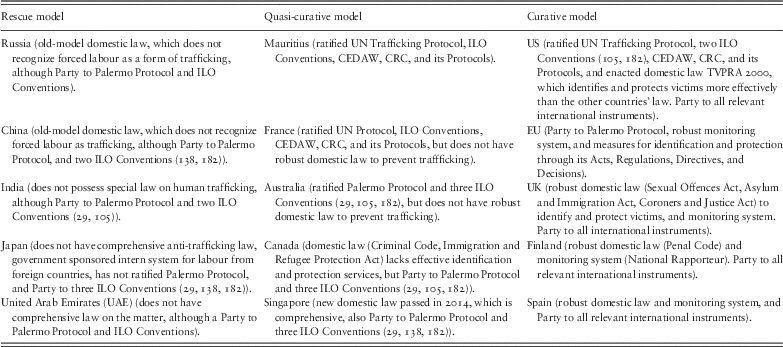
Another perspective utilized in this analysis is called the “problem-solving approach”, in which governments, the private sector, and individuals must undertake to share the burden or responsibility to solve the problem of human trafficking. To promote equitable development in the world, the wide differences amongst the nations and the nationals have to be bridged. This is possible only when the nation-states resolve to take all necessary measures to protect, prosecute, and punish traffickers, when the private sector makes promises to include anti-human trafficking policies in their corporate affairs, and when individuals decide not to buy trafficked sex and labour. Apart from a comprehensive survey of the existing literature, this paper attempts to take an innovative problem-solving approach to theorize this possibility. It would not be possible to carry out such theorization through a study of all of the legal systems of the world. Instead, I have selected some international and regional Conventions, treaties, and also some domestic legislation, compiled by the Protection ProjectFootnote 8 and the Trafficking in Persons [TIP] ReportsFootnote 9 to provide examples for my analysis and to test my theory. I have divided the existing legal regimes on human trafficking into three different models: rescue, quasi-curative, and curative (see Table 1). This division is based on thematic elements found in the models. Each of these models is discussed in brief detail in the next sections.
Existing models of law on human trafficking in selected countries.

A. The Rescue Model
The “rescue model” is the first model of existing legal regime to deal with trafficking in persons. Mostly used in the medical and disaster management areas, the term “rescue” connotes that the approach of the legal regime is to save the trafficked victims from the control of traffickers and to punish the latter.
Trafficking in persons is defined, in this model, as trafficking for the purpose of sexual exploitation of women and children. Such a definition is one-dimensional, as it takes into account only one aspect of the complex and evolving world of human trafficking. The various reports on human trafficking now tend to point out that trafficking for purposes other than sex constitutes more than half of the total number of trafficked people.Footnote 10 Unless the definition of human trafficking takes into account trafficking for the exploitation of labour, it will not be successful in addressing the problem comprehensively. Examples of the rescue approach on trafficking in persons can be found in the United Nations Conventions on human trafficking prior to 2000 (e.g. the 1904 Agreement for the Suppression of the White Slave Traffic,Footnote 11 the 1910 International Convention for the Suppression of White Slave Traffic,Footnote 12 the 1921 Convention for the Suppression of Traffic in Women and Children,Footnote 13 the 1933 Convention for the Suppression of the Traffic in Women of Full Age,Footnote 14 the 1949 Convention for the Suppression of the Traffic in Persons and of the Exploitation of the Prostitution of Others,Footnote 15 the South Asian Association for Regional Cooperation [SAARC] Convention on Preventing and Combating Trafficking in Women and Children for Prostitution 2002,Footnote 16 India’s Immoral Traffic (Prevention) Act 1956,Footnote 17 Bangladesh’s Suppression of Immoral Trafficking Act 1933,Footnote 18 Japan’s Prostitution Prevention Law 1956,Footnote 19 and Criminal Law of People’s Republic of China 1979.Footnote 20
This legal model does not recognize possible linkages between human trafficking and organized crime. In contrast with the other legal models, this model represents a simpler analysis of the whole gamut of trafficking by laying down stringent provisions only for the prosecution of pimps, brothel owners, and the procurer, who are at the lower end of the chain of human traffickers. The whole chain of traffickers present in trafficking for sexual exploitation—such as kingpin traffickers, harbourers, and recruiters—is left out. The organized and transnational nature of the business of human trafficking is also not recognized in this model. The nations that follow this model have not established a fully fledged investigative agency to investigate the organized nature of the acts of a line of connected traffickers. As a result, conspirators, planners, and masterminds are not prosecuted under this model. While the problem of organized crime may not be intricately linked with the human trafficking business in China, South Asia, and Southeast Asia, it does not mean that there is no link at all between the human trafficking industry and organized crime.Footnote 21 Hence, a legal model which does not recognize the linkages between human trafficking and organized crime cannot be successful and efficient in addressing the problem.
Considering the model vis-à-vis victims and witnesses, it can further be stated that this legal model at best “rescues” the victims of human trafficking in a limited way. First of all, the victims are identified according to the unidimensional definition of trafficking in persons, resulting in a limited number of instances where trafficked victims are identified. Second, the identified victims do not enjoy the protection of modern international human rights law.Footnote 22 The human rights regime, in other words, is not built into this legal model, although it might be found in the constitutions of many of the countries that adopt this model. Also, constitutional remedies are available to the citizens of the country but not the foreigners who might also be victims of trafficking. Most of the norms laid down in the context of human trafficking are derived from human rights standards laid down in the International Covenant on Civil and Political Rights [ICCPR],Footnote 23 the International Covenant on Economic, Social, and Cultural Rights [ICESCR],Footnote 24 the Convention on the Elimination of All Forms of Discrimination Against Women [CEDAW],Footnote 25 the Convention on the Rights of the Child [CRC],Footnote 26 the European Convention on Human Rights [ECHR],Footnote 27 and the American Convention on Human Rights [ACHR].Footnote 28 Such rights include the right of access to health services; the right of education with proper protection from traffickers; the right of access to the free labour market, legal aid to needy victims, and protection of identity during court proceedings, etc. These special categories of human rights are not specifically found in this model of law.
The right to a reflection period is necessary to recuperate from the trauma suffered by the victim in the hands of the traffickers.Footnote 29 It helps the victim become a human agent in the eyes of the law.Footnote 30 In the rescue model, victims are not considered as independent actors endowed with rights and reason. They are viewed as vulnerable beings in need of protection from the “evils of prostitution”.Footnote 31 This reflection period should be independent of immigration status, nationality, and whether the victim is willing to co-operate with the authorities or not. During the reflection period, the victim should get proper physical and psychological health services, counselling, and protection from the traffickers. Once the reflection period is over and the victim has reasonably recuperated from the trauma suffered earlier, and is willing to co-operate with the authorities in the prosecution of offenders, the special nature of human rights should be applicable thereafter.
However, in the rescue model, no such special category of human rights is available to the victim, and the victims have to depend upon their constitutional rights if they are nationals of the country, or upon the state authorities if they are not nationals. For instance, in the 1949 United Nations Convention for the Suppression of the Traffic in Persons and of the Exploitation of the Prostitution of Others, it was provided under Article 19 that State Parties to the Convention were obliged to make suitable provisions for the temporary care and maintenance pending the completion of arrangements for the repatriation of destitute victims of international traffic in persons. This rule did not oblige the Member States to the Convention to provide any rights to the victim or the witnesses; rather the authorities had the duty to provide care to the victims until repatriation. As a result, the victims of other countries find it very hard to recuperate from the trauma even when they are in the safe hands of state agencies.
In this legal model, preventive measures to be taken up by states are not inbuilt either. The task of prevention is left to other government agencies, which act as caregivers and adopt the parental approach. Human trafficking takes place because there is a huge demand for cheap labour, whether for sex or for other services.Footnote 32 Unless the demand side is controlled by law, prevention would not be successful in toto. Those who solicit cheap sex and labour with the knowledge that the person might be trafficked must face legal accountability.Footnote 33 This tool is considered to be an important preventive tool in those Western countries where demand is relatively higher and the state is prepared for a long-term plan of prevention. In fact, Sweden and the Netherlands have already passed domestic legislation to criminalize purchasers of sexual services.Footnote 34 However, in the rescue model, this legal tool is seldom used by law-makers. Ironically, women involved in soliciting clients for sex are almost always charged and prosecuted by law enforcement officers. Such an approach victimizes the victim again, which is counter-productive in the fight against human traffickers.Footnote 35
Other preventive measures, such as placing responsibility on states, corporations, and business firms involved either directly or indirectly in human trafficking, are also not found in this model. Considering that trafficking in persons takes place to exploit cheap labour, it may also be assumed that officials of states, companies, firms, or other such legal persons might be, directly or indirectly, involved in human trafficking.Footnote 36 In today’s era of globalization, privatization, and liberalization, each multinational company tries to compete with others to remain ahead in the market. This is possible when their product would be cheaper than that of their competitors. Inevitably, in the race for producing and procuring cheap goods, such legal persons might fall prey to the incentive offered by trafficked cheap labour. In such a situation, these legal persons should be held responsible for human trafficking. In fact, the U.S. Department of Labor maintains a list of goods and their source countries which it has reason to believe are produced by child labour or forced labour in violation of international standards.Footnote 37 Many transnational companies, such as Wal-Mart, Target, and Adidas have been reported to source their goods from trafficked labour.Footnote 38 In the rescue model of law for human trafficking, such responsibility does not reside in the legal persons in the existing law on human trafficking. That leaves the door wide open for the legal persons to exploit the prospective victims without fearing tough sanctions under existing law on human trafficking or under international law on state responsibility.
Further, the voluntary sector is given a subsidiary role in this model. There is relatively less focus on legal persons and the voluntary sector. The liability of legal persons has already been discussed under this model. Voluntary non-governmental organizations are not given sufficient monetary assistance to build shelter houses, and their capacity to refer the victim to governmental care homes is not respected. Partnership between the voluntary sector and the state agencies is minimal. States should be under a duty to investigate, prosecute, and convict the offender. It has the responsibility to extradite the offenders to other nations on request and on the conditionality of an extradition agreement. States also have to ensure that their visa systems are full of all safety measures, and that fraudsters cannot misuse the passports issued by it. Although this model relies essentially on the state, it does not put responsibility on the state when the latter fails to perform its duties. If the state fails to enact the law on trafficking in persons, or to investigate and prosecute any case of human trafficking from any perspective, there is no obligation upon the state to indemnify the victim.Footnote 39 Similarly, if the state is unable to have a sound system for passports and visas, the state agencies cannot be held “liable” at any international forum.
Corrupt government officials engaged in facilitating human trafficking should also be held accountable under either the existing law on trafficking in persons or under the law of state responsibility as provided under international law.Footnote 40 According to the Vienna Report of the United Nations, public corruption acts as the grease that permits this mechanism of illegal activity to occur at such an alarming rate.Footnote 41 In order to secretly transport human beings across national borders, traffickers rely on a network of public officials willing to accept bribes in return for their official acts.Footnote 42 According to the UN Office of Drugs and Crime, whether the official act involves creating false identification documents, refusing to enforce customs laws, or merely turning one’s back when obvious incidents of human slavery are present, these official acts facilitate the increasingly evasive actions of the traffickers and ensure their financial success in this illegal market-place.Footnote 43 In the same report, civil society organizations, such as Anti-Slavery International, Transparency International, and the Salvation Army, have documented incidents of traffickers creating illegal passports and bribing officials to obtain visas, and have documented the refusal of local law enforcement officers to intervene in situations where traffickers were openly and obviously holding victims against their will. Some victims reported that the bribe payment is even deducted from the paltry payments obtained from their employment. Unless the legal regime on human trafficking incorporates this factor into the whole fabric of law, it will not be successful in addressing the problem. The rescue model holds a very limited number of entities accountable for failing to perform their respective obligations. The result is a low rate of prosecution and conviction of the offenders of the law against human trafficking. This low rate of prosecution and conviction does not act as a deterrent to offenders, and human trafficking cannot thus be effectively controlled.
B. The Quasi-Curative Model
The “quasi-curative model” is another legal model developed by the international community in response to new developments in the field of human trafficking. In this model, the legal regime aims to provide curative approaches to curb trafficking in persons. It is a regime in which the victims are given not only instant relief from trafficking by prosecuting the offenders, but also state assistance in protecting human dignity.
Earlier, under the rescue model, the meaning of human trafficking was narrowed to mean trafficking for sexual exploitation. With the new, albeit very late, acknowledgement that trafficking for purposes other than sexual exploitation takes place on a massive scale, there were several efforts to broaden the definition of human trafficking to include trafficking for purposes other than sexual exploitation and to protect the victims and witnesses in a better way. The true catalysts of all these efforts were the challenges arising at the end of the Cold War.Footnote 44 These challenges were, inter alia: (a) huge migration after the collapse of the former USSR; (b) the new wave of liberalization, globalization, and privatization; (c) links between prostitution and human immuno-deficiency virus [HIV] or Acquired Immune-deficiency Syndrome [AIDS]; (d) the human trafficking industry becoming an industry for transnational organized gangs of criminals worldwide; (e) the close alliance of the human trafficking industry with that of drug trafficking, terrorism, money-laundering, and corruption; (f) the expansion of the EU; and (g) political instability in many regions of the world.
Previous efforts to recognize forced labour as slavery had been successful when the international community concluded the 1926 Slavery ConventionFootnote 45 and the 1956 Supplementary Convention on the Abolition of Slavery, Slave Trade, and Institutions of Practices Similar to Slavery.Footnote 46 The efforts of the International Labour Organization [ILO] are remarkable for the recognition of forced labour as one of the components of human trafficking. Several Conventions concluded under the auspices of the ILO had already provided the background to this recognition, such as the 1930 Forced Labour Convention (No. 29),Footnote 47 the 1957 Abolition of Forced Labour Convention (No. 105),Footnote 48 the 1973 Convention on Minimum Wage (No. 138),Footnote 49 the 1999 Convention on Worst Forms of Child Labour (No. 182),Footnote 50 and the 2011 Convention Concerning Decent Work for Domestic Workers (No. 189).Footnote 51 Some of the best examples of this model are the UN Convention against Transnational Organized Crime 2000,Footnote 52 and its Trafficking-specific Palermo Protocol,Footnote 53 the Statute of the International Criminal Tribunal for the Former Yugoslavia 1993,Footnote 54 the Rome Statute of the International Criminal Court 1998,Footnote 55 Vietnam’s Law on Preventing and Combating Human Trafficking 2011,Footnote 56 Nepal’s Human Trafficking and Transportation (Control) Act 2007,Footnote 57 etc. Countries which have endorsed this model are, inter alia, Indonesia, Mauritius, and Australia.
Four major characteristic features of this model may be outlined: (a) a wider definition of human trafficking to include trafficking for labour; (b) links with transnational organized crime asserted; (c) attempts to incorporate a human rights regime into the special law on human trafficking; and (d) more focus on prosecution and protection, and less on placing responsibility on corporations, states, and other legal entities.
This analysis begins with the first major characteristic. The definition of human trafficking has been expanded to include trafficking for exploitation of forced labour or services, slavery or practices similar to slavery, servitude, and the removal of organs.Footnote 58 This definition is broader than the restrictive definition under the rescue model. Although terms like “forced labour”, “slavery”, “servitude”, and “coercion” have not been defined in many Conventions, Protocols, and Acts related to human trafficking, their inclusion has widened the legal remedies available to the victims under the law on human trafficking which are more severe than the ordinary law on exploitation of labour, slavery, and servitude.Footnote 59 Forced or compulsory labour has been defined as all work or service which is exacted from any person under the menace of any penalty and for which the person has not offered himself voluntarily, subject to certain exceptions.Footnote 60 Trafficking for the purpose of the removal of organs has also been included in the definition. Such inclusion recognizes the fact that there are millions of people waiting for an organ donation worldwide and there is an acute shortage of voluntary donors of organs.Footnote 61
The second major feature of this model is the recognition that human trafficking is very closely linked with transnational organized crime. It primarily envisages human trafficking with the involvement of organized crime, spreading its tentacles in one or more countries. Recognition of such linkages has been the result of reports of organized illegal migration, especially to Western European countries and the US. Several reports of the involvement of Russia’s “Mob” and “Uralmash”, Chinese and Filipino “Triads” and “Snakeheads”, former Yugoslav organized crime groups (such as “Cosa Nostra”), Japanese “Yakuza”, Polish crime groups (such as the “Pruszkow” mafia), Albanian “Mobsters”, Mexican “Maras”, Italian and Bosnian “Mafia” and “La Cosa Nostra”, Nigerian organized crime, and so on, came to light in the context of organized illegal migration, insurgency, the threat of Boko Haram and human trafficking.Footnote 62 These reports propelled the international community to develop a legal model in which human trafficking is necessarily linked with transnational organized crime.
An organized crime group is defined in the Convention on Transnational Organized Crime as a structured group of three or more persons, existing for a period of time, and acting in concert with the aim of committing one or more serious crimes or offences established in accordance with the Convention, in order to obtain, directly or indirectly, a financial or other material benefit.Footnote 63 With the adoption of this definition, the nature of human trafficking was given a more useful shape than ever as the involvement of organized crime groups was considered to be essential for the application of this model. The UN Convention on Transnational Organized Crime 2000, its trafficking-specific Palermo Protocol, and the Rome Statute of the International Criminal Court are examples of this approach whereby the international community addressed trafficking as a matter of international criminal law.Footnote 64
The development of a full range of human rights during the second half of the twentieth century has also been instrumental in the modelling of quasi-curative law for trafficked persons. Some examples of those instruments on human rights are: the ICCPR, ICESCR, CEDAW, and CRC. However, the incorporation of human rights into the anti-trafficking Protocol was not smooth. Even during the drafting of the Palermo Protocol, sharp divisions amongst nations were visible. Those divisions were focused on two broad issues, in the words of Oxford professors Bridget Anderson and Julia O’Connell Davidson: “one concerns tensions between governments’ obligation to protect and promote human rights, and their desire to restrict irregular forms of migration (which is often regarded as a matter of state sovereignty); the other centres on conflicting views of the relationship between trafficking and prostitution.”Footnote 65
Victims of human trafficking present in destination countries were regarded as non-legal entities, which did not possess any agency. Jo Doezema, a sex worker and scholar in the UK, also argues that the Palermo Protocol is a result of bargaining with a number of states, international organizations, and non-governmental organizations [NGOs] actively involved in lobbying to further their interests.Footnote 66 Negotiations continued for two years on different sticking points, including the victims’ human rights. Ultimately, the human rights of trafficked victims were enshrined in Part II of the Palermo Protocol with a hope that State Parties would, on their own, provide assistance and protection to trafficked victims. The quasi-curative model started incorporating the human rights approach, which would give victims and witnesses much-needed protection.
The privacy and identity of victims of trafficking in persons are protected by state agencies to the extent possible under domestic law.Footnote 67 In any legal proceedings related to a victim of trafficking in persons, maintaining his/her confidentiality is viewed as a challenge. Under Article 6, State Parties to the Palermo Protocol are enjoined upon to provide legal assistance and aid to deserving and needy victims. Measures for the physical, psychological, and social recovery of victims are also provided for, with the purpose of reviving human agency. Keeping in mind the full recovery of a traumatized victim, appropriate housing needs are recognized. Provisions for counselling and information, in particular with regard to their legal rights, in a language that the victims of trafficking in persons can understand, are made in addition to medical, psychological, and material assistance. Employment, educational, and training opportunities have been envisaged. The need of special care for the different needs of children, aged persons, and women are recognized. The possibility of seeking compensation from the offender and the court is also carved out within this legal model. Victims of trafficking in persons in destination states should not be deported to the origin state immediately after identification. While repatriating the victim to his/her own country, risk and safety assessments must be undertaken in consultation with the state of origin.
The rationale for providing human rights to the victims of human trafficking does not end at the point of identification and protection. A closely related reason is the co-operation of the victim in the prosecution of the offender. Protection of the victims may not last if the victim is not willing to co-operate with the prosecution. According to Hussein Sadruddin, who practises immigration law in Texas, if the traumatized individuals are not able to meet complex eligibility requirements and co-operate with law-enforcement officials, they are ineligible for most protections, and may, in fact, be deported under the Victims of Trafficking and Violence Protection Act 2000.Footnote 68 The protection of victims of human trafficking should not stop once the offenders have been prosecuted; protection should go on further as there might be several circumstances where the victim has a genuine fear of retribution by members of the offender’s gang, or when there is a possibility of social exclusion after the victim’s return to the country of origin. In many cases, when the prosecution is over and the victim does not find a job, the possibility of re-trafficking arises.Footnote 69 Sometimes, victims find it not in their interests to help the prosecution. These are some of the reasons why the prosecution, on many occasions, does not get the much-needed co-operation of the victim despite the given legal mandate on protection.
However, the protection of victims would not be complete unless some mechanism to monitor human rights is built into the legal model. According to Mohamed Mattar of the Protection Project in the US, reporting by states is an essential element of monitoring the status of human trafficking, but this has not received adequate attention.Footnote 70 In the quasi-curative model, such monitoring by a treaty body is absent. This is peculiar considering the contemporary trend that human rights treaty bodies do contain monitoring mechanisms, such as the ICCPR, ICESCR, CRC, CEDAW, ECHR, ACHR, etc.Footnote 71 At a later stage, the UN Special Rapporteur on Trafficking in Persons was given a mandate to conduct country visits and monitor the situation of trafficking in persons.Footnote 72 However, this mechanism is not based on a treaty or Convention, but on a mandate given by the UN Office of the High Commissioner for Human Rights. The absence of a monitoring mechanism in this legal model dilutes the effectiveness of the protection regime, which has been so remarkably incorporated into this legal model to protect the survivor’s human rights.
Despite failing in practice, the emphasis of the nations that apply the quasi-curative model is more on prosecution and less on placing responsibility on states, corporations, and other legal entities. The UN Convention Against Transnational Organized Crime establishes the criminal liability of the corporation as a legal entity, in addition to the individual liability of persons who may be acting on behalf of the corporation.Footnote 73 According to Article 10 of the Convention, a corporation can be held liable for an organized crime, including for participation in an organized criminal group, laundering of the proceeds of crime, corruption, and obstruction of justice. However, the liability of a corporation is subject to the legal principles that apply to a legal person in a particular legal system.Footnote 74 This provision in the Convention paved the way for further developments in the legal regime pertaining to placing responsibility on corporations. However, much more needs to be done. Demand that fosters all forms of exploitation of persons, especially women and children, must be discouraged by the state.Footnote 75 Governments have to either create an oversight mechanism to keep a check on the tourism industry or enact punitive legislation to criminalize demand. For example, in Canada, the government has made an amendment to the criminal law by which any Canadian involved in sex with a trafficked child abroad would be punished in Canada on return.Footnote 76 In conclusion, no positive legal duties on states are present in this legal model to take up any specific preventive steps as discussed above, except the obligation to discourage the demand for trafficked persons.
C. The Curative Model
The “curative model” is an improved version of the quasi-curative model, in which the focus of the legal regime, inter alia, shifts to protecting the human rights of the trafficked victim from the earlier focus on prosecution.
This model, first of all, widens the definition of human trafficking by including trafficking for forced begging into its ambit. Forced begging is the worst kind of exploitation for labour, and the majority of the victims of forced begging are children and the disabled.Footnote 77 Forced begging has been identified in around fifty countries, such as Afghanistan, Albania, Algeria, Armenia, Austria, Azerbaijan, Belarus, Bosnia and Herzegovina, Bulgaria, Cambodia, China, Columbia, Costa Rica, Croatia, Ecuador, Egypt, Finland, Ghana, Guatemala, Guinea, Guinea-Bissau, Iraq, Italy, Kosovo, Macedonia, Mali, Mauritania, Mexico, Moldova, Montenegro, Morocco, Niger, Nigeria, Pakistan, Poland, Portugal, Romania, Russia, Saudi Arabia, Senegal, Serbia, Sierra Leone, the Slovak Republic, South Africa, Spain, Sudan, Sweden, Switzerland, Tajikistan, Uganda, Vietnam, and Somalia.Footnote 78 Considering the magnitude of this menace, the inclusion of forced begging specifically into the definition of human trafficking is a significant development for any special legal model. Some of the prominent examples of this model are: the Council of Europe Convention on Action against Trafficking in Human Beings 2005;Footnote 79 the EU Council Framework Decision on Preventing and Combating Trafficking in Human Beings 2011;Footnote 80 and the Victims of Trafficking and Violence Protection Act 2000Footnote 81 in the US.
Another major feature of this model is its recognition that human trafficking is also possible without the involvement of transnational organized crime groups. Even local, street, amateur, regional, or national gangs may be involved in human trafficking cases. This fact has been recognized in this model, and both types of human trafficking are punishable by law. On the issue of the linkages between transnational organized crime and human trafficking, there is still a division of opinion. One school of thought posits that human traffickers often comprise smaller, ad hoc groups, more aptly recognized as criminal entrepreneurs who engage in recognized crimes.Footnote 82 They argue that not all traffickers belong to transnational organized crime groups. On the other hand, another school posits that the groups involved in cross-border activities such as human trafficking emerge as clear examples of transnational organized crime.Footnote 83 However, the legal model in question endorses a middle ground and takes both of these schools of thought into consideration in combating human trafficking.
More significant than the above developments is the presence of provisions on the legal accountability of companies, firms, and other legal persons in this model. The EU and the US have taken the lead in regulating the supply chains of multinational business organizations by stipulating important provisions. Under Article 5 of the Directive on Preventing and Combating Trafficking in Human Beings, and Protecting Its Victims, legal persons can be held liable for the offence of human trafficking committed for their benefit by any person, acting either individually or as part of an organ of the legal person, who has a leading position within the legal person, based on (a) a power of representation of the legal person, or (b) an authority to take decisions on behalf of the legal person, or (c) an authority to exercise control within the legal person.Footnote 84 The inclusion of accountability of legal persons is a welcome development from the quasi-curative model in which there was an absence of any provisions on corporate responsibility or responsibility of other such legal persons. By such inclusion, many corporations that have a long supply chain at different places across the world will be more careful in dealing with trafficking in persons at their end.
In the US, the Executive Order Against Human Trafficking in Government Contracts 2012Footnote 85 and the California Transparency in Supply Chains Act 2010Footnote 86 lead the way in identifying corporate responsibility.Footnote 87 The Executive Order is very significant, as it addresses the whole of the US, and it enforces “zero-tolerance” for human trafficking. According to Virginia Kendall, with over 300,000 direct suppliers to the US government, not to mention the additional hundreds of thousands of sub-suppliers around the world, the Executive Order is guaranteed to transform the usual ripple effect into a series of rolling compliance waves.Footnote 88 In the US, California led the way before the federal action, when the California Transparency in Supply Chains Act 2010 required that qualifying companies detail and publicly disclose the nature and scope of their efforts to eradicate human trafficking, slavery, child labour, and forced labour from their worldwide supply chains. In terms of its reach, the Act applies to all (a) retail sellers and manufacturers with (b) more than US$100 million in annual global gross receipts who (c) do business in California. These norms are quite important to pave the way for reforms in the corporate culture of disclosure requirements and monitoring.Footnote 89 However, this model does not assign responsibility to states and international organizations. This lacuna urgently needs to be filled for an effective legal regime.
In terms of human rights, this model contains almost all of the major features of the human rights regime. Modern standards of protection of victims are observed, including: identification of victims, right of shelter, protection from traffickers, safety of persons, and right of residence when there is willingness on the part of the victim to co-operate with the prosecution.Footnote 90 Identifying victims or survivors is the starting point of all the efforts. In order to give it a good foundation, a national level referral mechanism has been established by many developed countries, such as the National Referral Mechanism in the UK, the National Human Trafficking Resource Centre, and the Human Trafficking Reporting System of the US. Provisions for the education, health, and employment needs of the victims during the time of co-operation with the state authorities are also taken care of in this model. All of these measures are undertaken by the state with the help of non-governmental organizations active in the area, such as the Poppy Project and Eaves in the UK, the Polaris Project in the US, and Les Amis du Bus des Femmes in France. Adequate legal aid and assistance to the victim have also been taken care of. Rights of repatriation and reintegration of the victim to society are also adequately ensured. However, these measures are temporary and contingent upon the victim’s continued support to the prosecution proceedings and the state authorities.
A monitoring mechanism for the implementation of human rights is also present in this legal model, which is of major significance. A group of experts are appointed by the national authorities to oversee the implementation of the obligations contained in this model. National Rapporteurs are also appointed under the 2011 Directive for functions similar to those in the EU Member States.Footnote 91 They present annual reports to the national legislature or to the regional agency about their activities, and provide suitable recommendations for further implementation. For instance, in the countries within the Council of Europe, the Group of Experts on Action Against Human Trafficking [GRETA] has been appointed to monitor the implementation of human rights obligations. Likewise, in the US, the Office to Monitor and Combat Trafficking in Persons [OMCTP] is appointed. However, the recommendations or reports submitted by these monitoring bodies are not binding on the state or regional agencies. For instance, the Dutch National Rapporteur made the insightful comment that “[p]roviding information to the government can be a means of creating a better basis for drawing up or amending policy, but what is important is the way in which policymakers actually use this information”.Footnote 92 That makes the monitoring mechanism weak in nature and erodes the faith of the victims in the implementing agencies. In some cases, there is inordinate delay in appointing National Rapporteurs for monitoring purposes. For instance, the UK did not appoint any National Rapporteur for six years after the coming into force of the EU Framework Decision 2009. Instead, it established a distinct monitoring mechanism in 2012, named “Inter-Departmental Ministerial Group on Human Trafficking”.Footnote 93
The prevention regime undertaken by the states in this model is also more structured, finite, and developed than that of any other legal model discussed earlier. Apart from making legal persons liable for the offence of human trafficking, this legal model specifically criminalizes the users of services exacted from trafficked persons, if done with the knowledge that the person is a victim of human trafficking. These services may be either sexual or forced labour. This measure may discourage the demand that fosters all forms of exploitation, as has been envisaged in the quasi-curative model, but given concrete shape in the curative model. In one recent study, it was found that ninety-six percent of the men from the UK who purchased sex from indoor facilities, many admitted that they were aware of pimping, trafficking, and other coercive control over the prostituted women they purchased in massage parlours, brothels, and escort agencies.Footnote 94 This position is also valid in many Asian countries, such as Thailand, Cambodia, South Korea, and the Philippines, where no negative sense is attached to trafficked sex purchased by males.Footnote 95 Sex tourists travelling worldwide for the purchase of sex may be prevented from having sex with trafficked women, if this provision is enforced properly in the countries that endorse this legal model. However, proving knowledge on the part of the users of services that the service provider is a trafficked victim may be a challenge.Footnote 96 The defence of “non-existence of knowledge” has proved to be a major obstacle in successfully prosecuting both legal persons and natural persons.
Although this legal model has many specific provisions on prevention, it does not have enough ability to hold states accountable for the failure to protect the victims of trafficking-in-persons and for the failure to enact laws to prosecute the traffickers. It is for this reason that the Recommended Principles and Guidelines on Human Rights and Human Trafficking published by the Office of the High Commissioner for Human Rights [OHCHR] in 2002 stresses that “a failure to identify a trafficked person correctly is likely to result in a further denial of that person’s rights. States are therefore under an obligation to ensure that such identification can and does take place.”Footnote 97 However, these principles are only non-binding recommendations to states and their parliamentarians.
Thus, even though the curative legal model has been adopted by a number of countries, the rate of success of prosecution and conviction is very low, and has been criticized by scholars.Footnote 98 There is an urgent need to develop an effective legal model which may lead to the successful prosecution of offenders and better protection of the victims. This aim may be achieved if the principle of state responsibility is enshrined in anti-trafficking legislation. I examine this possibility in the next section.
III. MODELLING AN EFFECTIVE LEGAL REGIME
In the legal models discussed and analyzed above, the protection of victims is not the primary aim, but is merely one of their many aspects. Similarly, state responsibility in cases of trafficking in persons is not the primary aim, but is one aspect in other related Conventions. Protection and state responsibility are rather secondary or even tertiary aims of the earlier models. The assessed deficiencies in these models result in less prosecution of human traffickers, less protection to the victims, and less preventive measures to stop human trafficking. According to the data provided by the U.S. State Department Reports for the years 2010, 2011, 2012, and 2013, 30,961 victims of human trafficking were identified worldwide in the year 2008, out of which there were 5,212 cases where the traffickers were prosecuted and 2,983 cases where they were convicted.Footnote 99 Similarly, 49,105 victims were identified in the year 2009, out of which there were 5,606 cases of prosecution and 4,166 of conviction. Again, 33,113 victims were identified in 2010, out of which 6,017 prosecution proceedings and 3,619 convictions were reported. In 2011, 42,291 victims were identified, out of which there were 7,909 cases of prosecution and ultimately 3,969 cases of conviction. In 2012, out of the 46,570 victims identified, the traffickers were prosecuted in 7,705 cases and convicted in 4,746. In 2013, out of the 44,758 victims identified, the traffickers were prosecuted in 9,460 cases and convicted in 5,776 cases. Assuming these figures are correct, it is surprising after analysis that if the total estimated number of victims of human trafficking worldwide is somewhere near twelve million, the percentage of victims identified by the state is 0.004 percent, the percentage of victims who had their traffickers prosecuted is 0.0004 percent, whereas that of those whose traffickers were convicted is 0.0003 percent. These figures show the reality of the success of the legal models described above. In other words, out of 1,000 estimated victims, only four are identified as victims by the state, whilst for 10,000 estimated victims, only four traffickers are prosecuted and convicted.Footnote 100 Does this not simply suggest that all the discussed legal models have proven to be major failures in their aims and objectives?
It is time to examine the possibility of a new legal model which would not only enhance the total number of prosecutions worldwide, but also provide maximum care and protection to the victims and give equal weight to the aspect of state responsibility regarding prosecution, protection, and prevention. The modelling of such a legal regime to protect the victims of human trafficking and to ensure state responsibility must be made with the primary aims of long-term protection of the victims and effective and concrete prevention, which will result in successful prosecution of human traffickers. A balance of all three aspects of any such law on human trafficking—prosecution, protection, and prevention—is required. All three aspects should be regarded as primary, not secondary or tertiary aims. Given this aim of the new model of law for trafficking in persons, many variations are possible. However, my model of a preventive legal regime is to combat human trafficking in a victim-centric manner. It views the victims as an important tool in the hands of the state to zero in on the traffickers.
I have three basic assumptions in this regard, though these assumptions have been factually proven. First, that there is, inter alia, economic cause behind any act of trafficking-in-persons. Huge amounts of money transacted in the course of this act lure the potential traffickers. Second, human traffickers must have amassed a lot of illegal wealth, as it is well documented that the profit generated from the trade in trafficking in persons is much more than in any trade activity. The third assumption is that the state in question is willing to take up the responsibility to prosecute, by giving the prosecuting and investigating body the required tools to investigate, prosecute organized criminal activities, and protect the victims of human trafficking. All three assumptions combined would develop a better legal regime to control human trafficking, which will be neither a rescue model, nor curative, nor quasi-curative; it would instead be called the “twin-pillars model”.
The twin-pillars model would have two basic frames. First, there would be a fixation of legal responsibility on the part not only of natural and other legal persons, but also of the state and international organizations. In this case, if the state fails to enact special legislation according to the UN Trafficking Protocol and/or fails to investigate and prosecute any reported incident of human trafficking, it can be held legally accountable.Footnote 101 Furthermore, if the state fails to protect the victim by taking special care of the needs of the victim vis-à-vis traffickers, it can again be held liable.Footnote 102 This argument also finds support from a judgment of the European Court of Human Rights, in which the Court laid down two situations for holding the state responsible for human trafficking: (a) states have an obligation to conduct full and effective investigation covering all aspects of trafficking and it fails to do so; and (b) states have a positive obligation to protect the victims by taking special care of the visa system which might be abused by the traffickers, and it fails to do so.Footnote 103
In the aforementioned case, Cyprus failed to protect twenty-year-old cabaret artist Oxana Rantseva from human trafficking, and failed to conduct an effective investigation into the circumstances of her death in 2001. The Court formulated novel state obligations ranging from raising awareness about the phenomenon of human trafficking, training law enforcement and immigration officials on issues related to human trafficking, implementing administrative measures to regulate the operation of businesses that cover up human trafficking, and instituting necessary changes in the policy and the law related to immigration, criminalization, and the investigation and prosecution of all aspects of trafficking, to practically and effectively protecting victims’ rights.Footnote 104 The European Court’s observations have opened the door for future legal development in which the state would be more accountable for the possible victims of human trafficking. Similarly, this proposition should be applicable to persons representing state and international organizations.
To build a case for state responsibility is a difficult task though, because of the complex nature of trafficking and its associated legal framework. Professor James Crawford rightly asks: How does the “continuing international discussion and application of human rights law, such as trafficking in persons law relate to the fundamental structure of the law of state responsibility”?Footnote 105 Anne Gallagher, too, points out the necessarily lengthy procedures involved in bringing states to accept accountability. She argues that these procedures under the rules of state responsibility are very time-consuming and expensive, while the establishment of monitoring mechanisms and committees under international instruments does not recognize the need for such international recourse.Footnote 106 States may sometimes be reluctant to accept legal responsibility for trafficking in persons and for violations of human rights that are integral to the trafficking process. They may argue that the primary wrong of the trafficking and associated harms has been committed by private criminals and not by the state itself. They might also claim to have done everything possible to avoid the harm.Footnote 107
However, states can be held responsible for their own acts or omissions that breach their obligations under international law, including human rights law, on the basis of the International Law Commission’s Draft Articles on Responsibility of States for Internationally Wrongful Acts adopted by the United Nations General Assembly in 2001.Footnote 108 Determining whether state responsibility exists in a particular situation involves a two-step test as laid down in the case of Velasquez Rodriguez Footnote 109 decided by the Inter-American Court of Human Rights in 1988: (a) is the situation, action, or omission attributable to the state? and (b) if yes, is the situation, act, or omission a breach of an international obligation of that state?Footnote 110
However, the attribution of any conduct of a person upon the state is a subjective matter and has been interpreted differently at different times by the international courts. In considering whether the wrongful conduct of the Contras in Nicaragua was attributable to the US, the International Court of Justice [ICJ] held that the dependency of the Contras on the US was insufficient. It was necessary to prove that the US in fact exercised “effective control” to the point that it was apparent that the Contras were acting on its behalf.Footnote 111
The Appeals Chamber of the International Criminal Tribunal for the Former Yugoslavia [ICTY], in considering the question of attribution in the context of individual criminal responsibility rather than state responsibility, rejected the “effective control” test on the basis that it was contrary to the very logic of state responsibility and inconsistent with state and judicial practice. It concluded that the degree of control required for attribution varied according to the factual circumstances, and that “overall control” was the preferred test.Footnote 112 The ICJ subsequently rejected the ICTY standard, affirming, in its Bosnian Genocide Judgment, the stricter “complete” and “effective” control tests first articulated in Nicaragua.Footnote 113 In rejecting the ICTY test of overall control, the ICJ expressed concern that such a test would have the effect of “broadening state responsibility well beyond the principles governing the law of state responsibility”.Footnote 114
As a general rule, the conduct of private persons or entities is not attributable to the state under international law.Footnote 115 In the majority of trafficking situations, direct state involvement is either not present or unable to be conclusively established. Can countries of origin, transit, and destination for trafficked persons absolve themselves of any responsibility to these individuals—and to the international community as a whole—on the basis that the conduct complained of is not directly attributable to them? States should not be able to avoid responsibility for the acts of private persons when their ability to influence an alternative, more positive, outcome can be established.Footnote 116 In such cases, the source of responsibility is not the act itself but the failure of the state to take preventive measures or respond in accordance with the required standard.Footnote 117 In other words, the state can incur international responsibility for a private act in the case of an action or omission of the state’s own organs “where these organs are guilty of not having done everything within their power to prevent the injurious act of the private individual or to punish it suitably if it has occurred despite everything”.Footnote 118
There have been many reports that diplomats, members of peace-keeping forces, and other persons deployed by international organizations have been found to be involved in acts of human trafficking, mainly domestic labour and sexual services.Footnote 119 Some diplomatic houses have been found to employ domestic workers in the beginning who were trafficked later, as was reported in The New York Times, CNN News, and The Guardian.Footnote 120 Under the guise of the immunity of diplomats, they act with impunity.Footnote 121 In these cases, if states and international organizations fail to effectively investigate the misdeeds of their employees, they should also be held accountable. The investigating and prosecuting agency of the state must be capable of investigating cases of organized crime in which there are many persons involved, and the kingpin of the organization is the final destination of the human trafficking ring. Such an agency must be capable of co-ordinating with different private organizations and government departments, such as immigration, home, labour, health, education, employment, child labour, women and children, and justice departments.
In this first frame of legal regime, the responsibility of legal persons must also be made sharper and more precise. Many legal persons run their supply chains in different jurisdictions.Footnote 122 This proposition holds true for big business companies or multinational companies that demand cheap labour, and individuals who demand cheap sex. Corporate policies must be made verifiable by state agencies and also by any independent investigator. Such policies should prohibit the use of exploitative labour throughout the supply chain all the way down to raw materials. If there is any complaint of human trafficking down the supply chain, it should be thoroughly investigated and the contract with suppliers could be revoked. Some remarkably good examples in this regard are the California Transparency in Supply Chains Act 2010, and the 2012 Executive Order on Government Contracts in the US, as well as the Proposal for a Directive of the European Parliament and the Council Amending Council Directives78/660/EEC and 83/349/EEC as Regards Disclosure of Non-Financial and Diversity Information by Certain Large Companies and Groups of the EU 2013.Footnote 123 Upon coming into effect on 1 January 2012, the Californian law requires retail sellers and manufacturers to disclose their efforts to eradicate slavery from their direct supply chains for tangible goods offered for sale. The European Commission has also proposed to amend the accounting directives, imposing a requirement on certain companies to report and be transparent with regard to their impact on social and environmental matters.Footnote 124 Supply chains have a very important role in identifying human trafficking cases. Every corporate lawyer should possess the knowledge of supply chain rules on human trafficking.Footnote 125 Future legal models must keep the example of Californian legislation, the Executive Order, and the EU proposal on supply chains in mind while legislating on human trafficking, although these legislations do not provide for a private right of action in the case of violation of duties by the corporations or the government.Footnote 126
Corrupt state officials engaged in facilitating human trafficking should also be strictly dealt with in this legal model. Under the rules of attribution laid down in the Draft Code on State Responsibility, conduct carried out by persons cloaked with governmental authority will be attributed to the state as an act of that state. At an international level, the task of distinguishing between “official” conduct and “private” conduct will, in the case of trafficking-related corruption, generally be relatively straightforward: corruption by governmental authorities that is enabled by their official position—as it so often is—is necessarily imbued with the colour of authority.Footnote 127 At the domestic level, states do have laws dealing with the corruption of public officials.Footnote 128 However, in most of the cases, the public officials enjoy a lot of immunity from prosecution within their state. The consent of the government to prosecute is deemed a prerequisite to trigger investigation in a corruption case against public officials. In the case of human trafficking, the act of identification, investigation, prosecution, and referral could be affected by the corrupt influences on public officials. A general overview of vulnerable public officials is provided by the Council of Europe, which includes police, customs officers, visa officers or embassy staff, border control, immigration services, local officials, intelligence/security services, armed forces (national or international), the private sector (travel agencies, airlines, the transportation sector, financial institutions, banks), as well as persons, groups, and parties with “influence”.Footnote 129
Many reports have provided evidence that police officials, immigration, and customs authorities have indulged in facilitating the trafficking of people.Footnote 130 Sometimes, judicial officers have also been reported to have indulged in these activities.Footnote 131 Public corruption increases human trafficking not only by facilitating the transport of victims due to the willingness of officials to accept bribes, but also by cultivating a climate fertile for the rapid growth of human trafficking.Footnote 132 According to Justice Kendall, anti-trafficking statutes should additionally possess a specific anti-corruption provision that focuses on the need to research and monitor the role that public corruption plays in a country’s human trafficking activities and allows for a powerful and flexible prosecutorial scheme under which corrupt public officials who benefit from allowing human traffic to flow will be brought to justice.Footnote 133 In a situation where the state concerned does not have a statute on trafficking-in-persons containing provisions on anti-corruption, or where it does not investigate the conduct of questionable public officials, the state agencies may be held liable under international law on the ground of state responsibility.
However, getting governments to prosecute their own officials is a much bigger challenge than having anti-corruption laws. On her country visits in different parts of the world, the UN Special Rapporteur on Trafficking in Persons, Ms J.N. Ezeilo, recommends zero-tolerance for corruption by government authorities engaging in human trafficking because their involvement weakens the investigation, prosecution, and adjudication of human trafficking cases.Footnote 134 In a joint paper issued by the United Nations Office on Drugs and Crime [UNODC], Anti-Slavery International, and Transparency International, it is further recommended to establish codes of conduct for public officials in every sector, including those who could play a role in trafficking-in-persons.Footnote 135 Some codes of conduct may have to be amended in order to meet the specific requirements relating to trafficking-in-persons. Measures may include, e.g. requesting police staff who are conducting brothel raids to always be accompanied by one or more colleagues, preferably female staff. Violations of codes of conduct should be sanctioned.Footnote 136 Statutes on trafficking-in-persons at the national level should also be amended to incorporate provisions on punishment of public officials engaged in corruption. Rules on electronic images as a relevant fact for the purpose of evidence should be allowed in court.
The second aspect of an effective model comprises the long-term employment, health, and educational rights of the trafficked victim. Protection of victims should not only be made dependent upon an offer of co-operation during the prosecution period. Instead, once the victim offers to co-operate with the prosecution, it should become a bounden duty of the agencies concerned with the developmental programmes to put the victims at the top of the priority list for future engagement in those programmes, after the completion of the prosecution proceedings. In the US, for example, the statute titled “Victims of Trafficking and Violence Protection Act” passed by Congress in 2000 created a new category of visa for victims of trafficking in persons, called the “T” visa.Footnote 137 This statute has strengthened the ability of law enforcement agencies to investigate and prosecute human trafficking, and also offers protection to victims. The victim is required to comply with a reasonable request from a law enforcement agency for assistance in the investigation and prosecution of the traffickers. This visa entitles the victim to apply for work on a temporary basis. Once a T non-immigrant visa is granted, a victim can apply for permanent residence after three years.Footnote 138 A work visa or the employment of the victim has a very important bearing on the rescue, return, and reintegration of trafficked victims.Footnote 139 Reintegration and rehabilitation assistance must also be built into the new legal model on human trafficking. Such assistance should focus on long-term employment generation for the victims of human trafficking.Footnote 140 Available data show that employment assistance by state authorities does not show the required positive impact due to a lack of adequate state funding.Footnote 141 In this view, a future legal regime should search for additional fundraising tools to provide further support to victims of trafficking.
Considering the magnitude of the illegal earnings of human traffickers, I propose that prosecution of the offender (including trafficker, individual, or any legal entity), if it leads to confiscation of his property, should be linked to the victim’s employment or grant of work permit. I do not argue that the victim’s employment or work permit has to be tied with successful prosecution. I argue rather that if the successful prosecution leads to confiscation of the traffickers’ illegally obtained property, this property may become an additional resource in the hands of the government to protect the victim and prevent trafficking-in-persons. In other words, the victim has an added incentive to assist the law enforcement officials, including the prosecution.
Confiscation of traffickers’ property has become a driving force behind the prosecution strategy. A preventive legal model would not only build upon this prosecutorial strategy, but also include the victim’s first—albeit not exclusive—right over the confiscated asset. The confiscated assets may also be put separately, neither exclusively in the hands of the victim nor the state, but instead be put in “trust” for the benefit of the victim survivor. However, the management of confiscated assets should be in the hands of the government, with the specified aim of creating long-term employment opportunities for trafficked victims. After the confiscation of a trafficker’s property, if more victims come up to demand employment, priority should be given to those who co-operate in further confiscation proceedings of such property. If employment opportunities cannot be created in the shortest possible time, authorities should consider granting work permits to foreign nationals during the tenure of their stay. The granting of such work permits should be made upon the advice of an advisory panel consisting of non-governmental organizations, social activists, and the corporate social responsibility departments of reputable companies. This kind of work visa is fully functional in the US, and it has helped the authorities to protect the victims and enable them to apply for employment.
During the time of the granting of work permits, and when employment is not available, state authorities should ensure the safety and adequate health care of the victims. Ensuring the safety of the victims depends on the number of “protection homes” intended especially for them.Footnote 142 The cost of creating such infrastructure should not be made dependent upon the funds generated by the confiscation of the assets of the trafficker. It should be an endeavour of the state to build such protection homes in sufficient numbers, either on its own or with the help of voluntary funding by the private sector. These protective homes must be charged with a duty to take care of the educational and health needs of the victims until they get employment. The educational needs of the victims should be commensurate with the skills and degrees already acquired by the victims. The authorities of the protection homes must ensure that the educational institution to which the victim is enrolled maintains the anonymity of the victim during the course of study. An important conclusion drawn during the study of protection homes in the UK was that homes run by private charities or trusts or organizations (the voluntary sector) for the help of trafficked victims were not given adequate assistance by the state authorities.Footnote 143 As the governments and law enforcement agencies all over the world feel that they cannot tackle human trafficking alone, and that they need the help of the voluntary and private sectors, they should also recognize the need to assist them financially.Footnote 144 The registration of protection homes with the state according to the law should be made necessary, and appropriate financial incentives, such as one-time grants to form a corpus fund of the voluntary sector in question, should also be given at the time of registration by the respective governments. Such financial incentives given by state authorities may be linked to the obligation of the voluntary sector to furnish details of the protection given to the trafficked victims on an annual basis. The curative-cum-preventive model of legal regime would ensure the incentive to register the protection homes of all types run by the voluntary sector and to get financial assistance from the state authorities.
Research has also shown that victims of trafficking in persons often come in contact with the health-care and behavioural health systems. Along with law enforcement personnel, health-care providers are among the most likely frontline providers who may interact with victims of human trafficking while they are still under conditions of exploitation.Footnote 145 In a study conducted in 2011 in Los Angeles, fifty percent of the survivors of sex and labour trafficking interviewed referred to encounters with health-care professionals while they were being trafficked, yet none of them were identified as a victim during these encounters.Footnote 146 In a 2014 study conducted across the cities of the US, almost eighty-eight percent of interviewed survivors of domestic sex trafficking had encountered one or more health-care professionals sometime during the period in which they were being trafficked, yet none were identified as a victim during these encounters.Footnote 147 Many international and regional instruments, such as the ICESCR, the European Social Charter, and the Charter of the Fundamental Rights of the European Union, underline the general health rights of all persons regardless of residence status.Footnote 148 General Comment 20 (2009) to the ICESCR also specifically names trafficked people as a group to whom the Covenant rights apply.Footnote 149 The CEDAW requires states to take appropriate measures to eliminate discrimination against women in the field of health care and to ensure equality of access to health-care services. In particular, CEDAW and the General Recommendation 24 of the Committee on the Elimination of Discrimination Against Women require states to ensure appropriate services during pregnancy and the post-natal period, and provide free services where necessary.Footnote 150 The UN Migrant Workers Convention recognizes the rights of migrant populations and their families to health-care and other protections.Footnote 151 However, the need is for a robust law to incorporate these health-care rights of trafficked persons into the domestic statutes. Health-care providers should be mandated to ensure first aid and maternal care to these victims. Health-care providers should be adequately funded for this via national funding measures.
An effective model would also be having a third structural frame, called the “National Fund for Trafficked Victims”. For instance, the US Attorney General had to formally ask Congress to release funds for the protection of trafficked victims in the state of Kansas.Footnote 152 Every nation must, therefore, be obliged to create this fund with the objective of promoting a preventive, anti-human-trafficking regime. In these efforts, the role of the private sector also has to be duly recognized. Well-known corporations are taking action to reduce the vulnerability of potential victims. Microsoft, for example, has programmes on the ground in the Asia-Pacific region. One such initiative, the “Unlimited Potential” programme, aims to reduce poverty in areas rife with trafficking, and to rehabilitate trafficking victims by teaching them technological skills. Another company, Manpower Inc., a Fortune 500 consulting firm with a worldwide network of 4,100 offices in eighty-two countries and territories, funds programmes that help women and children recognize illegal recruiters and understand the risks involved. It also partners with governments and NGOs to provide employment training that reduces the risk of being trafficked. For both companies, Microsoft and Manpower Inc., social responsibility is a large part of their business vision. There has, nonetheless, only been limited success in attracting the private sector to act. The result is a largely untapped sphere with resources that can make a significant difference in anti-trafficking efforts.
Identifying the needs and motives of the industry, therefore, is central to increasing successful engagement.Footnote 153 Private companies cannot be mandated, but should be encouraged to contribute towards this fund, or alternatively, any company found by the court to be involved in trafficking in persons should be made obliged to contribute. Many nations around the world have started making norms for corporate social responsibility, which may have clauses on trafficking in persons too. Another source of such funding may be possible if the individuals who are not traffickers, but who indulge in buying cheap sex or labour, are fined. If employment or a work permit is not given by the destination state (the state where the trafficked victim is identified), that state should, in consultation with the state of origin (the state of the trafficked victim), contribute to this national fund for trafficked victims. Such consultation should be made mandatory between the destination and origin states, which would discuss the modalities of contribution. The contribution to this fund may implement the principle of “common but differentiated burden sharing”.
The common but differential burden sharing principle has become a workable formula in the climate change mitigation regime.Footnote 154 Put simply, this principle captures the idea that it is the common responsibility of states to protect and restore the environment, but that the levels and forms of states’ individual responsibilities may be differentiated according to their own national circumstances.Footnote 155 The United Nations General Assembly drafted a text in 2014 according to which the rights of peoples and individuals to international solidarity consist of their entitlements along with the obligations of states that are well established in human rights treaties, with the addition of common but differentiated responsibilities arising from interactions in the various relevant fields at the national, regional, and international level.Footnote 156 In the context of human trafficking, the principle would recognize that the destination state bears greater responsibility than the state of origin because the destination states are, more often than not, those states which are economically more developed than the origin states. However, acceptance of this principle must not result in the evasion of any responsibility by the state of origin. The exact formula of burden sharing would be based on the consultation process, and is a matter of negotiation between the parties. If no result is forthcoming from such a consultation process due to the unequal fixation of responsibility, an equal division of financial responsibility may be fixed for each state to promote the victim’s wellbeing.
The consultation and partnership process between the destination and origin states should be based on two established facts: (a) the fact of prosecution proceedings already completed in the destination state, and (b) the fact that the victim belongs to the origin state.Footnote 157 Documents and other evidence of the prosecution proceedings and the recognition of the duty of the state of origin to take back the victim should be the foundation of such a consultation and partnership process. Apart from that, research on the patterns of trafficking from the state of origin to the destination state may also form a major part in this process. The patterns of trafficking from the origin to the destination state are also established facts on which there is a fair amount of consensus among scholars.Footnote 158
An example of this may be the fact that the highest number of trafficked victims identified in the UK in 2014 were from Albania.Footnote 159 In this case, if the victim has not gone back to Albania, Albania must contribute to the fund already established in the UK for the creation of suitable employment. However, if the victim has returned to Albania, then the UK must contribute to the Albanian national fund aimed at repatriating and reintegrating the victim and providing him or her with long-term employment. Such bilateral arrangements might take a long time in those cases where there is no pre-existing joint anti-trafficking institutional set-up. Hence, this paper proposes to develop bilateral institutions aimed at preventing human trafficking through regular dialogue and consultations, as well as to create employment opportunities for the victims. This fund may also be used to raise awareness about the harmful results of human trafficking at grassroots level. If a separate bilateral institution is not possible, it may be a component of other bilateral or multilateral institutions created for trading purposes.
One of those institutions that promises a great deal for the future of international trade and that has linked international trade with labour standards is the “Trans-Pacific Partnership” [TPP]. The TPP is a proposed free-trade agreement which includes the US and eleven countries: Australia, Brunei Darussalam, Canada, Chile, Japan, Malaysia, Mexico, New Zealand, Peru, Singapore, and Vietnam. It is likely to affect 792 million people and involve more than forty percent of the world economy. US Secretary of State John Kerry said in Singapore that the “TPP would benefit people in all 12 of the proposed trading nations and serve as a model for responsible commerce”.Footnote 160 This free trade agreement contains twenty-nine Chapters plus Annexes covering primarily market access for thousands of tariff lines.Footnote 161 The importance of this free-trade agreement can be gauged from the fact that some of these TPP partners were placed in Tier 3 of the annual Trafficking in Persons Report 2014, but as a result of the negotiations of this agreement in 2015, these nations have been upgraded to Tier 2 or Tier 2 Watch List.Footnote 162 As this trade agreement is quite complex, its exact provisions in deal with trafficking in persons have not been made public. However, Professor Raj Bhala points out that there is a separate Chapter for environmental and labour standards in the agreement.Footnote 163 The related clause provides that there would be an obligation to report and share information promptly on issues relating to anti-trafficking, including for law-enforcement purposes. Sharing of information and mutual reporting would be an important tool for promoting the possibility of negotiations on matters relating to trafficking in persons.
IV. CONCLUSION
The law on trafficking-in-persons faces many current challenges. Patterns of trafficking-in-persons have been changing and the law has to keep pace with it. Trafficking-in-persons has close links with organized crime and corrupt officials spread across multiple jurisdictions. Traffickers have to be prosecuted, taking into account different prevailing approaches. Traumatized victims have to be brought to status quo ante, in conjunction with a modern human rights approach. A prosecution strategy to law-making is needed, which gives equal importance to prosecution, protection, and state responsibility. Until now, the available legal frameworks place their primary importance on prosecution, secondary importance on protection, and tertiary importance on state responsibility. The result is manifest: a low rate of prosecution and conviction of offenders. This paper is an attempt to look into the reasons for such a low rate of prosecution and conviction. The paper concludes with important observations. Unless an advanced legal regime is developed, prosecution and conviction rates are unlikely to improve. Not only does the ambit of the definition of human trafficking have to be widened, the victims’ wellbeing has also to be assured. The accountability and responsibility of state authorities should also increase. Public authorities engaged in corruption on a human trafficking-related matter should be strictly dealt with. If the state does not deal with them, then the state would be held responsible. The responsibility of international institutions must also be clearly spelt out, as more and more personnel of international institutions are reportedly involved in incidents of human trafficking. Corporate responsibility is an even bigger area of interest, and corporate management must take cognizance of their duties not to tolerate any complaints of human trafficking down the supply chain anywhere in the world.
Furthermore, temporary protection of trafficked victims would not serve the purposes of prosecution. Victims need long-term solutions for their rehabilitation and reintegration into society. For that purpose, the employment, health, and educational needs of the victims must be considered by the state authorities in consultation with the voluntary sector, such as private or public companies, charities, and other institutions working in the field. Offering a job to a survivor of human trafficking by the private sector is a big factor towards reintegration. Funds must not be a constraint on the attempts of state authorities and the voluntary sector, as collaboration between the state and private sector is important. Confiscation and seizure of the traffickers’ and other offenders’ property, as well as the contribution made by the private sector, must be efficiently managed by the state for the benefit of the victim. Demand made by individuals for cheap sex and labour also has to be dealt with in a punitive way. If employment or a work permit is not given by the destination state, the victims should be sent back to the origin state. Each state should create a “National Fund” for the benefit of victims. The origin state must also bear the responsibility of contributing to the fund for the rehabilitation of the victims identified and protected by the destination state. Such contributions may or may not be equal. That would depend upon proper consultations between the states of origin and destination. A prosecution strategy of this kind should be incorporated into the law-making related to human trafficking. Certainly, this Noah’s legal ark would protect the victims of human trafficking and address the problem of the low rate of prosecution.