INTRODUCTION
Rocas Atoll is the only atoll in the south-west Atlantic Ocean and the first marine reserve in Brazil, created in 1979. Contrary to the Indo-Pacific and Caribbean atolls, which are mainly formed by hermatypic corals, Rocas is mainly composed of crustose coralline algae, foraminifera and gastropod shells (Gherardi & Bosence, Reference Gherardi and Bosence2001). Distant around 230 km from the mainland and 130 km from the Fernando de Noronha Archipelago, the atoll is protected from direct discharge of nutrients or other pollutants from the continent (Sales, Reference Sales1991). The South Equatorial Current splits close to this area into the Antilles and Brazil (Silveira et al., Reference Silveira, Schmidt, Campos, Godoi and Ikeda2000), which can determine colonization and dispersion patterns in the atoll.
The first efforts to study the marine flora of Rocas Atoll were in the 1970s, with the first list of benthic macroalgae species coming from an expedition performed in February 1972 (Oliveira-Filho & Ugadim, Reference Oliveira-Filho and Ugadim1974, Reference Oliveira-Filho and Ugadim1976). About 30 years later, Villaça et al. (Reference Villaça, Fonseca, Jensen and Knoopers2010) undertook an exhaustive study of the local flora, including seven three-week expeditions between 1999 and 2003, adding 47 new taxa to the previous list of 93 (Oliveira-Filho & Ugadim, Reference Oliveira-Filho and Ugadim1974, Reference Oliveira-Filho and Ugadim1976), and three species of crustose coralline algae to the findings of Gherardi & Bosense (Reference Gherardi and Bosence1999), summing a total of 143 species known for the atoll. Thus, the knowledge about the marine benthic flora of Rocas Atoll, in terms of species occurrence, has been considered well-established.
Interestingly, most of these efforts highlight the absence of the green calcified macroalgae Halimeda. This genus is broadly distributed worldwide, mainly in the tropical region, being usually abundant and sometimes dominant in tropical reefs (Hillis et al., Reference Hillis, Engman and Kooistra1998). Along the Brazilian coast, there are records of different species of Halimeda between latitudes 3° and 23°S, including the oceanic archipelago of Fernando de Noronha (Bandeira-Pedrosa et al., Reference Bandeira-Pedrosa, Pereira and Oliveira2004). Given the proximity of Rocas Atoll to this oceanic archipelago and other areas in the mainland where the genus is well established, the presence of Halimeda at the atoll would be highly expected. Yet, more than 40 years after the first effort to study the marine flora of Rocas Atoll, followed by extensive and exhausting studies, the occurrence of Halimeda at the atoll has never been reported (e.g. Oliveira-Filho & Ugadim, Reference Oliveira-Filho and Ugadim1974, Reference Oliveira-Filho and Ugadim1976; Gherardi & Bosense, Reference Gherardi and Bosence1999; Villaça et al., Reference Villaça, Fonseca, Jensen and Knoopers2010).
Herein, we report the occurrence of Halimeda opuntia (Linnaeus) J.V. Lamouroux at Rocas Atoll, and discuss the potential causes of the recent extension of its range of distribution.
MATERIALS AND METHODS
Sampling
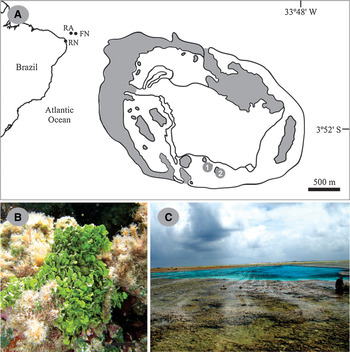
In January 2012, during a 25-day expedition to Rocas Atoll (03°50′30″S and 33°49′29″W; Figure 1A), involving benthic surveys and fish counts, the reef-flat, the lagoon, several tidal pools and one site on the outer reef were explored. The pools were classified either as open, when presenting a permanent link with the outer side of the atoll even during low tides, or closed when they become isolated during low tides. The surveys comprised 4 open (Barretinha, Falsa Barreta, Podes Crer and Salão) and 7 closed pools (Cemiterio, Tartarugas, Âncoras, Abrolhos, Zulu, Rocas and Fendas), previously explored by Villaça et al. (Reference Villaça, Fonseca, Jensen and Knoopers2010). When recorded, clumps of Halimeda sp. were collected and fixed in 4% formaldehyde for specific identification in the laboratory according to the description by Bandeira-Pedrosa et al. (Reference Bandeira-Pedrosa, Pereira and Oliveira2004), and specimens were deposited in the Herbarium FLOR of Federal University of Santa Catarina, Brazil. After this first record, the Rocas Marine Reserve team undertook more detailed surveys in several areas of Rocas Atoll during July 2012 searching for the algae, getting geographical coordinates, clump sizes and photographs. These surveys comprised the reef flat, visits to the same pools from the first expedition and 5 new closed pools (Donzelinha, Cemiteriozinho, Farol, Mapas and Garoupinha).
(A) Location map. RA, Rocas Atoll (pools where the alga was found: 1. Abrolhos, 2. Ancoras); FN, Fernando de Noronha Archipelago; RN, Rio Grande do Norte; (B) record of the occurrence of Halimeda opuntia in Ancoras pool and the presence of whitish fragments (scale bar 0.02 m) (photograph: G.O. Longo); (C) overview of the Ancoras pool (photograph: Rocas Marine Reserve team).

RESULTS
SYSTEMATICS
Order BRYOPSIDALES
Family HALIMEDACEAE
Genus Halimeda
Halimeda opuntia (Linnaeus) J.V. Lamouroux, 1816
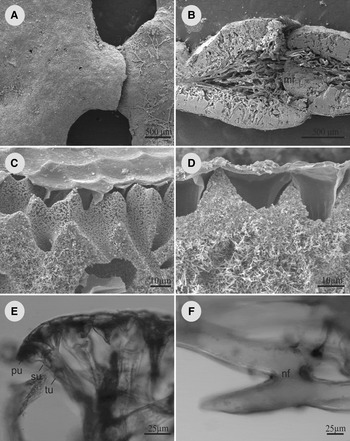
(Figure 2A–F)
DIAGNOSIS
A complete description of H. opuntia is given in Bandeira-Pedrosa et al. (Reference Bandeira-Pedrosa, Pereira and Oliveira2004). Material from Rocas Atoll (FLOR31356 and FLOR51027) showed as thallus erect, as forming compact or loosely prostrate tufts (Figure 1B), strongly calcified (Figure 2C, D); colour light-green; branching polystichous, attached to the substrate by multiple holdfasts; segments variable in shape, usually trilobite, flattened to cylindrical; external utricules rounded to polygonal, 12–25 µm in diameter, in surface view (Figure 2A), nodal medullary siphons fused in pairs for a short extension, ranging from 50 µm to 75 µm (Figure 2B).
Halimeda opuntia: (A) surface view of connection between two segments; (B) transversal section seen in scanning electron microscopy (SEM) showing medullary region (mr) and cortex; (C, D) longitudinal section seen in SEM, arrowhead showing heavy calcification; (E) detail of primary (pu), secondary (su) and tertiary utricles (tu); (F) short nodal fusion (nf) in pairs.

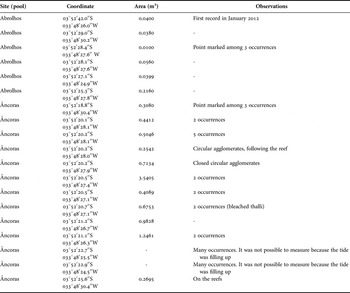
The first Halimeda clump was identified in the closed pool of Abrolhos (03°52′42″S 033°48′26″W), at a depth of around 0.5 m, and in a clump of approximately 0.04 m2 (Figure 1B), in January 2012. The presence of tall and bleached plants, as well as clump size, indicated somewhat long-standing colonization. The species, identified as Halimeda opuntia (Linnaeus) J.V. Lamouroux, was the first record of the genus for Rocas. Specimens were also observed in the reef flat around this pool, in a region that remains dry during low tides. During the surveys in July, this species was found at the reef flat close to the pool, where it was first recorded in January, with clumps as big as 0.7 × 0.4 m. Around 15 independent clumps were also recorded in the closed pool of Âncoras (Figure 1C). In both pools the patches comprised either scattered individuals, or were highly dense, with sizes varying between 0.038 and 3.540 m2, an average of 0.57 m2 (Table 1). The circular and closed agglomerates accompanied reef formation. A mound-like structure was observed, and the presence of bleached thalli was noted.
Record of the occurrence of Halimeda opuntia (Linnaeus) JV Lamouroux in July 2012, at the Rocas Atoll.

DISCUSSION
This is the first record of H. opuntia at Rocas Atoll. The exhaustive local efforts by macroalgal specialists without the register of either species or genus, suggests recent colonization. The genus Halimeda is represented by 33 species, worldwide, seven of which have been described for the Brazilian coast (Bandeira-Pedrosa et al., Reference Bandeira-Pedrosa, Pereira and Oliveira2004). Although Rocas Atoll presents a favourable environment for the development of Halimeda spp. the arrival and establishment of propagules or adult thalli appears to be of recent occurrence. The extent of a species geographical range depends on its ability to overcome a barrier, and thus establish a population in the new habitat (Luiz et al., Reference Luiz, Madin, Robertson, Rocha, Wirtz and Floeter2012). Halimeda opuntia, among all the species of Halimeda, has proven to be the most successful in vegetative reproduction, long-term viability, the recovery of fragments, and the capacity for establishing themselves on rigid substrates, both natural or artificial (Walters et al., Reference Walters, Smith, Coyers, Hunter, Beach and Vroom2002).
Although it is a very common species in the flora of the west Atlantic Ocean, Kooistra & Verbruggen (Reference Kooistra and Verbruggen2005) proposed that H. opuntia came to our coast through biofouling on ship hulls. Based on phylogenetic differences, their proposal was that H. opuntia originated in the Indo-Pacific Ocean, and its establishment in Brazil was independent of that in the Caribbean as a whole and the Bahamas in particular.
Another hypothesis is the current scenario of increased frequency and intensity of extreme events along the Brazilian coast (Machado et al., Reference Machado, Calliari, Melo and Klein2010), which could explain the transport of propagules from adjacent areas towards the atoll (230 km from the continent and 130 km from Fernando de Noronha Archipelago, in Brazil). Although information on the transport of floating objects indicates apparent regional scarcity and rarity of spatiotemporal dynamics factors (Ivar do Sul et al., Reference Ivar do Sul, Spengler and Costa2009), it is unquestionable that through facilitating marine-species dispersal, these could induce their local inclusion. Santos et al. (Reference Santos, Friedrich and Sul2009) concluded that floating debris leaving polluted coastal bays could accumulate on nearby pristine areas. Floating debris, the most common sea-going transport system, accounts for the dispersal of many marine organisms, through their use for hitchhiking (Barnes, Reference Barnes2002). Debris, either natural or of artificial origin, is a favourable factor for settler survival, the latter especially by lasting longer and travelling slower (Barnes, Reference Barnes2002). Since the oceanic movements of debris may change over time, even randomly at certain levels, it is likely that a floating object containing Halimeda sp. propagules may have reached currents that favoured their arrival at the atoll.
Apparently the alga is well established at Rocas Atoll and its presence can potentially affect the reef dynamics and functioning. Nugues et al. (Reference Nugues, Smith, van Hooidonk, Seabra and Bak2004) have shown that H. opuntia can be involved in transmission of infectious diseases in the Caribbean coral reefs. These temporal changes, associated with other human induced threats, such as climate change, are likely to modify dispersion patterns and larval pools that usually reach such remote places. Nowadays, this dynamic world has brought some new questions, such as: (i) which are indeed exotic or alien species?; and (ii) what we should do with these diversified types of biological invasion, as the simple extension of distribution edges or the introduction of opportunistic or exotic species? A plausible and synthetic answer would be intervene only when we are dealing with the introduction of an exotic species, since organism's dispersion is a natural process and part of their evolutionary biology. In this case, H. opuntia is widely distributed throughout the Caribbean and along the Brazilian coast, but the extension of its distribution reported here can cause important changes in the ecological dynamics of this single atoll formation in the south-western Atlantic, for example if these algae start to compete with corals. The sea urchin Tripneustis ventricosus (Lamarck, 1816) recently invaded the atoll probably through ballast water of ships (Soares et al., Reference Soares, Paiva, Godoy, Silva and Castro2010) and its population has been monitored since then in order to guide proper management when and if necessary. It is alarming that H. opuntia is commonly associated with phase-shifts in the Caribbean (see Hughes, Reference Hughes1994), thus it is critical to understand its ecological dynamics in Rocas Atoll to determine if we are dealing with an invasive species or a natural temporal fluctuation before implementing management and removal actions. Rocas Atoll is one of the unique no-take and no-entry zones on the Brazilian coast and a unique natural laboratory to evaluate long-term temporal dynamics of reef organisms and their ecological implications for the ecosystem function.
ACKNOWLEDGEMENTS
Financial support was provided by CNPq, CAPES and SISBIOTA-MAR (CNPq 563276/2010-0 and FAPESC 6308/2011-8 to S.R. Floeter; and CNPq/CAPES PROTAX 562336/2010-9 and CAPES/PNADB 2338000071/2010-61 to P.A. Horta). Technical and logistical support was provided by REBio Atol das Rocas and SOS Mata Atântica. We also thank Maurizélia de Brito Silva (Zélinha), Jarian Dantas, Renato Morais, Gisele Costa Fredo and Thalyta Rocha for invaluable fieldwork assistance.