


In Canada’s single-member plurality electoral system, elected MPs serve as the key channel through which the geographic and demographic diversity of Canadians’ policy preferences are represented in the federal Parliament. While this channel of representation may be supported by a number of representational mechanisms—such as politicians’ knowledge of their constituents’ attitudes and desire for re-election—many have emphasized the critical importance of politician-constituency congruence, or shared policy preferences between citizens and their representatives, as the most consistent and reliable mechanism by which politicians’ actions as legislators reflect their constituents’ preferences (Kingdon, Reference Kingdon1981; Lucas et al., Reference Lucas, Sheffer and Loewen2025; Mansbridge, Reference Mansbridge2009).
Surprisingly, however, we currently know very little about whether the individuals who seek to represent their districts across Canada do in fact align with their constituents’ policy preferences. In this article, we seek to remedy this absence by providing a systematic overview of both dyadic and collective congruence between federal election candidates and Canadian citizens. First, we describe the relationship between the policy preferences of constituents and those of the candidates who seek to represent them. This simple overall relationship clarifies how much of constituency-level congruence emerges from cross-party variation versus within-party variation—that is, how much of the alignment between constituents and politicians emerges from conservative districts electing Conservative MPs, as opposed to all parties fielding more conservative-minded candidates in conservative districts. Next, we assess how candidate, party, and district factors predict candidate-constituency congruence across Canada: whether specific candidate features (especially winners vs. losers) or district features (especially district-level heterogeneity) tend to be associated with stronger or weaker congruence. Finally, we broaden our focus from dyadic (district-specific) to collective (national) congruence, exploring whether shared demographic and geographic characteristics make policy congruence more likely for Canadians.
Answering these questions matters beyond the descriptive record. Policy congruence between citizens and politicians is an important condition for substantive representation, and the channels through which congruence is achieved tell us how Canada’s electoral institutions actually perform their representational function. For example, if alignment emerges mostly through across-party sorting, then representation in Canada rests primarily on the party system configuration and the electoral choices made by voters. If alignment emerges through within-party adaptation, then representation rests on the responsiveness of individual candidates and intra-party organizations to their districts. These two channels carry different implications for longstanding debates on electoral reform, party discipline, and the role of local representatives in Canadian democracy. Our study thus provides an empirical baseline for evaluating these institutional arguments.
To provide this overall assessment of dyadic and collective congruence in Canada, we rely on a survey of more than 300 federal election candidates in the 2021 Canadian federal election, combined with a large parallel survey of the Canadian public. Both surveys included a list of eleven policy questions across several policy domains. We use a local area estimation technique (multilevel regression and poststratification) to compare candidates with their constituents at the constituency level (dyadic congruence), along with a multilevel pairwise model to compare all citizens to all candidates in our surveys (collective congruence). We find strong evidence of overall policy congruence in the Canadian federal system—district-level alignment between candidates and constituents—especially among elected candidates, and we find that this congruence emerges much more strongly from across-party than within-party disagreement. In other words, Canadians achieve constituency-level congruence primarily by electing candidates in their constituency from the party whose policy preferences are closer to their own. In our collective-representation model, we then clarify how patterns of congruence vary across demography and geography in Canada, showing that shared demographic and geographic characteristics are related to policy alignment, and that these patterns of alignment emerge at the candidate-selection rather than the election-selection stage.
These findings enrich our understanding of policy representation in Canada. They are consistent with a strong party-delegate view of Canadian federal candidates. On most issues, district-level alignment between citizens and representatives emerges through a cross-party channel rather than a within-party channel: Canadians in progressive districts elect MPs from progressive parties, and Canadians in conservative districts elect MPs from conservative parties. Even so, we also see some evidence of meaningful within-party variation in policy preferences, especially on the emerging issue of immigration policy. Across both the cross-party and within-party channels, we find that Canadian federal elections do meaningful representational work, capturing geographic variation in policy preferences within Canada’s Parliament.
Background: Policy Congruence and Political Representation
The concept of substantive representation captures the extent to which elected representatives act on behalf of the policy preferences of those who they represent (Pitkin, Reference Pitkin1967). Substantive representation can be measured at several levels (Golder and Ferland, Reference Golder, Ferland, Herron, Pekkanen and Shugart2018)—including macro-level analysis of the relationship between citizens’ aggregate preferences and governments’ policy outputs (Ferland, Reference Ferland2021; Soroka and Wlezien, Reference Soroka and Wlezien2010), party systems (Calvo and Hellwig, Reference Calvo and Hellwig2011; Costello et al., Reference Costello, Thomassen and Rosema2012; Dalton, Reference Dalton1985), legislative institutions (Golder and Lloyd, Reference Golder and Lloyd2014; McDonald and Budge, Reference McDonald and Budge2005; Powell and Vanberg, Reference Powell and Vanberg2000) and government stages of representation (Ferland, Reference Ferland2016, Reference Ferland2018); Golder and Stramski, Reference Golder and Stramski2010; Powell, Reference Powell2009).
Here, we focus on individual-level congruence—attitudinal agreement between constituents and representatives—which has been an important focus of research in the broader domain of substantive representation for many decades (Converse and Pierce, Reference Converse and Pierce1986; Esaiasson and Holmberg, Reference Esaiasson and Holmberg1996; Miller and Stokes, Reference Miller and Stokes1963). Because elected representatives regularly rely on their own convictions when doing their job (Fenno, Reference Fenno1978; Kingdon, Reference Kingdon1981), and also consistently project their own views onto their perceptions of constituents’ attitudes (Dias et al., Reference Dias, Lucas and Sheffer2026; Lucas et al. Reference Lucas, Sheffer and Loewen2025; Sevenans et al., Reference Sevenans, Walgrave, Jansen, Soontjens, Bailer, Brack, Breunig, Helfer, Loewen, Pilet, Sheffer, Varone and Vliegenthart2023), policy alignment between politicians and citizens is an important ingredient in substantive representation more generally (Huber and Powell, Reference Huber and Powell1994; Kingdon, Reference Kingdon1981).
Golder and Stramski (Reference Golder and Stramski2010) helpfully clarify several distinct conceptualizations of citizen-elite congruence. A one-to-one relationship is agreement between a single citizen and a single representative. This relationship may be important for individual citizens, but it is less helpful for measuring politicians’ alignment with citizens as a larger group. A many-to-one relationship captures agreement between a group of citizens and a single representative (or a single party or government). This relationship captures district-level representation in Canada, in which many constituents in a district are represented by a single Member of Parliament. This relationship is also regularly referred to as dyadic (constituency-politician dyad) or local representation. A limit to this approach, however, is that it does not necessarily capture whether legislatures, taken as a whole, capture the diversity of citizens’ preferences—citizens whose preferences are not shared by their local MP might nevertheless find their views well represented by MPs elsewhere in the country. Thus, we may also be interested in the many-to-many relationship between all citizens and all representatives at a single point in time. This collective representation is also important for any assessment of congruence.
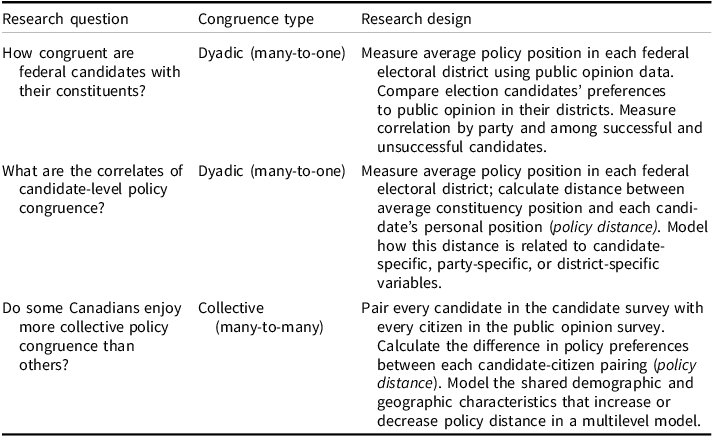
Taking this framework as our guide, our purpose in this article is to offer a systematic first look at both dyadic and collective congruence in Canadian federal electoral politics. We do so by means of three questions, each of which is summarized in Table 1. First, we ask how congruent federal electoral candidates are with their constituents, calculating the overall correlation between constituency opinion (measured as average district-level policy preference) and candidate opinion across Canada. Next, we investigate the correlates of the candidate-level policy congruence measured in the first step, exploring how individual-level factors (e.g. whether the candidate was successful or unsuccessful in the district), political party, and/or district level factors increase or decrease the probability of dyadic congruence across Canada. Finally, we turn to collective representation, asking if some Canadians tend to enjoy more collective policy congruence than others. Here, following recent methodological developments in other work (Lupu and Warner, Reference Lupu and Warner2022), we build a database in which each observation is a comparison between a federal election candidate and a public opinion survey respondent. This approach allows us to measure whether shared demographic and geographic characteristics predict higher or lower levels of collective policy congruence.
Research Questions and Research Designs

Table 1. Long description
A table with three rows and three columns. The columns are labeled Research question, Congruence type, and Research design. The rows are as follows: Row 1: Research question: How congruent are federal candidates with their constituents? Congruence type: Dyadic (many-to-one). Research design: Measure average policy position in each federal electoral district using public opinion data. Compare election candidates’ preferences to public opinion in their districts. Measure correlation by party and among successful and unsuccessful candidates. Row 2: Research question: What are the correlates of candidate-level policy congruence? Congruence type: Dyadic (many-to-one). Research design: Measure average policy position in each federal electoral district; calculate distance between average constituency position and each candidate’s personal position (policy distance). Model how this distance is related to candidate-specific, party-specific, or district-specific variables. Row 3: Research question: Do some Canadians enjoy more collective policy congruence than others? Congruence type: Collective (many-to-many). Research design: Pair every candidate in the candidate survey with every citizen in the public opinion survey. Calculate the difference in policy preferences between each candidate-citizen pairing (policy distance). Model the shared demographic and geographic characteristics that increase or decrease policy distance in a multilevel model.
Throughout our analyses, we pay particular attention to a distinction between within-party and across-party mechanisms of policy congruence. Canadian MPs operate in a context of strong party discipline, which constrains their legislative behaviour (Atkinson and Thomas, Reference Atkinson and Thomas1993; Aucoin et al., Reference Aucoin, Jarvis and Turnbull2011). As such, Canadian elected representatives are often considered delegates of their party when it comes to representation and policy-making (Docherty, Reference Docherty1997; Franks, Reference Franks1987; Savoie, Reference Savoie1999). Canadian scholars, however, have recently considered more carefully the agency of MPs and how they might represent their constituents. Importantly, researchers have uncovered some evidence of dyadic representation. For example, Soroka et al. (Reference Soroka, Penner and Blidook2009) found evidence of local representation in legislators’ behaviour in the House of Commons: MPs from left-wing constituencies are more likely to ask questions on welfare issues in Question Period. Similarly, Blidook (Reference Blidook2012) showed evidence of local representation in the bills and motions introduced by MPs in Private Members’ Business. In a related vein, Koop and Loewen (Reference Koop and Loewen2010) found a relationship between the bills introduced by MPs in the House of Commons and district-level interests.
This work suggests that both within-party and across-party alignment are plausible sources of congruence in Canada: policy alignment may arise because candidates tend to share positions with their district regardless of their party affiliation (within-party congruence), but it may also arise because voters select the party whose positions best align with local preferences (across-party congruence).Footnote 1 Put simply, this distinction focuses our attention on the extent to which conservative districts tend to feature a “menu” of relatively conservative candidates across all parties, or if conservative districts achieve dyadic congruence simply by electing Conservative Party candidates.
Importantly, answering these questions requires data not only from elected politicians—the candidates who are successful—but also from unsuccessful candidates. This is the case for two reasons. First, surveying candidates allows us to better distinguish within-party and across-party correlates of congruence; without data from unsuccessful candidates, it would be considerably more difficult to disentangle variation in policy attitudes within parties but across districts, as well as variation across parties within districts. Second, data on candidates are vital for understanding where failures or weaknesses in policy congruence enter the electoral process: by comparing correlates of policy congruence among all candidates, and then among elected candidates, we can clarify whether these covariates become important at the candidate or the election stage. If, for example, policy congruence tends to be stronger for older Canadians than for younger Canadians, data from candidates allows us to explore whether this relationship emerges at the candidate stage (all candidates tend to be closer in their preferences to older Canadians) or the election stage (candidates who are elected tend to be closer in their preferences to older Canadians). Our focus on candidates is therefore primarily motivated by our research questions and research design, rather than (as in some other studies) practical issues of sample size or statistical power.
General Overview: 2021 Canadian Candidates Survey
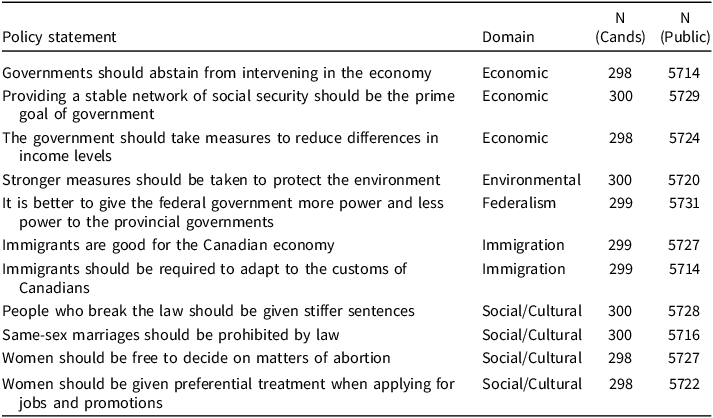
Our research questions require data on the policy preferences of citizens and election candidates, ideally across the whole of Canada and several policy domains. We thus rely on a parallel survey of federal election candidates and the Canadian public undertaken after the 2021 Canadian federal election. Both surveys elicited policy preferences from respondents on 11 policy questions covering economic and social issues, immigration and environmental policy, and federalism. We provide complete wording for these questions, along with our available, for each question in Table 2.
Policy Items: Complete Wording and Available Sample

Table 2. Long description
A table titled ‘Policy Items: Complete Wording and Available Sample’ presents data on policy preferences across various domains. The table has 11 rows and 4 columns. The columns are labeled ‘Policy statement’, ‘Domain’, ‘N (Cands)’, and ‘N (Public)’. The rows list different policy statements along with their corresponding domain and the number of candidates and public respondents for each statement. The domains include Economic, Environmental, Federalism, Immigration, and Social/Cultural. Each row provides the exact number of candidates and public respondents who were sampled for each policy statement. Notable policy statements include those about government intervention in the economy, social security, environmental protection, federalism, immigration, law enforcement, same-sex marriages, abortion, and gender preferences in job promotions.
Note: all items are measured on a 5-point Likert scale.
The 11 policy items in the survey were chosen to cover the main policy dimensions that have structured Canadian political competition in recent decades: an economic-redistributive dimension, a social-cultural dimension, an immigration dimension, an environmental dimension and a federal-provincial jurisdictional dimension. The selection draws on prior Canadian Election Study instruments and on the comparative congruence literature (Costello et al., Reference Costello, Thomassen and Rosema2012; Dalton, Reference Dalton2017; Stecker and Tausendpfund, Reference Stecker and Tausendpfund2016). These items are not intended to cover the full range of policy issues in Canadian politics. They rather capture key dimensions on which Canadians hold meaningful differences of opinion, and on which these preferences can be reliably measured. Identical wording was used for citizen and candidate items.
To measure the policy positions of candidates and elected representatives, we invited candidates who ran for the 2021 Canadian federal election across the 338 federal electoral districts to complete the survey. Because we are interested in substantive representation (rather than, say, protest parties or single-issue candidates), only candidates of the main political parties represented in the House of Commons at the time of the election were contacted (Liberals, Conservatives, NDP, Greens and Bloc Québécois). Candidates were contacted through their parties’ national head office and individually through social media (LinkedIn, Facebook) or their personal email when publicly available. Of the 1238 candidates (out of 1343) for whom we established valid contact information, 351 completed the survey, for a response rate of 28 per cent.
Our sample is not a perfect random sample of Canadian federal candidates, and readers should keep its composition in mind when interpreting our results. In general, our candidate survey is similar to the full population of candidates in terms of gender, region, and elected status. In the case of political party, however, Conservative candidates are somewhat underrepresented (17% of respondents, 25% of population), while Liberal and NDP candidates are overrepresented (27–28% of sample, 25% of population). We therefore weight our statistical analyses by party affiliation to correct for this imbalance; the resulting weights are modest (ranging from 0.83 to 1.5) and do not dramatically affect any of our reported results. We provide a full sample-population comparison in Supplementary Table 5.
For the citizen survey, we collected responses from 5739 Canadians of voting age. The survey was fielded by Léger, which operates the largest online panel of survey respondents in Canada. Quotas were applied on gender, age, province and education to ensure that the sample was representative of the voting-age population along these dimensions.
Because each of our research questions require distinct variables, measures and modelling strategies, we provide detailed information on variables and models as we proceed through each of our three main analyses. However, we provide a general overview of our research design and approach for each of the three research questions in Table 1 above.
Analysis 1: How Congruent Are Federal Candidates?
Canada’s institutions exert competing pressures on parties and candidates. On the one hand, several forces push in the direction of local candidates who share their local constituents’ policy preferences. In single-member district plurality electoral systems, a basic Downsian logic would predict that parties will select candidates (and/or candidates will adapt their own positions) to align with district-level median preferences (Cox, Reference Cox1990; Downs, Reference Downs1957). Candidates generally live in their own electoral districts (CCS, 2021), making it more likely that the candidates share their constituents’ preferences, and candidate nomination contests may reward candidates who can demonstrate that they are aligned with constituents’ views.
Even so, powerful centrifugal forces may pull Canadian candidates away from the local median voter. Parties have strong incentives to maintain a coherent national brand (Cox and McCubbins, Reference Cox and McCubbins2005), which discourages candidates from deviating from a party’s general policy commitments. Strong party discipline dampens the electoral incentives for strong constituency-level congruence, since voters cast their ballots predominantly on the basis of party rather than local candidate (Blais et al., Reference Blais, Gidengil, Dobrzynska, Nevitte and Nadeau2003; Stevens et al., Reference Stevens, Islam, de Geus, Goldberg, McAndrews, Mierke-Zatwarnicki and Rubenson2019). While party leadership often directly or indirectly monitors candidate selection in Canada, many nominations are decentralized and rest on the involvement of activists and party members preferences (Albaugh, Reference Albaugh2022) who generally favour candidates closer to the party base than to the median constituent (Lehrer, Reference Lehrer2012; Schumacher, De Vries and Vis, Reference Schumacher, De Vries and Vis2013). In the Canadian institutional context, these centrifugal pressures, and in particular strong party discipline, may lead us to expect limited within-party variation, with most geographic alignment operating through across-party sorting by voters.
Our first research question therefore concerns whether the policy preferences of Canadian federal election candidates align with local constituents’ policy preferences across federal electoral districts. This is an aggregate-level measure of dyadic policy congruence. Disentangling the within-party and across-party sources of this policy congruence requires that we measure the aggregate relationship between constituency attitudes and candidate attitudes within each party, and among unsuccessful and successful candidates.
Dyadic Congruence: Methods and Measures
To measure district-level policy attitudes among the Canadian public, we use multilevel regression and poststratification. This local area estimation technique uses information from respondents’ answers in the citizen survey and integrates sociodemographic information at the district level (based on census data) to generate precise estimates of public opinion at the district-level.Footnote 2 This approach is now widely used in the United States to measure public opinion in subregional units (Eggers and Lauderdale, Reference Eggers and Lauderdale2016; Hanretty et al., Reference Hanretty, Lauderdale and Vivyan2018; Kalla and Porter, Reference Kalla and Porter2021; Lax and Phillips, Reference Lax and Phillips2012) and has also been used recently in Canada (Lucas and Armstrong, Reference Lucas and Armstrong2021; Lucas et al., Reference Lucas, Sheffer and Loewen2025). Warshaw and Rodden (Reference Warshaw and Rodden2012) validated the technique across 1942 state senate districts in the United States. Importantly, they compare the accuracy of MRP estimates to those of a disaggregation approach which consists in estimating district opinion based on very large national samples and restricting the calculation of the district estimates to respondents living in each district. This validation process informs our decision to target a Canadian sample of about 6000 respondents. Indeed, Warshaw and Rodden find that a sample of 5000 national respondents generates reliable MRP estimates of public opinion across 1942 districts, comparable to MRP estimates from larger samples (e.g. 15 000 respondents), and more precise than the disaggregation approach based on a very large national sample (e.g. 30 000 respondents). Given the 338 Canadian federal electoral districts we study, we assume that a sample of about 6000 respondents is acceptable.
Because our analysis in this section is aggregate and descriptive, and to avoid overburdening readers with an excess of visual information, we combine our eleven policy items into five policy domains, based on the domains identified in Table 2 above: economic issues, immigration issues, social issues, federal vs. provincial power, and environmental policy.Footnote 3 While this decision simplifies our analysis, it does not substantively change our results; we provide a full breakdown of relationships without domain-level clustering in Supplementary Figure 1. In the Supplementary Material (SM5) we also provide a robustness test which demonstrates that our findings are substantively identical when we propagate uncertainty in MRP estimates through the analysis.
Dyadic Congruence: Aggregate Results
Figure 1 summarizes citizen-candidate alignment across our five policy domains: economic issues, immigration issues, social issues, federal-provincial power and environmental policy. In each panel, we plot constituency-level MRP estimates on the horizontal axis and candidate positions on the vertical axis, with the thin black line representing a perfect relationship between the two quantities. In each case, we have recoded issue positions such that higher values indicate more conservative policy positions, and lower values indicate more progressive policy positions (in the case of Panel D, higher values indicate more support for federal power rather than provincial power). In the left-hand column, we plot the relationships broken down by political party; in the right-hand column, we plot overall relationships among winners (black) and losers (grey).
Citizen-Candidate Aggregate Congruence.
Relationship between constituent preferences (horizontal axis) and candidate preferences (vertical axis), by policy issue area. Panels in left column report linear relationships by political party (Blue = Conservative, Red = Liberal, Orange = NDP, Green = Green, Light Blue = Bloc Quebecois). Right column reports linear relationships for winners (black) and non-winners (gray).

We observe several important patterns in Figure 1. First, in the left-hand column of Figure 1, we observe null relationships (flat lines) for most parties in most panels. Notice, for example, the flat lines in the “Social Issues” panel; the differences in intercepts indicate that Conservative Party candidates hold much more socially conservative policy views, on average, than Liberal, Green and Bloc candidates, and that NDP candidates tend to hold the least socially conservative policy views. However, the flat lines indicate that these policy positions are not conditional on a candidate’s district; Conservative Party candidates are not less socially conservative when running in more progressive districts, and NDP candidates are not less socially progressive when running in conservative districts. Much the same is true of economic policy in Panel A, federal-provincial power in Panel D, and environmental policy in Panel E. These flat lines indicate that, on most issues, meaningful variation in candidates’ policy attitudes is not related to within-party geographic variation, but is instead much more strongly linked to policy disagreement across parties. The only notable exception is the Conservative candidates, who seem more responsive to constituency opinion on economic policy than candidates from the other parties.
Despite this general pattern, we also observe that immigration issues (Panel B) are an important exception. While we still see strong party-level variation on immigration attitudes (strongest anti-immigrant sentiment among Bloc candidates, and strongest pro-immigrant sentiment among the NDP and Liberal candidates), the lines in Panel B are distinctly more upward-sloping than in the other panels, indicating a meaningful relationship between citizens’ and candidates’ preferences on immigration. These slopes are sufficiently strong that they generate meaningful within-party disagreement; for example, the results suggest that a Liberal candidate in a strongly anti-immigrant district in Canada would be expected to have more conservative views on immigration than a Conservative candidate in a strongly pro-immigrant district. In Supplementary Tables 1 and 2, we present the results of linear regressions that corroborate the visual patterns displayed in Figure 1.
Second, in the right-hand columns, we consistently find a strong, significant, positive relationship between winners’ policy positions and constituency positions across all five issue domains, indicating that, in the aggregate, Canadian federal elections produce constituency-level politicians who are directionally congruent with their constituents—more policy-conservative MPs in more policy-conservative districts. We also observe that the relationship between constituency attitudes and candidate attitudes is not consistently positive among unsuccessful candidates, suggesting that elections serve as an important selection mechanism for congruence. In the aggregate, Canadian citizens generate policy representation between themselves and their representatives by selecting representatives whose policy preferences are more in keeping with their own. Finally, we observe systematic directional bias in two instances—immigration and social issues—indicating that, on these issues, both candidates and elected MPs tend to be slightly to the left of the constituents they represent.
Taken together, these patterns indicate that the positive relationship between citizens’ and winners’ policy preferences (the black lines in the right-hand panels) is generated by selection across political parties—Canadians in progressive places elect representatives from progressive parties, and Canadians in conservative places elect representatives from conservative parties—rather than strong variation in policy attitudes within parties.
Analysis 2: Which Candidates Are Congruent?
Thus far, we have found evidence of aggregate policy congruence between citizens and candidates, at least among those who were successfully elected to office. However, much of this congruence appears to arise from across-party rather than within-party variation, with very little within-party variation on most issues. Here, we explore these dyadic congruence relationships in a more formal statistical setting, with a particular focus on three sets of predictors.
First, we explore more formally whether winners are indeed more congruent than losers across policy issues. Winning candidates, especially majority winners but also plurality winers, should be more congruent with their constituents than unelected candidates. In general, candidates who hold positions closer to the district position should be more likely to win under a first-past-the-post electoral system (Downs, Reference Downs1957). This logic holds, however, when there is no strong third party/candidate in a district (Cox, Reference Cox1997). The Canadian multiparty system, therefore, with the presence of non-centrist parties, might reduce the incentives of local elites to adopt attractive policy positions, making it more difficult for voters to select a congruent candidate.
Second, we consider candidate-level characteristics. Candidates who live in the district in which they ran should be more congruent with constituents than outsider candidates because these candidates are recruited from the pool of citizens from which aggregate attitudes are themselves drawn. In addition, intra-party procedures of candidate selection could help select candidates whether close to the district opinion or party membership. Rules that give substantial influence to party members tend to favour candidates closer ideologically to the party base (Lehrer, Reference Lehrer2012; Schumacher et al., Reference Schumacher, De Vries and Vis2013), while rules that concentrate selection in the hands of the party leadership tend to favour candidates oriented toward electoral viability, and therefore closer to the median voter (Hazan and Rahat, Reference Hazan and Rahat2010). We thus expect locally-selected candidates to be more congruent with constituents.
Finally, sociodemographic heterogeneity is associated with greater heterogeneity in policy preferences (Gerber and Lewis, Reference Gerber and Lewis2004). This might affect constituent-candidate congruence in two ways. If candidates are generally selected from their electoral districts, more heterogeneous districts may generate more heterogeneous, and thus less congruent, candidates. Moreover, heterogeneity of policy attitudes will make average constituency attitudes harder for candidates to match. If a district consists of one main group with a policy preference of 4, candidates may be quite likely to share this preference, whereas in a district of three equal groups with policy preferences 2, 3, and 7 (overall mean = 4) candidates are probably more likely to match one of these groups’ preferences, rather than the overall mean.
Correlates of Dyadic Congruence: Methods and Measures
We begin by joining district-specific MRP estimates for each issue to the candidate dataset, stacking the candidate dataset such that each observation is a candidate’s opinion on a specific issue. Our outcome variable is the distance between the candidate’s opinion and the average opinion on the same policy. A value of 0 thus indicates perfect congruence (i.e. a candidate whose policy position is the same than the average position in her district). We emphasize that our analysis in these models does not rely on the domain-level clustering reported in Figure 1; we include a candidate-constituency distance observation for each of our 11 issues separately. Negative relationships thus indicate reduced distance, and thus stronger congruence, between candidates and average district opinions. Descriptive statistics presented in the Supplementary Material (Supplementary Figure 2) indicate that levels of constituent-candidate congruence are relatively high on average in Canada with a mean distance of about 0.9. This is equivalent to a difference between two response categories on the 5-point Likert scale. While our distance measure of congruence is one of the most popular measures of congruence because of its foundation in the median voter theorem (Ferland, Reference Ferland2016; Golder and Stramski, Reference Golder and Stramski2010; Huber and Powell, Reference Huber and Powell1994), other measures do exist. In the Supplementary Material (Supplementary Table 3 and Figures 3–4), we replicate our analysis with two alternative measures of congruence: a binary indicator for agreement with the plurality/majority view in the district, and a continuous measure of the proportion of constituents with whom the candidate agrees. Levels of congruence are also high on these measures. For example, across issues, 65% of the candidates agree with the most popular view in the district.
We measure candidate outcomes using a categorical variable that includes losers, plurality winners, and majority winners in an election, and show in the Supplementary Material (SM2) that our findings are robust to alternative measures of election outcome. We measure local residence using a self-reported local residence measure, where zero (0) is living outside of district, and (1) is residence inside district. We measure selection within a district using a self-reported measure in which a candidate is selected by party members in a local nomination meeting (1) or selected in another way (0). Heterogeneity is measured using census data on religious, economic and educational fractionalization with 2021 census data by electoral district.Footnote 4
To model the correlates of candidate-constituency policy distance, we fit an OLS model with fixed effects for issue and standard errors clustered by respondent. We provide full model notation, along with an alternative multilevel model with varying intercepts by issue and respondent, in the Supplementary Material (SM2).
Correlates of Dyadic Congruence: Results
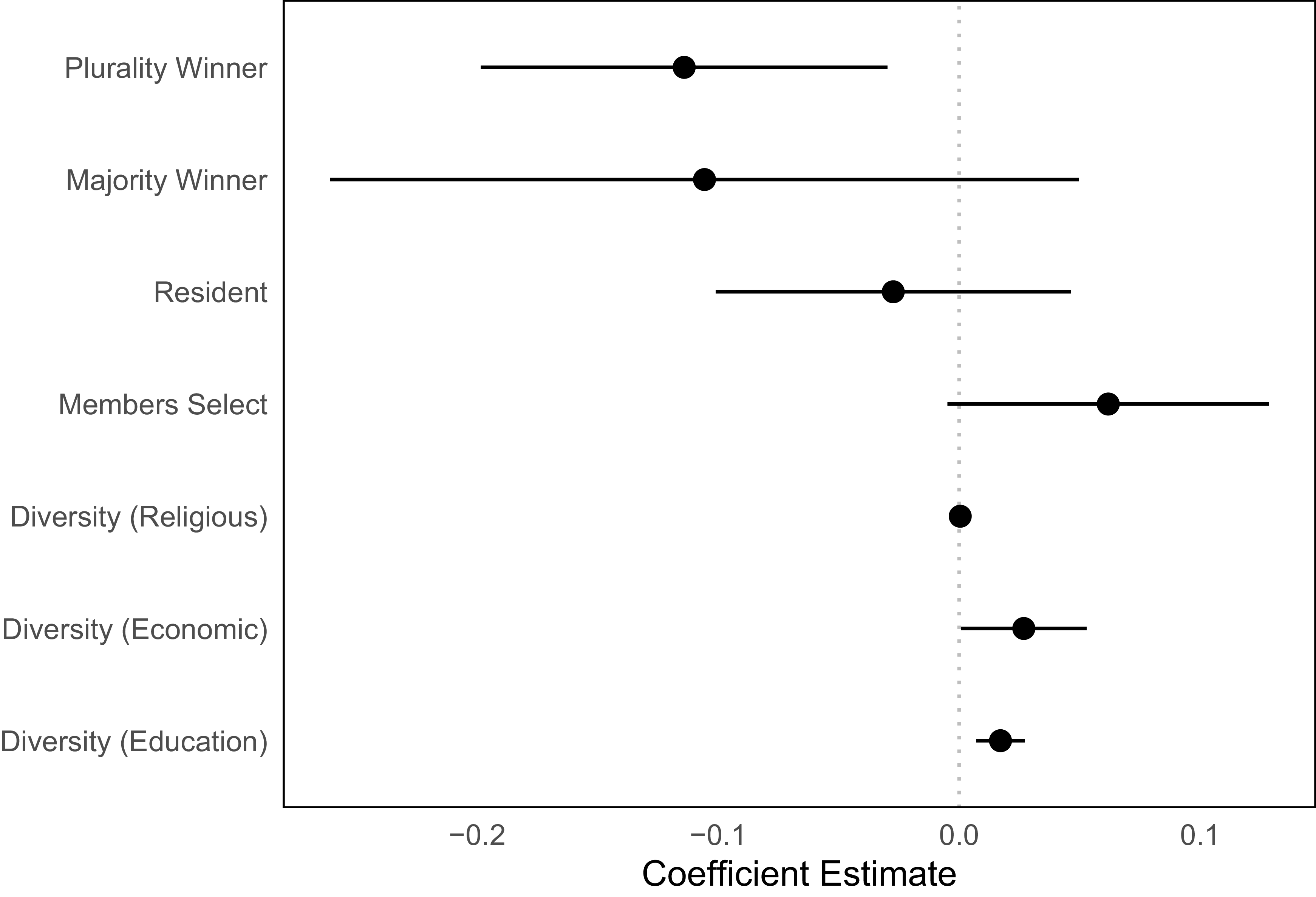
Figure 2 summarizes the results of our model of the correlates of candidate-level dyadic policy congruence, with coefficients and 95 per cent confidence intervals for each variable. The results indicate that winners are generally closer to constituency opinion than losers. Both the coefficients of plurality winner and majority winner are approximately −0.1, indicating smaller distances between winning candidates and constituents compared with unelected candidates. The effect sizes of plurality winner and majority winner are similar, although the coefficient of majority winner falls short of conventional levels of statistical significance (p = 0.1), likely a consequence of the small number of majority winners in the sample.
Correlates Citizen-Candidate Aggregate Congruence.
Coefficients from OLS model of citizen-candidate distance, with 95 per cent confidence intervals. Outcome variable is distance between candidate attitude and average attitude in constituency; negative relationships thus indicate stronger policy congruence. 0 indicates no difference in distance relative to the reference category for categorical variables. Full table and alternative specifications in Supplementary Table 3.

Against our expectations, candidates living in the federal electoral districts in which they ran for office are not more congruent with constituency opinions. While the coefficient of resident is negative, which suggests greater congruence, it is small and does not reach conventional levels of statistical significance. This is likely a consequence, in part, of the limited variation on this variable, given that most candidates reside in the district in which they run (about 2/3 of them). There is also some suggestion that constituent-candidate congruence is weaker when candidates are selected by party members: the coefficients of members select are positive (about 0.06), and the confidence intervals just overlap zero (p = 0.06 in each model). Turning to district-level heterogeneity, religious fractionalization does not appear to influence citizen-elite congruence, while economic and educational fractionalization are positively associated with candidate-constituent distance. In general, local heterogeneity does appear to have the expected relationship with congruence.
Overall, then, our findings in Figure 2 reinforce the visual relationships in Figure 1. Dyadic policy congruence is most strongly associated with winning an election, which implies that Canadian voters tend to select policy-congruent winners from among a larger basket of candidates. The relative weakness of other predictors of policy congruence, such as local residence and candidate selection processes, not only reinforces the importance of across-party selection for policy congruence, but also indicates that Canadian voters do pay attention to policy congruence when selecting candidates in federal elections.
Analysis 3: Shared Characteristics and Collective Congruence
Canada’s single-member plurality electoral system elects a single Member of Parliament in each federal electoral district. Consequently, a substantial share of voters in every district will not share the policy preferences of their elected MP. Those preferences, however, could still be represented through other MPs elsewhere in the country. For this reason, our overview of policy congruence must also examine how the policy preferences of electoral candidates reflect the diversity of citizen preferences. This many-to-many conceptualization of representation (Golder and Stramski, Reference Golder and Stramski2010), a collective form of representation, calls for the distributions of politicians’ and citizens’ preferences to be compared.Footnote 5
To assess this collective representation, we compare all candidates (and, in a separate analysis, all successful candidates) to citizens’ preferences. We acknowledge that our approach captures one of several dimensions of collective representation. Given the majoritarian character of decision-making in the House of Commons and the dominance of the government over the legislative agenda (Savoie, Reference Savoie1999), alternative measures might compare citizens to members of the government caucus, members of cabinet, or even the policy preferences of the Prime Minister. Citizen congruence with these bodies would thus capture representation in policy-making specifically, whereas our focus on all candidates and all MPs captures representation in the legislature as a deliberative and representative body. While these measures would be a valuable extension of our analysis, we focus here on the legislature as a whole (and the candidates who seek to enter that legislature).
Our collective representation analysis focuses on how shared characteristics between citizens and candidates, both demographic (gender, race, education, age) and geographic (province, district), predict increases in policy congruence across policy issues. This analysis is closely connected to longstanding interests in the connection between descriptive and substantive representation. Given the connection between sociodemographic identities and/or geographic residence and policy preferences in Canada (Borwein et al. Reference Borwein, Lucas, Romualdi, Taylor, Armstrong and McCoy2025), individuals’ whose identities or place types are underrepresented in Canada’s Parliament may suffer from decreased congruence as well. For example, research on gender representation has shown that women representatives prioritize different issues and shape party platforms (Greene and O’Brien, Reference Greene and O’Brien2016; Kittilson, Reference Kittilson2011; Phillips, 1998). Similar dynamics have been documented for the representation of youth (Stockemer and Sundström, Reference Stockemer and Sundstrom2022), racial and ethnic minorities (Butler and Broockman, Reference Butler and Broockman2011; Griffin and Newman, Reference Griffin and Newman2008) and for socioeconomic and educational strata, where politicians tend to be more responsive to affluent and educated constituents (Bartels, Reference Bartels2008; Gilens, Reference Gilens2012; Lupu and Warner, Reference Lupu and Warner2022). While the relationship between descriptive and substantive representation in Canada is complex, and past studies in Canada have yielded mixed results (Ferland et al., Reference Ferland, Gaspard, Savoy and Wutchiett2025; Francheschet et al., Reference Franceschet, Lucas and Rayment2024), we expect to find that characteristics shared between a citizen and a candidate, both demographic (gender, race, education, age) and geographic (province, district), are related to increased congruence between that pair.
Collective Representation: Methods and Measures
Following Lupu and Warner (Reference Lupu and Warner2022), we measure collective congruence by building a pairwise dataset in which each observation is a unique pairing between one candidate (from the candidate survey) and one citizen (from the public opinion survey) on a specific policy issue. For each pairing, we calculate the absolute distance between the citizen’s response and the candidate’s response on that issue. Smaller distances thus indicate higher levels of congruence. Combining all citizen-candidate pairings, and pooling across our eleven policy items, generates a dataset with approximately 18 million citizen-candidate-issue observations, and approximately 2.6 million observations when the analysis is restricted to successful candidates.
This pairwise analysis provides a statistical model with which to test whether the average distance between citizens and candidates varies as a function of demographic and geographic similarity. For each citizen-candidate pairing, we construct a set of binary indicators capturing whether the citizen-candidate pairing share the same gender identity, racial identity (as racialized or not), same level of educational attainment (university degree or not), and same age group (18–34, 35–54, 55+). These demographic indicators help to clarify whether candidates who share a citizen’s demographic characteristics and identities tend to share their policy preferences as well. In addition, we include indicators for geographic similarity: shared province and shared electoral district. This categorical variable compares politicians and citizens who are not in the same province (the baseline) with those who share a province but are in different districts (same province) and those who are in the same province and the same district (same district). This helps to illuminate the critical geographic dimension of the Canadian representation system: whether citizens tend to share the views of their elected representatives in the same region and, within that region, in the same specific federal electoral district.
To estimate this model, we again follow Lupu and Warner (Reference Lupu and Warner2022) and fit a multilevel linear model of citizen-candidate policy distance with random intercepts for citizens, candidates and policy issues. Negative coefficients in this model indicate reduced distance and thus greater congruence between similar citizen-candidate pairs. We estimate this model once on the full dataset of citizen-candidate pairs, and again on the restricted model in which candidates are winners (i.e. elected MPs). Comparing across the two models allows us to assess whether collective congruence patterns emerge at the candidate stage or the election stage of the electoral process. We provide full notation for this model, along with an alternative specification that includes party fixed effects, in the Supplementary Material (SM3).
Collective Representation: Results
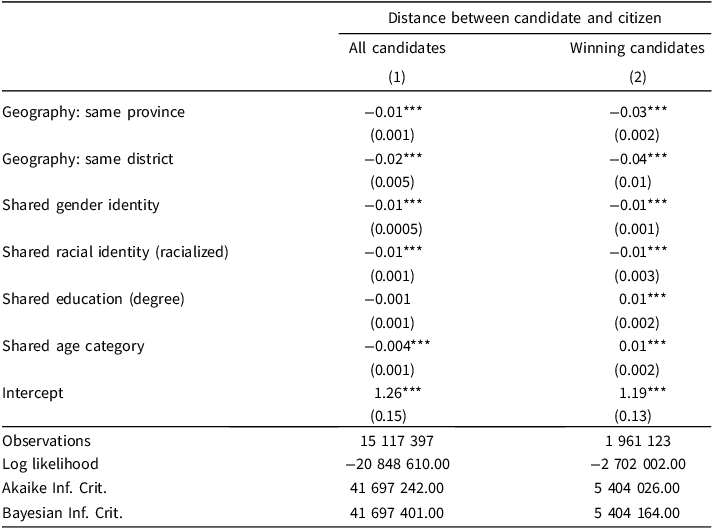
Table 2 summarizes the results of our pairwise collective representation analysis, with all candidates in Column 1 and winning candidates in Column 2. In all models, our dependent variable is the distance in policy preference between a candidate respondent and a citizen respondent; positive coefficients thus indicate increased distance (less congruence) and negative coefficients indicate decreased distance (more congruence).
All of the coefficients in both models are negative, and all are statistically significant, indicating, as expected, that candidates are more congruent with demographically and geographically similar citizens. Both shared province and shared federal electoral districts are statistically significant, and shared district is consistently (and statistically significantly) larger than shared province. This indicates that Canadians are more likely to share policy views with candidates from districts within their province than with candidates from districts outside their province, and even more likely to share policy views with candidates from their own district than with candidates from other districts in their province. We note, however, that these and the other relationships in the model are substantively extremely small—the coefficient for shared gender, for example, suggests that candidates (column 1) or winners (column 2) who share a Canadian citizen’s gender identity are, on average, 0.01 points closer to one another on a scale that ranges from zero to four. All of the shared characteristics in the model share this quality of statistical significance and substantive magnitude. Taken together, these model results suggest that a Canadian constituent-candidate pairing that shares all of the modeled characteristics with a representative—gender, race, age, education, and district—would be just 0.04 points closer together on a 0–4 scale than a constituent-candidate pairing that shares none of these characteristics. This finding reflects very large heterogeneity of policy preferences within geographic and sociodemographic groups in Canadian federal politics.
When we compare the relationships in columns one and two—all candidates vs. winning candidates—we observe almost no important differences in the direction, significance or magnitude of the relationships in the model. This suggests that, whatever congruence may emerge between citizens’ preferences and those of elected representatives, these emerge at the candidate stage rather than the election stage of the selection process. If, for instance, the coefficient for “same gender” was null among all candidates but strong and significant among elected members, this would suggest that elections select candidates in such a way as to generate shared-gender congruence; what we observe, however, is that whatever congruence does exist on shared characteristics, this congruence exists among both unsuccessful and successful candidates.
Overall, then, our pairwise analysis supports a “voice-giving” perspective on collective representation: citizens who have higher numbers of representatives who share their characteristics in the Canadian legislature are likely to enjoy greater policy congruence with the collective preferences of that legislature than are citizens whose characteristics are absent. The differences between the groups, however, are substantively very small, illustrating profound within-group heterogeneity in policy preferences across most policy issues in Canada. While shared characteristics are likely to be more important for some issues than others (Mansbridge, Reference Mansbridge1999), the modest coefficients in Table 3 stand in contrast with the strong across-party sorting documented in our previous analyses. Taken together, our findings suggest, once again, that citizens receive gains in congruence not so much by having representatives from their region or demographic identities, but by having representatives from their preferred party, within the Canadian Parliament.Footnote 6
Correlates of Pairwise Congruence

Table 3. Long description
A table titled Correlates of Pairwise Congruence. The table has 11 rows and 4 columns. The columns are labeled Distance between candidate and citizen, All candidates, and Winning candidates. The first column lists the shared characteristics between candidates and citizens, such as geography, gender identity, racial identity, education, and age category. The second and third columns show the corresponding values for all candidates and winning candidates, respectively. Each row provides the specific value and standard error for the shared characteristic. The table includes the following data: Row 1: Geography: same province, -0.01 (0.001), -0.03 (0.002). Row 2: Geography: same district, -0.02 (0.005), -0.04 (0.01). Row 3: Shared gender identity, -0.01 (0.005), -0.01 (0.001). Row 4: Shared racial identity (racialized), -0.01 (0.001), -0.01 (0.003). Row 5: Shared education (degree), -0.01 (0.001), 0.01 (0.002). Row 6: Shared age category, -0.004 (0.001), 0.01 (0.002). Row 7: Intercept, 1.26 (0.15), 1.19 (0.13). Row 8: Observations, 15117397, 1961123. Row 9: Log likelihood, -20848610.00, -2702002.00. Row 10: Akaike Inf. Crit., 41697242.00, 5404026.00. Row 11: Bayesian Inf. Crit., 41697401.00, 5404164.00.
Coefficients from multilevel linear model of pairwise congruence between all citizen-candidate pairings. Negative values indicate reduced distance, and thus greater congruence. Standard errors in parentheses. *p <0.01; **p < 0.05; ***p < 0.01.
Discussion and Conclusion
Our goal in this article has been to provide a systematic overview of dyadic and collective policy congruence between citizens and federal election candidates in Canada. To do so, we leveraged two original surveys administered to citizens and candidates using identical policy items immediately following the 2021 Canadian federal election.
We organized our analysis around three distinct analyses. First, we explored aggregate relationships between district opinion and candidate opinion, broken down by party and elected/unelected outcomes. We found that most of the congruence that emerges between citizens and candidates operates through the across-party channel, not the within-party channel. Candidate policy positions indeed vary much more across parties than within them, and the within-party adaptation of candidates to the ideological profile of their district, the mechanism that would be expected under a pure Downsian logic, is limited on the policy issues we examine. The exception is immigration, where we observe meaningful within-party variation: candidates of the same party do differ on immigration in ways connected to district opinion. On other issues, however, the within-party lines are essentially flat. This echoes Dassonneville et al. (Reference Dassonneville, Fréchet, Jabbour, Ferland and Homola2025), who find that parties have become more responsive to voters on the immigration dimension specifically. Our evidence thus suggests that, when district-politician policy alignment exists in Canada, it is produced mostly through citizens selecting parties and candidates whose national positions match local preferences. Canadians in progressive places secure policy preference congruence by electing progressive parties, and Canadians in conservative places do the same by electing conservative parties.
These findings align with important features of Canadian electoral politics. Given that most ballots are cast primarily on the basis of party (Blais et al., Reference Blais, Gidengil, Dobrzynska, Nevitte and Nadeau2003; Roy and Alcantara, Reference Roy and Alcantara2015; Stevens et al., Reference Stevens, Islam, de Geus, Goldberg, McAndrews, Mierke-Zatwarnicki and Rubenson2019), candidates have weaker incentives to tailor policy positions to local preferences, and stronger incentives to align with the national party platform. Consistent with prior scholarship (Docherty, Reference Docherty1997), our findings support the view that candidates often act as delegates of their parties, rather than as autonomous representatives of geographically distinct constituencies.
Second, we explored the correlates of congruence more formally. Winning candidates are more congruent with their constituents than losing candidates. While this finding represents something of a low normative bar for congruence, clearing this bar is by no means automatic, especially in a strongly nationalized electoral environment. It is notable that Canadian federal elections are able to achieve policy congruence between victorious candidates and voters across many issues, a finding that speaks not only to democratic performance but also to the organized ideological structure of party competition in Canada today (Cochrane, Reference Cochrane2015).
Our statistical analysis also speaks to the limits of individual-level predictors of congruence. Contrary to our expectations, candidates who live in the constituencies they contest do not display systematically higher congruence with local preferences. Nor are candidates selected by local party members significantly less congruent with constituents than those selected through other processes. Dyadic congruence is also lower in socially heterogeneous districts (in terms of income and education). This last finding deserves careful interpretation, however. A larger distance between a given candidate and the district mean in a heterogeneous district is not, by itself, straightforwardly “worse” representation on all accounts. It is simply the consequence of a more dispersed preference distribution, and it may coexist with, or even reflect, a richer menu of choices offered to voters at election time. On a many-to-one conception of representation, where the distance from the district mean is the relevant quantity, social heterogeneity does make congruence harder to achieve (Mansbridge, Reference Mansbridge2009).
Third, moving from dyadic to collective representation, we observe small but statistically significant improvements in congruence associated with demographic and geographic similarities between candidates and constituents. Importantly, these gaps emerge at the candidate stage and are neither amplified nor corrected at the election stage. The electoral process does not create the gaps, but it does not close them either.
We are careful not to overstate the normative implications of these findings. Policy preference congruence is a necessary condition for substantive representation, but in the Canadian context of strong party discipline, congruence alone does not guarantee that MPs can “act for” their constituents. An MP whose preferences align with her constituents may nonetheless be constrained by caucus discipline to vote against those preferences on a particular issue. Conversely, a disciplined MP may end up voting in line with constituents through the channel of party position rather than personal conviction. Our findings thus speak to the preference-congruence condition, which we see as important in its own right and as a precondition for substantive representation through the various caucus, committee and leader-selection channels discussed in the introduction, but not necessarily as a direct measure of whether citizens are acted for in Parliament.
We see considerable opportunity for future research to build on this work, including research that covers additional policy domains, emerging or lower-salience policy debates, and/or uses speeches or other data to include the full population of Canadian federal candidates or MPs. Our collective-representation model could (and should) be extended to alternative individual-representative pairings, including citizen-government and citizen-cabinet representation. This work might also be extended to focus on the role of shared characteristics, such as gender, for policy issues that especially divide, or especially affect, those with particular identities or group membership.
Our study also speaks to recurring debates in Canadian politics. Arguments for electoral reform, loosening party discipline, or strengthening the local roots of MPs all rest on assumptions about where representation currently succeeds or fails. Our results suggest that Canadians are moderately well represented by their candidates and elected MPs, though the representational link is constructed primarily through the party system rather than through individual-candidate adaptation to local preferences. Canadians thus secure representation in a manner consistent with the party-centred character of their political institutions. Whether this mode of representation is considered adequate ultimately depends on normative commitments about the role of parties, candidates and elected officials in a well-functioning representative democracy. These are important questions that further research—perhaps combining empirical evidence with normative reflection (Mansbridge, Reference Mansbridge2003; Wolkenstein, Reference Wolkenstein2021)—may fruitfully address.
Supplementary material
The supplementary material for this article is available at https://doi.org/10.1017/S0008423926101395.



 Open access

