

INTRODUCTION
A quadriplegic, who spent many months in the hospital at the M&DC [Medical and Diagnostic Center], suffered from bedsores which had developed into open wounds because of lack of care and which eventually became infested with maggots. Days would pass without his bandages being changed, until the stench pervaded the entire ward. The records show that in the month before his death, he was bathed and his dressings were changed only once. Equally neglected was another patient at the M&DC who could not eat. Although intravenous feeding was ordered, it was not administered, and no other form of nourishment was received for the three days prior to his death.
Newman v. Alabama (1972, 285)
This quote from the ruling in 1972’s Newman v. Alabama illustrates correctional systems’ neglect and mistreatment of incarcerated Americans. These episodes occurred in the Medical and Diagnostic Center, a minimum-security facility for the most seriously ill people imprisoned in Alabama. Here, staff and other medical resources far exceeded those of other facilities, and care was “remarkably good compared with that available in other prisons within the system” (Newman v. Alabama 1972, 282). In his ruling in Newman and a piece in the Texas Law Review, Judge Frank M. Johnson described a statewide system in which incarcerated people were routinely denied care through both intentional animosity and pure neglect. The divergence between Alabama’s correctional practices and free-world standards was sufficiently stark to belie the very label of “medical care” (Newman v. Alabama 1972; Johnson Reference Johnson1976, 907–08).
While failures in correctional health care (CHC) were especially severe in Alabama and other Southern states, these types of abuses constituted egregious examples of problems found in correctional systems nationwide. Differences in degree of inadequacy—not fundamental differences of kind—distinguished states’ medical care delivery systems for their incarcerated populations (Feeley and Rubin Reference Feeley and Rubin1998, 150). Until late in the twentieth century, many corrections facilities did not have any recognizable health care system. Where CHC was offered, there was minimal legal oversight. Blatant negligence was routine, and the care provided was frequently grossly inadequate and administered by unqualified individuals, often including other incarcerated people. For most of the country’s penal history, such conditions persisted with the courts’ tacit blessing, as judges repeatedly ruled that conditions of confinement were outside judicial oversight’s purview. Mainstream medicine was also conspicuously absent from these settings; despite its broader influence and power, the medical profession had little engagement with CHC.
Recent decades have seen both noteworthy reforms and persistent problems. Nearly all sizable correctional organizations now have formalized medical care delivery systems; this itself is an appreciable improvement (Anno Reference Anno1977, 94; Feeley and Rubin Reference Feeley and Rubin1998; Schlanger Reference Schlanger2018). CHC’s formalization has entailed a transition away from wholly unqualified individuals providing care, the routinization of basic services’ availability, and reductions in active denials of legitimate medical treatment and egregious abuses (Anno Reference Anno2001, 27; Feeley and Swearingen Reference Feeley and Van2004). Yet, CHC is far from achieving free-world medicine’s standards of care (Marquart et al. Reference Marquart, Merianos, Cuvelier and Leo1996; Vaughn and Carroll Reference Vaughn and Leo1998; Vaughn and Smith Reference Vaughn and Smith1999; Vaughn and Collins Reference Vaughn2004; Fleury-Steiner Reference Fleury-Steiner and Carla2008; Schlanger Reference Schlanger2018). Less-qualified individuals continue to provide frontline medical services in US jails and prisons, and Newman-style neglect and mistreatment have certainly not disappeared (see, for example, Chang Reference Chang2012; Puisis et al. Reference Puisis, Jack, Madie, Knox and Jay2018, 94–102; Dreiband et al. Reference Dreiband, Franklin, Town and Moore2019; Venters Reference Venters2019).
This article investigates one particular development: the emergence and proliferation of privately produced certifications of individual CHC practitioners. Drawing on archival research at the National Commission on Correctional Health Care (NCCHC) and interviews with key informants, we first sketch the legal and professional interventions that begat standardization in CHC and impelled certification programs. This history shows the connections between incarcerated people’s lawsuits and the reforms that certifications symbolize. Court rulings in these lawsuits encouraged expanded professional involvement, and common law changes are the basic foundation of the substantive reforms in CHC that began in the 1960s (Feeley and Rubin Reference Feeley and Rubin1998; Venters Reference Venters2019, 11).
As we explain below, subsequent developments—especially the Prison Litigation Reform Act—have buffered corrections actors’ exposure to legal liability. We thus hypothesize that contemporary individuals and organizations will wait until faced with salient legal threats to obtain certifications, rather than proactively seeking certifications to manage general legal risk. As this description suggests, we take corrections actors’ point of view, seeking to identify their reasons for pursuing certification. To test our historically derived hypotheses (see Stryker Reference Stryker1996), we probabilistically assess the contemporary relationship between our variables of interest. Our quantitative analyses support our hypothesis of legal reactivity.Footnote 1 We find a significant positive association between litigation and certifications, suggesting that corrections actors pursue these endorsements when seeking to temper the impact of realized legal threats or minimize similar threats’ chances of recurrence.
This result advances the sociolegal conversation regarding whether litigation and court rulings are (Epp Reference Epp2009) or are not (Rosenberg Reference Rosenberg2008) consequential in effecting meaningful social outcomes. Regarding prison conditions specifically, some argue that incarcerated people’s lawsuits offer avenues to substantive change (Feeley and Rubin Reference Feeley and Rubin1998; Feeley and Swearingen Reference Feeley and Van2004; Simon Reference Simon2014).Footnote 2 Others point to courts’ tendencies to defer to systems’ symbolic compliance with constitutional provisions (Reiter Reference Reiter2012, Reference Reiter2015), or how court orders related to overcrowding produce different consequences than improved conditions: namely, encouraging new prison construction (Schoenfeld Reference Schoenfeld2010). We conclude that lawsuits engender standardization and professionalization, offering some evidence of litigation’s capacity to impel change. In line with more skeptical perspectives, however, litigation does not appear to predict the highly consequential outcome of incarcerated people’s mortality.
Our findings also help to advance research at the intersection of organizational and criminal justice studies, shedding new light on the dynamic interrelationship between law and correctional organizations (see generally Edelman and Suchman Reference Edelman and Suchman1997). As our historical narrative describes, social movements helped push for reforms in the 1960s and 1970s. This reform era, characterized by increased involvement from organized professionals, included key changes to case law recognizing incarcerated people’s legal rights, opening space for third parties offering credentialing systems as resources for proactive insulation from legal risk. Under these conditions, normative pressures contributed to early certification adoptions, as corrections organizations sought to both ward off general legal risks and demonstrate legitimacy in a changing field (see Rubin Reference Rubin2015).
Subsequent legal changes, however, enervated incipient normative pressures and weakened incentives to pursue certifications proactively. In part, these changes manifested in courts’ tendency to defer to organizational practices (Edelman et al. Reference Edelman, Krieger, Eliason, Albiston and Virginia2011; Edelman Reference Edelman2016), with courts largely acceding to corrections organizations’ judgments about which complaints constitute the “serious medical needs” that trigger the legal obligation to provide care established under Estelle v. Gamble (1976). More explicitly political reactions notably included the Prison Litigation Reform Act (PLRA), which made it harder for incarcerated people to access the courts and to succeed in legal challenges regarding conditions of confinement. Together, these changes curtailed corrections actors’ exposure to litigation, boosting the appeal of reactive responses relative to that of proactive interventions. Indeed, our findings suggest that, in their contemporary operating environment, corrections actors tend to wait until they face significant coercive pressures—namely lawsuits—before adopting protective reactions (see also Skaggs Reference Skaggs2008, Reference Skaggs2009).
CORRECTIONAL HEALTH CARE’S EVOLVING LEGAL AND PROFESSIONAL ENVIRONMENT
Our historical narrative tracks CHC’s recent evolution to set up our probabilistic hypotheses.Footnote 3 We first describe the common law changes that precipitated the contemporary CHC environment, including the rise of CHC certifications. We then show how this history suggests two possible rationales underlying decisions to get certified: these decisions may reflect proactive attempts to manage risk through improving conditions, or reactive responses to manifest threats. Our account shows legal proactivity’s place in early standardization and professionalization initiatives and describes the contemporary circumstances that favor legal reactivity.
The Pre-Reform Situation
For most of US corrections’ history, a “hands-off” doctrine dominated courts’ relationships with correctional systems (see Ruffin v. Commonwealth of Virginia 1871; Price v. Johnston 1948). Federal judges generally held that only health care practices sufficiently inhumane to “shock the conscience of the court” merited judicial intervention (ABA and AMA 1974, 144; Anno Reference Anno1976, 36). Judges invoked federalism to justify their limited involvement in state and local correctional facilities’ administration and consistently declared day-to-day corrections management outside the realm of judicial review (Anno Reference Anno2001, 15). In more practical terms, rulings often noted that jails’ and prisons’ problems were complex and locally variable, and thus poor candidates for amelioration via court decisions. Such rulings suggested that on-the-ground administrators’ knowledge trumped that of judges working from a distance (Dubler Reference Dubler1979, 67).
Medical professionals were also minimally involved. In an interview, CHC pioneer and NCCHC cofounder B. Jaye Anno recalled collecting data during the pre-reform period, when health care for incarcerated people was legally regarded as a privilege, not a right. She described a typical prison clinic:
The clinic was run by unlicensed medical corpsmen, assisted by inmate nurses who weren’t nurses. If there was a physician, the physician-to-patient ratio was quite extraordinary…. When we were reviewing the Texas system, there were something like 25,000 inmates in twenty-three facilities and they had eleven physicians for that population.
As Dr. Anno relayed, to the extent that corrections systems provided health care at all in the pre-reform era, qualified professionals were rare. Facilities assigned service provision responsibilities to individuals without any formal medical training, including other incarcerated people. Among whatever formally credentialed staff were present, individuals routinely provided services exceeding their qualifications. And available MDs were not just overburdened, but often professionally compromised; many physicians working in corrections had faced professional or legal censure and accordingly had been barred from ordinary free-world practice and reissued licenses restricted to institutional settings.
Inadequate, negligent, and brutal CHC systems prevailed under this legal and professional disinvestment. The same factors curtailed transparency about the state of affairs. Early studies pulling back the veil on an obscured situation collectively decried the inhumane treatment that characterized correctional systems nationwide (Anno Reference Anno1976, 17).
Incarcerated people, of course, had direct knowledge of poor prison and jail conditions, including medical care inadequacies. These inadequacies contributed to unrest and uprisings at places like the Attica Correctional Facility and Walpole State Prison (Prout and Ross Reference Prout and Ross1988, 43; Useem and Kimball Reference Useem and Peter1991, 22; Thompson Reference Thompson2016). Improvements in medical care figured centrally in incarcerated people’s claims upon correctional systems in the 1960s and 1970s, including demands from collective uprisings and the contents of lawsuits (Anno Reference Anno1977, 12; Prout and Ross Reference Prout and Ross1988, 43–44; Thompson Reference Thompson2016).
Legal Change
Imprisoned people filed hundreds of lawsuits over the decades preceding the reform era, which federal judges largely rejected (Feeley and Rubin Reference Feeley and Rubin1998, 34; Schlanger Reference Schlanger2018, 365–68). A striking shift in judicial response to such litigation, however, began in the early 1960s, launching a period of noteworthy consensus among judges supporting interventionist oversight of correctional conditions (Feeley and Rubin Reference Feeley and Rubin1998, 43; Schlanger Reference Schlanger2018). A series of new decisions heralded a changed legal environment, with an expanded role for federal judges and their staff (Feeley and Rubin Reference Feeley and Rubin1998; Feeley and Swearingen Reference Feeley and Van2004). Amid the civil rights and prisoners’ rights movements (Jacobs Reference Jacobs1980; Fleury-Steiner Reference Fleury-Steiner and Carla2008), the federal courts took several important steps in recognizing basic legal rights for incarcerated people. Federalism-based justifications for nonintervention crumbled before proliferating perceptions of corrections systems as inhumane and ultimately unconstitutional.
Cooper v. Pate (1964) was pivotal, marking a decisive transition away from the hands-off doctrine in responses to incarcerated people’s lawsuits. Here, the Supreme Court expressly recognized that people incarcerated in state prison systems were eligible to invoke constitutional rights. This ruling’s establishment of incarcerated people’s access to constitutional protections was crucial for subsequent lawsuits (Anno Reference Anno1976, 37).
Holt v. Sarver (1970) built on this precedent. In this first “totality of conditions” decision, the US District Court for the Eastern District of Arkansas declared conditions in the entire Arkansas prison system so deficient that they constituted a systemwide breach of imprisoned people’s constitutional rights. This decision’s invocation of the Eighth Amendment prohibition of cruel and unusual punishment as a rationale for intervention and its application of an all-inclusive court order would both notably influence future decisions (Feeley and Rubin Reference Feeley and Rubin1998, 39).
These foundational cases set the stage for later constitutional lawsuits (Useem and Kimball Reference Useem and Peter1991, 12); for CHC specifically, Estelle v. Gamble (1976) was most directly consequential (Fleury-Steiner Reference Fleury-Steiner and Carla2008, 72). Ratifying previous lower court decisions, this ruling definitively established that the Eighth Amendment prohibition of cruel and unusual punishment applies to CHC (Greifinger Reference Greifinger, Robert, Bick and Goldenson2007). Stating that “deliberate indifference to serious medical needs” constitutes “unnecessary and wanton infliction of pain,” the Court declared that incarcerated people have a constitutional right to certain minimal standards of health care, including access to a professional health evaluation and a corresponding course of treatment. Demonstrating courts’ increased willingness to intervene in corrections, Estelle established incarcerated people as a unique group of Americans with a constitutional right to health care (Friedman Reference Friedman1992).
The prisoners’ rights movement and associated court victories, however, also engendered substantial backlash. Contentions that incarcerated people were living comfortably, or even lavishly, undergirded subsequent “tough on crime” initiatives, including measures making it harder to access medical care in jails and prisons (Lynch Reference Lynch2009). Fixation on an alleged explosion in frivolous lawsuits figured centrally in this discourse. These arguments reached a zenith in hearings on the 1996 Prison Litigation Reform Act (PLRA), where scandalized supporters of the legislation invoked lawsuits involving issues like haircuts, bath towels, and preferences between creamy and chunky peanut butter (Fleury-Steiner Reference Fleury-Steiner and Carla2008, 67–68). Although subsequent investigation found that many of these anecdotes seriously misrepresented the nature of the suits in question, their prominence in congressional debate both reflected and reinforced the notion that the prisoners’ rights movement had generated a wave of unwarranted and meritless claims. As discussed further below, the PLRA constituted a statutory culmination of the political pushback to the prisoners’ rights movement, limiting incarcerated people’s access to the courts and reducing their likelihood of prevailing in litigation.
Early Professional Engagement: Legal Proactivity through Ameliorating Conditions
As courts remade CHC’s legal context, organized professionals also began to expand their involvement. Environmental changes connoted new legitimacy considerations, engendering reactions from organizations like the American Medical Association (AMA) and American Bar Association (ABA) (see Meyer and Rowan Reference Meyer and Brian1977). Jaye Anno noted that resistance to Medicare in the 1960s had tarnished the AMA’s reputation and that refocusing organizational efforts on underserved populations—including incarcerated people—offered an opportunity to repair damaged legitimacy. Younger doctors especially saw this sort of reform-oriented activity as essential to restoring and maintaining the organization’s social standing.
Accordingly, the AMA was seeking “public benefit programs that organized medicine could become involved in”; along with free-world poor populations, correctional facilities were a promising target (Anno Reference Anno1977, 2). In her interview, Dr. Anno described how Bernard Harrison—her husband and later her partner in founding the NCCHC—helped move the medical profession into corrections. An AMA attorney, Mr. Harrison consulted with an ABA panel on conditions of confinement. Dr. Anno retrospectively recounted that, when he proposed focusing on CHC, both legal and medical professionals confessed, “we don’t know anything about [correctional] health care.” This perceived ignorance induced Mr. Harrison to create a nationwide CHC survey, focusing first on jails (Anno Reference Anno1976, 17).
Under Mr. Harrison’s direction, in 1972 the Jail Health Program sent surveys to 2,930 jails across the country, receiving 1,159 usable responses. Even with their low expectations, the responses were disheartening. Over 65 percent of jails reported having only first aid services, while nearly 17 percent offered no internal medical services of any kind, and over 30 percent did not have regularly available physicians. Just over a third provided dental care. Despite incarcerated populations’ elevated rates of substance abuse, only about 17 percent and 9 percent of responding jails had facilities for people addicted to alcohol and drugs, respectively. Similarly, despite the prevalence of mental illness among jailed people, only around 13 percent of jails offered specialized facilities for mental disorders, and 15 percent access to psychologists. While most jails dispensed prescription drugs, over 80 percent of responding jails had unlicensed, nonmedical staff—including other jailed people—distributing medication (Steinwald, Alevizos, and Aherne Reference Steinwald, Gus and Phil1973).
Harrison and his AMA colleagues used these survey results to ground their proposal for a program to improve CHC. Adopting these measures, in turn, could help corrections systems demonstrate legitimacy in an evolving organizational field (see Rubin Reference Rubin2015), and proactively insulate themselves from liability in their changed legal environment. Federal court rulings opened new possibilities for judicial intervention, but left the details of constitutionally acceptable care largely unspecified. This created a vacuum that the AMA could address (Anno Reference Anno1977, 1). Mr. Harrison took the survey results to the AMA Board of Trustees, who in early 1973 allocated $50,000 for “study and planning purposes in developing a program to improve medical care in jails” (Anno Reference Anno1977, 3). With this funding and $448,003 from the Law Enforcement Assistance Administration, the AMA project established pilot programs to improve standards of practice, data collection, and expert involvement at jails in six states (Wisconsin, Maryland, Michigan, Georgia, Indiana, and Washington). Throughout, they stressed bridging gaps between state and local medical professional organizations, the AMA, and corrections authorities (Anno Reference Anno1977, 11–14).
Reviewing the jail health project’s first year, Jaye Anno interviewed AMA representatives and state officials. Among other things, she asked them what they saw as the program’s most significant accomplishment. The responses shared a central theme. Among both groups, the most pronounced enthusiasm by far was around “the simple fact that organized medicine—at the national, state, and local levels—had gotten involved in jail health at all” (Anno Reference Anno1977, 93–94). Responding to the 1972 survey, one jail administrator said, “I’m sure no doctor wants the job, but that is one of those things that the doctors as a group must realize, someone has to be the prison doctor and doctors (as a group) should see that proper services are rendered” (AMA 1974, 20). As court rulings were indicating a new environment of legalized accountability, this administrator expressed notable interest in enlisting professional medicine to help proactively manage emerging normative pressures and legal obligations.
Legal Liability and Professional Standard-Setting
Harrison’s group held the First National Conference on Improved Medical Care and Health Services in Jails in 1977. This event foregrounded lawsuits’ role in creating an environment of legalized accountability in CHC (see Epp Reference Epp2009). Roland Machman, Jr., Chairman of the Human Rights Committee on the Alabama Prison System and an early observer of CHC reform, delivered the keynote address. After pointing out the connections between the civil rights movement and court decisions recognizing incarcerated people’s rights, he described reformist judges as “quite simply responding to a constitutional duty” (Machman Reference Machman1977, 13). Mr. Machman went on to express the view that the judicial branch had taken the lead where the executive and legislative branches had failed. He argued that the other branches of government needed to step up and take some responsibility for reform, at which point “courts will cheerfully withdraw” (Machman Reference Machman1977, 14). At the same meeting, Washington, DC Department of Corrections Medical Director Robert E. Lee echoed Mr. Machman’s emphasis on the importance of litigation. Dr. Lee highlighted researchers’ findings of major CHC inadequacies and their conclusions that these inadequacies alone proved insufficient to prompt organizational change. Only a class action lawsuit from people incarcerated in the DC Jail and a consequent court order provided the necessary impetus, pushing the DC government to reform (Machman Reference Machman1977, 42–43).
Professional organizations, acting as “internal governance units” within fields (Fligstein and McAdam Reference Fligstein and Doug2012), play crucial roles in periods of institutional change (Greenwood, Suddaby, and Hinings Reference Greenwood, Suddaby and Hinings2002). Responding to conditions of confinement lawsuits, courts turned to external organizations for guidance on appropriate minimum standards. Early on, they used general prison conditions standards from groups like the American Correctional Association (ACA) and American Bar Association (ABA) to inform basic guidelines for prison administration (Feeley and Swearingen Reference Feeley and Van2004, 447; Camp and Useem Reference Camp, Useem, Petersilia and Kevin2012). More specialized groups arose to provide guidelines tailored to particular issues, including medical service provision.
Most notable among these specialized groups is the National Commission on Correctional Health Care (NCCHC). AMA-organized activities around CHC in the 1970s and 1980s—including creation of the first CHC standards and the first accreditations of facilities’ CHC systems—constituted the NCCHC’s emergence in incipient form, leading to its incorporation as an independent nonprofit organization in 1983.Footnote 4 The NCCHC is both a key early mover and the leading contemporary voice on standards of best practice and formal endorsements of individual practitioners and facilities. It continues to organize the National Conference on Correctional Health Care, the annual meeting that evolved from the First National Conference in 1977; this event is the field’s preeminent venue for professional discourse, networking, education, and product exhibition. The NCCHC also manages the Journal of Correctional Health Care, the only national, peer-reviewed periodical dedicated to CHC, and provides other fora for discussion of CHC issues.
The NCCHC epitomizes specialized professional organizations’ development of procedural standards to establish uniformities across multiple sites of activity (see Timmermans and Epstein Reference Timmermans and Steven2010, 71–72). Their standards of appropriate minimums for CHC provision drive their accreditations of correctional facilities’ medical care delivery systems and their certifications of individual practitioners.
HYPOTHESIZING RELATIONSHIPS BETWEEN MORTALITY, LITIGATION, AND CERTIFICATIONS
Legal Proactivity: Certifications as Predictor
CHC is complex and fraught. There is a fundamental tension between “care” and “punishment” (Prout and Ross Reference Prout and Ross1988): correctional facilities need to square their core mission of secure confinement with their legal responsibility to provide for incarcerated populations’ needs, including medical care (AMA 1974, 13–14). Balancing treatment, resources, and legal liability while working with incarcerated populations is trying for both corrections administrators and frontline workers (Armstrong and Griffin Reference Armstrong and Griffin2004; Carlson and Thomas Reference Carlson2006; Griffin et al. Reference Griffin, Hogan, Lambert, Tucker-Gail and Baker2010; Lerman Reference Lerman2017). “Dual loyalty”—perceived tensions between duties to treat patients and obligations to security staff—can yield individual feelings of role conflict, and security staff and their priorities typically override health services and their mission of care (Pont, Stöver, and Wolff Reference Pont, Heino and Hans2012; Venters Reference Venters2019).
Incarcerated people are also an unusual and challenging patient population. Bad health is the norm, and their health care resources lag behind those available to free-world populations, often dramatically (Binswanger, Krueger, and Steiner Reference Binswanger, Krueger and Steiner2009; Wilper et al. Reference Wilper, Steffie Woolhandler, Lasser, Danny, Bor and Himmelstein2009; Ross Reference Ross2012; Nowotny, Rogers, and Boardman Reference Nowotny, Rogers and Boardman2017). Issues like mental illness and substance abuse complicate care provision anywhere, and the constraints of correctional contexts can compound these difficulties. Budgetary pressures push corrections systems toward austerity (Aviram Reference Aviram2010; Camp and Useem Reference Camp, Useem, Petersilia and Kevin2012), further limiting care resources.
Within this context, certification could appeal to both individuals and organizations seeking to demonstrate legitimacy and get out in front of health care–related risks. Proactively enhancing staff training and communicating compliance through certification may help organizations mitigate liability (Edelman Reference Edelman1992; Berrey, Nelson, and Nielsen Reference Berrey, Nelson and Nielsen2017, 101). Decisions to obtain certifications for these reasons reflect normative pressures, as corrections organizations seek to defend legitimacy through signaling professionalization and rational bureaucratization (DiMaggio and Powell Reference DiMaggio and Powell1983, 152). Certifications functioning in this way would constitute “normative endorsements,” like the formalized expressions of approval Ruef and Scott (Reference Ruef and Richard Scott1998) examine in their research on free-world health care organizations. These authors describe external experts’ assessments of organizations’ compliance with professional norms as “‘institutional legitimating devices’ that enhance public trust” (Ruef and Scott Reference Ruef and Richard Scott1998, 879, quoting Van de Ven and Garud Reference Van de Ven, Raghu and Rosenbloom1989, 211). Proactive risk management through certifications could function similarly in the specialized field of CHC. Private endorsements like certifications and facility-level accreditations are typically voluntary, not governmentally compelled (but see discussion of coercive pressures to adopt endorsements below). Yet, they offer the possibility of more effectively complying with vague legal dictates and reducing risk exposure (see Edelman Reference Edelman1992). Like regulators, third-party endorsers can be allies in efforts to avoid bad outcomes, “resources available for internal management of uncertainty and risk” (Gray and Silbey Reference Gray and Silbey2014, 120).
If this is how CHC certifications function, we would expect any significant association between certifications and lawsuits to be negative, with higher rates of certifications predicting reductions in incarcerated people’s litigation rates. This was the logic of early professional engagement in the 1970s. As the history above indicates, the NCCHC’s embryonic iterations entered the field offering resources aimed at substantively improving service provision. Standardization according to their guidelines appealed to corrections actors hoping to demonstrate legitimacy and forestall liability under emerging conditions of legalized accountability (see Epp Reference Epp2009; Rubin Reference Rubin2015).
If contemporary certification adoptions predict significant reductions in negative outcomes for corrections organizations (lawsuits, or mortality), different processes could underlie the relationship. Certifications themselves could have direct effects, reducing negative outcomes through ensuring or bolstering staff knowledge and skills. This relationship could also manifest if certifications indicate something “bigger” about corrections leadership in a given state; that is, certifications may be a proxy for broader proactive or progressive approaches to conditions of confinement.
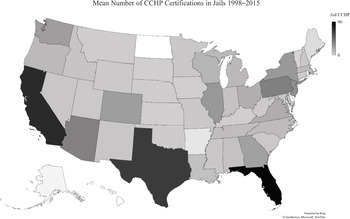
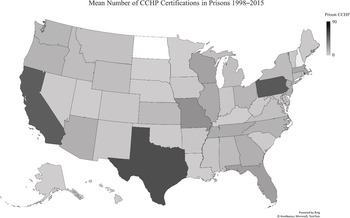
As NCCHC representatives themselves note, there are also reasons to doubt certifications’ causal impact. Fundamentally, certification rates are not particularly high, limiting their potential influence on important outcomes like litigation and mortality. In 2015, states’ prison systems averaged just 17 Certified Correctional Health Professionals (CCHPs), and states’ jail systems just 21; California had the most prison CCHPs at 150, and Florida had the most jail CCHPs at 151.
Certifications can also be valuable in ways that may not translate directly into measurable differences in litigation or mortality. Explaining their decisions to pursue certification, individual CCHPs invoke ideas like credibility, recognition, expertise, competence, dedication to the field, and personal growth (NCCHC 2021; authors’ correspondence with NCCHC); these factors’ connections to lawsuits and incarcerated people’s deaths are tenuous. Certification can be a source of pride for people who work in corrections (Camp and Useem Reference Camp, Useem, Petersilia and Kevin2012), who sometimes feel tainted by their association with stigmatized groups and settings. CHC representatives say that popular opinion degrades the occupation relative to free-world medicine; particularly given the legacy of disgraced physicians restricted to institutional licenses, certifications offer a stigma management resource (see Cohen and Dromi Reference Cohen and Dromi2018). Thus, employee certifications—like facility-level accreditations (see Friedmann Reference Friedmann2014; Hunter Reference Hunter2016)—may help individuals, corrections organizations, and health service contractors cultivate normative legitimacy and defend their reputations without necessarily connoting protection from liability or reducing deaths. Such patterns would contradict an expectation that certifications would significantly predict litigation or mortality rates.
Legal Reactivity: Certifications as Consequence
Compared to proactively adopting standards of best practice in hopes of reducing exposure to risks, legally reactive certification adoption reflects organizations’ responses to coercive pressures, as they endeavor to protect themselves from specific manifested threats, or reduce such threats’ chances of recurrence. A general expectation that organizations will respond more aggressively to apparent, immediate threats than vague potential risks would support favoring this mechanism to explain an association between undesirable outcomes and certifications (Skaggs Reference Skaggs2008, Reference Skaggs2009). Previous studies assessing organizational compliance signals as more symbolic than substantive augur similarly (Bisom-Rapp Reference Bisom-Rapp1999; Krawiec Reference Krawiec2003; Edelman Reference Edelman2016).
We expect filed lawsuits to be the most salient threats to contemporary corrections actors. Prior research indicates litigation’s power to compel changes, sometimes extensive and expensive changes (Feeley and Rubin Reference Feeley and Rubin1998; Feeley and Swearingen Reference Feeley and Van2004; Simon Reference Simon2014). Post-Estelle legal developments have enervated normative pressures and weakened the general environment of legalized accountability through limiting incarcerated people’s ability to sue successfully. These developments encourage correctional authorities to “wait and see” about legal liabilities, dealing reactively with specific threats that emerge rather than proactively taking steps to insulate themselves from general risk. Accordingly, we see legal reactivity as more plausible than legal proactivity in explaining contemporary certification adoptions.
Multiple legal developments indicate the attenuation of normative pressures and legalized accountability for corrections authorities. First, in case law, decisions affirming and applying the Estelle standard have given corrections actors broad discretion in deciding what constitutes a “serious medical need” triggering the obligation to provide care. Post-Estelle courts have largely deferred to local authorities’ determinations of what medical needs qualify as “serious.” These decisions include deference not only to physician assistants’, nurses’, and doctors’ evaluations of seriousness, but in some cases also to assessments from corrections officers with no relevant medical training (Vaughn and Smith Reference Vaughn and Smith1999; Vaughn and Collins Reference Vaughn2004). Beyond granting local correctional actors leeway to distinguish between “serious” and “nonserious” medical needs, rulings have not required CHC to meet any “community standard” of adequate health care and indeed held that prison medical care does not need to be ideal “or even very good” (Vaughn and Carroll Reference Vaughn and Leo1998, 7). Similarly, precedent dictates that incarcerated people do not have legitimate legal claims to the external benchmarks of acceptable care available to free-world patients (Vaughn and Carroll Reference Vaughn and Leo1998, 14).
Post-Estelle rulings have also foregrounded the “deliberate” element of Estelle’s “deliberate indifference” standard, holding that inadequate—or even directly harmful—CHC does not violate the standard without conscious disregard of a known risk (Friedman Reference Friedman1992, 929). In Wilson v. Seiter (1991), the US Supreme Court again affirmed the deliberate indifference standard, stating that prison health services must act with “either intent or wantonness” in the face of an organizationally acknowledged “serious medical need” to violate an incarcerated person’s Eighth Amendment rights (Friedman Reference Friedman1992, 930–31). Similarly, in Farmer v. Brennan (1994), the Court emphasized that the Eighth Amendment forbids cruel and unusual punishments only, not cruel and unusual conditions, and concluded that conditions themselves do not constitute punishments (Schlanger Reference Schlanger2018, 384–85). To substantiate a claim of unconstitutional deliberate indifference, they ruled, plaintiffs carry the burden of proof in demonstrating that defendants knowingly disregarded a serious risk of harm. These narrow interpretations of constitutional protections have limited incarcerated people’s litigation options, and thus corrections authorities’ constitutional accountability (Schlanger Reference Schlanger2006, Reference Schlanger2018).
Statutory intervention—namely the 1996 Prison Litigation Reform Act (PLRA)—has also eroded incarcerated people’s access to legal recourse, furthering “wait and see” reactive stances’ comparative appeal to corrections authorities. Driven by backlash to the prisoners’ rights movement (Fleury-Steiner Reference Fleury-Steiner and Carla2008; Lynch Reference Lynch2009), the PLRA curbed courts’ power regarding conditions of confinement cases through limiting injunctive relief and damages (Schlanger Reference Schlanger2015, 154). It also included several measures making it harder for incarcerated people to file lawsuits and easier for courts to dismiss their cases. The statute’s “exhaustion requirement” requires incarcerated people to go through their system’s entire internal grievance and appeal process before they are eligible to file lawsuits (Calavita and Jenness Reference Calavita and Valerie2015, 28). Further, the PLRA instituted new requirements for indigent incarcerated people to pay filing fees, and a “three-strikes” component requiring those who have had three previous lawsuits dismissed for certain reasons to pay their entire filing fee up front (Calavita and Jenness Reference Calavita and Valerie2015, 27–28). Through limiting attorneys’ fees, this law also increased incarcerated people’s likelihood of filing lawsuits pro se, without representation; already common before the PLRA, pro se filings now constitute well over 90 percent of imprisoned people’s civil rights cases (Schlanger Reference Schlanger2015, 166–67). Procedural hurdles and technical grounds for dismissal under the PLRA are consequential for incarcerated people who typically lack resources, education, and technical proficiency in legal matters; limited access to counsel compounds such difficulties. Collectively, the PLRA’s provisions dramatically affected imprisoned people’s litigation, both reducing filing rates and decreasing plaintiffs’ rates of success in those cases that are filed (Schlanger Reference Schlanger2015).
Post-Estelle doctrine and statutory restrictions on litigation mean that CHC must fail much more dramatically than free-world medicine to constitute legally actionable mistreatment (Vaughn and Carroll Reference Vaughn and Leo1998). Mere negligence or violations of civil recklessness standards fail to meet the “culpable state of mind” standard required for an Eighth Amendment violation (Schlanger Reference Schlanger2018, 384–85). Even in cases where correctional actors without formal medical training deem medical issues “nonserious,” the withholding of the “serious” designation can itself be sufficient to protect corrections organizations from liability (Vaughn and Carroll Reference Vaughn and Leo1998, 9–10). To establish legal wrongdoing, CHC plaintiffs must establish that correctional actors caused harm through deliberate inaction in the face of recognized serious medical needs. Courts do not consider failures to meet basic competence standards or recognize serious medical issues evidence of legal wrongdoing; indeed, in the latter case, an organizational failure to identify a serious medical need points toward legal vindication, not legal liability. This insulation from liability encourages corrections actors to wait and deal with litigation when (and if) it eventuates, rather than seeking legal prophylaxis.
Although lawsuits are especially noteworthy threats to corrections actors, we also consider the possibility that negative health outcomes, especially deaths, may cause defensive reactions. Perceived crises in health outcomes that attract popular or political attention can precipitate scrutiny for correctional administration and contracted service providers; deaths in particular can be notably impactful compared to less visible morbidity issues (Venters Reference Venters2019). We expect, however, that elevated mortality rates will primarily manifest as threatening through their potential effects on litigation rates, meaning that any mortality effect would flow through litigation.
Whether resulting from litigation or mortality, the pressures engendering reactivity are coercive, rather than the normative pressures engendering proactivity (see DiMaggio and Powell Reference DiMaggio and Powell1983). Occasional legal mandates to standardize according to professional organizations’ guidelines constitute directly coercive pressures underlying hypothetical legally reactive behavior, while manifest threats may present to corrections actors as crises demanding amelioration. Under reactivity, certifications constitute responses signaling compliance when under scrutiny (see Gray Reference Gray2006; Skaggs Reference Skaggs2008, Reference Skaggs2009).
Hypotheses
Correctional health care’s history and contemporary dynamics suggest two main hypotheses regarding relationships between mortality, litigation, and CHC certifications. Because we see lawsuits as the primary threat to corrections actors (and mortality as potentially threatening mainly through a prospective contribution to litigation), we posit:
H1: Mortality and certifications will demonstrate no significant association.
And, because we expect contemporary corrections actors’ certification adoptions to be legally reactive, not legally proactive, we posit:
H2: Litigation and certifications will demonstrate significant positive association.
DATA AND METHODS
Data Sources and Variables
Our quantitative analyses draw on data from the NCCHC, the Bureau of Justice Statistics (BJS), and the Federal Judicial Center (FJC). Our data measure states across the years 1998–2015, giving us good coverage of the contemporary (post-PLRA) legal context. Our unit of analysis is the state-year.
NCCHC Certifications
The NCCHC is not the only organization that offers third-party CHC endorsements. Our focus on their certification program reflects our expectation that, if any endorsements will significantly relate to litigation or mortality rates, it will be theirs. The NCCHC and its forebears pioneered external professional engagement with CHC, giving them a substantial first-mover advantage in the field. They are also specialists in CHC, not generalists in corrections administration, and are comparatively independent of corrections organizations while comparatively linked to mainstream medicine.Footnote 5
The NCCHC’s Certified Correctional Health Professional (CCHP) endorsement is the leading professional certification for CHC practitioners. Certification requires passing an exam on NCCHC standards, guidelines, and legal principles. The exam does not test clinical skills or competency. Until 2004, the exam was essay-based, take-home, and open-book. Concerns about subjective grading encouraged the switch to a proctored, multiple-choice exam in 2005. The current exam comprises eighty to one hundred multiple-choice questions, covering governance and administration; safety; personnel and training; health care services and support; care and treatment; special needs and services; health records; and medical-legal issues. Candidates have two hours to complete the exam, and passing requires a minimum score of 65 percent; between 2015 and 2018, the median pass rate was 82.5 percent (authors’ correspondence with NCCHC). The certification is valid for one year. In the 1990s, recertification required retaking the exam; today, recertification requires eighteen continuing education credits—six specific to CHC and twelve in related areas.Footnote 6
Using NCCHC administrative records, we calculated each US state’s annual numbers of CCHPs.Footnote 7 CCHPs self-report their work setting type, allowing us to differentiate between individuals working in state prisons and individuals working in jails; our analyses exclude CCHPs who reported other work settings. Figures 1 and 2 map the national distribution of CCHPs during our period of analysis in jails and prisons respectively.
National distribution of jail CCHPs.

National distribution of prison CCHPs.

Outcomes of Incarceration
Our main analyses examine two outcomes of incarceration: incarcerated populations’ mortality rates and litigation rates.
Mortality
We operationalize correctional medical outcomes via mortality. This is partly practical: the BJS Deaths in Custody Reporting Program provides some of the best data available on facilities’ medical outcomes, albeit data focused on a specific outcome.Footnote 8 Our focus on mortality, however, also reflects our theoretical framework. We expect deaths to be more threatening to corrections actors than less visible morbidity issues in correctional populations (Venters Reference Venters2019), and thus comparatively likely to influence behaviors like seeking certification.
The BJS jail mortality rates are the number of deaths in jails per one hundred thousand jailed people.Footnote 9 The BJS prison mortality rates are the number of deaths in state prisons per one hundred thousand imprisoned people.Footnote 10 The mortality rates for both jails and prisons include nonnatural causes of death (e.g., homicide, suicide, overdose), but exclude executions.
Litigation
We measure litigation as counts of cases filed in each state in each year. It is difficult to measure directly relevant litigation using available federal court data. The US district courts’ nature of suit codes group all conditions of confinement lawsuits together, complicating the identification of CHC-specific suits.Footnote 11 Available data also do not differentiate between cases arising from jails and cases arising from prisons. Absent an extensive case-coding effort, these limitations force us to include all conditions of confinement cases in our litigation measure. This necessarily coarse measure is not ideal, as it includes all conditions of confinement suits, not just suits including a CHC allegation, and does not allow us to differentiate between imprisoned people’s suits and jailed people’s suits. A study of lawsuits against state correctional officials disposed of in 1992 found that 62 percent originated from state prisons and 36 percent from jails (Hanson and Daley Reference Hanson and Daley1994, 16). Given prisons’ larger populations and longer average sentences, it is safe to assume that this basic trend persists and that imprisoned people’s lawsuits constitute the bulk of our litigation figures. We regret our inability to isolate CHC cases among conditions of confinement suits and to delineate between suits arising from jails and suits arising from prisons; the possibility of nonrandom variation in these proportions is cause for caution in interpreting our results.
Controls
We included covariates to control for the time-variant state-level variables most plausibly related to correctional mortality and litigation: state population;Footnote 12 number of incarcerated people;Footnote 13 number of corrections employees; and system-level corrections expenditures.Footnote 14 ,Footnote 15 As discussed below, we control for states’ time-invariant characteristics with fixed effects.
Models
Because we are interested in changes in the rate of certifications within states, across time, we estimated state fixed effects models. Each model included year dummy variables to remove potentially impactful national-level changes, such as developments in federal law. Thus, the models control for both states’ time-invariant characteristics and year-specific national factors. We used rates of certification in the prison and jail systems separately when examining mortality, and combined facility types when examining litigation, because our litigation measure includes cases originating in both jails and prisons.Footnote 16
To elucidate possible relationships between the focal variables—mortality, litigation, and certifications—we examined certifications both as a predictor and as an outcome variable.
Assessing if NCCHC certifications predict mortality rates, we estimated two sets of state fixed effects models. We examined if certifications in the prison system were related to prison mortality, and then examined jails separately. We estimated models predicting mortality with covariates measured at the same year (t), as well as at t-1, t-2, and t-5. Because several states had years with no certified employees, we also estimated the same models excluding time points with zero certifications. These additional models’ results did not substantially differ from our main models’ results.
To assess if certifications predict lawsuits, we estimated a fixed effects negative binomial regression model, examining potential relationships between combined prison and jail certifications and rates of litigation.Footnote 17 As with mortality, we estimated models predicting lawsuits with covariates measured at the same year (t), as well as at t-1, t-2, and t-5.
To model reactivity scenarios, we estimated models with mortality and litigation predicting certification. Similar to the previous analyses, we controlled for number of incarcerated people, number of employees, and corrections expenditures. During the period of analysis, the certification process typically took two to five months to complete (authors’ correspondence with NCCHC); thus, reactive certification adoptions could be reflected in the same year as elevated mortality or litigation rates. In addition to our same-year models, we also estimated lagged-year models to determine if mortality or litigation in one year predicted certifications one, two, or five years later.
To further try to ascertain the temporal order between lawsuits and certifications, we also estimated cross-lagged panel analyses, assessing whether there is a stronger relationship between certifications in one year and lawsuits one, two, or five years later, or between lawsuits in one year and certifications one, two, or five years later. These models would only converge without additional covariates and thus should be interpreted with caution.
RESULTS
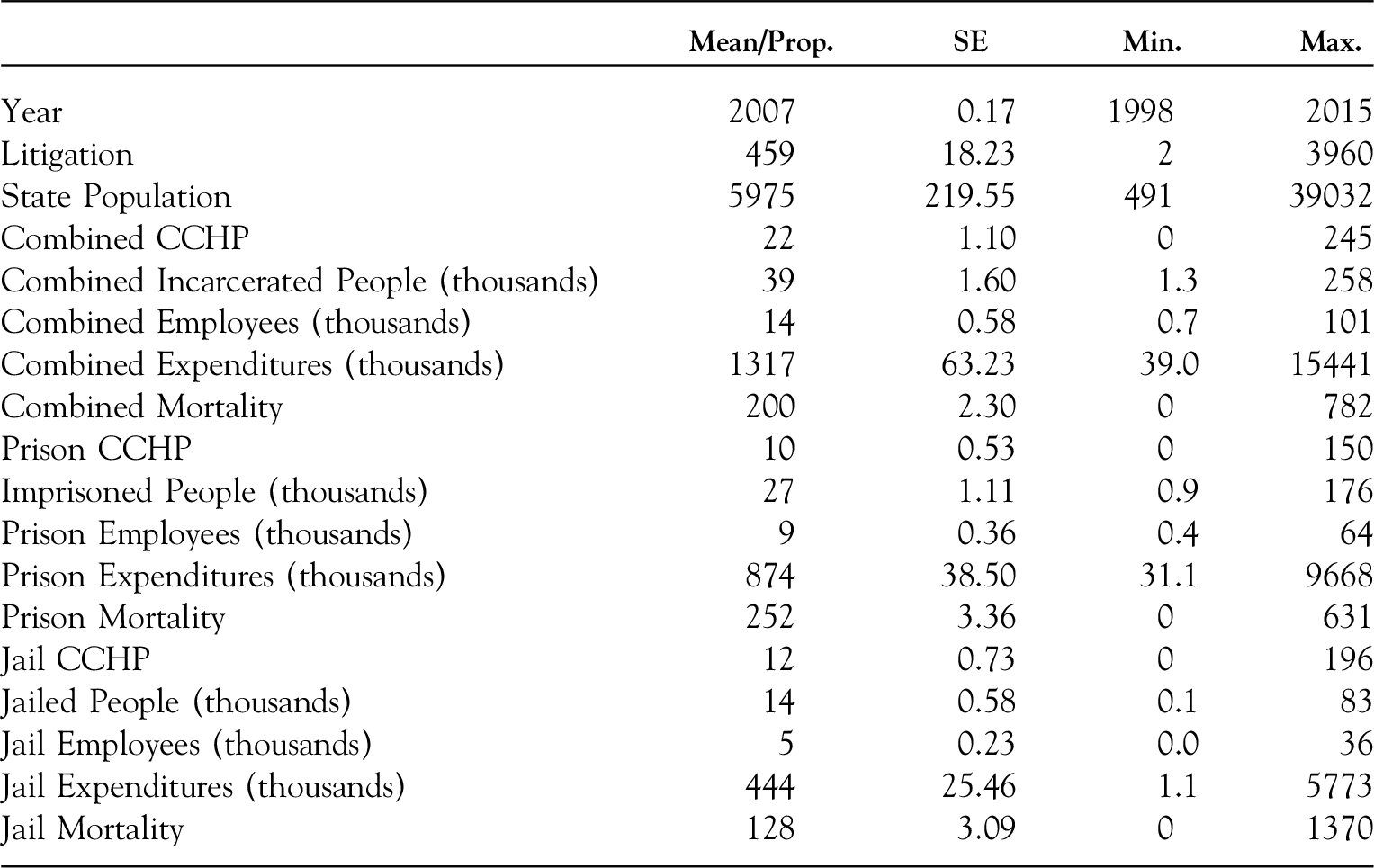
Table 1 provides descriptive statistics.
Descriptive statistics (n=900) a

a n=810 for jail variables after excluding 5 states with integrated jail/prison systems.
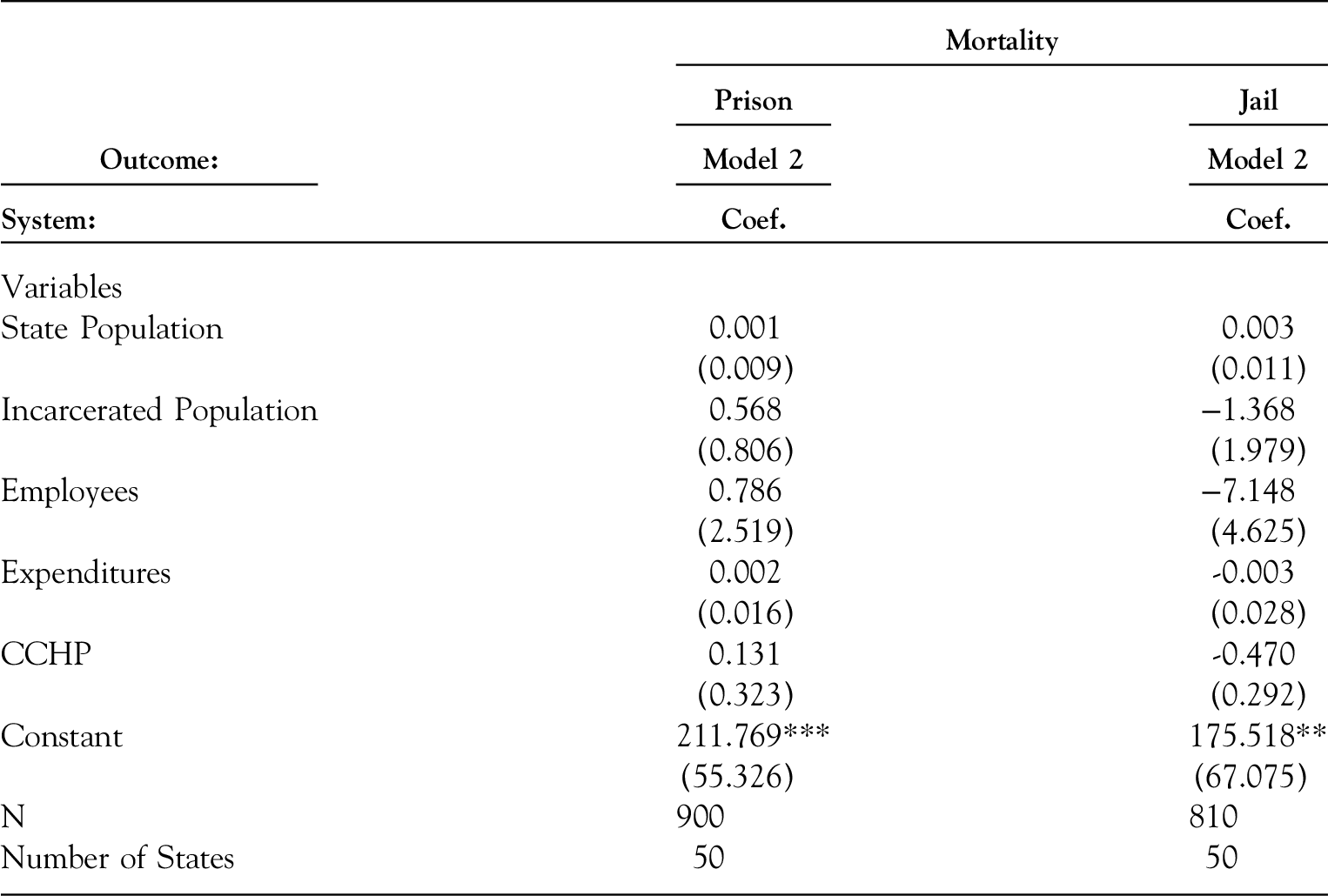
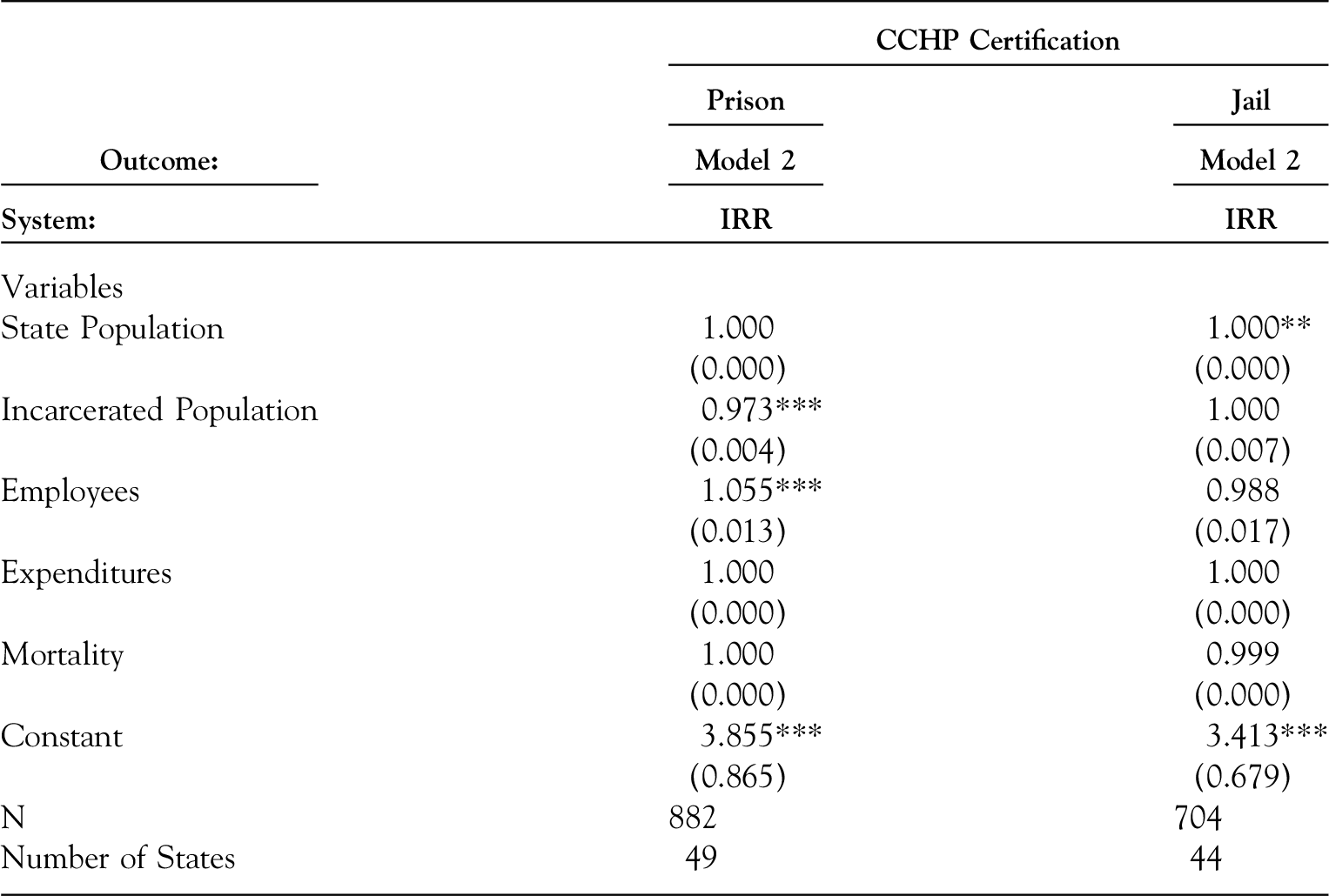
As Tables 2 and 3 show, we found no significant relationship between certifications and mortality in jails or prisons, supporting H1. Table 2 presents results from state fixed effects regressions for mortality from 1998 to 2015 in prisons (model 1) and jails (model 2), showing that certifications do not predict mortality. Table 3 presents state fixed effects negative binomial models predicting certification, showing that mortality does not predict certifications in jails or prisons.
Fixed effects regression predicting mortality from same-year certifications

* p<0.05, ** p<0.01, *** p<0.001; standard errors in parentheses
Fixed effects negative binomial predicting certifications from same-year mortality

* p<0.05, ** p<0.01, *** p<0.001; standard errors in parentheses
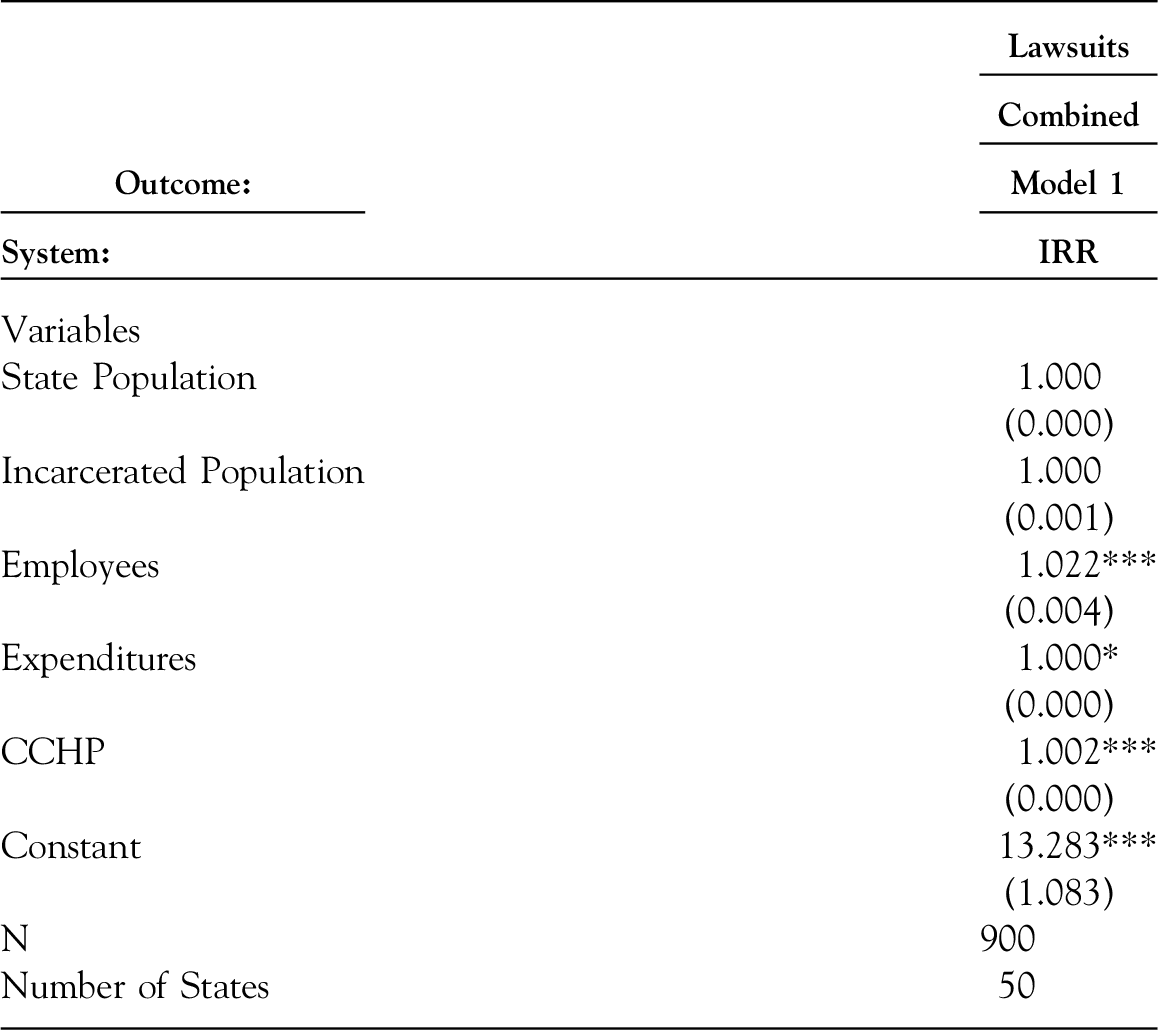
Table 4 presents state fixed effects negative binomial models predicting rates of litigation from certification in jails and prisons combined. The results from model 1 present the relationship between CCHP certifications and litigation rates. Each additional certification is associated with an increase in litigation by a factor of 1.002 (p < 0.001).
Fixed effects negative binomial predicting litigation from same-year certifications

* p<0.05, ** p<0.01, *** p<0.001; standard errors in parentheses
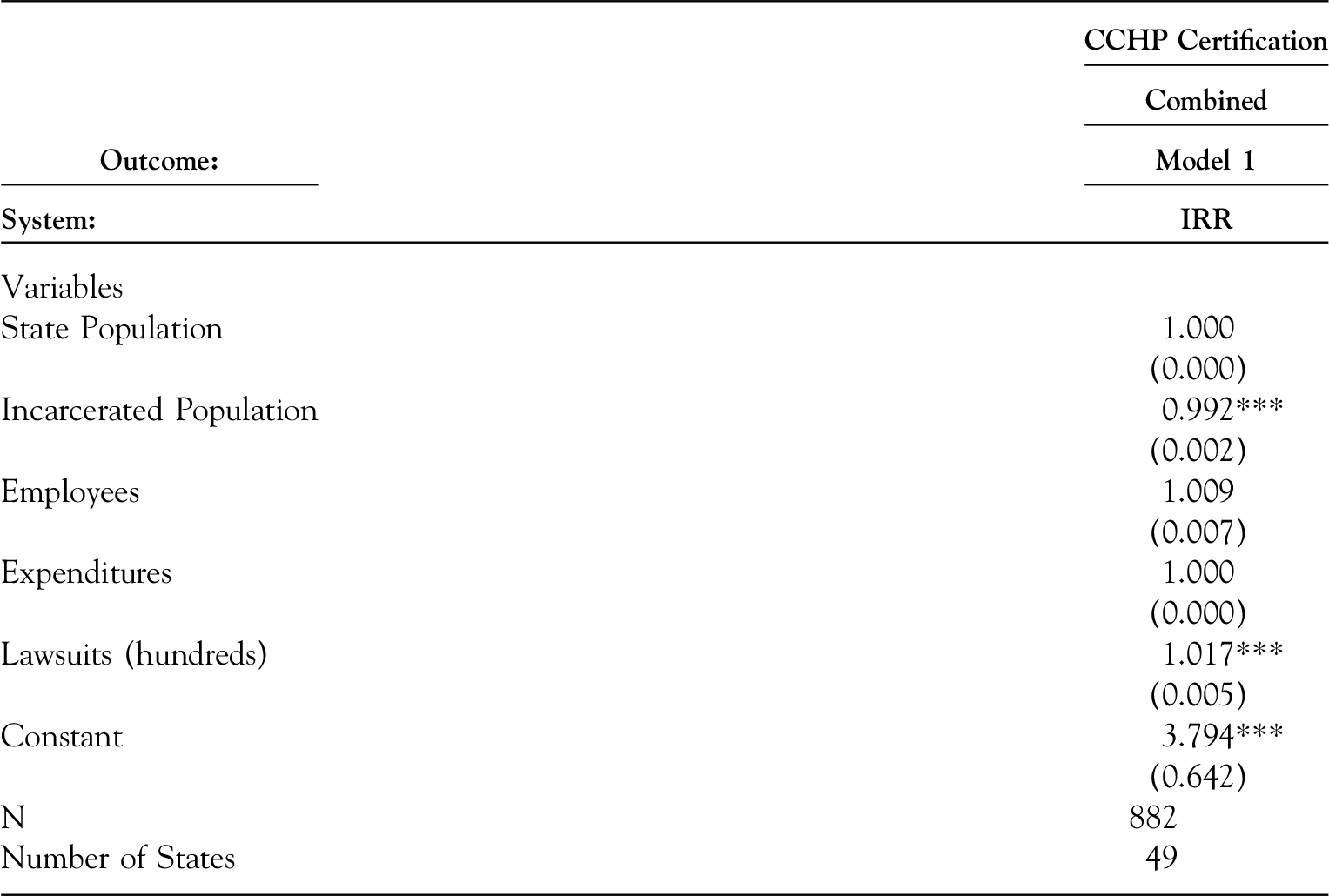
Table 5 presents results from a fixed effects negative binomial predicting certification in jails and prisons from litigation. The incidence rate ratio (IRR) for litigation in Table 5 was 1.000 and significant; to better demonstrate the relationship, we used hundreds of lawsuits. As shown in model 1, for every hundred additional lawsuits filed, certifications increase by a factor of 1.017 (p < 0.001).
Fixed effects negative binomial predicting certifications from same-year litigation

* p<0.05, ** p<0.01, *** p<0.001; standard errors in parentheses
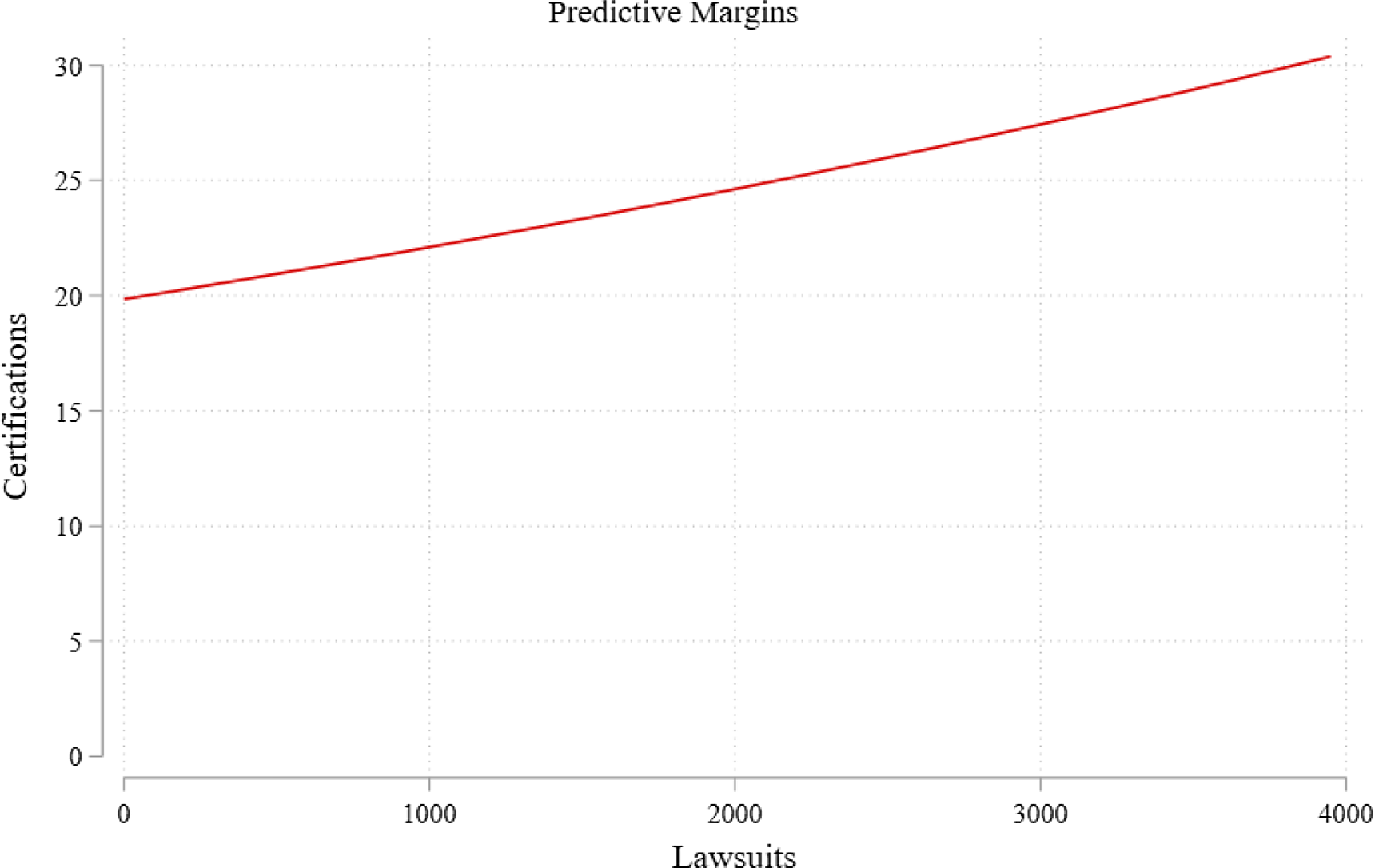
Figure 3 presents the marginal effects of litigation on certification adoptions. On average, a standard deviation increase in litigation (547 lawsuits) is associated with 1.976 (p=0.016) additional individual certifications. Showing a positive relationship between litigation and certifications, the findings from Tables 4 and 5 and Figure 3 support H2.
Marginal effects predicting certifications from litigation rate.

As indicated above, we also estimated a series of lagged models, assessing relationships between outcome variables in year t and predictor variables in years t-1, t-2, and t-5. These models did not yield significant results for years t-1 or t-2. Similarly to the same-year models, the models for year t-5 showed statistically significant positive relationships between rates of litigation and individual certifications.
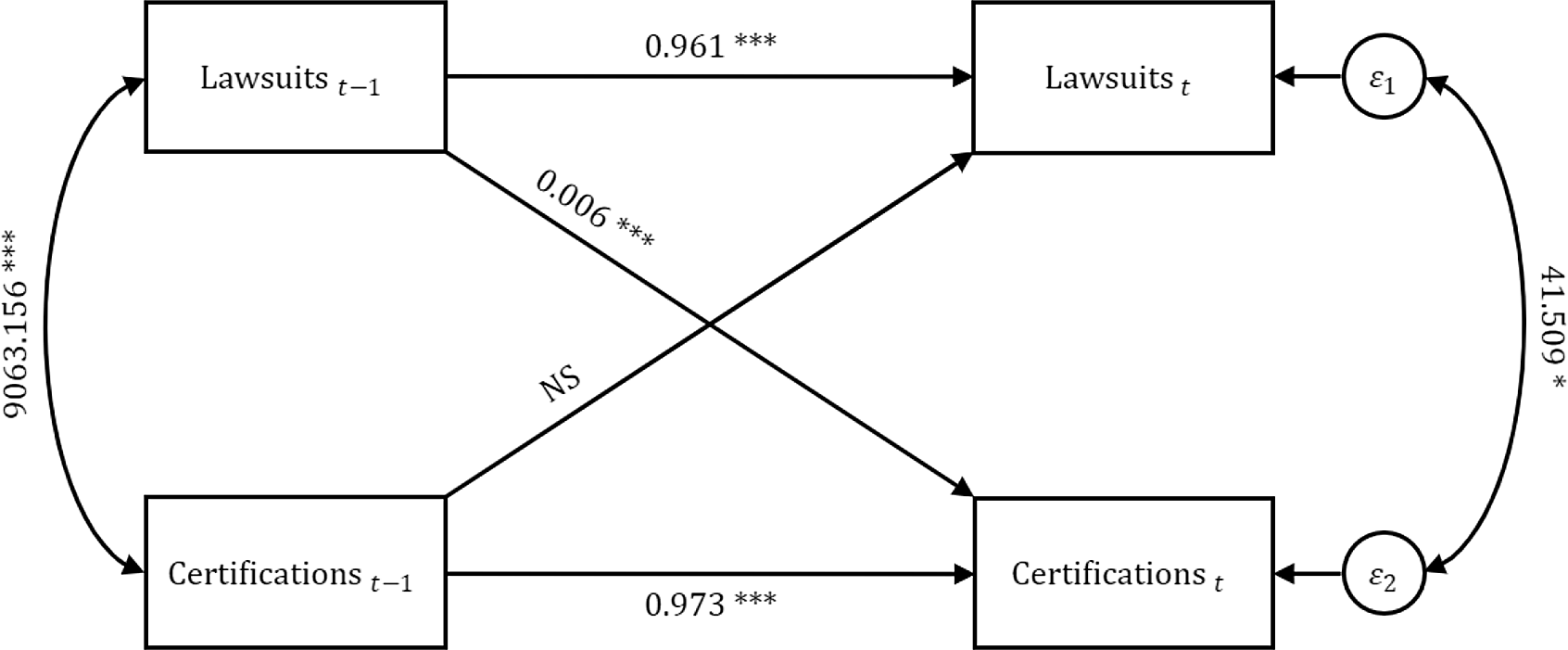
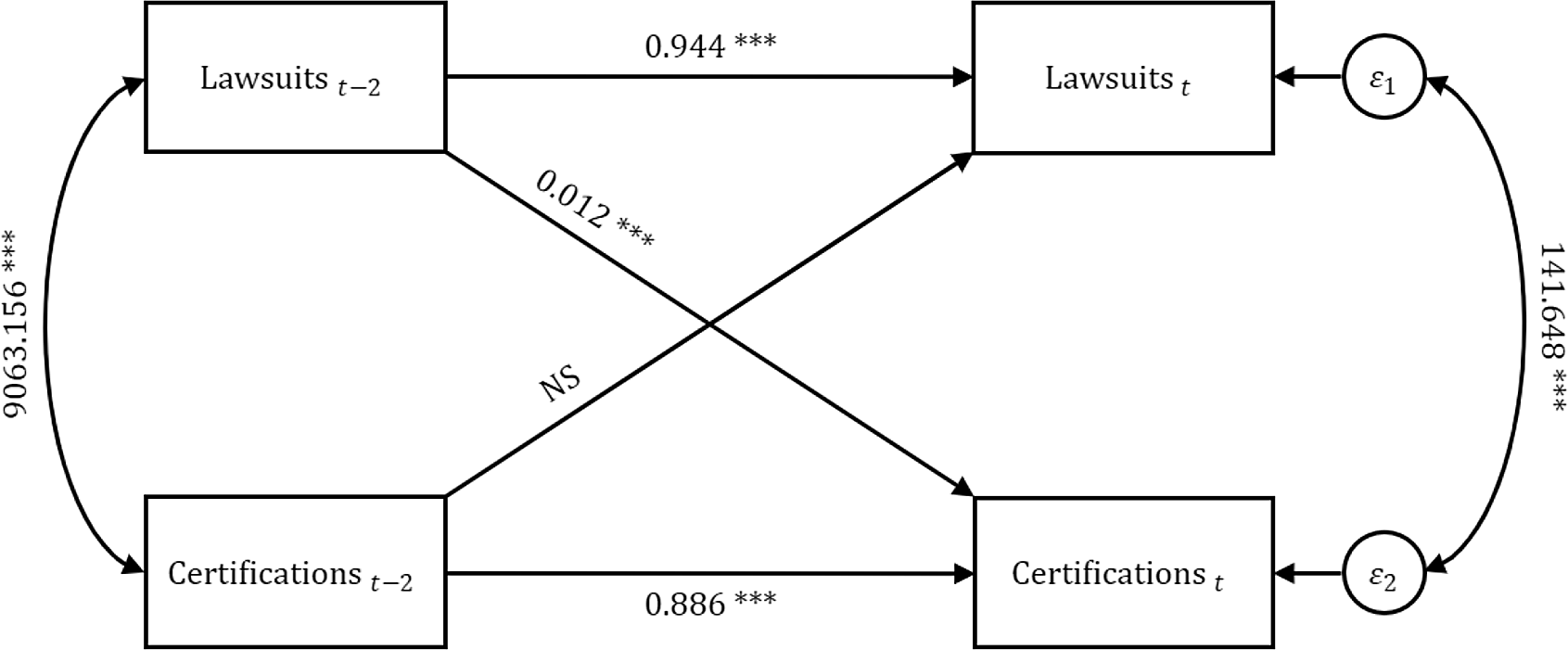
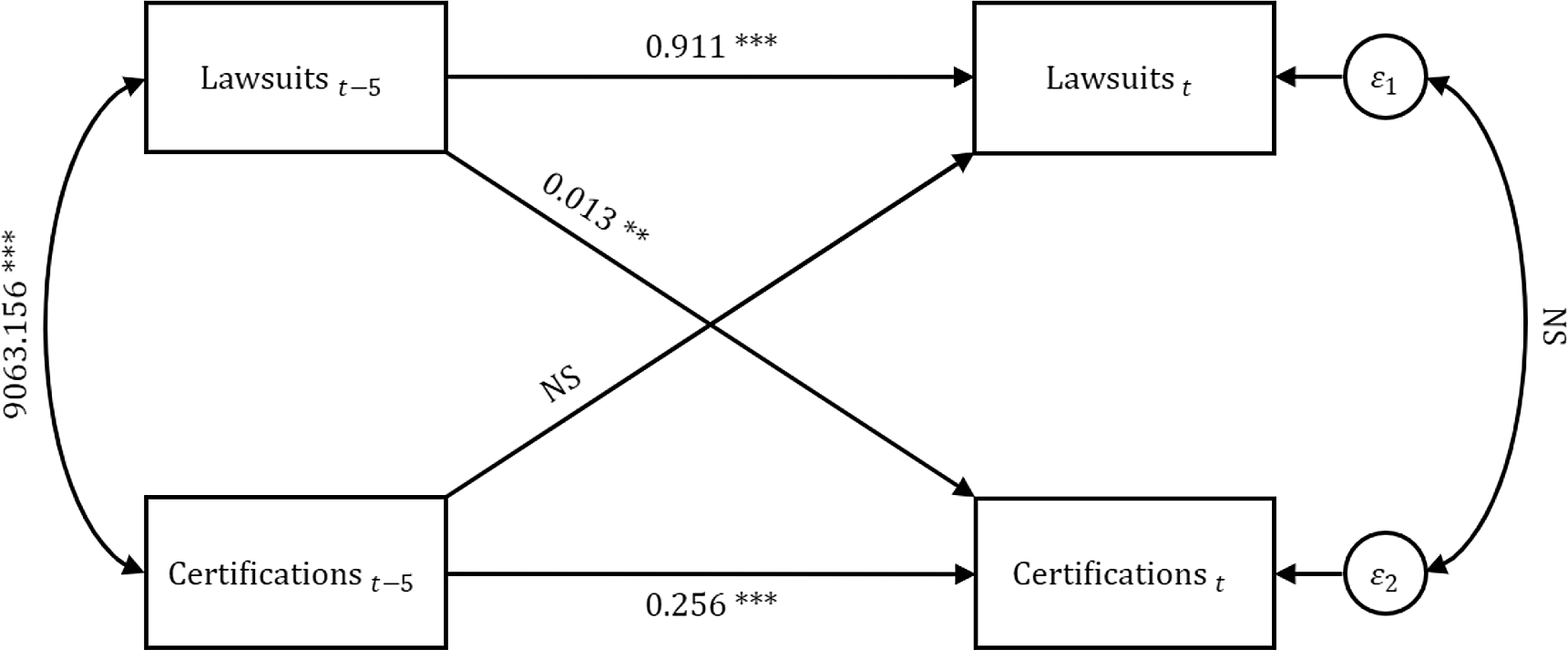
Our cross-lagged panel analyses yielded statistically significant relationships. Figures 4, 5, and 6 present results for the cross-lagged panel models examining one-, two-, and five-year lags respectively.
Cross-lagged panel analysis, one-year lag.

Cross-lagged panel analysis, two-year lag.

Cross-lagged panel analysis, five-year lag.

Figures 4, 5, and 6 show that, controlling for the number of certifications in the same year, numbers of lawsuits are positively associated with rates of certification in subsequent years. Each additional lawsuit is associated with 0.006 (p < 0.001) more certifications the next year (Figure 4), 0.012 (p < 0.01) more certifications in two years (Figure 5), and 0.013 (p < 0.01) more certifications in five years (Figure 6). As each figure shows, certifications do not significantly predict lawsuits the next year, two years later, or five years later.
These models’ results suggest support for our hypothesized legal reactivity process: higher rates of litigation significantly predict rates of certification one, two, and five years later, while certifications do not predict lawsuits on any of these time lags. Again, however, these results should be interpreted with caution; the only cross-lagged models that would converge are reduced models, without the covariates the other models include.
DISCUSSION
Our quantitative analyses support both of our hypotheses. We do not find evidence of a significant association between certifications and mortality rates. We do find a significant positive relationship between certifications and litigation rates, supporting the proposed legal reactivity pattern.
The lack of a significant relationship between mortality and certifications is unsurprising, both to us and to our interlocutors at the NCCHC. Given the many variables involved in predicting incarcerated people’s rates of death, it would be unreasonable to expect that NCCHC certifications (especially in modest numbers) would be significant factors. For the reverse relationship—the idea that corrections actors might adopt certifications in response to elevated mortality rates—we expected that deaths would be less significant influences than legal threats, and that any mortality influence on certification adoption would likely flow through mortality’s potential contribution to litigation.
Like those predicting mortality, the pathways producing incarcerated people’s litigation rates are complex and subject to multiple idiosyncratic influences; accordingly, we did not expect certifications to function as significant predictors of rates of suit. An idealized set of statistical controls might allow us to identify certifications’ impact on these outcomes, but such controls are beyond the scope of our inquiry (and arguably unobtainable altogether).
Although we observe a positive association between certifications and lawsuits, we think it is unlikely that certifications are in any way “causing” more litigation. Fundamentally, there are multiple other factors that we think are more important than certifications in producing lawsuits. And, if certifications did directly affect rates of litigation, we can think of no reason why more certifications would lead to more lawsuits; by our reckoning, the skeptical position on certifications’ substantive impact on CHC would entail the perspective that certifications do not reflect meaningful substantive differences, not that they reflect worse or more legally actionable circumstances. The results from our cross-lagged panel analyses offer additional empirical support for the proposed legal reactivity process, suggesting that higher rates of certification follow from higher rates of litigation, rather than vice versa.
The paths leading to certifications are also complex and subject to idiosyncrasies. It is easier, however, to envision the pathway through which lawsuits would significantly predict certifications than vice versa. Litigation is a powerful influence on corrections organizations (Feeley and Rubin Reference Feeley and Rubin1998; Feeley and Swearingen Reference Feeley and Van2004; Simon Reference Simon2014; Venters Reference Venters2019). Other factors doubtless inform decisions about seeking these validations (although our models suggest that one potential such factor, incarcerated people’s mortality rate, does not do so significantly). The factors here, though, appear less diverse and intricate than the factors shaping mortality and litigation. The association that we observe suggests that our litigation measure indeed captures an important influence on decisions to obtain certifications.
It is important to bear in mind that our litigation variable is a measure of all conditions of confinement lawsuits filed in a state, across both jails and prisons. It is not limited to those cases involving a CHC allegation. For these reasons, the measure is imprecise. This imprecision, however, is arguably less problematic for a legally reactive relationship between litigation and certifications. Overall lawsuit volume may influence CHC decisions through signaling legal threat, even if those lawsuits pertain to more than CHC. As part of a general pattern of apparent legal exposure on conditions of confinement issues, both CHC-related suits and other types of suits could inform protective reactions, including the certifications that we examine. It seems less likely, on the other hand, that total conditions of confinement litigation would respond to rates of CHC-specific certifications.
Pertinent legal compulsion also supports the proposed legal reactivity relationship. That is, conditions of settlements or court orders may push corrections organizations to meet privately produced standards or adopt third-party endorsements.Footnote 18 The US Department of Justice’s (DOJ) investigation of conditions at Chicago’s Cook County Jail included recommendations to train staff “in accordance [with] generally accepted professional standards” and provide treatment in line with “generally accepted correctional standards of care” (Becker and Fitzgerald Reference Becker and Fitzgerald2008, 85–86). A 2010 consent decree in the subsequent lawsuit also emphasized “generally accepted correctional standards” and “generally accepted professional standards,” naming the NCCHC as a source of such standards (United States v. Cook County 2010). Settlements in other cases have explicitly referenced NCCHC standards and required corrections organizations to obtain NCCHC accreditations (see, for example, Presley v. Epps 2006; Flynn v. Doyle 2010; Parsons v. Ryan 2014).
We cannot systematically measure such legal interventions’ contribution to a legal reactivity pattern. Some cases offer conjectural evidence of such influence. For instance, in 2008, the year the DOJ concluded their Cook County investigation, twenty-three CCHPs worked in Illinois jails; by 2009, that number had almost doubled, to forty-three. On the other hand, our data do not suggest any direct influence of the 2014 settlement in Parsons v. Ryan. Although this settlement imposed conditions on all Arizona Department of Corrections facilities, the number of accredited facilities was constant at twelve in 2013, 2014, and 2015.Footnote 19 While the number of CCHPs working in state prisons grew from twenty-nine to thirty-three between 2014 and 2015, the rate of growth in certifications was slower in Parsons v. Ryan’s immediate wake than it had been over the preceding three years.
Several other limitations curtail our ability to fully tease out the complicated relationships between CHC certifications and litigation. Fundamentally, we cannot account for various unobserved factors with potentially significant impact. These include important factors such as changes in correctional administration (Venters Reference Venters2019, 7), as well as the possibility of singularly influential events, such as especially consequential deaths or lawsuits (see Skaggs Reference Skaggs2008, Reference Skaggs2009). Particularly because incarcerated people’s lawsuits so rarely succeed, it seems intuitive that the relatively rare event of a plaintiff-favoring settlement or court order may have an outsized effect on corrections actors’ decisions to seek certification. Although we cannot measure this phenomenon systematically, it would align with a general pattern of legal reactivity; this gives us confidence that our broader conclusions hold, regardless of the extent to which this phenomenon occurs.
Our data’s level of aggregation also presents a general limitation. The possibility of nonrandom variation in the proportion of conditions of confinement suits involving health care issues and in the share of cases arising from jails relative to prisons is an important caveat to our conclusions. Because our data are state-level, not facility-level, we also cannot systematically account for the place of interfacility differences in certification adoption in the broad patterns we observe. Similarly, we cannot empirically account for mimetic isomorphism’s (DiMaggio and Powell Reference DiMaggio and Powell1983) potential contribution to states’ certification rates; it is possible that early adopters influence proximate counterparts who perceive certification as beneficial. Our aggregated data necessitate lumping states’ systems of correctional organizations together, creating an even coarser unit of analysis than many studies’ treatment of organizations as unitary actors (see Gray and Silbey Reference Gray and Silbey2014). Future research—especially work employing facility-level data and other finer-grained evidence—could usefully address many of this study’s shortcomings, including through directly investigating the possibility that more “legalistic” correctional environments are more prone to both lawsuits and certification adoptions (see Kagan Reference Kagan2001).
Although privatized prisons have attracted substantial popular attention, this conversation does not always attend to private contractors’ substantial role in public correctional facilities; this is another factor that our models cannot accommodate. The state and local governments that run many of this study’s focal prisons and jails contract for-profit firms to provide an array of services, including health care. Such arrangements significantly affect care provision (see Hurst, Castañeda, and Ramsdale Reference Hurst, Castañeda and Erika2019). Although our study cannot ascertain contractors’ place in the phenomena we describe, particular dynamics may characterize correctional contexts involving these public-private hybrids; for instance, some contracts between government and private service providers require that providers obtain NCCHC endorsements (e.g., County of Alameda Contract #900324; State of Vermont Contract #7891). As governments try to reduce corrections expenditures (Aviram Reference Aviram2010; Gottschalk Reference Gottschalk2014), relationships between correctional administration, private contractors, and validation organizations merit closer study.
CONCLUSION
In the early stages of the CHC reforms that began in the 1960s, expanding professional oversight ventures reflected legal proactivity: the nascent NCCHC focused on substantive reforms in the field, helping corrections actors manage general risk in an emerging environment of legalized accountability (see Epp Reference Epp2009). Subsequent legal developments, including court rulings deferring to corrections authorities and the PLRA, curtailed incarcerated people’s ability to effectively sue over conditions of confinement. In the post-PLRA legal environment, we expected to find that corrections actors would typically wait until direct legal threats manifested in the form of elevated litigation rates to adopt certifications. Our results support this proposition, indicating that contemporary corrections actors tend to use certification as a resource when responding to specific threats, rather than a proactive measure to reduce exposure to abstract legal risk. March (Reference March and Shapira1997, 15) observes that “estimations of risk are systematically biased by the experiences decision makers have in organizations.” In CHC, experiences with salient threats—namely, elevated litigation rates—appear to underlie reactive decisions to seek certification. This finding corresponds to other research suggesting that organizations respond more vigorously to direct external pressure from litigation than to general conditions of their normative environments (Skaggs Reference Skaggs2008, Reference Skaggs2009).Footnote 20
The patterns we identify indicate how legal endogeneity plays out in the corrections context (see Edelman Reference Edelman2016, 230–35). The expanded recognition of incarcerated people’s legal rights in key reform-era rulings signaled a new environment of legalized accountability in the country’s correctional facilities (Feeley and Rubin Reference Feeley and Rubin1998; Epp Reference Epp2009). To a certain degree, this environment lent itself to proactive responses from corrections authorities seeking to insulate themselves from general risks of litigation in this changed organizational environment.
However, subsequent action in the judicial and legislative branches reduced incentives to take such proactive steps: courts generally deferred to organizational protocols and decisions, and Congress enervated incarcerated people’s legal recourse with the PLRA. These caveats and circumscriptions limited the apparent pressure on corrections authorities to demonstrate legitimacy and adopt prophylactic risk insulation measures. Instead, the dynamic interplay between corrections organizations and legal institutions shifted the legal environment in a direction more favorable to adopting defensive measures if and when specific threats materialized. With court rulings and statutory changes making successful legal challenges appear exceedingly unlikely, the comparatively robust environment of legalized accountability that emerged in the 1960s and 1970s gave way to a much more limited version, in which corrections authorities could reasonably infer that aggressive efforts to protect themselves from prospective lawsuits were unnecessary. Our results bear this out: in the specific case of CHC endorsements, at least, post-PLRA corrections actors are likely to wait until manifest legal threats arise before taking ameliorative action.
Throughout the post-Estelle legal developments, courts and legislators repeatedly prioritized correctional facilities’ core mission of secure confinement over potentially competing considerations, including incarcerated people’s ability to meaningfully claim constitutional rights. This tendency facilitated corrections’ “organizational internalization of law” (Edelman and Suchman Reference Edelman and Suchman1999), helping them keep complaints in-house and minimizing their exposure to general legal risk (see Calavita and Jenness Reference Calavita and Valerie2015).
Thus, our analysis illuminates how characteristic environmental pressures influence correctional organizations’ behavior. Pfeffer and Salancik (Reference Pfeffer and Salancik1978, 96) note that organizations’ environments may present conflicting demands and that organizations “may attend to one set of demands at one point in time and to some other set when they become more pressing.” Security, not health care, is corrections’ top priority, and security considerations trump care considerations as a matter of course (Prout and Ross Reference Prout and Ross1988; Venters Reference Venters2019). In the contemporary correctional context, proactive measures to manage uncertainty and risk related to health care services are less widely embraced than reactive responses to manifest trouble, when explicit legal threats elevate conditions of confinement considerations and impel corresponding action.
Within this context, our results also offer some support for litigation’s capacity to cause change (see Feeley and Rubin Reference Feeley and Rubin1998; Feeley and Swearingen Reference Feeley and Van2004; Simon Reference Simon2014). Lawsuits do appear to encourage standardization and professionalization. Litigation, however, does not appear to significantly affect mortality, either directly or through the pathway of standardization and professionalization.
Stakes are high for incarcerated people pursuing medical care cases and other conditions of confinement grievances (Calavita and Jenness Reference Calavita and Valerie2015, 63–64). And current and future incarcerated people are not the only stakeholders in CHC; as the COVID-19 pandemic has laid bare, correctional facilities’ treatment of their confined populations also has significant implications for the general public. Imprisoned and jailed people are starkly unhealthy compared to their free-world counterparts (Binswanger, Krueger, and Steiner Reference Binswanger, Krueger and Steiner2009; Wilper et al. Reference Wilper, Steffie Woolhandler, Lasser, Danny, Bor and Himmelstein2009; Nowotny, Rogers, and Boardman Reference Nowotny, Rogers and Boardman2017). The increasing health care needs of a “graying” prison population compound these problems and their fiscal costs (Reimer Reference Reimer2008; Nowotny et al. Reference Nowotny, Alice, Laurie and Boardman2016; Skarupski et al. Reference Skarupski, Alden, Schrack, Deal and Eber2018). CHC also constitutes a significant public health matter, particularly in communities disproportionately affected by mass incarceration (Schnittker et al. Reference Schnittker, Christopher, Shannon and Suzy2015; Nowotny and Kuptsevych-Timmer Reference Nowotny and Kuptsevych-Timmer2018). Millions of people cycle through the nation’s correctional facilities every year. Upon release, formerly incarcerated people bear above-average burdens of disease—including communicable illnesses—and have below-average access to health-supportive resources (Tyler and Brockmann Reference Tyler and Bradley2017; Western Reference Western2018). Although correctional facilities are often obscured from public view, their activities’ humanitarian, fiscal, and public health consequences extend far beyond jail and prison walls.
Biographical Statement/Acknowledgments
The authors thank current and former National Commission on Correctional Health Care (NCCHC) leadership and staff, many of whom aided the project in various ways. Paula Hancock, Ed Harrison, and the late Scott Chavez magnanimously supported the historical component, and Brent Gibson and Jim Pavletich generously facilitated the data access that enabled the later quantitative stages. The quantitative analyses would have been impossible without Matissa Sammons’s gracious provision of NCCHC data and resolute assistance with numerous technical questions.
The authors also gratefully acknowledge help from others outside the NCCHC. Margo Schlanger provided litigation data and offered valuable guidance on the project. Shawn Bauldry and Trent Mize provided indispensable advice and assistance on the quantitative analyses. Alex Friedmann, Managing Editor of Prison Legal News, provided insights on references to accreditation in settlements and court orders. Brian Kelly, Bob Nelson, Heather Schoenfeld, Christie Sennott, Kevin Stainback, Robin Stryker, Mark Suchman, and Bert Useem all offered helpful comments.
Supplementary Material
To view supplementary material for this article, please visit https://doi.org/10.1017/lsi.2021.23
CASES CITED
Cooper v. Pate, 378 U.S. 546 (1964).
Estelle v. Gamble, 429 U.S. 97 (1976).
Farmer v. Brennan, 511 U.S. 825 (1994).
Flynn v. Doyle, No. 2:06-cv-00537-RTR (E.D. Wis. 2010).
Holt v. Sarver, 309 F. Supp. 362 (E.D. Ark. 1970).
Newman v. Alabama, 349 F. Supp. 278 (M.D. Ala. 1972).
Parsons v. Ryan, No. 2:12-cv-00601 (D. Ariz. 2014).
Presley v. Epps, No. 4:05-cv-00148-JAD (N.D. Miss. 2006).
Price v. Johnston, 334 U.S. 266 (1948).
Ruffin v. Commonwealth of Virginia, 62 Va. 790 (1871).
United States v. Cook County, No. 1:10-cv-02946 (N.D. Ill. 2010).
Wilson v. Seiter, 501 U.S. 294 (1991).
CONTRACTS CITED
County of Alameda Contract #900324: Medical Services Agreement. 2008. On file with authors.
State of Vermont Contract #7891. 2004. On file with authors.