INTRODUCTION
Predation is considered as one of the most important biotic factor for the population regulation of prey species (Begon et al. Reference Begon, Townsend and Harper2006), and, on the other hand, invasive species provide an interesting opportunity to study predator–prey interactions (e.g. Salo et al. Reference Salo, Nordström, Thomson and Korpimäki2008; Kaunisto et al. Reference Kaunisto, Kortet, Härkönen, Kaitala, Laaksonen and Ylönen2012a ). Understanding the interactions between alien species and native communities plays a central role in understanding and predicting species range expansions (Schönrogge et al. Reference Schönrogge, Begg and Stone2013). Predation may have a considerable role in the invasion success of a novel prey (Lodge, Reference Lodge1993; Vermeij, Reference Vermeij, Sax, Stachowicz and Gaines2005). For example, natural predators in the receiving range may show a preference for the invader and thereby slower or even prevent its establishment (e.g. Barber et al. Reference Barber, Marquis and Tori2008; Carlsson et al. Reference Carlsson, Sarnelle and Strayer2009). On the contrary, the enemy release hypothesis posits that natural enemies (e.g. predators, parasites and pathogens) in the receiving range show greater negative impact on native species than on a new arrival species, and the invasion success of a new arrival therefore results from the reduced predation pressure (e.g. Williamson, Reference Williamson1996; Keane and Crawley, Reference Keane and Crawley2002; Shwartz et al. Reference Shwartz, Strubbe, Butler, Matthysen and Kark2009). However, the role of natural predators in the regulation of invasive pest insects and other invertebrates has remained quite poorly studied (but see Negm and Hensley, Reference Negm and Hensley1967; Schoener and Spiller, Reference Schoener and Spiller1995; Kotiaho and Sulkava, Reference Kotiaho and Sulkava2007; Kaunisto et al. Reference Kaunisto, Kortet, Härkönen, Kaitala, Laaksonen and Ylönen2012a , Reference Kaunisto, Välimäki, Kortet, Koskimäki, Härkönen, Kaitala, Laaksonen, Härkönen and Ylönen b ; Schönrogge et al. Reference Schönrogge, Begg and Stone2013; Ghoneim, Reference Ghoneim2014). Especially interactions between natural predators and invasive arthropod ectoparasites have thus far not received any attention (Kaunisto et al. Reference Kaunisto, Kortet, Härkönen, Kaitala, Laaksonen and Ylönen2012a , Reference Kaunisto, Välimäki, Kortet, Koskimäki, Härkönen, Kaitala, Laaksonen, Härkönen and Ylönen b ).
During the on-host stages of their life cycle arthropod ectoparasites live on a stable habitat: the outer surface of the host animal, and consume assured resources (host blood, secretions, keratin, skin cells) (e.g. Grimaldi and Engel, Reference Grimaldi and Engel2005). Therefore, host-related factors (e.g. host availability, density and specificity) are generally thought to be the main factors determining abundance and geographical distribution of terrestrial arthropod ectoparasites (e.g. Krasnov et al. Reference Krasnov, Poulin, Shenbrot, Mouillot and Khokhlova2005; Shenbrot et al. Reference Shenbrot, Krasnov and Lu2007; Välimäki et al. Reference Välimäki, Kaitala, Madslien, Härkönen, Várkonyi, Heikkilä, Jaakola, Ylönen, Kortet and Ytrehus2011; Meier et al. Reference Meier, Bonte, Kaitala and Ovaskainen2014). However, ectoparasites are vulnerable to heavy mortality, especially during their possible off-host stages, due to other biotic factors and environmental conditions; external factors thus playing greater roles than commonly thought in the distribution of terrestrial ectoparasite fauna (Samish and Rehacek, Reference Samish and Rehacek1999; Johnson et al. Reference Johnson, Dobson, Lafferty, Marcogliese, Memmott, Orlofske, Poulin and Thieltges2010; Krasnov et al. Reference Krasnov, Mouillot, Shenbrot, Khokhlova, Vinarski, Korallo-Vinarskaya and Poulin2010; Mize et al. Reference Mize, Tsao and Maurer2011; Kaunisto et al. Reference Kaunisto, Välimäki, Kortet, Koskimäki, Härkönen, Kaitala, Laaksonen, Härkönen and Ylönen2012b , Reference Kaunisto, Härkönen, Rantala and Kortet2015a ). Although previously neglected in ecological research, predation amongst parasites is very widespread in nature and found in a variety of forms (Lafferty et al. Reference Lafferty, Dobson and Kuris2006). Moreover, there is clear documentation that vertebrate and invertebrate predators can consume free-living stages of ectoparasites (Mwangi et al. Reference Mwangi, Newson and Kaaya1991; Samish and Rehacek, Reference Samish and Rehacek1999; Sutherst et al. Reference Sutherst, Wilson and Cook2000; Kaunisto et al. Reference Kaunisto, Kortet, Härkönen, Kaitala, Laaksonen and Ylönen2012a , Reference Kaunisto, Välimäki, Kortet, Koskimäki, Härkönen, Kaitala, Laaksonen, Härkönen and Ylönen b ).
Our study species, the deer ked (Lipoptena cervi, Hippoboscidae, Diptera; Linnaeus, 1758), is an obligate blood-feeding ectoparasite of several boreal cervid species. Lipoptena cervi is of Palearctic origin and has rapidly expanded its distribution and increased in abundance from Russia to eastern Fennoscandia during the preceding five decades (Välimäki et al. Reference Välimäki, Madslien, Malmsten, Härkönen, Härkönen, Kaitala, Kortet, Laaksonen, Mehl, Redford, Ylönen and Ytrehus2010; Madslien et al. Reference Madslien, Ytrehus, Viljugrein, Solberg, Bråten and Mysterud2012). This ectoparasitic fly has also been introduced to the Nearctic region (Samuel et al. Reference Samuel, Madslien and Gonynor-McGuire2012). Lipoptena cervi is a serious nuisance on humans; it acts as a potential vector for bacterial diseases such as Bartonella (Kortet et al. Reference Kortet, Härkönen, Hokkanen, Härkönen, Kaitala, Kaunisto, Laaksonen, Kekäläinen and Ylönen2010; Korhonen et al. Reference Korhonen, Vera, Pulliainen, Sironen, Aaltonen, Kortet, Härkönen, Härkönen, Paakkonen, Ylönen and Vapalahti2015), and can cause notable harm on cervid hosts (e.g. Kynkäänniemi et al. Reference Kynkäänniemi, Tikkakoski, Kortet, Härkönen, Kaitala, Paakkonen, Mustonen, Nieminen, Härkönen, Ylönen and Laaksonen2014; Korhonen et al. Reference Korhonen, Vera, Pulliainen, Sironen, Aaltonen, Kortet, Härkönen, Härkönen, Paakkonen, Ylönen and Vapalahti2015). A cervid host offers a constant favourable habitat for adult L. cervi to feed, mate and reproduce all year round. Lipoptena cervi female gives birth one at a time to a pre-pupa that completes its pupation immediately and drops off the host (Haarløv, Reference Haarløv1964). Offspring production is highly asynchronous; reproductive phase lasting the whole winter from the previous autumn to the following summer. Adult emergence from pupae and host colonization by emerged adults takes place in early autumn. Therefore, duration of the off-host pupal stage may last up to 10 months depending on birth time of a pupa (Haarløv, Reference Haarløv1964; Härkönen et al. Reference Härkönen, Kaitala, Kaunisto and Repo2012). We previously demonstrated, by field experiments, that L. cervi pupae are predated by a number of titmice species during winter, and that the predation rate seems to be dependent on the local prevalence of L. cervi and the period of invasion history (Kaunisto et al. Reference Kaunisto, Välimäki, Kortet, Koskimäki, Härkönen, Kaitala, Laaksonen, Härkönen and Ylönen2012b ). However, so far, nothing has been known about natural summer predation of L. cervi in the wild (but see Kaunisto et al. Reference Kaunisto, Kortet, Härkönen, Kaitala, Laaksonen and Ylönen2012a ).
Here, we examine and identify experimentally the natural predator guilds and the magnitude of the summertime predation on pupal stage of L. cervi by possible avian, mammalian, reptilian and invertebrate predators in different habitats in Central Finland. Due to the fact that central Finland falls within the current core area of L. cervi with relative high L. cervi abundance, we predict that at least some insectivorous invertebrates and vertebrates have already adapted or learned to use L. cervi pupae as their prey, and this will be reflected on varying predation pressure in different habitats. We also hypothesize that a large proportion of pupae will escape predation since L. cervi has already successfully invaded two thirds of Finland up to the polar circle in the North within five decades.
MATERIALS AND METHODS
Pupal collection and rearing
For the predation experiments, we collected L. cervi pupae from the winter bedding sites of the moose (Alces alces), from March to April 2010, in five Finnish communes: Siikalatva (64°30′20″N, 25°39′00″E), Kontiolahti (62°88′58″N, 29°68′95″E), Liperi (62°48′82″N, 29°23′84″E), Vimpeli (63°11′94″N, 23°86′32″E) and Alajärvi (63°05′22″N, 24°21′20″E). Pupae (n = 1710) were collected from the winter bedding sites of the moose, as the moose is the main host of the species in Finland and because black pupae can be easily detected against snow on recently laid bedding sites (Kaunisto et al. Reference Kaunisto, Kortet, Härkönen, Härkönen, Ylönen and Laaksonen2009, Reference Kaunisto, Ylönen and Kortet2015b ). Pupae are of oval shape and usually circa 3 mm long (Kaunisto et al. Reference Kaunisto, Ylönen and Kortet2015b ). After collections, all diapausing pupae (n = 1710) were kept in a cold room (+3 °C) to mimic late winter temperatures. Temperatures near +5 °C have been observed to maintain pupal diapause of L. cervi in laboratory conditions (Härkönen and Kaitala, Reference Härkönen and Kaitala2013). Before the predation experiments that occurred in June–August 2010, the pupae were transferred for 2 weeks to a room temperature (+22 °C, 60% RH and a photoperiod of 19 h/5 h for day/night) to start post-diapause development. Therefore, developmental stage of the experimental pupae corresponded to that of wild pupae in summer (see Härkönen and Kaitala, Reference Härkönen and Kaitala2013). Before the experiments, we carefully inspected the condition of each pupae under a stereo microscope and only alive pupae with an unimpaired pupal shell were used in the experiments. Pupae were handled wearing latex gloves to avoid any human-related contamination.
Predation experiments in the field
The predation experiments were conducted in natural field conditions near the Konnevesi Research Station (62°37′N, 26°20′E) in Central Finland between the 24 June and 21 August 2010. We conducted the study in three different habitats: (1) Half-open moist heath forest (former logging area, less than 10 years ago harvested, with relatively moist and thick soil, tussocks, dense willow thickets and less than 5 years old planted pine forest); (2) Open, logged dry heath forest (less than 5 years ago logged area with early stages of secondary succession, surrounded by mixed forest); (3) Open moist meadow (surrounded by dense mixed forest). Hereafter, the above-mentioned habitats are called ‘half-open forest’, ‘open forest’ and ‘meadow’, respectively. We selected the study site and habitats within the moose winter range, which was estimated by frequent observations of snow tracks, droppings, bedding sites and eaten pine and willow shoots during the previous winter. Flying L. cervi adults (emerged from pupae) were observed in the habitats during the previous autumn. Lipoptena cervi has invaded Central Finland including Konnevesi region already in the 1980s (Hackman et al. Reference Hackman, Rantanen and Vuojolahti1983; Välimäki et al. Reference Välimäki, Madslien, Malmsten, Härkönen, Härkönen, Kaitala, Kortet, Laaksonen, Mehl, Redford, Ylönen and Ytrehus2010). Therefore, possible predators were likely already familiar with L. cervi pupae. Distance between the three study habitats was 10–20 km and, therefore, it was unlikely that the same predator individuals visited the other habitats during our experiments.
To study summertime predation on pupal stage of L. cervi among different predator guilds (see info about the different experimental arenas below), we exposed L. cervi pupae to avian, mammalian, reptilian and invertebrate predators. Lipoptena cervi pupae were placed on special square-shaped sheets, which were positioned on the ground. The sheets [50 cm × 50 cm × 7 mm (thickness)] were made of ground-coloured light-brown plywood and ten L. cervi pupae were placed on the centre of one plywood sheet. Plywood sheets were used because otherwise slippery L. cervi pupae can be easily lost in the forest litter, making observations on the predation difficult and imprecise. All the plywood sheets contained a square-shaped ‘sand-wall’ to mimic the unevenness of the ground and to prevent pupae falling from the sheet. The height of the sand-wall was 2 mm, width 6 cm and the length of the outer boundary of the sand-square was 120 cm (30 cm × four sides). Pupae were placed inside this sand-perimeter, onto the centre of a sheet. Ten L. cervi pupae were always arranged in a similar pattern on the centre of the plywood sheets. In natural conditions, L. cervi pupae are most likely found on host bedding sites in the clumped distribution most originating from the neck and back regions of a bedding moose (Kaunisto et al. Reference Kaunisto, Kortet, Härkönen, Härkönen, Ylönen and Laaksonen2009).
In each study point, three kinds of experimental arenas (with plywood sheet), destined for different predator guilds, were positioned on the ground (Jacob et al. Reference Jacob, Ylönen, Perry and Singleton2002). All of the experimental arenas included the plywood platform with the 2 mm high sand-wall (see above). One experimental arena, referred to ‘open arena’, allowed all possible predators (e.g. birds, small mammals, reptiles and invertebrates) to visit the plywood sheet and had access to the pupae. This type of experimental arena included only the plywood platform with the sand-wall. The second experimental arena (referred to ‘mammal, reptile and invertebrate arena’) blocked the entrance for avian predators, but allowed small mammals, reptiles and invertebrates to visit the plywood sheet and pupae. This arena contained a plastic plexi sheet [50 cm × 50 cm × 4 mm (thickness)] three cm above the plywood sheet. A third experimental arena was designed for possible invertebrate predators only (referred to ‘invertebrate arena’). In this arena the plexi sheet was put at a height of 8 mm above the plywood platform. Three different types of experimental arenas were always placed on the ground in a triangle-like position; each arena-type forming one corner of the triangle. The length of each side of a triangle (i.e. distance between the experimental arenas) was ca. 1·5 m. The positions of the experimental arenas were always randomized. Hereafter, these triangles consisting of three different arena types will be called ‘triplets’. The distance between the triplets in each habitat was ca. 50 m to avoid pseudoreplication; i.e. minimize the possibility that same predatory individuals visited the same triplets.
A total of 57 triplets (i.e. 171 experimental arenas) were positioned in the natural field sites: 19 triplets in half-open forest, 18 triplets in open forest and 20 triplets in meadow, respectively (see Table 1).
Predation percentages of L. cervi pupae for each arena type in three different habitats and when habitats counted together

The number of impacted arenas (i.e. >0 pupa eaten) of all experimental arenas are given in parenthesis.
Predation experiments were timed to coincide with high-pressure and warm weather events in order to ensure similar environmental conditions for each habitat experiments and minimize the possibility that rainfall would ruin the ‘open arena’ experiments. In addition, possible invertebrate predators were presumed to be more active during warmer periods. Predation experiments started (i.e. the arena triplets and pupae were positioned on the ground) in the morning between 7:00 a.m. and 8:00 a.m. Arenas were kept in the field for 72 h. We monitored the experimental arenas for possible pupal predation at 12, 24, 36, 48, 60 and 72 h after the onset of experiments. A pupa was considered to be predated if it had disappeared and was not found on the plywood sheet or in the immediate surroundings of the experimental arena.
Trapping and identification of possible predators
We conducted this study in accordance with the Finnish legislation. All applicable institutional and/or national guidelines and standards for the care and use of animals were followed. We applied a minimum trapping effort (3 days; the traps examined twice per day) to yield reliable capture of animals around arenas. Immediately after the predation experiments ended (after the first 72 h) the trapping was started, to collect those animals that were on the move nearby the arenas and that could be identified as possible predators to L. cervi pupae. Three Ugglan vole/shrew traps were set at the locations where three arenas of a triangle had previously been situated (three traps were set for every 57 triplet replicate in a similar manner, i.e. in total of 171 traps). The traps were active for 3 days (72 h) and they were examined twice per day. The captured small mammals were marked by cutting off a piece of their fur and then releasing them back into the wild. If the reptiles or amphibians were caught by the vole/shrew traps, they were released back to nature at least 1 km from the capturing sites to minimize pseudoreplication (i.e. capturing the same individuals). Passerine birds that possibly visited open arenas were not systematically observed or caught. In general, there are few dozens of nesting forest, forest edge or meadow passerine species in the Konnevesi region, the majority of them being insectivorous or omnivorous (Konnevesi Wind Farm Oy, 2013).
To identify invertebrates which were on the move in the immediate vicinity of the arenas, a total of 171 wet pitfall traps were also sunk into the soil immediately after the predation experiments. Three pitfall traps were sunk into the soil at the exact locations of the predation arenas, and this was done for every replicate (i.e. triplet) in a similar manner. For said pitfall traps, we used plastic containers (capacity of 1 litre; height of 11·5 cm; bottom ø 11 cm; mouth ø 12·5 cm). Pitfall traps were sunk into the soil by using soil borer, so that the mouth of the pitfall traps was at the same level with the soil surface. Plain water was added to the bottom of the container (at the height of 3 cm) and a few droplets of detergent (Fairy® dishwashing liquid) were added to break the surface tension of the water to promote quick drowning of invertebrates. Pitfall traps were active for 3 days (72 h) and were examined once per day for invertebrates. One additional examination of the pitfall traps was conducted daily for possible accidental trapping of vertebrate animals (e.g. reptiles or shrews) in every habitat. The contents of the three pitfall traps were combined per replicate (i.e. one sample per triplet, in total of 57 invertebrate samples). Invertebrates were sampled and stored in 70% ethanol until the detailed identification. Invertebrates were identified using available taxonomic keys and species descriptions. For identification, structural features of the invertebrates were analysed under a stereo microscope (7×, 9–40×). Possible predatory invertebrates were selected for analyses and non-insectivorous invertebrates (such as certain Muscidae, Calliphoridae, Culicidae and Tipulidae species) were automatically excluded from the analyses. Herbivorous invertebrates were identified to class or order level. Predatory invertebrates were identified more accurately, to genus level, if possible. The centipedes (Chilopoda), the harvest-spiders (Opiliones), ants (Formicidae) and most of the spiders (Araneae) were identified to genus level. The carabid beetles (Carabidae) were identified to family level and the rove beetles (Staphylinidae) were identified to the sub-family level.
Statistical analyses
The data were analysed with SPSS for Windows (version 21.0). To study possible differences in pupal survival (i.e. pupal predation) between the three types of experimental arenas (treatments) in the triplets, we ran the Kaplan–Meier survival analysis separately for each three habitats. Survival time (12, 24, 36, 48, 60 or 72 h after the onset of experiments) was analysed for each individual pupa. There were two groups of the event status variable: 0 = censored (a pupa still alive/left at the end of the experiment, at 72 h) and 1 = event occurred (i.e. pupa was predated before the end of the experiment). Arena type was selected as a factor. We used a log rank test to determine if there were differences in the survival distribution for the different types of arenas (the level of significance was set at the P < 0·05). Further, log rank (Mantel–Cox) pairwise comparisons were run to determine which arena types had different survival distributions. A Bonferroni correction was made with statistical significance accepted at the P < 0·0167 level to compensate for making multiple comparisons. Half of the open arenas (30 open arenas, ten for each habitat) were excluded from the survival analysis because occasional rainfall ruined the data.
To determine if there were differences in the pupal survival between the different habitats, we ran the Kaplan–Meier survival analysis separately for each arena types, selecting habitat type as the factor. Survival time (12, 24, 36, 48, 60 or 72 h after the onset of experiments) was analysed for each individual pupa. There were two groups of the event status variable: 0 = censored (a pupa still alive/left at the end of the experiment, at 72 h) and 1 = event occurred (i.e. pupa was predated before the end of the experiment). We used a log-rank test to determine if there were differences in the survival distribution for the different habitat types (the level of significance was set at the P < 0·05). Further, log rank (Mantel–Cox) pairwise comparisons were run to determine which habitat types had different survival distributions. A Bonferroni correction was made with statistical significance accepted at the P < 0·0167 level to compensate for making multiple comparisons. Half of the open arenas (30 open arenas, 10 for each habitat) were excluded from the survival analysis because of unexpected rainfall that ruined the open arena data.
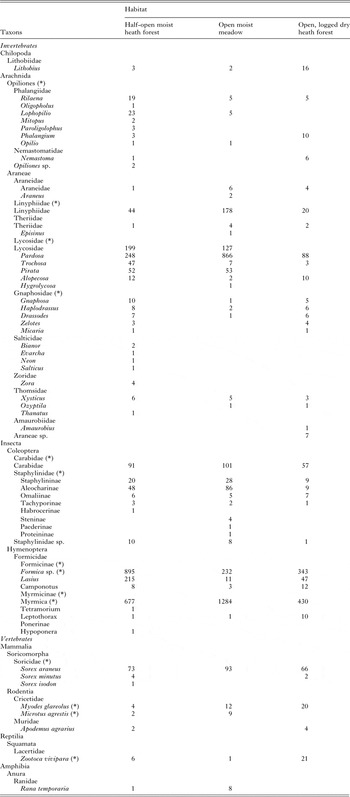
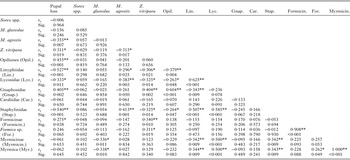
A Pearson or Spearman's rank-order correlation was run to assess the relationship between lost pupae and abundance (individual numbers) of different animal groups visiting arenas. The statistical significance was computed using two-tailed test. The level of significance was mainly set at the P < 0·05. If the test result was considered statistically significant at the P < 0·01, it will be mentioned separately in parentheses in the result section. Correlation analyses were conducted separately for the ‘mammal, reptile and invertebrate arena’ and for the ‘invertebrate arena’. In addition, the relationships between pupal loss and invertebrate numbers were studied by summing the data from the ‘mammal, reptile and invertebrate arena’ and ‘invertebrate arena’. Because an occasional rainfall ruined half of the open arenas, all the data from open arenas were excluded from the correlation analysis. The analysed 14 animal groups were: Sorex shrews, bank vole (Myodes glareolus), field vole (Microtus agrestis), common lizard (Zootoca vivipara), the harvest-spiders (Opiliones), Linyphiidae-spiders, wolf spiders (Lycosidae), ground spiders (Gnaphosidae), ground beetles (Carabidae), rove beetles (Staphylinidae), Formicinae (three genus), Formica sp., Myrmicinae (three genus), Myrmica sp. In the analysis, the animal groups were formed depending on the individual numbers. Some of the smallest and separate groups were excluded from the analysis (e.g. five species of the family Salticidae containing only five individuals). See Table 2 for details of the orders, families, sub-families, genuses and species selected for the analysis.
Identified invertebrates and vertebrates in three study habitats
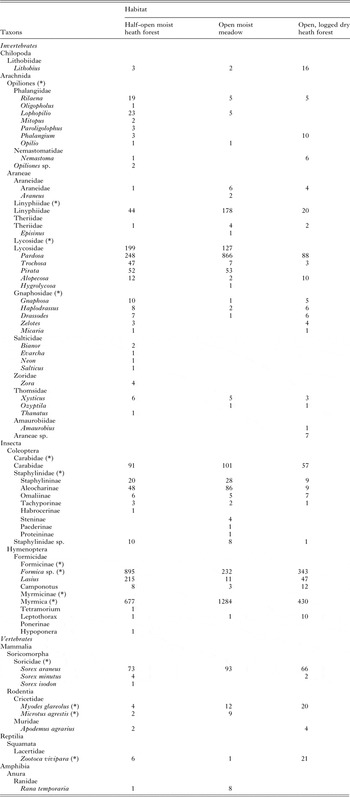
Asterisk (*) refers to the taxonomic level included in the statistical analyses.
RESULTS
Identified invertebrates
The pitfall samples contained a total of 16 434 invertebrates when material from all the three habitats is combined. 6845 invertebrates were identified as potential predators to L. cervi pupae and non-insectivorous invertebrates (some species of Muscidae, Calliphoridae, Culicidae and Tipulidae) were excluded from the analyses. The potential invertebrate predators belonged to four classes or orders: the centipedes (Chilopoda), the harvest-spiders (Opiliones), spiders (Araneae) and insects (Insecta) (see Table 2). There were a total of 15 families, eight sub-families and 37 genera. 5751 invertebrates were identified to species level. A total of 854 invertebrates were identified to family level, 231 were identified to the sub-family level, but nine individuals were identified only at the class or order levels. The most abundant groups were: ants from Myrmica (2391 individuals) and Formica (1470 individuals) genus, spider genus Pardosa (1202 individuals) belonging to the family of wolf spiders (Lycosidae) and beetles (Coleoptera) from the Staphylinidae family (250 individuals) and Carabidae family (249 individuals).
Identified vertebrates
A total of 232 common shrews (Sorex araneus), six Eurasian pygmy shrews (Sorex minutus), one taiga shrew (Sorex isodon), 36 bank voles (M. glareolus), 11 field voles (M. agrestis) and 28 common lizards (Z. vivipara) were caught in the traps (see Table 2). These were included in the analysis. Also six striped field mice (Apodemus agrarius) and nine common frogs (Rana temporaria) were caught in the traps, but these were not included in the analysis because of the small sample sizes.
Pupal predation
About half of the open arenas (ten for each habitat) were excluded from the analysis because an occasional rainfall affected on open arenas. This was taken into account when calculating predation percentages. 22·9% of all the experimental pupae were predated during the 72-h monitoring period. 16% of the pupae in the ‘open arenas’ were predated, 28·8% of the pupae in the ‘mammal, reptile and invertebrate arenas’ were predated, and 20·4% of the pupae in the ‘invertebrate arenas’ were predated. See Table 1 for detailed predation percentages of pupae for each arena type in different habitats.
Survival distributions of pupae in three predator guild arenas
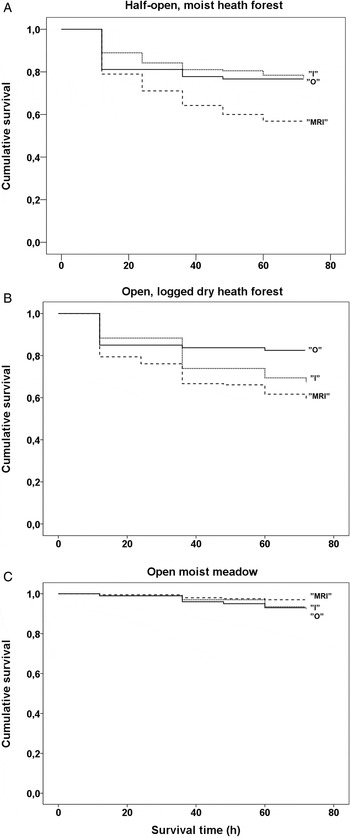
The survival distributions for the three arena types, indicating different predator guilds, were significantly different in the half-open forest [a log rank, Mantel–Cox: χ 2(2) = 22·410, P < 0·0005]. In the half-open forest – habitat, there was a significant difference in survival distributions for the ‘mammal, reptile and invertebrate arena’ vs ‘open arena’, χ 2(1) = 9·486, P = 0·002, and the ‘mammal, reptile and invertebrate arena’ vs ‘invertebrate arena’, χ 2(1) = 18·875, P < 0·001. However, the survival distributions for the ‘open arena’ and the ‘invertebrate arena’ treatments were not different, χ 2(1) = 0·045, P = 0·833. In the half-open forest–habitat, the pupal predation rate was highest in the ‘mammal, reptile and invertebrate arena’ treatment (i.e. the pupal survival rate was lowest) (Fig. 1A).
Survival distributions of L. cervi pupae for the three arena types in the three habitats. (A) Half open forest; (B) open forest and (c) meadow. Solid line ‘O’ = open arena; small dashed line ‘I’ = invertebrate arena; large dashed line ‘MRI’ = mammal, reptile and invertebrate arena.

In the open forest, the survival distributions for the three arena types were different [a log rank, Mantel–Cox: χ 2(2) = 13·689, P = 0·001]. There was a difference in survival distributions for the ‘mammal, reptile and invertebrate arena’ vs ‘open arena’, χ 2(1) = 12·904, P < 0·001. The difference between the ‘open arena’ vs ‘invertebrate arena’ was close to statistical significance after the Bonferroni correction [χ 2(1) = 5·683, P = 0·017]. Moreover, the survival distributions for the ‘mammal, reptile and invertebrate arena’ and the ‘invertebrate arena’ treatments were nearly significantly different, χ 2(1) = 3·431, P = 0·064. Highest survival (i.e. lowest predation rate) of pupae was in the ‘open arena’ treatment (Fig. 1B).
In the meadow habitat the predation impact was generally low and the survival distributions for the three arena types were not significantly different [a log rank, Mantel–Cox: χ 2(2) = 3·995, P = 0·136] (Fig. 1C).
Between-habitat differences in the survival of pupae
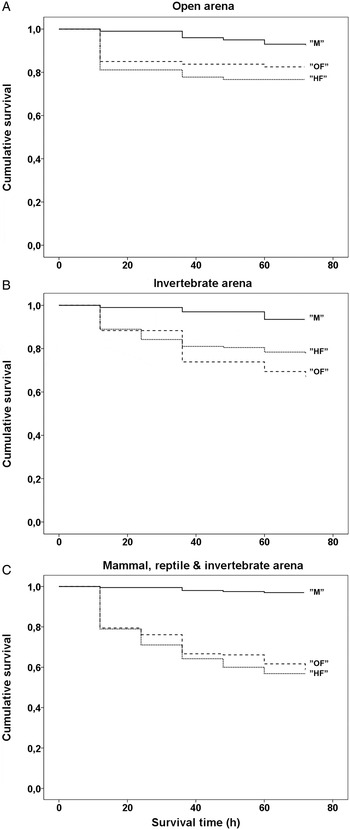
Pupal survival distribution on the ‘open arena’ differed between the different habitats [χ 2(2) = 8·813, P = 0·012]. The meadow habitat differed from the half-open forest χ 2(1) = 9·091, P = 0·003. There was no significant difference between the meadow habitat and the open forest, although the result was near significant after the Bonferroni correction [χ 2(1) = 3·982, P = 0·046]. Survival distributions for the half-open forest and the open forest did not differ significantly [χ 2(1) = 0·872, P = 0·350]. Lowest predation (i.e. highest survival) on the ‘open arena’ was observed in the meadow habitat (Fig. 2A).
Survival distributions of L. cervi pupae in the three habitats. Large dashed line ‘OF’ = open forest; small dashed line ‘HF’ = half-open forest, solid line ‘M’ = meadow) for different predator guild arena types. (A) Open arena; (B) invertebrate arena and (C) mammal, reptile and invertebrate arena.

Also, pupal survival in the ‘invertebrate arena’ differed between the different habitats [χ 2(2) = 42·421, P < 0·001]. The meadow habitat differed from the half-open forest χ 2(1) = 21·588, P < 0·001 and from the open forest (χ2(1) = 45·319, P < 0·001). Survival distributions for the half-open forest and the open forest did not differ significantly [χ 2(1) = 4·260, P = 0·039]. Lowest predation (i.e. highest survival) on the ‘invertebrate arena’ was found in the meadow habitat (Fig. 2B).
Pupal survival distribution on the ‘mammal, reptile and invertebrate arena’ differed significantly between the different habitats [χ 2(2) = 96·598, P < 0·001]. The meadow habitat differed significantly both from the half-open forest χ 2(1) = 94·154, P < 0·001 and the open forest [χ 2(1) = 86·679, P < 0·001]. Survival distributions for the half-open forest and the open forest did not differ significantly [χ 2(1) = 0·261, P = 0·610]. Lowest predation (i.e. highest survival) in the ‘mammal, reptile and invertebrate arena’ was observed in the open meadow habitat (Fig. 2C).
Pupal loss and predatory animals
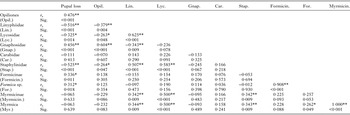
When the predation data from ‘invertebrate arena’ was analysed, there was a statistically significant positive correlation between the number of lost pupae and number of individuals of Opiliones [Spearman r s (55) = 0·275, P = 0·038], Gnaphosidae [Spearman r s (55) = 0·329, P = 0·013], Formicinae [Spearman r s (55) = 0·292, P = 0·027; Pearson r (55) = 0·405, P = 0·002, at the 0·01 significance level], and Formica sp. [Spearman r s (55) = 0·259, P = 0·052; Pearson r (55) = 0·413, P = 0·001, at the 0·01 significance level]. When we analysed the pooled data from both the ‘mammal, reptile and invertebrate arena’ and the ‘invertebrate arena’, the positive correlations between pupal loss and individual numbers of Opiliones, Gnaphosidae, Formicinae and Formica sp. still existed (see Table 3). There were also some negative correlations between pupal loss and number of individuals from certain groups of invertebrates (Linyphiidae, Lycosidae, Staphylinidae) (Table 3).
Spearman correlation matrix to assess L. cervi pupal loss in relation to presence of different invertebrate groups (number of individuals)
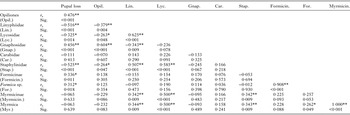
The correlations between the different invertebrate groups are also shown in the matrix. The pupal losses of the ‘Mammal, reptile and invertebrate’ and ‘Invertebrate’ arenas were summed together in each triplet (replicate n = 57). The data were pooled among three study habitats. r s refers to the Spearman correlation coefficient. ** = Correlation is significant at the 0·01 level (two-tailed). * = Correlation is significant at the 0·05 level (two-tailed).
When we analysed the data only from the ‘mammal, reptile and invertebrate arena’ there was a positive correlation between the pupal loss and number of individuals of Z. vivipara (see Table 4). Again, in this arena-type, there was positive correlation between the pupal loss and number of individuals of Opiliones [Spearman r s (55) < 0·455, P < 0·001, at the 0·01 significance level], Gnaphosidae [Spearman r s (55) = 0·405, P = 0·002, at the 0·01 significance level], Formicinae [Spearman r s (55) = 0·275, P = 0·038].
Spearman correlation matrix to assess L. cervi pupal loss in relation to presence of different animal groups (number of individuals/group). The correlations between the different animal groups are also shown in the matrix
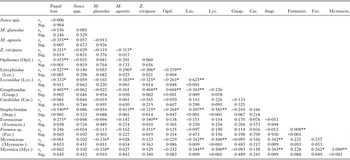
The data are obtained from ‘Mammal, reptile and invertebrate’ arenas (n = 57). The data are pooled among three study habitats. r s refers to the Spearman correlation coefficient. ** = Correlation is significant at the 0·01 level (two-tailed). * = Correlation is significant at the 0·05 level (two-tailed).
DISCUSSION
The obligatory off-host life cycle stages of parasites are exposed to totally different abiotic and biotic environments than the stages on or in the host. We have earlier demonstrated the importance of avian predation on the deer ked pupae during winter, when the dark pupae are conspicuous against snowy background at the moose beddings (Kaunisto et al. Reference Kaunisto, Kortet, Härkönen, Kaitala, Laaksonen and Ylönen2012a , Reference Kaunisto, Välimäki, Kortet, Koskimäki, Härkönen, Kaitala, Laaksonen, Härkönen and Ylönen b ), but during the summer, the diversity of potential predators is far larger. Prior to this study, the details of the natural summer time predation on pupae of the invasive deer ked L. cervi in the wild were unknown. Here, we examined the summer time predation on the pupal stage of L. cervi by birds, small mammals, reptiles and invertebrates in different natural habitats representing the southern Central Finland. We found that the total predation rate of pupae was notable, as 23% of all pupae used in the field experiments were predated upon, even within a short time interval (72-h monitoring period). Pupal predation rate was lowest in the open, meadow habitat, and predation pressure also varied notably within habitats. There was a positive correlation between pupal loss and the number of predatory ground-dwelling invertebrates and lizards, but, based on the present data, small mammals and birds do not seem to be major predators on L. cervi pupae during summer. It is presumable, that the number of pupae in the habitat correlates with the number of host-attacking imagoes later in the autumn, which likely will be reflected on the realized parasite loads of cervid hosts in the area. Thus, any predation on pupae during summer time may decrease parasite loads of the hosts in the later season. However, there is no data on this and more studies are needed to verify this assumption.
The significance of predation on parasites, in general, has received very little attention, especially when predation does not lead to transmission of parasites, or the transmission of parasite-related pathogens between individuals and/or species (Johnson et al. Reference Johnson, Dobson, Lafferty, Marcogliese, Memmott, Orlofske, Poulin and Thieltges2010). Parasites have not often been included in food-web-related research because they are difficult to measure and assumed to have low total biomass (Lafferty et al. Reference Lafferty, Dobson and Kuris2006, Reference Lafferty, Allesina, Arim, Briggs, De Leo, Dobson, Dunne, Johnson, Kuris, Marcogliese, Martinez, Memmott, Marquet, McLaughlin, Mordecai, Pascual, Poulin and Thieltges2008; Johnson et al. Reference Johnson, Dobson, Lafferty, Marcogliese, Memmott, Orlofske, Poulin and Thieltges2010). Although previously neglected, predation on parasites is widespread in the wild and found in a variety of forms (Lafferty et al. Reference Lafferty, Dobson and Kuris2006), including concomitant predation on the parasite together with its host, grooming by host itself or predation on a host by mutualistic conspecifics/other species, predation on free-living stages outside the host, or intraguild predation within the body of the host (Johnson et al. Reference Johnson, Dobson, Lafferty, Marcogliese, Memmott, Orlofske, Poulin and Thieltges2010). For example, avian predators are observed to remove ectoparasites directly on the ungulate hosts (e.g. Massei and Genov, Reference Massei and Genov1995; Peres, Reference Peres1996; Samuel et al. Reference Samuel, Mooring and Aalangdong2000; Sazima, Reference Sazima2007). There is also some documentation that vertebrate and invertebrate predators can consume free-living stages of ectoparasites outside the host (Wilkinson, Reference Wilkinson1970; Mwangi et al. Reference Mwangi, Newson and Kaaya1991; Samish and Rehacek, Reference Samish and Rehacek1999; Sutherst et al. Reference Sutherst, Wilson and Cook2000). Our present data provide further dimension to this earlier literature.
This is the first comprehensive field study on natural predation of L. cervi during summer time, and it provides, within limitations of the experimental setup, a basis for rough estimations of the magnitude of the maximal predation in the wild in different habitats. In our trials, the pupae were displayed openly in the arenas, while naturally they are camouflaged on the ground, which decreases predation. We found a positive correlation between pupal loss and number of individuals of Gnaphosidae ground spiders and Opiliones harvestmen as potential invertebrate predators. In literature, however, we found no earlier reports showing that the ground spiders would predate on insect pupae. On the other hand, Gnaphosids are mostly generalized predators, feeding on a wide range of prey, including insects (Ubick, Reference Ubick, Ubick, Paquin, Cushing and Roth2005; Bradley, Reference Bradley2013). In addition, most ground spiders lack a prey-capture web and generally run prey down on the surface, thus potentially making L. cervi pupae vulnerable to them. Members of the Gnaphosidae family resemble wolf spiders (Lycosidae), which are reported to predate on various invertebrates including pupae of Mediterranean fruit fly, Ceratitis capitata (Urbaneja et al. Reference Urbaneja, Marí, Tortosa, Navarro, Vanaclocha, Bargues and Castañera2006). Ceratitis capitata pupae are a similar size as L. cervi pupae. In this study, however, there was no positive correlation between pupal loss and number of individuals of family Lycosidae. According to our knowledge, there is no previous data on pupal predation by Opiliones either. However, the diets of many harvestmen (such Phalangiidae and Nemastomatidae) are very diverse including live and dead arthropods (Hvam and Toft, Reference Hvam and Toft2008; Tomasson et al. Reference Tomasson, Tammaru and Kurina2012). Therefore, we judge the harvestmen as possible predators on L. cervi pupae.
We found a positive correlation between L. cervi pupal loss and number of individuals of Formicinae and of Formica sp. The species of genus Formica are of major ecological importance in boreal ecosystems; most species being generalist predators and scavengers (Bourke and Franks, Reference Bourke and Franks1995), and foraging mainly on the ground or on vegetation (Rosenheim, Reference Rosenheim1990). Moreover, there are previous references to the predation on insect pupae by Formica ants (Brookes et al. Reference Brookes, Stark and Campbell1979; Youngs and Campbell, Reference Youngs and Campbell1984; Harrison and Wilcox, Reference Harrison and Wilcox1995). In this study, genus Formica was most abundant in the identified Formicinae-subfamily. We have also observed that Formica species attack L. cervi pupae on the foraging paths of the ants (unpublished data).
Among the vertebrates, only the number of Z. vivipara lizards was positively correlated with the pupal loss of L. cervi. In habitats where these lizards were present, the pupal predation rate was significantly or almost significantly higher in the ‘mammal, reptile and invertebrate’ arena compared with the other arena types. In general, Z. vivipara actively forage on invertebrates, especially on insects (Itämies and Koskela, Reference Itämies and Koskela1971; Koponen and Hietakangas, Reference Koponen and Hietakangas1972; Herrel et al. Reference Herrel, Van Damme, Vanhooydonck and De Vree2001). There were no correlations between pupal loss and observed small mammal numbers. In the previous food preference experiments (conducted in the laboratory conditions), we have shown that L. cervi pupae are not the most preferred food source for the insectivorous S. araneus and mainly herbivorous M. agrestis, who preferred alternative food items if available (Kaunisto et al. Reference Kaunisto, Kortet, Härkönen, Kaitala, Laaksonen and Ylönen2012a ). Since this field study was conducted in summer, it is likely that there were more palatable food items than L. cervi pupae available for both shrews and rodents. It is also likely that in the field conditions, granivorous–omnivorous bank voles M. glareolus prefer other food items if available; although in the laboratory conditions, they consumed L. cervi pupae regardless of the availability of alternative food (Kaunisto et al. Reference Kaunisto, Kortet, Härkönen, Kaitala, Laaksonen and Ylönen2012a ). Evidence for summer time predation on pupae by birds was not found in the present study. Although the pupae on the open arenas were available for all possible predators, including birds, the pupal predation in the open arenas was lower or equal compared to that of other arena types restricting entry for birds. Lower predation in open arenas clearly suggests that invertebrates, lizards and small mammals avoided foraging on pupae on open arenas. One explanation for this could be that they possibly avoided becoming attacked by other predators, as open arena provides no shelter, for example, for lizards and small mammals against raptors. Interestingly, we have earlier verified the importance of avian predation on L. cervi pupae on fresh bedding sites of the host animal during winter (Kaunisto et al. Reference Kaunisto, Välimäki, Kortet, Koskimäki, Härkönen, Kaitala, Laaksonen, Härkönen and Ylönen2012b ). If the birds detect L. cervi pupae on the snow they usually eat all the pupae. However, during winter, birds seem to exploit a host-derived cue to locate L. cervi pupae; reddish brown snow discoloration on bedding sites indicates heavy L. cervi infestation of the host and consequently higher pupal number (Kaunisto et al. Reference Kaunisto, Kortet, Härkönen, Härkönen, Ylönen and Laaksonen2009). During summer time, these visual cues are missing and birds may have not learned to detect L. cervi pupae against camouflaged brownish background compared to conspicuousness on the snow. In addition, during the summer, birds are likely not food restricted as they are in the winter.
Pupal predation was lowest in the open, meadow habitat. However, the survival distributions for the half-open, moist heath forest and the open, logged dry heath forest did not differ significantly. This indicates that in certain habitats, predation pressure on L. cervi pupae can be higher than in other habitats. Variation in predation pressure among habitats is likely to result from different predator composition and habitat characteristics (Tvardikova and Novotny, Reference Tvardikova and Novotny2012). For example, lizards were more commonly found in the open forest compared with meadow habitat; as the dry clearcut soil of the open forest is probably warmer and the preferred habitat for them. Opiliones and Formicinae instead, were more common in the moist heath forest compared to the meadow habitat, and Gnaphosidae were most rare in the meadow habitat. Different predator composition and, subsequently, predation pressure between L. cervi habitats should lead to variation in local L. cervi abundances.
In addition to between-habitat variation, the pupal predation rate also varied within the habitats. As we predicted, a big portion of pupae escaped predation. Almost 42% of the experimental arenas used in this study remained totally intact (i.e. all ten pupae left) throughout the experiment. Most of these intact arenas were in the meadow habitat (72% of the arenas). Also, within the moist heath forest, 27·7% of the arenas remained totally intact and within the dry, logged heath forest 22·7%. It is possible that in natural conditions there are spots in which group of L. cervi pupae can escape predation. The location of L. cervi pupae on the ground depends on host movements and most of L. cervi pupae normally drop off the host on the host bedding sites probably with varying degrees of predation pressure (Kaunisto et al. Reference Kaunisto, Välimäki, Kortet, Koskimäki, Härkönen, Kaitala, Laaksonen, Härkönen and Ylönen2012b ).
We showed that the invasive ectoparasite L. cervi has natural predators during summer. Our results share a relative resemblance to natural conditions, as the experiments were conducted in the field with natural predator guilds. The observed high magnitude of pupal predation is naturally product of our experimental set up, but it provides some idea of the importance of maximal predation for the local L. cervi abundances. However, predation alone – regardless of if it is during winter or summer – does not seem to prevent geographical invasion of L. cervi, as the species has already successfully invaded large areas in the Northern Europe. We found moderate positive correlations between L. cervi pupal loss and certain generalist invertebrates and common lizards. In general, predation pressure may not be particularly high against certain prey species by generalist predators, which can enable the establishment and even invasion of novel species (Koss and Snyder, Reference Koss and Snyder2005). Lower predation pressure in certain habitats and microenvironments may maintain the population size of L. cervi at adequate levels for invasion. Further studies on the regulative role of predation in L. cervi invasion are needed; for example, to be conducted in the edge-of-range areas and beyond the current range of L. cervi. Moreover, the significant correlations between pupal loss and generalist predators found in this study may imply causative associations, and need further investigation, for example, by using the camera-trap methodology.
ACKNOWLEDGEMENTS
We thank the staff of the Konnevesi research station for their help during the experiments. We thank Aino and Sauli Kaunisto for their help with the pupal collection. We also thank Laura Forster and anonymous reviewers for their valuable feedback on the manuscript.
FINANCIAL SUPPORT
The study was partly funded by the Ella and Georg Ehrnrooth Foundation (S. K.), the Biological Society of Finland Vanamo (S. K.), Societas Pro Fauna et Flora Fennica (S. K. and I. R.), Helsingin Hyönteistieteellinen Yhdistys (I. R.), the Finnish Cultural Foundation (R. K.), the North Karelia Regional Fund (S. K.), and the Alfred Kordelin Foundation (S. K.). S. K. finished the manuscript in London, Canada, while being financed by Marie Sklodowska-Curie Action, Individual Fellowship No. 661122 of the European Commission.