INTRODUCTION
Philometra ovata (Zeder, 1803) (=Philometra abdominalis Nybelin, 1928) is a parasitic nematode dwelling in the body cavity of its definitive host, fish of genera Gobio, Phoxinus and Leuciscus (Molnár, Reference Molnár1967; Moravec, Reference Moravec1977a , Reference Moravec2004; Keskin, Reference Keskin1988; Innal and Keskin, Reference Innal and Keskin2005; Saraiva et al. Reference Saraiva, Hermida, Costa, Maia, Reis, Cruz and Valente2008). This species, as other Philometra nematodes living in the temperate zone, has been noted to have a regular, yearly seasonal life cycle (Molnár, Reference Molnár1967; Moravec, Reference Moravec1977a ). In the early summer, first stage larvae of P. ovata are eaten by the intermediate hosts, copepods, where larvae reach their infective stage (Moravec, Reference Moravec1977b ). Infective larvae of P. ovata are trophically transmitted to the definitive fish host when the parasitized copepod is preyed on by the aforementioned cyprinid fish (Molnár, Reference Molnár1967; Moravec, Reference Moravec1977a , Reference Moravec b ). In the definitive host, juvenile P. ovata first penetrate the intestine wall of the host fish, then migrate and inhabit under the serose cover of the swim bladder, where both male and female larvae sexually mature and mate (Molnár, Reference Molnár1967; Moravec, Reference Moravec1977a ). After mating, while males remain in the swim bladder, gravid females with eggs in their uterus migrate from the swim bladder to the body cavity of the fish host. Mated female P. ovata are able to continue growing to their final size (which can be more than 70 mm long) only in the body cavity of the host. Females attain a fully developed uterus with great numbers of free first-stage larvae by the end of the next spring or early summer. At a particular time of the year, such as from late May to the end of June in central Europe (Molnár, Reference Molnár1967), P. ovata females leave the body cavity of the host by penetrating the tissues around the anus of the host. The worms rupture immediately due to the hypotonic effect of the surrounding water and release the first-stage larvae in to the water (Molnár, Reference Molnár1967; Moravec, Reference Moravec1977a ).
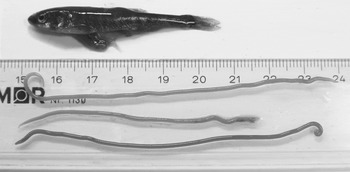
In addition to southern and central European countries (e.g. Molnár, Reference Molnár1967; Moravec, Reference Moravec1977a ; Innal and Keskin, Reference Innal and Keskin2005; Saraiva et al. Reference Saraiva, Hermida, Costa, Maia, Reis, Cruz and Valente2008), P. ovata has been recorded in Finland in the European minnow (Phoxinus phoxinus) (Kekäläinen et al. Reference Kekäläinen, Leppänen, Huuskonen, Lai, Valkama and Taskinen2011; Lai et al. Reference Lai, Taskinen, Kekäläinen and Kortet2012). During the breeding season, male minnows have intensive intra-sexual competition, and develop clearly visible breeding ornamentation, such as dark lateral colouration, bright red abdominal colouration and breeding tubercles on the head (Müller and Ward, Reference Müller and Ward1995; Jacob et al. Reference Jacob, Evanno, Renai, Sermier and Wedekind2009; Kekäläinen et al. Reference Kekäläinen, Valkama, Huuskonen and Taskinen2010, Reference Kekäläinen, Leppänen, Huuskonen, Lai, Valkama and Taskinen2011). The male ornamentation in minnows has been demonstrated to signal dominance status (Jacob et al. Reference Jacob, Evanno, Renai, Sermier and Wedekind2009; Kekäläinen et al. Reference Kekäläinen, Valkama, Huuskonen and Taskinen2010), low parasite load (Kekäläinen et al. Reference Kekäläinen, Leppänen, Huuskonen, Lai, Valkama and Taskinen2011), genetic heterozygosity (Müller and Ward, Reference Müller and Ward1995), fitness-related traits (Lai et al. Reference Lai, Kekäläinen and Kortet2013) and performance in anaerobic burst swimming (Lai et al. Reference Lai, Kekäläinen and Kortet2013). It has been shown that the occurrence of body cavity dwelling (BCD) P. ovata is associated with a decrease of male ornamentation in minnows (Kekäläinen et al. Reference Kekäläinen, Leppänen, Huuskonen, Lai, Valkama and Taskinen2011). In addition, it has been reported that BCD P. ovata mainly locates among the gonads in minnows (Moravec, Reference Moravec1977a ), and thus is likely to cause parasitic castration (Moravec, Reference Moravec2006). Interestingly, European minnows are smaller in body length (mostly <9 cm, see Fig. 1) than most other host species, such as European Chub, Leuciscus cephalus (Innal and Keskin, Reference Innal and Keskin2005) and Gobio lozanoi (Saraiva et al. Reference Saraiva, Hermida, Costa, Maia, Reis, Cruz and Valente2008). It is thus possible that the fitness impact of BCD P. ovata may be more severe on minnows than on other host species.
A male minnow parasitized by three BCD P. ovata.

Although the interaction and impact of BCD P. ovata on minnows has been noted (Kekäläinen et al. Reference Kekäläinen, Leppänen, Huuskonen, Lai, Valkama and Taskinen2011), the ecology of P. ovata infection in minnows has only been studied in central Europe (Moravec, Reference Moravec1977a ) and never in Finland (but see Lai et al. Reference Lai, Taskinen, Kekäläinen and Kortet2012). In other words, our knowledge on the seasonality and ecology of P. ovata infection in minnows has been limited, especially the infection ecology of swim bladder dwelling (SBD) P. ovata, which has never been studied. Therefore, by monthly monitoring of minnow population in Eastern Finland, as well as observing lab-housed minnows with/without BCD P. ovata for almost 1 year, we aimed to investigate the seasonality of infection and characteristics in both SBD P. ovata and BCD P. ovata in the European minnows.
MATERIALS AND METHODS
Monthly field survey in 2010 and 2011
From April to November (i.e. non-ice-covered period) in 2010 and 2011, we caught minnows monthly from brook Kuusoja (62° 48′N, 30° 1′E) in Eastern Finland by dip net and minnow traps (Promar, Gardena, California, USA). After catching, minnows were transported to the laboratory in the University of Eastern Finland and euthanized with an overdose of tricaine methanesulfonate (MS-222, Sigma®, Sigma Chemical Co., St. Louis, Missouri, USA). We measured the total length (L T), body mass (W M, not including the biomass of all BCD P. ovata in infected fish) and gonad weight (W G) and determined the sex of each minnow by dissection. The condition factor (K) of each collected minnow was calculated using the equations: 106 × W M /L T b, where b is the slope of a regression of log10 (W M) on log10 (L T) of all examined minnows (Bolger and Connolly, Reference Bolger and Connolly1989), and gonadosomatic index (GI) as W G /W M × 100 (Erickson et al. Reference Erickson, Hightower and Grossman1985).
In dissection, we also recorded the infection status and number of BCD P. ovata in each minnow, as well as the body length (L P.o.), body weight (W P.o.) and the development status of offspring (egg and larva) in the uterus of each worm. In addition, by squeezing the swim bladder of minnows between two glass plates, we also recorded the number of SBD P. ovata with a dissecting microscope. Moreover, from October 2010, we determined the sex (male, female or larva) of SBD P. ovata with the copulation spicules in male worms and uterus filled with eggs in female worms (Molnár, Reference Molnár1967), and thus we were able to distinguish the respective number of female, male and larval SBD P. ovata in minnows.
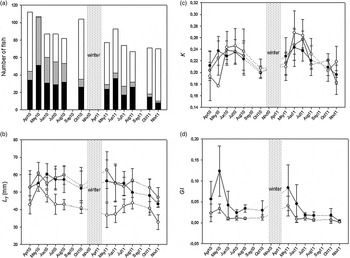
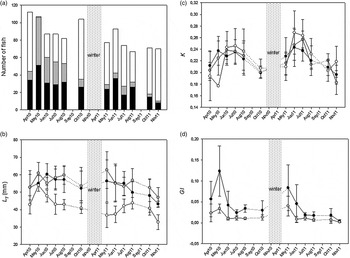
In total, we caught 1027 minnows (327 females, 181 males and 519 immature fish), an average of 86 individuals collected per month (range 67–112) in the field survey. No minnows were collected in November 2010 or April 2011, despite the fact that Brook Kuusoja was ice-opened, and no collecting was conducted in September of either year due to technical reasons. Monthly numbers, sizes and measured parameters of female, male and immature minnows caught are given in Fig. 2.
Number (A), total length (B), condition factor (C) and gonadosomatic index (D) (mean ± s.d.) of female, male and immature (black, grey and white bar or circle, respectively) minnows collected monthly in Brook Kuusoja from April to November in 2010 and 2011. Dotted lines indicate the presumed pattern in non-surveyed months.
Observation of P. ovata evacuation in summer 2011 and bimonthly survey of P. ovata in lab-housed minnows in 2011 and 2012
In May 2011, we collected 51 minnows that were found to be infected by BCD P. ovata with the highly reliable non-invasive diagnosis (Lai et al. Reference Lai, Taskinen, Kekäläinen and Kortet2012) from brook Kuusoja. Another 45 fish that were not infected by BCD P. ovata were collected in Kuusoja as the control group. In the lab, minnows were marked with group-specific (i.e. group of infected or non-infected fish) dorsal fin clips for the later identification of infection status. All 96 collected minnows were then mixed and housed in a 45 L aquarium with continuous flow of 12 °C water under a natural photoperiod, and were automatically fed daily with commercial fish food (Biomar®, Aqualife, Denmark).
In June and July 2011, lab-housed minnows were monitored daily for the evacuation of gravid BCD P. ovata. The mortality of infected and non-infected minnows was recorded to understand if the penetration due to the evacuation of P. ovata leads to a higher acute mortality in minnows.
From August 2011 to April 2012, we took ca. 20 minnows randomly from the aquarium bimonthly, and euthanized, measured and examined these fish as described above. After dissection, the infection status and number of BCD P. ovata, along with L P.o., W P.o., and development status of the offspring (egg and larva) in the uterus of each BCD P. ovata in each minnow was recorded. We also recorded the number of male, female and larval SBD P. ovata, respectively.
As five minnows died before August 2011, we had 91 minnows in the final analysis, of which 46 and 45 individuals were diagnosed as infected and non-infected by BCD P. ovata respectively in May 2011. From August 2011 to April 2012, we examined on average 18 (range: 11–21) individuals of these lab-housed minnows bimonthly. All the procedures were performed according to the license of the Finnish Animal Experimental Board (ESAVI/1906/04·10·03/2012).
Statistics
Monthly field survey in 2010 and 2011
The following analyses were conducted in SBD P. ovata and BCD P. ovata, respectively. The prevalence (proportion of infected individuals in the population) and intensity (number of parasites in an infected individual) of P. ovata infections, according to Bush et al. (Reference Bush, Lafferty, Lotz and Shostak1997), were calculated for female, male, mature (i.e. female+male), immature minnows and for the total (i.e. female+male+immature) minnows collected in every month. A paired t-test was used to examine the difference of monthly prevalence of P. ovata between female and male minnows and between mature and immature minnows. Due to the non-parametric data characteristics of intensity, Kruskal–Wallis test was used to examine the difference of overall intensity of P. ovata between male and female minnows and between mature and immature fish. In addition, to reveal the potential impact of P. ovata infection on the fitness of minnows, we tested the association between each fitness-related factor (L T, K and GI, dependent variables) of minnows and intensity of P. ovata infection and, in particular, the sum L P.o. of BCD P. ovata (covariates) with a general linear model (GLM) analysis. The collecting month and fish sex were included as fixed factors in these analyses.
After October 2010, to investigate the dynamics of P. ovata larvae transmitting from intermediate hosts to the swim bladder of minnows, we conducted a one-way analysis of variance (ANOVA) to test the difference of proportion of larval SBD P. ovata among all SBD P. ovata (dependent variable) in all (female+male+immature) minnows between each month. To investigate the emigrating dynamics of female P. ovata from the swim bladder to the body cavity in minnows, and the dynamic of male P. ovata in the swim bladder, we also conducted two one-way ANOVAs for female and male SBD P. ovata among all SBD P. ovata, respectively, to test the difference of proportion of female and male SBD P. ovata (dependent variables) between the months. In addition, the monthly proportion of female and male SBD P. ovata in all minnows was analysed with a paired t-test to reveal if P. ovata has any sex-bias. The association between the developmental status of offspring (egg and larva, dependent variable) in uterus and the body size (length and weight, covariates) of BCD P. ovata was also tested with logistic regression.
Bimonthly survey of P. ovata in lab-housed minnows in 2011 and 2012
The prevalence and intensity of SBD P. ovata and BCD P. ovata, as well as the proportion of female, male and larval SBD P. ovata, were calculated, respectively, in each examining month. The proportion of female and male SBD P. ovata was analysed with a paired t-test to reveal if emigration of female P. ovata from swim bladder leads to a male-biased group in the swim bladder without a fresh infection of larvae. The dependence of the developmental status of offspring in uterus (egg or larvae) on the body length of BCD P. ovata in the survey was tested with logistic regression. Finally, the infection status of BCD P. ovata distinguished previously by non-invasive diagnosis in May 2011 in each minnow was compared with the infection status revealed by dissection under examination by Chi-Square (χ 2) test. Since the infection status of BCD P. ovata revealed by dissection in the survey belonged to the next annual cycle of P. ovata comparing to the infection status distinguished in May 2011, we were able to examine if the emigration of female P. ovata from the swim bladder is correlated between two sequential annual cycles in the analysis.
RESULTS
Monthly field survey of minnows in 2010 and 2011
Philometra ovata in swim bladder
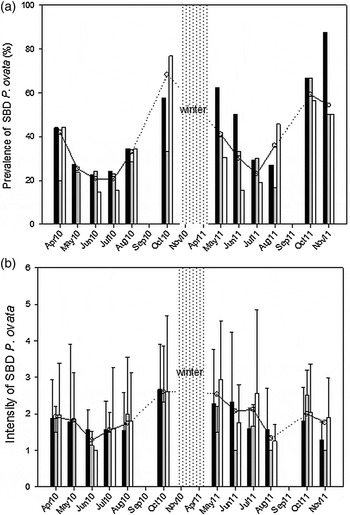
Over the whole field survey, the monthly prevalence of SBD P. ovata infection varied between 20 and 70% with a regular annual cycle, in which the prevalence decreased in spring, stayed low in mid-summer, then increased in late summer and autumn (difference of SBD P. ovata prevalence between July (mid-summer) and October (autumn): in 2010, χ 2 = 143·48, P < 0·001; in 2011, χ 2 = 52·54, P < 0·001; Fig. 3A). Such a pattern of an annual seasonal cycle of SBD P. ovata infection was very clear in females and immature minnows, and also obvious in male minnows (Fig. 3A). In addition, the mean monthly prevalence of SBD P. ovata infection in minnows in our field survey was 37·8 ± 15·1%, while in female, male and immature minnows was 44·4 ± 19·8%, 32·5 ± 13·5% and 33·6 ± 20·9%, respectively. The mean monthly prevalence of SBD P. ovata in female minnows was significantly higher than in males, while the mean monthly prevalence between mature and immature minnows was not significantly different (paired t-test: female and male, t 11 = 3·252, P = 0·008; mature and immature, t 11 = −1·491, P = 0·164, Fig. 3A). On the other hand, the mean intensity of SBD P. ovata infection in all infected minnows in our field survey was 2·0 ± 1·5 (n = 387), while in female, male and immature infected minnows was 1·9 ± 1·4 (n = 130), 1·7 ± 1·0 (n = 47) and 2·1 ± 1·6 (n = 210), respectively (Fig. 3B). The seasonal cycle in intensity of SBD P. ovata infection (Fig. 3B) followed roughly the same pattern as the prevalence. In addition, differences in intensity of SBD P. ovata infection between female and male infected minnows, as well as between mature and immature infected fish were both non-significant (Kruskal–Wallis test: female and male, χ 2 = 0·756, P = 0·385; mature and immature, χ 2 = 3·124, P = 0·077, Fig. 3B). Taken together, it is thus indicated that female minnows have a higher possibility than male minnows to be infected by SBD P. ovata, but the numbers of SBD P. ovata in infected female and male minnows were similar.
Prevalence (A) and intensity (B) (mean ± s.d.) of SBD P. ovata in female, male, immature (black, grey and white bar, respectively) and in total (empty circle) minnows collected monthly in Brook Kuusoja from April to November in 2010 and 2011. Dotted lines indicate the presumed pattern in non-surveyed months. Numbers of female, male and immature minnows examined in each month can be referred in Fig. 2A.

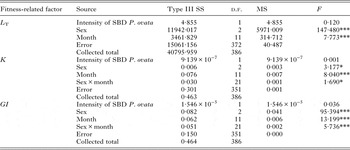
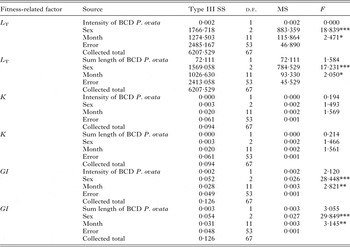
GLM analysis showed that, despite the significant effects of the seasonality and sex of minnow on K and GI (i.e. K and GI of minnows increased in the spawning season, Fig. 2C and D), all the associations between each fitness-related factor (L T, K and GI) of minnows and the intensity of SBD P. ovata infection were non-significant (Table 1). Thus, it is suggested that infection of SBD P. ovata may not retard the host growth, impair the host body condition or decrease the host relative gonad size in minnows.
GLM statistics for the association between fitness-related factors of minnows (L T, K and GI; dependent variable) and intensity of SBD P. ovata in minnows, with fish sex and collecting month as fixed factors
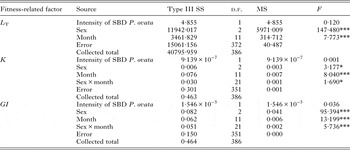
Non-significant interactions in each analysis (P > 0·1, P > 0·3, P > 0·7, respectively) were excluded from this final table. *: P < 0·05; **: P < 0·01; ***: P < 0·001.
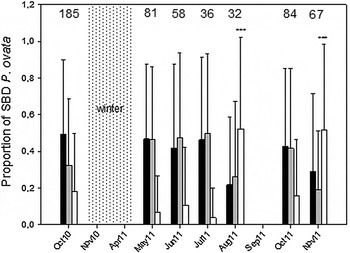
The proportion of female and male SBD P. ovata was generally higher than that of larval SBD P. ovata (Fig. 4). The proportion of female SBD P. ovata from total SBD P. ovata was not different between months (ANOVA: F 6 = 1·953, P = 0·073), while proportion of male and larva SBD P. ovata were both significantly different between months (ANOVA: male, F 6 = 2·744, P = 0·013; larva, F 6 = 10·489, P < 0·001). However, post hoc tests showed that the proportion of larval SBD P. ovata was significantly higher only in August and November 2011 than in other surveying months (Fig. 4). On the other hand, the monthly proportion of female and male SBD P. ovata was not different (pair t-test: female and male, t 244 = 1·047, P = 0·296). Taken together, it is implied that the P. ovata population in our survey was not sex-biased. The monthly proportion of female P. ovata was stable in the swim bladder, while the proportion of larval P. ovata was variable between months, rising particularly in August, when fresh infections by larval P. ovata mainly occur.
Monthly proportion (mean ± s.d.) of female, male and larval SBD P. ovata (black, grey and white bar, respectively) in minnows from October 2010 to November 2011. The asterisks over the bar indicate the proportion of larval SBD P. ovata in the month was significantly (P < 0·001) higher than in other months. The number of SBD P. ovata examined in each month is indicated above.

Philometra ovata in body cavity
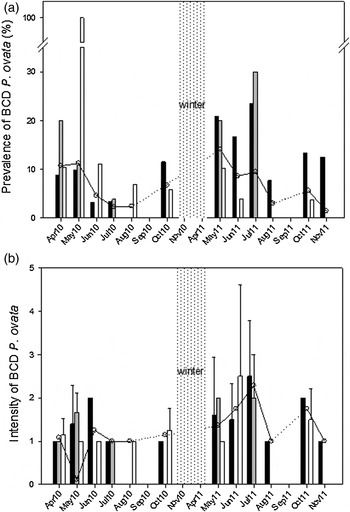
As in SBD P. ovata, the prevalence of BCD P. ovata in our field survey also showed a regular annual pattern, in which the prevalence decreased from May to August then mildly increased in autumn, and was always less than 14% (difference of BCD P. ovata prevalence between July (mid-summer) and October (autumn): in 2010, χ 2 = 9·09, P < 0·005; in 2011, χ 2 = 1·21, N.S.; Fig. 5A). Due to the different numbers of collected fish between sexes, the prevalence of BCD P. ovata in female, male and immature minnows was highly variable, and the pattern of prevalence in total minnows was merely observed in female minnows (Fig. 5A). The mean monthly prevalence of BCD P. ovata in our field survey was 6·7 ± 3·9%, while in female, male and immature minnows was 10·9 ± 6·8%, 7·1 ± 10·1% and 12·7 ± 26·6%, respectively. In addition, the mean monthly prevalence of BCD P. ovata between female and male minnows, as well as between mature and immature fish, were not significantly different (pair t-test: female and male, t 11 = 1·577, P = 0·143; mature and immature, t 11 = −0·281, P = 0·784). The seasonal changes in the intensity of BCD P. ovata in all minnows, as well as in female, male and immature minnows roughly followed the pattern observed for the prevalence of BCD P. ovata infection (Fig. 5B). The mean intensity of BCD P. ovata in all infected minnows in our field survey was 1·4 ± 0·8 (n = 68), while in female, male and immature minnows was 1·6 ± 0·9 (n = 31), 1·6 ± 0·7 (n = 12) and 1·2 ± 0·7 (n = 25), respectively. In addition, intensity of BCD P. ovata infection between female and male infected minnows as well as between mature and immature infected fish were not significantly different (Kruskal–Wallis test: female and male, χ 2 = 0·480, P = 0·488; mature and immature, χ 2 = 3·395, P = 0·065; Fig. 5B). Taken together, it is indicated that female and male minnows have similar possibility to be burdened by BCD P. ovata, and the numbers of BCD P. ovata between infected female and male minnows are similar.
Prevalence (A) and intensity (B) (mean ± s.d.) of BCD P. ovata in female, male, immature (black, grey and white bar, respectively) and in total (empty circle) minnows collected monthly in Brook Kuusoja from April to November in 2010 and 2011. Dotted lines indicate the presumed pattern in non-surveyed months. Numbers of female, male and immature minnows examined in each month can be referred in Fig. 2A.

Similarly, despite the significant effects of the seasonality and sex of minnows on K and GI (Fig. 2C and D), GLM analysis showed that all the associations between each fitness-related factor (L T, K and GI) of minnows and the intensity, as well as sum L P.o. of BCD P. ovata, were non-significant (Table 2). Thus, it is indicated that BCD P. ovata may not retard host growth, impair host body condition or decrease host relative gonad size in minnows.
GLM statistics for the association between fitness-related factors of minnows (L T, K and GI, dependent variable) and intensity and sum length of BCD P. ovata (covariate) in minnows, with fish sex and collecting month included as fixed factors
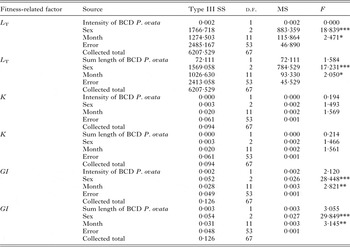
Non-significant interactions in each analysis (P > 0·4, P > 0·3, P > 0·09, P > 0·7, P > 0·08, P > 0·1, respectively) were excluded from this final table. *: P < 0·05; **: P < 0·01; ***: P < 0·001.
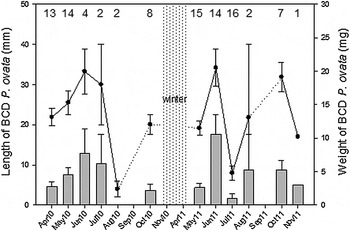
In total, we found 98 BCD P. ovata in minnows collected in our field survey in 2010 and 2011. The body length and body weight of these BCD P. ovata obviously showed a regular pattern of annual cycle, in which the length and weight of BCD P. ovata increased from autumn to spring, reached their maximum in June, then dropped with higher variance in July and August supposedly due to the evacuation (Fig. 6). On the other hand, only one BCD P. ovata (40 mm) in Aug 2011 was found with larvae in the uterus among 98 individuals, and thus no correlation was observed between development status of offspring in the uterus and body size of BCD P. ovata.
Length and weight (circle referred to left axis and bar referred to right axis, respectively; mean ± s.d.) of BCD P. ovata in minnows collected monthly in Brook Kuusoja from April to November in 2010 and 2011. Dotted lines indicate the presumed pattern in non-surveyed months. The number of BCD P. ovata examined in each month is indicated above.

Observation of P. ovata evacuation in summer 2011 and bimonthly survey of P. ovata in lab-housed minnows in 2011 and 2012
Observation in June and July 2011
In the 2 months of observation, five minnows that were diagnosed as infected with BCD P. ovata died. During an autopsy, three of the five minnows were found to still contain BCD P. ovata. Furthermore, plenty of physical damages, including obvious skin necrosis around the anus, intensive adhesion among mesentery and organ membranes in the posterior body cavity, great areas of bruises under the body surface in the posterior abdomen and around the anus, as well as bruises in the abdominal body muscle near the anus and in the basal muscle of the anal fin, were found externally and internally in these dead minnows. We even observed a hole through the body muscle near the anus in one of the five minnows. Therefore, we highly suspected that these damages and death were caused by BCD P. ovata in evacuation. Taken together, since all the five minnows that died in the laboratory were diagnosed as infected, the mortality of 51 minnows infected with BCD P. ovata was 9·8%. When compared to the mortality (0·0%) of non-infected minnows (n = 45), it is implied that the mortality of minnows infected with BCD P. ovata may be increased because of the evacuation of BCD P. ovata.
On July 1st, we observed the sign of evacuation, i.e. several pieces of white, soft, worm-like, floating lines with a great number of white particles in the aquarium, for the first time. Under the dissecting microscope, we found that these white particles in the aquarium were the first stage larvae of P. ovata, while the pieces of white floating lines were the broken and collapsed body parts of P. ovata after evacuating from the body cavity. Such a sign of evacuation was observed on the 1st, 4th, 6th, 11th, 14th and 22nd of July.
Bimonthly survey of P. ovata in lab-housed minnows in 2011 and 2012: P. ovata in swim bladder
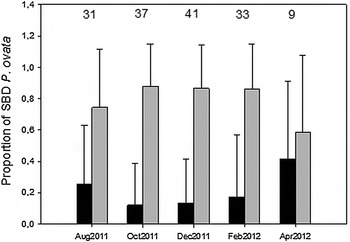
In all 91 examined minnows, three out of four minnows were infected with SBD P. ovata, while the mean intensity of SBD P. ovata infection was higher than two worms per infected fish (Table 3). We found no larval SBD P. ovata in the examination. Furthermore, the proportion of female SBD P. ovata was significantly lower than that of males (proportion: female, 0·2 ± 0·4; male, 0·8 ± 0·3; pair t-test: t 68 = −7·664, P < 0·001, Fig. 7). Therefore, it is obvious that the SBD P. ovata population in our examination was male-biased, which is likely due to the emigration of female P. ovata from the swim bladder without a fresh infection of new larval individuals.
Proportion (mean ± s.d.) of female and male (black and grey bar, respectively) SBD P. ovata in minnows examined in every 2 month from August 2011 to April 2012. The number of SBD P. ovata examined in each month is indicated above.

Prevalence and intensity (mean ± s.d.) of SBD and BCD P. ovata in lab-housed minnow P. phoxinus examined bimonthly from August 2011 to April 2012

Bimonthly survey of P. ovata in lab-housed minnows in 2011 and 2012: P. ovata in body cavity
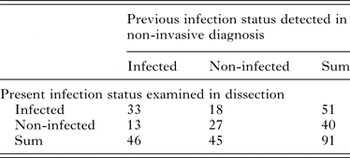
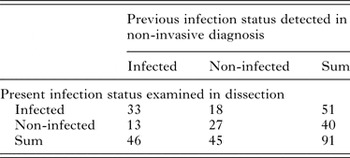
In these 91 minnows (of which 46 and 45 individuals were diagnosed as infected and non-infected by BCD P. ovata, respectively, in May 2011), 51 individuals were found infected with BCD P. ovata under examination, and the intensity of BCD P. ovata in these 51 infected minnows was more than 1·5 (Table 3). In addition, 33 out of these 51 infected minnows were diagnosed as infected in May 2011 (Table 4). Thus, if a minnow was infected with BCD P. ovata in the previous year, the probability of being infected again for this individual was 71·7% (33/46), which was significantly higher than the prevalence of BCD P. ovata in the lab-housed group (50·6%; χ 2 = 8·26, P < 0·005). In the other 40 individuals which were found to be non-infected with BCD P. ovata under examination, 27 individuals were diagnosed as non-infected in May 2011 (Table 4), Thus, if a minnow was non-infected with BCD P. ovata in the previous year, the probability of remaining non-infected for this individual was 60·0% (27/45), which was non-significantly different from the non-infection rate of BCD P. ovata in the lab-housed group (49·4%; Chi-square test: χ 2 = 2·00, P > 0·1). Taken together, it is implied that the present infection status of BCD P. ovata was correlated with the infection status in the following cycle, i.e. the emigration of female P. ovata from swim bladder is correlated in sequential annual cycles.
Comparison between present infection status of BCD P. ovata examined in dissection and previous infection status detected in non-invasive diagnosis in May 2011
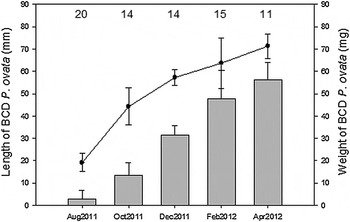
Under examination, we found 81 BCD P. ovata from the 51 infected minnows. Among these 81 BCD P. ovata, 7 individuals were atrophied dead corpses and no measurement was conducted, thus we measured the body length and weight in 74 individuals in total. The length and weight of BCD P. ovata increased in each examining month (Fig. 8). None of these BCD P. ovata was found to have larvae in the uterus under examination, and thus again no correlation between development status of offspring in the uterus and body size of female parasite was observed.
Length and weight (circle and bar, respectively; mean ± s.d.) of BCD P. ovata in minnows examined in every 2 month from August 2011 to April 2012. The number of BCD P. ovata examined in each month is indicated above.

DISCUSSION
To the best of our knowledge, this is the first study which includes the infection ecology of P. ovata dwelling not only in the body cavity but also in the swim bladder, and also includes the sex ratio of SBD P. ovata. According to the proportion of larval P. ovata and prevalence of SBD P. ovata, the fresh infection and settling of larval P. ovata in the swim bladder in our minnow population occurred mainly in August, which is included in the time period reported in Czech (Moravec, Reference Moravec1977a ) but over 1 month later than it has been reported in Hungary (Molnár, Reference Molnár1967).
After infecting the swim bladder of minnows, it is implied that female P. ovata emigrate to the body cavity mainly in September, according to the raised prevalence and body size of BCD P. ovata in October. Nevertheless, the prevalence and intensity of SBD P. ovata was higher than BCD P. ovata in our field survey. The sex ratio of SBD P. ovata in our field survey indicated that the proportion of female SBD P. ovata was similar to that of SBD males in minnows, which implied that some female P. ovata stay in the swim bladder for reasons that remain unknown and were not able to emigrate to the body cavity to grow fully and eventually evacuate. These remaining female P. ovata in the swim bladder inevitably reduced the number of BCD P. ovata, and led to not only higher intensity but also higher prevalence of SBD P. ovata than BCD ones.
It has been suggested that in an obligatory host, all female SBD P. ovata are likely to reach maturity and start development when male worms are presented. On the contrary, in a facultative host, only some female P. ovata are able to complete the entire developmental cycle, while most female worms are remained in swim bladder and retarded in growth regardless of the number of young individuals in both sexes (Molnár, Reference Molnár1967). In our monthly survey, the proportion of females in SBD P. ovata has been constant and similar as males, and the prevalence of SBD P. ovata has been 3-to-4-folds higher than that of BCD ones as similar as the case in European chub (Molnár, Reference Molnár1967). In addition, the surveyed length and weight of BCD P. ovata increased constantly with constant variable before evacuation in both our field-collected minnows and the lab-housed ones. Taken together, it is indicated that a certain proportion of SBD female P. ovata in minnows were unlikely to emigrate freely to the body cavity anytime in the annual cycle but waited in the swim bladder until the end of the evacuating period, as documented in the facultative host European chub (Molnár, Reference Molnár1967). Therefore, although European minnow has been suggested as an obligatory host to P. ovata in the previous study in Czech (Molnár, Reference Molnár1967), it seems that minnow in the present study should be regarded as a facultative host to P. ovata.
After emigrating to the body cavity of minnows, female P. ovata grow to their full size from autumn to the next summer, and the eggs in uterus develop into first stage larvae nearly 1 month before the evacuation (Molnár, Reference Molnár1967; Moravec, Reference Moravec1977a ). It has been observed that female BCD P. ovata were in various body sizes by evacuation (e.g. 50–60 mm in present study; 77–110 mm in Molnár, Reference Molnár1967; 70–95 mm in Moravec, Reference Moravec1977a ; 44–70 mm in Innal and Keskin, Reference Innal and Keskin2005), which implies that the development of first stage larvae in uterus could occur in various sizes of female BCD P. ovata and is likely to be determined by environmental factors such as the water temperature (Moravec, Reference Moravec1977a ).
According to the prevalence and body size of BCD P. ovata, it is indicated that P. ovata in minnows in Eastern Finland have a regular annual cycle, as other populations in previous studies have shown (Molnár, Reference Molnár1967; Moravec, Reference Moravec1977a ). The prevalence of BCD P. ovata in minnows decreased from April/May to July or August and then mildly increased in autumn, while the body length and weight of these P. ovata increased from autumn to April/May, reached the peak in June, and then steeply decreased in July or August. Taken together, it is suggested that female BCD P. ovata grow from October and reach their full size by the end of the next June, and evacuate from the body cavity of minnows in July or the beginning of August at latest.
According to the varied prevalence of BCD P. ovata in summer between 2010 and 2011 and their variant body size in July and August, the yearly evacuation period of P. ovata in minnows may not be as regular as that population parasitizing in Hungary (Molnár, Reference Molnár1967). Instead, the evacuation time period and the regularity of P. ovata annual cycle in our minnow population are more similar to the case surveyed in Czech (Moravec, Reference Moravec1977a ). Our observation of lab-housed minnows showed that the evacuation of BCD P. ovata in our minnow population occurred several times throughout July, which was a time period of similar length as previously described in Hungary from the end of May to the end of June (Molnár, Reference Molnár1967). However, the evacuation of P. ovata in July in Finland is later than the evacuation period from the surveyed population in Hungary (Molnár, Reference Molnár1967), but is included in the time range of evacuation from July to early September reported in Czech (Moravec, Reference Moravec1977a ). As Moravec (Reference Moravec1977a ) suggested, it is likely that the lower temperature in late spring and early summer in Finland may be the reason for the variance of evacuation time in the yearly cycle.
After the evacuation of those BCD individuals, female P. ovata with retarded development that remained in the swim bladder may emigrate to the body cavity in the next developmental cycle. In our lab-housed minnows, the sex ratio of SBD P. ovata, which is supposedly unbiased according to our field survey, became male-biased from August, and the emigrated female P. ovata also occurred in the body cavity of minnows. Since lab-housed minnows were isolated from a fresh infection of P. ovata, and therefore a fresh infection of larvae from intermediate hosts is impossible, these small, newly emigrated female BCD P. ovata must be those retarded females which have remained in swim bladder. Therefore, it is implied that in the next developmental cycle after evacuation, females with retarded development that remained in swim bladder may have an opportunity again to emigrate from the swim bladder and then grow ordinarily even after being retarded. Since it has been evidenced that SBD P. ovata survives for 2 years and more in a host minnow (Moravec, Reference Moravec1977a ), retarded females may at least have the second opportunity for emigration and further development in the body cavity.
Interestingly, according to our examination on lab-housed minnows, minnows hosted with BCD P. ovata have a higher possibility to host BCD P. ovata again in the next annual cycle. This result indicates that female SBD P. ovata are likely to emigrate to the body cavity if the emigration already occurred in the previous year. We suggest that the emigrating possibility of SBD P. ovata is probably determined by the inheritable parasite resistance in host minnows. Thus, SBD P. ovata are more likely to develop and emigrate ordinarily to the body cavity in certain host individuals. On the other hand, since the swim bladder is not connected to the body cavity with a natural duct in minnows, it is also possible that female SBD P. ovata emigrate to the body cavity more easily because the emigrating route between swim bladder and body cavity was opened wider due to the emigration that occurred in the previous year.
The transmission of P. ovata relies on minnows preying on the infected intermediate hosts, and it is likely that larger minnows may feed on more intermediate hosts of P. ovata. It has also been reported in host Gobio gobio that older (larger) host fish has higher prevalence of BCD P. ovata infection than younger (smaller) individuals (Moravec, Reference Moravec1977a ). In our field collected minnows, females have higher prevalence but similar intensity of SBD P. ovata than males. Due to the fact that a number of females were larger than males in our field collected minnows, it is reasonable that female minnows on average fed on more intermediate hosts of P. ovata than males did, which thus results in a higher prevalence of SBD P. ovata in female minnows. It is also likely that female minnows may naturally spend more time feeding than males to obtain the energetic requirement for the eggs, and thus females take a higher risk to be infected by SBD P. ovata through feeding on more of the intermediate hosts of P. ovata. However, although female minnows have a higher prevalence of SBD P. ovata, no difference was found between female and male minnows in either the prevalence or intensity of BCD P. ovata.
Finally, despite the large size of the parasites, the impairment on fitness of minnows from BCD P. ovata infection may not be as considerable as presumed. Although K and GI of minnows increased in the spawning season, and were consequently associated with collecting month and sex, the intensity of infection and summed length of BCD P. ovata was not associated with K or GI of minnows, which demonstrates that BCD P. ovata do not impair relative gonad size or condition factor in minnows. Our results thus disagreed the previous observation that BCD P. ovata mainly locates among the gonads in minnows (Moravec, Reference Moravec1977a ), and no parasitic castration (Moravec, Reference Moravec2006) was observed. In addition, the intensity of BCD P. ovata was shown to be positively correlated with the condition factor of host G. lozanoi, while the prevalence of BCD P. ovata was positively correlated with the relative gonad size of hosts (Saraiva et al. Reference Saraiva, Hermida, Costa, Maia, Reis, Cruz and Valente2008). Accordingly, it has been implied that BCD P. ovata may not impair the condition factor and relative gonad size of the host. Nevertheless, although the impairment of BCD P. ovata on fitness-related traits has not been found, BCD P. ovata still potentially increased the mortality of infected minnows during the evacuation period, and caused apparent damages internally and externally in infected minnows in our observation, which has also been shown histologically in previous study (Saraiva et al. Reference Saraiva, Hermida, Costa, Maia, Reis, Cruz and Valente2008). Taken together, it is indicated that infection of BCD P. ovata may be harmful to the fitness of minnows through potentially increased mortality and physical damages in evacuation period, but not impair fitness-related traits.
In conclusion, the regular pattern of yearly cycle and infection ecology of P. ovata in minnows in Eastern Finland is revealed with a survey of both the body cavity and swim bladder. The timing and length of yearly evacuation period of P. ovata in our minnow population is different from those of other populations, which is likely to be dependent on water temperature. Our study also reveals that minnows may merely be a facultative host rather than an obligatory host for P. ovata because a certain amount of female P. ovata retard their development and stay in the swim bladder until the end of the evacuating period. On the other hand, SBD P. ovata is likely to emigrate to the body cavity of minnows if the emigration had already occurred in the host individuals in the previous year. Finally, the evacuation may cause obvious injuries to hosts and potentially raise the mortality of infected minnows. Thus, infection of BCD P. ovata, despite its large size, may only be harmful to the fitness of minnows through potentially increased mortality and physical damages during the evacuation period, but not impair fitness-related traits as previously presumed.
ACKNOWLEDGEMENTS
The authors thank Elli Jelkänen, Matti Heep and Ilkka Sirkka for their help in the fish sampling and examination. The authors also thank Angela Eads in the University of Western Australia for the English editing.
FINANCIAL SUPPORT
This study was financially supported by Emil Aaltonen Foundation (Y-T.L., grant number 6-15079-13), North Carelia regional fund of Finnish Cultural Foundation (Y-T.L., grant number 77138-15725 and 94513-13416), and Kone foundation through Finnish Post-Doc Pool (J.K.).