1. Introduction
As one of the most remarkable arthropods from the Burgess Shale (Cambrian Miaolingian, Wuliuan; British Columbia, Canada), the morphology (e.g. Walcott, Reference Walcott1911; Bruton, Reference Bruton1981; Stein, Reference Stein2013; Zacaï et al. Reference Zacaï, Vannier and Lerosey-Aubril2016; Bicknell et al. Reference Bicknell, Paterson, Caron and Skovsted2018b), phylogeny (e.g. Lerosey-Aubril et al. Reference Lerosey-Aubril, Zhu and Ortega-Hernández2017) and palaeoecology (e.g. Zacaï et al. Reference Zacaï, Vannier and Lerosey-Aubril2016; Bicknell et al. Reference Bicknell, Ledogar, Wroe, Gutzler, Watson and Paterson2018a) of Sidneyia Walcott, 1911 have been studied extensively. However, the known palaeogeographical distribution of this arthropod was particularly limited. More than a hundred years after its original description, Sidneyia remained known only from its type locality, the Burgess Shale in British Columbia (Bruton, Reference Bruton1981; Caron et al. Reference Caron, Gaines, Mángano, Streng and Daley2010, Reference Caron, Gaines, Aria, Mángano and Streng2014; Zacaï et al. Reference Zacaï, Vannier and Lerosey-Aubril2016), and claimed additional occurrences within Laurentia (e.g. Briggs & Robison, Reference Briggs and Robison1984; Briggs et al. Reference Briggs, Lieberman, Hendricks, Halgedahl and Jarrard2008; Peel, Reference Peel2017) have all proved incorrect or insufficiently documented. In the present paper, we describe a nearly complete specimen of Sidneyia from the middle Cambrian (Miaolingian, Wuliuan) Mantou Formation at Weifang, Shandong Province, North China that is nearly identical to the type species S. inexpectans. This discovery extends the known geographical distribution of Sidneyia beyond North America, indicating that it had a larger palaeogeographical distribution than was previously thought.
Miaolingian Burgess Shale-type Lagerstätten are essentially known from Laurentia, such as the Marble Canyon, Spence Shale, and Wheeler, Marjum and Weeks formations (e.g. Caron et al. Reference Caron, Gaines, Aria, Mángano and Streng2014; Robison et al. Reference Robison, Babcock and Gunther2015; Lerosey-Aubril et al. Reference Lerosey-Aubril, Gaines, Hegna, Ortega-Hernández, Van Roy, Kier and Bonino2018; Kimmig et al. Reference Kimmig, Strotz, Kimmig, Egenhoff and Lieberman2019). The only notable exception is the Kaili Formation in South China (Zhao et al. Reference Zhao, Zhu, Babcock and Peng2011). This stresses the need for searching for Miaolingian Burgess Shale-type Lagerstätten in other terranes. Previous studies have documented the presence of exceptionally preserved fossils in the Upper Shale Member of the Mantou Formation, North China (Resser & Endo, Reference Resser, Endo, Endo and Resser1937; Liu et al. Reference Liu, Huang and Gong2012; Sun et al. Reference Sun, Wang and Yuan2015; Wang et al. Reference Wang, Fatka, Sun, Budil and Gao2018), which is further confirmed by the discovery of Sidneyia cf. inexpectans here. In addition, exceptional preservation has been recorded in the Lower Shale Member of the Mantou Formation (Lin, Reference Lin1995; Huang, Reference Huang2012; Huang et al. Reference Huang, Wang, Gao and Wang2012; Zhu et al. Reference Zhu, Lerosey-Aubril and Esteve2014), making the Mantou Formation a potential Lagerstätten assembly.
2. Geological setting and fossil locality
The Mantou (alternate spelling ‘Manto’) Formation is widely distributed in North China and was originally characterized as consisting of brick-red shale (Willis et al. Reference Willis, Blackwelder, Sargent, Willis, Blackwelder and Sargent1907; Xiang et al. Reference Xiang, Zhu, Li and Zhou1999). In Shandong Province, the Mantou Formation is subdivided into the Shidian Member (argillaceous dolostone and shale), the Lower Shale Member, the Honghe Member (sandstone) and the Upper Shale Member (Zhang & Liu, Reference Zhang and Liu1996).
There is a well-established trilobite biostratigraphy for the Cambrian of Shandong Province, where the Mantou Formation spans the interval extending from the Redlichia chinensis Zone (lower Lungwangmiaoan, corresponding to the lower part of Cambrian Stage 4) to the Bailiella lantenoisi Zone (uppermost Hsuchuangian, corresponding to the uppermost Wuliuan) (Zhang & Liu, Reference Zhang and Liu1996; Yuan et al. Reference Yuan, Li, Mu, Lin and Zhu2012). In many parts of Shandong Province, the Mantou Formation comprises 13 trilobite biozones.
The presence of sandy conglomerate in the upper part of the Honghe Member, together with the presence of bidirectional trough cross-stratified layers and halite pseudocrystals in the Shidian Member, suggests that the Mantou Formation may represent a tidal flat environment (Zhang & Liu, Reference Zhang and Liu1996). However, because the Mantou Formation represents an extended period of sedimentation, the depositional environments of this deposit were probably diverse. Additionally, the dark shale and global agnostoids in the uppermost part of the Mantou Formation (Sun, Reference Sun1989; Sun et al. Reference Sun, Wang, Zhao and Yuan2018) correspond to the global eustatic flooding surface at the base of the Ptychagnostus gibbus Zone (Babcock et al. Reference Babcock, Peng, Brett, Zhu, Ahlberg, Bevis and Robison2015).
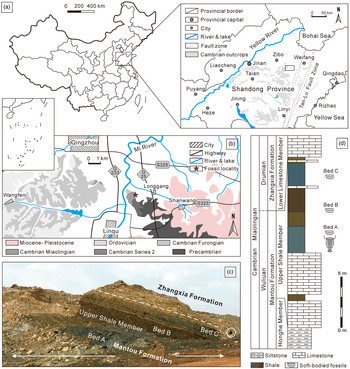
The new material described in this paper was collected from the Upper Shale Member of the Mantou Formation (Bailiella lantenoisi Zone) in the Longgang section near the town of Shanwang (Longgang village), Linqu County, Shandong Province (Fig. 1). Burgess Shale-type fossils occur in three distinct fossiliferous beds called, in ascending order, Beds A, B and C. Sidneyia was found in Bed A along with the trilobites Proasaphiscus lui (Chang, Reference Chang1959), Ptychagnostus sinicus Lu, Reference Lu1957, Peronopsis rotundatus Ergeliev, Reference Ergaliev1980 and Pe. taitzuhoensis Lu, Reference Lu1957. Bed A also contains other fossils, including algae, brachiopods, the bivalved arthropods Tuzoia manchuriensis Resser & Endo in Resser, Reference Resser1929 and Isoxys sp., worm-like animals and possible Hurdiidae (unpublished). Bed B has yielded the trilobites Bailiella lantenoisi (Mansuy, Reference Mansuy1916) and Pe. rotundatus, the bivalved arthropod T. manchuriensis, sponges, chancelloriids and worm-like animals. Lastly, Bed C has yielded the trilobites Pr. yabei Resser & Endo in Kobayashi, Reference Kobayashi1935 and Lioparia bassleri Resser & Endo, Reference Resser, Endo, Endo and Resser1937, the bivalved arthropod T. manchuriensis, brachiopods and hyolithids.
Location and geological setting of the Longgang Section. (a) Regional map. (b) Simplified geological map of the area near the Longgang Section. (c) Upper Shale Member, Mantou Formation in the Longgang section, viewed from the south. Note the circled person for scale. (d) Stratigraphic column of the Upper Shale Member and fossil horizons in the Longgang Section. The alternate spelling of Zhangxia is ‘Changhia’.

The occurrence of two global agnostoid trilobites, Pt. sinicus and Pe. rotundatus, in the Upper Shale Member allows biostratigraphical correlation of the Bailiella lantenoisi Zone with the Ptychagnostus gibbus Zone (top of the Wuliuan) (Zhang, Reference Zhang1986; Peng, Reference Peng2009; Yuan et al. Reference Yuan, Li, Mu, Lin and Zhu2012; Sun et al. Reference Sun, Wang, Zhao and Yuan2018). Pt. praecurrens (Westergård, Reference Westergård1936) in the Burgess Shale (Rasetti, Reference Rasetti1967) belongs to the Ptychagnostus praecurrens Zone (Sundberg, Reference Sundberg1994), which lies below the Ptychagnostus gibbus Zone. Therefore, Sidneyia cf. inexpectans from the Upper Shale Member of the Mantou Formation is younger than S. inexpectans from the Burgess Shale.
3. Material and methods
The single specimen of Sidneyia cf. inexpectans described in this paper is deposited in the Nanjing Institute of Geology and Palaeontology, Chinese Academy of Sciences, China (NIGPAS 170198). Photographs were taken under crossed-polarized light using a Nikon D810 camera fitted with a Nikon AF-S Nikkor 105 mm lens. Images were processed using PhotoshopTM to adjust tone, contrast and brightness. Morphological terminology used in this paper mainly follows Bruton (Reference Bruton1981), Stein (Reference Stein2013) and Zacaï et al. (Reference Zacaï, Vannier and Lerosey-Aubril2016). Measurements were made parallel to or normal to the sagittal line, directions of which are referred to as sagittal (sag.) / exsagittal (exs.) and transverse (tr.), respectively.
4. Description
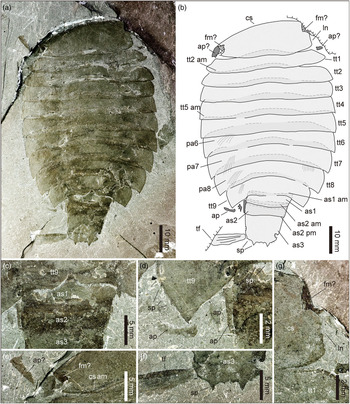
Single nearly complete specimen flattened parallel to bedding, which consists of a long, oval-shaped exoskeleton measuring 82.5 mm long (sag.) and 51.1 mm wide (tr.). Exoskeleton smooth and complete, but for the tailspine, which is represented by a single uropod only (i.e. telson and second uropod missing) (Fig. 2a, b).
Sidneyia cf. inexpectans Walcott, 1911 (NIGPAS 170198) from the Cambrian (Miaolingian, Wuliuan) Upper Shale Member, Mantou Formation (Bailiella lantenoisi Zone) in the Longgang section, Weifang, Shandong Province, North China. (a) Nearly complete exoskeleton. (b) Interpretative drawing of the exoskeleton. (c) Close-up of anterior part of abdomen. (d) Close-up of appendages near abdomen. (e) Close-up of left side of cephalic shield. (f) Close-up of posterior part of abdomen and tail fan. (g) Close-up of right side of cephalic shield. Abbreviations: am – anterior margin; ap – appendages; as1–3 – first to third abdominal segments; as1–3 am – anterior margins of first to third abdominal segments; as1 pm and as2 pm – posterior margins of first and second abdominal segments; cs – cephalic shield; fm – frontal margin; ln – lateral notches; pa – post-antennal appendages; pa6–9 – sixth to ninth post-antennal appendages; pm – posterior margins; sp – spines; tf – tail fan; tt – thoracic tergite; tt1–9 – first to ninth thoracic tergite; tt2 am – anterior margin of second thoracic tergite.

Cephalic shield broadly (tr.) semi-elliptical in outline, slightly deformed (ventrally curved?) on the left side, measuring 12.0 mm long (sag.) and 35.4 mm wide (tr.). Presence of numerous wrinkles near anterior margin indicating post-depositional compression of shield into sediment plane in forward tilted posture (Fig. 2e, g). Lateral notches (ln in Fig. 2b, g) preserved on right side of cephalic shield accounting for one-third of total length (exs.) of cephalic shield and measuring c. 4.1 mm long (sag.). Anterior margin of cephalon steeply sloping, while smooth posterior margin partially overlaps first thoracic tergite. Present beneath dorsal shield, and exposed by exfoliation of dorsal shield (Fig. 2e, g), possibly a wide frontal margin previously observed extending ventrally (Bruton, Reference Bruton1981; Stein, Reference Stein2013), but other structures such as appendages or eyes cannot be excluded (fm? in Fig. 2b, e).
Thorax consisting of nine partially overlapping tergites (tt in Fig. 2b), with anterior margin of each tergite exposed owing to compaction of exoskeleton. Thorax 52.9 mm long (sag.), with maximum width of 49.2 mm between thoracic tergites 4 and 5 and minimum width of 31.1 mm (width of posteriormost thoracic tergite). Thoracic tergites 1–4 narrow, with average length (sag.) 7.3 mm; first and shortest thoracic tergite 6.5 mm long (sag.), last five thoracic segments averaging 8.2 mm long (sag.) (length data for thoracic tergites include portion covered by adjacent tergite). First four thoracic tergites widening and lengthening (tr.) posteriorward; thoracic tergites 5–9 gradually narrowing (tr.). Impressions of exopodites of appendages present on both sides of each thoracic tergite (pa in Fig. 2b). Posterolateral margins of thoracic tergites bearing spines (sp in Fig. 2d).
Abdomen consisting of three overlapping abdominal segments and a separate tail fan (Fig. 2a–c, f), and measuring 17.6 mm long (sag.). Abdominal segments relatively long, with segment 1 measuring 9.2 mm long (sag.), segment 2 measuring 6.6 mm long (sag.) and segment 3 measuring 12.4 mm long (sag.) (foregoing data include covered portion). Anterior margins of abdominal segments represented by two lines, which indicates shape of the abdominal segment is cylindrical. Posterior margin of third abdominal segment exhibits several pairs of spines, one of which is larger than other (sp in Fig. 2a, b, f). Single uropod preserved to the left of third abdominal segment measures 12.2 mm in length.
Impressions of appendages present on both sides of each thoracic tergite, with portion of each impression preserving exopodites (pa in Fig. 2b). Endopodite fragments present near abdomen (ap in Fig. 2b, d, e).
5. Discussion
In the new specimen from North China, the length-to-width ratio is close to 0.33, as in S. inexpectans from the Burgess Shale reported by Bruton (Reference Bruton1981). In addition, the new specimen is hardly distinguishable from S. inexpectans from the Burgess Shale in other measurements and in the outline of the exoskeleton (Bruton, Reference Bruton1981). Certain details, such as the fact that the posterolateral margins of the thoracic tergites bear spines (sp in Fig. 2d), and that the last abdominal segment exhibits several pairs of spines (sp in Fig. 2b, f), are also identical to the type species (Bruton, Reference Bruton1981). Therefore, even though the morphologies of the tail fan and appendages are incompletely shown, the new specimen is not significantly different from the type species in the exoskeleton. Because only one specimen has been collected so far, it is appropriate to assign this specimen to Sidneyia as a conformis of the type species S. inexpectans. A more accurate taxonomic assignment needs more material from the fossil horizon.
Although Stein (Reference Stein2013) revised the length-to-width ratio of the cephalic shield of S. inexpectans from 0.33 to 0.5 (Stein, Reference Stein2013), this reinterpretation may be problematic (R. Lerosey-Aubril, pers. com. 2019). Zacaï et al. (Reference Zacaï, Vannier and Lerosey-Aubril2016, fig. 2) illustrated a specimen with a short (sag.) cephalic shield preserved in lateral orientation, and this preserved orientation is incompatible with a taphonomic shrinking of the cephalic shield. Therefore, a short cephalic shield is more likely to represent the original morphology, and Bruton’s ratio data remain a more precise description of S. inexpectans (Bruton, Reference Bruton1981).
It should also be noted that different specimens of S. inexpectans may have different numbers of abdominal segments. Walcott (Reference Walcott1911) and Simonetta (Reference Simonetta1963) described what is now called the ‘abdomen’ as two segments, Bruton (Reference Bruton1981, p. 633) noted that some specimens have three abdominal segments and in recent years investigators have stated that there are two such segments in their studied sample (Zacaï et al. Reference Zacaï, Vannier and Lerosey-Aubril2016). In the presence of detailed descriptions and photographs of specimens, it is hard to conclude that Bruton’s observations were incorrect. The abdomen of S. inexpectans probably consists of two or three segments. The new specimen from North China exhibits three of them (Fig. 2c).
In addition to specimens from the Burgess Shale, several questionable specimens have been identified as Sidneyia. Among them, Sidneyia sp. from the Kinzers Formation (Resser & Howell, Reference Resser and Howell1938, pl. 13, fig. 3) was incorrectly assigned to Sidneyia (Bruton, Reference Bruton1981; Briggs et al. Reference Briggs, Lieberman, Hendricks, Halgedahl and Jarrard2008). A couple of appendages from the Wheeler Formation in Utah have been tentatively assigned to the genus by Briggs & Robison (Reference Briggs and Robison1984), but this interpretation was rejected by Stein (Reference Stein2013). Another species, Sidneyia sinica Zhang & Shu in Zhang et al. Reference Zhang, Han and Shu2002, was described from the Chengjiang biota, but the assignment of this fossil was rejected by Briggs et al. (Reference Briggs, Lieberman, Hendricks, Halgedahl and Jarrard2008), Stein (Reference Stein2013) and Lerosey-Aubril (Reference Lerosey-Aubril2015). Additionally, Sidneyia sp. from the Spence Shale (Briggs et al. Reference Briggs, Lieberman, Hendricks, Halgedahl and Jarrard2008) is incomplete, and no preserved characters in this fossil allow a confident assignment to this genus. Sidneyia? sp. from the Sirius Passet biota (Peel, Reference Peel2017) is similar to the type species in general outline of the body, but except for this, data supporting a convincing assignment to the genus are still unavailable. In other words, Sidneyia was only confidently known from the Burgess Shale (Fig. 3). Accordingly, the discovery of Sidneyia from the Mantou Formation is both the first well-supported occurrence outside the Burgess Shale and its first occurrence of the genus outside Laurentia.
Geographical distribution of Sidneyia Walcott, 1911 during the Cambrian Wuliuan period. The palaeogeographical reconstruction is based on true polar wander data (after Torsvik & Cocks, Reference Torsvik, Cocks, Torsvik and Cocks2017).

The palaeogeographical location of North China during the Cambrian Period is far from resolved, various hypotheses having been proposed: on the margin of Western Gondwana (McKenzie et al. Reference McKenzie, Hughes, Myrow, Choi and Park2011), in the oceanic region between Gondwana and Siberia (Torsvik & Cocks, Reference Torsvik, Cocks, Torsvik and Cocks2017), north of Australia (Brock et al. Reference Brock, Engelbretsen, Jago, Kruse, Laurie, Shergold, Shi and Sorauf2000; Golonka, Reference Golonka, Spencer, Embry, Gautier, Stoupakova and Sørensen2011), on the north or northeastern margin of East Gondwana (e.g. Burrett et al. Reference Burrett, Long, Stait, McKerrow and Scotese1990; Li et al. Reference Li, Zhang, Yun and Li2016; Yun et al. Reference Yun, Zhang, Li, Zhang and Liu2016; Pan et al. Reference Pan, Brock, Skovsted, Betts, Topper and Li2018) or thousands of kilometres to the east of Australia in the Palaeo-Pacific Ocean (e.g. Li & Powell, Reference Li and Powell2001; Li et al. Reference Li, Evans and Halverson2013). Despite these different hypotheses, extensive palaeontological and geological data have supported that North China had strong biogeographic links with Australia, which was situated on the East Gondwana margin during early and middle Cambrian times (e.g. Álvaro et al. Reference Álvaro, Ahlberg, Babcock, Bordonaro, Choi, Cooper, Ergaliev, Gapp, Ghobadi Pour, Hughes, Jago, Korovnikov, Laurie, Lieberman, Paterson, Pegel, Popov, Rushton, Sukhov, Tortello, Zhou, Żylińska, Harper and Servais2013; Hally & Paterson, Reference Hally and Paterson2014). Given that North China is not close to North America in any of these palaeogeographical reconstructions, it can be concluded that Sidneyia was more widespread than previously thought.
6. Conclusions
Although only one specimen of Sidneyia has been collected from North China, its morphology allows a confident assignment to this genus, at least as a similar species to the type species S. inexpectans. The new Sidneyia specimen is younger than the type material from the Burgess Shale, but the temporal range of Sidneyia remains restricted to the Wuliuan. This is not only the first occurrence of Sidneyia outside Laurentia but also the first well-supported occurrence of this genus outside the Burgess Shale. The occurrence of Sidneyia on two distinct palaeocontinents greatly expands its known palaeogeographical distribution and provides evidence that Sidneyia was more widespread than previously thought. The reason why Sidneyia was previously believed to be a local species is that Burgess Shale-type Lagerstätten in the Cambrian Miaolingian were found mainly in Laurentia. The discovery of Sidneyia in North China raises the potential of discovering additional Burgess Shale-type fossils from North China.
Acknowledgements
This research was supported by the Strategic Priority Research Program (B) of the Chinese Academy of Sciences (XDB26000000). We thank Heyo Van Iten for improving the English of this manuscript and Mr Rongrong Xing, who collected and donated the specimen described in this study. We are also grateful to the reviewers Rudy Lerosey-Aubril and John Paterson for their invaluable suggestions and comments, which greatly improved the earlier version of this paper.