Arguably the most eccentric movement Haydn ever composed.
James WebsterFootnote 1‘TEMPORA MUTANTUR ETC.’
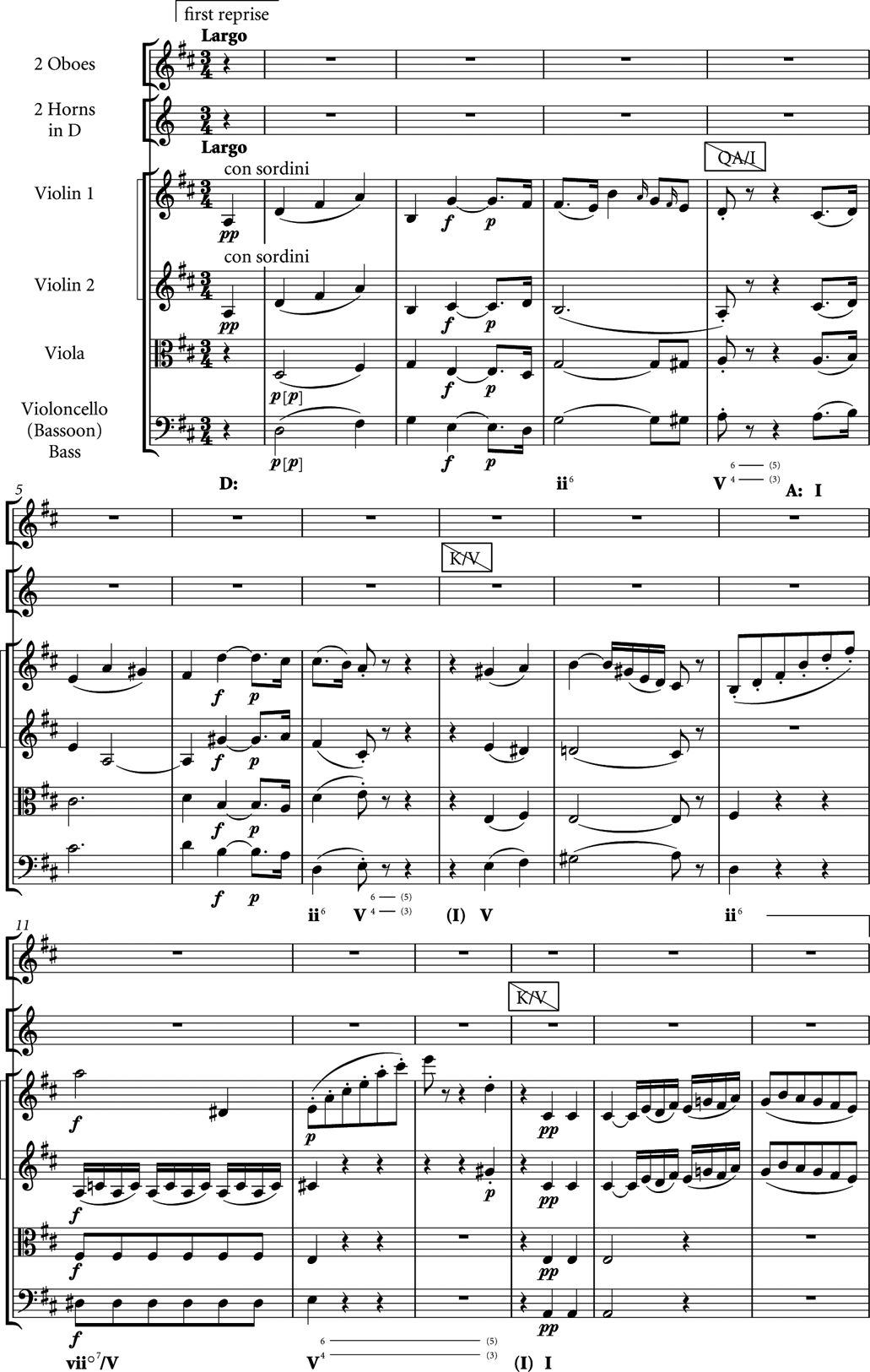
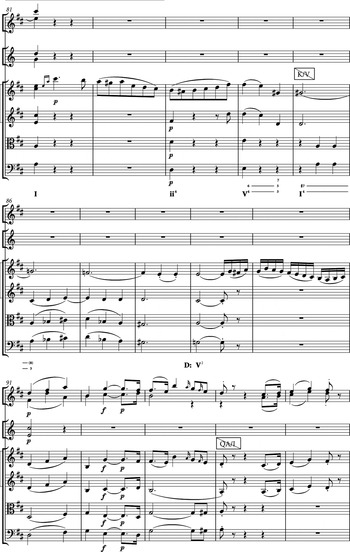
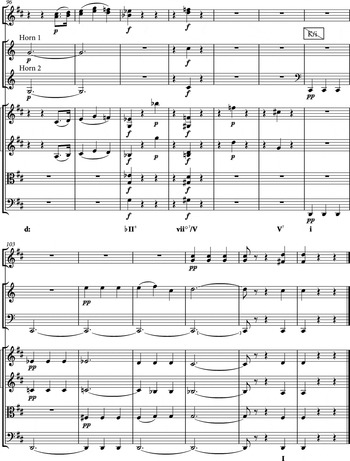
‘It would take an entire article to describe this extraordinary movement adequately. I mention here merely its inability to complete musical phrases properly, its discontinuities of material, dynamics, and register, its refusal to execute an intelligible form (I could go on).’Footnote 2 With these words James Webster refers to the slow movement of Haydn's Symphony No. 64, ‘Tempora mutantur’ (see Example 1). Of the extraordinary features on his list, the first is certainly the most eccentric: whereas discontinuities of material and unorthodox formal procedures can be found in many pieces, no other tonal composition consistently neglects to complete its phrases. This feature of the slow movement was approached from another perspective by W. Dean Sutcliffe: ‘Nothing could more obstruct listener absorption than its unparalleled feat of failing to offer a single functional perfect cadence throughout.’Footnote 3 Not only perfect: the movement contains no cadence at all. Throughout its course cadences are thwarted or dissolved. Consequently, they are absent.
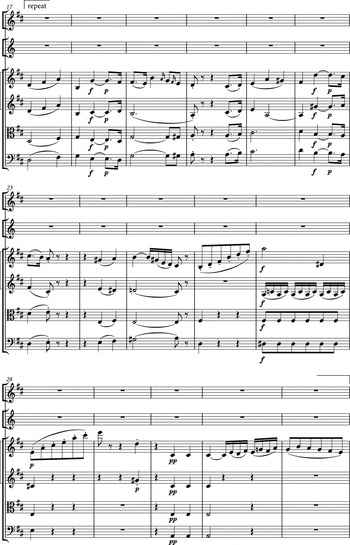
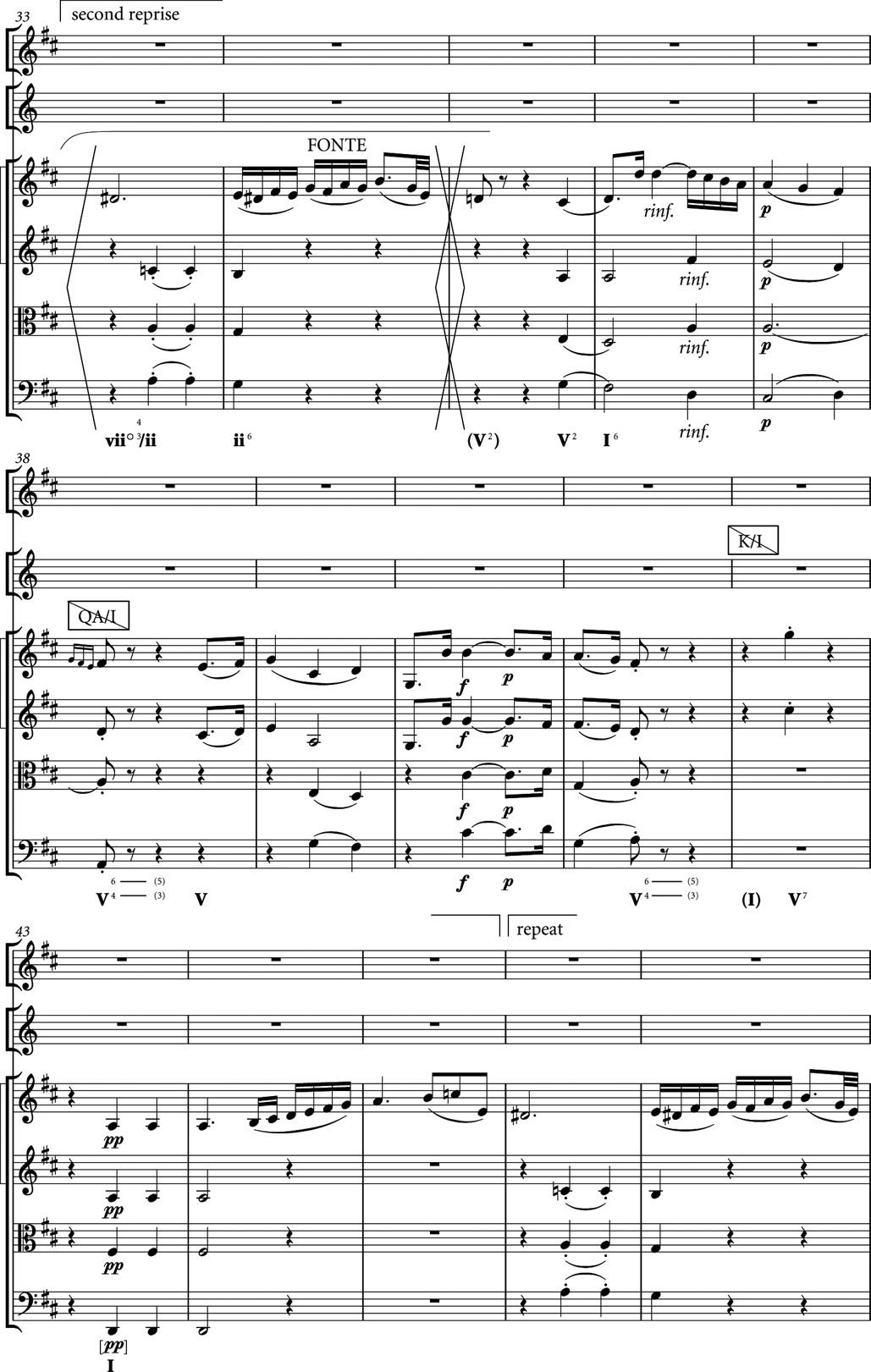
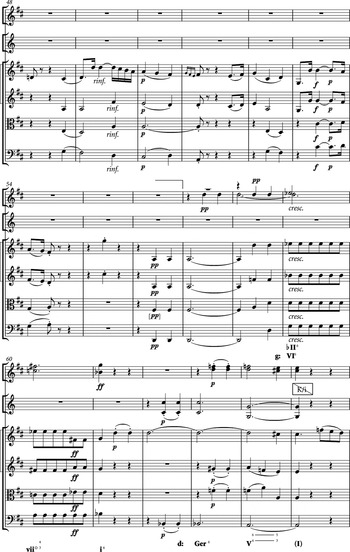
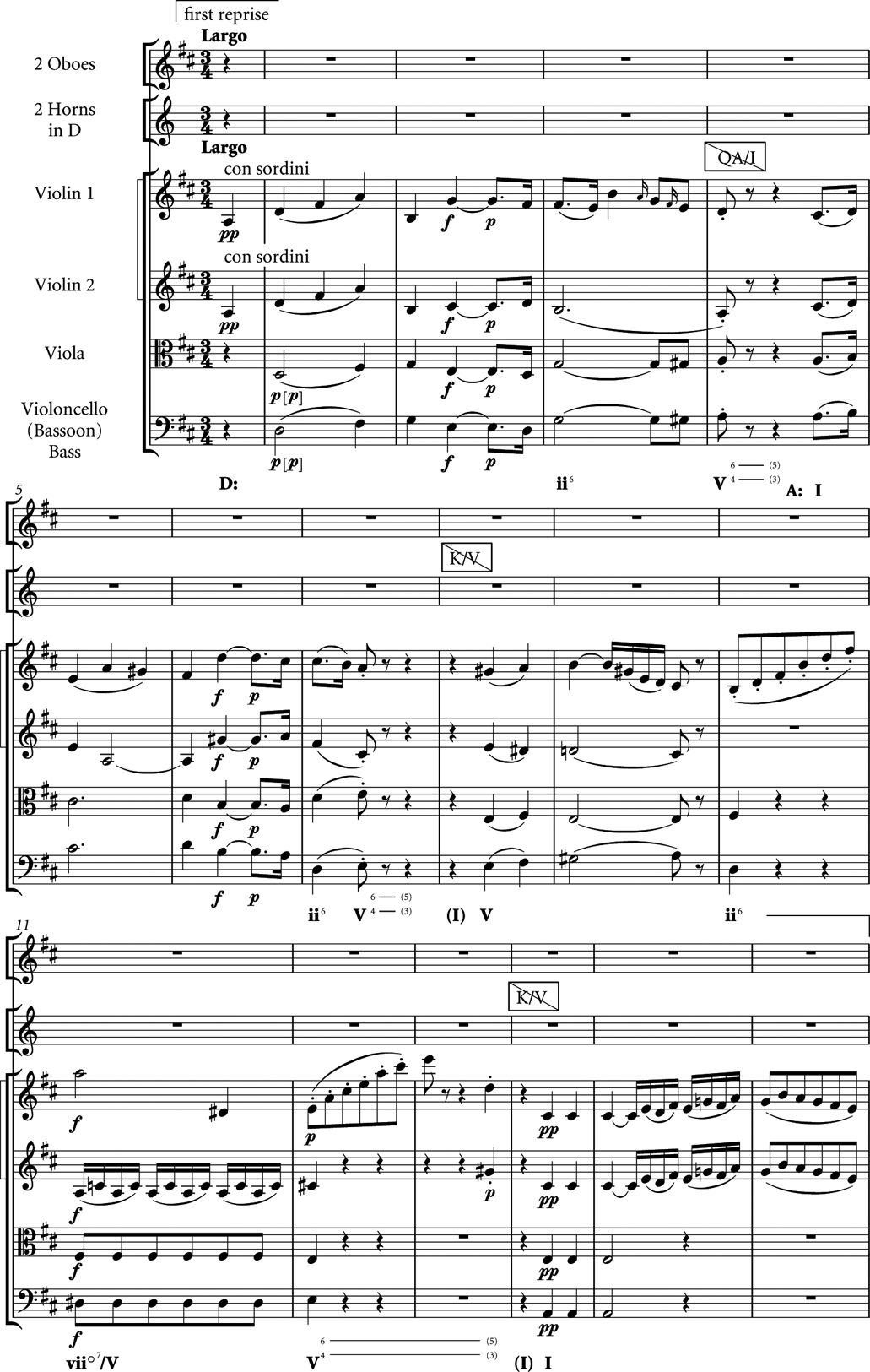
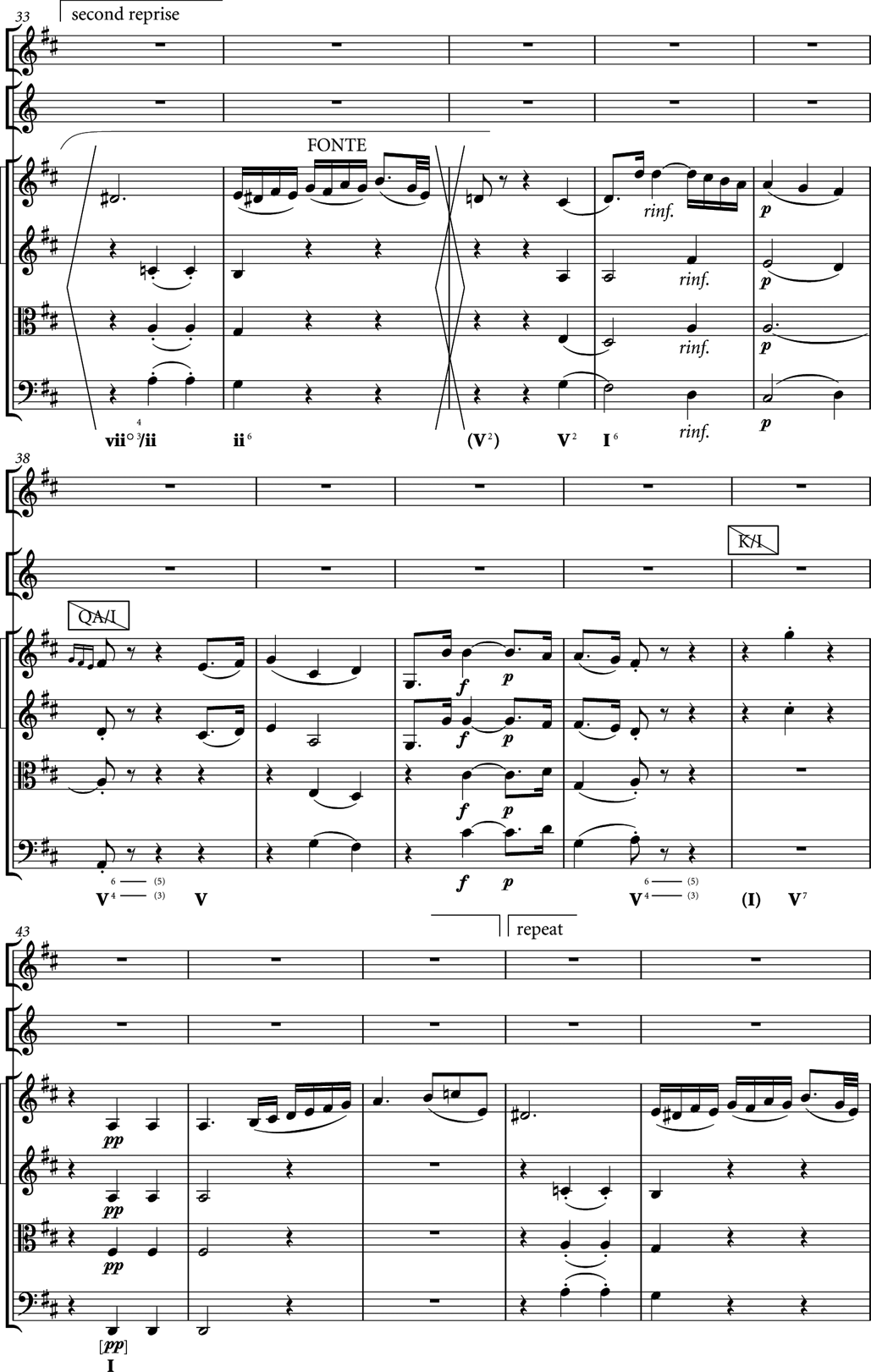
Haydn, Symphony No. 64 in A major, ‘Tempora mutantur’, second movement (Critical Edition of the Complete Symphonies, ed. H. C. Robbins Landon, volume 6 (Vienna: Universal, 1967)). Crossed-through abbreviations and bracketed harmonic symbols refer respectively to cadences and chords that are expected by the listener but do not actually occur
continued

continued
continued

continued

continued

continued

The eccentricity of Haydn's feat can be appreciated if one takes into account that cadences belonged to the basic elements of eighteenth-century musical language. As conclusions of phrases or sections, they defined musical form and tonality. In vocal music, they were coordinated with punctuation marks in the text. The parallelism between linguistic and musical punctuation in songs, recitatives and arias underlay the parallel between music and language, which, in the course of the eighteenth century, was extended beyond vocal music and helped to transfer the concept of musical punctuation to instrumental genres. The fundamental precepts of musical punctuation in both vocal and instrumental music were formulated by Johann Mattheson in Kern melodischer Wissenschaft (Hamburg: Herold, 1737) and incorporated by him into Der vollkommene Capellmeister (Hamburg: Herold, 1739). They were subsequently developed in composition handbooks by Joseph Riepel, Johann Philipp Kirnberger and Heinrich Christoph Koch. How to articulate musical punctuation marks was discussed in handbooks of musical performance.Footnote 4 For Haydn's contemporaries, a composition consisting of incomplete phrases was as unthinkable as a series of incomplete sentences. If Haydn could not just think of it, but, in fact, compose it, he must have had some special reasons.
Conjectures about such reasons behind the slow movement of Symphony No. 64 have been nourished by the title: ‘Tempora mutantur’ comes from the Latin inscription ‘Tempora mutantur etc.’ found on a wrapper for the authentic Esterházy parts for the symphony.Footnote 5 Although the wrapper is later than the parts and the inscription may not come from Haydn, it may have been copied from the authentic wrapper, and it is thought to be derived from the Latin epigram by John Owen, a near-contemporary of Shakespeare:
Tempora mutantur, nos et mutamur in illis;
Quamodo? Fit semper tempore peior homo.
The relation between the title of Haydn's symphony and Owen's epigram was posited by Jonathan Foster,Footnote 6 who also cited the English translation of the epigram published in 1677 by Thomas Harvey:
The Times are Chang'd, and in them Change'd are we:
How? Man, as Times grow worse, grows worse, we see.
While Foster related the title to the rondo finale, James Atkins suggested that the title should be associated with the slow movement.Footnote 7 Atkins's suggestion was adopted by Elaine Sisman, who used it to support her hypothesis that this movement formed part of Haydn's incidental music for Shakespeare's Hamlet.Footnote 8 The German adaptation of Hamlet by Franz von Heufeld was performed at Eszterháza by the famous Karl Wahr troupe in the summer of 1773 or 1774.Footnote 9 One contemporary newspaper and a few theatrical journals point to Haydn as the composer of the incidental music.Footnote 10 Sisman connects Haydn's eccentric manipulations of cadences with the couplet that ends Shakespeare's first and Heufeld's second act: ‘The time is out of joint. O cursed spite, / that ever I was born to set it right!’.Footnote 11 ‘In fact’, she observes, ‘the slow movement of Symphony no. 64 is an extended essay on time out of joint: it is precisely the joins, or cadences, that are delayed and subsumed in the next phrases, until the resolutions fall further and further behind the period structure.’Footnote 12 I will reconsider Sisman's hypothesis in the course of this article. I will first focus on the absent cadences and examine them in the light of theories of musical grammar and rhetoric. Then I will turn to the form of the slow movement and account for it in terms of eighteenth-century punctuation form. I will also consider its affect and come up with a different hypothesis about its connection with theatre. My discussion will conclude by revisiting the question of the symphony's title.
ELLIPSES
Sisman's observation that cadences are ‘delayed and subsumed in the next phrases’ suggests that, for her, they are present. This analytical reading can be justified by noting the smooth harmonic connections that exist between phrases. The first two phrases of the slow movement (Example 1) are interrupted by general pauses after the cadential  chords. Both general pauses leave the listener with clear expectations of what should follow and give her as much time as she needs to fill in the blanks.Footnote 13 In bar 4 the listener expects a half-cadence (to use Koch's terminology, a Quintabsatz, QA) in D major and in bars 7–8 a full cadence (Kadenz, K) in A major.Footnote 14 The new phrases start with chords that should have followed the . The chord on the third beat of bar 4 is identical with the dominant expected on the second beat. Likewise, the dominant on the second beat of bar 8 is identical with the dominant chord expected on the third beat of bar 7. Yet the chords after the general pauses do not continue the cadential harmonic progressions announced before them. The chord on the third beat of bar 4 brings no resolution of the cadential to the dominant of the main key. Rather, it becomes the tonic of the dominant key and starts the second phrase in A major. The dominant on the second beat of bar 8 retains its tonal function, but, again, it does not resolve the cadential from bar 7 and does not lead directly to the tonic.Footnote 15 Instead, it takes a different harmonic turn and starts the third phrase.
If the listener has taken these chords for continuations of cadences, she must revise her understanding in the light of what follows. Although the revision takes place in real time, it affects the flow of musical time represented by metre. This follows from the eighteenth-century rule concerning the metrical position of caesuras. According to Mattheson, Kirnberger, Koch and other authors, caesuras of musical punctuation marks represented by cadences must fall on downbeats.Footnote 16 The final tonic of the full cadence expected to close the second phrase should thus fall on the downbeat of bar 8 and be preceded by the dominant on the third beat of bar 7. If the dominant on the second beat of bar 8 is taken for the delayed resolution of the cadential chord, it implies that the tonic will fall on the third beat in the same bar – a metrical position inappropriate for caesuras. The same rule holds for caesuras of half-cadences (Quintabsätze), but they, as all Absätze, can be decorated by means of appoggiaturas. While the dominant harmony must be reached on the downbeat, an appoggiatura can postpone the melodic resolution to the second beat. In 3/4 metre the resolution can be postponed to the third beat, but in bar 4 this possibility interferes with the expectation – conditioned by the starting-point of the first phrase – that the second phrase will begin with a crotchet upbeat. In order to perceive the chords after the general pauses as delayed resolutions of the chords, the listener must discount the pauses and shift the chords to the metrical positions on which they were expected. By revealing that these chords start new phrases, the following events correct this perception and the metrical grid must be readjusted: the general pauses should be counted after all.Footnote 17
From this discussion it follows that, even if initially the listener may think that the cadences are delayed, she ultimately recognizes that they are absent.Footnote 18 But absent cadences transgress the rules of musical grammar. Can they be accounted for in terms of eighteenth-century music theory? Does this theory have a concept for them? Such a concept can, indeed, be derived from the parallel between music and language. In the eighteenth century this parallel extended from the realm of grammar to that of rhetoric. While these domains were distinct from each other, rhetoric could encroach upon grammar for the sake of expression. Such phenomena, called rhetorical figures, consisted in deviations from grammatical rules under the influence of emotion.Footnote 19
In Kern melodischer Wissenschaft Mattheson supplements his discussion of musical punctuation with remarks on rhetorical figures and draws a distinction between figures of diction (figurae dictionis) and figures of sentence (figurae sententiae).Footnote 20 In Der vollkommene Capellmeister he translates these Latin terms into German as ‘Wörter-Figuren’ and ‘Spruch-Figuren’ and adds their definitions.Footnote 21 The influence of rhetorical figures upon musical grammar is not discussed in the composition handbooks of Riepel, Kirnberger and Koch, but it is taken up by two other authors. Among the twelve rhetorical figures described in Critischer Musicus by Johann Adolph Scheibe,
die IIIte ist das Verbeißen, (Ellipsis,) oder das Abbrechen eines Satzes, den man nur anhebet, aber nicht völlig endiget. Sie geschieht auf zweyerley Art. Erstlich, wenn man in dem heftigsten Affecte und mitten in einem angefangenen Satze unvermuthet abbricht und stille hält, endlich aber mit einem ganz fremden Gedanken aufs neue wieder anhebt. Oder auch, wenn man am Schlusse eines Satzes den gewöhnlichen Schlußton verändert, und in einen ganz fremden und unerwarteten Accord fällt. Dieses letztere nennen die Componisten, das Ausfliehen der Cadenz. Je heftiger aber der Affect ist, oder seyn soll, desto fremder muß auch der Accord seyn, in den man die gewöhnliche Cadenz verändert. Die erste Art dieser Figur ist die schönste, und erfordert wegen des Abbrechens, und weil man zugleich dem ganzen Satze Einhalt thun muß, viel Geschicklichkeit, Feuer und Stärke so wohl in der Melodie, als Harmonie. Die Töne, in welchen man stille hält, müssen so beschaffen seyn, daß sie auch ohne Worte eine Vollführung erfordern. Dießfalls sind auch dissonirende, oder enarmonische Intervallen am besten darzu geschickt. Die Töne, welche auf das Aufhalten folgen, und solches zugleich unterbrechen, müssen ferner den vorhergegangenen Tönen ganz entgegen seyn. Sie müssen eine fremde und mit einer andern Tonart verbundene Harmonie ausmachen, und endlich muß darauf eine ganz neue Gattung von Melodie und von Taktbewegung folgen.Footnote 22
the third is the ellipsis, or breaking-off of a phrase which one only starts but does not completely finish. This happens in two ways. First, when, in the most violent mood and in the middle of a phrase, one unexpectedly breaks off, comes to a halt and finally starts again with a completely different idea. Or when one changes the final note at the end of a phrase and falls into a completely different and unexpected chord. The latter is called by composers the deceptive cadence. The more violent the affect is, or should be, the more distant the chord into which the ordinary cadence is twisted. The first kind of this figure is the most beautiful and, because of the break and because one must halt the entire sentence, requires lots of skill, fire and strength in both the melody and harmony. The notes on which one halts must be so arranged that they demand completion even in the absence of words. Therefore dissonant or enharmonic intervals are most convenient for this purpose. The notes that follow, and thus interrupt, the standstill must be completely contrary to the preceding ones. They must make up a foreign harmony related to a different key and represent a completely new type of melody and metrical motion.
Scheibe's description is echoed by Johann Nikolaus Forkel in the Introduction to the first volume of his Allgemeine Geschichte der Musik:
Eine auffallende Art von Aeußerung einer Empfindung ist die, wenn sie, nachdem sie nach und nach zu einem hohen Grad von Stärke angewachsen, auf einmal plötzlich stille steht, und abbricht. Diese Figur wird Ellipsis genannt. Die Kunst, die diese Art von Aeußerung ausdrücken will, muß sie daher so in ein Bild zu bringen suchen, daß dadurch der Gang der Leidenschaft für die Einbildungskraft gleichsam sichtbar werden kann. Sie kann es auf zweyerley Art bewerkstelligen, nehmlich 1) wenn ein nach und nach zu einer großen Lebhaftigkeit angewachsener Satz unvermuthet abbricht, sodann aber mit einem ganz veränderten Gedanken aufs neue wieder anfängt, und weiter fortgeht. … 2) Wenn ein ebenfalls nach und nach sehr lebhaft gewordener Satz bis zu einer Art von Cadenz fortgeführt wird, anstatt aber diejenige Cadenz zu machen, die sich aus der hervorgehenden Modulation hätte erwarten lassen, in eine sogenannte ausfliehende Cadenz fällt, und dadurch den Faden der Modulation abreißt … Je heftiger aber die Empfindung ist, deren Lauf schleunig unterbrochen werden soll, desto fremder und entfernter muß auch die Cadenz seyn, in welche die gewöhnliche verändert wird.Footnote 23
A conspicuous manner of expressing a sentiment is when, after it has gradually grown up to a high level of intensity, it suddenly stops and breaks off. This figure is called ellipsis. The art that seeks this type of expression must therefore try to represent it so that the course of the passion becomes visible, as it were, for the imagination. It can achieve this in two ways, namely: 1) when a phrase which has been growing more and more lively unexpectedly breaks off, then starts again with a completely different idea and continues. … 2) When a phrase which has likewise been growing more and more lively leads toward a cadence but, instead of reaching it, as one would have expected on the basis of the foregoing course of modulation, goes over into the so-called deceptive cadence and in this way breaks off the thread of modulation … The more passionate the sentiment whose course is to be interrupted, the stranger and more distant must be the cadence into which the expected one is twisted.
As these descriptions make clear, Scheibe and Forkel distinguish between two types of ellipsis: the first type occurs in the middle of a phrase, while the second takes place in the course of a cadence. Their different positions condition a cognitive difference between them: whereas an interruption of a cadential schema in the second type of ellipsis leaves the listener with a clear expectation of what should have followed, an earlier interruption of a phrase in the first type arouses no such expectation (unless it interrupts another schema). These two types of one rhetorical figure can be more precisely (and more properly) associated with two different – though related – rhetorical figures: ellipsis and aposiopesis. According to Friedrich Wilhelm Marpurg, ‘der Unterschied zwischen diesen Figuren besteht darinnen, daß jene nur ein oder ein paar Worte, die sich leicht errathen lassen; diese aber ganze Sachen, die sich nicht allezeit errathen lassen, betrifft’ (the difference between these figures consists in the fact that the former affects only a few words which can be easily guessed while the latter affects entire segments which cannot always be guessed).Footnote 24 The similarity between them is manifest from the fact that they are indicated by the same punctuation mark – the dash (Denkstrich). Along with question mark, exclamation mark and parenthesis, dash is subsumed by Marpurg under rhetorical punctuation marks, by contrast to ordinary punctuation marks represented by full stop, colon, semicolon and comma.Footnote 25
In the light of these remarks, the absent cadences in the first two phrases of Haydn's slow movement can be heard as ellipses but stray from the descriptions of this rhetorical figure by Scheibe and Forkel because they combine features of both types: they take place in the course of cadences, as in the second type, but cut them off by means of general pauses, as in the first type. In addition, ‘the notes that follow … the standstills’ are not ‘completely contrary to the preceding notes’ and they do not ‘make up a foreign harmony’, as they should, according to Scheibe. Instead, the new phrases seem to continue the cadential harmonic progressions interrupted by the general pauses. The principle adopted by Haydn of interrupting the cadential progressions after the chords, rather than after the dominants, enables him to create ellipses before a full as well as before a half-cadence and explains why, in Sisman's words, the delayed resolutions ‘fall further and further behind the period structure’. She corroborates this point as follows: ‘the first phrase lacks a single beat on which to resolve; the second phrase lacks two beats; while the third phrase, of seven measures, displaces the dynamic accent of the first two phrases and creates parallel two-measure incises (subphrases) that are themselves lopsided and lead to a delayed resolution’.Footnote 26 Because the cadential is the penultimate chord of the half-cadence but the antepenultimate chord of the full cadence, the second ellipsis enters sooner, and is longer, than the first. In the third phrase the listener expects another full cadence in A major and the cadence is again interrupted by a general pause after the chord (bar 13), but this interruption creates no ellipsis because the chords following the general pause do not start a new phrase. The dominant arrives on time on the third beat of bar 13 but it is reduced to only two notes (G♯–D) and weakened in terms of dynamics (piano), articulation (staccato) and texture (violins only).Footnote 27 The tonic is delayed until the second beat of bar 14 and further weakened (pianissimo). Although the full four-part texture is restored, the top voice resolves the seventh of the dominant to the third of the tonic one octave lower than expected. Consequently, this delayed resolution cannot count as a cadence (Kadenz). The harmonic progression V7–I in bars 13–14 brings no resolution of the cadence announced in bars 10–13, but its dissolution, and thus resembles asyndeton, the rhetorical figure which creates the effect of ‘dissolution by the absence of connecting particles’.Footnote 28 If ellipses curtail phrases, asyndeton results in phrase expansion. Further expansion of the third phrase is achieved by means of repetition and a change of the composed metre. The ‘parallel two-measure incises’ (bars 10–11 and 12–13) observed by Sisman form a ‘displacement or a similar repetition of a segment of the phrase on other degrees of the scale’, a means of phrase expansion described by Koch.Footnote 29 The deceleration of harmonic rhythm from bar 10 signals the change of metre from 3/4 to 6/4, confirmed at the end of the phrase by the structurally ‘empty’ bar 16. This exemplifies the phenomenon of Doppeltakte, in which notated bars become beats of composed bars.Footnote 30 The repetition of the tonic triad in bar 14, before its arrival on the downbeat of bar 15, causes even further expansion of the third phrase through the insertion of one bar of notated 3/4 metre equal to half a bar of composed 6/4 metre.
FORM
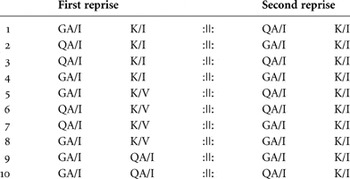
Even without cadences, the first three phrases of the slow movement have interesting implications for the musical form. The first two of them, which ought to be concluded with the half-cadence in the tonic (QA/I) and the full cadence in the dominant (K/V), suggest that the movement is in small two-reprise form. Koch calls this form a ‘small composition’.Footnote 31 Only in this form can one modulate to the dominant in the second phrase. A half-cadence in the tonic followed by a full cadence in the dominant is mentioned by Koch as one of the possible patterns of punctuation in the first reprise of small compositions containing four phrases (see Table 1, rows 6–7).Footnote 32 Although small compositions can contain more phrases than four, only two phrases can be contained in the first reprise of dances. Three phrases occasionally occur in the first reprise of ‘the melodies to odes, songs, and small pieces of unrestricted type and tempo’,Footnote 33 but in this case the second phrase cannot close with a full cadence. Rather, ‘if the melody is already in the fifth in the second phrase, this phrase always closes with a half-cadence [Quintabsatz] in the key of the fifth’.Footnote 34 It follows that the pattern consisting of a half-cadence in the tonic and two full cadences in the dominant (QA/I, K/V, K/V) is not regarded as possible in small compositions. ‘Only in larger compositions does the case occur that two different melodic sections form a cadence immediately after one another in one and the same key.’Footnote 35 Apparently, with the third phrase the movement turns toward a ‘larger composition’. This turn is also suggested by the extension of this phrase in Haydn's movement and its bolder melodic gestures. The pacification of these gestures and ultimate dissolution of the phrase suggest a withdrawal from a larger composition and a return to the original formal template. This template is confirmed by the written-out repeat of the first reprise with all the vicissitudes caused by the third phrase (bars 17–32).
Patterns of punctuation in major-mode small compositions containing four phrases, after Heinrich Christoph Koch, Versuch einer Anleitung zur Composition, volume 3 (Leipzig: Böhme, 1793), 57–127. English translation by Nancy Kovaleff Baker in Introductory Essay on Composition (New Haven: Yale University Press, 1983), 85–117

GA=Grundabsatz, QA=Quintabsatz, K=Kadenz
The second reprise of what seems again to be a ‘small composition’ starts with what promises to be a Fonte at bar 33: this sequential harmonic gambit involves transposing a segment of material from the second to the first scale degree.Footnote 36 After the first segment of the Fonte in bars 33–34, the second segment should continue with the same material transposed down a step in bars 35–36, but it is curtailed by a general pause.Footnote 37 While the D♮ in bar 35 could function as an appoggiatura to C♯, equivalent to D♯ in bar 33, the general pause cuts off its resolution. The third-inversion dominant seventh with C♯ in the top voice occurs on the third beat of bar 35 and resolves to the first-inversion tonic triad in bar 36, equivalent to the first-inversion triad in bar 34. However, rather than being heard as the continuation of the sequence, which it in fact is, this harmonic progression starts a new phrase. The phrase leads to a half-cadence (QA/I) but is cut off after the cadential by the general pause in bar 38, as the first phrase was in bar 4. The following phrase (bars 39–41) corresponds to the second phrase (bars 5–7) and is interrupted after the chord before it can reach a full cadence (K/I). After the listener has mentally supplied the missing chords, these chords actually sound in bars 42–44, as they did in bars 13–15. Anomalous as it is on account of the absent cadences, the second reprise thus adheres to the template of a small composition containing four phrases (Table 1, row 6). According to Koch, when the first reprise of such a composition modulates to the dominant, the first phrase of the second reprise should turn back to the tonic and close with a half-cadence (QA/I). The second phrase should close with a full cadence (K/I). If it contains a thematic return, the returning material could be either the first or the second phrase of the first reprise.Footnote 38 The slow movement of Symphony No. 64 illustrates the latter option, even if it combines the second phrase with echoes of the (supernumerary) third phrase of the first reprise.
A small composition should finish with a repetition of the second reprise. The repeat follows in bars 46–57, but the slow movement continues beyond this section and its texture grows with the unexpected entrance of the winds. From D major the music veers off to G minor (bars 58–61) and approaches a full cadence in D minor. After the German augmented-sixth and cadential chords followed by the dominant (bars 62–64), the tonic is expected in bar 65. This expectation is conditioned, again, by the metrical position of caesuras. The resolution of the chord to the dominant on the third beat of bar 64 implies that the tonic should fall on the downbeat of the following bar. By coming to stop on the dominant and repeating this harmony over the bar line, the composer creates a harmonic syncopation and, having avoided the cadence, returns to the beginning. Or does he? Bars 68–71 repeat the first phrase of the movement (bars 1–4) but bars 72–74 form a hybrid of the second phrase (bars 5–7) with its variant familiar from the thematic return (bars 39–41).
The deviation from the main key and the faked return to the beginning after the end of the second reprise reveal the fundamental problem of this movement: a small composition is the wrong formal template for it. According to Koch, this form is suitable for dances, songs and other short pieces but not for symphonic movements, which he calls ‘larger compositions’.Footnote 39 After the wrong choice of formal template, the question is how to continue: how to enlarge a ‘small’ composition so as to make it ‘larger’. The composer, as affected by Haydn, does not seem to know the answer, and his attempts to find one take him into wrong keys: in bars 58–67 this is the key of D minor. In bars 76–82, he turns toward A major via another Fonte. The sequence should continue for one more bar, but it is abandoned and the music approaches a cadence (K/V) yet, once again, stops on the dominant (bar 85). The accompaniment provides the tonic pitch A on the second beat of this bar and the appoggiaturas G♯–D could still resolve to A–C♯ in bar 86, but the composer seems to be seized by doubts. He avoids the cadence by adding the seventh to the tonic and withdraws from A major via a ‘doubtful modulation’ (dubitatio), reaching the third-inversion dominant seventh of D major (bar 89).Footnote 40 With the resolution of this chord to the tonic of the main key we are once again back to the beginning. Bars 91–95 correspond to bars 68–72, but the second phrase stops in the middle (aposiopesis). The doubts increase, the mode changes to minor and the cadential harmonic progression is dissolved (asyndeton), its chords disconnected from each other in space and time. The dominant seventh (bar 101) is suggested by only two notes, and the tonic pedal does not complete the cadence. Rather, it consolidates the absent cadence with a postcadential harmonic progression in D minor (bars 102–107). Only after this progression – and detached from it by a general pause – does the tonic triad with the major third occur.Footnote 41
It follows from my analysis that the absent cadences of Symphony No. 64 are involved in an extended play with the musical form. As is the case with the cadential tricks, the formal manipulations play with the listener's expectations, but, if the former could be perceived by all listeners, including less competent ones (Liebhaber), the latter could only be appreciated by connoisseurs (Kenner) familiar with eighteenth-century punctuation forms. It is the concept of punctuation form, fundamental for eighteenth-century music and summarized by Koch, that brings the solution to the problem of form in the slow movement.Footnote 42 This problem has been noted by many authors: H. C. Robbins Landon compares ‘its curious form (no double bars at all, and durchkomponiert)’ to ‘the equally enigmatic Capriccio of Symphony No. 86’.Footnote 43 For Sisman the movement has ‘an apparently unique two-reprise structure with both parts ending in the tonic’.Footnote 44 For Webster it refuses ‘to execute an intelligible form’.Footnote 45 For A. Peter Brown ‘it consists of two expository statements (mm. 1–16, 17–32), a middle section that is still more disruptive in its phrase structure, two recapitulatory statements (mm. 68–90, 91–101), and a coda’.Footnote 46 Sutcliffe relates the problem of form to the absence of cadences: ‘If there are no proper cadences, then there can be no proper sections: the movement is therefore in a sense formless, even though the recurrences of the opening material clearly create some sort of structure.’Footnote 47 The first part of his reasoning is sound, but, even if absent, the cadences are announced clearly enough to allow an eighteenth-century connoisseur to map the music upon a familiar formal template. For such a listener the form was thus ‘unique’ but not ‘formless’. It was ‘intelligible’, even if it was a forme manqué in that the listener had to fill in its blanks. With this caveat, the slow movement of Symphony No. 64 can, indeed, be considered ‘a wonderful illustration of the process of Verfremdung’ that Sutcliffe finds central to Haydn's musical thought: ‘renewing our perception by making strange something that could normally be taken for granted’. ‘Yet’, as he adds, ‘all such considerations could equally be absorbed into an affective reading that concerns nostalgia and melancholy. The disrupted cadential activity and incomplete phrases represent a sort of broken utterance under stress, they are painful and discomforting.’Footnote 48 He connects this affective reading to Sisman's: ‘in her hypothesis that this movement may have formed part of the incidental music Haydn is supposed to have written for Hamlet, she captures something of its melancholic affect.’Footnote 49
AFFECT
But is this movement melancholic? One musical characteristic that could be indicative of this affect is its tempo: Largo. For Johann Georg Sulzer ‘diese Bewegung schicket sich also für Leidenschaften, die sich in feyerlicher Langsamkeit äussern, für melancolische Traurigkeit, und etwas finstere Andacht’ (this tempo is suitable for passions that express themselves in solemn slow movement, for melancholic sadness and somewhat gloomy meditation).Footnote 50 Not so the key. Although ascribing characteristics to keys was surrounded by controversies in the eighteenth century, D major was unanimously characterized as gay, funny, joyful, bright, lively, brilliant and uplifting. For an anonymous reviewer in Carl Friedrich Cramer's Magazin der Musik it was ‘the perfect key for funny pieces and joyful dances’; for Francesco Galeazzi ‘the most cheerful and gay key that music has’.Footnote 51 Some authors found it suitable for the expression of tender love, serenity and calm,Footnote 52 but not for melancholy. This last affect was associated with flat minor keys, D minor being most frequently mentioned.Footnote 53
The slow movement is also short on harmonic, melodic and rhythmic signs of melancholy. Foremost among them were chromatic lines, chords and harmonic progressions. The connection of chromaticism with melancholy was grounded in Affektenlehre and justified by the mimetic relationship between musical motion and emotion. ‘If one knows that sadness is a contraction of these subtle parts of our body’, consisting of blood vapours, which were considered the source of human passions, ‘then it is easy to see that the small and smallest intervals are the most suitable for this passion’.Footnote 54 Since melancholic sadness was believed to be caused by an excess of black bile, which tends to sink and causes depression, melancholy was represented by descending lines and lamento basses. Also suitable for melancholic expression were ‘sigh’ motives (Seufzer) and short pauses called ‘sighs’ (Sospiren).Footnote 55 All these musical characteristics abound in free fantasias, the eighteenth-century epitome of melancholy, frequently associated with this affect by contemporary listeners and in one case – that of C. P. E. Bach's Fantasia in C minor, h75, the concluding Probestück from his Versuch über die wahre Art, das Clavier zu spielen (Berlin: Henning, 1753) – explicitly related by one listener, Heinrich Wilhelm von Gerstenberg, to Hamlet's monologue.Footnote 56 In fact, Haydn's Largo is a far cry not only from free fantasias but also from eighteenth-century representations of melancholy in other genres, such as C. P. E. Bach's trio sonata Sanguinicus et melancholicus, h579, ‘Il Malinconico’ from Carl Ditters von Dittersdorf's Il combattimento dell'umane passioni and the finale of Beethoven's String Quartet Op. 18 No. 6, ‘La Malinconia’. With its diatonic harmony and singing melody, played by the violins con sordini in the comfortable middle range, Haydn's theme sounds serene, even sleepy.Footnote 57 The crotchet motion in 3/4 metre calls to mind the topic of sarabande with (somewhat exaggerated) accents on the second beats.Footnote 58 In contrast to fantasias, where sudden pauses bring about changes of affect, the general pauses cause here no affective contrasts between phrases. Rather, the affect continues from phrase to phrase, as if the music were submerging into, and then emerging from, the silence. Only the third phrase of the small composition (bars 8–16 and 24–32) deviates from its affective and formal conventions, turning toward a larger form with emotionally charged melodic gestures ascending into the high register. A few turbulent passages occur after the completion of the small composition: The dramatic turn to D minor in bars 59–66 via the Neapolitan-sixth, diminished-seventh and German augmented-sixth chords brings contrasts of dynamics and texture characteristic of ombra scenes in opera seria.Footnote 59 This texture returns in bars 76 and 80. The dubitatio in bars 85–88 and the final turn to D minor from bar 97 feature further chromatic harmonies. Sisman points to these ‘highly expressive and darkly colored’ passages in the course of her discussion,Footnote 60 but, rather than Hamlet's sombre ruminations or fear at the appearance of the ghost, they may depict the agitation of the fictive composer mock-terrified by his initial mistake and subsequent inability to finish the piece.Footnote 61
One more characteristic of the slow movement that can be associated with a melancholic affect is the absence of cadences. Sutcliffe is right that ‘the disrupted cadential activity and incomplete phrases’ may represent ‘a sort of broken utterance under stress … painful and discomforting’, but the rhetorical figures to which he refers can express a variety of affects. Aposiopesis, which interrupts a sentence, leaving the sense ‘uncertain [how] to be understood’, can ‘indicate passion or anger’, but for Quintilian the same figure ‘may serve to give an impression of anxiety or scruple’.Footnote 62 The list of affects associated with it is extended by other authors. According to George Puttenham, aposiopesis arises ‘when we doo interrupt our speech for feare’ or ‘for shame’, or ‘for anger or by way of menace’, or ‘to show a moderation of wrath as the grave and discreeter sort of men do’, or ‘upon some sodaine occasion’. Besides, ‘this figure is fit for phantasticall heads and such as be sodaine or lacke memorie’.Footnote 63 The ‘polysemous nature’Footnote 64 of aposiopesis is illustrated by Brian Vickers with examples from Shakespeare's dramas. Two of them, in fact, come from Hamlet. One is Hamlet's uncompleted message to Fortinbras, symbolizing death:
Hamlet. So tell him, with th'occurrents more and less
Which have solicited – the rest is silence.Footnote 65
(Hamlet, Act 5 Scene 2, lines 357–358)The other comes from a comic episode between Polonius and Reynaldo, and illustrates how aposiopesis can be used by ‘such as … lacke memorie’:
Polonius. And then, sir, does'a this – 'a does –
what was I about to say?
By the mass, I was about to say something.
Where did I leave?
Reynaldo. At ‘closes in the consequence’.
Polonius. At ‘closes in the consequence’, ay, marry.
He closes thus: ‘I know the gentleman …’Footnote 66
(Hamlet, Act 2 Scene 1, lines 49–55)Of course, ‘lack of memory’ was the theme of another play staged at Eszterháza by Karl Wahr and his troupe: Jean-François Regnard's Le Distrait. The German revival of Regnard's comedy, called Der Zerstreute, was first performed in 1774 and then taken by the troupe to other towns. Contemporary reviews of this production praise Haydn's incidental music, which consists of an overture, four entr'actes and a finale. This music, subsequently detached from the play, started an afterlife as Symphony No. 60, ‘Il Distratto’. Sisman discusses it along with No. 64 and lists a number of ‘characteristic techniques by which Haydn makes known his specific theatrical intentions’.Footnote 67 The list includes no absent cadences but, in the first movement, distraction is depicted by the music gradually ‘losing its way’ (perdendosi), ‘as though the composer had forgotten where he was and what he was to do next’.Footnote 68 Could the slow movement of Symphony No. 64 be related to Der Zerstreute?
Interesting as it is, this question is ultimately beyond the point, as can be seen from the earliest review of Haydn's music for Der Zerstreute. The correspondent of the Preßburger Zeitung reports that connoisseurs regarded it as masterful and found in its ‘musically comic humour [musikalisch-komischen Laune] the same spirit that enlivens all of Haydn's works’.Footnote 69 Gretchen Wheelock quotes this review at the conclusion of her analysis of Symphony No. 60 in order to justify her take on this piece. If Sisman and earlier authors have concentrated on Haydn's ‘characteristic techniques’ as they relate to devices of plot and character in Der Zerstreute,Footnote 70 Wheelock focuses on the considerable independence of these techniques from the theatrical context and stresses that they remain effective even if dissociated from the play.
The approach taken by Wheelock was elaborated by Gerhard Winkler.Footnote 71 As does Wheelock, Winkler observes that theatrical gestures of Symphony No. 60 do not directly refer to situations from Regnard's comedy but, rather, create equivalent musical ones. He distinguishes between two types of such situation. One of them, illustrated by the perdendosi passage of the first movement, has for its subject a fictive persona of the composer: ‘Als ein Schauspieler seiner selbst verliert er nach und nach die Kontrolle über den musikalischen Prozeß und läßt sich schließlich gleichsam “von außen” wieder an das Steuer zurückholen, während der “reale” Komponist Haydn die Zügel der ganzen Veranstaltung fest in der Hand gehalten hat.’ (Like an actor of himself, he gradually loses control over the musical process and lets himself be eventually brought back to the rudder ‘from outside’, as it were, whereas the ‘real’ composer Haydn has firmly held the reins of the whole enterprise in his hand.)Footnote 72 The other type of comic musical situation arises when the ‘real’ composer prescribes quasi-theatrical roles to performers. This is exemplified by the ‘forgetful’ violinists who have not remembered to tune their instruments before the finale of ‘Il Distratto’. As Winkler observes, this situation can be performed with theatrical gestures: ‘gestrengter Blick des Dirigenten, Abwinken, betretene Gesichter der Streicher’ (sharp look of the conductor, stroke of the baton, mortified faces of the violinists).Footnote 73 Winkler calls it orchestral pantomime. It is under this category that I propose to subsume the slow movement of Symphony No. 64. Although it contains no quasi-theatrical roles for performers, the fictive persona of the composer is arguably far more distracted than that of ‘Il Distratto’: not only does he choose a wrong formal template, he then forgets its course, loses his way in the third phrase and, finally, loses himself in unsuccessful attempts to close the movement. All along, he forgets to close phrases and complete harmonic gambits.Footnote 74
As far away as it takes us from Sisman's hypothesis that the slow movement of Symphony No. 64 formed part of Haydn's incidental music for Hamlet, my interpretation brings us back to her conclusion: ‘A connection between Tempora mutantur and Hamlet, between Haydn's symphonic movements and theatrical rhetoric … suggests a new category for his theater music. Instead of writing theater music and then incorporating it into his symphonies (as in no. 60), he developed musical styles appropriate to the theater, and could simply use a grouping of movements in spoken plays.’Footnote 75 Sisman calls this category ‘music in the playhouse idiom’.Footnote 76 For her it only pertains to Sturm und Drang symphonies, but more recent Haydn scholarship has suggested that theatrical rhetoric permeates Haydn's music from other periods and spreads to other genres.Footnote 77 The more we become familiar with eighteenth-century musical conventions and able to reconstruct the experience of eighteenth-century connoisseur listeners, the closer we come to share their view, conveyed by the correspondent of the Preßburger Zeitung, that comic spirit ‘enlivens all of Haydn's works’.
SIC TEMPORA MUTANTUR
What remains to be explained is the question of the title, ‘Tempora mutantur’. Although Sisman refers to it in connection with her interpretation of the slow movement of Symphony No. 64 as ‘an extended essay on time out of joint’ and hypothesizes that it formed part of Haydn's incidental music for Hamlet, the title is open to other interpretations. As such, it deserves a separate discussion.Footnote 78
The relation proposed by Foster between the title of Haydn's symphony and Owen's epigram is based on the assumption that ‘most Europeans of literary culture in the seventeenth and eighteenth centuries were acquainted with the works of Owen, ten books of epigrams which commanded extraordinary influence, particularly in German literature’.Footnote 79 Sisman adds credence to this assumption by pointing out that Owen's epigrams ‘had been translated frequently into German, and had been published in Latin in Basel as recently as 1766’.Footnote 80 She also corroborates the relation between the slow movement of the symphony and the second line of the epigram by suggesting that the temporal progress of the former reflects the progress of moral corruption described in the latter: ‘The epigram embodies a human truth; the slow movement is clearly a musical interpretation of that truth. The times are changed and we grow worse’.Footnote 81 Foster's own attempt to match the words of the epigram with the melody of the rondo theme is limited to the first line and, as he states, it is ‘especially the first line’ that became world-famous.Footnote 82 This clue is revealing in the light of his further remark that ‘Owen did borrow single lines from predecessors and work them up into epigrams’. Foster himself admits that ‘some of the credit for the first line is due variously (according to dictionaries of quotations) to Lothar I of Germany and to Raphael Holinshed’, although he finds it ‘fair to claim that its international fame is due wholly to Owen’.Footnote 83 In reality, this line is much older than Foster suspects. In English literature it is quoted in William Harrison's Description of England (1577), part of Holinshed's Chronicles, and occurs in John Lyly's Euphues (1578).Footnote 84 Its tradition goes back further in Germany, where it has been a popular proverb since the Reformation. Before 1554 it was recorded by Caspar Huberinus:
Tempora labuntur, tacitisque senescimus annis;
Tempora mutantur, nosque mutamur in illis.Footnote 85
The German translation of the proverb was provided in 1565 by Johannes Nas:
Tempora mutantur et nos mutamur in ipsis;
Die zeit wirdt verendert vnd wir in der zeit.Footnote 86
Somewhat altered, it occurs in a couplet dedicated by Matthias Borbonius to Emperor Lothar I and was included in the anthology Delitiae Poetarum Germanorum:
Omnia mutantur, nos et mutamur in illis
Illa vices quasdam res habet, illa vices.Footnote 87
The opening clause of the Borbonius version is a quotation from Ovid's Metamorphoses: ‘Omnia mutantur, nihil interit’.Footnote 88 Lyly also refers to Ovid: ‘The tymes are chaunged as Ouid sayeth, and wee are chaunged in the times.’Footnote 89 The fact that he quotes the opening clause imprecisely betrays that it does not come from Ovid. In fact, it is an adage adopted from an oral tradition and inherited from classical antiquity by the Middle Ages as one of those Latin sententiae that formed the stuff of grammar and rhetoric and adorned scholarly discourse up to the eighteenth century.Footnote 90 And discourse about music too: early eighteenth-century music-theoretical treatises overflow with sententiae, and one of them contains the sentence we are concerned with. In his first treatise, Das Neu-Eröffnete Orchestre, Mattheson writes, ‘Der bey den Alten verbotene Sprung der Septimae ist bey itziger Zeit unsere beste decoration. Sic tempora mutantur.’ (The skip of the major seventh, prohibited by the old, is now our best decoration. Sic tempora mutantur.)Footnote 91
The stylistic change from the ‘old’ baroque music to the ‘new’ galant style in the first decades of the eighteenth century demonstrated that compositional rules are conventions and that, from time to time, they change. To be sure, cadences were the most important eighteenth-century conventions. Would a day come when they disappeared? This might be the question Haydn asked himself and tried to answer in the slow movement of Symphony No. 64. To label it ‘Tempora mutantur etc.’ would not be far from the mind of someone who started his pieces In Nomine Domini, finished them Laus Deo and laced his conversation with Latin proverbs.Footnote 92 But in his days this movement remained a thought experiment. Cadences did not disappear from eighteenth-century music. One had to wait for another century to see this convention wane, and, when it declined, this brought about the end of tonality and disintegration of traditional musical forms. For Haydn and his generation, music without cadences was music of the future – and so it remained.