1. INTRODUCTION
Planar diodes, with explosive-emission cathodes, are widely used for the generation of wide-aperture pulsed ion and electron beams with energy densities in excess of 0.5 J/cm2. One of the most important parameters of any intense ion beam accelerator, from an industrial perspective, is good reproducibility of the beam and a long lifetime under repetitive operation.
In a previous paper (Pushkarev et al., Reference Pushkarev, Isakova and Khailov2012b), we presented the analysis of shot to shot reproducibility of the parameters of an ion beam formed by self-magnetically insulated ion diodes of different design with an explosive emission graphite cathode. The typical shot to shot variation in the ion current density, quoted in different papers, is about 25–30%. Data on the stability of a magnetically-insulated ion diode utilizing a polymer anode for experiments performed using the TEMP-6 accelerator (300–350 kV, 80 ns, 150–300 A/cm2) were reported by Zhu et al. (Reference Zhu, Lei, Dong and Ma2003; Reference Zhu, Dong, Han, Xin and Lei2007). It was shown that parameter variation increases with the number of shots, being especially significant after more than 400 shots. The ion current density variation was about ±5% for N ≤ 200, increasing to 15 ÷ 20% for N ≥ 400. The authors attributed the large increase in ion current density variation to the formation of a large amount of discharge products, lower-molecular-weight polymers, on the polyethylene surface.
A number of authors have shown that the stability and reproducibility of ion current density is determined by the processes of plasma formation on the anode surface (Zhu et al., Reference Zhu, Lei, Dong and Ma2003; Ito et al., Reference Ito, Fujikawa, Miyake and Masugata2009). For determination of the most important factors affecting ion beam reproducibility in the diode with an explosive-emission cathode, we carried out the correlation analysis of the ion current density with other output parameters of the accelerator, namely accelerating voltage, total diode current, and the duration of the first pulse (Pushkarev et al., Reference Pushkarev, Isakova and Khailov2012b). Our observations show that the correlations between the ion current density and output parameters of the Blumlein are weak, with the determination coefficient not exceeding 0.3–0.35, which indicates that the shot-to-shot variations observed do not seem to be due to the reproducibility of the pulsed power system. Besides, ion beam is formed non-uniformly along the length of the diode. The coefficient of determination for the current density at the points distant from each other of more than 5 cm does not exceed 0.01. It is thought that a poor reproducibility of the ion beam current density is caused by an uncontrollable nature of the processes in the diode, such as non-uniformity of the electron sheath, inhomogeneous plasma formation, etc.
A significant factor affecting the properties of a treated specimen is the thermal effect of the beam, rather than ion implantation for intense pulsed ion beam. With the ion current density of 40–70 A/cm2 and pulse duration of 100–150 ns, the resulted charge density per pulse is 2–4 µC/cm2. This gives a fluence of ions of (1.3–2.5) × 1013 cm−2 per pulse. The range of 200–300 keV carbon ions in metals does not exceed 1 µm. Therefore, the concentration of carbon atoms in the irradiated target is approximately 1017 cm−3 with the density of atoms in the target being 1023–1024 cm−3. It is found that, the contribution of H+ to the energy deposition in target is negligible at the beam composition of 70% C+ and 30% H+ (Xin et al., Reference Xin, Zhu and Lei2011). The energy deposited per unit mass (absorbed dose) with C+ is two orders higher than that of single H+ species. Therefore considerable attention should be paid to achieving good reproducibility of the beam energy density. Previously we found that for a strip focusing diode the total energy of the beam and the energy density is strongly dependant on the accelerator output parameters, since the coefficient of determination >0.9 (Isakova et al., Reference Isakova, Pushkarev and Khaylov2013a). The purpose of the performed research is the correlation analysis (with output parameters of the accelerator) of the total energy and beam energy density, formed by ion diodes with the explosive-emission cathode of different design and determination of beam energy instability sources.
2. EXPERIMENTAL SET-UP AND DIAGNOSTICS
Investigations were conducted with the TEMP-4M accelerator (Pushkarev & Isakova, Reference Pushkarev and Isakova2013a) configured in double pulse mode: the first pulse is negative (300–500 ns, 100–150 kV) and the second is positive (120 ns, 250–300 kV). The accelerator consists of a capacitive storage—Marx generator, a nanosecond double forming line (Blumline line), and a vacuum ion diode with magnetic self-insulation of electrons and different diagnostics. The ion energy density was 0.5–5 J/cm2 (depending on the geometry), and the pulse repetition rate was 5 to 10 pulses per minute. The diode current and voltage were measured by a Rogowski coil and a high-frequency voltage divider, respectively. The ion current density was measured by a magnetically insulated Faraday cup. The electric signals from sensors were recorded with Tektronix 2024B oscilloscope (200 MHz, 5 GSPS). The ion energy density and total beam energy were measured using infrared imaging diagnostics adapted for double pulse mode (Isakova & Pushkarev, Reference Isakova and Pushkarev2013b), using the Fluke TiR10 infrared camera and a 100 µm stainless steel foil as a target. Information on the diode geometry, diagnostic equipment used in the accelerator, and calibration can be found elsewhere (Isakova, Reference Isakova2011; Pushkarev & Isakova, Reference Pushkarev and Isakova2013a). Typical waveforms are shown in Figure 1.
(Color online) Waveforms of accelerating voltage, total diode current and ion current density of the strip planar diode with self-magnetic insulation.

All the diodes with self-magnetic insulation and explosive emission cathode operated efficiently with the chamber pressurized to 0.1 Pa producing more than 106 pulses (10 years without breakage). The pulse repetition rate was limited only by the heating of the diode.
3. STRIP FOCUSING DIODE
The majority of experiments were done using a strip focusing diode, measuring 22 cm × 4.5 cm, with the focusing distance being 14 cm. The anode—cathode (A–C) gap spacing of 8–9 mm was chosen so that diode impedance matches the characteristic wave impedance of the Blumlein (4.9 Ohm). The potential electrode is made from graphite and the grounded electrode is made from stainless steel with a matrix of 2 cm × 0.5 cm slots resulting in an overall transparency of 70%. The focusing diode has concave shaped electrodes focusing the beam within the yz plane, where the z-axis is in the beam propagation direction. Figure 2 shows a photo of the strip focusing diode and the distribution of the beam energy density in the cross-section, obtained with infrared-imaging diagnostics. For improvement of beam focusing, we used a metal shield installed on the grounded electrode (Pushkarev et al., Reference Pushkarev, Isakova and Khailov2013b).
(Color online) Photo of the focusing diode with the shield and the beam energy density distribution in the focal plane in vertical and horizontal cross-sections.
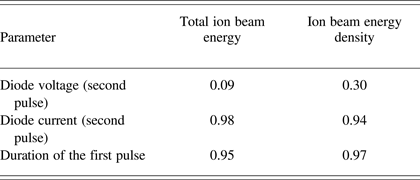
A previous study (Pushkarev et al., Reference Pushkarev, Isakova and Khailov2012b) showed that the correlations between the ion current density and the output parameters of the Blumlein are weak, with the determination coefficient R (adj. R-Square in the Origin Pro 8) not exceeding 0.3–0.35 and with a 10-seconds time interval between pulses. When the time interval between pulses increases the correlation of the ion current density with the accelerator output parameters remains weak. The determination coefficient does not exceed 0.2 for 25 shots with a 120 seconds interval between each pulse. This indicates that the shot-to-shot variations observed do not seem to be due to the reproducibility of the pulsed power system. However, we observed a strong correlation between the total energy and beam energy density with some of the output parameters of the accelerator (Table 1). The statistic was derived from 37 pulses with a 120 seconds interval between them.
Correlation analysis of the total beam energy and energy density with the output parameters of the accelerator (determination coefficient is shown)
Unlike the ion current density, energy density and total energy of the beam are integral parameters, reflecting beam formation over the whole time of generation, therefore one should compare these to integral parameters for the Blumlein, such as the charge (time integral of current) transferred during the second pulse, and integral of accelerating voltage. The space charge limited ion current flowing in the diode, (Langmuir, Reference Langmuir1913) taking into account the reduction of A–C gap spacing due to plasma expansion and the plasma erosion effect (Pushkarev et al., Reference Pushkarev, Isakova, Saltimakov and Sazonov2010a) can be found as:
 $$I_i \lpar t\rpar = \displaystyle{4{\rm \varepsilon} _0 \sqrt{2z} \over 9\sqrt{m_i}} \cdot \displaystyle{U^{3/2} \cdot S \over \lsqb d_0 - v \cdot \lpar t - t_0 \rpar \rsqb ^2},$$
where U is the accelerating voltage; d 0 = the initial A–C gap spacing; m i = ion mass; z = ion charge; S = area of the anode; v = plasma expansion speed, t 0 = time when voltage polarity is reversed (500 ns in Fig. 1).
The total energy of ion beam is then:
 $$E_{calc} = \vint U\lpar t\rpar I_i \lpar t\rpar dt = \displaystyle{4{\rm \varepsilon} _0 \hbox{S}\sqrt{2z} \over 9\sqrt{m_i}} \vint \cdot \displaystyle{U^{5/2} \lpar t\rpar dt \over \lsqb d_0 - v \cdot \lpar t - t_0 \rpar \rsqb ^2}.$$
Figure 3 shows the dependence of the measured beam energy and energy density on the calculated energy by Eq. (1) with the anode area of 100 cm2 and the plasma expansion speed of 1.5 cm/µs. The total beam energy is measured by both calorimeter and thermal-imaging diagnostics. Figure 3 shows summary of experimental data for the strip focusing diode at different A–C gap spacings. The observed correlation between measured ion beam energy and calculated energy is very weak.
(Color online) The dependence of experimental ion beam energy (a) and energy density (b) on calculated energy. Summary data is given for A–C gap spacings of 7, 8, 9, and 10 mm.
We found a strong correlation between the beam energy and total charge transferred in the diode gap. Figure 4 shows the results of the correlation analysis of the total charge (which was calculated as integral of the measured total diode current during the second pulse), with total energy and energy density of the beam. Even though strong correlation of the beam energy and total charge in the diode (R = 0.85–0.93) was observed, the dependence of these parameters on accelerating voltage is weak (R < 0.3).
(Color online) The dependence of the total ion beam energy (a) and energy density (b) on the total charge transferred in the diode. Summary data is given for A-C gaps of 7, 8, 9, and 10 mm.
The thermal imaging diagnostics does not allow statistical measurements of the energy density at high repetition rate since time interval between shots should be over 100 seconds to allow target temperature to cool down. The acoustic diagnostics (Pushkarev et al., Reference Pushkarev, Isakova, Xiao and Khailov2013c) based on piezoelectric transducer was developed to allow statistical measurements of the energy density with a 10 second interval between shots, which is not possible using thermal imaging diagnostics. If the beam pulse duration is significantly smaller than the period of a stress wave propagating in the target, then the amplitude of the piezoelectric transducer (PZT) signal is directly proportional to the input energy density (Lyamshev, Reference Lyamshev1997). Figure 5 shows the waveforms of the signal measured by PZT and the dependence of the PZT signal (amplitude of second positive half-wave) on the total charge transferred in the diode.
(Color online) Waveforms of the signal measured by PZT and the dependence of the PZT signal on the total charge in diode.
As a target we used a copper strip with a rectangular cross-section measuring 2 × 7 mm2; the length of the strip was 5 m. A piezoelectric transducer was fixed at one end of the strip, while the other end was placed in the diode chamber and subjected to ion beam irradiation (Pushkarev et al., Reference Pushkarev, Isakova, Xiao and Khailov2013c). Acoustic diagnostics also confirms a good correlation between energy density and the total charge transferred in the diode.
For characterization of the operating modes of the diode, we shall derive parameter η, equal to the ratio of the total beam energy to the total charge transferred in diode gap during the beam generation pulse. When the total charge transferred in the diode changes from 2 mC to 7 mC at different A-C gap spacings for the strip focusing diode η = 10–17 kJ/C.
4. OTHER SELF-MAGNETICALLY INSULATED DIODES
A part of the experiments was carried out using the annular focusing self-magnetically insulated ion diode (Pushkarev et al., Reference Pushkarev, Isakova and Vahrushev2013b). Figure 6 shows a photograph of inside of the diode chamber with the annular diode and the energy density distribution in the cross-section at the focus of the diode. The outer diameter of the annular diode is 20 cm and the inner diameter is 9.2 cm. It has concave shaped electrodes focusing the beam within the xyz plane, where the z-axis is in the beam propagation direction. The average length of the annulus of the grounded electrode is 46 cm (compared to 25 cm for the strip diode); the working surface area of the potential (graphite) electrode is 220 cm2. The A-C gap spacing is 8–10 mm, the focusing distance (with maximum energy density) is 12 cm downstream from the diode.
(Color online) Photo of the annular focusing diode and distribution of beam energy density in horizontal and vertical cross-sections.
In self-magnetically insulated ion diodes electrons confined by magnetic field drift in crossed E × B field along the diode. Electron drift along the diode increases the electron transit time in the gap and thus decreases electronic component of the total current diode providing higher efficiency of ion beam production. The average length of the annulus in the annular diode is 46 cm, which is a factor of 2–2.5 times the length of the planar strip and focusing diodes. This leads to an increase in the transit time of electrons, which makes them drift in the A-C gap for longer in the annular diodes. However, we observed that the correlation between the total ion beam energy and the total charge transferred in the gap is the same as for the strip focusing diode (Fig. 7).
(Color online) Dependence of the total beam energy (a) and energy density in the diode focus (b) on the total charge in the diode.
The same correlation analysis has been performed for the strip planar diode (Pushkarev et al., Reference Pushkarev, Isakova and Guselnikov2011). A photo of the planar diode and the beam energy density distribution over cross-section are shown in Figure 8. The studies show that the reproducibility of the ion current density in the planar diode is worse than in the focusing strip diode, because in the latter variations in different parts of the diode will partially compensate each other (Pushkarev et al., Reference Pushkarev, Isakova and Khailov2012b). The standard deviation of ion current density is 35–40% for the planar diode, but at the same time the output parameters of the Blumlein are comparatively stable with the variations not exciding 10% (Pushkarev et al., Reference Pushkarev, Isakova and Khailov2012b).
(Color online) Photograph of the strip planar diode and the beam energy density distribution in cross-section.
Similar to the strip focusing diode correlation analysis for planar diode showed weak correlation between ion current density and output parameters of the Blumlein while correlation between the energy density and output parameters of the Blumlein was strong. The results of correlation analysis of total beam energy and integral parameters of Blumlein such as total charge transferred during the second pulse for the strip planar diode at different A-C gap spacings is shown in Figure 9. The ion energy density and total beam energy were measured using infrared imaging diagnostics. The correlation observed was good for all gap spacing, with the coefficient of determination for the complete data set being 0.7.
(Color online) The dependence of the energy density of the beam on a total charge carried in the diode gap. Summary data for the A-C gap spacings ranging from 7 to 10 mm.
In previous study (Pushkarev et al., Reference Pushkarev, Isakova and Khailov2012b), we examined the correlation between the simultaneous measurements of ion current density from two Faraday cups positioned at various points within the cross-section of the beam. The measurements were made for planar strip diode using two Faraday cups. Figure 10 shows the correlation between the ion current density measured by two FC separated by 5 cm (Fig. 10a) and the energy density measured in the different points along the diode (Fig. 10b).
(Color online) The correlation between the ion current density measured by two independent FC (a) and the energy density measured in the different points along cross-section of the beam (b).
Our observations show that the correlation between ion current density measurements at different positions along the length of the diode decreases with increased distance between the Faraday cups. The coefficient of determination for the current density at the points distant from each other of more than 5 cm does not exceed 0.01 (Pushkarev et al., Reference Pushkarev, Isakova and Khailov2012b). This indicates that ion beam is formed non-uniformly along the length of the diode. At the same time, strong correlation exists between beam energy density measured in different points along the cross-section of the beam (Fig. 10b). The coefficient of determination for energy density at the points, distant from each other of 10 cm along the beam cross-section exceeds 0.9.
Finally, we studied the correlation between the total energy of the ion beam and total charge carried by the beam for different diodes. A good correlation between the total energy of the extracted beam and the total charge transferred in the diode was found not only for the strip diodes studied here, but also for spiral geometry (Pushkarev & Isakova, Reference Pushkarev and Isakova2012a). The results are shown in Figure 11.
(Color online) The dependence of the total beam energy on the total charge carried in the diode gap for the strip focusing and planar diodes, annular focusing diode and a spiral diode.
For all diodes except for the spiral diode, the relationship between the total beam energy and total charge can be described by the lineal relation E calc = −35 + 22Q d and fits one line with a standard deviation of 10% at different A-C gap spacings. The total ion beam energy was measured using both a calorimeter and an infrared camera. None of these diodes feature closed electron drift. The dependence of the total beam energy on total charge is somewhat different for the spiral diode (Pushkarev & Isakova, Reference Pushkarev and Isakova2013d).
5. RESULTS DISCUSSION
Previously, we found that ion current density is only weakly dependent on the accelerating voltage and other output parameters of the accelerator, with the coefficient of determination <0.3 (Pushkarev & Isakova, Reference Pushkarev and Isakova2012b). At the same time, in this paper, we have identified that the total energy of the beam and the energy density are identically defined by the total charge transferred in the diode during beam generation, since the coefficient of determination is >0.9. It was shown that the correlation of the energy density in different points along the beam cross-section is strong and considerably exceeds the correlation between ion current density measured in different points along the diode. Besides, we found that shot to shot variation in ion current density is large (sd = 25–30%) while for the same diode the variation on the energy density is much lower (sd = 10–11%). The obtained results can be explained by the presence of energetic neutral atoms in the beam which are produced though charge exchange processes between accelerated ions and molecules of the residual gas in the A-C gap. The charge exchange process involves the interaction of a high-velocity positive ion with a stationary neutral, with an electron passing from the neutral to the ion; thus the high-velocity ion becomes neutral, and the initially stationary neutral becoming a positive ion (which is then also accelerated). In double pulse operation mode of the self-magnetically insulated diode, plasma formation occurs on the first pulse, and acceleration of ions on the second pulse; the presence of a long pause (400–500 ns) between the two can increase the thickness of the neutral layer formed over the anode surface. The greater the number of neutrals, the more charge exchanges will occur when ions are accelerated during the second pulse, thereby increasing the neutral component of the beam. The self-magnetically insulated diode appears to produce a beam composed of both accelerated ions and charge exchange neutral atoms.
Additional confirmation of the presence of charge exchange neutral atoms in the beam is the difference in measurements of energy density using two independent diagnostics. The beam energy density, determined using the two methods (1) by multiplying the measured current density from a Faraday cup with the diode voltage, and integrating this product over time; (2) by the use of infrared imaging on a foil target, was in good agreement for the applied B r diode (Isakova et al., Reference Isakova, Pushkarev and Khailov2012) and found to be 3.6–4 J/cm2 (TEMP-4M configured in single pulse mode), while for the self-magnetically insulated diode studied here the results differed by a factor of 4–6, with the infrared diagnostic suggesting much higher energy density of the beam; the difference may be explained by the presence of neutrals in the beam. Neutrals present in the beam, having no net electrical charge, cannot be registered by the Faraday cup collector and therefore will not show up in measurements of ion current density. However, travelling at high velocity they will still transfer energy, contributing to heating of the target as measured by the infrared camera.
During the charge exchange process the initial quantity of ions which take part in charge exchange acts does not change and therefore the correlation between the energy density of the combined beam and the output parameters of the accelerator should not be better than the correlation between ion beam charge density and other accelerator parameters because of the additional instability of accelerating voltage. High correlation between the energy density of combined beam (ions + neutrals) with the accelerator output parameters while the ion current density in only weakly dependent on total diode current indicates that there exists a feedback between ions formation and charge exchange processes in the diode. If the quantity of atoms, which can participate in charge exchange process with accelerated ions is limited then the charge exchange process will stabilize the reproducibility of the total beam energy. When the total quantity of ions increases, the number of charge exchange acts decreases by one ion and vice versa. The total energy of the accelerated neutrals in the combined beam considerably exceeds the total kinetic energy of ions, therefore, the correlation of total beam energy with accelerator output parameters is higher than the correlation of ion current in the diode.
In many respects the operation of the self-magnetically insulated ion diode is determined by the total current, flowing though the diode. The magnetic field in the A-C gap is formed by this current; it explains the existence of the critical value of total charge carried in the diode gap which can be seen in the dependence of total beam energy on total charge (Fig. 4, Fig. 7, and Fig. 11). Besides, self-magnetically insulated diodes feature ion current density enhancement by a factor of 8–10 due to partial compensation of ion space charge by diffusion of electrons from the E × B drift area to the A-C gap (Pushkarev et al., Reference Pushkarev, Isakova and Vahrushev2010b). Thus, the ion fluence is defined not only by space charge density, but also by the compensation factor of the space charge by electrons, diffusing from the E × B drift area. The fluence of diffusing electrons is defined by the electron density in the E × B drift area. It is known that the typical efficiency of self-magnetically insulated diodes does not exceed 10–15%, it means that ion component in total diode current does not exceed this value. Therefore, the total charge transferred in the diode during the beam generation, is generally defined by electrons. It explains good correlation of total beam energy with the total charge, which is typical for all self-magnetically insulated diodes studied here, operating in double-pulse mode.
6. CONCLUSION
We have conducted statistical and correlation analysis of the reproducibility of ion beam generated by self-magnetically insulated diodes of different design, operating in the double-pulse mode. The correlation analysis showed that ion current density is only weakly dependent on the accelerating voltage and other output parameters of the accelerator, with the coefficient of determination <0.3. At the same time, in this paper we have identified that the total energy of the beam and the energy density is strongly dependant on the accelerator output parameters, since the coefficient of determination >0.9. For all diodes which feature unclosed electron drift, except for the spiral diode, the relationship between the total beam energy and total charge carried by the beam can be described by the relation E calc = −35 + 22Q d and fits one line with a standard deviation of 10% at different A–C gap spacings. The total ion beam energy was measured using both a calorimeter and an infrared camera. The dependence of the total beam energy on total charge is somewhat different for the spiral diode. These results suggest a fundamental difference between the two forms of diode, the differences between which we explain by the mechanism of closed electron drift in the spiral diode. The relationship between the total beam energy and the total charge transferred in the A–C gap during the beam generation is 2–18 kJ/C for this type of diodes.
Charge exchange effects in an ion diode are actually rather beneficial since it allows for the limitation of space charge effects in the A–C gap, which can significantly increase the energy density of the combined beam (ions + neutrals). The realization of charge exchange provides an increase in energy density by a factor of 25–30 times compared to space-charge-limited current density (Childe-Langmuir limit). The heating of the material is the same for ions or neutrals at the same velocity. For a material with high thermal conductivity the heat penetration depth exceeds the depth range of ions within 100–150 ns.
Self-magnetically insulated diodes utilizing an explosive-emission cathode, graphite is the most common choice of material, and have an operational lifetime of up to 106 shots, since there is negligible degradation of the electrode surface, which make it promising for various technological applications.
ACKNOWLEDGMENT
The research was conducted with the support of the Russian Fundamental Research Fund, within scientific project no. 12-08-00118-a.