

In this paper, we focus on recent work undertaken in the Rego da Murta megalithic cluster, in central Portugal, where two dolmens (antas in the original Portuguese) have recently been excavated. In one of these structures, a number of small quartzite stones were found embedded within the deepest layer of the site. Their location with respect to the orthostats’ placement and the orientations formed amongst them could be indicative of their use in planning the construction of the monument in which they were found. We therefore report on this discovery and conduct a preliminary assessment of this hypothesis.
In addition, it was observed that some of the orientations marked by the stones are similar to the orientation of the passage or corridor, which adds weight to the hypothesis that the orientation of these structures was intentional. Therefore, an analysis of the orientation of the two structures was completed with respect to potential alignments with orographic and/or celestial features. With only two monuments excavated, a statistical analysis of orientation as commonly practised in archaeoastronomy is impossible (eg, Hoskin Reference Hoskin2001; Ruggles Reference Ruggles1999). However, we opt for a more in-depth, almost micro-scale approach, looking at each monument in turn and presenting all their possible alignments, before turning to a meso-scale approach in search of similarities and differences at the cluster scale. As suggested by Silva (Reference Silva2014), these approaches are applicable to both monuments and take the wider archaeological record into account.
The Rego da Murta Megalithic Cluster
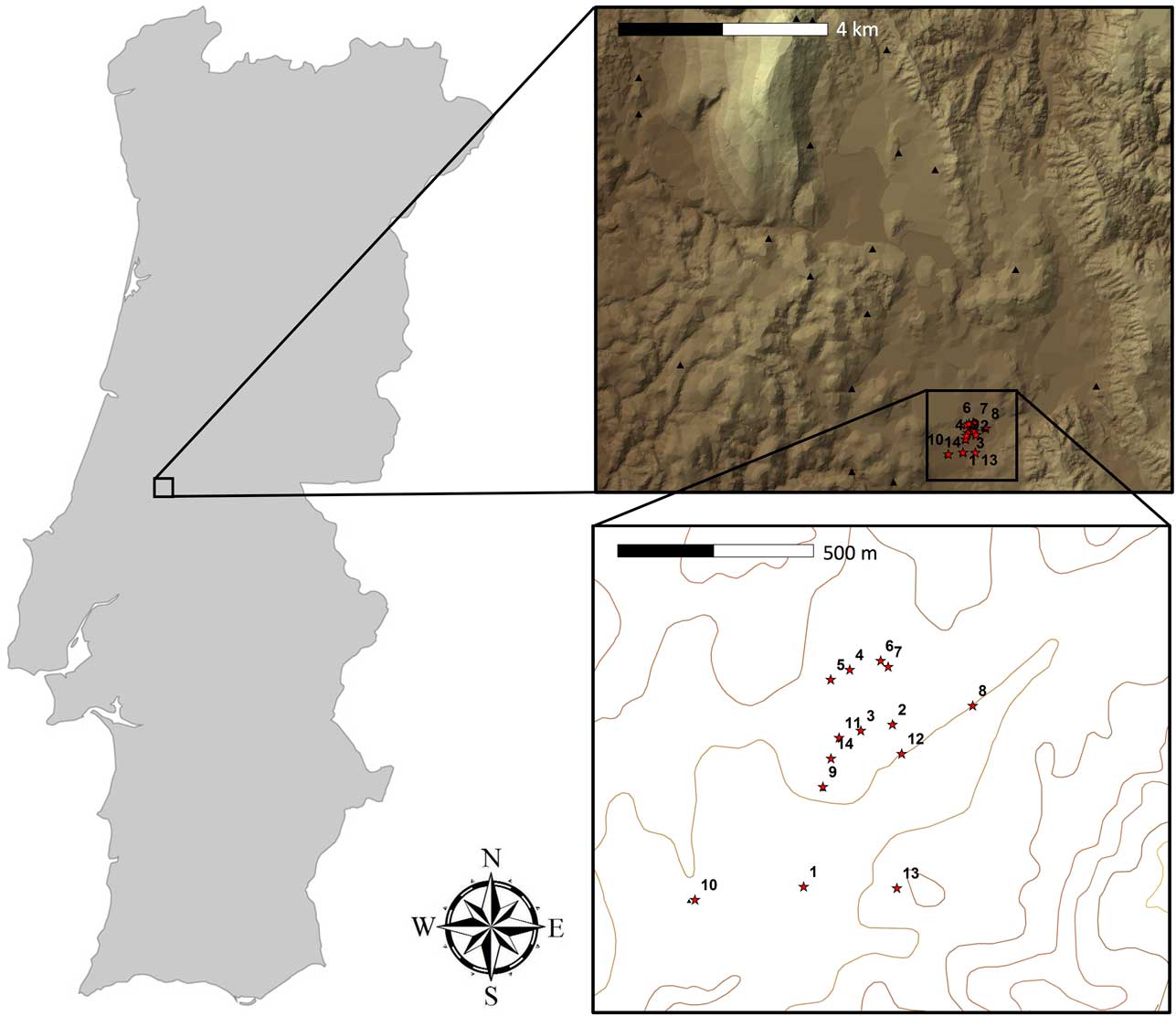
The Rego da Murta megalithic cluster is a large complex of megalithic monuments that extends over an area of about 1 km2 in Alvaiázere, in the Leiria district of central Portugal (Velho Reference Velho2003; Figueiredo 2004a; Reference Figueiredo2013a). It is located on Mesozoic limestone terrains (which form the whole mountain range of Alto Nabão) in the plain between the Nabão River and Zêzere River, which is a tributary of the Tagus River (Fig. 1). This region of central Portugal, almost equidistant to the earlier megalithic centres of innovation in northern Portugal (eg, Cruz Reference Cruz1995) and to the rich megalithic area of Alentejo in the south (eg, Rocha Reference Rocha2010), was subject to diverse cultural influences (Figueiredo 2006; 2007; Reference Figueiredo2010). This is demonstrated by the presence of foreign materials in the depositional assemblages, such as chrysoprase beads (Figueiredo Reference Figueiredo2006), as well as the presence of a high percentage of individuals that did not originate from the region (Waterman et al. Reference Waterman, Figueiredo, Thomas and Peate2013). It is highly likely that these communities used the Tagus River and its tributaries to move to and from the north and the interior of the country.
The Rego da Murta megalithic cluster: location and distribution of monuments. Stars represent the structures of the megalithic cluster as follows: 1) Dolmen I; 2) Dolmen II; 3–9) Menhirs; 10–14) Other structures. Triangles represent prehistoric structures in the wider region

Much like in the neighbouring regions to the north and south, Neolithic and Chalcolithic occupation is mostly visible in the form of funerary depositions in caves, as well as monumental constructions and associated depositions. Such megalithic structures often appear as part of clusters of monuments. These can include structures that are often referred to as ‘atypical’ – such as dolmen, menhir, or cist – as they do not fit into the typical morphological types in the country. In a few cases, such atypical structures also contain funerary deposits, as is the case at Jogada 5 (Cruz Reference Cruz2004) and Colos (Batista 2006; Reference Batista2013; Cruz et al. Reference Cruz, Berruti, Delfino and Gaspar2016), which are both located in Abrantes, just south of Rego da Murta.
The Rego da Murta megalithic cluster has been undergoing excavation since 1998. At the time of writing, it includes a total of 14 known structures – including dolmens, menhirs, and other atypical monuments – four of which have been excavated and restored (Velho Reference Velho2006; Figueiredo 2004b; 2005; 2006; 2007; 2010; Reference Figueiredo2013b). Two of the menhirs from this cluster have also been excavated (Figueiredo Reference Figueiredo2013b). Morphologically, they are rounded on one side (the ‘belly’) and flat on the other. In both cases the belly side faces north. In Menhir I, a cup mark at the centre of the belly was identified. A small deposition consisting of a great number of seeds (unidentified), silex materials, and a small ceramic fragment was found near Menhir II. The two other excavated monuments, Dolmen I and II, are the main focus of this paper.
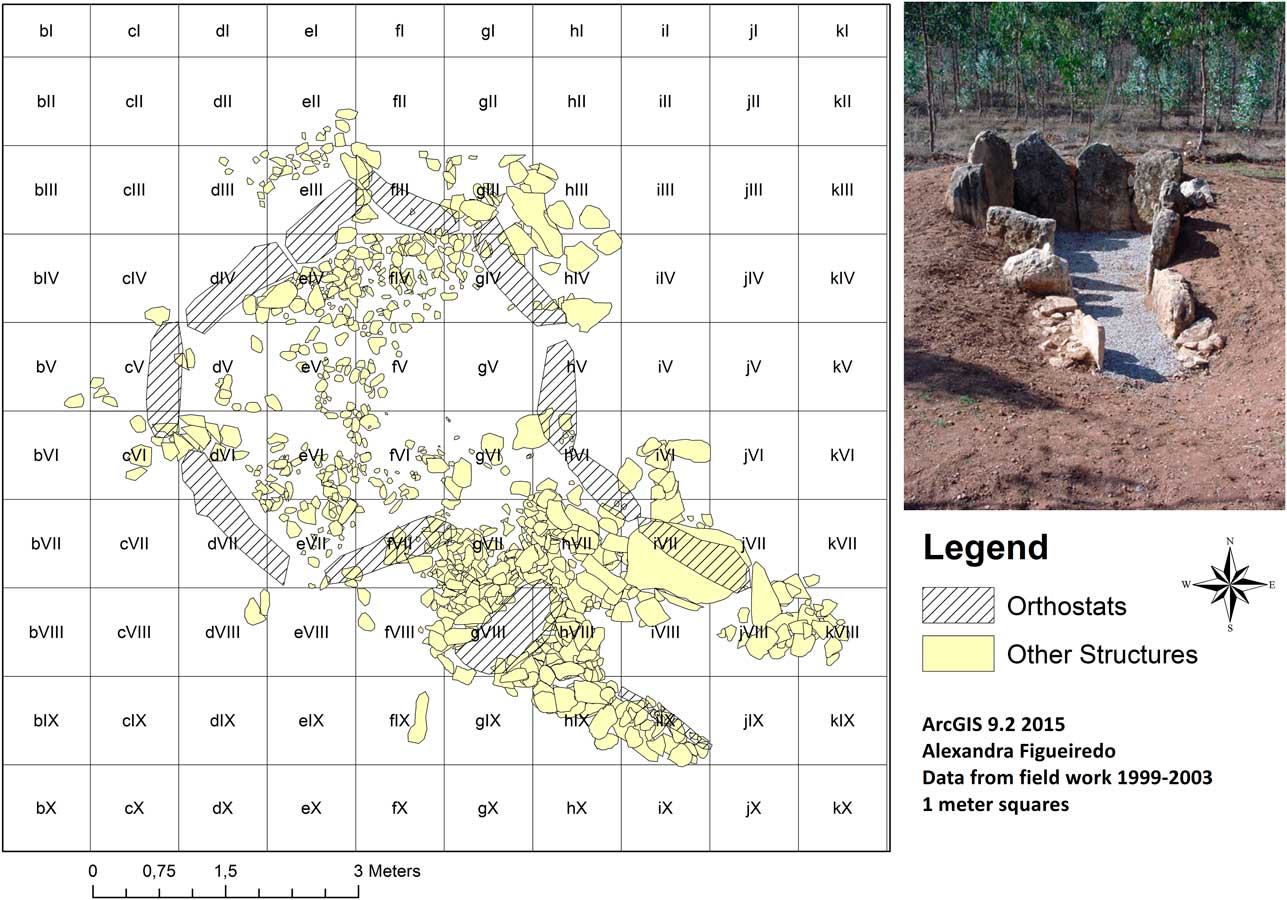
Rego da Murta Dolmen I is composed of an octagonal chamber and a relatively prominent corridor, which is more or less the same length as the diameter of the chamber (Fig. 2). Excavation has revealed burials from two distinct periods, the Late Neolithic and the Early Bronze Age, which together span almost 1500 years (Figueiredo Reference Figueiredo2006, 77–93). The burials (of unknown type) comprise a minimum of 50 individuals of varied sex (only ten could be gendered) and age. They were associated with wild (mainly rabbit) and domestic (pig, ovicaprid, and dog) animal bones and a varied artefact assemblage (Figueiredo Reference Figueiredo2006, 41–2). The artefacts included: a wide assortment of ceramic vessels, mostly undecorated; blades and lamellae; some arrowheads, mostly with triangular base; a large set of necklace beads, mostly in slate; and polished objects (axes and gouge). In addition to the burials, excavators identified a large stone circular structure in the centre of the chamber (Fig. 2), possible traces of paintings on the backstones, and a zig-zag engraving on an orthostat on the left side (Figueiredo Reference Figueiredo2006, 38–42).
Plan of Rego da Murta Dolmen I (left), with compass rose pointing towards true cardinal points. Photograph of the Dolmen after the 2004 restoration works (top right)

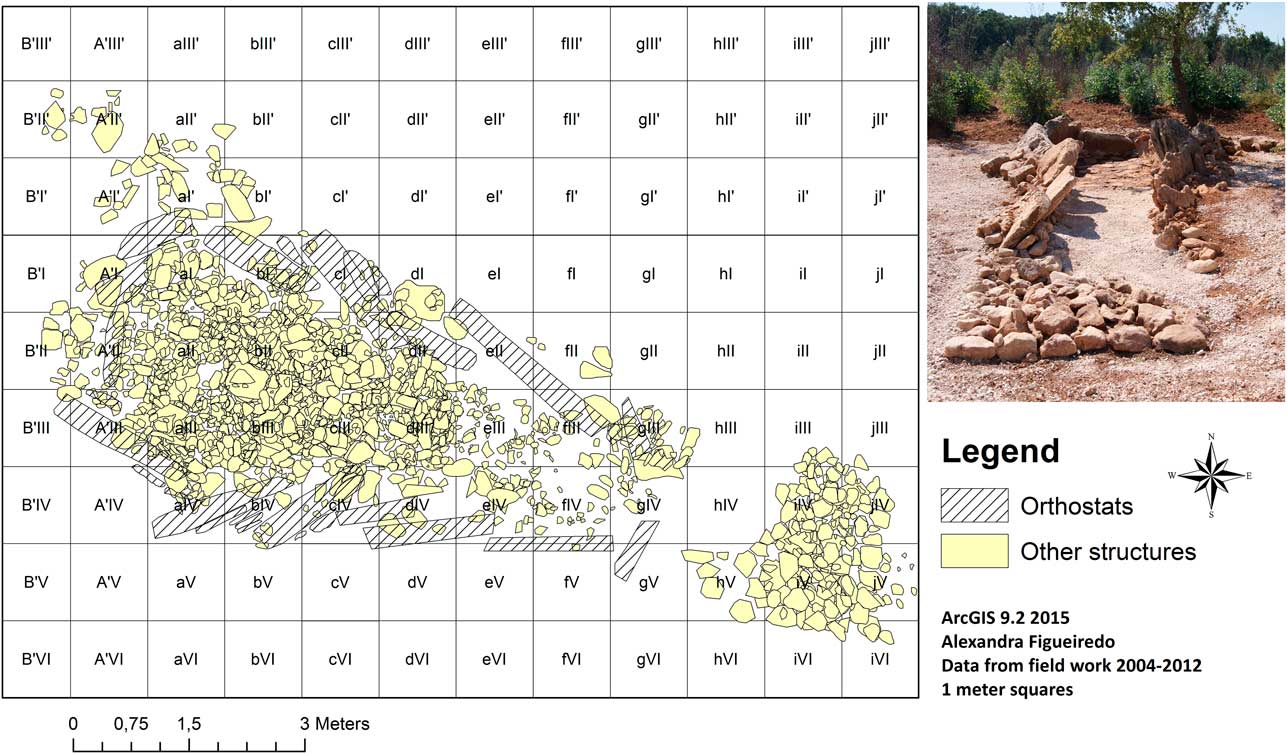
To the north of Dolmen I, a second dolmen, Rego da Murta Dolmen II, has also been excavated (Figueiredo 2004b; 2007; Reference Figueiredo2010). This dolmen differs morphologically from the first, as it lacks a clear distinction between its chamber and corridor (Fig. 3). It contains eight pit deposits of a mixture of faunal and human bones (MNI of 54), closed off by limestone rocks and associated with overturned vessels, some of them whole, as well as a multitude of traces that fit chronologically in the mid- to late Chalcolithic period. Beneath this, the chamber of this dolmen includes a paved area, probably built in the early to mid-Chalcolithic, which lies on top of a series of contemporary or earlier depositions where small traces of very fractured, unburnt osteological splinters were identified, one of which was dated (3370–3100 cal bc, Beta-451546; see below).
Plan of Rego da Murta Dolmen II (left), with compass rose pointing towards true cardinal points. Photograph of the Dolmen after the 2012 restoration works (top right)

Radiocarbon dates
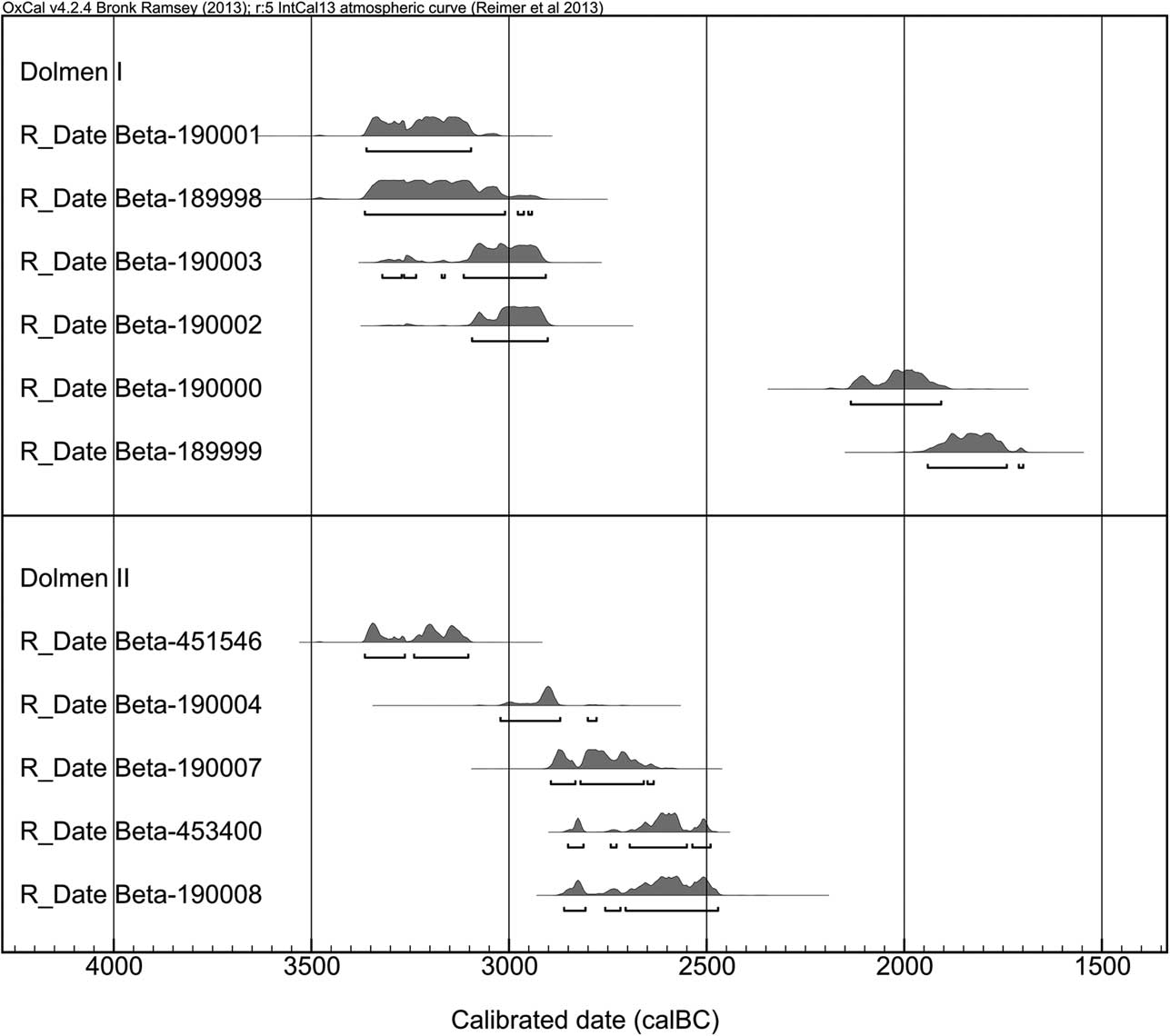
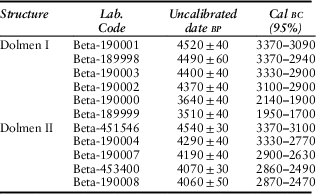
Collagen samples from recovered human bone provided nine AMS radiocarbon dates for Dolmens I and II (Figueiredo Reference Figueiredo2010). Together with two charcoal dates from Dolmen II, they provide a clearer picture of the use of this cluster through time. Table 1 and Figure 4 show all the dates obtained, which were calibrated using the INTCAL13 calibration curve OxCal v4.2 (Reimer et al. Reference Reimer, Bard, Bayliss, Beck, Blackwell, Bronk Ramsey, Buck, Chenge, Edwards, Friedrich, Grootes, Guilderson, Haflidason, Hajdas, Hatté, Heaton, Hoffmann, Hogg, Hughen, Kaiser, Kromer, Manning, Niu, Reimer, Richards, Scott, Southon, Staff, Turney and van der Plicht2013; http://c14.arch.ox.ac.uk/).
Probability distributions of dates from the Rego da Murta megalithic cluster

Table of absolute ams dates of bone fragments for both rego da murta dolmens

Dolmen I’s first phase of use is possibly related to its construction and certainly to the earliest depositions which correspond to the Late Neolithic/Early Chalcolithic (c. 3200–2800bc). This phase is equally represented by one of the dates for Dolmen II (3370–3100 cal bc, Beta-451546), which was obtained from one small bone fragment found beneath the pavement of this dolmen. There is then a chronological gap in Dolmen I; however, the remaining dates for Dolmen II are from this phase, c. 2800–2200 cal bc. A later phase, corresponding to the Late Chalcolithic/Early Bronze Age (c.2200–1600bc) is present only in Dolmen I.
Funerary practices
Depositions in the caves at Gruta dos Ossos (Oosterbeek Reference Oosterbeek1993) and Gruta do Cadaval (Oosterbeek & Cruz Reference Oosterbeek and Cruz1985), which are contemporaneous with Dolmen I and II, provide insight into the funerary practices of the region and period that can help interpret the Dolmens’ diachronic record (Figueiredo 2006; Reference Figueiredo2010). The cave deposits have established that, across the period of interest to us, there were two distinct funerary practices. The first practice, prevalent throughout the Neolithic, consisted of ritualised deposition of disarticulated bones (burnt and unburnt) and the subsequent cult of these individuals in dolmens and/or caves (Figueiredo Reference Figueiredo2006, 26). The second practice began in the mid-Chalcolithic and focused on the digging of pits. Within these were placed disarticulated bones from different individuals, irrespective of age and gender. They were covered by semi-circular lithic structures that were mixed with other materials, such as pottery, and deposited possibly as votive offerings (not unlike ossuaries) (Oosterbeek Reference Oosterbeek2004).
The two Dolmens might have experienced periods of use and disuse; they underwent profound alterations of their internal structures, but had minimal changes to their lithic structures (Figueiredo Reference Figueiredo2006, 77–80). Both dolmens were probably constructed and used at the same time, as indicated by the oldest dates of the two structures (3370–3090 cal bc, Beta-190001 and 3370–3100 cal bc, Beta-451546, Fig. 4). Most likely they were constructed when the first of the two aforementioned funerary practices was enacted. In the Late Neolithic/Early Chalcolithic, the interior of Dolmen II was cleared of its contents, a pavement placed, and the ossuaries deposited. It was at this time that the ceiling of the monument had to have been removed, as the depositions had been placed directly from above. By contrast, Dolmen I was never cleared, but its interior presented evidence of extensive mixing of material, including of the bone assemblages. This might indicate the occurrence of another shift in funerary practice in the Early Bronze Age, a period in which burials lack the lithic structures that were visible in the mid- to late Chalcolithic. In addition, the left side of the corridor of Dolmen I must have been modified in the Early Chalcolithic when an orthostat fell, as evidenced by depositions found both beneath (3370–2940 cal bc, Beta-189998) and above it.
The quartzite stones
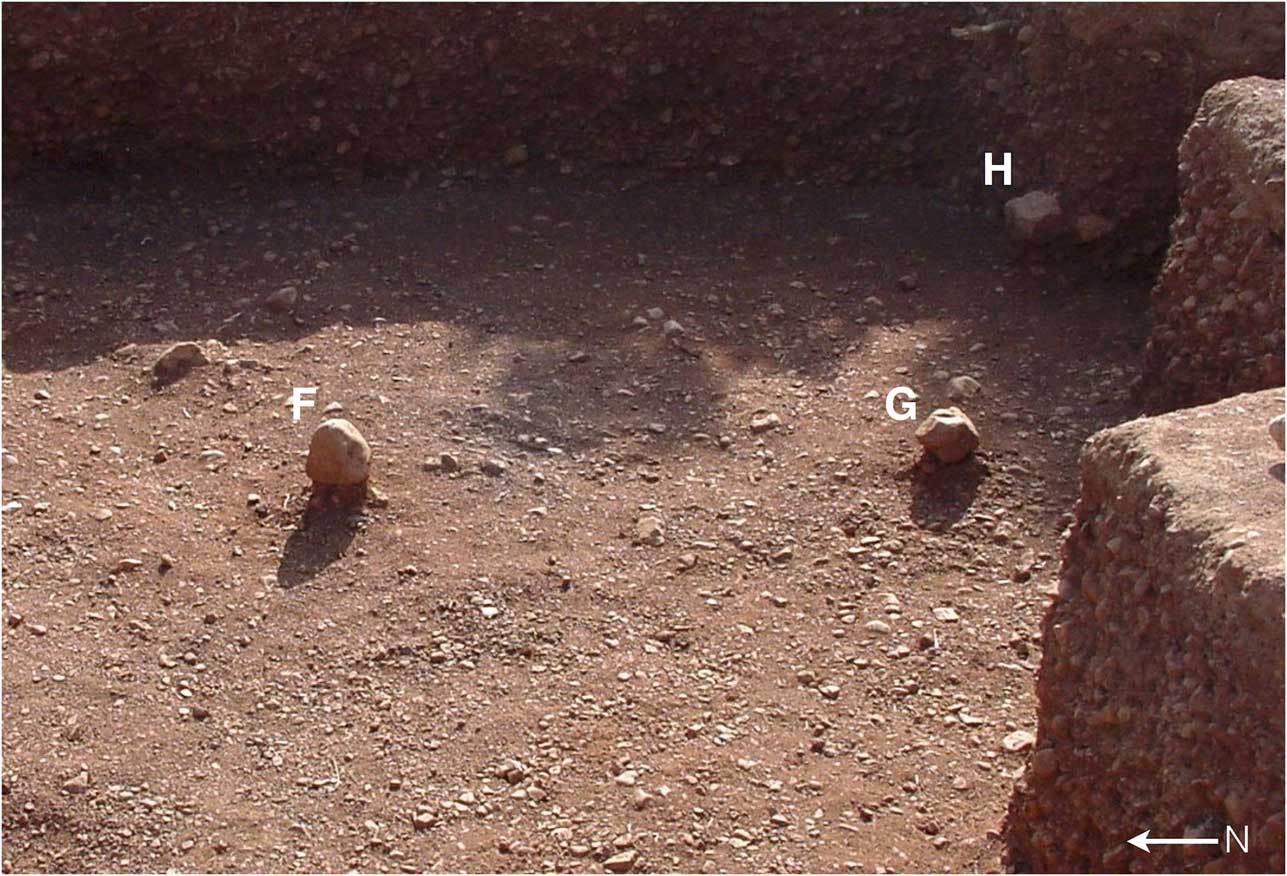
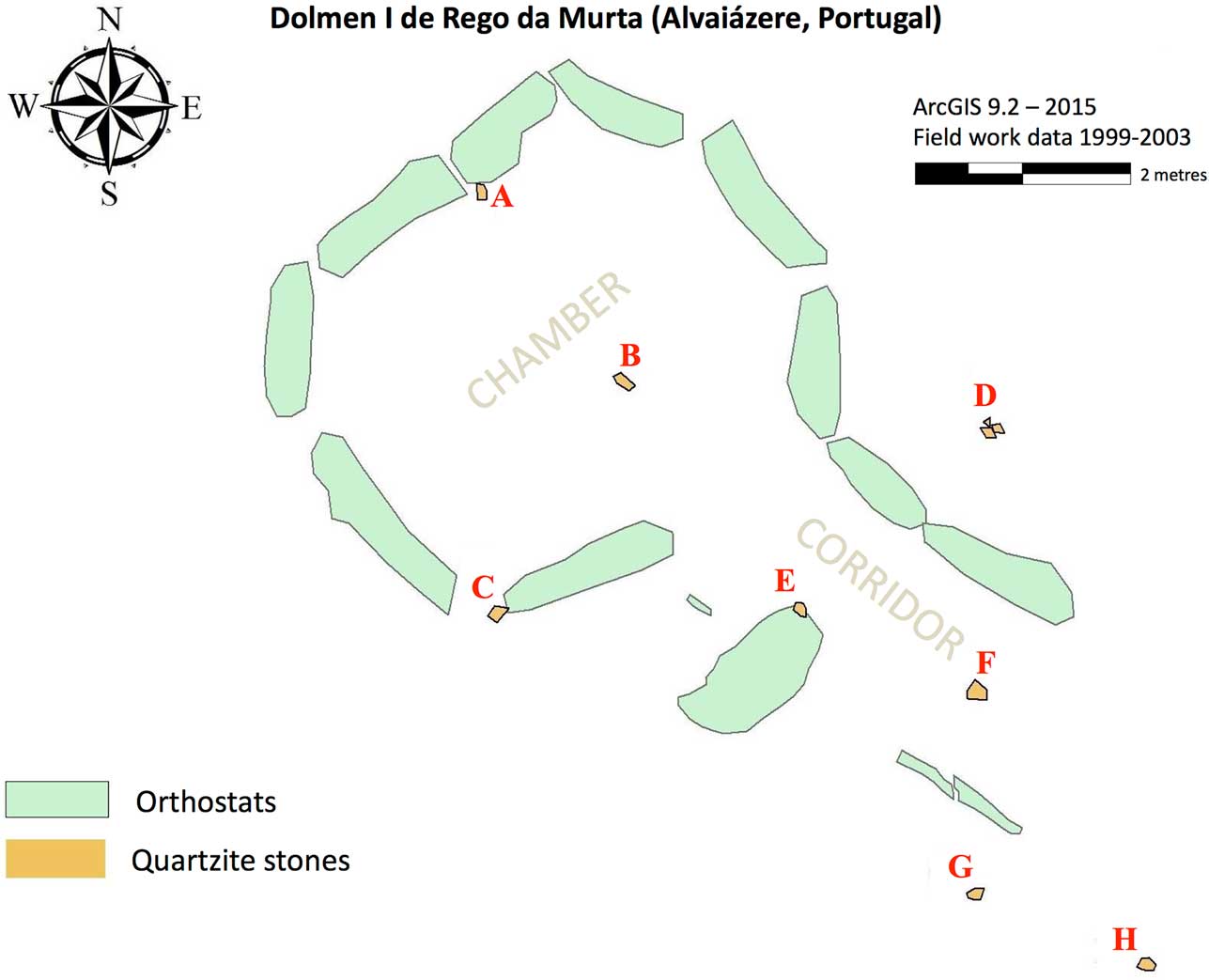
At the end of the Dolmen I excavation, a set of small sub-quadrangular stones were found at the bottom of all the archaeological layers (Fig. 5) (Figueiredo Reference Figueiredo2006, 170–4). These were made of quartzite with regular dimensions (10–15 cm wide) and were placed almost equidistant from each other (Fig. 6). They are very different from the other stones used in these monuments, both in shape and material constitution. All the megalithic orthostats, as well as the stones used to close-off depositions and buttress the orthostats, are limestone. Spatially, the quartzite stones occupy the entire extent of the monument, with one (A) located between the two backstones, another one (C) in the southern edge of the chamber, and yet another (F) at the end of the corridor.
Three of the quartzite stone markers in situ

Plan of Dolmen I showing the location of the quartzite stone markers

According to the interpretation of the layers of Rego da Murta Dolmen I (Figueiredo Reference Figueiredo2006), these stone markers were placed in the deepest layer, but extended in height to the level where the orthostats are planted: the tops of two stones markers were at the same height as the bottom of the deepest orthostat (the backstone). The archaeological remains of the human burials mentioned above were only recorded in the layer above that where the orthostats are planted. The intentional placement of these stone markers in the ancient soil suggests there was a plan for the construction of the monument prior to the placement of the orthostats that formed the chamber and corridor.
In Dolmen II, because of the good architectural preservation, the research team did not excavate below the base level of the orthostats, as was done with Dolmen I. However, since a sub-quadrangular quartzite stone was also located near the backstone of this dolmen, we believe that others might also be present, mimicking the findings of Dolmen I.
Methodology
Accurately determining the orientation of a dolmen is not an easy task. Traditionally, archaeoastronomers have measured a supposed axis of symmetry, understood as the direction from the centre of the backstone to the centre of the entrance or passage (Hoskin Reference Hoskin2001). If the entrance had been destroyed, Hoskin states that the direction faced by the backstone will give a reasonable direction and should be used instead.
The problem with this method, as stated by Silva (Reference Silva2014), is that even when a long corridor has survived intact or been accurately restored, the determination of its orientation can still be plagued by uncertainties. The inherent non-uniformity of the orthostats, as well as irregularities in their layout, could mean that the builders were either limited by technology or that a perfect alignment of the corridor stones was simply not important to them. In either case, dolmens are rarely symmetrical, and therefore any measurement of a central axis is an approximation with unknown uncertainty. As an example, Silva (Reference Silva2014, 26) shows that several different, but equally likely, delineations for a central axis can be measured and that their orientations can vary by as much as 10° in a specific case-study.
For these reasons, the measurement of the complete range of orientations allowed by the structure’s architecture, the so-called window of visibility, has been proposed (Silva Reference Silva2014). For structures with a passage or corridor, this is measured by the diagonals of the passage and the chamber’s entrance, which yield minimum and maximum azimuths that correspond to the maximum uncertainty in the measurement of orientation. This is safer than previous methods, for if the builders had any intention regarding the orientation of the dolmen then the intended target (celestial, orographic, or both) is sure to fall within the minimum and maximum range of the window of visibility (which can be calculated without projecting modern western notions of axis or symmetry into the prehistoric past).
Orientation measurements using both the traditional (following Hoskin Reference Hoskin2001) and window (following Silva Reference Silva2014) methods were taken using a survey-grade sighting compass with an advertised precision of 0.5°. Magnetic anomalies were checked for in the field by measuring orientation in both directions and comparing their values, as suggested by Ruggles (Reference Ruggles1999, 165). Azimuths were then corrected for true north using the International Geomagnetic Reference Field model provided by the National Oceanic and Atmospheric Administration website (https://www.ngdc.noaa.gov/geomag-web/?model=igrf#igrfwmm).
The quartzite stones were removed after excavation, so the orientation between pairs of these stones could not be measured in situ. However, their location had been accurately recorded using a total station during excavation and, therefore, the orientations between the quartzite stones could be obtained using the COGO module of ArcMap v10.3 (http://desktop.arcgis.com/en/arcmap). To confirm that no systematic errors were being introduced, all in situ measurements were also recreated in ArcMap, using the monuments’ plans. We found good agreement amongst them to within 0.5° and, therefore, we present all results rounded to the nearest half degree.
The azimuth tells only half the story about potential alignments to celestial objects; the altitude of the horizon is equally important. For example, with a high horizon a celestial object will be seen to rise at a higher azimuth. It is therefore necessary to measure both azimuth and horizon altitude in the field and, subsequently, calculate the corresponding declination (eg, Ruggles Reference Ruggles1999, 22–3). In astronomy, declination is the angular distance between a heavenly body and the celestial equator, measured on a great circle that passes through the celestial pole and the heavenly body. It is, therefore, the equivalent of latitude on the celestial sphere. It is useful in archaeoastronomy for the identification of potential targets for alignments, and can be easily calculated using a well-known trigonometric equation (Ruggles Reference Ruggles1999, 22).
Vegetation cover meant that it was impossible to observe the horizon in situ. It has recently become common to rely on digital elevation models to provide an estimate of the horizon altitude (eg, Silva Reference Silva2014). We used the estimates provided by the free software HeyWhatsThat, which uses the Shuttle Radar Topography Mission digital elevation model to recreate 360º horizon panoramas (Kosowsky Reference Kosowsky2016). This horizon data was then imported into purpose-built R v3.3.2 code which, together with packages astrolibR and palinsol, allows for the representation of orbits of celestial objects in any given time period (Chakraborty et al. Reference Chakraborty, Feigelson and Babu2014; Crucifix Reference Crucifix2016; R Core Team 2016).
We have elected to keep an open mind regarding the choice of potential celestial targets. Rather than restrict ourselves to what might be the most obvious choices from a modern western perspective (such as the sun and moon), we have also looked at bright stars. We have done this for two main reasons: first, because stars are often considered by most, if not all, historical and ethnographic societies (eg, Campion Reference Campion2012; Hayden & Villeneuve Reference Hayden and Villeneuve2011); and secondly, because claims for stellar alignments of Neolithic dolmens in other regions of Portugal have already been proposed and substantiated (eg, Silva 2013b; Reference Silva2015). Considering the stars, however, requires that we are specific about the time period we consider. The stars’ positions (ie their declination) can vary considerably through the centuries due to their apparent motion as well as the phenomena of axial precession (eg, Ruggles Reference Ruggles1999, 57); therefore, we need to consider the entire range of their rising positions over the period of interest. For present purposes, we have chosen the range 3370–2900 cal bc based on the 95% ranges of the radiocarbon dates associated with the first phase of both Dolmen I and II (see discussion above and Fig. 4; Table 1). The range of stellar rising positions, as well as their associated orbits, will be displayed as shaded areas in Figures 9 and 11.
Results and Discussion
The quartzite stones in Dolmen I
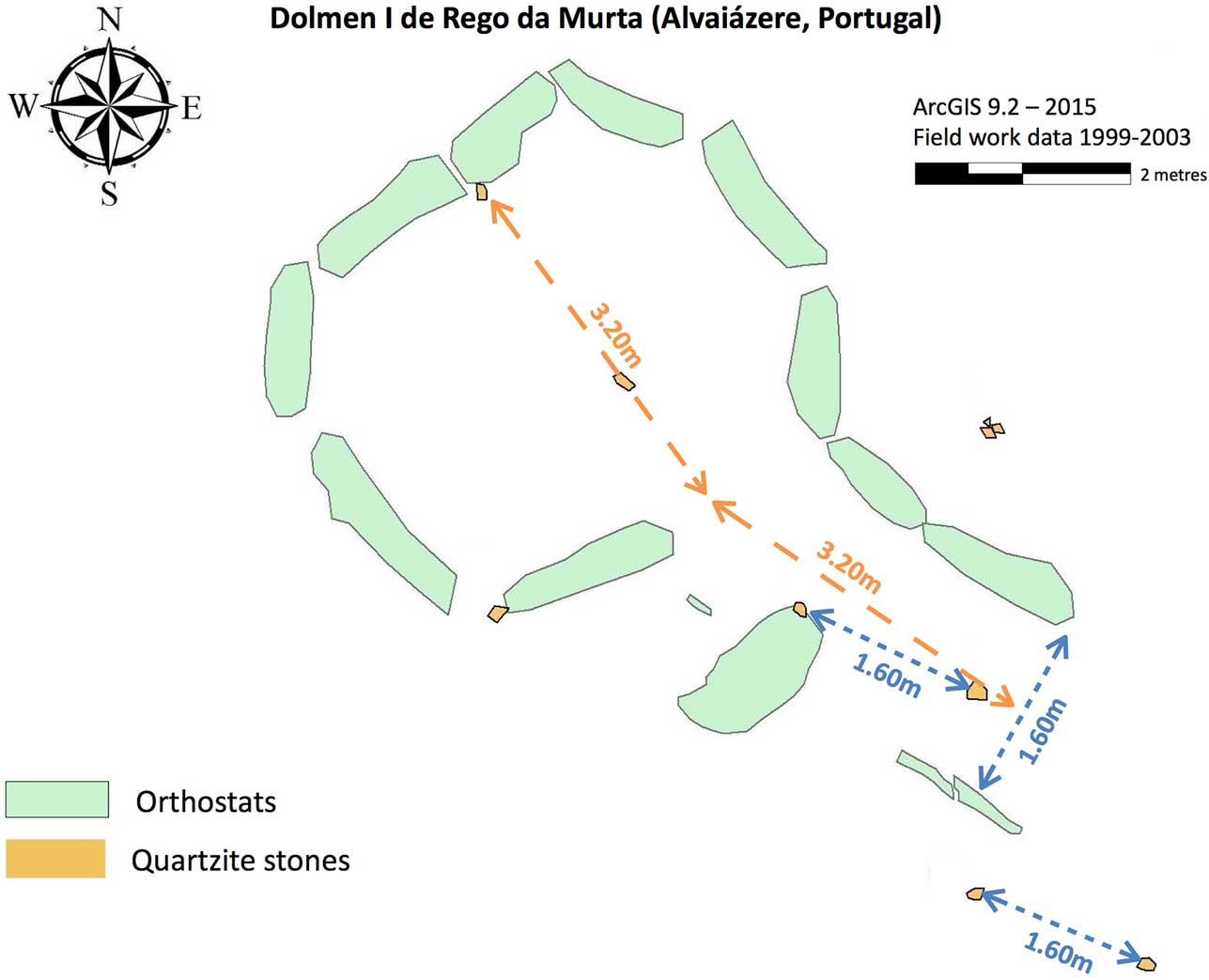
Our first observation was that the stone pairs E–F and G–H are relatively equidistant at 1.60 m apart (Figueiredo Reference Figueiredo2006). This distance is exactly the same as the width of the corridor, as well as half the diameter of the chamber and half the length of the corridor (Fig. 7). These observations suggest a possible standard unit of measurement or the use of an instrument (possibly made from a perishable material such as wood) for the purpose of placing the stone markers and laying out the megalithic structure.
Key lengths and widths of the dolmen’s chamber and corridor, as well as between stone pairs E–F and G–H

It is interesting to note that the smallest length identified (1.60 m) is close to the length of two Megalithic Yards (1.66 m), the unit of measurement claimed by Alexander Thom (Reference Thom1962) to have been used in the construction of British megalithic structures. However, the significance of the Megalithic Yard has recently been downplayed, as the available data were also consistent with, for example, a human pace. Monuments could have been ‘set out by pacing, with the ‘unit’ reflecting an average length of [a] pace’ (Ruggles Reference Ruggles1999, 83); this is a likely interpretation for the lengths identified here, since the Portuguese passo (pace), as recorded in the 19th century, is similarly 1.65 m (Silveira Reference Silveira1868).
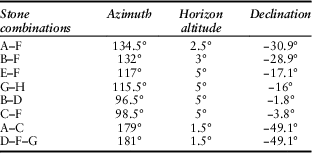
Table 2 includes eight of the most meaningful orientations provided by combinations of these small stones. Such a selection of combinations is always an exercise in subjectivity, therefore we have chosen to include only those orientations that are formed by stones located in what appear to be key architectural locations such as the midpoint of the backstone (stone A), the midpoint of the chamber (stone B), and the entrance of the corridor (stone F). In addition, we have highlighted combinations that are repeated twice by different stone pairs. Out of the 28 possible combinations of two stones, we include seven that are close to other orientations of interest. To these, we add one combination of three stones (out of 56 possible combinations).
Orientation of the quartzite stone combinations, including their azimuth, altitude of the horizon along that azimuth, and corresponding celestial declination

Some of these combinations are within a couple of degrees of the orientation of the corridor of the structure (eg, A–F & B–F). Others match the orientation of a conspicuous hilltop on the horizon (eg, E–F & G–H). Both of these will be discussed in more detail below. Other combinations might have served as indicators of the cardinal directions. Stone combinations A–C and D–F–G indicate north–south directions with fairly good accuracy, whereas stone pairs B–D and C–F point 7–9° south of a true east–west direction.
Their locations within the structure and the similarity of their orientations to the monument’s orientation (measured using the traditional methodology) suggest that the quartzite stones may have been used in planning the construction of the monument, which would have included the marking of its orientation prior to construction. How this would have occurred, and what was the role of the stones placed outside of the megalithic structure (stones D, G, & H), we do not know. Nevertheless, we hope that we can test and further refine this working hypothesis with future research and possible new finds in other structures of the megalithic cluster and elsewhere.
The orientation of Dolmen I
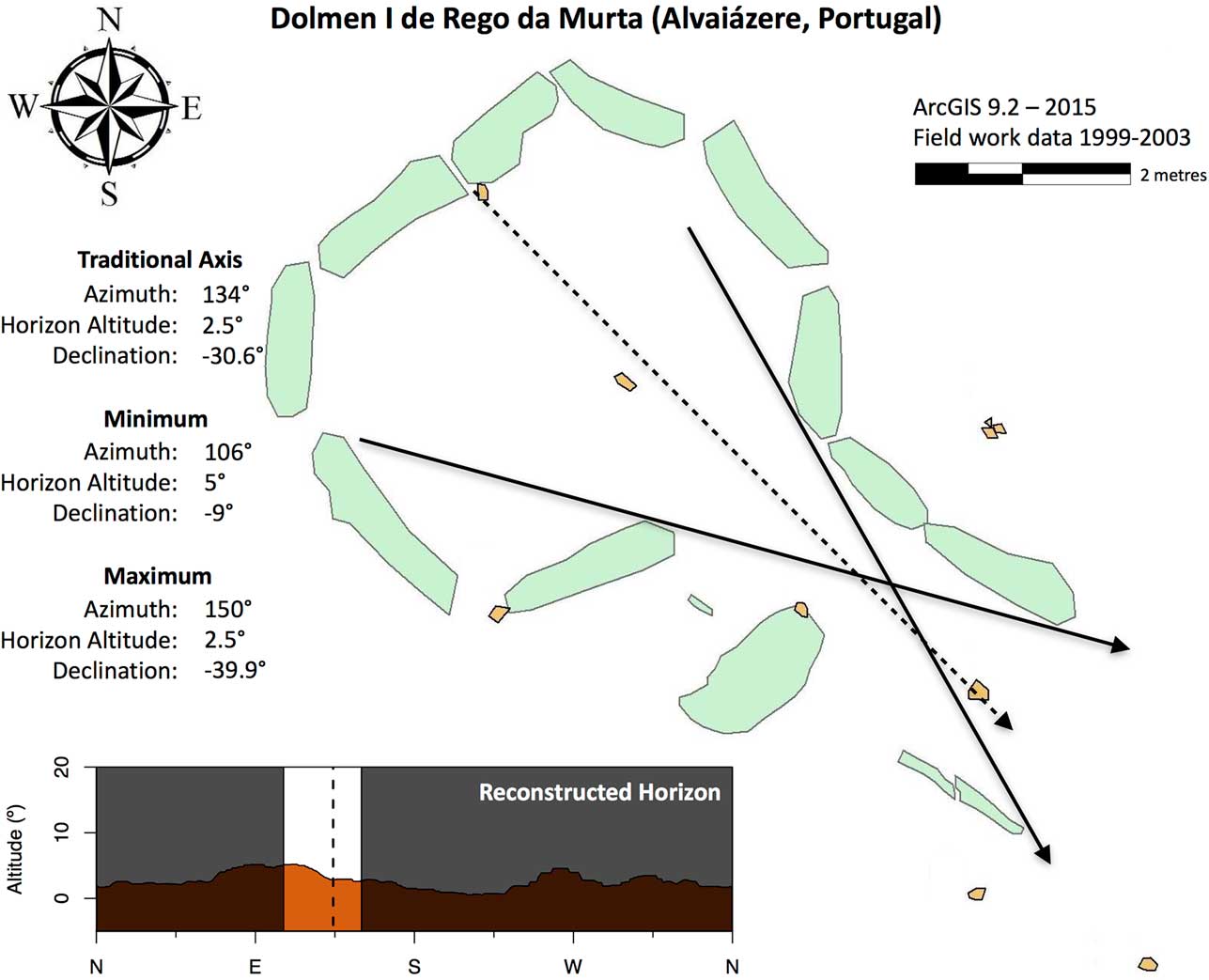
The traditional axis of symmetry of Dolmen I (dotted arrow in Fig. 8) shows a declination of –30.6°, which is very close to the orientations of stone pairs A–F and C–F, as mentioned above. In terms of the landscape, this orientation does not match any particularly interesting orographic feature (see the dotted line in the reconstructed horizon of Fig. 8). In terms of the skyscape, this orientation is outside the range of sunrise, which for the period under consideration occurs between declinations +24.0° and –24.0°. However, the moon can rise to an extreme position (covering declinations ±29.2°) that the sun never reaches in what is known as a major standstill year, which occurs once every 18.6 years. Knowledge of the moonrise in such a year is well documented in many cultures (eg, Malville Reference Malville2015), and its unique features when associated with the solstices provide another possible reason for considering it a potential target of an alignment (eg, Sims Reference Sims2016). An alternative suggestion is the Southern Cross constellation which, during the Late Neolithic, would have its top-most star, Gacrux, rise at this horizon point.
The measured orientations of Rego da Murta Dolmen I (arrows) and its reconstructed horizon (inset at bottom)

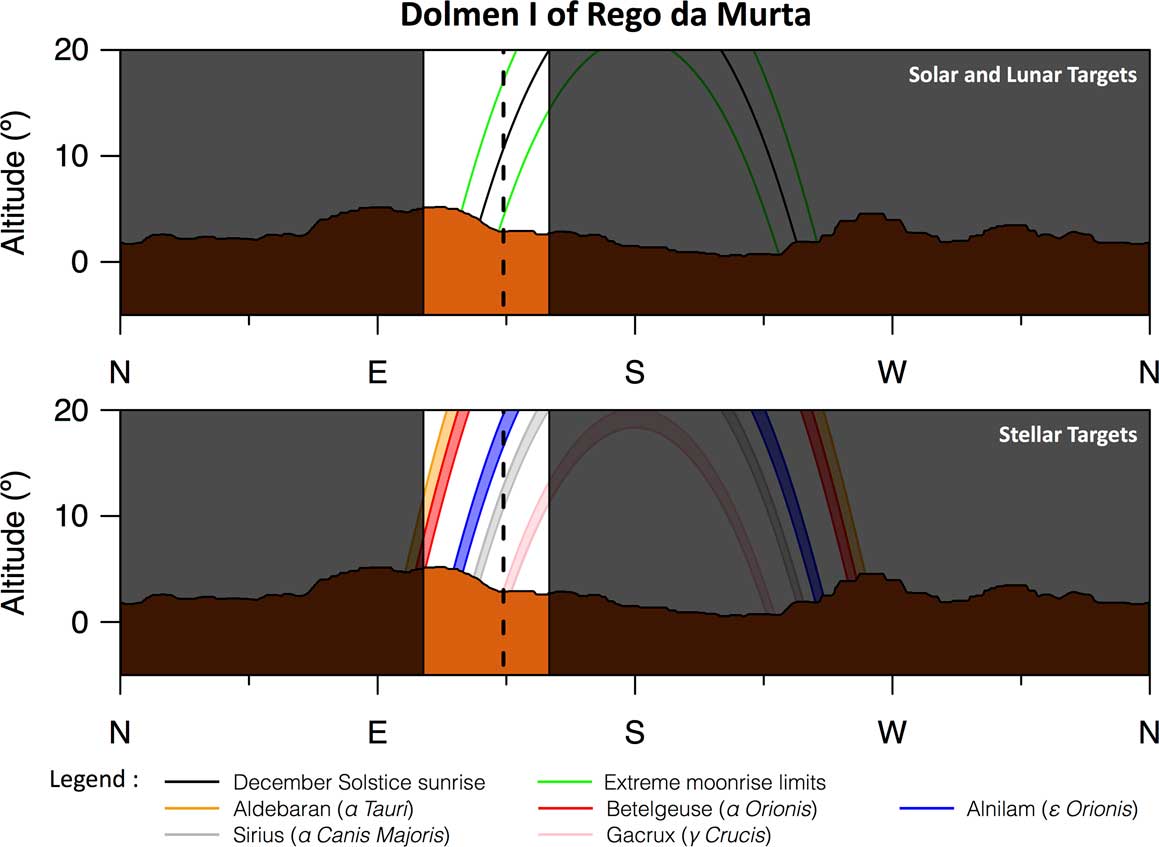
The window of visibility (the solid arrows and non-shaded area of the reconstructed horizon of Fig. 8) reveals a broader view that allows for more options. The window is centred on a downward slope, from which the sun would have risen on the December solstice (Fig. 9, top). From the same exact spot rose Sirius, the brightest star in the night-sky, a possible alternative target. The view from this dolmen also encompasses one hilltop. The orientation toward this hilltop might have been important for the megalith builders, as it also matches the orientation of stone pairs E–F and G–H (Table 2). This might have marked the position of moonrise on a minor standstill year (the other extreme of the 18.6-year cycle mentioned above, covering declinations ±18.9°), although here the coincidence of orography and moonrise is not as accurate as in the aforementioned scenario. With the same level of accuracy, this hill also marked the location where the three stars of Orion’s belt (including Alnilam, the brightest of the three), recognisable even in the light-polluted skies of modern metropolises, rose in the Late Neolithic (Fig. 9, bottom).
Reconstructed horizon of Rego da Murta Dolmen I with its window of visibility highlighted (area not shaded in grey) and traditional axis of symmetry (dashed vertical line). Also represented are: the orbit of the sun on the December solstice (top), the moon at its most extreme southern positions (top), and the five stars discussed in the main text: Aldebaran, Betelgeuse, Alnilam, Sirius, and Gacrux (bottom)

The orientation of Dolmen II
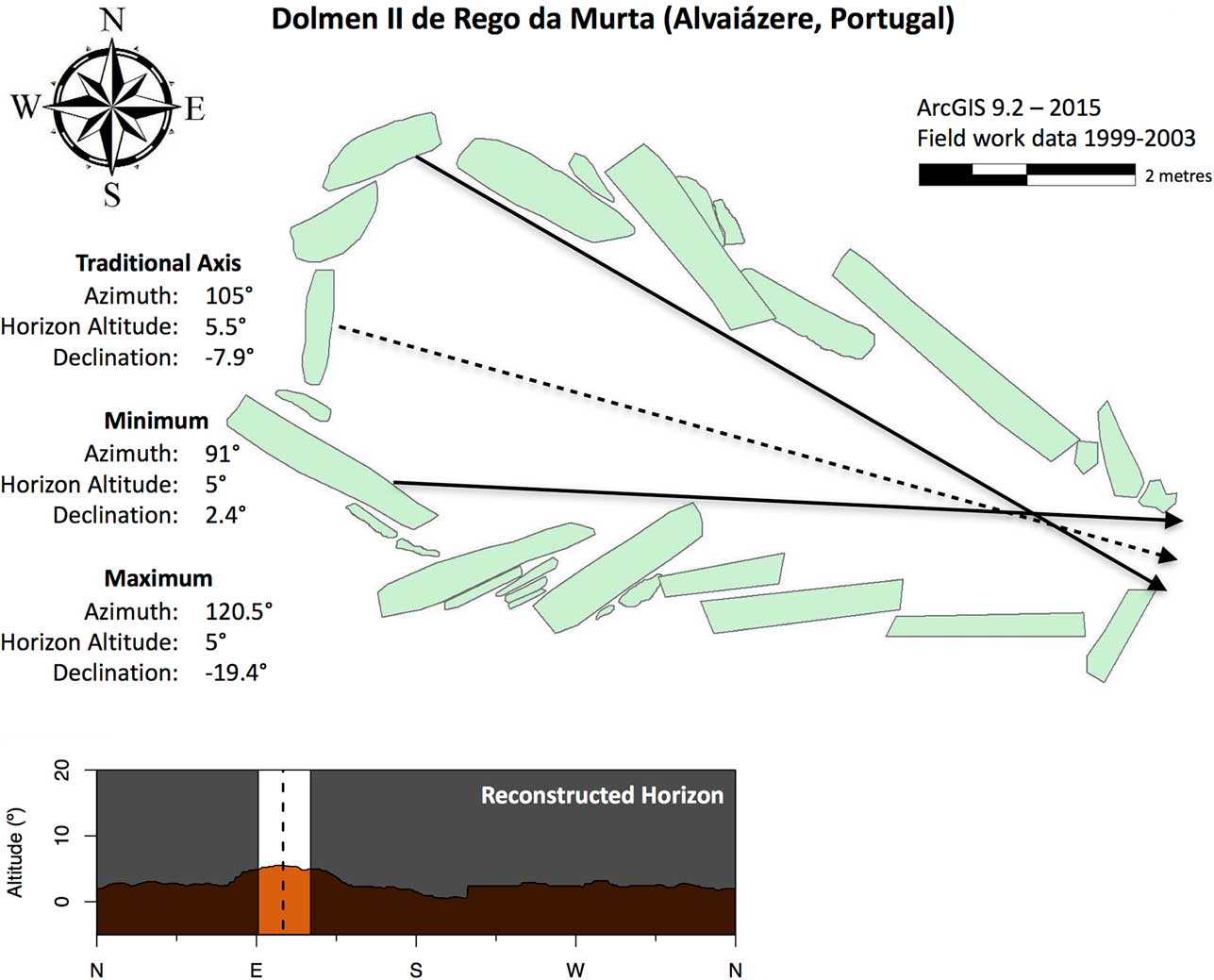
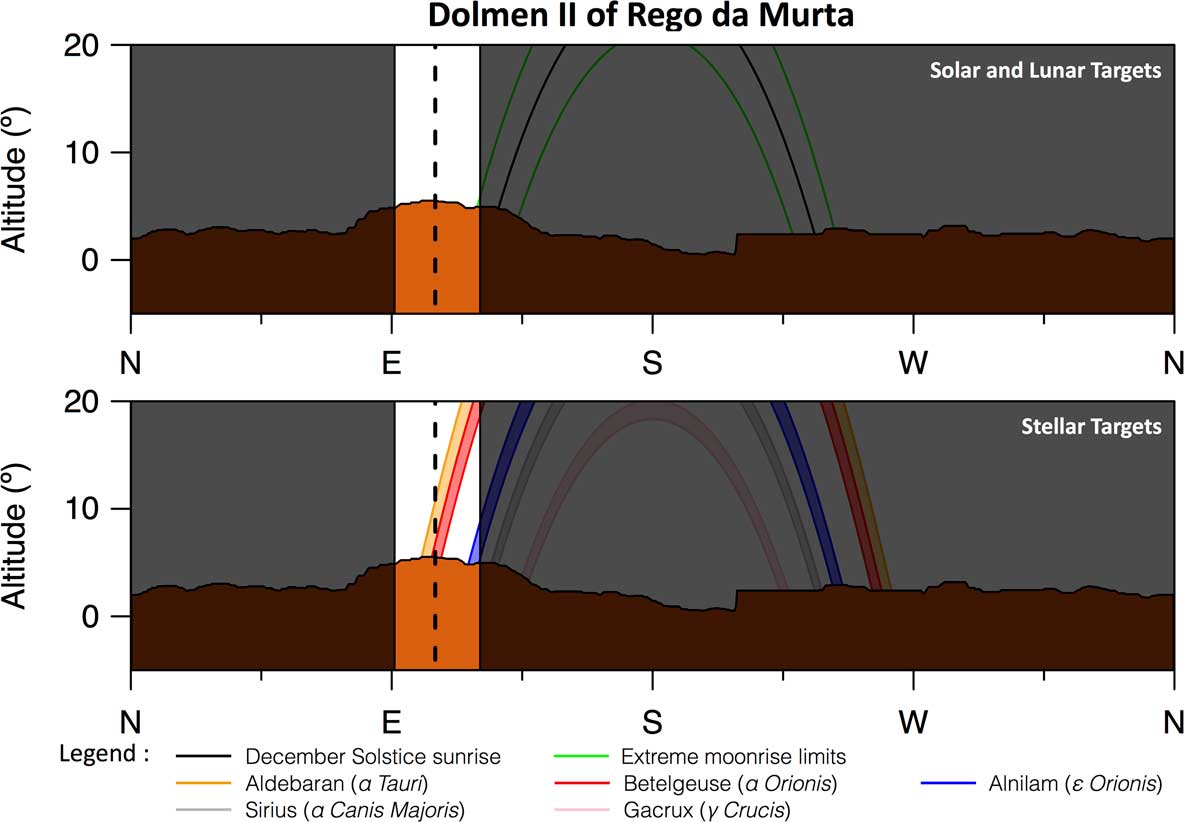
Turning our attention to Dolmen II, the traditional axis of symmetry is –7.9°, which is a 23° difference of declination from that of Dolmen I. However, because Dolmen II is situated 250 m north of Dolmen I, it is still orientated towards the same hill discussed above (Fig. 10). Because the view from this dolmen is also narrower than that from Dolmen I, it gives more prominence to this conspicuous hilltop – the only orographic feature worthy of note in this megalithic cluster’s eastern horizon. Due to its northwards shift and the narrower window of visibility, the corridor of Dolmen 2 excludes most celestial events mentioned for Dolmen 1 (Fig. 11).
The measured orientations of Rego da Murta Dolmen II (arrows) and its reconstructed horizon (inset at bottom)

Reconstructed horizon of Rego da Murta Dolmen II with its window of visibility highlighted (area not shaded in grey) and traditional axis of symmetry (dashed vertical line). Also represented are: the orbit of the sun on the December solstice (top), the moon at its most extreme southern positions (top), and the five stars discussed in the main text: Aldebaran, Betelgeuse, Alnilam, Sirius, and Gacrux (bottom)

This orientation is harder to explain as targeting the sun or moon, since it is far away from their most extreme rise positions (Fig. 11, top). However, this view would capture sunrise in the months immediately preceding the March equinox (ie late modern winter) and immediately succeeding the September equinox (modern autumn). It would equally capture moonrise of two or three full moons just after the March equinox, including the spring full moon (da Silva Reference da Silva2004; Silva & Pimenta Reference Silva and Pimenta2012), and two or three full moons just before the September equinox.
The view, and indeed the traditional axis of symmetry, highlights the peak of the aforementioned hilltop. For the time period under consideration, this declination range matched that of the very bright red stars Aldebaran and Betelgeuse (Fig. 11, bottom), which have already been suggested as possible targets for other megalithic clusters in both the north and south of Portugal (Silva 2013a; 2013b; Reference Silva2015).
Interpretative hypotheses
The two dolmens of this cluster have orientations differing by about 30° of azimuth (23° of declination) and windows of visibility that exclude most commonalities between them, particularly in terms of the sky captured by their views. In addition to the null hypothesis that their orientation was arbitrary, one can formulate three potentially testable hypotheses to account for this significant difference.
The first hypothesis is that the orientation of the two structures might target the hilltop on the horizon and not any celestial object. The fact that both structures target the same hilltop, albeit different sections of it, suggests that it was significant to these Late Neolithic/Chalcolithic communities. This hypothesis could be strengthened by finds of other megalithic structures orientated towards this hill in its vicinity, as well as potential archaeological finds on the hilltop itself, which is a mere 2 km away from the Rego da Murta cluster.
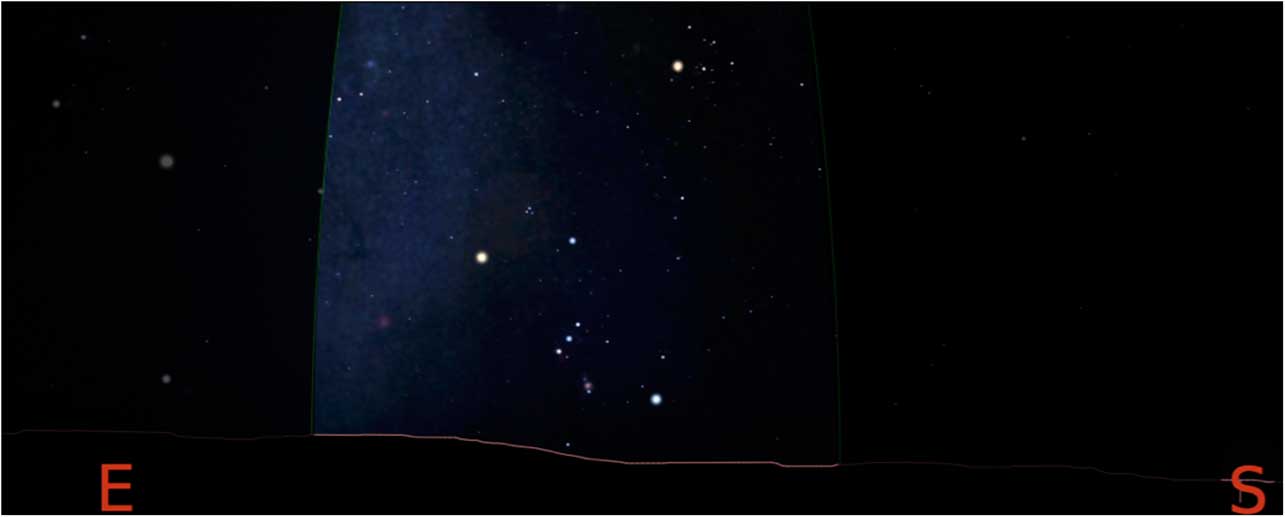
A second hypothesis is that, despite their different central axes, the two monuments target and align with a single celestial object, in addition to aligning with the same hill. This hypothesis can be fleshed out by finding a pattern within the windows of visibility of the two dolmens, rather than thinking in terms of central axes (Silva Reference Silva2014). Comparing their ranges, one finds that there is a small but considerable overlap in declination (−9° to −18.5°). The stars Betelgeuse and those of Orion’s belt are the only celestial objects of note that match this declination range for the period under consideration (compare Figs 9 & 11, bottom; see also Fig. 12).
Orion rising, as seen from within the chamber of Rego da Murta Dolmen I (the parts of the sky not visible are greyed out). Betelgeuse is the bright star on the top left of Orion. Aldebaran, another bright star, is also visible at the very top, on the right. Reconstruction created using Stellarium v0.15.1 (http://www.stellarium.org)

The third hypothesis is that the two monuments target different celestial objects. Dolmen I could be targeting the sunrise in or around the December solstice, the full moon around the June solstice, the star Sirius, or the Southern Cross constellation. This is a rich part of the sky and, without any complementary and independent evidence, it is impossible to choose one target over the others without making assumptions. On the other hand, Dolmen II could be targeting the spring full moon, or the stars Aldebaran and Betelgeuse. This hypothesis could imply a transition of the dolmen builders’ cosmology, but as the currently available radiocarbon dates suggest contemporaneous primary deposition in both structures, a better interpretation might be that of complementarity. This could mean that the two structures were not meant to replicate one another in orientation, but instead form a cohesive whole, targeting different objects that were important to their builders. In this regard, it is interesting to note that such complementarity was also materialised in the different morphologies of the two structures, as well as in the way they were treated and internally modified in the periods following their erection.
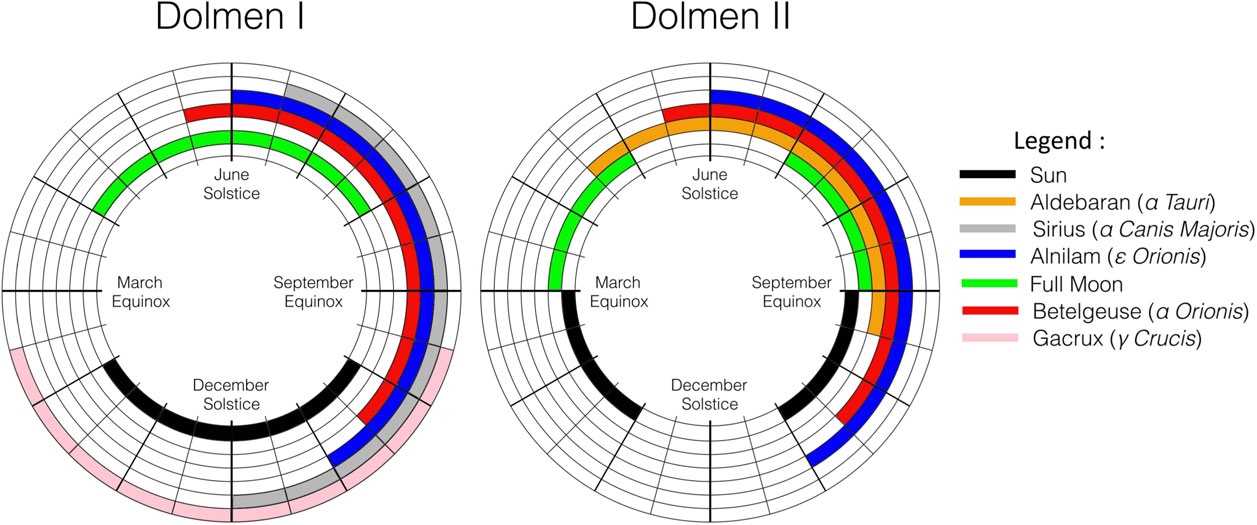
When considering potential celestial targets, it is very important to consider their seasonality. Sun and moon do not rise and set on the same spot on the horizon throughout the year. And although stars always rise and set on the same spot, they cannot be seen to rise every night of the year. Hence when seasonality can be inferred from the archaeological record, it can help falsify or constrain the various archaeoastronomical hypotheses. Figure 13 graphically shows the seasons in which the targets mentioned thus far could be seen to rise in alignment with the two dolmens, rounded to the nearest fortnight. The sun and Gacrux alone act as visible targets in the colder half of the year, whereas all the other targets emphasise the warmer half, especially the modern summer, with the spring full moon and Aldebaran being the only spring targets visible from Dolmen II.
Seasonality of observable celestial rises from within the chamber of the two dolmens. Coloured regions indicate the corresponding celestial object that can be seen as it is rising

A better understanding of the seasonality of occupation and use of the megalithic cluster could help discern between the potential celestial targets and exclude several, if not most of them. It could also help discern between the aforementioned hypotheses, since only two of the targets considered (Betelgeuse and Alnilam) overlap between the two structures. Unfortunately, the megalithic cluster’s seasonality of occupation, as inferred from the archaeological record, is inconclusive. Access to the dolmens would have been difficult in winter as they are located on floodplains, which might preclude any winter alignments. However, based on the presently available data, or lack thereof, we refrain from speculating any further, but hope to return to these hypotheses later when more evidence is available.
Conclusion
We have remarked on the finding of eight small quartzite stones in Rego da Murta Dolmen I, which were embedded in its deepest layers and predate the erection of the megalithic monument. Their location relative to the dolmen’s orthostats, the distances between them that mirror key lengths of the megalithic structure, and their orientations are indicative of their use in planning the orientation and construction of the monument (Figueiredo Reference Figueiredo2006, 170). This is a rare West Iberian example that demonstrates a sense of planning, forethought, and coordination, as well as some standardisation of measurement and the possible erection of preliminary structures to aid in the orientation and construction of the megalithic monuments. Considering the fortuitous nature of the discovery of the quartzite stones, it may be that they are present at other sites too. With this paper we hope to highlight their potential significance so that future excavators will take their presence seriously if found on their sites.
The quartzite stones that were found outside the chamber and corridor do not appear to have been of use in laying out the monument’s architecture or orientation, based on their position and orientation. They might be indicative of further complexities in the monuments’ construction, assuming they were purely functional, or perhaps they suggest that the quartzite stones had some symbolic, possibly cosmological, character that escapes our present understanding. In order to further explore these hypotheses, as well as the others suggested in this paper, more evidence is needed.
We have also measured and analysed the orientation of the two dolmens of the Rego da Murta cluster. Their orientations focus around a particular hilltop on the horizon, which may betray intention on the part of their builders. However, their morphological differences are also reflected in their orientations, which differ by about 20° of declination, excluding most commonalities in potential celestial alignments. We considered and discussed possible celestial targets, including the sun, moon, and stars, the most prominent of which are Aldebaran and those of the modern constellation Orion (see Fig. 12). These have already been suggested as celestial targets and seasonal markers for the megalith-building communities of the Mondego valley, to the northeast of Rego da Murta, and beyond (eg, Silva Reference Silva2015). Other possibilities include full moonrise in the warmer half of the year or sunrise in the coldest.
So as to better constrain, and indeed exclude most, potential celestial targets, we argue that an improved understanding of the seasonality of use and occupation of the Rego da Murta cluster is essential. We hope that future excavations of the remaining structures, as well as surveys of the surrounding landscape, might provide further clues.
Acknowledgements: We thank the three reviewers for their comments on an earlier draft of this paper, which strengthened it considerably. Fabio Silva has received funding from the European Union (EU)’s Horizon 2020 research and innovation programme under the Marie Skłodowska-Curie Individual Fellowships/H2020-MSCA-IF-2014 Grant Agreement n. 656264.