Introduction
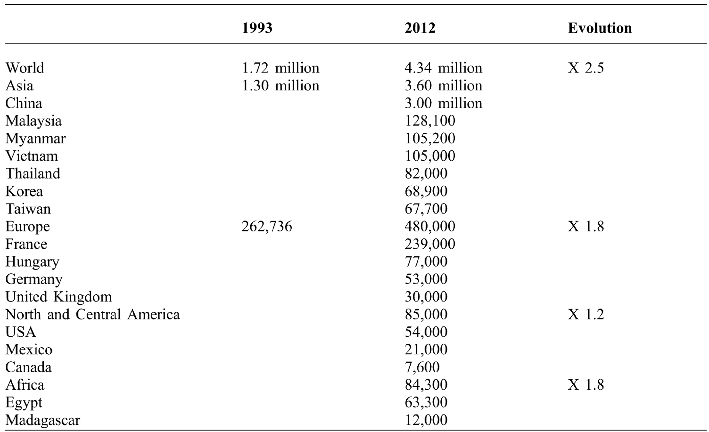
World duck production has increased considerably since 1993, and meat production has risen from 1.72 to 4.34 million tons (Deman, Reference DEMAN2014). Asia is the leading production region and this is where the industry is expanding most rapidly. Asia accounted for 76 and 83% of duck meat output in 1993 and 2012, respectively (Table 1, FAO statistics, 2014), and of this, China's contribution represented 86%. The next largest producers are Malaysia, Myanmar, Vietnam, Thailand, the Republic of Korea and Taiwan. Europe represents the second highest production region, with France being the leading producer. Next in order is Hungary, followed by Germany and the UK. Production in North and Central America is dominated by the USA followed by Mexico and Canada. In Africa, the industry is mainly focused in Egypt and Madagascar. Less than 4% of duck meat production was exported, according to these statistics. In 2011, the main exporters were China (42,616 tons), Hungary (23,670), Germany (20,129 tons) and The Netherlands (17,511 tons) and the main importers for Asia and Europe were Japan (4,865 tons) and Germany (16,232 tons).
Duck meat production (tons) in the world (FAO statistics, 2014).

The most common breed used to produce duck meat are Pekin, Muscovy (mostly in France) and mule ducks - a hybrid resulting from the cross between male Muscovy duck, Cairina moschata, and female Pekin, Anas platyrhynchos, used mostly in France for the production of foie gras, and Taiwan. Other duck species, such as Jinding and Shao ducks in China, Tsaiya ducks in Taiwan, Khaki Campbell, Indian runner and Desi ducks in India, Vietnam, Cambodia and Indonesia, are used mainly for egg production with meat as a by-product (Pingel, Reference PINGEL2004).
Different production systems are used in the world. In developed countries, ducks are mainly reared intensively in total-confinement housing which may have some access to pasture (free-range, organic or ‘label rouge’ systems, mule ducks reared for foie gras production) and sometimes access to water for swimming. In Asia, extensive systems such as fish-duck farming are widely used, ducks being housed above fishponds (Prinsloo et al., Reference PRINSLOO, SCHOONBEE and THERON1999; Syed, Reference SYED2002). Ducks may be reared in rice fields to decrease feed costs (Men et al., Reference MEN, OGLE and LINDBERG2002a; Reference MEN, OGLE and LINDBERG2002b).
As seen in marketing from other poultry species, the industry has developed cut and processed duck products. The meat yield of ducks has therefore increased and carcass fatness decreased owing to genetic selection and improvements in duck management, particularly in nutrition. This review presents the requirements of meat type ducks for energy, crude protein (CP) and amino acids (AA) and for minerals, vitamins and trace-elements, and presents recommendations regarding feed management. As the growth rate, the efficiency and body composition of Pekin, Muscovy and mule ducks are different, the specific features of each breed are addressed. The review focuses on ducks reared in intensive production systems.
Energy
According to Leclercq (Reference LECLERCQ1990), the duck's energy requirement in conditions of thermal neutrality (25°C) can be estimated using the following equation:
E = 105 BW0.75 + 14 Prot + 11 Lip
whereby E = the daily energy requirement (MJ), BW = Body Weight (kg), Prot = the amount of daily stored proteins and Lip = the amount of daily stored lipids.
Ducks are able to regulate the amount of energy ingested via feed intake, and is considered non-responsive to variations in dietary energy level. Hence growth will be the same if fed high (12.54 MJ ME/kg) or low (10.45 MJ ME/kg) dietary energy levels, but feed consumption and the feed conversion ratio will be higher with low dietary energy levels than with high dietary energy levels. According to Scott and Dean (Reference SCOTT and DEAN1991), the Pekin duck is able to regulate the amount of energy ingested when the level is between 9.61 and 12.96 MJ ME/kg. For Muscovy ducks, the range of energy level variation is between 10.45 and 12.54 MJ/kg (Leclercq, Reference LECLERCQ1990).
Duck diets are usually formulated using ME values obtained from chickens, although a few studies have shown differences between the two species for some feedstuffs (Elkin, Reference ELKIN1987). For Pekin ducks, Adeola (Reference ADEOLA2006) recommended diets containing 11.81-12.02 MJ ME/kg for the starting period (up to two weeks of age) and 12.75-12.85 MJ ME/kg for the growing period (two to six weeks of age). The NRC (1994) requirements are 12.12 and 12.54 MJ ME/kg for the starting and growing periods, respectively. Recommended dietary energy levels for Muscovy duck are usually between 11.70 and 12.54 MJ ME/kg (INRA, 1989).
Fan et al. (Reference FAN, XIE, WANG, HOU and HUANG2008) analysed the effects of dietary energy on performance and carcass composition of growing Pekin ducks from two to six weeks of age. The dietary energy level varied between 10.87 and 12.96 MJ/kg whereas the crude protein, methionine, cysteine and lysine content was similar for all diets (180, 4.0, 3.2 and 9.0 g/kg, respectively). This study showed that the apparent metabolisable energy (AME) requirements for optimal weight gain and FCR were 12.57 and 12.66 MJ/kg, respectively. Dietary energy level had no effect on carcass composition except for the proportion of abdominal fat, which was lower for diets providing 10.87 and 11.29 MJ/kg than with the other diets.
Xie et al. (Reference XIE, ZHAO, HOU and HUANG2010) determined the AME requirement of Pekin ducklings from hatching to three weeks of age. The dietary energy level varied between 10.26 and 12.75 MJ/kg whereas the crude protein, methionine, cysteine, lysine, threonine and tryptophan content was similar for all diets (205, 5.2, 3.5, 11.0, 7.8 and 2.4 g/kg, respectively). This study showed that the AME requirement for optimal feed conversion efficiency was 12.63 MJ/kg. It was not possible to determine the requirement for optimal weight gain, however, the highest body weight at three weeks of age was obtained with the diet providing 12.75 kcal/kg (1.319 vs. 1.194 kg for the diet providing 10.26 kcal/kg). Energy level did not affect carcass meat yield, but the proportion of abdominal fat increased with higher energy from 0.58 to 0.94% with diets providing 10.26 and 12.75 kcal/kg, respectively.
Because of limited research, diet formulations for ducks use AME values obtained from chickens. However, the accuracy of using such data to formulate diets for ducks is questionable. Siregar et al. (Reference SIREGAR, CUMMING and FARRELL1982) showed that, unlike chickens, the AME of conventional duck diets declined as they aged. On the other hand, Martin and Farrell (Reference MARTIN and FARRELL1998) found that the AME value of lipids in rice bran increased from 15.6 to 17.9 MJ/kg between three to seven and 17 to 21 days of age. Corresponding values for chickens at similar ages were 10.5 and 13.0 MJ/kg. Several studies have been conducted to determine apparent and true metabolisable energy of a variety of grains, meals and by-products for ducks (Adeola, Reference ADEOLA2006; Hoai et al., Reference HOAI, KINH, VIET, SY, HOP, OANH and YEN2011; Table 2). The hierarchy of energy values for the grains and meal is the same for ducks and broilers. Of the grains examined so far, energy values for barley, rye and triticale are significantly lower than corn, sorghum or wheat. It is necessary to state that values obtained by Adeola (Reference ADEOLA2006) were obtained by using the total faeces collection method.
Apparent metabolisable energy (AME), nitrogen-corrected apparent metabolisable energy, true metabolisable energy and nitrogen-corrected true metabolisable energy, expressed as MJ/kg of feed ingredients for white Pekin ducks (Hoai et al., Reference HOAI, KINH, VIET, SY, HOP, OANH and YEN2011; Adeola, Reference ADEOLA2006).
nd = not determined
It is generally assumed that the ME values of individual feedstuffs can be added together to match the required energy supplied by the diet. This assumption was tested and verified with a complete barley-canola meal diet (Hong et al., Reference HONG, RAGLAND and ADEOLA2001) and a corn-wheat red dog-soybean meal diet (Hong et al., Reference HONG, RAGLAND and ADEOLA2002a). Zhao et al. (Reference ZHAO, ZHANG, HOU and ZHANG2008) and Wan et al. (Reference WAN, CHEN, QI, PENG and PENG2009) showed that neutral detergent fibre (NDF) content could be used as an effective indicator to predict the true metabolisable energy (TME) value of corn and wheat milling by-products, respectively, for ducks.
Protein and amino acids
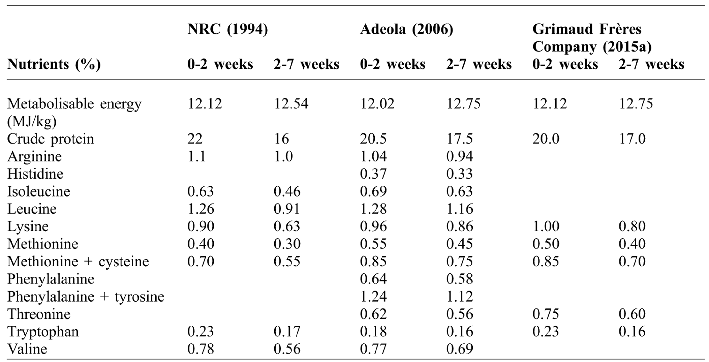
The recommendations for dietary protein and amino acid (AA) content for Pekin ducks are given in Table 3. For most duck diet formulations, methionine, lysine, threonine and tryptophan are the most common limiting AA. Elkin et al. (Reference ELKIN, STEWART and ROGLER1986) reported that one-day-old male Pekin ducklings required between 3.82 and 4.22 g methionine/kg diet during the first 12 days of life. Xie et al. (Reference XIE, HOU, HUANG, ZHAO, YU, LI and WU2004) estimated the optimal methionine and cysteine requirements of Pekin ducklings from hatching to 21 days of age to be 4.81 and 3.25 g/kg, respectively. Between 21 and 49 days of age, the optimal methionine requirement was 3.8 g/kg (Xie et al., Reference XIE, HOU and HUANG2006). According to Bons et al. (Reference BONS, TIMMLER and JEROCH2002), the dietary lysine concentration should be 11.7 g/kg for the starter period (until 21 days of age) and 10.0 g/kg for the grower period (from 22 days until slaughter). Xie et al. (Reference XIE, GUO, ZHANG, HOU and HUANG2009) evaluated the dietary lysine requirement from 7 to 21 days of age at 9.8 g/kg. With a diet containing 180 g/kg CP and 12.50 MJ/kg, Timmler and Rodehutscord (Reference TIMMLER and RODEHUTSCORD2003) estimated the optimal dietary valine levels to be 8.0 g/kg for ducks in the first three-weeks post-hatching. Zhang et al. (Reference ZHANG, XU, DOSTER, MURDOCH, COTTER, GARDNER and APPLEGATE2014) estimated the threonine requirement to be 8.0 g/kg from 15 to 35 days. Between 1 and 21 days of age, arginine requirements were determined to be 9.5, 11.6 and 9.9 g/kg for optimal weight gain, FCR and breast meat yield in ducks, respectively (Wang et al., Reference WANG, XIE, HUANG, XIE, TANG and HOU2013).
Protein and amino acid requirements of white Pekin ducks.
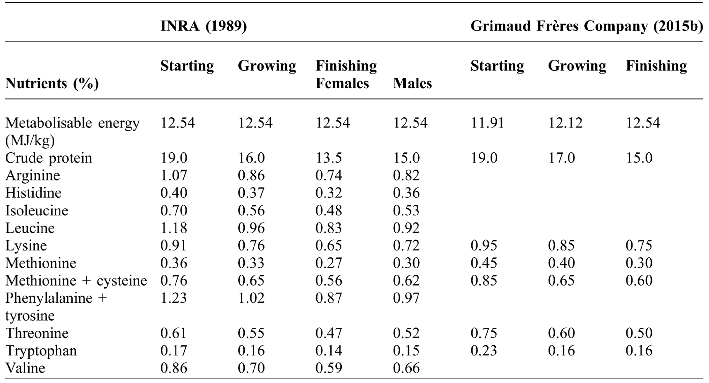
The recommendations for dietary protein and AA content for Muscovy ducks are given in Table 4. Leclercq and De Carville (Reference LECLERCQ and DE CARVILLE1977) reported that male Muscovy ducklings required 6.0 and 5.5 g total sulphur AA/kg for maximum growth from three to six and six to 10 weeks of age, respectively, with diets containing 155 or 130 g CP/kg and 12.48 or 12.92 MJ ME/kg, respectively. The three to six week lysine requirement was estimated to be 6.0 g/kg (i.e. 2.2 g lysine per 4.18 MJ ME), representing an absolute intake of 21 g lysine over that period (Leclercq and De Carville, Reference LECLERCQ and DE CARVILLE1979). The six to 10 week lysine requirement was calculated to be 1.96 g lysine per 4.18 MJ ME, representing an absolute intake of 30-35 g lysine over the period (Leclercq and De Carville, Reference LECLERCQ and DE CARVILLE1979). For threonine, Leclercq (Reference LECLERCQ1998) estimated the dietary requirement to be 3.97 g/kg between eight and 12 weeks of age.
Protein and amino acid requirements of Muscovy ducks.
Starting period = 0-3 weeks for females and 0-4 weeks for males
Growing period = 3-6 weeks for females and 4-8 weeks for males
Finishing period = 6-10 weeks for females and 8-12 weeks for males
For mule ducks, Baéza et al. (Reference BAÉZA, BERNADET and LESSIRE2012) showed that 235, 154 and 138 g CP /kg levels gave optimal growth performance in the starting (day old to three weeks of age), growing (three to seven weeks of age) and finishing ( seven to 10 weeks of age) respectively for diets containing 12.18 MJ kcal/kg. Chen and Shen (Reference CHEN and SHEN1979) reported that for maximum weight gain and feed efficiency from nine to 21-days old, the minimum dietary requirements for lysine and arginine were 10.6 and 10.8 g/kg, with diets containing 11.82 MJ and 11.75 MJ ME/kg, respectively. The minimum dietary tryptophan level required for maximum growth and feed efficiency between 8 and 20 days of age was 2.3 g/kg with a diet containing 12.59 MJ/kg and 180 g/kg CP (Wu et al., Reference WU, WU and SHEN1984). The minimum dietary requirements for leucine, isoleucine and valine between eight to 20 days of age were 12.6, 6.3 and 7.8 g/kg, respectively (Yu and Shen, Reference YU and SHEN1984). Lin and Shen (Reference LIN and SHEN1994) showed that the minimum requirement of phenylalanine plus tyrosine was 11.1 g/kg between day old and three weeks of age.
Diets for ducks are usually formulated by using total AA requirement or the digestibility coefficients of AA determined for broilers, although studies have shown that coefficients may be lower for ducks compared to broilers (Helmbrecht, Reference HELMBRECHT2012). There are few studies on AA utilisation in feed ingredients for ducks. A comparison of digestibility coefficients for the essential AA in corn, barley, bakery meal, canola meal, soybean meal and wheat red dog revealed considerable variations (Adeola, Reference ADEOLA2006). In general, true digestibility of essential AA is lower in barley than in corn; and much lower in canola meal than in soybean meal. Digestibility coefficients for most of the essential AA in canola or soybean meals are greater than 80%. By comparing diets containing threonine levels of 5.7 to 8.0 g/kg, Zhang et al. (Reference ZHANG, XU, DOSTER, MURDOCH, COTTER, GARDNER and APPLEGATE2014) calculated the apparent ileal digestibility (AID) of threonine between 73 and 83%. The assumption of additivity of individual feed ingredients was tested with two different diets (barley with canola meal, and corn, wheat red dog with soybean meal; Hong et al., Reference HONG, RAGLAND and ADEOLA2001; Reference HONG, RAGLAND and ADEOLA2002a). Whilst the true digestibility values were additive for most AA, significant exceptions were observed for arginine, histidine, lysine, tryptophan and aspartate. True digestibility values of some AA are thus not additive, demonstrating some combined effects that vary with the ingredient matrix (Hong et al., Reference HONG, RAGLAND and ADEOLA2001; Reference HONG, RAGLAND and ADEOLA2002a).
A diet providing 12.59 MJ ME/kg and 182 g CP/kg, supplemented with 10 g/kg L-arginine to Pekin ducks between 21 and 42 days of age, decreased carcass fatness and increased meat yield in comparison to an unsupplemented group (Wu et al., Reference WU, FANG and GUO2011), and the lipid and protein content of breast muscle was increased.
Baéza and Leclercq (Reference LECLERCQ1998) examined the possibility of decreasing the CP concentration in finishing diets of Muscovy ducks by adding four essential AA in order to cover essential requirements. Feed consumption during finishing is economically important, as it represents nearly 50% of the total feed intake for male Muscovy ducks, and CP and AA requirements are lower. Unlike in broilers, FCR and fattening are not affected by decreased dietary CP concentration for ducks. In addition, reduced CP content can reduce nitrogen in excreta and litter, which is a source of environmental pollution. Baéza and Leclercq (Reference LECLERCQ1998) showed that it was possible to reduce the CP content of a finishing diet supplemented with the four essential AA to 12.4%, and there was no advantage in supplying more than 4.3 g digestible lysine/kg. When threonine was not added, breast yield decreased significantly (-4.3%), while omitting tryptophan supplementation did not influence growth performance or body composition. It will be interesting to test decreased dietary protein concentrations for the starting and growing periods by supplementing diets with essential and possibly non-essential AA by using the ideal protein concept developed for broilers according to Baker and Han (Reference BAKER and HAN1994) and Mack et al. (Reference MACK, BERCOVICI, DE GROATE, LECLERCQ, LIPPENS, PACK, SCHUTTE and VAN CAUWENBERGHE1999).
Minerals, vitamins and trace-elements
The recommendations for dietary mineral content for Pekin ducks are given in Table 5. Rodehutscord et al. (Reference RODEHUTSCORD, TIMMLER and WENDT2003) showed that Pekin ducks required dietary non-phytate phosphorus levels of 3.4 (one to 21 days of age) and 2.3 g/kg (21 to 49 days of age) based on phosphorus retention findings.
Mineral requirements of white Pekin ducks.
The recommendations for dietary mineral content for Muscovy ducks are given in Table 6. Leclercq et al. (Reference LECLERCQ, DE CARVILLE and GUY1990) stated that the best bone characteristics were obtained with 4.0 g non-phytate phosphorus and 8.4 g calcium/kg between three and eight weeks of age and 2.6 g non-phytate phosphorus and 4.3 g calcium/kg between eight and 12 weeks of age. Bernadet et al. (Reference BERNADET, NYS and GUY2002a; Reference BERNADET, NYS and GUY2002b) showed that the non-phytate phosphorus requirement for mule ducks was 3.1 and 1.4 g/kg for the starting (0-28 days of age) and growing (28-84 days of age) periods, respectively. Wendt and Rodehutscord (Reference WENDT and RODEHUTSCORD2004) reported that phosphorus availability for Pekin ducks depended on inorganic sources and ranged between 77 and 100% and this should be taken into account in diet formulation. Other research suggests that ducklings require approximately 1.4 g sodium and 1.2 g chloride/kg for maximum weight gain (Dean, Reference DEAN1972).
Mineral requirements of Muscovy ducks.
Starting period = 0-3 weeks for females and 0-4 weeks for males
Growing period = 3-6 weeks for females and 4-8 weeks for males
Finishing period = 6-10 weeks for females and 8-12 weeks for males
Vitamins and trace-elements
The recommendations for these nutrients are provided in NRC (1994), Adeola (Reference ADEOLA2006), Elkin (Reference ELKIN1987) and INRA (1989) (Table 7). The variability of these recommendations according to species and literature source, suggests that some values still need to be precisely determined.
Requirements of ducks for vitamins and trace-elements.
Wen et al. (Reference WEN, TANG, HOU, GUO, HUANG and XIE2014a; Reference WEN, HOU, TANG, FENG, HUANG, GUO and XIE2014b) recently revised the choline requirements of Pekin ducks to 810 and 823 mg/kg to optimise weight gain and feed intake during the starting (day old to three weeks) period and to 980 and 950 mg/kg to optimise weight gain and feed intake during the growing period (three to six weeks of age). To prevent excessive liver lipid deposition during the growing period, dietary choline concentration should be 1130 mg/kg. Halle et al. (Reference HALLE, HENNING and KÖHLER2011) reported that 20 µg/kg vitamin B12 is sufficient to meet the requirements of growing ducks. Further to this latter study, cobalt supplementation did not provide any additional benefits for the ducks. The riboflavin recommendation from hatching to 21 days of age is 3.3 mg/kg for Pekin ducks (Tang et al., Reference TANG, XIE, YANG, WEN, ZHU, HUANG and HOU2013). Attia et al. (Reference ATTIA, QOTA, ZEWEIL, BOVERA, ABD AL-HAMID and SAHLEDOM2012; Reference ATTIA, ABD AL-HAMID, ZEWEIL, QOTA, BOVERA, MONASTRA and SAHLEDOM2013) showed that dietary supplementation with 8 mg/kg copper and 30 ppm zinc from inorganic sources was optimal for growth performance of Pekin ducks from hatching to 56 days of age.
Feed management
Pelleted diets are utilised more efficiently by ducks than diets in mash form because of reduced wastage, which can reach 10 to 20%, and ease of consumption (NRC, 1994). Starter diets are usually fed as pellets of 3 mm diameter and 8 mm length and diets are 5 mm in diameter and 12 mm in length for grower feed.
Feed restriction is practised in duck production systems primarily to reduce feed cost. Tan et al. (Reference TAN, OHTANI and TANAKA1999) tested feed restriction to 80, 60 and 40% of ad libitum intake in Pekin ducks from seven to 14 days of age. The ducks ate the same starter diet (12.12 MJ ME/kg and 230 g CP /kg) from hatching to 21 days of age and the same finisher diet (13.38 MJ ME/kg and 190 g CP/kg) up to 47 days of age. At slaughter age, feed restriction was found to have no effect on body weight or carcass composition, but FCR was reduced by comparison with the ad libitum fed group (2.47 to 2.69 vs. 2.84). Leclercq and De Carville (Reference LECLERCQ and DE CARVILLE1978) tested slight (5%) and severe feed restriction (20%) between eight and 12 weeks of age in male Muscovy ducks. The 5% restriction had no effect on slaughter body weight or carcass composition, whereas the severe feed restriction had a negative impact on slaughter body weight (3,453 vs. 3,629 g) and breast yield (15.8 vs. 16.2%) and decreased carcass fatness. The Muscovy duck is able to compensate for earlier feed restrictions (25%) e.g. imposed between four and six weeks of age, with no effect on performance for the whole rearing period or carcass composition at 12 weeks of age (Baéza, Reference BAÉZA2000).
Another way to restrict feed intake is to dilute diets with feedstuffs containing high fibre. Wu et al. (Reference WU, GUO and FANG2012) tested 40 and 60% inclusion of rice hulls in the basal diet of Pekin ducks between eight and 14 days of age. Ducks were fed the same starter diet (12.13 MJ ME/kg and 210 g CP/kg) from hatching to 14 days of age and the same grower diet (12.55 MJ ME/kg and 180 g CP/kg) up to 42 days of age. The use of 40% rice hulls had no effect on body weight, FCR or meat yield at 42 days of age. Carcass fatness and lipid content of breast muscle were decreased whereas the protein content of carcass and breast muscle was increased. Guo et al. (Reference GUO, FANG and WU2013) confirmed that diluting the diet with 40% rice hull between eight and 14 days of age would be a suitable method to improve FCR and to reduce carcass fatness in the production of Pekin ducks. Whatever the feed restriction applied, it is important to provide sufficient access to feeders in order to avoid competition between ducks, heterogeneity in body weight and cannibalism behaviour.
Use of enzymes
As in broilers, the use of enzymes (xylanase, β-glucanase, amylase, cellulase, protease, phytase) for ducks can improve the nutritive values and digestibility of feedstuffs by reducing digesta viscosity (Timmler and Rodehutscord, Reference TIMMLER and RODEHUTSCORD2001; Adeola, Reference ADEOLA2006) and may decrease nitrogen and phosphorus in excreta (Hong et al., Reference HONG, BURROWS and ADEOLA2002b; Rodehutscord, Reference RODEHUTSCORD2006). For ducks, the use of enzymes appears to be more efficient during the starting and growing periods than during the finishing period. It allows the use of feedstuffs rich in phytic phosphorus and non-starch polysaccharides, and therefore decreases the need for mineral phosphorus in diets (Baéza et al., Reference BAÉZA, UZU and PREYNAT2010). The use of a diet containing 1.6 g/kg non-phytate phosphorus (versus 3.2 g/kg in the control diet) supplemented with 600 FTU phytase/kg between four and 13 weeks of age resulted in reductions of up to 26 g per mule duck of phosphorus in excreta (Bernadet et al., Reference BERNADET, NYS and GUY2004).
Feedstuffs
In practice, many duck diets closely resemble diets for chickens, being largely based on corn and soybean meal. However, several non-traditional nutrient sources are available for formulation into the diets of ducks worldwide. Broken rice, full fat rice bran and extracted rice bran are available in Thailand, and duck producers can use full fat rice bran and cassava in Vietnam. In Malaysia, Thailand and Indonesia, palm kernel cake is available and can be used at 10-15% (Creswell, Reference CRESWELL2012). Distiller's dried grain with solubles (DDGS) imported from the USA is available in all Southeast Asian countries and can be used at 10-15% (Creswell, Reference CRESWELL2012). Inclusion of up to 25% corn DDGS in the diet of Pekin ducks between 22 and 56 days of age had no adverse effect on growth performance, carcass composition at slaughter, chemical composition, pH or colour of breast meat (Kowalczyk et al., Reference KOWALCZYK, LUKASZEWICZ, ADAMSKI and KUZNIACKA2012). Peillod et al. (Reference PEILLOD, MANCINI, METAYER, SKIBA and LABORDE2010) showed that it was possible to include up to 24% corn DDGS in growing and finishing diets without negative effect on growth performance of mule ducks. The main inconvenient of DDGS is the high variability of chemical composition due to processing conditions. Wheat is available in several Asian countries (imported from Australia) and Europe, and wheat milling by-products (bran, pollard) can be used. Copra, cottonseed and groundnut meals are suitable ingredients for ducks, but testing for aflatoxins is recommended before use (Creswell, Reference CRESWELL2012), as ducks are particularly susceptible. It is for this reason that binders are often included in duck feed formulations to minimise the mycotoxin risk.
Jiang et al. (Reference JIANG, SONG, HUANG, WU, ZHOU, ZHENG and JIANG2012) showed that 3, 6 or 9% dietary alfalfa meal introduced in the diet between 14 and 49 days of age decreased carcass fatness and increased breast meat yield in Muscovy ducks, without any adverse effect on performance. It is possible to use 7% rapeseed meal for the starting period and 14% for the growing-finishing period without adverse effects on growth or carcass fatness of mule ducks (Bernadet and Lessire, Reference BERNADET and LESSIRE2010). Up to 12% sunflower meal can be used in growing diets without affecting performance of Pekin ducks (Attia et al., Reference ATTIA, EL-DEEK and OSMAN1998). El-Deek and Brikaa (Reference EL-DEEK and BRIKAA2009) showed that up to 12 and 15% of washed, dried (72 h at 60°C) and ground red seaweed, Polysiphonis spp., can be used in starter (hatch to 35 days of age) and finisher (35-63 days of age) diets of Pekin ducks, respectively, without adverse effects on growth performance, carcass composition or sensory quality of meat. The inclusion of sweet lupin at 400 g/kg in starter and finisher diets had no deleterious effects on growth performance or carcass composition of Pekin ducks (Olver, Reference OLVER1997). Bitter lupin can also be used in duck diets at the same level, but it is necessary to soak and micronized it beforehand (Olver and Jonker, Reference OLVER and JONKER1998). Nowadays, alkaloid reduced varieties of lupins have been developed to be used in animal nutrition.
Fatty acid composition of diets and meat quality
As for all monogastric animals, it is easy to modulate the fatty acid (FA) composition of duck meat by using different fat sources in diets. Feeding Muscovy ducks diets containing fish meal or oil has been shown to enrich adipose and muscle tissues with n-3 FA but reduce the sensory acceptability of meat (El-Deek et al., Reference EL-DEEK, BARAKAT, ATTIA and EL-SEBEAY1997; Schiavone et al., Reference SCHIAVONE, ROMBOLI, CHIARINI and MARZONI2004). Schiavone et al. (Reference SCHIAVONE, CHIARINI, MARZONI, CASTILLO, TASSONE and ROMBOLI2007) enriched the breast meat of Muscovy ducks with docosahexaenoic acid (DHA), a long chain polyunsaturated n-3 FA that is valuable for human health, by supplementing diets with 5 g microalgae meal/kg. They reported that protein and lipid content, colour, pH, oxidative stability and sensory characteristics were not affected. Moreover, it is possible to decrease the oxidative susceptibility of duck meat enriched with polyunsaturated FA by supplementing diets with vitamin E. Schiavone et al. (Reference SCHIAVONE, MARZONI, CASTILLO, NERY and ROMBOLI2010) measured two-fold lower values of thiobarbituric acid reactive substances (an indicator of lipid peroxidation) in breast meat from ducks fed a diet containing 230 mg α-tocopheryl acetate/kg than in breast meat from ducks fed a diet containing 30 mg α-tocopheryl acetate/kg.
Conclusions
The majority of duck nutrition studies have been limited to the effects of nutrients on growth performance at the end of a designated experimental period or at the slaughter age, and on the chemical composition of the carcass or cut parts (breast or thigh meat, abdominal fat) which affect the nutritional quality of meat. However, diet composition and characteristics can also affect the technological (pH, colour, water holding capacity, processing yield, oxidative susceptibility) and sensorial (texture, flavour, juiciness) qualities of meat. These parameters should be taken into account in future work, as studies on broiler have shown these parameters to be linked. Berri et al. (2008) showed that an increase in dietary digestible lysine from 8.3 to 9.3 g/kg between 21 and 42 days of age increased growth rate and breast yield, and improved FCR in broilers. Growth performance and carcass composition remained unchanged when digestible lysine was higher than 9.3 g/kg. However, when the lysine increased from 8.3 up to 10.3 g/kg, the ultimate pH of breast meat significantly increased (6.02 vs. 5.91), which was correlated with decreased drip loss (0.85 vs. 1.10%), suggesting modifications of breast muscle energy metabolism, particularly glycogen storage, and thus improving the technological quality of breast meat. Dietary AA composition can also influence the sensory quality of meat. Increasing dietary concentrations of isoleucine and valine 10 days before slaughter was reported to increase free glutamate (a taste-active component) content and the sensory score of overall taste intensity of broiler breast meat (Imanari et al., 2008).
In order to determine AA requirements precisely it is necessary to measure the digestibility of AA in duck species during the different feeding periods. Apart from enzymes, there is also a wide variety of feed additives (probiotics, prebiotics, antioxidants, clays, plant extracts) that can be used for ducks in relation to their health, gut microbiota and physiological responses when faced with environmental stress. These ingredients need to be evaluated in duck production. Finally, in order to continue making progress in promoting efficient worldwide duck production, nutritional evaluation of non-traditional nutrient sources is required for the determination of optimal inclusion levels in formulations and to produce safe and sustainable meat to meet requirements for high-quality protein.