Introduction
In 2005 the Australian Government provided A$320.6 million over five years to support people with dementia and their carers. This Dementia Initiative includes a number of training projects aimed at improving the knowledge, attitudes and skills of health professionals and family carers who support people with dementia. The Dementia Training Study Centres for Health Professionals (DTSC) project is one of the major components of the Dementia Initiative. The aim of the DTSCs is to promote dementia studies in Australian graduate and undergraduate curricula as well as providing tertiary dementia career pathways. The DTSCs are responsible for undertaking various types of educational activities to facilitate a better understanding of how to support and care for people with dementia. Given that dementia training in Australia has received this recent funding boost from the Federal Government, it seems timely to examine the evidence for the effectiveness of various methods of delivery of professional education and training, and to seek any lessons from the general literature on health professional education and training.
The importance of continuing professional education (CPE) is widely recognized, and has been shown to improve professional behavior and patient outcomes. In light of the predicted epidemic of dementia in the next few decades, CPE programs on dementia are necessary not only for specialists and GPs, but also for all categories of healthcare staff who are likely to be involved in providing care to persons living with dementia and their carers. The CPE programs should be tailored to each healthcare professional. In spite of the strenuous effort and high costs required to train health professionals to become more confident in dealing with dementia, such training could lead to a positive breakthrough in the effectiveness of healthcare management.
When designing CPE for dementia care, many factors have to be taken into account. In particular, the methods used should be suitable for the recipients of CPE, and should be acceptable to the organizations or healthcare settings in which these individuals would be working. Collaboration between the appropriate academic groups, professional associations and healthcare institutions, together with appropriate leadership, is essential to create the best learning systems in any discipline.
A recent review of staff training programs for people with behavioral problems associated with dementia concluded that the effectiveness of training programs was difficult to evaluate because of problems in research design, and difficulties in conducting research in nursing homes (McCabe et al., Reference McCabe, Davison and George2007). Because of these difficulties, it was thought helpful to examine the effectiveness of different training approaches outlined in the wider literature on training and professional education. These findings may then be able to be applied to the specific area of dementia care training.
This review aims to present an overview of the published literature on CPE and the different methods employed in providing CPE in various healthcare settings. The effectiveness of these education initiatives is compared in terms of their role in bringing about changes in practices in healthcare settings generally, and thereby improving patient management and outcomes. Therefore, this article includes review articles, meta-analyses and research articles on CPE and other educational interventions aimed at changing professional practices. It is expected that the findings of this article will prove useful to the planners and designers of CPE for health professionals, and particularly for application to dementia care.
Methods
A literature search was performed in the period May–November 2007, using National Library of Medicine's PubMed database, the Cochrane database and Eric databases. The search was limited to English language articles from the year 1980 onwards. The key search terms used were: dementia, continuing medical education, effect of CME/CPE/CPD on health care outcomes, lessons for dementia care, dementia and CPE/CPD/CME.
The emphasis of the search focused more on finding literature that described effectiveness or evaluated different methods of interventions used for CPE. The authors did not try to identify an exhaustive list of CPE-related articles.
In total, 564 articles were found in the databases, and after excluding duplicates, incomplete references and inspecting titles for relevance, 476 articles were deemed to be eligible for inclusion in this review. These articles were reviewed for relevance and content, and those articles deemed to be of high quality and providing sound evaluation of the methods used in providing CPE were chosen. For Section A (CPE in general), only review articles for which the full texts were available were included. Commentaries were excluded except for the commentary by Vysohlid and Walton (Reference Vysohlid and Walton1990), which gave a good account on the history and development of CPE. For Section B (CPE and dementia care), both review articles and individual studies relating to dementia care were included. Commentaries were excluded except for that by Mittman (Reference Mittman2005) which gave a comprehensive account on the role of education in dementia management.
The findings of this review are reported under the following headings:
• Concepts and development of CPE
• Effectiveness of CPE
• Effectiveness of various methods used in providing CPE
• CPE for various provider groups
• CPE activities aimed to improve dementia management.
The methodology, objective and summary or conclusion of each article is presented in the series of tables in this paper. Each section concludes with a comment by the authors of this paper on the significance and quality of the studies.
Results and discussion
Section A: CPE in general
Concepts and development of CPE
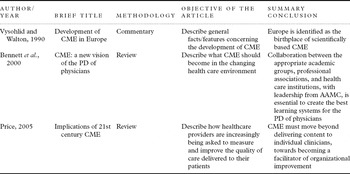
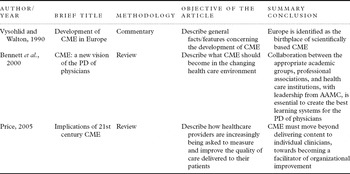
CPE is the process by which the knowledge of health professionals is kept updated to meet the needs of patients, the health service, and their own professional development. It includes the continuous acquisition of new knowledge, skills and attitudes to enable competent practice. Studies reported in the literature related to the concepts and development of CPE are presented in Table 1. There is no sharp division between CME and CPE; the past decade has seen CME include topics beyond the traditional clinical medical subjects, such as managerial, social and personal skills. The term CPE acknowledges not only the wide-ranging competencies needed to practice high quality medicine, but also the multidisciplinary context of patient care.
Articles related to concepts and development of CPE
AAMC = Association of American Medical Colleges; CME = continuing medical education; CPE = continuing professional education; PD = professional development.
The literature suggests that there is a need to move CPE activities beyond delivering content to individual clinicians to one of being more of a facilitator of organizational change, development and improvement. Therefore, collaboration among the appropriate academic groups, professional associations and healthcare institutions is recognized as essential for creating best learning systems for professional development. The findings of the review by Bennett et al. (Reference Bennett2000) highlight that, even though well-planned and constructed CME could help physicians in improving their performance, the real outcome of CME depends not only on the commitment and capacity of the participants, but also on the actual settings in which they would be working. Price (Reference Price2005) emphasized in his review that the processes used in planning and accrediting CME programs should be aimed at and become a part of organizational change, quality improvement and diffusion of innovation. He briefly outlines several of these models and explains how CME programs can be designed as part of a multifaceted intervention using principles derived from these models.
Effectiveness of continuing professional education
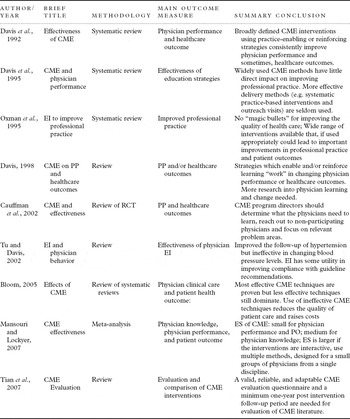
Table 2 provides a summary of the articles on the effectiveness of CPE. The main outcome measures used in determining the effectiveness of CPE were patient/healthcare outcomes and physician performance. The literature suggests that the use of ineffective CPE techniques reduces the quality of patient care and raises the cost. Interestingly, the majority of randomized controlled trials in this area can be found in studies addressing faculty development for resident physicians. Although the reviews by Davis et al. (Reference Davis, Thomson, Oxman and Haynes1992; Reference Davis, Thomson, Oxman and Haynes1995) and Oxman et al. (Reference Oxman, Thomson, Davis and Haynes1995) provide good coverage of the effectiveness of CPE, more recent reviews are needed to determine how the effectiveness of CPE has changed over time.
Findings from studies on evaluation of effectiveness of various education methods used in different healthcare settings

PO = patient outcome; ES = effect size; CME = continuing medical education; ME = medical education; RCT = randomized control trial; EI = education intervention; PP = physician performance.
The use of computers and internet to deliver CPE is increasingly gaining popularity. The interactive web-based CPE activities are found to be satisfactory for users. However, their effectiveness in bringing about improved patient outcomes, sustainable changes in practice, and satisfactory cost effectiveness needs to be explored further. The technical barriers to the use of this medium have to be eliminated before recommending them for general use.
There is no single proven method of CPE activities that produce positive results in all circumstances. The studies recognize many types of ineffective CPE activities. However, the CPE interventions that used practice-enabling/reinforcing strategies and interactive multifaceted interventions were found to be more effective in bringing about changes in practice and patient outcomes. Conversely, traditional methods of CPE meetings and printed materials were found to have no effect or only minor effects on physician behavior. Additionally, educational outreach visits, when combined with social marketing, were shown to modify physician behavior. The use of local opinion leaders has also been shown to improve physician behavior in most circumstances. As well, audit and feedback have also been shown to be effective in improving professional practice, although the effect size is small or moderate in most cases.
Various approaches used in providing CPE
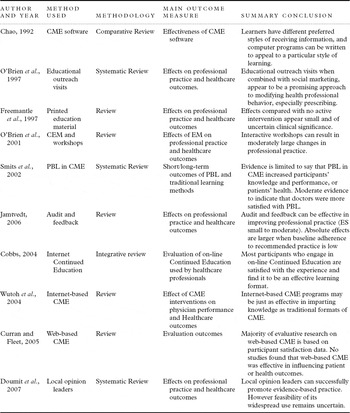
The providers of CPE use various approaches to deliver education to their audiences. These various approaches tend to vary in effectiveness depending on the setting in which they were applied. Table 3 summarizes review articles which describe some of the main approaches used in CPE.
Articles on various methods used in providing CPE and their effectiveness

EM = educational meetings; CEM = continuing education meetings; PEM = printed educational material; PBL = problem-based learning.
The evidence suggests that interactive methods of delivering CPE produce a large effect size in the measured outcomes. Although Freemantle et al. (Reference Freemantle, Harvey, Wolf, Grimshaw, Grilli and Bero1997) included many methods of CME, none of the studies included full economic analyses, making it unclear as to the extent to which the effects of any of the interventions would be worthwhile once the costs involved were considered. More research is needed in the area of effective internet/web-based methods of CPE in order to determine their effectiveness.
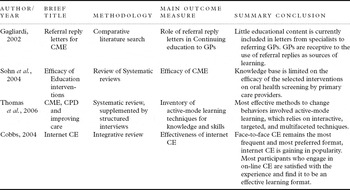
It appears that the most effective methods to bring about change in the behavior of general practitioners (GPs) involve multiple educational efforts, including written materials or toolkits, combined with feedback and strong communication channels between instructors and learners (see Table 4). There is also evidence that although GPs are receptive to the use of referral replies as a source of learning, few educational materials are included in letters from specialists to the referring GPs.
Reviews related to application of CPE in general practice and nursing

GP = general practitioner; CME = continuing medical education; CE = continuing education.
CPE for different provider groups
Evidence suggests that multiple educational efforts, combined with feedback and strong communication channels between instructors and learners, are worth consideration when designing future CPE interventions for healthcare professionals. Interestingly, more studies have used internet/web-based interventions for nurses than for other healthcare categories. Many nurses who are exposed to internet/web-based CPE interventions are satisfied with the experience; however, further research is needed to identify the suitability of such methods for the other health care professionals (see Table 4). Studies conducted before 2004 have identified non availability of computers and lack of basic knowledge about computer use as limitations for use of computer-based approaches. Therefore, a more recent review that incorporates the latest articles in this area would be worthwhile in order to ascertain whether these limitations still apply.
Section B: CPE and dementia care
Section B includes findings from studies related to educational activities aimed to improve dementia management. Both reviews and individual articles are included in this section.
Reviews
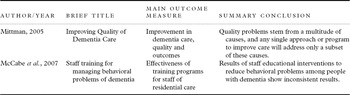
As detailed in Table 5, few reviews have been undertaken of CPE in dementia care. Mittman (Reference Mittman2005) states that “the evidence of the effectiveness of CPE on other chronic diseases (intensive, multi-level, multifaceted approaches comprising coordinated efforts by a broad spectrum of stakeholders) is equally true for dementia care as well.” He emphasizes the need to redesign delivery systems and use organizational and technological strategies for sustainable quality improvement of dementia care. As stated in the Introduction above, the results of the review by McCabe et al. (Reference McCabe, Davison and George2007) demonstrate the use of a wide range of psychosocial and educational interventions to reduce behavioral problems among older people with dementia. However, many of the studies included in this review are limited by problems in the research design, making it difficult to evaluate their effectiveness. This review also discusses the problems in conducting research in nursing home settings.
Reviews related to application of CPE for improvement of dementia care

Individual studies
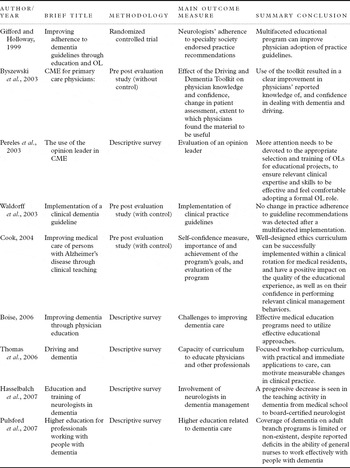
Table 6 summarizes individual studies that have been undertaken on the application of CPE in improving dementia care. Gifford and Holloway (Reference Gifford and Holloway1999) pointed out the importance of multifaceted educational programs in adapting practice guidelines by a group of neurologists in U.S.A. However, Waldorff et al. (Reference Waldorff, Almind, Marjukka, Møller and Waldemar2003) failed to demonstrate increased adherence to practical guidelines by general practitioners in Denmark after multifaceted interventions. This could either be due to differences in the study populations or differences in study methodologies.
Studies related to application of CPE for improvement of dementia care

OL = opinion leaders.
The literature also highlighted the inadequate coverage of dementia in post-registration teaching curriculum streams.
The published literature on evaluations of CPE activities relating to dementia care and management is limited. However, the available literature describes the large gaps that exist in the quality of care provided to patients and their family caregivers.
Since many people living with dementia are cared for at the primary health care level, the importance of using CPE interventions to improve the quality of care provided by GPs is widely recognized. Interventions that are intensive, interactive and have multifaceted approaches are found to produce significant lasting improvements in patient care. The coverage of dementia in postgraduate medical and paramedical curricula is limited and needs to be improved. Recommendations in the literature are to include obligatory teaching and training in dementia as part of specialized training in neurology. Furthermore, well-constructed practice guidelines (e.g. dementia and driving toolkit) have shown to improve the knowledge and practices of physicians in the subject area.
Conclusion
This review has demonstrated that CPE needs to be targeted carefully, and that much can be learned by examining educational approaches highlighted in the wider professional and medical education literature.
In general, when the findings were summarized, it was evident that interactive, multifaceted interventions, and interventions with repeated inputs appear more effective in bringing about positive changes than traditional non-interactive techniques.
Conflict of interest
None.
Description of authors' roles
Rasika Rampatige designed the study, collected, analyzed and interpreted the data, and wrote the first draft of the manuscript; David Dunt analyzed and interpreted the data, supervised the drafting of the manuscript and revised the manuscript critically for intellectual content; Colleen Doyle revised the manuscript critically for intellectual content; Susan Day conceived and designed the study; and Pauline van Dort revised the manuscript critically for intellectual content.