Introduction
Given the limited resources available to the health sector in Iran, policy makers need to develop a rationing plan in order to equitably distribute the resources, and thereby meet the needs of the general public (Reference Badakhshan, Arab, Rashidian, Mehrdad and Zendehdel1). The development of emerging health technologies contributes to the improvement of the health and quality of life of patients; however, it also increases treatment costs and potentially threatens the financial stability of the health system. Therefore, health policy makers inevitably need to prioritize new healthcare services (Reference Khayatzadeh-Mahani, Fotaki and Harvey2).
According to the new definition of health technology assessment (HTA) “HTA is a multidisciplinary process that uses explicit methods to determine the value of a health technology at different points in its lifecycle. The purpose is to inform decision making in order to promote an equitable, efficient, and high-quality health system” (Reference O’Rourke, Oortwijn and Schuller3). In Iran, the development of an HTA program was initiated in 2007. Synthesizing and generating evidence on clinical and economic effects of technologies, training skilled manpower, organizing master programs in universities, and holding workshops for health managers and policy makers were the major efforts made to increase knowledge among students, health staff, managers, and authorities about HTA and the process of healthcare prioritization (Reference Yazdizadeh, Mohtasham and Velayati4). Box 1 shows institutional arrangement of HTA related to health insurance coverage. However, the gap between evidence and health policy still needs to be investigated, because healthcare priority setting is a political and value-laden process that involves factors that go beyond the clinical and economic effects of healthcare services (Reference Majdzadeh, Sajadi and Yazdizadeh6).
Institutional arrangement of Iran’s HTA program for insurance coverage decision making.
Scoping: The Secretariat of the High Council for Health Insurance, HCHI, affiliated with the Ministry of Health and Medical Education, MoHME, is in charge, among others, of screening all requests for new healthcare insurance coverage. Any stakeholder can submit an application electronically through HCHI’s web site. A special Task Force for Evidence Collection, TFEC, affiliated with the Secretariat, prioritizes all incoming requests. They mostly follow the First-In–First-Out method, whereby requests are processed in the order with which they are received, with the proviso that new medicines that are produced locally receive higher priority. Core members of this taskforce are full-time employees. In consultation with other experts, they follow the Population, Intervention, Comparison, and Outcomes (PICO) approach to guide the necessary assessments.
Assessment: The HTA Office (affiliated with the Department of Treatment, MoHME), the Office for Drug Control (affiliated with the Food and Drug Administration of Iran), and the National Institute of Health Research are publicly funded HTA agencies that both conduct HTAs and technical reviews of already available reports at the request of applicants. Requests from government organizations (e.g., the Ministry of Health, etc.) are funded by these three agencies, while private sector requests are usually funded by the requesting firms. The HTA Office proposed a standardized framework for writing HTA reports, similar to the HTA Core Model of European countries (Reference Kristensen, Lampe, Wild, Cerbo, Goettsch and Becla5). The technical review of the reports happens in a double blinded manner. Once completed, the reports are submitted to the HCHI Secretariat.
Appraisal takes place at two levels: Technical Working Group (TWG) and National Advisory Committee (NAC). TWG includes the technical representatives of three social health insurance agencies (the Social Security Organization, the Iran Health Insurance Organization, and the Armed Forces Health Insurance Organization), MoHME, the Food and Drug Administration, Ministry of Cooperatives, Labor, and Social Welfare, Ministry of Economic Affairs and Finance, and Iran Medical Council. They discuss the HTA reports and other gathered evidence. In some cases, clinical specialists related to the request or representative of the manufacturer, are invited to the TWG meeting. The participants are not managers, but they are mainly specialists with high technical knowledge. The Secretariat of HCHI is in charge of managing the meeting. The composition of the NAC resembles that of the TWG, but its members have more senior positions in their respective organizations. The NAC tries to reach consensus, but if that fails they may resort to voting before formulating their recommendation to the HCHI for their final approval.
Implementation: The Secretariat of HCHI issues instructions to social health insurance agencies to cover the newly approved healthcare services. These agencies are legally obliged to implement all approved acts. In some cases, an approved act needs to be ratified by the Cabinet of Iran (e.g., if more than 90 percent and 70 percent of healthcare costs are covered in the inpatient and outpatient platforms, respectively).
Appeal mechanism: Once a coverage decision has been taken, any organization and even any Iranian citizen can appeal against it. They can approach the Secretariat to raise their objection to a decision without time restriction. If the objection is considered valid, the case will be reviewed in the upcoming TWG committee session. If an amendment is considered appropriate, a proposal to that effect will be sent to the NAC. A new decision may then be issued, which will be published nationally through the web site and communicated through formal channels; supporting documents will only be provided in case of an objection to a former decision.
Monitoring and evaluation: An M&E framework to assess to what extent HTA decisions are adhered to, and their long-term impact is yet to be designed.
The inclusion of social values in the HTA process is of critical importance to ensure legitimacy in healthcare priority setting. A recent survey showed that Iranians prefer equitable access to health care and expansion of health insurance coverage by the government over the strategy of maximizing benefits (Reference Darvishi, Daroudi and Yaseri7). Designing a value assessment framework is one of the options to deal with this challenge. A value assessment framework describes a set of criteria that represent the social preferences related to healthcare priority setting in a community (Reference Littlejohns, Sharma and Jeong8). Clark and Weale developed a prioritization framework based on a combination of process values and content values (Reference Clark and Weale9). They link the criteria of accountability, transparency, and participation to process values, while clinical effectiveness, cost-effectiveness, equity, and social solidarity are linked to content values. Clark and Weale’s value assessment framework encouraged researchers in Germany and South Korea to develop prioritization models (Reference Ahn, Kim, Suh and Lee10,Reference Kieslich11). Mostafavi et al. found considerable differences between the type and meaning of health prioritization-related values mentioned in Clark and Weale’s framework and the social values reported in Iranian policy documents (Reference Mostafavi, Rashidian, Arab, Mahdavi and Ashtarian12). They argued that social values related to healthcare priority setting are rooted in the macro values of a society, and one can therefore not ensure the generalizability of most social values across countries. Hence, scientific investigations must be applied to identify values related to healthcare priority setting in each country (Reference Torbica, Fornaro, Tarricone and Drummond13). A consensus-based framework of social values associated with Iranian healthcare priority setting is yet to be established to link HTA program evidence to priority setting and policy-making processes. One way to explore this is to systematically investigate local endeavors on social values identification. This study aims to summarize findings of previous studies on social values related to healthcare priority setting and attempts to provide a base to design a value assessment framework for healthcare priority setting in order to increase the legitimacy of the HTA program as part of health policy making in Iran.
Method
Scoping reviews are secondary analysis methods that aim to analyze key concepts associated with a generally complicated research area that has not been thoroughly reviewed before (Reference Arksey and O’Malley14). This scoping review was conducted for two reasons. First, no study had until then comprehensively reviewed studies on social values related to healthcare priority setting in Iran. Second, the original studies used various quantitative and qualitative analysis techniques; therefore, one cannot simply summarize the evidence or pool the findings. This scoping review was carried out according to the following five steps proposed by Arksey and O’Malley (Reference Arksey and O’Malley14).
Step 1 – Define a clear review objective
The main research question was: What social values influence healthcare priority setting in Iran? Identifying these underlying values and making them explicit would strengthen Iran’s HTA program and reinforce stakeholder support.
Step 2 – Identifying relevant studies
A comprehensive search strategy was developed to identify relevant studies. The databases of PubMed, EMBASE, and EBSCO were searched without considering any time restriction using keywords related to benefit package design, HTA, social values, resource allocation, and prioritization (Supplementary file 1). In addition, web sites such as http://iranmedex.ir and http://sid.ir were searched to find studies published in Farsi. Furthermore, the researchers contacted prominent Iranian health economists and HTA experts and asked them if they had any unpublished studies. Snowballing was done by examining the list of references of the identified studies.
Step 3 – Study selection
We followed the Preferred Reporting Items for Systematic Reviews and Meta-Analyses (PRISMA) guidelines for scoping reviews (Reference Tricco, Lillie and Zarin15). The authors (R.J. and Z.G.) reviewed all studies carried out with the aim of identifying social values related to policy making, prioritization, and allocation of resources to healthcare services in Iran, irrespective of the country of authorship. We include studies that focused on identifying social value and prioritization criteria for healthcare services in Iranian health system. The studies were selected without considering any language restrictions. Different scientific methods can be used to identify social values; therefore, no restriction was imposed regarding the use of various types of research methods. We excluded the studies that were not implemented in Iranian health system and also non-original studies. After eliminating duplicate studies, two reviewers independently studied the titles and abstracts of the selected studies. The full texts of all studies associated with the purpose of the present study were scrutinized. Disagreements between reviewers were settled in discussions with a third reviewer.
Step 4 – Charting the data
A data extraction form was designed to extract relevant data from the selected studies. It gathered information about the names of authors, year of publication, technology category, research method, research technique, evidence collection method, and reported criteria. Although technically they have different meanings, criteria and values were used interchangeably (Reference Nouhi16). The criteria were extracted from the included studies. If a criterion was mentioned in more than one study, we counted it only once. Since relevant studies were selected without considering any language restriction, some of the extracted criteria were similar in meaning to others (e.g., financial burden, size of financial burden, financial effects, budget impact, and budget effects). Therefore, within a category of similar criteria, only one criterion was selected as representative for the entire category, so similar criteria were omitted.
Step 5 – Collating, summarizing, and reporting the results
The value framework designed by Shams et al. (Reference Shams, Sari and Yazdani17) was used to analyze the extracted criteria. This framework considers values in (health) policy making as factors that determine the direction of decisions and that therefore often play a role in decision-making situations. Shams et al. distinguishes content values from process values, similar to Clark and Weale’s framework (Reference Clark and Weale9). Content values include terminal and intermediate values. Terminal values play a role in the decision-making process as ultimate goals. Terminal values are often conceptually complex and ambiguous; hence, intermediate values/criteria are used to make them quantifiable and measurable. According to Shams et al., values associated with the decision-making process are called process values (Reference Shams, Sari and Yazdani17). After extracting all the criteria from the included studies two researchers (Z.G. and R.J.) independently reviewed and categorized them, based on the nature of the effects of the criteria and their functional similarities, and compared the results. Where they disagreed they called upon a third reviewer (Reference Hadian, Jouyani, Asadi, Palangi and Rahimnia18) for arbitration.
Results
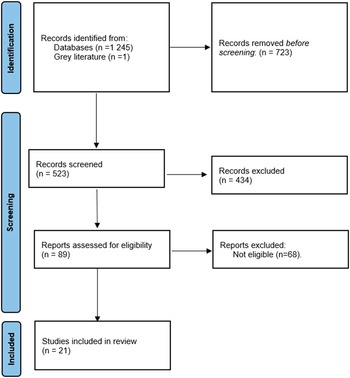
In total, 1,245 studies were identified following a systematic search of the aforementioned databases. After removing duplicate studies, the titles and abstracts of the remaining 523 studies were reviewed. Of these, 434 records were excluded since they did not meet the inclusion criteria. The full texts of the remaining eighty-nine studies were assessed, and after eliminating studies that did not meet the inclusion criteria (n = 68), twenty-one studies were finally selected to analyze. Figure 1 illustrates the study selection process.
Flowchart of the study selection process.

Primary results
Publication time and language, and publication method
The selected studies were published between 2008 and 2022. Seventeen articles were in English and four in Farsi (Reference Kabir, Heidari, Jafari, Honarvar, Behnampour and Mirkarim19–22) all with an abstract in English. One unpublished document was provided by an MoHME expert (22).
Sources and methods of social values identification
Among the selected studies, eighteen identified social values through the use of expert opinions (Reference Darvishi, Daroudi and Yaseri7;Reference Mostafavi, Rashidian, Arab, Mahdavi and Ashtarian12;Reference Hadian, Jouyani, Asadi, Palangi and Rahimnia18;Reference Kabir, Heidari, Jafari, Honarvar, Behnampour and Mirkarim19;Reference Dehnavieh, Tourani and Maleki21–Reference Karyani, Sari and Woldemichael34). One study identified social values merely by analyzing policy documents and national evidence (Reference Mostafavi, Rashidian, Arab, Mahdavi and Ashtarian12), while two studies involved a public survey to elicit social values (Reference Karyani, Sari and Woldemichael34;Reference Mohamadi, Olyaeemanesh and Rashidian35). Three studies used multiple sources to identify values (Reference Mostafavi, Rashidian, Arab, Mahdavi and Ashtarian12;Reference Rashidian, Arab, Mahdavi, Ashtarian and Mostafavi28;Reference Karyani, Sari and Woldemichael34), two of which combined policy documents with expert opinions (Reference Mostafavi, Rashidian, Arab, Mahdavi and Ashtarian12;Reference Rashidian, Arab, Mahdavi, Ashtarian and Mostafavi28), and the remaining study used both experts and public opinions (Reference Karyani, Sari and Woldemichael34).
The criteria measurement
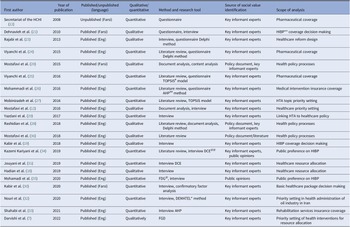
A total of thirteen studies assigned weights to the criteria (Reference Kabir, Heidari, Jafari, Honarvar, Behnampour and Mirkarim19;22;Reference Viyanchi, Rasekh, Ghatari and SafiKhani24–Reference Mobinizadeh, Raeissi, Nasiripour, Olyaeemanesh and Tabibi27;Reference Mobinizadeh, Raeissi, Nasiripour, Olyaeemanesh and Tabibi29–Reference Karyani, Sari and Woldemichael34), while eight studies described the criteria qualitatively (Reference Darvishi, Daroudi and Yaseri7;Reference Mostafavi, Rashidian, Arab, Mahdavi and Ashtarian12;Reference Hadian, Jouyani, Asadi, Palangi and Rahimnia18;Reference Dehnavieh, Tourani and Maleki21;Reference Rajabi, Esmailzadeh, Rostamigooran and Majdzadeh23;Reference Rashidian, Arab, Mahdavi, Ashtarian and Mostafavi28;Reference Kabir, Heidari and Nahid30). The discrete choice experiment (Reference Jouyani, Hadiyan, Salehi and Souri31;Reference Karyani, Sari and Woldemichael34), technique for order of preference by similarity to ideal solution (Reference Viyanchi, Ghatari, Rasekh and SafiKhani25;Reference Mobinizadeh, Raeissi, Nasiripour, Olyaeemanesh and Tabibi27), the analytic hierarchy process (Reference Mohamadi, Tabatabaei and Olyaeemanesh26;Reference Shahabi, Pardhan and Ahmadi Teymourlouy33) confirmatory factor analysis (Reference Kabir, Heidari and Nahid30), and decision making trial and evaluation laboratory (Reference Nouri, Riahi, Nabi and Jahangiri32) methods had been applied to quantify the criteria. Table 1 presents detailed information about the included studies. Table 2 shows frequency of prioritization criteria in relation to four value clusters.
General characteristics of the included studies

*decision making trial and evaluation laboratory/#technique for order of preference by similarity to ideal solution/$health technology assessment/**health insurance benefit package/@focused group discussion/@@discrete choice experiment/##analytical hierarchy process.
Frequency of healthcare prioritization criteria to four clusters

Secondary results
A total of 237 criteria were reported in the twenty-one studies, but only fifty-five unique criteria remained after removing the duplicate and synonym criteria. More than half of all criteria (57.8 percent) were repeated in at least four studies. Cost-effectiveness was identified as an important criterion in eight studies (Reference Mostafavi, Rashidian, Arab, Mahdavi and Ashtarian12;Reference Kabir, Heidari, Jafari, Honarvar, Behnampour and Mirkarim19–22;Reference Viyanchi, Rasekh, Ghatari and SafiKhani24;Reference Mohamadi, Tabatabaei and Olyaeemanesh26;Reference Mobinizadeh, Raeissi, Nasiripour, Olyaeemanesh and Tabibi27), clinical effectiveness in nine (Reference Mostafavi, Rashidian, Arab, Mahdavi and Ashtarian12;Reference Mostafavi, Arab and Rashidyan20–22;Reference Viyanchi, Ghatari, Rasekh and SafiKhani25;Reference Mobinizadeh, Raeissi, Nasiripour, Olyaeemanesh and Tabibi27;Reference Yazdani and Jadidfard29;Reference Nouri, Riahi, Nabi and Jahangiri32;Reference Shahabi, Pardhan and Ahmadi Teymourlouy33), availability of suitable alternatives in three (22;Reference Mohamadi, Tabatabaei and Olyaeemanesh26;Reference Mobinizadeh, Raeissi, Nasiripour, Olyaeemanesh and Tabibi27), and quality of evidence in four studies (Reference Dehnavieh, Tourani and Maleki21;22;Reference Viyanchi, Rasekh, Ghatari and SafiKhani24;Reference Mobinizadeh, Raeissi, Nasiripour, Olyaeemanesh and Tabibi27). Criteria related to characteristics of target population were reported in two papers (Reference Mobinizadeh, Raeissi, Nasiripour, Olyaeemanesh and Tabibi27–Reference Yazdani and Jadidfard29), to disease severity in four studies (Reference Hadian, Jouyani, Asadi, Palangi and Rahimnia18;22;Reference Rashidian, Arab, Mahdavi, Ashtarian and Mostafavi28;Reference Jouyani, Hadiyan, Salehi and Souri31), and to budget in eight studies (Reference Hadian, Jouyani, Asadi, Palangi and Rahimnia18;Reference Dehnavieh, Tourani and Maleki21;Reference Viyanchi, Ghatari, Rasekh and SafiKhani25–Reference Mobinizadeh, Raeissi, Nasiripour, Olyaeemanesh and Tabibi27;Reference Yazdani and Jadidfard29;Reference Kabir, Heidari and Nahid30;Reference Karyani, Sari and Woldemichael34).
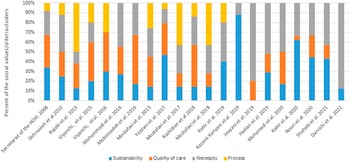
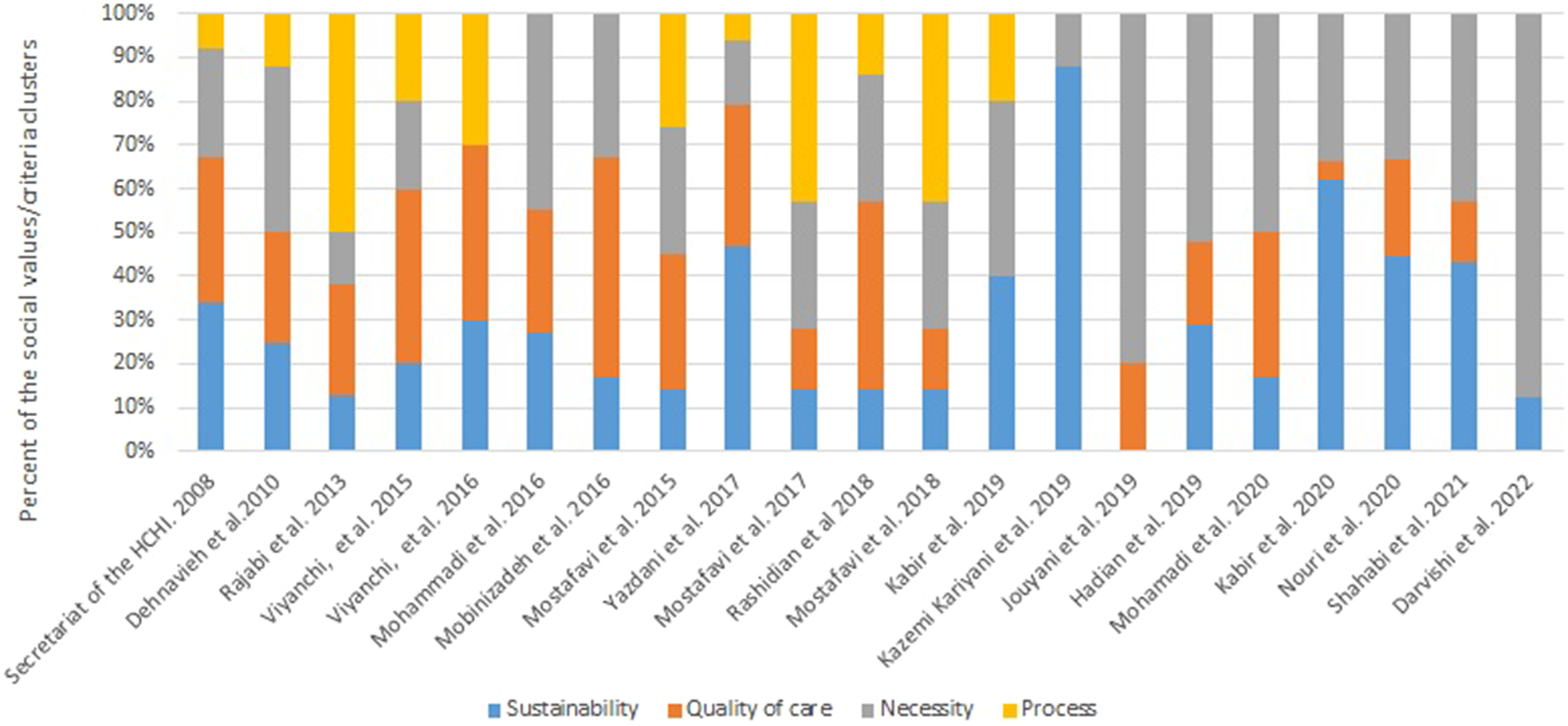
The identified criteria were then categorized as either related to content or to process values. Content values in turn, were divided into three clusters, of which the definitions and scope are provided below. Figure 2 shows the distribution of the identified criteria over the four clusters of values in each study.
Distribution of identified criteria over four value clusters per study.
Sustainability
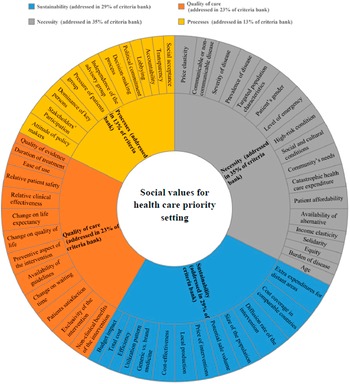
Thirteen of the extracted criteria (representing 29 percent of the total bank of 237 criteria reported by all twenty-one studies combined) were classified in the value cluster sustainability (Figure 3). These criteria focused on the capacity of the Iranian healthcare system to facilitate the adoption of new healthcare services in terms of financing, organizational capacity, and healthcare provision. Budget impact is a criterion that plays a decisive role in estimating the implementation capacity of the healthcare system. Obviously, high cost of a health service in combination with high service utilization rate leads to a high budget impact and thereby increases the financial burden on the health system. This, in turn, may affect the financial coverage of other services.
Identified social values related to healthcare priority setting in Iran.

Cost-effectiveness is another important criterion related to the implementation capacity of the healthcare system. It compares the expected clinical outcomes of a new medical technology for the patient with related costs. A low incremental cost-effectiveness ratio (ICER) indicates that the use of the technology can bring greater benefits to the healthcare system compared to its alternatives.
Another criterion is the price of services and medicines. Undoubtedly, high prices restrict the capacity of the healthcare system to adopt new technologies. Type of drugs and their production methods is also important. The local production of generic drugs, rather than importing brand-name drugs from abroad, lowers the financial pressure on the health system, and thereby facilitates their adoption.
Quality of care
Thirteen of the extracted criteria (representing 23percent of the total bank of 237 criteria) belong to this cluster (Figure 3). They relate to various aspects of the benefits of a health technology. The criteria of clinical effectiveness, patient safety, effect on patient’s quality of life, changes in quality-adjusted life-years (QALYs), and disability-adjusted life-years (DALYs) were included in this cluster. If a new health technology brings considerable clinical effectiveness with lower side effects, it will definitely increase the quality of care.
Moreover, some of the criteria were associated with the quality of evidence, for example, existence of (evidence-based) clinical guidelines, and evidence about the clinical effectiveness. Accordingly, the inclusion of a healthcare service in the clinical treatment guidelines indicates high therapeutic and scientific value of the services provided. Patient satisfaction was another important criterion that highlights the importance of a technology, in this case from a patient’s point of view. Ease of use of a healthcare service increases overall patient satisfaction and raises the likelihood of follow-up treatment, which is a sign of high quality. Therefore, researchers could take into account the appreciation of a technology by patients.
Necessity
Eighteen of the identified criteria (representing 35 percent of the total bank of 237) fell into this cluster (Figure 3). These criteria focus on the medical necessity to cover the cost of a health technology and social reasons why coverage is considered important. The criteria were disease severity, probability of death and disability, availability of suitable alternatives in the service package, out-of-pocket payments, and price and income elasticity of the patient when using the health technology. In this category, the most frequently mentioned criterion is patients’ out-of-pocket. It is an indication of the level of equity in healthcare utilization. High costs of new healthcare service increase household expenditure and may lead to impoverishment. The higher the direct costs of a health technology, the more crucial it is to have a public coverage mechanism, such as inclusion in health insurance benefit packages.
Lack of suitable alternatives in the current health insurance benefit package is considered a major criterion in determining the necessity of adopting a new health technology. However, the availability of a good alternative in the service package that meets clinical needs of patients reduces the necessity of covering new technologies. It could work for a new generation of medicines known as “me-too” or “follow-on drugs” (Reference Saravdekar, Shukla, Upadhya, Rai and Giri37). The higher the severity of a disease, the greater the importance is to cover relevant health technology. There is also pressure to prioritize and invest in service coverage for certain targeted population such as mothers and children and elderly patients.
Income elasticity means the percent change in individual’ demand for health technology divided by the percent change in his/her income. Lower price and income elasticity of a technology indicates higher necessity of the technology to be prioritized.
Process
Eleven of the extracted criteria (covering 13 percent of the total bank of 237) related to the priority-setting process (Figure 3). These indicators reveal elements that affect a fair decision-making process. The extracted criteria include stakeholder presence, impartiality, transparency, conflict management, accountability, the use of evidence in decision making, and the use of experiences from similar countries. The prioritization process is a value-based process. An evidence-informed deliberative process (EDP) is a practical framework to guide healthcare priority setting in a structured manner (Reference Oortwijn, Jansen and Baltussen38). It provides a practical tool to apply principles of accountability, transparency, appeal, and evidence-based decision making for real-world decision making. Managing stakeholder conflicts can have as much impact on fair prioritization of services as the presence of all stakeholders (Reference Oortwijn, Jansen and Baltussen39). The use of evidence in the decision-making process can reduce stakeholder conflicts and increase the perceived legitimacy of choices made.
Discussion
The history of studies carried out in Iran to identify appropriate criteria for health service prioritization goes back to 2008 and has resulted in a host of criteria, of which neither the commonalities not their distinctness have so far been investigated in a systematic manner. This study is novel in that it identifies and synthesizes social values related to national healthcare priority setting through an analysis of twenty-one original studies identified in a literature search. Based on the framework developed by Shams et al. (Reference Shams, Sari and Yazdani17), more than 230 criteria reported in twenty-one studies were clustered according to their underlying social values. Three social value clusters relate to the content of healthcare prioritization (sustainability, quality, and necessity), and the fourth one to the process of prioritization.
Although policy-related process criteria were extracted from only a relatively small number of the selected studies, such criteria can substantially enhance the legitimacy of the value assessment framework. According to surveys, ignoring the transparency of the service prioritization process, and making decisions without involving relevant stakeholders, including citizens, constitutes an obstacle and may impede the achievement of universal health coverage in Iran (Reference Mohamadi, Olyaeemanesh and Rashidian35;Reference Azadiyan, Vosoogh Moghaddam and Farhadi Mahalli40). The studies included in the review used three sources for the identification of relevant decision criteria and social values, that is, policy documents, expert opinions, and general public/patient opinions. Experts views about healthcare priorities and priority setting different from the view of patients or the general public. Different criteria selection methodologies also led to different results. Researchers had used a variety list of quantitative and qualitative methods to identify decision criteria and values. They also faced challenges, such as double counting, quantitative weighting, and the difficulty of establishing links between identified values.
To prepare a basis for analysis, the criteria extracted from the included twenty-one articles were divided into four value clusters. Assessing the possible interaction between the four clusters can provide a framework for a better understanding of current priority-setting situation in Iran. It appears that necessity as a value is considered more important than service quality or sustainability, which suggests a dominance of the principle pf egalitarianism (Reference Shams, Sari and Yazdani17). It may show itself in the shape of Iran’s healthcare benefit package. Historically, the standard health insurance benefit package covers almost all forms of health care, regardless of their clinical and economic impacts on the health system. Fast access to new promising health technologies used to be considered important, without any consideration for possible disinvestment of certain technologies that might have become redundant or less relevant. As a result, it has been argued, the current health insurance benefit package suffers from inefficiencies and low-value care (Reference Nouhi, Baltussen and Razavi41). The current health benefit package tends to cover any new health technology that effectively reduces the severity of a disease in patients, even if it is expensive and not cost-effective. Access to new technologies for severe diseases (necessity) seems to be considered more important than the efficient allocation of scarce health resources (sustainability) (Reference Mohamadi, Takian and Olyaeemanesh42). As a result, the health insurance benefit package covers almost all forms of health care, regardless of their clinical value, and this in turn impacts on efficiency. To deal with this problem, a program has recently been developed and actually started to revise the health insurance benefit package by taking into consideration relevant content and process values at the same time (Reference Nouhi, Baltussen and Razavi41). Iran’s national health transformation plan, adopted in 2014, is based on a new welfare policy in order to progress toward universal health coverage (Reference Harirchi, Hajiaghajani and Sayari43). While this reform enhances financial risk protection for poor patients, it risks to increase supplier-induced service demand, and thereby undermine, in the longer term, the financial sustainability of the insurance scheme and the health system as a whole (Reference Ghahramani and Lankarani44).
The present research has several limitations. Some of the included studies were published in Farsi; the translation of the decision criteria and social values into English may have reduced the literary richness of some of the concepts. The four proposed social value clusters are just a first attempt at synthesizing social values related to healthcare priority setting; it would be appropriate to validate and possibly refine them by conducting surveys among different stakeholders.
Further research
To validate this first step toward a consolidated value assessment framework, a national study would be required to identify any further decision criteria considered important by relevant stakeholders. It would also be good to enhance the active participation of stakeholders, including representatives of patient organizations and ordinary citizens, in priority setting and decision making around new health technologies; participatory value evaluation may serve as an example (Reference Mouter, Koster and Dekker45).
Conclusion
A wide range of social values must be taken into consideration when setting priorities for health care. While several studies on social values related to healthcare priority setting have been conducted in Iran, this research synthesized the results of these studies and provided some essentials for the development of a comprehensive value assessment framework based on four core social values. HTA agencies in other countries might benefit from the experience in Iran, to develop their own value assessment frameworks based on a systematic elicitation of local preferences among relevant stakeholders.
Supplementary material
The supplementary material for this article can be found at https://doi.org/10.1017/S0266462323000302.
Funding statement
This research received no specific funding from any agency, commercial or not-for-profit sectors.
Competing interest
The authors declare that they have no competing interests.