1. Introduction
This study aims to uncover the effect of virtual reality (VR) on reducing foreign language anxiety (FLA) in comparison to similar modes of communication. It is concerned with two distinct computer-assisted language learning (CALL) topics: (1) computer-mediated communication (CMC) and (2) the application of VR technology in language teaching contexts. It is argued here that VR represents a hybrid mode of communication that may offer the benefits of both face-to-face (FTF) and computer-mediated modalities. However, it is currently unknown how VR-based communication affects learners’ FLA, forming the impetus for the current study.
FLA is one of the most commonly experienced, negatively influential factors that hinders successful language acquisition (Gardner & MacIntyre, Reference Gardner and MacIntyre1993; Oxford, Reference Oxford and Arnold1999). As such, practitioners strive to create low-anxiety learning contexts (Melchor-Couto, Reference Melchor-Couto2018). One such domain that holds promise for reducing FLA is CMC, and more specifically the use of virtual environments such as virtual worlds and online games (Deutschmann, Panichi & Molka-Danielsen, Reference Deutschmann, Panichi and Molka-Danielsen2009; Melchor-Couto, Reference Melchor-Couto2017, Reference Melchor-Couto2018). In virtual worlds (VWs), interaction is achieved through user-created avatars, a feature that has been shown to promote a reduction in FLA as learners are shielded from their interlocutor (Melchor-Couto, Reference Melchor-Couto2017), particularly when using a text-based modality (Rosell-Aguilar, Reference Rosell-Aguilar2005). VR is a similar modality, engaging learners in avatar-mediated communication, yet provides access to a higher definition of paralinguistic cues (gestures). These cues have been shown to aid comprehension (Yanguas, Reference Yanguas2010); however, they may also be a source of increased FLA (see, e.g., Fitze, Reference Fitze2006). That is, the lack of paralinguistic cues in some synchronous computer-mediated communication (SCMC) modalities (such as text chat and voice) have been considered positive in reducing learners FLA. Warschauer (Reference Warschauer1996) found that participation between interlocutors in a text-chat SCMC modality was more equal between participants than the FTF modality due to the lessened threat to face. Similarly, anonymized interaction within SCMC is considered positive in removing social distance between non-native and native speakers, thereby reducing anxiety (Marjanovic, Reference Marjanovic1999).
VR’s affordance for reducing FLA is therefore both currently unknown and unpredictable based on the considerations above. That is, the addition of paralinguistic cues and an immersive environment that resembles FTF communication could prompt improved comprehension and increased social presence and therefore have a positive impact on FLA, or, alternatively, the lessened anonymity compared to text- and voice-based modes could be a source of increased anxiety. In this study, 30 learners (15 dyads) completed the same information-gap task in three different modalities: oral SCMC, video-enhanced oral SCMC, and finally in a custom-built VR SCMC environment. Using a reduced version of Horwitz, Horwitz and Cope’s (Reference Horwitz, Horwitz and Cope1986) Foreign Language Classroom Anxiety Scale (FLCAS), the effect of each modality in reducing low-level EFL learners’ FLA was investigated in a counterbalanced, repeated measures experiment.
2. Literature review
2.1 CMC affordances for language learning
CMC may be conducted asynchronously (ACMC) via tools including email, bulletin board system forums, YouTube comments, and on popular news websites such as Reddit. An alternative to ACMC, and more commonly used for personal communication, is synchronous CMC (SCMC), which may be subdivided into text and oral modalities. Framed from an interactionist or sociocultural perspective to second language acquisition (SLA), SCMC has been shown to exhibit striking similarities to FTF communication, such as promoting negotiation for meaning (Yanguas, Reference Yanguas2010), allowing learners to notice the gap between their output and target-like forms (Chen, Reference Chen2008) and opportunities to notice target language features (Smith, Reference Smith2003). Oral SCMC is considered particularly beneficial for improving pronunciation due to breakdowns in communication resembling FTF communication and subsequent phonetically modified output (Bueno Alastuey, Reference Bueno Alastuey2010). In a comparison of voice- and video-based SCMC, Yanguas (Reference Yanguas2012) also found that listening comprehension was higher for tasks completed in the voice-only modality suggesting that oral SCMC may have benefits over other modalities. Several meta-analyses have also examined the affective and cognitive benefits of CMC for language learning (Lin, 2014; Sauro, Reference Sauro2011; Ziegler, Reference Ziegler2016). In Lin’s (Reference Lin2015) meta-analysis of 25 studies from a 12-year period, more than half of the SCMC studies used voice over Internet protocol (VOIP) services such as Skype. One third of studies utilized text chat, and only two studies employed both of the above two modalities. The results of her meta-analysis revealed that, generally, compared to FTF or no intervention, SCMC had a slight positive effect on learners’ oral proficiency.
Regarding VWs, benefits of this modality range from lowering the affective barrier to learning (Lee & Pass, Reference Lee, Pass, Gerber and Abrams2014), providing exposure to rich sources of target language input (Zhao & Lai, Reference Zhao, Lai and Ferdig2009), and promoting task-like, goal-oriented behavior (Zheng, Reference Zheng2012). They afford expert–novice interactions (Rama, Black, Van Es & Warschauer, Reference Rama, Black, Van Es and Warschauer2012) and present teachers and learners with contexts that are difficult to replicate in the second language (L2) classroom (Milton, Jonsen, Hirst & Lindenburn, Reference Milton, Jonsen, Hirst and Lindenburn2012). Virtual domains also offer numerous cultural benefits such as providing a space for intercultural communication between first language (L1) speakers and L2 learners (Canto, de Graaff & Jauregi, Reference Canto, de Graaff, Jauregi, González-Lloret and Ortega2014; Thorne & Black, Reference Thorne and Black2007), which can lead to intercultural communicative competence (Tudini, Reference Tudini2007). Finally, VWs as SCMC environments offer learners the opportunity to communicate via multiple modalities where it has been shown that text chat may be utilized to support oral interactions (Wigham & Chanier, Reference Wigham and Chanier2015).
As this paper is concerned with understanding the affective affordances of CMC, the following section introduces the concept of FLA and then focuses more specifically on studies that have explored the affective affordances of CMC.
2.2 FLA and CMC studies
Horwitz et al. (Reference Horwitz, Horwitz and Cope1986: 128) characterized foreign language learning anxiety as “a distinct complex of self-perceptions, beliefs, feelings, and behaviors related to classroom language learning arising from the uniqueness of the language learning processes.” A large body of research literature on FLA has been generated over the last few decades, where most tend to agree that FLA affects learners negatively (Hewitt & Stephenson, 2012; Liu, Reference Liu2016; MacIntyre & Gardner, Reference MacIntyre and Gardner1991). However, others have posited that FLA can encourage a learner to push themselves to improved performance (Brown, Reference Brown2000). FLA is thus generally considered one of the most important affective factors in determining the successful acquisition of a second language. It relates to what Krashen (Reference Krashen1981) termed the “affective filter,” which inhibits a learner’s ability to acquire the second language based on their mood, motivation, self-confidence and anxiety. FLA is theorized to be particularly acute for the subjects of the present study: low-level learners engaged in speaking activities (Liu, Reference Liu2016; MacIntyre & Gardner, Reference MacIntyre and Gardner1991; Young, Reference Young1999).
In CMC research, text-based SCMC has been shown to reduce FLA over FTF modes (Abrams, 2003; Tudini, Reference Tudini2007; Warschauer, Reference Warschauer1996). However, the same is not true of oral SCMC (Satar & Özdener, Reference Satar and Özdener2008). This may be due to several factors: lack of body language causing awkward silences (Hampel & Baber, Reference Hampel, Baber and Felix2003), the increased time demands to produce output, or the perception of increased task difficulty (Sauro, Reference Sauro2011). In an oral ACMC environment, however, Charle Poza (Reference Charle Poza2005) found that learners’ anxiety diminished due to the lessened time restrictions and editability of voice messages before transmission to an interlocutor.
Satar and Özdener (Reference Satar and Özdener2008) investigated the effect of SCMC on learners’ FLA and speaking proficiency. Their study was concerned with two modalities: text- and voice-based SCMC. Using a between-subjects research design, ninety 16- and 17-year-old Turkish learners of English were assigned to one of three groups: one control group and two experimental groups. As well as a weekly 40–45-minute English lesson, which all groups received, the experimental groups also participated in an additional 40–45-minute extracurricular discussion session via one of the two modalities of communication explored in the study. Findings suggested that both text-based and oral SCMC modalities were successful in improving learners’ speaking proficiency but that only the text-based SCMC group showed a decrease in anxiety. The reason for the difference in anxiety levels was attributed to the oral modality presenting more threat to face than the text modality; however, it could equally have been due to the additional practice that the control group did not get.
Communication within VWs has also been widely researched, where affective affordances include an increased willingness to communicate as well as a feeling of reduced pressure to perform compared to the FTF modality (Reinders & Wattana, Reference Reinders and Wattana2014). The use of an avatar has also been linked to lowered anxiety and a feeling of relaxation and confidence, which is considered a precursor to improved willingness to communicate (Zhao & Lai, Reference Zhao, Lai and Ferdig2009). In a study by Jauregi, Canto, de Graaff, Koenraad and Moonen (Reference Jauregi, Canto, de Graaff, Koenraad and Moonen2011), comparing VW-based SCMC to video SCMC, all participants preferred the VW modality; however, reasons given for this were mixed. Some participants expressed that the shielding effect of the avatar was more comfortable for them than the video modality; others reasoned that the VW presented fewer technical issues to their communication and was therefore more appealing.
In summary, there is a wealth of literature on the positive affective affordances of CMC and more specifically the use of VWs in comparison to other modalities. However, although currently garnering a growing interest from CALL researchers (Kessler, Reference Kessler2018), research on the affordances of CMC for reducing anxiety is considered lacking. As recently as 2016, Ziegler calls for more research that investigates “the extent that technology might affect learners’ anxiety, as well as their subsequent L2 development and performance” (p. 148). This paper aims to provide information in this area comparing three different SCMC modalities in terms of their ability to reduce FLA.
2.3 VR in language learning and teaching
There are few CALL studies that have explored the benefits of VR for language learning or teaching to date. For instance, Bonner and Reinders (Reference Bonner and Reinders2018) provide several ways in which VR may be incorporated into language teaching contexts such as for presentation practice, virtual campus or city tours, or creative expression. Gadelha (Reference Gadelha2018: 41), rather hyperbolically, posits that VR has the potential to revolutionize education based on its ability to “[immerse] students in their learning more than any other available medium.” For second and foreign language learning, this could imply a connection to target language speakers in a way that closely resembles FTF communication.
From a language learning perspective then, immersion is traditionally associated with the concept of being surrounded by the target language or culture. Such a context can be created by moving to the target language speaking country, or in dual-language programs (see Potowski, Reference Potowski2007). With the growth of the Internet came the possibility for virtual immersion (Blyth, Reference Blyth2018). Immersion in virtual domains is linked to improved conceptual understanding (Dede, Reference Dede1995) and compelling educational experiences (Kern, Reference Kern2009). VR may, therefore, offer a unique and particularly high level of this kind of immersion.
3. Research questions
The research questions of the current study are as follows:
-
1. Do different SCMC modalities have an effect on learners’ FLA? If so, which modality reduces FLA the most?
-
2. What are the affective affordances of learning with each modality?
The current study was conducted with the aim of understanding how VR-based communication effects learners’ perceived FLA in comparison to voice and video-based SCMC.
4. Method
This study was inspired by Satar and Özdener (Reference Satar and Özdener2008), who investigated the effect of CMC on learners’ speaking proficiency and FLA. While they investigated oral and text-based SCMC, this study investigates three oral SCMC modes: oral (henceforth voice), video and VR. These were chosen for a number of reasons. First, there is a gap in the literature on the affordances of voice SCMC in comparison to video SCMC (for exceptions, see Yanguas, Reference Yanguas2010, Yanguas & Bergin, Reference Yanguas and Bergin2018). Second, VR was selected over VW technology as there are already a number of studies that have investigated the affective affordances of VW for language learning (Dickey, Reference Dickey2005; Melchor-Couto, Reference Melchor-Couto2017, Reference Melchor-Couto2018; Peterson, Reference Peterson2012).
Based on the literature review, a hypothesis was generated that the anonymity afforded by both the VR and voice SCMC modalities would result in a larger positive effect on learners’ perceived FLA than the video SCMC modality. Due to the anxiety-reducing effect of avatar-based communication and addition of paralinguistic content, the VR modality may promote a further reduction in perceived FLA than both the voice and video SCMC modalities. To investigate these hypotheses, a 3 x 3 repeated measures design was used. The three experimental conditions are voice, video and VR conditions.
4.1 Participants
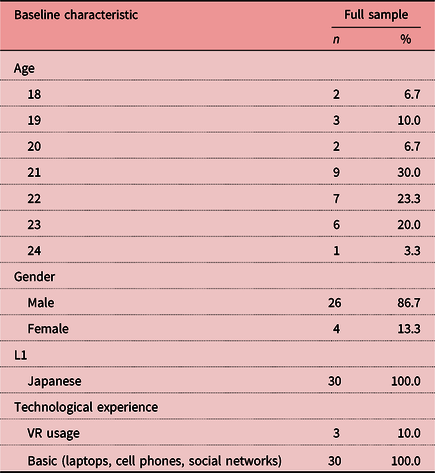
The current study was conducted in a laboratory context at a science and technology university in Japan where a total of 30 students volunteered to take part. These participants consisted of 26 undergraduate and four graduate computer science students (M age = 21.3, SD = 1.56). None of the participants were currently studying English. Although they had all received eight years of compulsory English education, their English proficiency is low; however, their proficiency was not examined in any systematic way. While all participants had experience using smartphones, few had experienced VR technology. Demographics are available in Table 1.
Participant demographics

Note. L1 = first language; VR = virtual reality.
4.2 Instruments
4.2.1 Pre-task
The experiment was designed from a task-based language teaching approach to SLA. As such, all dyads completed a pre-task priming phase to orientate them to the upcoming main task, which was concerned with goal-oriented oral communication. Therefore, materials created for the pre-task phase were devised as a model of the upcoming task and comprised a vocabulary brainstorming activity, introduction to prepositions, and a warm-up task (see Appendix C). Explicit grammar instruction was not given. Dyads were allocated 15 minutes to complete the pre-task priming materials.
4.2.2 Main task
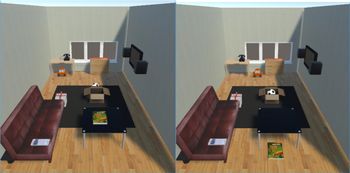
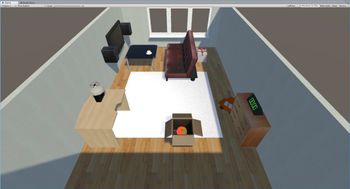
The current study used a spot-the-difference task in all three modalities. In order to keep factors related to modality as consistent as possible, all three tasks featured objects that were created in the real-time game development program, Unity. That is, the voice and video SCMC modalities required participants to find differences between two static images of objects created in Unity, whereas the VR modality presented learners with a 3D version made with the same assets (Figure 1). All three tasks were operationalized to feature the same number of items in each room and the same number of differences to find (n = 3), thus reducing task complexity influences (based on Robinson’s, Reference Robinson and Robinson2011, triadic componential framework).
Spot-the-difference task design

4.2.3 Voice and video modalities
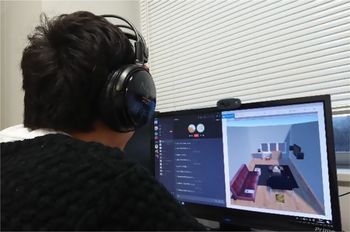
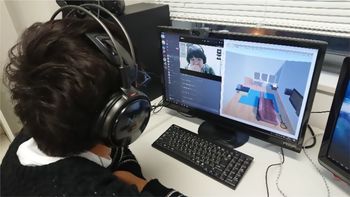
This study employed the use of the text-chat-, voice-, and video-enabled VOIP software Discord for all three modalities. However, the way that this software was utilized differed for each modality. For the voice and video modalities, participants were told not to use the text-chat functionality. For the voice modality, participants utilized the VOIP function only, and for the video modality, participants used both VOIP and video functionality (Figure 2 and Figure 3).
A participant undertaking the spot-the-difference task using Discord in the voice SCMC modality

A participant completing the spot-the-difference task with a partner in the video SCMC modality

4.2.4 VR modality
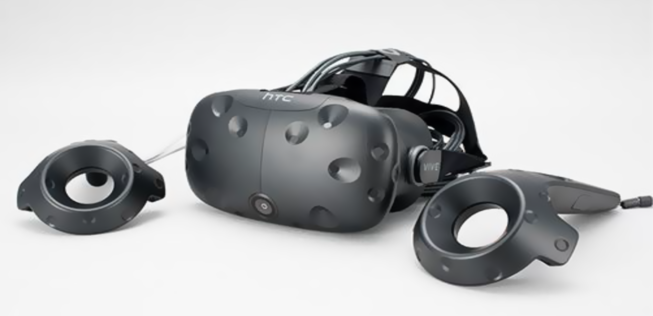
The VR modality required the use of a head-mounted display unit (HMD) and PC for each participant. The HMD employed in this study was the HTC Vive (Figure 4). Within the VR environment, in order for participants to be able to see their interlocutor, the room featured in the spot-the-difference task was not created to life-size scale but instead appeared in front of each participant as a doll’s house. The house was closed on three sides and opened at the front to allow the participants to see their own room but not their interlocutor’s (Figure 5).
HTC Vive head-mounted display unit and controllers

An example of the “doll’s house” used in the VR task

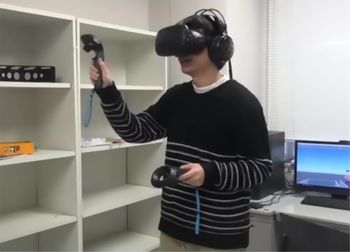
The VR tasks also allowed participants to interact with each other via the use of body language and gestures. This is achieved in two ways. First, the position of the HMD is tracked in three dimensions, which means that as a participant moves their head, their moves accordingly (this includes body movement based on the position of the head). Second, two complementary controllers to the HTC Vive headset allow the learners to create simple gestures with the avatar’s arms (Figure 6). Finally, communication between participants was again achieved through the use of the VOIP software.
A participant undertaking the spot-the-difference task in the VR modality

4.2.5 Pre-experiment and post-task questionnaire: Reduced Horwitz et al.’s FLCAS
A reduced version of Horwitz et al.’s (Reference Horwitz, Horwitz and Cope1986) FLCAS was designed for this project to measure participants’ FLA at the pre-experiment and post-task level. This reduced version was considered more appropriate and specifically designed to answer the research questions of this project (see Appendix A). The reduced version comprised only seven questions, which appear in Melchor-Couto (Reference Melchor-Couto2017, Reference Melchor-Couto2018):
-
1. I never feel quite sure of myself when I am speaking in my foreign language class.
-
2. I don’t worry about making mistakes in language class.
-
3. I start to panic when I must speak without preparation in language class.
-
4. In language class, I can get so nervous I forget things I know.
-
5. Even if I am well prepared for language class, I feel anxious about it.
-
6. I feel confident when I speak in foreign language class.
-
7. I am afraid that the other students will laugh at me when I speak the foreign language.
The questionnaire also contained seven items from Satar and Özdener’s (Reference Satar and Özdener2008) study regarding participants’ opinions of completing the task within each mode of communication. These items are designed to investigate RQ2 regarding participants’ perceptions of conducting language tasks in each modality:
-
1. Chatting in pairs decreased my anxiety.
-
2. I feel like I want to chat with native speakers now.
-
3. There were communication problems when using this mode of communication.
-
4. I didn’t have time to think before speaking with this mode of communication.
-
5. It was easy to express my feelings with this mode of communication.
-
6. I was not worried about my pronunciation using this mode of communication.
-
7. It was difficult to understand my partner using this mode of communication.
This questionnaire was completed on paper at the pre-task and post-task stages by all participants.
4.2.6 Post-experiment questionnaire
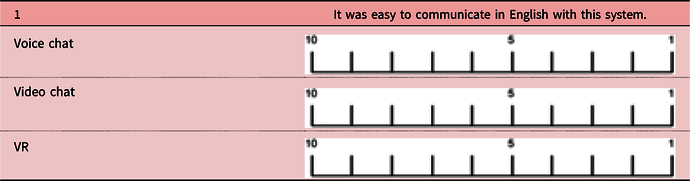
Upon completing tasks in all three modalities, a final post-experiment questionnaire was administered in paper format to participants. The questionnaire allowed an explicit comparison of participants’ experiences between the three modalities (see Table 2). Space was also provided for participants to write a response in longer form about their experiences. No guidance was given regarding which modality participants should comment on.
Example item on the post-experiment questionnaire

Note. VR = virtual reality.
4.3 Procedure
This study was conducted using a counterbalanced, 3 x 3 factorial design with all participants completing tasks in all three modalities. Before the experiment, all participants completed the FLCAS in their native Japanese. Following that, all dyads completed a pre-task worksheet, which familiarized them with the main spot-the-difference task. This stage is typical of a task-based language teaching approach to instructed SLA, where learners are primed on the upcoming task. For this study, it was also considered a necessary step as a way of reducing the influence of learners’ differing English abilities on their FLA. Following the pre-task phase, groups of dyads completed the tasks in different orders. For example, Group A completed the tasks in the following order: voice, then video, and finally VR (for more detail, see Figure 7).
Experimental procedure

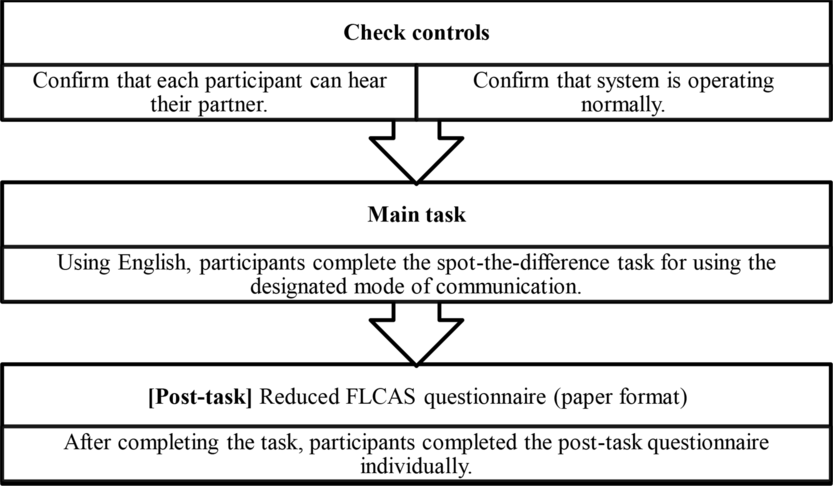
The task cycle consisted of the following procedure for each of the three modalities (Figure 8). First, participants were introduced to how to control the particular environment. For instance, with the video SCMC task, participants were told how to use the communication software. Second, participants worked together to complete the main interactive jigsaw task. Finally, upon completing the task, participants completed the post-task questionnaire.
Main task procedure

After a dyad had completed the three task cycles, they were instructed to fill in the post-experiment questionnaire, explicitly comparing their experiences of completing tasks within the three different modalities.
4.4 Data analysis
To measure the effects of mode of communication on participants’ FLA, the following statistical tests were utilized. A paired samples t-test was used to analyze participants’ FLA scores between the pre-experiment questionnaire and for each of the individual post-task questionnaires. A one-way repeated measures ANOVA was used to compare mean scores for all three post-task questionnaires and to compare mean scores between modes of communication on the post-experiment questionnaire. An alpha level of p = .05 was set for all statistical tests. The statistical analysis software used was IBM’s SPSS Version 24.
5. Results
5.1 RQ1: Effect of modality on participants’ FLA
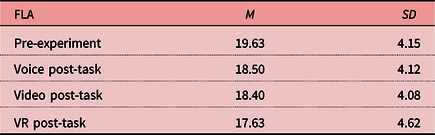
The scores recorded for each participant on the pre-experiment FLCAS questionnaire were compared with their scores on the questionnaires administered in paper format after completing the tasks for each mode of communication. Mean scores for each modality, as well as the pre-experiment questionnaire, are provided in Table 3.
Mean foreign language anxiety (FLA) scores per session

Note. VR = virtual reality.
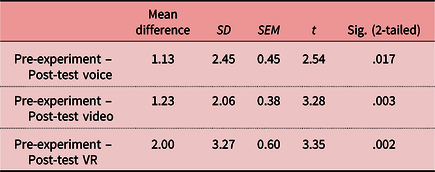
Inspection of descriptive statistics revealed that participants’ FLA was reduced after completing tasks within each modality compared to their original pre-experiment FLA scores. Subsequently, paired sample t-tests were used to check for statistical significance where results revealed that participants’ FLA was statistically significantly reduced after completing tasks in all three modalities (Table 4).
Paired samples t-test results comparing pre-experimental FLA scores with each experimental condition

Note. FLA = foreign language anxiety; VR = virtual reality.
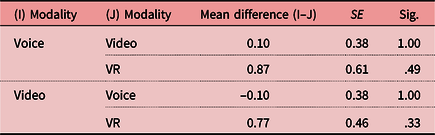
To evaluate whether these three SCMC modes affect FLA differently (RQ1), the data were further analyzed with one-way repeated measures ANOVAs. There were no outliers, and the data were normally distributed as assessed by Shapiro–Wilk test of normality on the studentized residuals (p > .05). Subsequently, Mauchly’s test of sphericity indicated that the assumption of sphericity had been violated, χ2(2) = 9.79, p < .01; therefore, Greenhouse–Geisser was used to correct the results. Inspection of the results of the ANOVA test revealed that there was no significant interaction of the condition between pre-test and post-test, F(1.54, 44.78) = 1.85, p = .18. Finally, pairwise comparisons on the data also revealed no statistical differences in mean FLA scores between modalities (Table 5). In summary then, although results suggest that participants’ FLA scores were statistically significantly reduced by all three CMC modalities, no statistical significance was found when between the mean scores of each modality.
Pairwise comparisons of mean FLA scores by modality

Note. FLA = foreign language anxiety; VR = virtual reality.
5.2 RQ2: Participants’ perceptions of the affective affordances of each modality
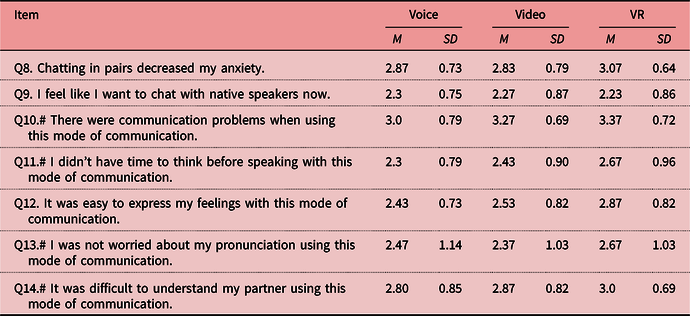
As part of the post-task questionnaire was a section to explore participants’ perception of learning within each modality (Appendix A, items 8–14). Mean scores recorded for each item are presented in Table 6. The questions are also presented here.
Mean scores and standard deviations for Q8–14 on the post-test questionnaire

Note. # refers to items that were negatively weighted. Mean scores have been reversed in this table.
One-way repeated measures ANOVAs were run on the results to check for statistically significant differences in mean scores between modes of communication for each measure. Of the seven items, only one item revealed a statistically significant difference in means: item 12 (It was easy to express my feelings with this mode of communication). It was considered easier to express feelings with the VR modality than the voice modality, F(1, 58) = 7.65, p < .05. As there were no statistically significant differences for the other items on the post-task questionnaire, this finding lends support to the above results that, in general, modality did not have a strong effect on learners’ FLA. There were no discernible problems communicating with each modality, with no obvious difference in technical difficulties. In the following section, the post-experimental questionnaire data is explored, where participants were asked to explicitly compare their experiences of learning within each modality.
5.3 Post-experiment questionnaire data
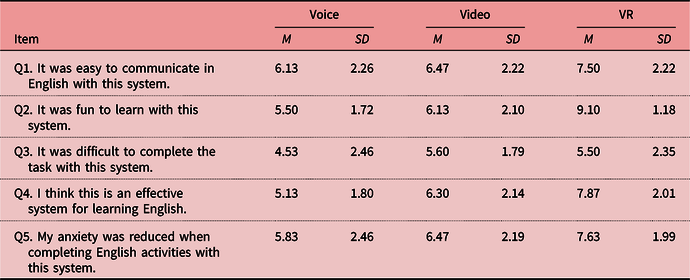
In this section, each item of the post-experiment questionnaire is presented sequentially. All items are available in Appendix B. Descriptive statistics are presented in Table 7. Analysis reveals that for all items other than item 3, mean scores for answers relating to the VR modality are the highest of the three modalities. That is, the affective affordances for learning with VR was the most pronounced.
Descriptive statistics for the post-experiment questionnaire

One-way repeated measures ANOVAs were used to explore the post-experiment questionnaire data for statistically significant differences in mean scores. The first item asked participants to compare their experiences of speaking English within each domain. Results of the ANOVA revealed a statistically significant difference in mean scores between the voice and VR modes, F(2, 58) = 3.63, p = .03 (Table 8, Figure 9). Subsequently, pairwise comparisons revealed that the VR modality was considered significantly easier with which to communicate in English than the voice modality (p < .05). However, no statistical significance was found between the video and VR modalities.
Pairwise comparisons for mean scores of item 1 on the post-experiment questionnaire

Graphical representation of mean scores for item 1 (“It was easy to communicate in English with this system.”) on the post-experiment questionnaire

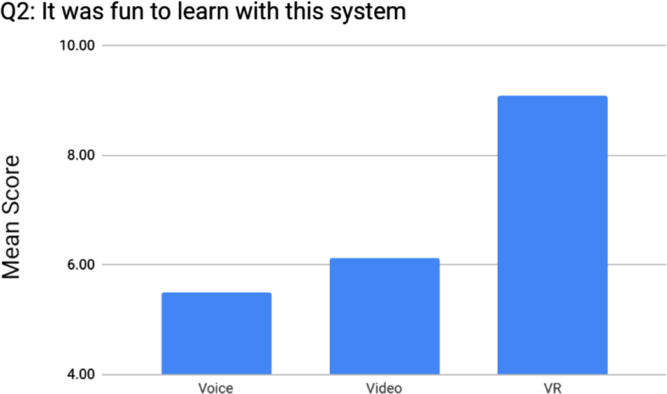
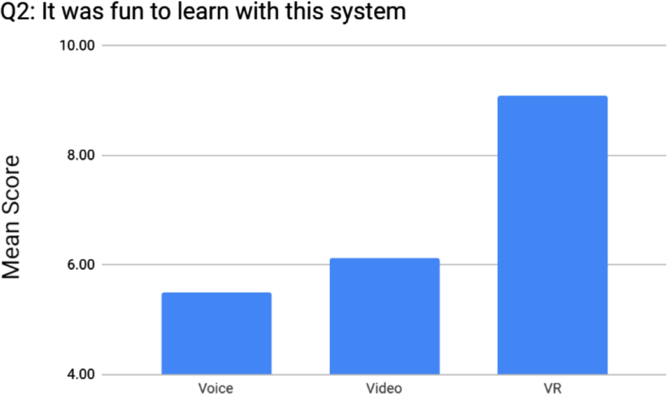
The second item asked participants to compare their experiences in terms of enjoyment of completing tasks in each modality. Statistical analyses again revealed a statistically significant difference in mean scores, F(2, 58) = 56.52, p < .001. Participants perceived the VR modality to be statistically significantly more enjoyable than both the video and voice modalities (Table 9, Figure 10).
Pairwise comparisons for mean scores of item 2 on the post-experiment questionnaire

Graphical representation of mean scores for item 2 on the post-experiment questionnaire
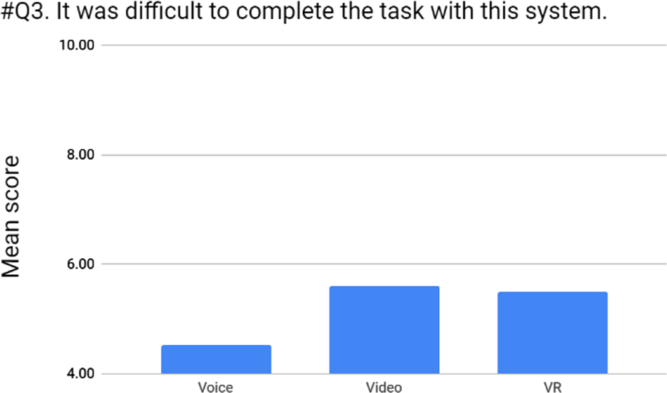
The third item was negatively weighted and asked participants to compare modalities in terms of difficulty. Statistical analyses again revealed a statistically significant difference in mean scores, F(2, 58) = 4.14, p = .03. Participants perceived the voice modality to be statistically significantly more difficult to complete than the video modality; however, no significant difference was found between the voice and VR modality (Table 10, Figure 11). Indeed, responses to this item suggested that of the three modes, the video modality was easiest to complete.
Pairwise comparisons for mean scores of item 3 on the post-experiment questionnaire

Graphical representation of mean scores for item 3 on the post-experiment questionnaire

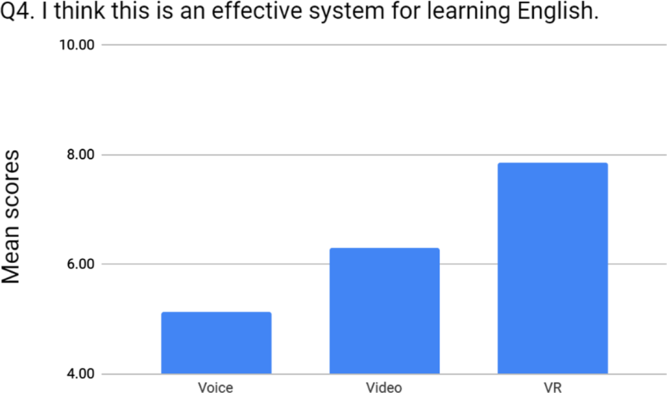
The fourth item asked participants to compare the effectiveness of each modality for learning English. Statistical analyses again revealed a statistically significant difference in mean scores, F(2, 58) = 19.13, p < .001. Participants perceived the VR modality as the most effective domain for learning English where statistically significant differences in mean scores were recorded between all mean scores (Table 11, Figure 12). The order in perceived effectiveness followed the order of voice to video to VR as most effective.
Pairwise comparisons for mean scores of item 4 on the post-experiment questionnaire

Graphical representation of mean scores for item 4 on the post-experiment questionnaire

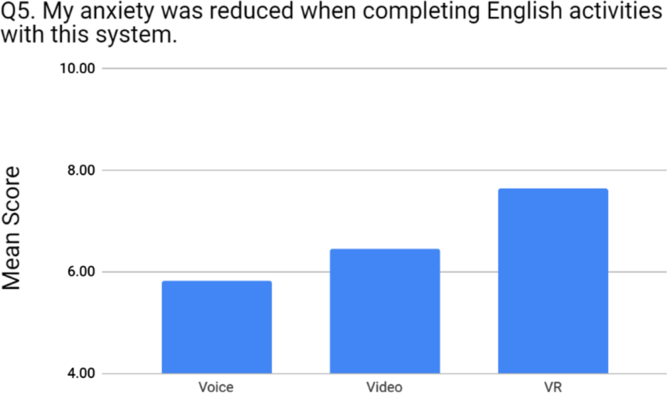
The fifth and final item asked participants to compare the modes of communication in terms of lowering their FLA. There was a statistically significant difference in mean scores, F(2, 58) = 8.03, p < .001. Participants perceived the VR modality as the most effective domain for lowering their FLA, where statistically significant differences in mean scores were recorded between the VR and video and VR and voice modalities (Table 12, Figure 13). There was no statistically significant difference in mean score between the voice and video modalities.
Pairwise comparisons for mean scores of item 5 on the post-experiment questionnaire

Graphical representation of mean scores for item 5 on the post-experiment questionnaire

5.4 Open-ended questions
Finally, this section explores participants’ responses to the open-ended question on the post-experiment questionnaire. Of 30 possible responses, 18 were recorded. These responses show a broad range of opinions regarding completing English communication activities via SCMC. There were 11 responses that mentioned the VR environment, four responses for the video environment, and only one response specifically mentioning the voice-only environment. The following sections explore comments for each of the SCMC modalities in turn.
5.5 Responses regarding VR
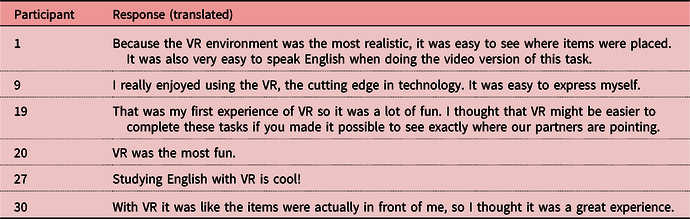
Results of statistical analysis of the post-experiment questionnaire data revealed that the VR modality was considered the most fun, effective, and easiest environment to communicate in English. A total of six responses mentioned that the VR environment was the most fun activity to complete, which could be the reason for participants’ positive review of this environment in the post-experiment questionnaire. Responses recorded are available in Table 13. The novelty of completing tasks within the “cutting edge technology” (Participant 9) of VR also appears to be one major reason for increased enjoyment. Participant 9 also mentions that VR promoted ease of expression, which lends weight to the statistically significant finding from the post-task questionnaire that VR was the easiest modality to express oneself (item 12).
Positive responses regarding VR to the open-ended question on the post-experiment questionnaire
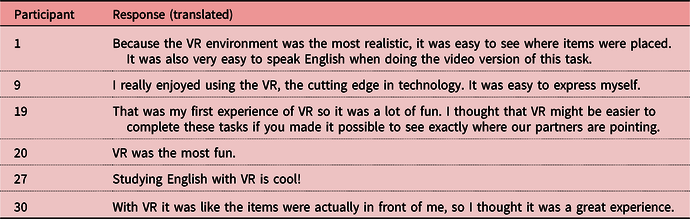
However, not all responses related to the VR environment were positive. Two negative responses were also recorded, related to the unfamiliarity of conducting activities in VR and an observation that the VR environment actually decreased visual saliency:
「HMDがつけづらい」
(It was hard to put on the headset)
「一部見にくいところがあった」
(There were some areas which were hard to see)
In general, then, although the majority of comments regarding the VR modality were positive, some participants did not perceive their experiences in this modality to be as positive as the more traditional, voice and video, modalities. Participant 1 in particular summed up this point by mentioning the positive affordances of both VR and video (Table 13).
5.6 Responses regarding the video modality
There were only four responses that mentioned the video modality. Participant 10’s response, in particular, highlighted the hypothesis that being seen by one’s partner would be a source of anxiety. This participant also mentioned that if the task was carried out FTF, they may have been less nervous:
「ビデオ通話だと少し恥ずかしい
(実際の対面ではおそらく恥ずかしくない)」
(I was a little embarrassed when communicating via video.
[If we had communicated face to face I don’t think I would have been so nervous]).
A response with the opposite perception was also recorded. Participant 6 felt that the addition of video aided communication with the video SCMC modality:
「VoiceやVideoは相手の声色や表情が見れるので逆にコミュニケーションしやすかった。」
(I could hear and see my partner when doing the voice and video versions so it was easier to communicate with these tools.)
In summary, then, a range of opinions were recorded regarding the effect of modality on ease of communication, fun, and FLA that provide further insight into the lack of significant differences in post-task FLA mean scores. That is, participants’ different dispositions toward technology use may have affected their FLA and perceptions.
6. Discussion
The present study aimed to discover how VR-based SCMC may affect FLA in comparison to two other modalities: voice and video SCMC. Results suggested that all three SCMC modalities statistically significantly reduced participants’ FLA. This finding is consistent with those found in the literature (Melchor-Couto, Reference Melchor-Couto2017; Satar & Özdener, Reference Satar and Özdener2008). However, unlike previous studies, the current research aimed to compare the effect between SCMC modalities. Statistical analyses of post-task mean FLA scores for the three modalities did not reveal any significant differences. Implications of this are that for voice-SCMC modalities, modality may not be a key factor in reducing FLA. Subsequently, this study asked participants to explicitly compare their perceptions of learning in each environment, which revealed that VR was considered to be the most fun, effective, and least anxiety inducing. Interestingly, participant perceptions did not align with the results of the post-task FLCAS questionnaire. This could be due to the low number of participants in this study, which promotes the need for further research in this area.
Surprisingly, no responses to the post-experiment questionnaire mentioned anonymity as a benefit of VR. As Melchor-Couto (Reference Melchor-Couto2018) found, although it may be hypothesized that the anonymity afforded by VR may help reduce FLA levels, in this study, there was no positive correlation between the anonymity afforded by the VR modality and reduced FLA. Moreover, the presence of paralinguistic cues in VR did not appear to be a strong indicator of increased anonymity as reported by Fitze (Reference Fitze2006). This suggests that anonymity may not be a strong factor in reducing FLA. Subsequently, regarding the disembodiment effect of VR was a source of reduced anxiety for some participants but not all, again echoing the works of Melchor-Couto (Reference Melchor-Couto2017) and Jauregi et al. (Reference Jauregi, Canto, de Graaff, Koenraad and Moonen2011) with VWs and Hampel, Uschi, Hauck and Coleman’s (Reference Hampel, Uschi, Hauck and Coleman2005) use of an earlier SCMC system. Thus, regardless of the advancement in technology, instructors must be aware that some participants will prefer to speak FTF over CMC.
7. Conclusion
Conclusions of this study tentatively suggest that VR may be beneficial in reducing learners’ FLA compared to voice and video SCMC modalities. Although the mean scores of the post-task FLCAS did not reveal any statistically significant differences between modes, when explicitly comparing their experiences on the post-experimental questionnaire, participant perceptions suggested that VR was most effective in reducing FLA. Results of the quantitative questionnaire data also suggested that VR was a significantly easier, more enjoyable and effective domain for communication compared to more traditional SCMC modalities. Participant responses also provide hints as to why they preferred learning in the VR environment. This related to immersion and degree of expression. Surprisingly, the avatar effect or anonymity of communicating in VR did not appear to be a strong factor in determining participants’ positive perceptions.
7.1 Limitations
This study represents an initial step into research on the affective affordances of VR for language learning. As such, there are a number of limitations. Participant numbers were low, which may be one reason that statistically significant differences were not recorded between post-task FLA scores. The L2 proficiency of participants was considered to be homogenic but not rigorously assessed prior to the experiment. Anxiety levels are shown to be different based on proficiency, which could have influenced the results of this study (Liu, Reference Liu2016). Participation was also voluntary, a factor that could have influenced results. Subsequently, although not appearing as a strong theme in participant responses, the novelty of completing tasks in the VR domain may have reduced FLA. Finally, the tasks utilized in this study were of only a single type (jigsaw task). Using various task types may result in different results to those found here (see York, Reference York2019).
Tasks were operationalized to be of a similar task complexity for all three modalities, which implies that the VR task utilized very few of the technological affordances or “semiotic budget” (Levak & Son, Reference Levak and Son2017; van Lier, Reference van Lier2004) of the VR environment. In further studies, the implementation of interactivity with the environment may yield different results to those here. Specifically, forcing learners to interact with their environment as part of tasks may increase the cognitive load on learners and thus hinder language production, leading to increased anxiety. However, alternatively, increased interactivity could produce a state of flow in learners as they rise to the challenge and therefore a reduction in anxiety. Such questions may be explored in further research.
7.2 Pedagogical implications
The current study was conducted as a preliminary experiment into the applicability of VR as a low-anxiety SCMC domain for language learning contexts. While VR may not be a viable tool in typical large, FTF classrooms, the present study has shown that for contexts that have less restrictive financial constraints, VR may offer an authentic domain for oral communication with the added benefit of reducing learner FLA compared to existing systems. However, the disembodiment of communicating with an avatar may be perceived as a positive or negative depending on learner predispositions to technology, meaning that VR is not inherently natural or enjoyable for all learners.
The present study focused only on communication between student dyads; however, the system is able to support any number of interlocutors. Therefore, there is a strong potential for VR to be adopted in online language courses where physically meeting is impossible, such as in telecollaboration or intercultural communication contexts.
7.3 Future research
Based on the results of the present study, and the perceived limitations outlined above, the authors are currently working on a number of further projects to gather more empirical, longitudinal data on this topic. These projects are interaction analysis using the CAF (complexity, accuracy and fluency) model to assess how modality affects oral proficiency (see York, Reference York2019; Ziegler, Reference Ziegler2016), the effect of increased interactivity (and thus cognitive demand) on participants’ perceived FLA, and an analysis of the affective affordances of smartphone VR in comparison to PC-based VR. This final study represents a shift from lab-based to empirical, classroom-based research in an attempt to provide answers regarding the successful pedagogical implication of VR technology.
Supplementary materials
To view supplementary material for this article, please visit https://doi.org/10.1017/S0958344020000154
Ethical statement
All participants in this paper were unpaid volunteers and completed a consent form that outlined how their data would be collected, stored and used. Participants agreed to the terms of use of the data that appear in this study and signed the consent form. The experiment was conducted in line with the university’s ethics policy.
About the authors
James York is a lecturer at Tokyo Denki University where he researches the application of games and play for teaching languages. He also co-edits Ludic Language Pedagogy, an open-access journal.
Koichi Shibata is a master’s student studying information sciences at Tokyo Denki University. He conducts research on the application of virtual reality in language education.
Hayato Tokutake is a master’s student studying information sciences at Tokyo Denki University. He conducts research on the application of virtual reality in language education.
Hiroshi Nakayama is a professor of instructional technology at Tokyo Denki University, conducting research on the integration and application of technology for educational purposes.
Author ORCIDs
James York, https://orcid.org/0000-0003-1667-7107
Koichi Shibata, https://orcid.org/0000-0002-9429-3937
Hayato Tokutake, https://orcid.org/0000-0001-5963-4399
Hiroshi Nakayama, https://orcid.org/0000-0002-2934-3176