Physical aggression is present in the majority of young children and it decreases with age as emotion regulation skills and alternative conflict-resolution strategies emerge, aided by development of language and cognitive abilities (Tremblay, Reference Tremblay2000; Tremblay & Nagin, Reference Tremblay, Nagin, Tremblay, Hartup and Archer2005). However, it is also clear that those children who show the highest levels of physical aggression during early childhood are most at risk of chronic physical aggression throughout childhood (Côté, Vaillancourt, LeBlanc, Nagin, & Tremblay, Reference Côté, Vaillancourt, LeBlanc, Nagin and Tremblay2006; NICHD Early Child Care Research Network, 2004), followed by serious violent and nonviolent delinquency during adolescence (Broidy et al., Reference Broidy, Nagin, Tremblay, Bates, Brame and Dodge2003; Nagin & Tremblay, Reference Nagin and Tremblay1999). Recent studies show that children with early, persistent aggression show not only more externalizing problems at follow-up but also more internalizing and peer problems (e.g., depression, loneliness, poor friendship quality) compared with children on the lower and desisting aggression trajectories (Campbell, Spieker, Burchinal, Poe, & The NICHD Early Child Care Research Network, Reference Campbell, Spieker, Burchinal and Poe2006). It is therefore important to determine which factors or combinations of factors predict consistently high physical aggression during early childhood.
Research has linked maternal prenatal smoking to early childhood physical aggression (Huijbregts, Séguin, Zoccolillo, Boivin, & Tremblay, Reference Huijbregts, Séguin, Zoccolillo, Boivin and Tremblay2007; Tremblay et al., Reference Tremblay, Nagin, Séguin, Zoccolillo, Zelazo and Boivin2004) and to other externalizing (Orlebeke, Knol, & Verhulst, Reference Orlebeke, Knol and Verhulst1997) and disruptive behavior problems (Wakschlag, Leventhal, Pine, Pickett, & Carter, Reference Wakschlag, Leventhal, Pine, Pickett and Carter2006). Maternal prenatal smoking has also been associated with CD in school-aged children and adolescents (Fergusson, Woodward, & Horwood, Reference Fergusson, Woodward and Horwood1998; Wakschlag & Hans, Reference Wakschlag and Hans2002) and violent and repeated offending in adults (Räsänen et al., Reference Räsänen, Hakko, Isohanni, Hodgins, Järvelin and Tiihonen1999).
It has been suggested that prenatal smoking might index a broader antisocial phenotype in the mother (Silberg, Parr, Neale, Rutter, Angold, & Eaves, Reference Silberg, Parr, Neale, Rutter, Angold and Eaves2003). Antisocial behavior in parents can influence the children's risk for physical aggression through multiple routes. One of these routes is direct genetic transmission of antisocial traits. Heritability has been estimated to account for approximately 70% of the variance in offspring aggressive antisocial behavior (Eley, Lichtenstein, & Stevenson, Reference Eley, Lichtenstein and Stevenson1999) and approximately 60% in offspring physical aggression (Dionne, Tremblay, Boivin, Laplante, & Pérusse, Reference Dionne, Tremblay, Boivin, Laplante and Pérusse2003). Alternative routes through which parental antisocial behavior might influence offspring behavior are poor parenting and parental sensitivity, family dysfunction, and socioeconomic disadvantage (Ge et al., Reference Ge, Conger, Cadoret, Neiderhiser, Yates and Troughton1996; O'Connor, Deater-Deckard, Fulker, Rutter, & Plomin, Reference O'Connor, Deater-Deckard, Fulker, Rutter and Plomin1998; Rutter, Silberg, O'Connor, & Simonoff, Reference Rutter, Silberg, O'Connor and Simonoff1999).
Most studies investigating the relationship between maternal prenatal smoking and offspring antisocial behavior have included statistical control for a number of factors associated with parental antisocial disposition. Studies controlling directly for parental antisocial personality or offending behavior have generally confirmed maternal prenatal smoking to be an independent predictor of different forms of offspring antisocial behavior (e.g., Brennan, Grekin, & Mednick, Reference Brennan, Grekin and Mednick1999; Button, Thapar, & McGuffin, Reference Button, Thapar and McGuffin2005; Maughan, Taylor, Caspi, & Moffitt, Reference Maughan, Taylor, Caspi and Moffitt2004; Wakschlag & Hans, Reference Wakschlag and Hans2002). Maughan et al. (Reference Maughan, Taylor, Caspi and Moffitt2004) pointed out that a number of these studies were possibly limited because they only took into account antisocial behavior of one parent (usually the mother), and because they controlled only for relatively extreme indicators of parental antisocial behavior. Nonetheless, when less extreme antisocial behaviors of both parents were taken into account, there was still a residual independent effect of maternal prenatal smoking on offspring physical aggression (Huijbregts et al., Reference Huijbregts, Séguin, Zoccolillo, Boivin and Tremblay2007; Tremblay et al., Reference Tremblay, Nagin, Séguin, Zoccolillo, Zelazo and Boivin2004) or antisocial behavior (Maughan et al., Reference Maughan, Taylor, Caspi and Moffitt2004).
Development of psychopathology involves a complex set of interactions between biological, family, and social risk factors (Cicchetti & Cannon, Reference Cicchetti and Cannon1999; Raine, Reference Raine2002). Testing for such interactions is important both methodologically, because sole use of covariates could mask key effects, and developmentally, because specific combinations of adverse conditions early in life might increase risk for persistent antisocial behavior beyond the simple sum of such risk factors (Raine, Reference Raine2002). A combination of maternal prenatal smoking and parental antisocial behavior might be particularly harmful (see Moffitt, Caspi, & Rutter, Reference Moffitt, Caspi and Rutter2005) because they are both associated with hypothalamic–pituitary–adrenal (HPA) axis and autonomic nervous system (ANS) abnormalities in offspring (parental antisocial behavior: Brennan et al., Reference Brennan, Raine, Schulsinger, Kirkegaard-Sorensen, Knop and Hutchings1997; Van Goozen & Fairchild, Reference Van Goozen and Fairchild2006; maternal prenatal smoking: Horne, Franco, Adamson, Groswasser, & Kahn, Reference Horne, Franco, Adamson, Groswasser and Kahn2004; Slotkin et al., Reference Slotkin, Seidler, Qiao, Aldridge, Tate and Cousins2005). We do not know if maternal prenatal smoking and parental history of antisocial behavior interact in the prediction of offspring physical aggression, but there are some indications prenatal smoking interacts with factors associated with parental antisocial behavior. One study showed that prenatal maternal smoking resulted in a higher risk for conduct disorder (CD) symptoms only when there was a poor early caregiving environment as measured by maternal responsiveness (Wakschlag, & Hans, Reference Wakschlag and Hans2002). In another study absence of father from the household interacted with maternal prenatal smoking in predicting early onset of offending (Gibson, & Tibbetts, Reference Gibson and Tibbetts2000). A third study showed that maternal prenatal smoking was associated with overt CD symptoms only for low socioeconomic status (SES) children but not for those with high SES (Monuteaux, Blacker, Biederman, Fitzmaurice, & Buka, Reference Monuteaux, Blacker, Biederman, Fitzmaurice and Buka2006). Little evidence exists for interactions between maternal prenatal smoking and factors that are not associated with parental antisocial behavior. The exception is gender. In two studies, maternal prenatal smoking predicted antisocial behavior only in school aged or adolescent boys (e.g., Fergusson et al., Reference Fergusson, Woodward and Horwood1998; Wakschlag, & Hans, Reference Wakschlag and Hans2002), although other studies of younger children did not replicate these findings (Maughan et al., Reference Maughan, Taylor, Caspi and Moffitt2004; Orlebeke et al., Reference Orlebeke, Knol and Verhulst1997).
In the present study, we hypothesized that the effects of maternal prenatal smoking on early childhood physical aggression would be compounded when accompanied by mother's and father's history of antisocial behavior. We also investigated the possibility that maternal prenatal smoking interacted with factors indicative of the early caregiving environment (i.e., maternal responsiveness, maternal hostile-reactive parenting, family functioning, family status) and early socioeconomic environment (i.e., family income, maternal education), which might represent pathways from family history of antisocial behavior to children's physical aggression. Finally, we tested whether maternal prenatal smoking interacted with gender in the prediction of early childhood physical aggression, expecting that the effect of prenatal smoking would be similar for boys and girls considering their young age.
Method
Participants
The children of this study were born in 1997/1998 in the province of Québec, Canada, and participate in the Québec Longitudinal Study of Children's Development. This sample excluded very remote regions of the province populated mainly by aboriginal people (2.1% of live births), babies for whom gestational age could not be computed (1.3%), babies born in a different territory but whose parents reside in Québec (4.5%), and very premature babies (<24 weeks) and babies for whom there were delays in filing the birth records in the Master Birth Registry on time for the first assessment, that is, babies born after 42 weeks gestation (0.1%; for full details, see Jetté & Des Groseilliers, Reference Jetté and Des Groseilliers2000). A total of 2,940 infants met inclusion criteria and were selected through a region-based stratification procedure (Jetté & Des Groseilliers, Reference Jetté and Des Groseilliers2000). Of this original selection, a number of families could not be included in the initial 5-month assessment for the following reasons:
1. families were not found on time (incorrect address/telephone number) (n = 172, 5.9%);
2. families were excluded (total n = 93, 3.2%) because of death of the baby (n = 5), because of participation in other longitudinal studies (n = 5), because they had insufficient command of either English or French language (n = 81), or because the instruments of the study were not designed to adequately measure development of children with severe physical or mental handicaps (n = 2);
3. families could not be reached (n = 14, 0.5%); and
4. families who declined participation (n = 438, 16.4%).
The first assessment comprised 2,223 families (75.6%) and took place when the infants were 5 months old. Demographic characteristics of this Québec sample were comparable to those of a large Canadian sample consisting of 13,439 households representative of the 10 Canadian provinces (Human Resources Development Canada, 1996: National Longitudinal Survey of Children and Youth, 1994–1995). Assessments relevant to this study took place at 17, 30, and 42 months. Parental informed consent was obtained before every assessment. Data were incomplete for 478 participants who had either dropped out since the initial assessment at 5 months or had missing values for one or more predictor variables or for computing physical aggression trajectories. Thus, the final study sample consisted of 1,745 children (78.5% of families enrolled at 5 months: 884 boys, 861 girls). There were no significant differences between children who had been included and those who were excluded regarding maternal prenatal smoking, mother's and father's history of antisocial behavior, and children's physical aggression levels.
Measurements
Physical aggression
Maternal ratings of physical aggression were obtained with the use of an early childhood behavior scale from the Canadian National Longitudinal Study of Children and Youth (Statistics Canada, 1995), which incorporates items from the Child Behavior Checklist for Ages 2–3 (Achenbach, Edelbrock, & Howell, Reference Achenbach, Edelbrock and Howell1987), the Ontario Child Health Study Scales (Offord, Boyle, & Racine, Reference Offord, Boyle and Racine1989), and the Preschool Behavior Questionnaire (Tremblay, Desmarais-Gervais, Gagnon, & Charlebois, Reference Tremblay, Desmarais-Gervais, Gagnon and Charlebois1987). To assess physical aggression mothers were asked at 17, 30, and 42 months to indicate whether the child: (a) hits, bites, kicks; (b) fights; and (c) bullies others. The items were scored as follows: never or not true (0), sometimes or somewhat true (1), or often or very true (2). The items were summed to obtain the physical aggression score (range = 0–6). The mean physical aggression scores at 17, 30, and 42 months were 0.62 (SD = 0.97), 0.94 (SD = 1.1), and 1.37 (SD = 1.35). The internal consistency values (Cronbach α) were 0.80 at 17 months, 0.82 at 30 months, and 0.72 at 42 months. The physical aggression scale has been related specifically to overt delinquency (physical violence) in adolescence (Nagin & Tremblay, Reference Nagin and Tremblay1999), and to mother and child reports of CD (Séguin et al., Reference Séguin, Nagin, Assaad and Tremblay2004). Its validity in early childhood is also well established (Côté et al., Reference Côté, Vaillancourt, LeBlanc, Nagin and Tremblay2006; Tremblay et al., Reference Tremblay, Nagin, Séguin, Zoccolillo, Zelazo and Boivin2004).
Maternal prenatal smoking
When the children were 5 months of age, mothers were asked about their smoking behavior throughout pregnancy. The questions assessing smoking behavior during pregnancy were straightforward: “Did you smoke during pregnancy?” and “How many cigarettes/day did you smoke whilst pregnant?” These questions are similar to those found in most other assessment instruments (e.g., the Centers for Disease Control and Prevention Pregnancy Risk Assessment Monitoring System Questionnaire; see Beck et al., Reference Beck, Morrow, Lipscomb, Johnson, Gaffield and Rogers2002) and like those found in most other studies (particularly those assessing large samples, e.g., Button et al., Reference Button, Thapar and McGuffin2005; Fergusson et al., Reference Fergusson, Woodward and Horwood1998; Maughan et al., Reference Maughan, Taylor, Caspi and Moffitt2004; Wakschlag & Hans, Reference Wakschlag and Hans2002). Because amount of cigarettes reportedly smoked tends to be a “rounded” number, for example, 5, 10, 15, and so forth, mothers were classified into one of three groups (0, 1–9, ≥10 cigarettes/day). This or similar classifications have been used in most other studies investigating smoking during pregnancy (e.g., Button et al., Reference Button, Thapar and McGuffin2005; Fergusson et al., Reference Fergusson, Woodward and Horwood1998; Maughan et al., Reference Maughan, Taylor, Caspi and Moffitt2004; Wakschlag & Hans, Reference Wakschlag and Hans2002). Although there is a risk for a social desirability bias, several studies have indicated a relatively strong association between retrospective self-report and blood/urine cotinine levels (i.e., the main nicotine metabolite; e.g., Law et al., Reference Law, Stroud, LaGasse, Niaura, Liu and Lester2003; Pickett, Rathouz, Kasza, Wakschlag, & Wright, Reference Pickett, Rathouz, Kasza, Wakschlag and Wright2005). Further reliance on self-report measures may be inferred from the strong relation between the amount reportedly smoked during pregnancy and birth weight (e.g., Huijbregts et al., Reference Huijbregts, Séguin, Zelazo, Parent, Japel and Tremblay2006; Kramer et al., Reference Kramer, Platt, Wen, Joseph, Allen and Abrahamowicz2001). It has also been shown that a relatively strong concordance exists between ante- and postnatal reports of tobacco exposure (e.g., Jacobson, Chiodo, Sokol, & Jacobson, Reference Jacobson, Chiodo, Sokol and Jacobson2002). For the current analyses, 1,307 (74.9%) mothers reported not to have smoked during pregnancy, 202 (11.6%) reported to have smoked 1–9 cigarettes/day, and 236 (13.6%) reported to have smoked 10 or more cigarettes/day during pregnancy. A total of 25.2% of mothers who smoked during pregnancy is common in present-day Western countries (see Breslau, Paneth, Lucia, & Paneth-Pollak, Reference Breslau, Paneth, Lucia and Paneth-Pollak2005; Côté et al., Reference Côté, Vaillancourt, LeBlanc, Nagin and Tremblay2006).
Parental history of antisocial behavior
To assess history of antisocial behavior, both parents completed a questionnaire at the 5-month assessment. The questionnaire included items related to childhood/adolescence (i.e., the period before the end of high school) and items related to adulthood (Zoccolillo, Reference Zoccolillo2000; see also Tremblay et al., Reference Tremblay, Nagin, Séguin, Zoccolillo, Zelazo and Boivin2004) and was largely derived from the NIMH Diagnostic Interview Schedule (Robins, Helzer, Croughan, & Radcliff, Reference Robins, Helzer, Croughan and Ratcliff1981). Fathers were asked whether before the end of high school they had often been in fights that they had started, stolen more than once, been involved with youth protection or the police because of their misbehavior, or had been expelled or suspended from school. Mothers were asked whether before the end of high school they had been in more than one fight that they had started, stolen more than once, been involved with youth protection or the police because of their misbehavior, skipped school more than twice in 1 year (truancy), or ran away from home overnight. Pilot testing had shown that stealing, youth arrests, fighting, and school expulsion/suspension were much less prevalent in mothers. Therefore, the question about expulsion/suspension for fathers was replaced by the question about truancy and running away from home for the mothers. Regarding antisocial behavior as an adult, both fathers and mothers were asked whether they had been arrested (other than for traffic violations), had been fired from a job (more than once for fathers, and excluding layoffs for lack of work), or had caused trouble at work, with family, or with the police because of drug or alcohol abuse. In addition, whereas fathers were also asked whether they had gotten into fights more than once or assaulted or hurt anyone physically, mothers were asked whether they had hit or thrown things at the spouse or partner with whom they were living, because pilot testing revealed that no mothers responded positively to the fights/assault question. Internal reliability for the maternal scale was 0.54 (Cronbach α) and 0.59 for the paternal scale. Latent class analysis (Vermunt & Magidson, Reference Vermunt and Magidson2005) identified three class models for both mothers (not antisocial, moderately antisocial, antisocial) and fathers not antisocial, antisocial as an adolescent but not as an adult, moderately antisocial as an adolescent, antisocial as an adult). We refer to these classes as “no,” “moderate,” and “serious” histories of antisocial behavior.
Control variables
At the 5-month assessment, mothers provided information about family income (1 = <$10,000 Canadian, to 8 = >$80,000 Canadian, M = 5.93, SD = 2.21, range = 1–8), maternal education (1 = no high school diploma to 7 = university degree, M = 4.29, SD = 2.15, range = 1–7), age at birth of their first child (M = 25.93, SD = 4.87, range = 14–41 years), and family status (separation/divorce: no, N = 1,407, 80.6%/yes, N = 338, 19.4%). Family functioning (at 5 and 17 months) was assessed with a scale containing 12 items measuring communication, problem resolution, control of disruptive behavior, and expression and reception of affection (Statistics Canada, 1995). Scores per item could be 0 (never), 1 (sometimes), or 2 (often), thus ranging from 0 to 36 on the scale. The Cronbach values were 0.86 (5 months) and 0.98 (17 months). Trained observers rated the Home Observation for Measurement of the Environment (HOME)—Infant version (Caldwell & Bradley, Reference Caldwell and Bradley1984) at 5 and 17 months based on the 3-hr home visit required for the interview and testing. From the HOME, one parenting measure, maternal responsiveness, was included in statistical analyses. The mean of scale score across the 5 and 17 months assessments was used. The Cronbach values were 0.85 at 5 months and 0.83 at 17 months. A second parenting measure, maternal hostile-reactive parenting, was assessed with the Parental Cognitions and Conduct Toward the Infant Scale (PACOTIS; Boivin et al., Reference Boivin, Pérusse, Dionne, Saysset, Zoccolillo and Tarabulsy2005). The PACOTIS, a questionnaire consisting of 23 items rated by the mother, includes seven hostile-reactive parenting items: “I have been angry with my baby when he/she was particularly fussy”; “When my baby cries, he/she gets on my nerves”; “I have raised my voice with or shouted at my baby when he/she was particularly fussy”; “I have spanked my baby when he/she was particularly fussy”; “I have lost my temper when my baby was particularly fussy”; “I have left my baby alone in his/her bedroom when he/she was particularly fussy”; “I have shaken my baby when he/she was particularly fussy.” Items were rated on an 11-point scale (higher = more hostile reactive parenting). Cronbach values were 0.43 at 5 months and 0.73 at 17 months. For our analyses we kept only the 17 months scale score for hostile-reactive parenting because of the low internal reliability at 5 months.
Whereas interactions between maternal prenatal smoking and the above-mentioned variables were investigated because they represent the early caregiving and socioeconomic environment, a number of other variables were included in the analyses because they have also been shown to be indicative of both the predictor variables and children's physical aggression. These variables were: prenatal exposure to illegal drugs (yes, N = 22, 1.3%)/no, N = 1,723, 98.7%) and alcohol (7-point scale: never, N = 1,095, 62.8%; less than once a month, N = 496, 28.4%; one to three times/month, N = 92, 5.3%; once/week, N = 50, 2.9%; two to three times/week, N = 7, 0.4%; four to six times/week, N = 2, 0.1%; and every day, N = 3, 0.2%; information provided by the mother at the 5-month assessment), birth weight (M = 3,405 g, SD = 499, range = 990–5,255), and maternal depression (using the Center for Epidemiologic Studies Depression [CES-D] scale, Radloff, Reference Radloff1977; M = 5.93, SD = 2.21, range = 1–9). Birth weight and gestational age were derived from birth records. Birth weight for gestational age was standardized within gender for each week of gestation using recent Canadian norms (Kramer et al., Reference Kramer, Platt, Wen, Joseph, Allen and Abrahamowicz2001).
Data analyses
Assignment to trajectories
Scores from the three assessment points were analyzed to identify distinctive behavioral trajectories across time (Nagin, Reference Nagin1999, Reference Nagin2005; Nagin & Tremblay, Reference Nagin and Tremblay2001). Rather than to assume that all children follow the same developmental pattern, this methodology identifies different groups of individuals who tend to follow similar patterns over time. For example, some children may never show a given problem behavior (intercept model or zero-order polynomial), others may show constant high levels (also intercept model), and others may increase or decrease over time (e.g., linear first-, quadratic second-, or cubic third-order polynomials). To identify the model that best represents the development of a specific behavior during a given time frame, models with a varying number of trajectories are estimated. Model selection is dependent on a combination of statistical and investigator-guided concerns: key decisions are based on Bayesian fit indices for model selection in accordance to procedures described by Nagin (Reference Nagin2005), for example, the higher the Bayesian information criterion (BIC), the better. A key output of model estimation is the posterior probability of group membership. For each trajectory group this probability measures the likelihood of an individual of belonging to that trajectory group based on observations across assessments. In other words, 100% accuracy in classification is not assumed nor required. For example, in the case of an individual who scores high on physical aggression at all assessment periods, the posterior probability of membership to a chronically high trajectory group would be high, whereas the probability of membership to a low trajectory group would be near 0.
Prediction of physical aggression
Because our design was unbalanced but without empty cells we have used a general linear model (GLM) with Type III sums of squares, a very conservative measure (Tabachnick & Fidell, Reference Tabachnick and Fidell2001). Type III sums of squares corrects for nonorthogonality of effects and are invariant to cell frequencies (SPSS Inc., 2003), such as those indicating the number of mothers with a history of elevated antisocial behavior (see Table 1). Unequal cell frequencies, however, do also increase the risk for nonhomogeneity of variance, as was observed in the present sample. This was corrected by log transforming the dependent variable, that is, the posterior probability of membership to the highest physical aggression trajectory. The log-transformed high and rising physical aggression probability was used in all analyses. It was further standardized to facilitate interpretation of the results.
Distribution of maternal prenatal smoking intensity across parental latent class groups for history of antisocial behavior

Note: MPS, maternal prenatal smoking; MA1, no maternal history of antisocial behavior; MA2, moderate maternal history of antisocial behavior; MA3, serious maternal history of antisocial behavior; PA1, no paternal history of antisocial behavior; PA2, moderate paternal history of antisocial behavior; PA3, serious paternal history of antisocial behavior. Data courtesy of the Institut de la Statistique du Québec.
GLM analysis of variance (ANOVA) and analysis of covariance (ANCOVA) were used to test statistical interactions between maternal prenatal smoking and parental history of antisocial behavior, and social and socioeconomic factors associated with parental history of antisocial behavior. We also tested the assumption that effects would be constant across genders through sample stratification and, more rigorously, by including an interaction term between maternal prenatal smoking and gender. Analyses of simple main effects and Bonferroni post hoc comparisons were used to investigate significant interactions in more detail. Linear regression analyses were used to investigate which potential confounders predicted high and rising physical aggression between ages 17 and 42 months, whereas ANOVAs and chi-square tests of independence (for potential confounders with dichotomous answer categories) were used to assess which potential confounders were related to maternal prenatal smoking and the independent variables (IVs) with which maternal prenatal smoking interacted (i.e., mother's and/or father's history of antisocial behavior; social and socioeconomic factors associated with parental history of antisocial behavior).
Results
Assignment to trajectories
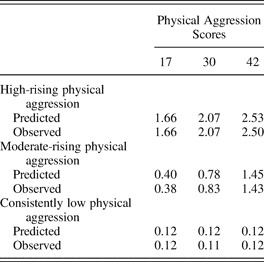
Using PROC TRAJ for SAS (Jones, Nagin, & Roeder, Reference Jones, Nagin and Roeder2001; SAS Institute, 2001), models with between two and five trajectories and varied shapes for each trajectory were compared using BIC. Three trajectories were modeled for physical aggression between ages 17 and 42 months using a zero-inflated Poisson distribution: consistently low, moderate and rising, and high and rising trajectory, representing 25, 50, and 25%, respectively, of the sample. All of these were best modeled using a linear trend except for the low group, which was best represented by a constant term. The shape and level of the physical aggression trajectories were very similar to those we identified in Tremblay et al. (Reference Tremblay, Nagin, Séguin, Zoccolillo, Zelazo and Boivin2004), in a smaller sample using the same measures. It reveals that most of the children show an increase of physical aggression between 17 and 42 months of age, which is consistent with other longitudinal and cross-sectional studies of early childhood (see predicted and observed means from PROC TRAJ output in Table 2).
Mean predicted and observed physical aggression scores at ages 17, 30, and 42 months for children following the high-rising, moderate-rising, and consistently low trajectories

Note: Data courtesy of the Institut de la Statistique du Québec.
In the current model for physical aggression the average posterior probabilities for the assigned trajectory group were .78 for consistently low physical aggression, .77 for moderate-rising physical aggression, and .81 for high-rising physical aggression, thereby indicating good fit (Nagin, Reference Nagin1999, Reference Nagin2005). Further, a close match of predicted and observed means shown in Table 2 also illustrates this good fit. Models with three trajectories for physical aggression have also produced the best fit in studies using other samples that included children in early childhood (e.g., Côté et al., Reference Côté, Vaillancourt, LeBlanc, Nagin and Tremblay2006; Shaw, Lacourse, & Nagin, Reference Shaw, Lacourse and Nagin2005; Tremblay et al., Reference Tremblay, Nagin, Séguin, Zoccolillo, Zelazo and Boivin2004).
Control variables
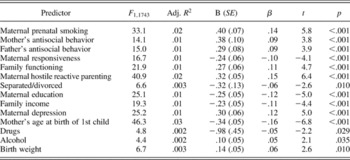
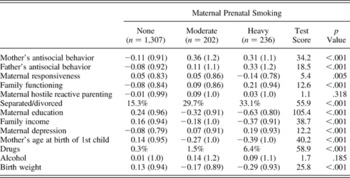
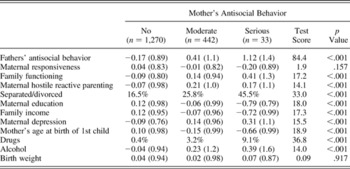
Maternal prenatal smoking, mother's history of antisocial behavior, and father's history of antisocial behavior were all predictive of high and rising physical aggression between ages 17 and 42 months (Table 3). Table 3 also shows which other (control) variables were associated with children's high and rising physical aggression. Most, but not all, of these variables were also related to both maternal prenatal smoking (Table 4) and parental history of antisocial behavior (Table 5). All variables were nonetheless included in further analyses because we opted for a conservative approach by not excluding variables that may have previously been shown to be associated with adverse behavior outcomes in offspring, prenatal smoking, and parental antisocial behavior. Finally, we included gender because it was a predictor of high and rising physical aggression, F (1, 1743) = 26.5, p < .001, adj. R 2 = .014, and could be a further moderator of the effects of maternal prenatal smoking on physical aggression.
Predictors of high and rising physical aggression between ages 17 and 42 months

Note: The log-transformed probability of high and rising physical aggression was used for the analyses. Data courtesy of the Institut de la Statistique du Québec.
Associations between control variables and maternal prenatal smoking

Note: Values are expressed as mean standardized score (SD), except for Separated/divorced (% yes) and Drugs (% of women who used illegal drugs during pregnancy). Test score: F (2, 1742), except for Family status and Drugs: χ(2) 2. Data courtesy of the Institut de la Statistique du Québec.
Associations between control variables and mother's history of antisocial behavior

Note: Values are expressed as mean standardized score (SD), except for Separated/divorced (% yes) and Drugs (% of women who used illegal drugs during pregnancy). Test score: F (2, 1742), except for Family status and Drugs: χ(2) 2. Data courtesy of the Institut de la Statistique du Québec.
Maternal prenatal smoking and parental history of antisocial behavior
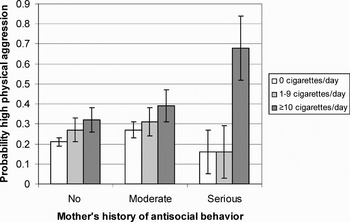
A 3 × 3 GLM ANCOVA with maternal prenatal smoking and mother's history of antisocial behavior as IVs, the (log transformed, standardized) high physical aggression probability as dependent variable (DV) and all control variables introduced as covariates resulted in a significant model, F (21, 1723) = 9.7, p < .001, partial η2 = .11, with a significant main effect for maternal smoking during pregnancy, F (2, 1723) = 7.4, p < .001, partial η2 = .009, a nonsignificant main effect for mother's history of antisocial behavior, and a significant interaction between maternal prenatal smoking and mother's history of antisocial behavior, F (4, 1723) = 2.8, p = .027, partial η2 = .006. Analyses of simple main effects within each category of maternal antisocial behavior history revealed a disproportionate effect of maternal prenatal smoking on the probability of high physical aggression in the serious antisocial group (see Figure 1). More specifically, in the “not antisocial group,” F (2, 1254) = 5.1, p = .006, partial η2 = .008; in the “moderately antisocial group,” F (2, 426) = 1.9, p = .148, partial η2 = .009; in the “seriously antisocial group,” F (2, 17) = 5.0, p = .019, partial η2 = .37. Bonferroni post hoc comparisons showed that, for children of “nonantisocial” mothers, the mean standardized difference in probability of high physical aggression between children of heavy smokers and nonsmokers was 0.24 (95% confidence interval [CI] = 0.03–0.46, p = .022). The mean standardized difference between children of moderate smokers and nonsmokers approached significance: 0.21 (95% CI = 0.01–0.44, p = .071). For children of “moderately antisocial” mothers, there were no significant differences between children of nonsmokers, moderate smokers, and heavy smokers. For children of “seriously antisocial” mothers, however, there were significant differences between children of heavy smokers and nonsmokers: 1.14 (95% CI = 0.10–2.17, p = .026), and between children of heavy smokers and moderate smokers: 1.52 (95% CI = 0.48–2.57, p = .002). These differences were either much larger than observed in the non- or moderately antisocial groups (heavy vs. nonsmoking) or not present in those groups (heavy vs. moderate smoking). In summary, the robust interaction between maternal prenatal smoking and mother's history of antisocial behavior indicated that smoking 10 or more cigarettes/day when pregnant was associated with a disproportionate increase in children's physical aggression when the mother also had a serious history of antisocial behavior.
The untransformed probability of displaying high and rising physical aggression between ages 17 and 42 months (mean and 95% CI) by maternal prenatal smoking and mother's history of antisocial behavior. For analyses the log transformed probability was used to achieve equality of variance across groups, Levene's test: F (8, 1736) = 1.3, p = .231. Data courtesy of the Institut de la Statistique du Québec.

A similar 3 × 3 GLM ANCOVA with maternal prenatal smoking and father's history of antisocial behavior as IVs, the (log transformed, standardized) high physical aggression probability as DV, and all control variables introduced as covariates, showed a significant main effect of maternal prenatal smoking, F (2, 1723) = 6.3, p = .002, partial η2 = .007, but no significant main effect for father's history of antisocial behavior or a significant interaction. It should be noted that such an interaction was not observed in an ANOVA without covariates either, despite significant main effects for both maternal prenatal smoking, F (2, 1736) = 10.5, p < .001, partial η2 = .012, and fathers' history of antisocial behavior, F (2, 1736) = 4.4, p = .013, partial η2 = .005.
Maternal prenatal smoking and early caregiving and socioeconomic environment
Next, we investigated possible interactions of smoking during pregnancy and factors indicative of early caregiving environment (family functioning, responsiveness, hostile reactive parenting, and family status) and early socioeconomic environment (maternal education, family income) in the prediction of high and rising physical aggression. The only further interaction we found was between smoking during pregnancy and family income, F (2, 1739) = 4.9, p = .008, partial η2 = .006. In that model, there were also significant main effects for smoking during pregnancy, F (2, 1739) = 8.9, p < .001, partial η2 = .010, and family income, F (1, 1739) = 11.3, p = .001, partial η2 = .006.
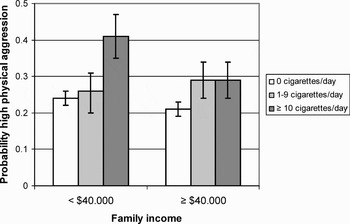
This interaction remained significant after introduction to the model of all potential confounders (shown in Table 6) and gender: F (2, 1726) = 3.8, p = .015, partial η2 = .005. The main effect of smoking during pregnancy also remained significant, F (2, 1726) = 5.6, p = .004, partial η2 = .006, but the main effect of family income was no longer significant. We created two family income groups to clarify the interaction. Although we chose to split roughly at the mean of the ordinal scale (<$40,000, Canadian/year, N = 742, 42.5% vs. ≥$40,000/year, N = 1,003, 57.5%), the interaction between family income and maternal prenatal smoking could be replicated using many different cutoffs for family income. Analyses of simple main effects within each family income category showed that maternal prenatal smoking explained a significant proportion of the variance in high physical aggression probability when family income was (relatively) low, F (2, 726) = 9.6, p < .001, partial η2 = .026, whereas it fell just below significance (and subsequently explained a smaller proportion of the variance) as a predictor of high physical aggression when family income was (relatively) high, F (2, 987) = 2.4, p = .092, partial η2 = .005 (see Figure 2). Bonferroni post hoc comparisons showed that when family income was high there was only a significant mean difference in high aggression probability between children of moderate smokers and children of nonsmokers (0.25, 95% CI = 0.004–0.51, p = .045). When family income was relatively low, there was no significant difference between children of moderate and nonsmokers, but there were significant differences between children of heavy smokers and children of nonsmokers (0.39, 95% CI = 0.16–0.62, p < .001) and between children of heavy smokers and moderate smokers (0.33, 95% CI = 0.03–0.62, p = .003). Thus, heavy smoking had a greater impact when combined with relatively low family income.
The untransformed probability of displaying high and rising physical aggression between ages 17 and 42 months (mean and 95% CI) by maternal prenatal smoking and family income. For analyses the log transformed probability was used to achieve equality of variance across groups, Levene's test: F (2, 1742) = 1.3, p = .280. Data courtesy of the Institut de la Statistique du Québec.

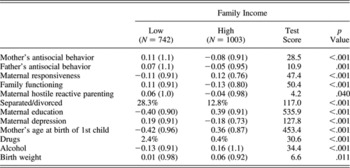
Associations between control variables and family income

Note: Values are expressed as mean standardized score (SD), except for Separated/divorced (% yes) and Drugs (% of women who used illegal drugs during pregnancy). Low family income: <$40,000 (Canadian)/year; high family income: ≥$40,000/year. Test score is for continuous income variable: F (1, 1742). Data courtesy of the Institut de la Statistique du Québec.
Other significant predictors in the analysis examining the interaction between maternal prenatal smoking and mother's history of antisocial behavior and the analysis examining the interaction between maternal prenatal smoking and family income were gender, father's history of antisocial behavior birth weight, maternal responsiveness hostile reactive parenting, age of the mother at the birth of her first child, and alcohol use during pregnancy.
Maternal prenatal smoking and gender
The mean raw probability of high and rising physical aggression between 17 and 42 months was 0.28 (SD = 0.39) for boys and 0.21 (SD = 0.29) for girls. When the analyses of variance predicting log-high and rising physical aggression during early childhood were performed for boys and girls separately, the effect of maternal prenatal smoking was significant for both groups: boys, F (2, 881) = 8.9, p < .001, partial η2 = .020; girls, F (2, 858) = 9.0, p < .001, partial η2 = .021; also, when all control variables were introduced: boys, F (2, 869) = 3.9, p = .021, partial η2 = .009; girls, F (2, 846) = 4.6, p = .010, partial η2 = .011. ANOVAs simultaneously introducing maternal prenatal smoking and gender showed significant main effects of maternal prenatal smoking, F (2, 1739) = 17.9, p < .001; partial η2 = .020, and gender, F (1, 1739) = 17.3, p < .001, partial η2 = .010, but no significant interaction between maternal prenatal smoking and gender (p > 0.9). This did not change when all control variables were introduced as covariates: maternal prenatal smoking: F (2, 1726) = 7.9, p < .001, partial η2 = .009; gender: F (1, 1726) = 14.4, p < .001, partial η2 = .008; Maternal Prenatal Smoking × Gender: F (2, 1726) = .080, p = .923, partial η2 < .001.
Discussion
The main new findings of this study are the interactions of maternal prenatal smoking with mother's history of antisocial behavior and family income in the prediction of early childhood physical aggression. The interaction between maternal prenatal smoking and mother's history of antisocial behavior indicated that children of mothers who smoked heavily (≥10 cigarettes/day) during pregnancy were at a disproportionately high risk of being on a high physical aggression trajectory when mothers also had a serious history of antisocial behavior. The interaction between maternal prenatal smoking and family income indicated that the effects of heavy smoking are more serious under relatively low-income conditions.
This is also the second sample (following Tremblay et al., Reference Tremblay, Nagin, Séguin, Zoccolillo, Zelazo and Boivin2004) in which the relation between maternal prenatal smoking and children's physical aggression has been observed before age 4 years. Wakschlag, Leventhal, et al. (Reference Wakschlag, Leventhal, Pine, Pickett and Carter2006) showed associations between maternal prenatal smoking and a general index of externalizing behavior (which included physical aggression directed toward peers) during toddlerhood as well as specific relations with “stubborn defiance” and a score composed of aggression (not necessarily physical) directed toward the mother and destructive behavior toward objects. Conduct problems during early childhood, and specifically high-stable levels of physical aggression continuing into middle childhood, are important because they have been shown to predict serious antisocial behavior during adolescence and adulthood (Broidy et al., Reference Broidy, Nagin, Tremblay, Bates, Brame and Dodge2003; Campbell et al., Reference Campbell, Spieker, Burchinal and Poe2006; Caspi, Moffitt, Newman, & Silva, Reference Caspi, Moffitt, Newman and Silva1996; Lacourse et al., Reference Lacourse, Nagin, Vitaro, Côté, Arseneault and Tremblay2006; Nagin & Tremblay, Reference Nagin and Tremblay1999; Tremblay, Pihl, Vitaro, & Dobkin, Reference Tremblay, Pihl, Vitaro and Dobkin1994). Two earlier studies showed an association between prenatal smoking and such atypical trajectories of problem behavior (Tremblay et al., Reference Tremblay, Nagin, Séguin, Zoccolillo, Zelazo and Boivin2004; Wakschlag, Pickett, Kasza, & Loeber, Reference Wakschlag, Pickett, Kasza and Loeber2006). Together with the present study, these results indicate that maternal prenatal smoking is a risk factor for early and persistent antisocial behavior. However, the present study more specifically suggests that maternal prenatal smoking may be a risk factor for a persistent and high physical aggression trajectory, which can be measured from as early as age 1.5 years (e.g., Côté et al., Reference Côté, Vaillancourt, LeBlanc, Nagin and Tremblay2006; NICHD Early Child Care Research Network, 2004), and that this risk is severely compounded by a maternal history of antisocial behavior and relatively low family income.
The interaction between maternal prenatal smoking and mother's history of antisocial behavior remained a significant predictor of children's physical aggression after control for variables that might conceptually represent pathways from parental history of antisocial behavior to children's problem behaviors or proxies of maternal prenatal smoking. A closer look at this interaction revealed that the effect of maternal prenatal smoking on physical aggression was particularly substantial for the children of seriously antisocial mothers, although it was also significant for children of mothers without a history of antisocial behavior and approached significance for children of moderately antisocial mothers. The amount of variance in physical aggression explained by maternal prenatal smoking was, however, halved in the non- and moderately antisocial groups when biological, family, and social risk factors for physical aggression were introduced, whereas it remained almost unchanged in the seriously antisocial group. Still, our results also indicate that the risk presented by prenatal smoking alone cannot be discarded. Prenatal maternal smoking did not significantly interact with variables that might represent a broader antisocial phenotype, with the exception of family income. A closer look at this second interaction revealed that maternal prenatal smoking more strongly predicted physical aggression under (relatively) low-income conditions. This interaction could not be accounted for by control variables either. Thus, these findings not only provide support for theories stating that combinations of biological and social adversities may have interactive effects on the development of antisocial behavior (Cicchetti & Cannon, Reference Cicchetti and Cannon1999; Raine, Reference Raine2002) but also highlight empirically which combination of these factors may be most relevant to the development of chronic physical aggression.
The possibility of an interaction between maternal prenatal smoking and parental history of antisocial behavior had not been examined before, whereas the interaction between maternal prenatal smoking and family income corroborates a recently reported interaction between maternal prenatal smoking and family SES in the prediction of overt CD (Monuteaux et al., Reference Monuteaux, Blacker, Biederman, Fitzmaurice and Buka2006). Parental separation/divorce and maternal responsiveness have also been suggested as moderating influences on global antisocial behavior (Gibson & Tibbetts, Reference Gibson and Tibbetts2000; Wakschlag & Hans, Reference Wakschlag and Hans2002), but we did not find evidence for these effects in the present study, possibly because of large differences in sample characteristics. For example, in the sample studied by Wakschlag and Hans, 47% of children had a documented history of prenatal exposure to opioid drugs, whereas in our general population sample the prevalence of prenatal exposure to opioid drugs was very low (N = 22, 1.3%). The children in our study were also much younger than those in the other studies. It is thus possible that only prolonged exposure to adverse parenting practices or a single-parent household will moderate the effects of maternal prenatal smoking.
We also failed to find an interaction between maternal prenatal smoking and gender as suggested by the results of Fergusson et al. (Reference Fergusson, Woodward and Horwood1998) and of Wakschlag and Hans (Reference Wakschlag and Hans2002). Our results are consistent with those of Maughan et al. (Reference Maughan, Taylor, Caspi and Moffitt2004), Orlebeke et al. (Reference Orlebeke, Knol and Verhulst1997), and Tremblay et al. (Reference Tremblay, Nagin, Séguin, Zoccolillo, Zelazo and Boivin2004) who, like us, studied very young samples. It is possible that early childhood measures of disruptive behavior might be “gender-neutral,” whereas for older children diagnostic measures of CD have often been used, which might be driven by typically male manifestations. Although in our young sample boys showed higher levels and greater variation of physical aggression than girls, which indicates sensitivity of our measure, gender differences in physical aggression increase with age (Côté, Reference Côté2007; Côté et al., Reference Côté, Vaillancourt, LeBlanc, Nagin and Tremblay2006).
Limitations and recommendations for further studies
Although we have identified that both maternal history of antisocial behavior and family income interacted with maternal prenatal smoking in predicting high and rising physical aggression, the first of these interactions should be treated with caution because of the relative low number of “seriously” antisocial mothers. Although this specific interaction needs to be replicated in another sample, it was nonetheless significant despite our selection of the most robust analysis for unbalanced designs.
One might argue that the interaction between maternal antisocial behavior and maternal prenatal smoking represents a gene–environment interaction, where maternal antisocial behavior would represent genetic risk for antisocial behavior and maternal prenatal smoking would represent a biological (prenatal) environmental insult. The seriously antisocial mothers identified in our study may be those with chronic and pervasive conduct problems, that is, the type of conduct problems under greater genetic influence (Taylor, Iacono, & McGue, Reference Taylor, Iacono and McGue2000; Thapar et al., Reference Thapar, Langley, Fowler, Rice, Turic and Whittinger2005). An interpretation of our finding in terms of a gene–environment interaction would, however, be very speculative, particularly because no significant interaction between father's history of antisocial behavior and maternal prenatal smoking was found. Despite the fact that this study was not genetically informative, the results do suggest that the search for gene–environment interactions could be an important aim for future studies. For example, one study suggested a Gene × Environment interaction by showing a significant association between maternal prenatal smoking and both hyperactive-impulsive and oppositional behaviors only in children homozygous for the 480 base pair (bp) dopamine transporter, DAT, allele (Kahn, Khoury, Nichols, & Lanphear, Reference Kahn, Khoury, Nichols and Lanphear2003). Based on these results, the dopamine transporter gene (DAT) appears to be a good candidate for further investigations of interactions with prenatal maternal smoking. Other candidates include genes coding for the enzymes catechol-O-methyltransferase and monoamine oxidase A, which are responsible for catecholamine catabolism in the brain, and genes coding for serotonin receptors (e.g., 5HT1Dbeta) and transporters (5HTT). Functional polymorphisms in these genes have been associated with aggressive antisocial behavior (Davidge et al., Reference Davidge, Atkinson, Douglas, Lee, Shapiro and Kennedy2004; Volavka, Bilder, & Nolan, Reference Volavka, Bilder and Nolan2004). Exposure to nicotine and carbon monoxide has also been shown to affect catecholaminergic and serotonergic neuromodulation (Slotkin et al., Reference Slotkin, Seidler, Qiao, Aldridge, Tate and Cousins2005; Xu, Seidler, Ali, Slikker, & Slotkin, Reference Xu, Seidler, Ali, Slikker and Slotkin2001). The fact that a genetic predisposition toward antisocial behavior and smoking during pregnancy seem to result in similar neurobiological changes in the central nervous system might increase the likelihood that they reinforce each other's impact (Moffitt et al., Reference Moffitt, Caspi and Rutter2005).
Further, we cannot rule out that other environmental (e.g., peer relationships) and biological (e.g., postnatal tobacco exposure, HPA, and ANS functioning) factors account for the interaction between mother's history of antisocial behavior and maternal prenatal smoking. Similarly, studies should investigate which factors further explain the interaction between maternal prenatal smoking and family income. Some factors may be relatively easy to assess in future studies (e.g., peer relationships), but other factors have proven to be more difficult to take into account. For example, Maughan, Taylor, Taylor, Butler, and Bynner (Reference Maughan, Taylor, Taylor, Butler and Bynner2001) proposed that persistent rather than prenatal maternal smoking might be a prime risk for early-onset conduct problems. However, other studies did not confirm this, indicating that the very high correlation between pre- and postnatal smoking makes it difficult to distinguish the two parameters (e.g., Höök, Cederblad, & Berg, Reference Höök, Cederblad and Berg2006; Weissman, Warner, Wickramaratne, & Kandel, Reference Weissman, Warner, Wickramaratne and Kandel1999). There are also some variables for which the measurement method might be improved or for which assessment through multiple methods (i.e., less reliance on maternal reports) may be required. For example, it may be the case that tobacco exposure in a certain trimester is more harmful than smoking during other trimesters (cf. Mortensen, Michaelsen, Sanders, & Reinisch, Reference Mortensen, Michaelsen, Sanders and Reinisch2005). Our study did not include the type of measurements required to adequately address this issue.
Conclusion
Although realizing that the findings of our study need to be replicated and extended, we conclude that, when combined, maternal prenatal smoking and mother's history of antisocial behavior or family income present risks for antisocial behavior in offspring that exceeds their simple addition. Replication of these results will strongly suggest that support should be given from pregnancy onward to families where the mother is a heavy smoker and has a history of antisocial behavior problems, or where the mother is a heavy smoker and family income is low. There are programs that have already shown to benefit specifically disadvantaged families where the mother is a heavy smoker (see Olds et al., Reference Olds, Henderson, Kitzman, Eckenrode, Cole and Tatelbaum1999). In this respect the interaction between maternal prenatal smoking and mother's history of antisocial behavior might be particularly important and limited resources would be best prioritized for this relatively small group.