One of the enduring open questions in ancient Indian history is the identity of the king who identifies himself on the reverse of his gold coins as prakāśāditya. Ever since the discovery of his coins in a hoard of Gupta coins in 1851, Prakāśāditya has been assumed to be a Gupta king by almost all scholars and other observers. Then, in 1990, Robert GöblFootnote 2 suggested that Prakāśāditya was not a Gupta at all, but a Hun. However, except for a small group of scholars in Vienna, who might be thought of as Göbl's intellectual heirs, most authors have continued to treat Prakāśāditya as a Gupta king. Why Göbl's hypothesis has not gained wider acceptance is not entirely clear. It may be because it was published in a German journal which has not been read by many, or perhaps because Göbl's prose is reportedly quite difficult to understand. Of course, it may also be that readers have not found Göbl's argument persuasive enough. In any case, Göbl was unable to establish Prakāśāditya's identity more specifically, speculating without much evidence that he might have been the Hun king Toramāṇa. Thus the issue of his identity is still an open question.
Part of the reason for the uncertainty around the identity of Prakāśāditya is that the obverse legend on his coins has not yet been read. It would be hoped that a full reading would be able to establish his identity clearly. All Gupta coins carry an epithet or biruda of the king on the reverse, but his name is typically revealed in the obverse legend. The parts of the legend so far read on the obverse of Prakāśāditya's coins have not contained any parts of his real name.
In this paper, I will review the various proposals on the identity of Prakāśāditya, arguing that we can be quite sure, as Göbl had suggested, that he was in fact a Hun king. Then, by presenting a near-complete reading of the obverse legend, I argue that there is a strong probablity (indeed, a near certainty) that he was in fact Toramāṇa, as Göbl had speculated. Implications of this finding are then considered.
Background
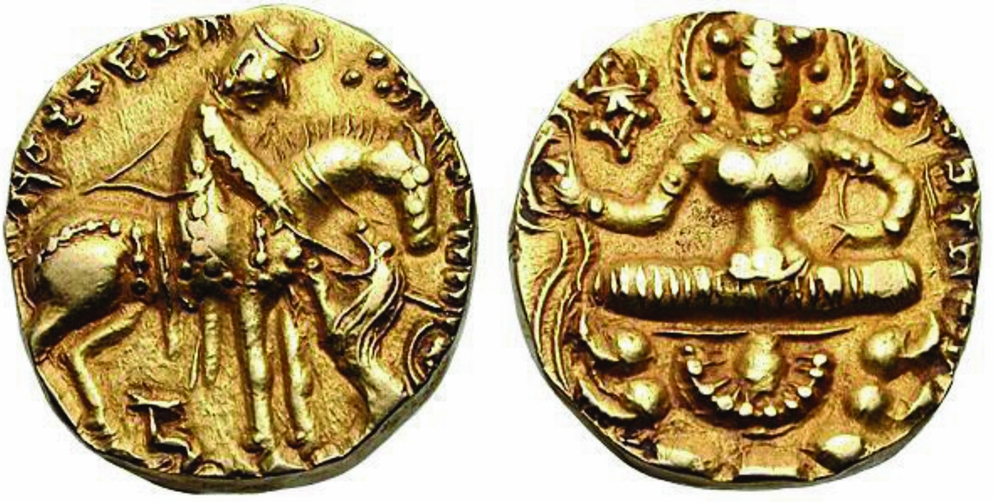
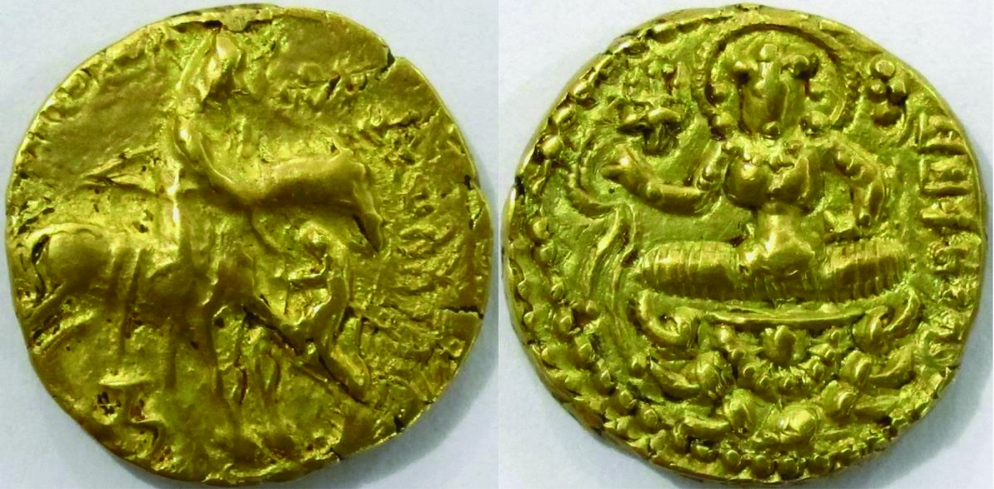
A typical coin of Prakāśāditya is shown in Figure 1. All the published coins so far are of this type, which might be called the horseman lion-slayer type. The principal design feature on the obverse is a figure, presumably the king, mounted on a horse right and thrusting his sword through the gaping mouth of a lion (or tigerFootnote 3 ) at right. The eagle symbol of the Guptas, Garuḍa, appears above the horse's head, here represented by three simple dots, but visible as a recognisable bird on some other specimens.Footnote 4 There is a prominent Brāhmī letter under the horse. Here, and on most known coins, it is the letter u (sometimes read as ru), although a few other published specimens have the letter va or vi (sometimes read as ma or mi), and one unpublished example at the National Museum in Delhi features the letter tya.Footnote 5 The purpose of these letters is not known. The reverse features the usual goddess seated on a lotus and holding a diadem and a lotus, with the legend śrī prakāśāditya at right.
Gold dinar of PrakāśādityaFootnote 8
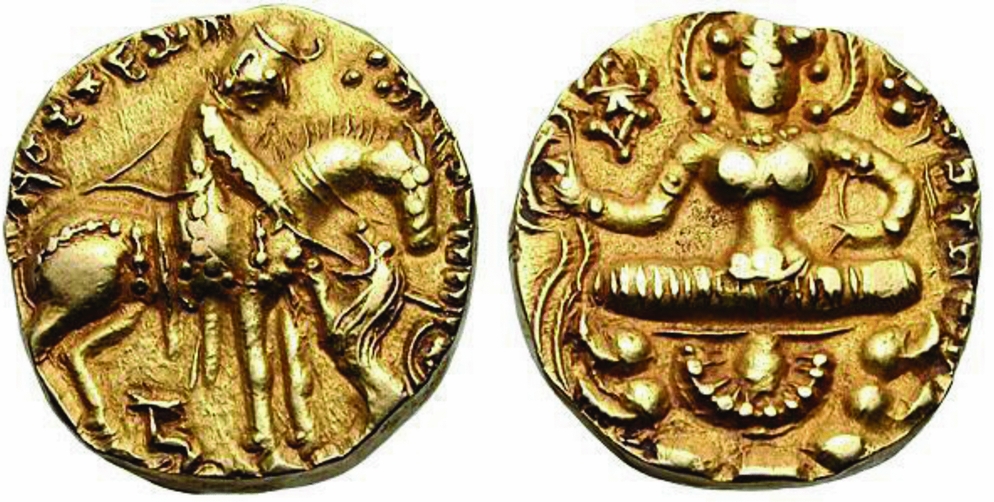
The coins first came to the notice of historians with the discovery of the Bharsar hoard in 1851.Footnote 6 Bharsar is a place near Varanasi, and the hoard consisted of approximately 160 gold coins. Unfortunately, most of them were apparently melted down; we have the details of only 32 coins, of which two are of Prakāśāditya. The rest are of the Gupta kings from Samudragupta (reigned c. 350–376) to Skandagupta (c. 456–467)Footnote 7 . The fact that the coins were found in a hoard of Gupta coins, the similarity of the reverse design to other Gupta coins, the āditya ending biruda,Footnote 9 and even the rough similarity of the obverse design to other Gupta coins, all these factors led to the apparently obvious conclusion that Prakāśāditya must have been a Gupta king. The only question was: Which one? The obverse legend, which would normally reveal the king's name, remained unread for the most part. Only the last part of the legend, (viji)tya vasudhāṁ divaṁ jayati, had been read; in particular, no coin with that part of the obverse legend that would contain the king's name had come to light. And there was no clear reference in any literary or epigraphic source to this king Prakāśāditya.
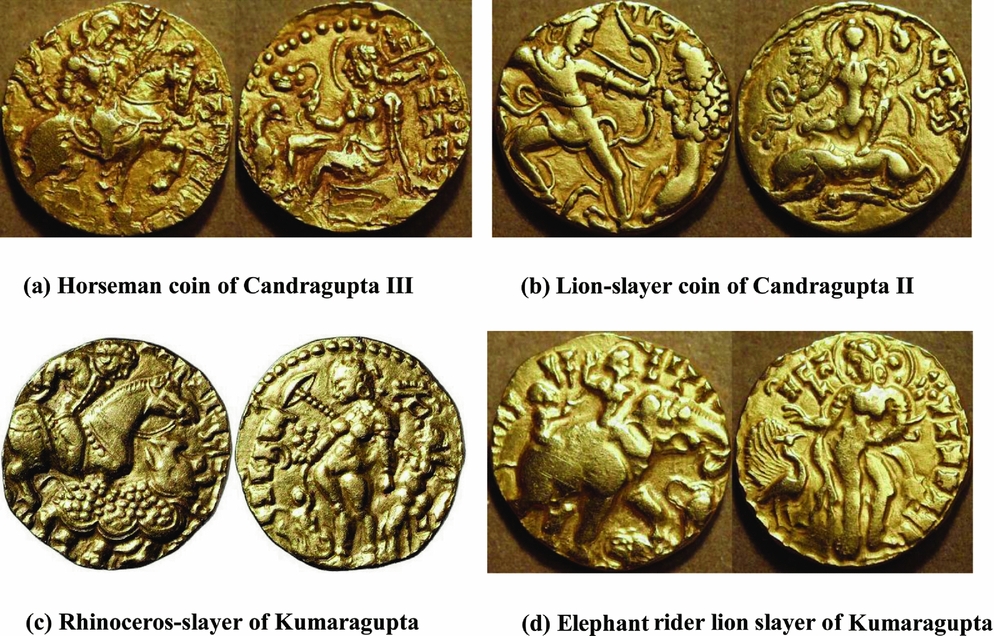
It is worth pointing out that, despite the loose similarity to other Gupta coins, the specific obverse design of Prakāśāditya's coins is in fact unknown in the Gupta canon. Several kings (Candragupta II (reigned c. 376–415), Kumāragupta I (c. 415–447), Candragupta III/Purugupta (c. 448–455)Footnote 10 and Skandagupta) issued Horseman coins depicting the king riding a horse, as in Figure 2(a). Several (Samudragupta, Candragupta II, Kumāragupta I, and Skandagupta) issued Lion- or Tiger-slayer coins in which the king was shown killing a lion or tiger, as in Figure 2(b). But the lion- and tiger-slayer coins always show the king standing on the ground; no coins show the king mounted on a horse while killing a big cat. The closest Gupta precursors to Prakāśāditya's coin type are Kumāragupta's rhinoceros-slayer type, in which he is mounted on a horse while killing a rhinoceros (see panel (c) in Figure 2), and elephant-rider lion-slayer type (panel (d) in Figure 2). Thus no known Gupta coin type can be considered a direct model for Prakāśāditya's coins; they represent an innovation which might be thought unlikely for a minor king.
Possible precursors to the coins of PrakāśādityaFootnote 11

At the same time, it is also worth noting that the overall style of Prakāśāditya's coins is relatively crude. As P.L. Gupta put it, “the Prakāśāditya coins lack the grace of the early Gupta art”.Footnote 12 Similarly, Pratapaditya Pal observed that “the animals are not as naturalistically rendered as in the earlier imperial issues and the composition is less dramatic”.Footnote 13 Gupta was arguing that the lack of grace indicated that the coins were issued late in the Gupta period. However, the relative crudeness could also be used to suggest that the Prakāśāditya coins may not have been Gupta issues at all. But it seems this was not thought to be a possibility worth considering very seriously.
Previous Attempts at Identification
One of the earliest attempts to identify Prakāśāditya was by Vincent Smith, who stated that he was “still unable to identify the king who took the title of Prakâśâditya”, and “should not be surprised if he turned out to be either Kumâra or Skanda Gupta. … But it is more likely that Prakâśâditya is a title of an early member of the later dynasty of the Guptas of Magadha, which ruled from about 480 ce to 700 ce or a little later”.Footnote 14 Thus he remained quite agnostic on the identification. On the other hand, Hoernle, while noting that the proper name of Prakāśāditya would be known only from the obverse legend, ventured that it “may now be suggested that these coins perhaps belong to Puragupta”.Footnote 15 He did not offer an explanation, but Allan, in his British Museum Catalogue, suggested that the implicit argument was simply that no coins of Purugupta were known, and these coins needed to be attributed to a Gupta king. Hence it seemed plausible to assign these coins to him.Footnote 16
Allan added a supporting argument, that, since the latest coins in the Bharsar hoard were those of Skandagupta and Prakāśāditya, these two kings may have been roughly contemporaneous, thus narrowing down the time frame from Smith's open-ended estimate of early in the period 480–700 ce. As Skandagupta and Purugupta were both sons of Kumāragupta I, their coin issues would have been fairly close in time. Hence the Prakāśāditya coins were plausibly of Purugupta. Nevertheless, Allan followed this exposition with the observation that there was evidence that Purugupta had the title Vikramāditya and that it “is highly improbable that Purugupta was called both Vikramāditya and Prakāśāditya, so that we must attribute these coins to some king, probably a Gupta, whose name is not yet known, and who must be placed about the end of the fifth century ce”.Footnote 17 He followed this analysis with the suggestion that “is quite in keeping with the numismatic evidence, namely, that he [Prakāśāditya] was the son or a descendant of Skandagupta”. Despite these reservations, when the time came to list the coins in the catalogue, Allan listed Prakāśāditya as “perhaps identical with Puragupta”.Footnote 18 Thus Purugupta seemed like the leading candidate in a highly ambiguous situation. It is notable, though, that Allan recognised the possibility that Prakāśāditya was not a Gupta at all when he characterised him as only “probably a Gupta.”
In 1909, Hoernle made a new suggestion, namely, that Prakāśāditya may have been the Mālwa king Yaśodharman of the Mandasor column inscription.Footnote 19 This inscription declares Yaśodharman as the conqueror of the Hun king Mihirakula and as the ruler of a vast empire from the western sea (probably off modern Gujarat) to the Lauhitya (Brahmaputra) river and from the Himālaya (Kashmir) to the Mahendra mountains (in modern Odisha).Footnote 20 Hoernle argued that the visible part of the obverse legend on the coins of Prakāśāditya, which read (viji)tya vasudhāṁ divaṁ jayati (having conquered the earth, wins heaven), pointed to a great conqueror, something that could not be claimed by Purugupta but could be claimed by Yaśodharman. Hoernle further buttressed the attribution by suggesting that the letter u that appeared on most examples below the horse may have been a mint-mark, standing for Ujjain, Yaśodharman's capital.
This suggestion did not receive much acceptance. Allan, for example, dismissed it as having “no real foundation”.Footnote 21 The flowery legend, Allan argued, had become quite stereotyped among Gupta legends and therefore its content could not be taken too seriously. Further, the letter under the horse could just as well be ru and not u, and even if it were u there was no evidence that it signified a mint. Further, even if the letter did stand for Ujjain, that did not automatically imply that the coin had been issued by Yaśodharman; nor was there any other evidence that Yaśodharman was ever known as Prakāśāditya. I would add a much more concrete and fatal criticism to this proposal: Yaśodharman ruled too late to plausibly be the issuer of the Prakāśāditya coins. By Hoernle's own calculation, Yaśodharman's reign must have started around 525 ce and his war with Mihirakula would have taken place during the years c. 525–528.Footnote 22 The Prakāśāditya coins, if issued by Yaśodharman, would then have to have been issued after 528. But all signs point to a date for the Prakāśāditya coins in the middle to late fifth century. The metal content of Prakāśāditya's coins is comparable to that in the coins of Kumāragupta II (known date 154 GE = 473 ce) and Budhagupta (known dates 157–169 GE = 476–488 ce),Footnote 23 so it is likely his coins were issued at around the same time. More important, his coins were found in the Bharsar hoard and were, along with the coins of Skandagupta (died c. 467), the latest coins in the hoard. Although there is a possibility that there were originally later coins in the hoard which were melted down before they were recorded, the combination of the hoard information along with the metal content makes it veritably certain that Prakāśāditya's coins were issued too early to be Yaśodharman's.
K. P. Jayaswal proposed to identify Prakāśāditya as Budhagupta.Footnote 24 He pointed out that the Sanskrit text Mañjuśrī-mūlakalpa named the successor of Kumāragupta II as U. Now we know that Kumāragupta II was ruling in the year 473–474 and Budhagupta in 476–477, so it might be reasonable to suppose that Budhagupta was Kumāragupta II's successor. Further, the coins of Prakāśāditya feature the prominent letter u underneath the horse. Jayaswal suggested that this letter had the same significance as the U identifying the successor of Kumāragupta II in the Mañjuśrī-mūlakalpa. Hence Prakāśāditya must have been the biruda of Budhagupta. Why the letter U would signify this king was never explained, so this theory seems quite far-fetched. In any case, we now know of coins of Budhagupta (they were not known at the time Jayaswal was writing) and the biruda on them is śrī vikrama, so we can safely reject this theory.
Thus Purugupta remained the best guess on the identity of Prakāśāditya. Citing all the same arguments, Altekar took the view that the “cumulative effect of the … evidence seems to point to the identification of Prakāśāditya with Purugupta”, although he cautioned that the “proposed identification of Prakāśāditya with Purugupta is only a probable theory; it may be confirmed or disproved by the discovery of fresh evidence”.Footnote 25 B. P. Sinha also argued for the identification of Prakāśāditya with Purugupta, citing many of the same arguments already made.Footnote 26
P. L. Gupta, however, rejected the idea that Prakāśāditya was Purugupta. He found the arguments supporting the identification unconvincing. His main argument against it was that the crudeness of the coins’ execution argued for them to be later than Budhagupta; hence they could not be issues of Purugupta.Footnote 27 Based largely on his analysis of the metal content of the different coins, he placed Prakāśāditya between Budhagupta and Narasiṃhagupta Bālāditya. He then turned to the testimony of Xuanzang (Yuan-Chwang or Hiuen Tsiang), who listed various donors, among them, in that order, Budhagupta, Tathāgatagupta and Bālāditya. Accordingly, P. L. Gupta identified Prakāśāditya with Tathāgatagupta.Footnote 28 Unfortunately, we have no independent information on this Tathāgatagupta, so it is not clear how much this identification advances our understanding of Gupta political history. This paper will provide an alternative explanation for the relative crudeness of Prakāśāditya's coins.
In 1980, K. S. Shukla published a coin of Prakāśāditya on which he claimed to read on the obverse, from 2 o'clock to 4 o'clock, the name bhānugu(pta).Footnote 29 Now Bhānugupta is a name that appears in an inscription on a small pillar in Eran, in which he is identified as a rājā in the Gupta era year 191 = c. 510 ce. Shukla concluded that Bhānugupta was a king of Mālwa and that Prakāśāditya must have been his vassal or viceroy, since his name was only on the reverse of the coin. It is odd that Shukla assumed that Bhānugupta and Prakāśāditya were different individuals; a more logical conclusion from his reading would be that they were the same, with Prakāśāditya being Bhānugupta's biruda. In an Editor's Note following the paper,Footnote 30 T. P. Verma makes precisely this point, calling the coin “an epoch making discovery for the history of the Gupta dynasty” and declaring that the “coin firmly establishes the identity of Bhānugupta of the Eran inscription … and Prakāśāditya of the coins”.Footnote 31 Verma went even further, concluding his remarks by asserting that the “discovery of this coin by K. S. Shukla now ends the long debate about the identity of Prakāśāditya of coins and firmly places Bhānugupta in the genealogy of the imperial Guptas”.Footnote 32
If Shukla's reading of this coin is correct, it would indeed be an important discovery. However, the reading appears to be doubtful. As Verma himself remarked, the “photograph of the coin is … not very satisfactory”Footnote 33 and the coin is no longer available for examination, as its whereabouts are unknown. Thus it is hard to put much credence on this apparent discovery. S. R. Goyal reports that Professor Jagannath Agrawal categorically rejected the reading of bhānugupta, and quotes P. L. Gupta's observation that the name of the king would be expected somewhere between 5 and 7 o'clock, not between 2 and 4 o'clock where Shukla claims the name to be. The illustration from Shukla's article revealed no letters at all; how Shukla and, even more surprisingly, Verma, could see bhānugu(pta) between 2 and 4 o'clock defies explanation.Footnote 34 Goyal concludes that “the so-called new evidence on Prakāśāditya has proved to be a non-starter”.Footnote 35 Ashvini Agrawal, in a careful analysis of the coin, actually obtained a better photograph directly from Shukla, and also looked at Shukla's notes from the time he examined the coin.Footnote 36 He observed that the letter Shukla saw as bhā was actually the lower part of the figure of Garuḍa above the horse's head (the rest being off the flan), and there was no sign of the letters nu or gu. Thus Agrawal opined that the “reading Bhānugupta is out of the question”.Footnote 37 In any case, the Eran inscription identifies Bhānugupta only as a rājā; it seems far-fetched to then regard him as a member of the imperial Gupta dynasty with the ability to issue gold coins, particularly of an entirely new type. Having now looked at dozens of images of Prakāśāditya's coins, I can testify that, among coins on which any letters of the right hand side part of the legend are visible, I have found no coin on which a reading of bhānugupta could be surmised or justified. I would therefore suggest that this reading can indeed be rejected until we have new evidence to support it.
Gӧbl's 1990 paper offered a radical new solution to the identity of Prakāśāditya, namely, that he was not a Gupta at all, and this proposal will be considered in detail in the next section. This paper however, seems not to have changed the nature of most of the discussion, perhaps because it was little noted.
Browne published a paper in 1992 in which he proposed a full reading of the obverse legend, but this reading did not contain a king's name and therefore did not offer an answer to the question of the king's identity.Footnote 38 But Goyal, relying like Jayaswal on the Mañjuśrī-mūlakalpa (MMK),Footnote 39 did propose a new identification. He suggested that “it can reasonably be assumed that Prakāśāditya of coins was no other than the rebellious Prakārākhya, the son of Bhānugupta”.Footnote 40 In a sense, this theory coincides with that of Shukla considered above. Shukla had indicated that Prakāśāditya was the vassal of Bhānugupta, and Goyal is claiming he was his son. The claim is based on the story in the MMK that a descendant (apparently) of Samudragupta with a name starting with Bh. had a son with a name starting with P. or Pra.Footnote 41 This son had been imprisoned by a king named Gopa. A powerful king coming from the west named H. or A.Footnote 42 invaded the east and installed the boy as king in Magadha. The king H./A. then went to Kāśī where he fell ill. Before he died, he installed his son, identified only as graha (planet),Footnote 43 as king. Graha was an evil king and was dispossessed of his kingdom by his enemies.Footnote 44
In his interpretation of the MMK, Jayaswal identified Bh. as Bhānugupta of the Eran inscription, with the king Gopa being Goparājā of the same inscription. He then took P/Pra. to be Prakaṭāditya, known from an inscription on a pedestal from Sārnāth. Further, he took H./A. to be Toramāṇa (the H. standing for Hūṇa) and graha to be his son Mihirakula (since mihira = sun). Goyal adopts the same interpretation, with the difference that he takes P./Pra. to be Prakārākhya, the son of Bhānugupta.Footnote 45 He then takes this Prakārākhya to be the same as Prakāśāditya. This argument requires so many leaps of faith in identification that it can, at best, be regarded as highly speculative. It seems impossible to prove or disprove it on the basis of the evidence available so far. In any case, this theory has not received any acceptance.
Finally, Ashvini Agrawal took up a careful analysis of Prakāśāditya's coins in 1992. He conducted an exhaustive review of the literature and noted that there was no clear consensus on the identity of this king. He then gathered all the available information on several aspects of the coinage: the diameter of the coins, their weight, their metal composition, the presence of the letter underneath the horse, and the type of reverse symbol on the coins. Comparing this information for Prakāśāditya's coins with all other coins of the Gupta series, he asserted that “it becomes absolutely clear that Prakāśāditya has to be placed sometime after Skandagupta, alongwith Ghaṭotkachagupta and Kumāragupta II and to some extent with Budhagupta but definitely before Vainyagupta, Narasiṁhagupta, Kumāragupta III and Vishṇugupta”.Footnote 46 This dating is consistent with most of the prior discussion. Agrawal then goes on to his final conclusion. “Once we place Prakāśāditya at his correct place, alongwith Ghaṭotkachagupta and Kumāragupta II, his identity becomes clear. It is well known that there was a change in the line of succession sometime after the death of Skandagupta leading Purugupta and his successors to the imperial Gupta throne. It is simple to infer that this Mahārājādhirāja Purugupta, known from the Bhitari silver-copper seal of Kumāragupta III and other inscriptions, ascended the throne after the death of his brother Skandagupta and issued the … Horseman-lion slayer types in the name of Prakāśāditya which apparently was his epithet”.Footnote 47 Essentially, therefore, Agrawal reaffirmed the old argument identifying Prakāśāditya as Purugupta, using the same argument that the coins could be dated to that time period and we had no other candidate coins for Purugupta.Footnote 48
That was the last attempt to solve this puzzle. The prevailing view continues to be that Prakāśāditya was a Gupta king, most probably Purugupta. Auction houses universally list Prakāśāditya's coins among their Gupta offerings, identifying him as a Gupta king, and sometimes as Purugupta.Footnote 49 This is true even of German auctions, whose curators might be presumed to be familiar with Gӧbl's paper.Footnote 50 Indeed, I have never seen a coin of Prakāśāditya offered as anything but a Gupta coin. And recently Ellen Raven is reported to have identified Prakāśāditya as Purugupta at a conference of the Oriental Numismatic Society.Footnote 51 The only exception I have seen is in the writings of scholars from Vienna, who treat Prakāśāditya as a Hun without any explanation.Footnote 52 Obviously, they have fully accepted Gӧbl's proposal, to which I now turn.
Gӧbl's Proposal
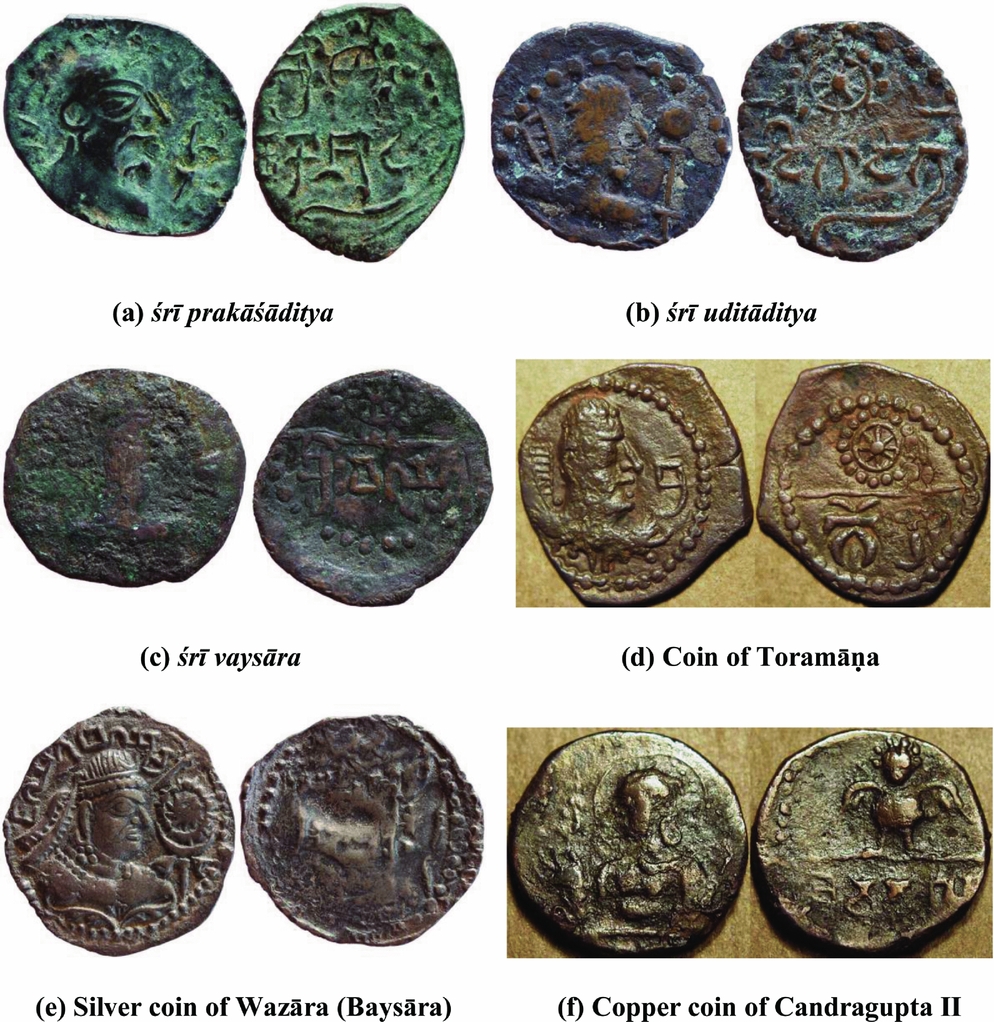
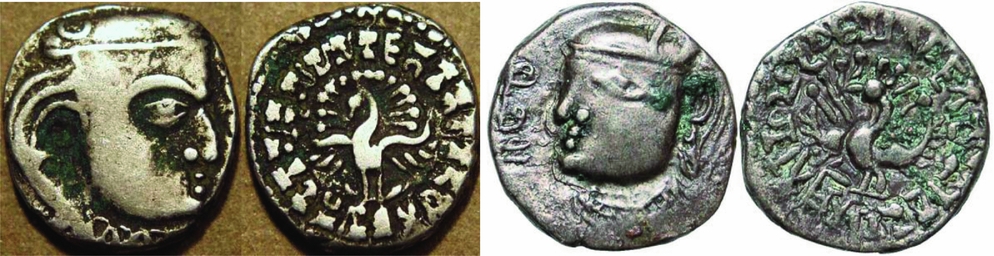
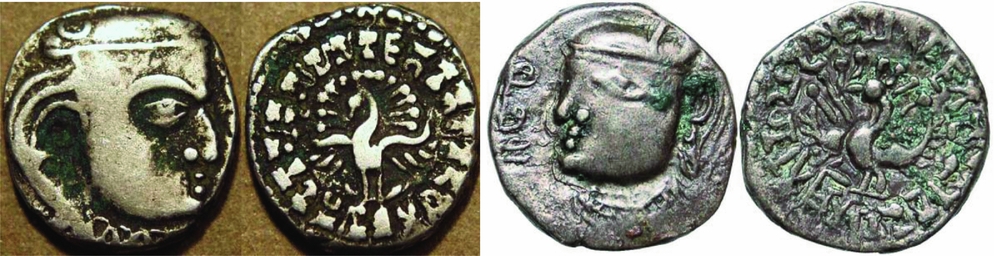
The idea that Prakāśāditya might be a Hun was not first brought up by Gӧbl. At least as early as 1907, Smith had published a group of copper coins that were clearly Hun in origin, some of which had the legend śrī prakāśāditya, and this raised the possibility that Prakāśāditya might be a Hun. But Smith categorically stated that they could not be issues of the same king as the one who issued the gold coins with the same legend. He didn't offer an argument; he simply asserted what he thought was obvious: “Of course, the White Hun chief must have been distinct from the Gupta king who used the same title, which means ‘sun of splendor’”.Footnote 53 The coins Smith was discussing included issues of several kings, three of which are shown in Figure 3; the legends on these three read śrī prakāśāditya, śrī uditāditya and śrī vaysāra. We can be sure they are Hunnic coins for a number of reasons. There are coins of Toramāṇa of very similar format, as seen in panel (d) of the Figure. The portrait style is distinctly Hunnic, with the ribbons attached to the king's necklace. The reverse design, with a sun or wheel above and legend below, is virtually identical. And there are silver coins of the Gandhāran type known for the king whose legend is śrī vaysāra, as in panel (e) of the Figure.Footnote 54 Note the sun/wheel standard on the silver coin in front of the king's face. Thus these copper coins are certainly Hunnic, and they at least hint at the possibility that Prakāśāditya was a Hun king. Smith, however, rejected this possibility and it seems to have been ignored by all other scholars until Gӧbl took it up again.
Hun Copper Coins and Related IssuesFootnote 55
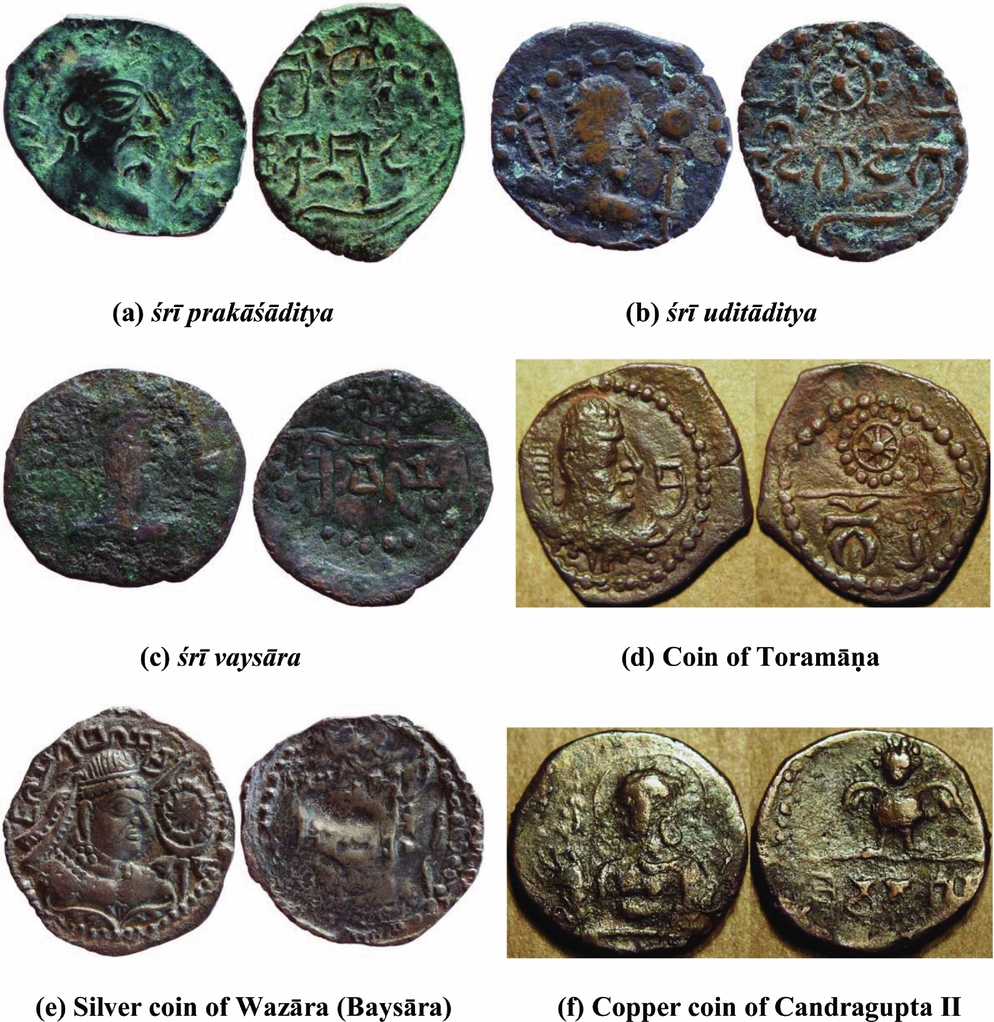
It is worth noting that the format for these Hun coppers is borrowed from the format of some Gupta copper coins. Figure 3(f) shows a copper coin of Candragupta II that serves as a precursor to the Hun coppers. The obverse has a portrait bust of the king within a dotted border. And the reverse design consists of two registers within a dotted border, the upper one displaying the dynastic symbol of the king and the lower inscribing his name in Brāhmī letters. Thus it is quite clear that the Huns were drawing inspiration from the Guptas for their Indian coinage.
Smith's rejection of a connection between the copper and gold prakāśāditya coins seems to have been universally accepted until Gӧbl published his paper. In addition to noting the evidence of the copper coins, Gӧbl's argument that Prakāśāditya was a Hun rested on several aspects of the king's representation on the coin. Specifically, Gӧbl pointed to three features of the king's image:
-
(a) the crown,
-
(b) the shape of the head, and
-
(c) the presence of a moustache.
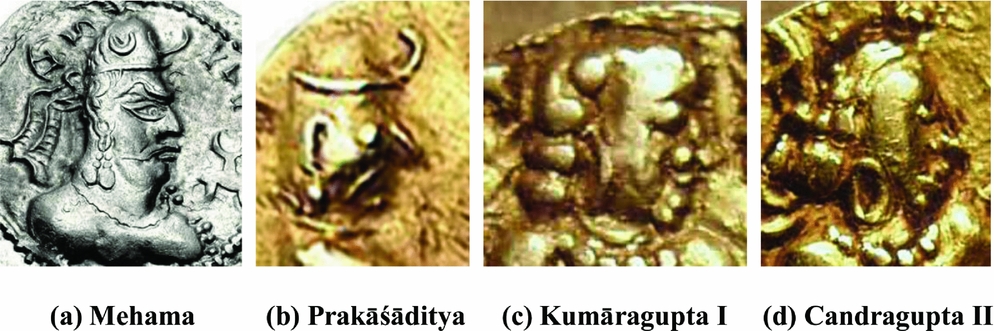
The crown worn by Prakāśāditya is distinctly Hunnic. It consists of a diadem or band that runs around the king's head and is decorated by a crescent ornament at the forehead. This is a type of crown seen on virtually all coins of the Alchon Huns, and is never seen on Gupta gold coins. Figure 4 shows details from four different coins. Panel (a) shows the portrait from a silver drachm of the Alchon Hun king Mehama, which clearly shows the horizontal band and the forehead crescent ornament. Panel (b) is a detail from the Prakāśāditya coin already displayed in Figure 1. It shows the same horizontal band and forehead ornament as the Mehama coin. Panels (c) and (d) show portraits from Horseman coins of Kumāragupta I and Candragupta II respectively. These portraits are typical and show no crown whatsoever. When Gupta gold coins do show a crown on the king, it is never of the kind seen in panels (a) or (b) of the Figure.Footnote 57
PortraitsFootnote 56
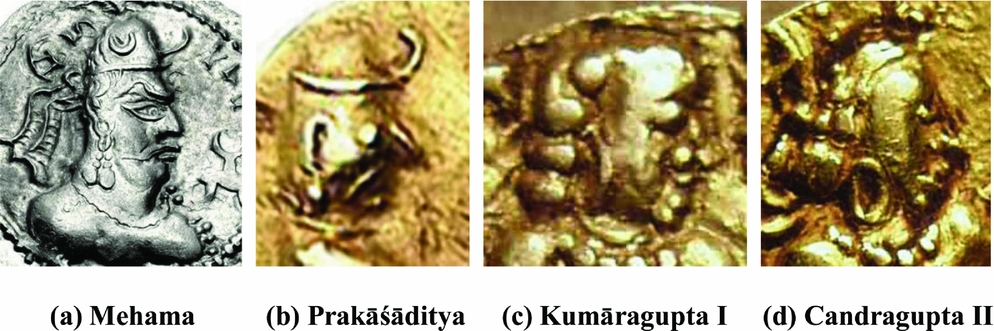
The second feature of the portrait pointed out by Gӧbl is the shape of the head. The Huns apparently practiced head-binding, resulting in the king's head being rather elongated. The portraits on Hun coins show this elongated head with a rounded top, as on the Mehama coin in Figure 4(a) and the Prakāśāditya coin in Figure 4(b). The Gupta coins do not show such a head shape. The third aspect of the king's image addressed by Gӧbl is the presence of a moustache in the king's portrait. Once again, the portraits in Figure 4 confirm that Prakāśāditya, like Mehama, is depicted with a moustache. Except for their western silver coins, where the Gupta kings continued the custom of the Śaka Western Kṣatrapas to depict their portraits with moustaches, Gupta kings are generally not shown with moustaches, as panels (c) and (d) in Figure 4 illustrate. Gӧbl concludes, therefore, that Prakāśāditya was not a Gupta king, but a Hun.Footnote 58
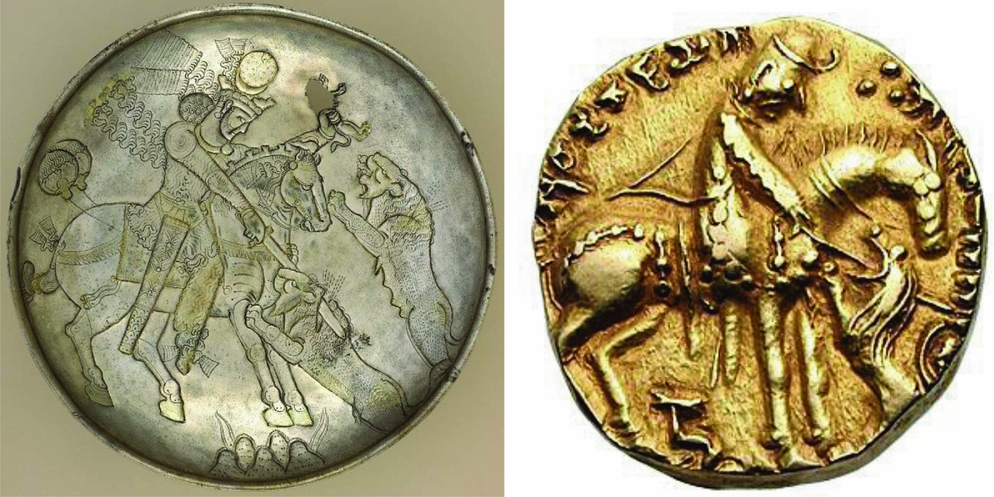
To these arguments, a further one could be added. It has often been remarked, and has been discussed above, that Prakāśāditya's coins seem not to have any true precursors among Gupta coins. Some who have looked into this have pointed out that, rather, they seem to draw inspiration from Sasanian or Hunnic prototypes. For example, Pathak points out the long history of Sasanian silver plates depicting the horse-rider hunter king.Footnote 60 In considering the standing lion-slayer types of various Gupta kings and the horse-rider lion-slayer type of Prakāśāditya, Pathak concludes that the former “posture is connected with the later Kushāṇas and the Sassanians, [while] the horse-riding king is connected with the Hūṇas”.Footnote 61 Pathak points particularly to a Sogdian plate published by Belenizki in which the crowned king rides his horse into the back of a lion, holding his sword raised and ready to strike. Perhaps an even closer parallel however, is the Sasanian silver plate of Varahran V (reigned 420–438) in the British Museum, reproduced here in Figure 5. The horse here appears to be standing still, as on Prakāśāditya's coins. The king is bent forward as he puts his weight behind the blow he is inflicting on the lion. The lion itself is up on its hind legs in an attacking posture never seen on Gupta coins, but similar to the pose on Prakāśāditya's coins. If we modify this image by condensing the two lions into one, and having the king direct his sword into its mouth, we would have the precise design of the Prakāśāditya coin. Note that the king here is dressed in armour, as on Prakāśāditya's coins. The treatment of the king's foot, almost vertical like a ballerina en pointe, is virtually identical on the plate and on the coins. Clearly this image is a far closer precursor to Prakāśāditya's coins than anything in the Gupta oeuvre.
Silver plateFootnote 59 of Varahran V compared with Prakāśāditya coin
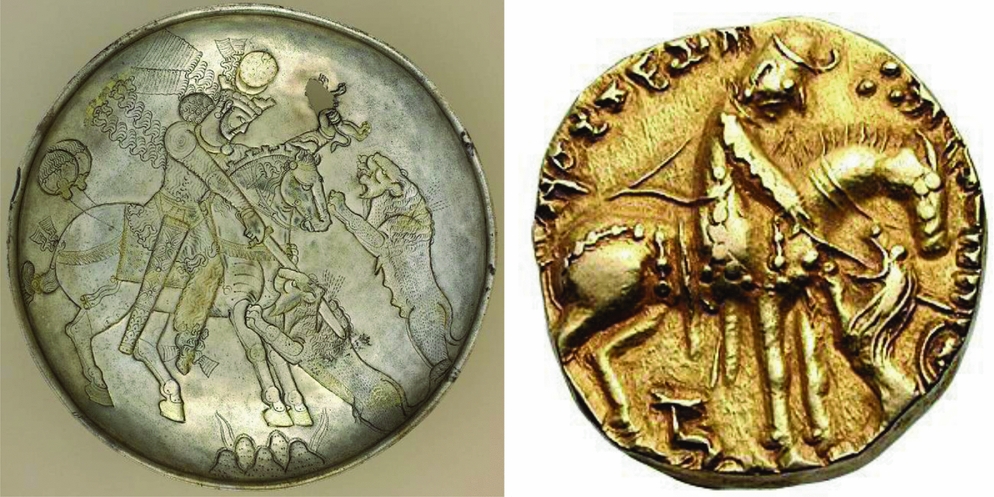
A side-by-side comparison of the Varahran plate and Prakāśāditya's coin reveals such a close parallel that it is hard to imagine that the die cutter who carved Prakāśāditya's coin dies was not aware of the design on the silver plate. It is worth remembering that Varahran V (Bahram Gur) had a history of fighting (and vanquishing) the Huns who invaded his kingdom.Footnote 62 It is therefore quite plausible to assume that a certain amount of cultural interchange took place and that a plate such as this one could have come into the possession of Hun celators, or at least that they might have seen one.
Having pointed to a Sogdian inspiration, Pathak argues that Gupta die cutters could well have adapted such images for their purposes. He suggests that the Gupta struggle against the Huns might be hinted at by this motif. But surely a simpler explanation for the appearance of this design is that the coin is in fact not a Gupta issue at all, but Hunnic. The Huns repeatedly show strong Sasanian influences on their coins, particularly in their silver series from Gandhara, such as the Mehama coin in Figure 4(a) or the Wazāra coin in Figure 3(e). It would therefore not be surprising to see them draw inspiration from Iran for their gold issues as well. Assigning the coins to the Huns would also help explain why they seem not to be up to the artistic standard of Gupta coins up to that point in time.
One question that could arise in this context is, if the Prakāśāditya coins are Hun issues, why do they include the image of Garuḍa, the dynastic symbol of the Guptas? We might have expected them to replace it by a Hun tamgha, for example, the well-known bull/lunar tamgha seen on most Alchon coins, such as the Mehama coin in Figure 4(a). Two observations can be made about this. The first is that, in fact, Gupta coins of the Horseman type or Lion-slayer type never show a Garuḍa banner. Thus the presence of the Garuḍa on the Prakāśāditya coins is actually a departure from Gupta practice and therefore its occurrence actually strengthens the case for arguing that these are not Gupta issues. Perhaps there was a propaganda value to including the Garuḍa symbol on the coins of the conqueror. The second point is that the symbol is not rendered very well and indeed is often reduced to just three simple dots, as on the coin in Figure 1. This suggests that the eagle was not of great symbolic value to the makers of the coins, something that would be impossible to believe of the Gupta die cutters. Therefore, on these grounds too, the evidence of the Garuḍa symbol points to a non-Gupta manufacture.
It is worth making note of the fact that the prior presumption that Prakāśāditya must have been a Gupta king was based on rather flimsy evidence. Of course, the reverse of the coin features a seated goddess in the same style as on Gupta coins, so there is a clear connection. But I have already argued that the subject of the obverse design is quite different from the designs seen on Gupta coins and have demonstrated that the theme of the mounted lion-hunter actually owes much to Sasanian prototypes. The hoard evidence on Prakāśāditya's coins is extremely thin, since there is only one recorded hoard (the Bharsar hoard) where Prakāśāditya coins were found together with Gupta coins. All other known coins have uncertain provenances or were apparently single stray finds. So there really should not have been a presumption that Prakāśāditya was a Gupta king.
The combination of arguments, including the confluence of the gold and copper issues, the various aspects of the king's image, the evidence of the Garuḍa symbol, and the Sasanian inspiration for the design, seems to lead to the inescapable conclusion that Prakāśāditya was indeed a Hun king, and not a Gupta one at all. What remains to be determined is his precise identity. Gӧbl had suggested he was probably Toramāṇa, but this was not on the basis of any solid evidence. We have already seen that Toramāṇa had issued copper coins based on a Gupta model. He had also issued silver coins that copied Gupta prototypes; Figure 6 shows a silver drachm of Skandagupta and a similar coin of Toramāṇa, clearly derived from the former. So the idea that Toramāṇa might have issued gold coins that drew some inspiration from Gupta dinaras seems reasonable. The conclusive evidence we need lies in the obverse legend, and I turn to this next.
Silver Coins of Skandagupta (left) and Toramāṇa (right)Footnote 63
Reading the Obverse Legend
Only the last part of the obverse legend on Prakāśāditya's coins has so far been read satisfactorily. Based on very clear specimens at the British Museum and the Indian Museum, Calcutta, Rapson had concluded that the legend ended …tya vasudhāṁ divaṁ jayati.Footnote 64 Given the formulaic nature of these legends, it seems reasonable to suppose that the first word of this section of the legend can be restored as vijitya, leading to the phrase vijitya vasudhāṁ divaṁ jayati (having conquered the earth, [he] wins heaven). So far, that is the only part of the legend about which we can feel confident.
In their catalogue of the Gupta gold coins in Bharat Kala Bhavan, Gupta and Srivastava present the legend as parahitakārī rājā … vijitya vasudhāṁ divaṁ jayati.Footnote 65 However, they do not give any information on how they arrived at the first two words in the legend, and none of the coins they illustrate in the catalogue would support this reading. So it seems this may have been a speculative guess based on the fact that some coins of Skandagupta and Budhagupta begin with the word parahitakārī. We cannot give much credence to this reading.
K. S. Shukla published a coin on which he claimed to read near the start of the legend the word bhānugu… and concluded this could be completed to justify attributing the coins to Bhānugupta. This coin and Shukla's reading have been considered above and it has already been argued that the reading appears to be incorrect.
Finally, reference was previously made to a 1992 paper by Browne, which purported to provide a complete reading of the legend. Browne's reading was:
aprativitato rājā [viji]tya vasudhāṁ divaṁ jayati.
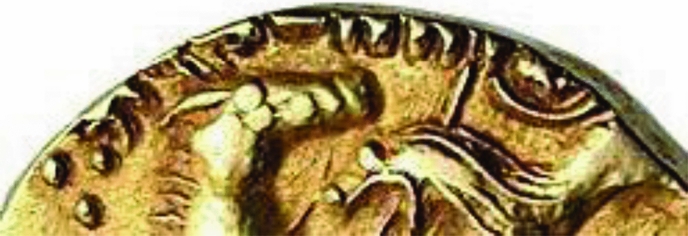
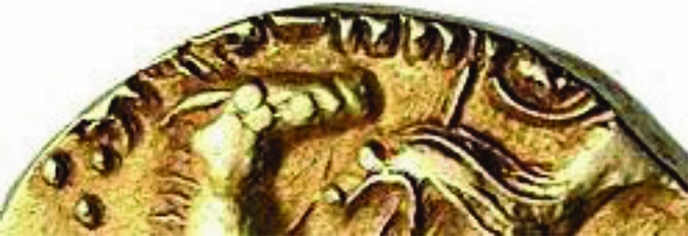
This translates as “Unopposed, the king, having conquered the earth, wins heaven”. Browne based his reading on the coin that has been reproduced above in Figure 1. Figure 7 provides a detail of the first part of the legend, and we can see that the reading is by no means certain. By Browne's own admission, “the tops of the first six akṣaras in the obverse inscription are off the flan”.Footnote 66 Indeed, even the eighth letter, which Browne has read as jā shows only one horizontal stroke. This could be the lowest stroke of the letter ja, but there are other possibilities also, such as the letter ma or va. Thus Browne's reading is a reasonable guess at best. A close look actually seems to contradict the possibility that the third letter is ti. Another factor mitigating against this reading is that such a legend is unknown in the Gupta canon. Browne acknowledges that “the word [aprativitato] as a whole is not known to me elsewhere,” although “its components appear in other Gupta coin legends.”Footnote 67 Finally, it would be quite extraordinary that an obverse legend would simply refer to the king (and only a rājā at that) without naming him. This paper will offer a more definitive reading of the legend, which will be compatible with Browne's coin as well, and which conforms more closely to the usual legend patterns.
First part of legend on the Browne coin
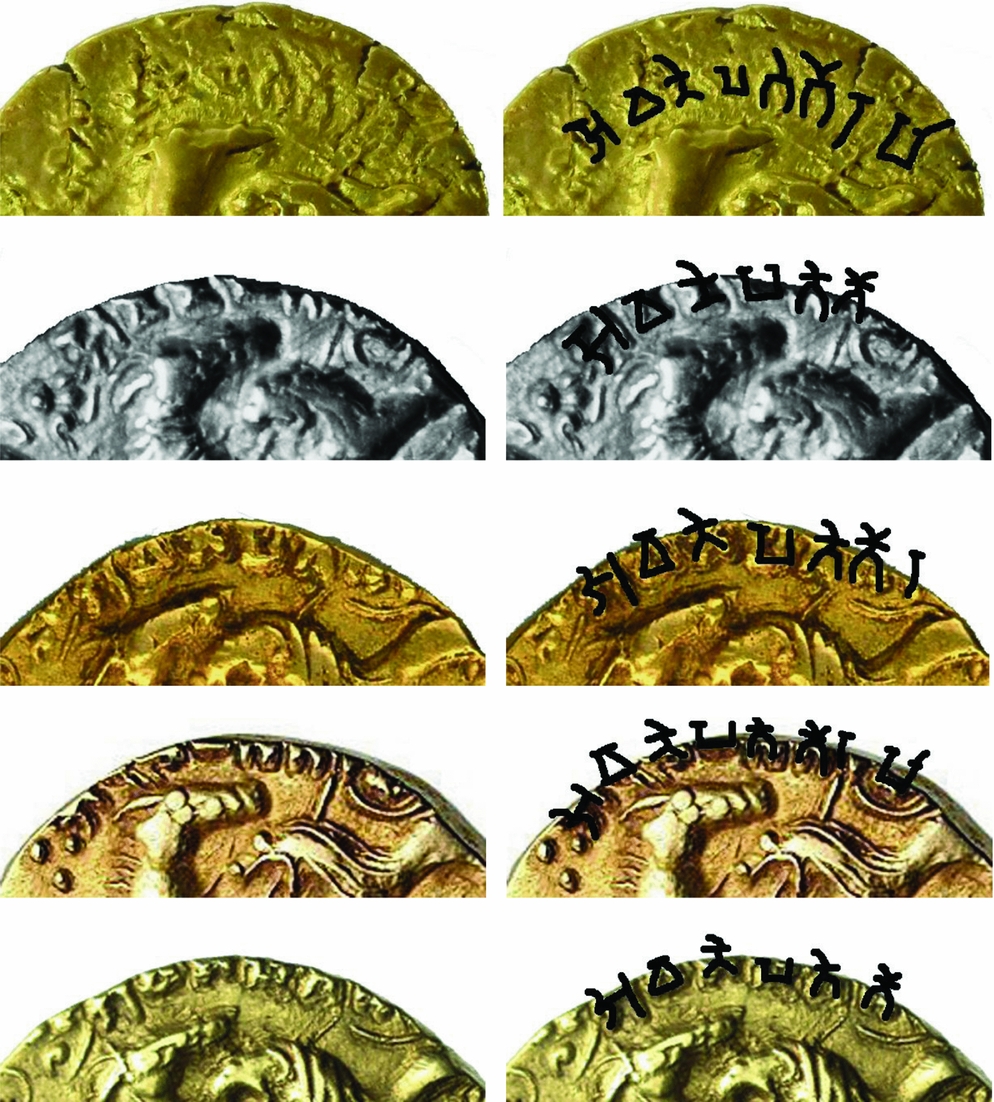
The reading being proposed here is based on several coins. I gathered as many photographs of Prakāśāditya's coins as I could and was able to collect a total of 66 coin images, of varying quality. Of these, five coins had significant parts of the right-hand side of the legend visible on the coin. These included coins from the Lucknow Museum, the Patna Museum, the National Museum, Delhi, a Gemini auction (which was the same as the Browne coin) and a Ponteiro auction.Footnote 68 Of these, the Lucknow Musuem coin is the most important, as it contains the full right side of the legend on the flan, albeit on a worn and somewhat damaged specimen. The Patna Museum coin adds crucial details and the National Museum coin serves as a check on the entire legend. The reading is consistent with every coin of Prakāśāditya whose photographs I have been able to examine. The reading is:
avanipatitoramā(ṇo) vijitya vasudhāṁ divaṁ jayati,Footnote 69
(the lord of the earth, Toramāṇa, having conquered the earth, wins heaven). The meter is Upagīti.Footnote 70
Because of its importance to the reading, I present an enlarged image of the Lucknow coin in Figure 8. As can be seen, the coin is somewhat worn, it is poorly struck, with clear evidence of double striking, and there is damage at 12 o'clock of the flan, indicating that the coin is ex-jewelry. Presumably, a loop had been attached at the top to make the coin wearable as a pendant. Nevertheless, it is also clear that the coin shows a remarkable amount of the right hand side of the flan, with full images of all the letters of the legend, including the diacritic marks. This coin is the key to unlocking the first part of the legend and, in particular, the real name of the issuer.
The Lucknow Museum coin, inventory number 6283
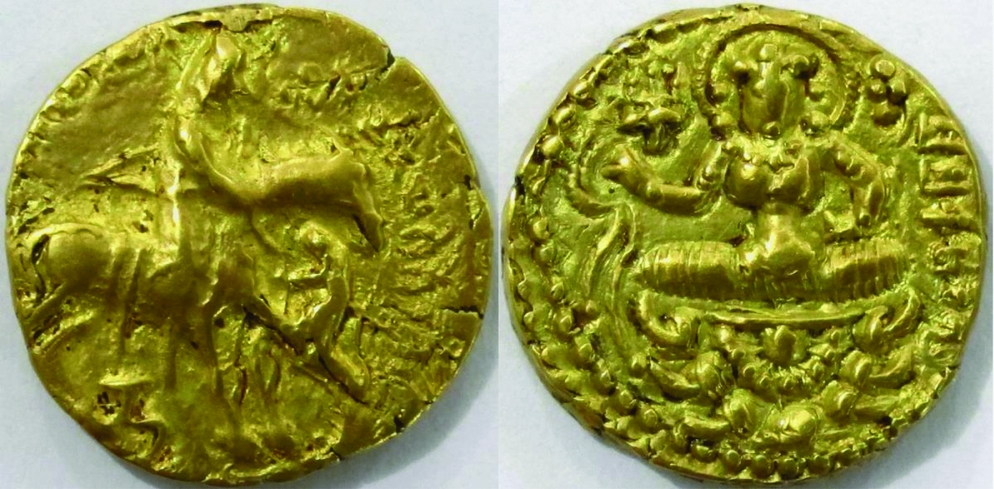
Figure 9 presents details of the five coins in my image database with the most visible initial parts of the legend. On the left, I have presented the coin itself, and, on the right, the restored legend as I have proposed it. I think this figure speaks for itself and makes the reading of avanipatitora absolutely certain. On the Lucknow coin, there is a glob of metal above the va that might suggest it needs to be read as vā. However, a close examination reveals that the glob of metal is not part of the original coin design as it does not lie on the same plane as the rest of the legend. My best guess is that it is a droplet of gold that was deposited on the coin during the process of either attaching or removing the loop at 12 o'clock of the coin during its phase as an item of jewelry. The damage caused by that loop can be seen in Figure 8.
Details of the first part of the legend on 5 coinsFootnote 71
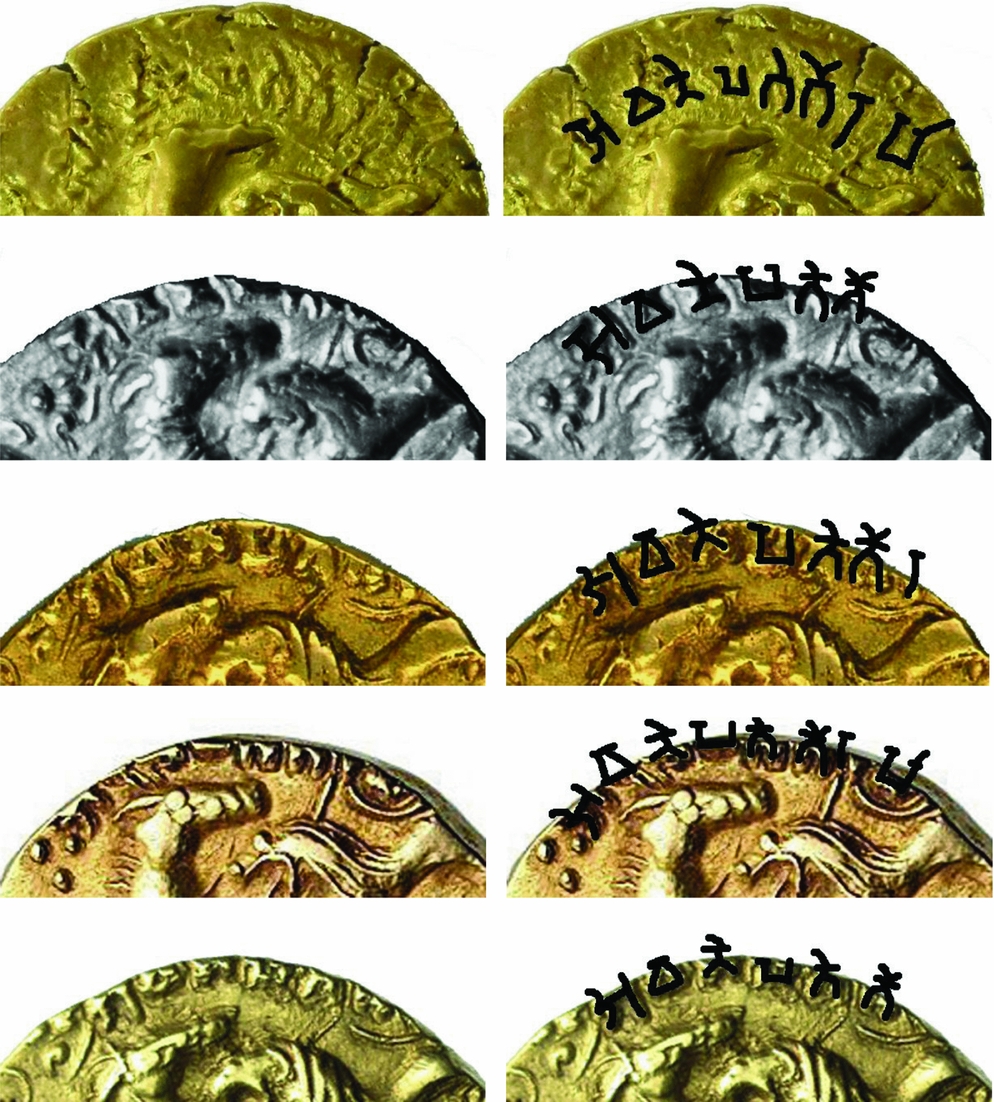
The Lucknow Museum coin also strongly indicates that the letter following tora is mā and this is consistent with the little bit of the letter visible on the Gemini coin also. However, because of the double-striking on the Lucknow coin, I cannot be absolutely certain of this reading, although I do have a very high degree of confidence in it.
The Patna Museum coin, illustrated in Figure 10, confirms that the letters preceding the known part of the legend … tya vasudhāṁ divaṁ jayati are indeed va and ja as expected. Thus we now have a known reading of the beginning and ending of the legend:
avanipatitoramā … vijitya vasudhāṁ divaṁ jayati.
The question remains, what letter or letters are present in the missing section?
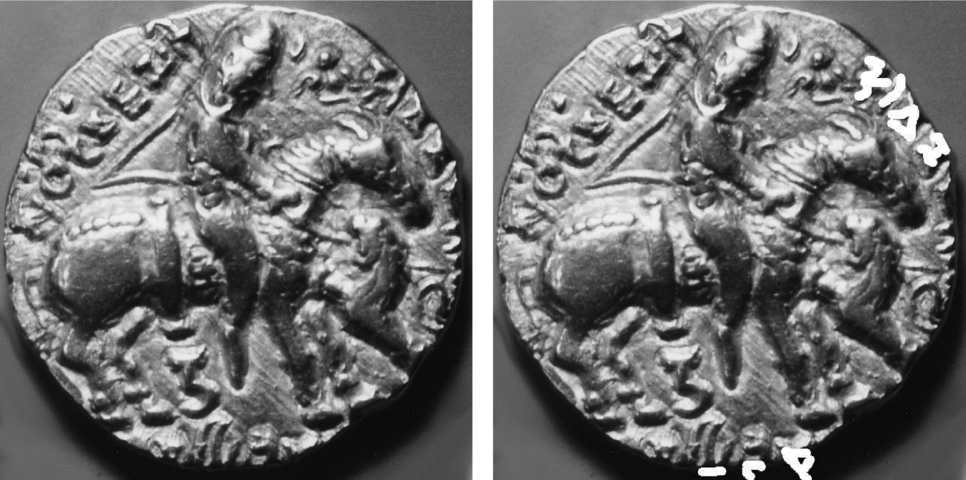
The Patna Museum Coin, with partially restored legend

What becomes clear from looking at so many coins is that the legend is not continuous but is interrupted, first by the hindquarters of the lion and then by the hind legs of the horse. We had known from the British Museum and Indian Museum specimens that the letter tya and sometimes the letters tya va of the last part of the legend (vijitya vasudhāṁ divaṁ jayati) appear below the letter under the horse, with the remainder of the legend then continuing above the horse's back. The Patna Museum coin shows that there is room for only one or two letters before that under the horse's front hooves. Thus it seems plausible that the full legend might be the proposed avanipatitoramāṇo vijitya vasudhāṁ divaṁ jayati. There is not enough room for a lot more letters. The fact that the legend perfectly fits the requirements of the Upagīti meter gives us further confidence that this is indeed the full reading.
In this context, there is an interesting piece of information in the paper by Agrawal. In his analysis of the coin published by Shukla, he had requested and obtained a photograph of the coin from the author and was able to confirm that the reading of bhānugu was incorrect. But he also discovered “the occurrence of another letter immediately before vijitya, exactly under the front hoof of the horse. It is clearly pa and indicates the continuation of the legend clock-wise”.Footnote 72 Now the location of the letter reported by Agrawal is precisely where we would expect the letter ṇa to be to complete the name toramāṇo. Further, the letters pa and ṇa are very similar in Brāhmī, with their lower parts being virtually identical. Agrawal no doubt saw only the lower part of the letter, and read it as pa, but it could easily have been the letter ṇa and not pa, thus completing the legend as I have restored it. I believe therefore that we can have considerable confidence that the full reading is indeed avanipatitoramāṇo vijitya vasudhāṁ divaṁ jayati.
This legend happens to be very similar to the legend on Toramāṇa's silver coins, one of which was illustrated above in Figure 6. The legend on the silver coins is:
vijitāvaniravanipati śrī toramāṇa divaṁ jayati. Footnote 73
The similarity of this legend to the proposed reading of the gold coin legend is obvious and further strengthens our confidence in the reading.
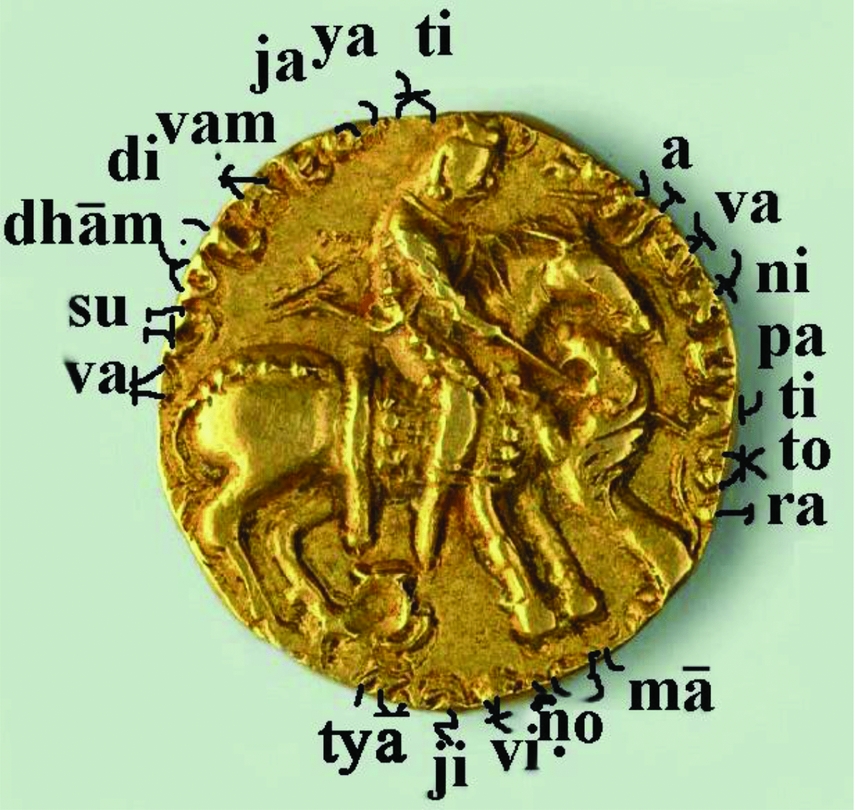
The National Museum coin shows little bits of almost all letters in the legend and serves as a final check on the reading. As an aside, it is worth pointing out that the coin has a hitherto unremarked letter under the horse: it is tya (or possibly gya)Footnote 74 rather than the usual u or va/vi. Returning to the legend, Figure 11 shows the coin with the missing parts of the letters in the restored legend drawn in. Once again, we see that the legend fits comfortably and is consistent with all the visible parts of the letters. On this coin, the arrangement of the legend, emphasizing the points at which the legend is interrupted, is:
avanipatitora (lion) māṇo vijitya (horse) vasudhāṁ divaṁ jayati.
Full legend restored on the National Museum Coin
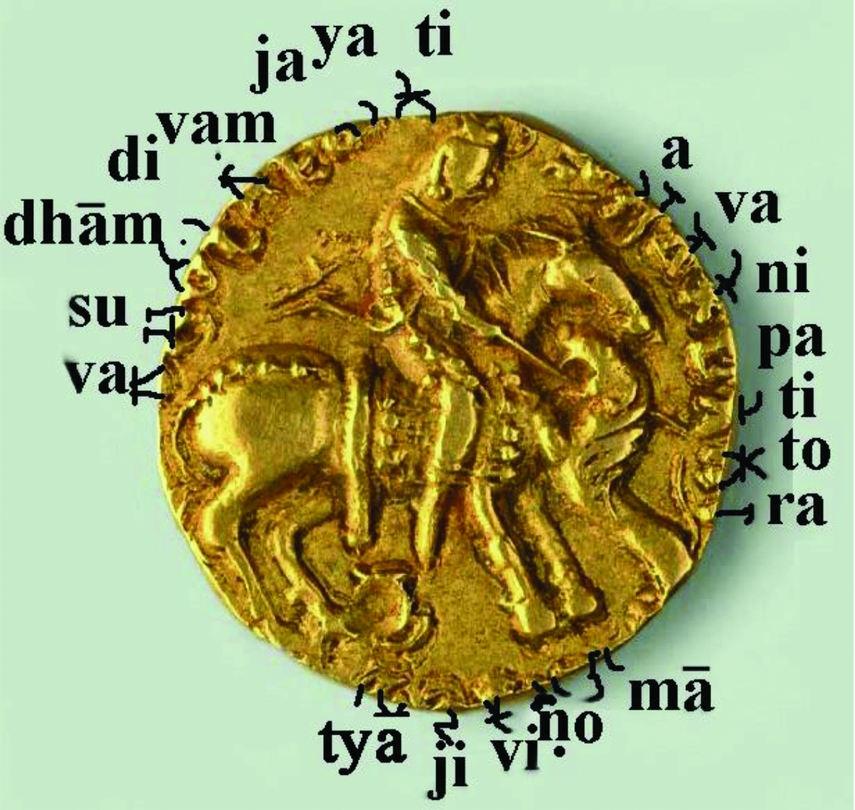
I believe on certain other coins, such as the Lucknow Museum coin, the arrangement is:
avanipatitoramā (lion) ṇo vijitya va (horse) sudhāṁ divaṁ jayati.
I have also seen a coin where only the phrase divaṁ jayati appears above the horse. Thus there appear to be at least three different legend arrangements, accounting for some observed differences in the coins seen.
Implications
This paper has demonstrated that there can be little doubt that Prakāśāditya was a Hun king, and that, almost certainly, he was Toramāṇa. I believe this puts to rest a debate that has continued for over 160 years on the identity of this king.
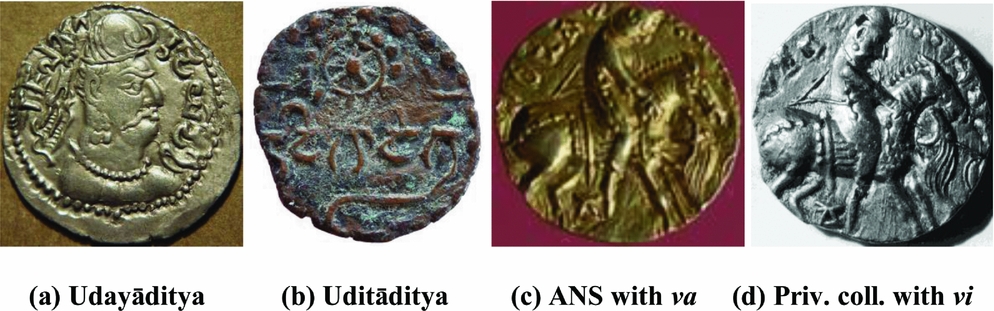
Knowing that Prakāśāditya was Toramāṇa allows us a fresh look at the prominent Brāhmī letters situated below the horse. The most commonly found letter is the letter u, read by some as ru. This letter appears on at least two different Hunnic coin types: the silver drachms of Udayāditya and the copper coins of Uditāditya. As we can see in the first two coins of Figure 12, the letter form for u on these coins is identical to that on the Prakāśāditya coins, suggesting that the letter is indeed u and not ru. In addition, there are a few Prakāśāditya coins where the letter below the horse is va or vi, sometimes read as ma or mi. Figure 12 shows two such coins, and comparison of the letter form to the va on Prakāśāditya's obverse legend confirms that the letter is indeed va (or vi) and not ma. Finally, there is the one coin, seen in Figure 11, where the letter is tya or gya.
Coins concerning the letter under the horseFootnote 75

What might these letters have signified? One obvious theory that has often been discussed is that they represent mintmarks. Since the centre of Toramāṇa's empire must have been in the west, perhaps in Mālwa, it might be quite reasonable to guess that the u stood for Ujjain, and the va/vi might have represented Vidiśā. Unfortunately, I have been unable to account for the letter tya/gya seen on the unique National Museum coin, so this theory must remain quite speculative.
Apart from resolving the question of identity, the reading of the Prakāśāditya coin legend has at least three other important implications. First, we can abandon once and for all the speculative belief held by many to this day that Prakāśāditya was Purugupta. So we can reopen the question of Purugupta's coinage and ask whether that king did issue any coins. I have argued elsewhere that there is a very strong argument to be made that the king who has come to be called Candragupta III was none other than Purugupta.Footnote 76 To the arguments made there, I can add one more at this point. There can be little doubt that the coins of Candragupta III were issued more or less at the same time as those of Skandagupta. In his excellent paper on Prakāśāditya, Agrawal had shown very convincingly that the coins of Prakāśāditya must have been issued around the time of Skandagupta and then argued that “his identity becomes clear” in concluding that he must have been Purugupta. Agrawal was correct on the timing, but his leap of faith in assigning the coins to Purugupta was a mistake. Now that argument has fallen down, but the same argument can be made for Candragupta III. His coins are also roughly contemporary with those of Skandagupta and I believe the case that they are the coins of Purugupta has become stronger now that we know the Prakāśāditya coins are not.
A second point is that we now know that Toramāṇa issued copper coins both in his own name (the torā coins, as in Figure 3d) and with his biruda (the prakāśāditya coins, as in Figure 3a). This suggests that other kings may have done the same thing. For example, it could well be that the king Vaysāra/Baysāra (Wazāra) may have had the biruda uditāditya. Notice that the uditāditya coin in Figure 3b has the same sun/wheel standard in front of his face as the baysāra coin in Figure 3e. Might this indicate that these two coins were issued by the same king? This now seems to be a possibility that might not have been considered previously, and is an area that may be worth greater study.
A third implication of the establishment of Prakāśāditya's Hunnic identity is that we now know that the Huns issued gold coins roughly on the Gupta pattern, as they did copper and silver coins. This makes it quite clear that the Alchon Huns in India must have had a substantial and rich empire, with the capacity to issue a relatively large volume of gold coins. To add to this, the Lucknow Museum has a gold coin of the Archer type with the name prakāśa on it, and there can be little doubt that it is also an issue of Prakāśāditya (i.e., Toramāṇa). This raises the distinct possibility that the so far unattributable Archer coins that lack a name under the king's arm may also have been Hun issues, thereby further expanding our view of the wealth of the Hun kingdom. I will be exploring this possibility in future research.