

As more and more of people's everyday activities are carried out via their smartphones, they are finding it increasingly difficult to keep their smartphones in their pockets (Anshari et al., Reference Anshari, Alas, Hardaker, Jaidin, Smith and Ahad2016). The new norm is that people are permanently online, with the expectation that they are on standby, ready for digital communication with others at any time, which discourages putting down smartphones (Vorderer, Hefner, Reinecke, & Klimmt, Reference Vorderer, Hefner, Reinecke and Klimmt2017). Whether people are sitting in a classroom attending a lecture or at a café having coffee with friends, or even at the dinner table having dinner with family, chances are they are holding their smartphones in their hands (Chasombat, Reference Chasombat2014). The behaviour of engaging with a smartphone instead of paying attention to the physically co-present person is called phubbing, which can be defined as ‘the act of snubbing someone in a social setting by looking at your phone instead of paying attention’ (McCann & Macquarie Dictionary, 2014). Phubbing undermines the relationships that smartphone users have with those currently physically co-present (David & Roberts, Reference David and Roberts2017). It has been found to have a negative impact on relationship quality and satisfaction (Halpern & Katz, Reference Halpern and Katz2017; Krasnova, Abramova, Notter, & Baumann, Reference Krasnova, Abramova, Notter and Baumann2016; McDaniel & Coyne, Reference McDaniel and Coyne2016; Roberts & David, Reference Roberts and David2016; Wang, Xie, Wang, Wang, & Lei, Reference Wang, Xie, Wang, Wang and Lei2017), conversation quality (Vanden Abeele, Antheunis, & Schouten, Reference Vanden Abeele, Antheunis and Schouten2016), and employee engagement (Roberts & David, Reference Roberts and David2017). Additionally, being phubbed is negatively correlated with life satisfaction and mood (David & Roberts, Reference David and Roberts2017; McDaniel & Coyne, Reference McDaniel and Coyne2016; Roberts & David, Reference Roberts and David2016; Wang et al., Reference Wang, Xie, Wang, Wang and Lei2017).
With the phubbing phenomenon spreading across the world, it is no surprise that a number of researchers have already studied it. Most of the studies on phubbing have focused on one relationship group (e.g., partner-partner); Roberts and David (Reference Roberts and David2017) focused on boss phubbing, David and Roberts (Reference David and Roberts2017) looked at the impact of phubbing on consumers (among other things), McDaniel, Galovan, Cravens, and Drouin. (Reference McDaniel, Galovan, Cravens and Drouin2018) investigated phubbing and parenting, and Song, Wang, and You (Reference Song, Wang and You2014) researched phubbing among students. Meanwhile, partner phubbing and the effect of phubbing on romantic relationships accounted for the majority of these studies (see, e.g., Halpern & Katz, Reference Halpern and Katz2017; Krasnova et al., Reference Krasnova, Abramova, Notter and Baumann2016; McDaniel & Coyne, Reference McDaniel and Coyne2016; Roberts & David, Reference Roberts and David2016; Wang et al., Reference Wang, Xie, Wang, Wang and Lei2017). See Table 1 for a brief summary of the main findings of some of the existing research on phubbing. Prior research suggests that the impact of phubbing varies depending on the relationship closeness between dyads. It appears that phubbing impacts those with whom the phubber has a closer relationship than those with whom the phubber has a distant relationship (Al-Saggaf & MacCulloch, Reference Al-Saggaf and MacCulloch2018; Misra, Cheng, Genevie, & Yuan, Reference Misra, Cheng, Genevie and Yuan2016). This inspired the interest in understanding how phubbing differs across different relationship groups (e.g., family vs. people at work and friends vs. strangers) and within the same relationship group (e.g., in the case of family relations: parents vs. children and partner vs. grandparents). The fact that the visibility of mobile devices has affected dyads in closer relationships more profoundly than dyads in distant relationships makes comparing phubbing between those in close relationships and those in distant relationships important.
Main Findings of Some of the Existing Research on Phubbing

The study addresses the following research questions: Who do smartphone users phub more frequently? And in what situations do smartphone users phub? The recency of the phubbing phenomenon and the dearth of research that has used theoretical frameworks to explain who people phub more frequently than others and in what situations more than others make it difficult to adopt a theoretical framework for this study. That being said, the reason certain people are phubbed more frequently than others and in specific situations more than others might be subject to social norms. This study will rely on social norms to make sense of the findings. Considering the dearth of studies that have used this framework, this study's adoption of social norms is a significant contribution to the literature on phubbing behaviour.
The study is also significant because it is the first study that compares phubbing across different relationship groups (e.g., Who do people phub more frequently: family members or people at work?). It is also the first study that compares phubbing within the same relationship group (e.g., Who do people phub more frequently: children or parents?). These findings will highlight which relationship groups and individuals are affected by phubbing more than others. The study is also the first that investigates in what situations people are more likely to phub others and offers comparisons across situation types (e.g., Where do people phub more frequently: while socialising or during meetings?) and within the same situation type (e.g., Where do people phub more frequently: in bed or during work coffee/lunch breaks?).
Background and Related Work
Social Norms
Social norms are rules that guide behaviour (Hall, Baym, & Miltner, Reference Hall, Baym and Miltner2014). This definition is consistent with Cialdini and Trost's definition (Reference Cialdini, Trost, Gilbert, Fiske and Lindzey1998, p. 152, as cited in Bobek, Hageman, & Kelliher, Reference Bobek, Hageman and Kelliher2013) that social norms are ‘rules and standards that are understood by members of a group, and that guide and/or constrain social behavior without the force of laws’. In addition, while for Perkins and Berkowitz (Reference Perkins and Berkowitz1986) social norms are a framework for determining what is acceptable and what is not acceptable, for Bandura (Reference Bandura2004), norms reflect perceived social pressures and the motivation to comply with them. Social norms are not static; they are continuously changing. Social norms also differ from one social group to the other (Perkins & Berkowitz, Reference Perkins and Berkowitz1986), from one society to the other, from one culture to the other, and from one generation to the other (Hall et al., Reference Hall, Baym and Miltner2014). Moreover, nothing has challenged social norms more than new technologies. New technologies have not only modified existing expectations but have created entirely new ones and, in some cases, blurred the boundaries between what is acceptable and what is not acceptable (Vorderer et al., Reference Vorderer, Hefner, Reinecke and Klimmt2017).
Social norms can be injunctive, in which case the norms are shared by all group members within a social context, or internalised, where the norms are based on individuals’ perception of what is acceptable and what is not acceptable. Internalised norms can be different from the injunctive norms shared by a particular society (Hall et al., Reference Hall, Baym and Miltner2014). The literature indicates that these two types of norms influence smartphone users’ phubbing behaviour (Hall et al., Reference Hall, Baym and Miltner2014). While injunctive norms may determine who is unacceptable to phub and in what situation it is unacceptable to phub, internalised norms may determine who is okay to phub and in what situation it is okay to phub. For example, with regard to phubbing across different relationship groups, while injunctive norms may dictate that it is not okay to phub people at work because it is unprofessional, or to phub strangers because it is rude, those who phub family members or friends may do so because their internalised norms may permit that. With regard to phubbing within the same relationship group, while injunctive norms may dictate that it is not okay to phub parents or grandparents because it is disrespectful, those who phub partners may do so because according to their internalised norms it is okay to do that. Similarly, with regard to phubbing in specific situations, while injunctive norms may dictate that it is not okay to phub during mealtimes with family because it violates well-established table manners, internalised norms may permit phubbing while socialising with friends. Injunctive and internalised norms will be used in this study to interpret the findings.
One study that used social norms as a theoretical lens in the context of smartphone use was by Derks, van Duin, Tims, and Bakker (Reference Derks, van Duin, Tims and Bakker2015). Derks et al. were interested in the role of social norms in moderating the relationship between daily smartphone use and daily work-home interference. The authors found that for employees whose supervisors had high expectations regarding their availability outside working hours, their daily smartphone use was strongly related to the tension they faced with regard to their role in the home. This was not the case for employees, whose supervisors did not have such high expectations of them. In light of the theory of social norms, smartphone use comes with the expectation of being always available and constantly ready to respond to work-related communications (Derks et al., Reference Derks, van Duin, Tims and Bakker2015). The employees’ appropriation of this expectation created pressure on peers to behave the same. This has made the expectation to be online and accountable to others at any time and place a norm (Derks et al., Reference Derks, van Duin, Tims and Bakker2015). Social norms also manifest themselves through reciprocity. Chotpitayasunondh and Douglas (Reference Chotpitayasunondh and Douglas2016) argue that snubbing someone by looking at the smartphone may cause such a behaviour to be reciprocated, and with repeated reciprocity, phubbing behaviour eventually becomes a norm. In the past, Chotpitayasunondh and Douglas note, social norms took decades or even centuries to form. In today's fast-paced age, social norms are adopted faster.
Frequency With Which Smartphone Users Phub and Their Characteristics
The aim of this study is to understand which relationship groups are more frequently phubbed than others and in what situations. To improve our understanding of the phubbing behaviour of the participants of this study, the frequency with which people look at their smartphones while having a face-to-face conversation with others and their characteristics must be investigated. There is a paucity of research on how frequently smartphone users, especially those outside the United States, United Kingdom, Canada and China, where most of the studies on phubbing originated, phub others and what the relationship is between phubbing and smartphone users’ characteristics. The current study will address these gaps in the literature.
Few studies have looked at the frequency with which people look at their smartphones while having a face-to-face conversation with others. In a recent study, Chotpitayasunondh and Douglas (Reference Chotpitayasunondh and Douglas2016) recruited 276 participants from a combination of MTurk, social media and the University of Kent and asked them to fill in an online questionnaire. This questionnaire asked them, among other things, how often they phub. In the results, 69% of participants reported phubbing at least once per week, while 44% reported phubbing at least once per day. In another study of 143 participants, McDaniel and Coyne (Reference McDaniel and Coyne2016) examined the frequency of technoference — everyday intrusions and interruptions due to technology devices — in romantic relationships and looked at whether these everyday interruptions affect women's personal and relational wellbeing. Participants were married or cohabiting women who completed an online questionnaire. The majority (70%) reported that smartphones interfered with their interactions with their partners ‘sometimes’, ‘often’, ‘very often’ or ‘all the time’. These findings are supported by Roberts and David (Reference Roberts and David2016) and Wang, Xie, Wang, Wang, and Lei (Reference Wang, Xie, Wang, Wang and Lei2017), who found that partner phubbing is a frequent occurrence. With such reliance on smartphones, we expect a large proportion of our sample to phub others while having a face-to-face conversation with them.
Limited studies have examined gender and phubbing frequency, and geographic area and phubbing frequency, but none known to the authors have examined age and phubbing frequency. With regard to gender, studies by Chotpitayasunondh and Douglas (Reference Chotpitayasunondh and Douglas2016) and Karadağ et al. (Reference Karadağ, Tosuntaş, Erzen, Duru, Bostan, Şahin and Babadağ2015) found that females phub more frequently than males. With regard to geographic area, early results from an unpublished study by Vernon and Uink (Reference Vernon and Uink2017) found that people from metropolitan areas were more likely to phub than people from rural areas. It is suggested that the reasons for these findings can be traced back to the determinants of phubbing, with females, for example, being more likely to have a smartphone addiction (De-Sola Gutierrez, de Fonseca, & Rubio, Reference De-Sola Gutierrez, de Fonseca and Rubio2016; Lee et al., Reference Lee, Kim, Ha, Yoo, Han, Jung and Jang2016), SMS addiction (Lister-Landman, Domoff, & Dubow, Reference Lister-Landman, Domoff and Dubow2017), or social media addiction (Karadağ et al., Reference Karadağ, Tosuntaş, Erzen, Duru, Bostan, Şahin and Babadağ2015; Kuss & Griffiths, Reference Kuss and Griffiths2017). With regard to age, studies have found that older people are less likely to use, or be addicted to, their smartphones than younger people (Andone et al., Reference Andone, Błaszkiewicz, Eibes, Trendafilov, Montag and Markowetz2016; David & Roberts, Reference David and Roberts2017; de Sola Gutierrez et al., Reference De-Sola Gutierrez, de Fonseca and Rubio2016; Wang, Xie, Wang, Wang, & Lei, Reference Wang, Xie, Wang, Wang and Lei2017). They are also less likely to use, or be addicted to, the internet (Kuss, Griffiths, Karila, & Billieux, Reference Kuss, Griffiths, Karila and Billieux2014; Kuss & Lopez-Fernandez, Reference Kuss and Lopez-Fernandez2016), social media (Kuss & Griffiths, Reference Kuss and Griffiths2017), or SMS (Pew Research Center, 2011). Thus, we expect females to phub more frequently than males; people from urban areas to phub more frequently than people from rural areas; and younger people to phub more frequently than older people.
Who People Phub (Research Question 1)
A study by Turner and Reinsch (Reference Turner and Reinsch2007) found that people are more likely to multicommunicate with colleagues (people of their own organisational status) than superiors (people of a higher organisational status). Additionally, McDaniel and Coyne (Reference McDaniel and Coyne2016), Roberts and David (Reference Roberts and David2016), and Wang et al. (Reference Wang, Xie, Wang, Wang and Lei2017) found that partner phubbing is a frequent occurrence. Other studies have found that people often look at their phones while communicating with their children (Radesky et al., Reference Radesky, Kistin, Zuckerman, Nitzberg, Gross, Kaplan-Sanoff and Silverstein2014), other family members (Oduor et al., Reference Oduor, Neustaedter, Odom, Tang, Moallem, Tory and Irani2016), and their friends (Moser, Arbor, Schoenebeck, Arbor, & Reinecke, Reference Moser, Arbor, Schoenebeck, Arbor and Reinecke2016). No study has examined which relationship groups are phubbed more frequently than others, and no study has examined which members within the same relationship group are phubbed more frequently than others.
With regard to phubbing across different relationship groups, it is expected that people will phub others at work less compared to family members. In accordance with the shared injunctive norms, phubbing people at work is unprofessional. Similarly, it is expected that people will phub strangers less compared to family members. In accordance with the shared injunctive norms, phubbing strangers is considered rude. The reason that people will more likely look at their smartphones when they are with people they are closer to (e.g., family members over people at work and strangers) is because according to their internalised norms of smartphone usage, as well as those of the people they phub, phubbing is acceptable (Vorderer et al., Reference Vorderer, Hefner, Reinecke and Klimmt2017), even if it is not consistent with the prevailing societal expectations. People are more comfortable around family members and are not as worried that their phubbing will be perceived as objectionable. With regard to phubbing within the same relationship group, it is expected that people will phub others with whom they are closer (e.g., partner over grandparents). Again, this is because according to their internalised norms of smartphone usage as well as those of the people they phub, phubbing is acceptable. In the case of grandparents, injunctive norms dictate that phubbing them is disrespectful. Therefore, our first hypothesis is:
Hypothesis 1 (H1):
People are more likely to look at their smartphone while having a face-to-face conversation with people with whom they have a closer relationship than with people with whom they have a distant relationship.
Situations in Which People Phub (Research Question 2)
Studies suggest that people phub others in a range of situations such as at work (Roberts & David, Reference Roberts and David2017), at home (Oduor et al., Reference Oduor, Neustaedter, Odom, Tang, Moallem, Tory and Irani2016), at the dinner table (Moser et al., Reference Moser, Arbor, Schoenebeck, Arbor and Reinecke2016), and at fast food restaurants (Radesky et al., Reference Radesky, Kistin, Zuckerman, Nitzberg, Gross, Kaplan-Sanoff and Silverstein2014). The overall frequency with which they do it is less clear, as is the situations in which they are more or less likely to do it. However, injunctive and internalised norms are also likely to influence in which situations smartphone users phub. It is expected that people will more likely phub when they are travelling than when they are socialising with friends. But they are expected to more likely phub when socialising than during mealtimes with family. This is because phubbing during mealtimes with family violates well-established table manners. On the other hand, internalised norms shared among friends may permit phubbing while socialising with them. Therefore, our second hypothesis is:
Hypothesis 2 (H2):
People are more likely to look at their smartphones while having a face-to-face conversation with people in situations where internalised norms permit such behaviour.
Method
Survey and Participants
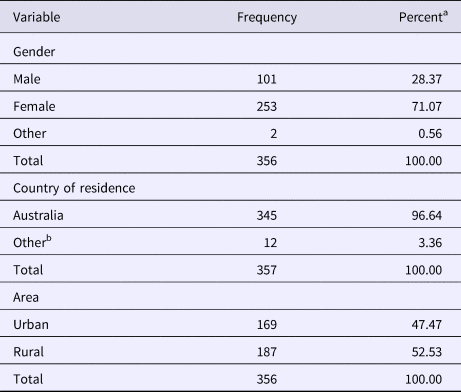
Data were collected using an online survey that was administered using SurveyMonkey. The online questionnaire was opened on 22 December 2017 and closed on 5 February 2018. Three hundred and eighty-five participants were recruited via social media (links posted by the authors as well as others on Twitter, Facebook and LinkedIn), the authors’ university daily email newsletter, a media release by the authors’ university, newspaper and magazine articles advertising the survey, and through personal contacts. Participants were considered eligible for inclusion in the study if they were 18 years of age or older and owned or used a smartphone. The participants were predominantly Australian with a mean age of 41.04 (SD = 13.30, Mdn = 40.00, range = 18–72). Other demographic characteristics of participants are shown in Table 2.
Demographic Characteristics of Participants

Note: aPercent = valid percent. bOther includes New Zealand, United Kingdom, Canada, Germany, India, Indonesia, Philippines, South Africa, Switzerland and Singapore.
Procedure
Individuals who were interested in participating in the survey first clicked on the survey link. This link took them to SurveyMonkey. The first page of the survey consisted of an information sheet for participants, which outlined the purpose of the study, the ethical considerations and the rights of the study participants, such as who to contact if they had concerns about the conduct of the study. The bottom of the information sheet then thanked individuals for considering the invitation and informed them that by proceeding to the survey questions they were consenting to participate. As mentioned previously, participants were considered eligible for inclusion in the study if they were 18 years of age or over and owned/used a smartphone. Thus, after the information sheet, participants were asked the following questions: (1) ‘Are you 18 years of age or older?’ Yes/No; and (2) ‘Do you own/use a smartphone?’ Yes/No. Participants who selected ‘no’ for either question were thanked for their time and exited from the survey.
Measures
Participants considered eligible for inclusion in the study were then taken to the survey. The demographic information collected from participants included their gender, age, country/state of residence, and area (urban vs. rural). Phubbing frequency was assessed by asking participants how often they look at their smartphone while having a face-to-face conversation with another person or persons: (a) never, (b) rarely, (c) sometimes, (d) often, or (e) all the time.
The frequency with which people phub certain groups was examined by asking participants, on a scale of 1 to 5, where 1 equals never and 5 equals all the time, how often they look at their smartphone while having a face-to-face conversation with (a) their work supervisor/manager, (b) colleagues, (c) subordinates, (d) clients/customers, (e) close friends, (f) friends, (g) acquaintances, (h) strangers, (i) their partners, (j) their parents, (k) their siblings, (l) their grandparents, (m) their children, and (n) other relatives.
The frequency with which people phub in certain situations was examined by asking participants, on a scale of 1 to 5, where 1 equals never and 5 equals all the time, how often they look at their smartphone while having a face-to-face conversation with another person or persons (a) during work-related meetings, (b) during non-work-related meetings, (c) during work coffee/lunch breaks, (d) while commuting on public transport, (e) while travelling in private transport, (f) while socialising with friends, (g) while shopping, (h) during mealtimes with family, (i) during lectures/classes, and (j) in bed. A 5-point scale was chosen, rather than a 7-point scale, to more closely mirror scales used in previous research (see, e.g., Karadag et al., 2015).
Data Analysis
Data were analysed using SPSS. Descriptive statistics were generated for all variables. A Spearman's rank order correlation was generated to assess age and phubbing frequency. Mann-Whitney U tests were used to assess gender and phubbing frequency, and area (urban vs. rural) and phubbing frequency. Items in the ‘who people phub’ question were assessed using a Friedman test with post-hoc Dunn-Bonferroni tests. Items were first examined individually and then grouped into categories (and then examined within and across categories). These categories were friends/acquaintances, consisting of close friends, friends, and acquaintances; strangers (one item; i.e., strangers); family, consisting of parents, siblings, children, grandparents, other relatives, and partner; and people at work, consisting of work supervisor/manager, colleagues, subordinates, and clients/customers.
A Friedman test with post-hoc Dunn-Bonferroni tests was also used to assess items related to the phubbing situation question. Items were once again examined individually and then grouped into categories (and examined within and across categories, with Wilcoxon signed-rank tests used for categories with only two items). These categories were: travel, consisting of commuting on public transport and travelling in private transport; socialising, consisting of socialising with friends and during meal times with family; meetings, consisting of work-related meetings, lectures/classes and non-work-related meetings; and downtime, consisting of work coffee/lunch breaks, shopping and in bed.
Results
Phubbing Frequency and Smartphone Users’ Characteristics
The majority of participants (62.34%) reported looking at their smartphone while having a face-to-face conversation with another person or persons ‘sometimes’ (47.79%), ‘often’ (12.99%) or ‘all the time’ (1.56%). A Mann-Whitney U test was conducted to see whether there was a significant difference between phubbing frequency scores for males and females. Results showed no significant difference between the medians of the two groups, U = 12,668, z = −.135, p = .893. A Spearman's rank-order correlation was run to assess the relationship between participants’ age and phubbing frequency. Results showed a weak negative relationship between the two variables, r s(355) = −.272, p < .01. That is, an increase in age was weakly associated with a decrease in phubbing frequency. A Mann-Whitney U test was also conducted to see if there was a significant difference between phubbing frequency scores for urban and rural participants. Results showed no significant difference between the medians of the two groups, U = 14097.50, z = −1.897, p = .058. Given that phubbing has been found to result in a range of negative outcomes (see, e.g., David & Roberts, Reference David and Roberts2017; Roberts & David, Reference Roberts and David2017; Wang et al., Reference Wang, Xie, Wang, Wang and Lei2017), the finding that it is a frequently occurring phenomenon is concerning, as it suggests this behaviour is already a social norm.
Research Question 1 and Hypothesis: Who People Phub
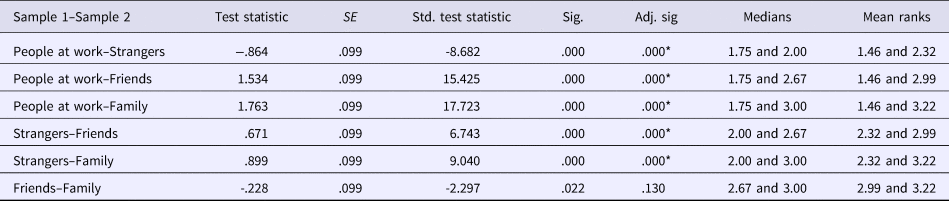
A Friedman test was carried out to compare phubbing frequency scores for the grouped categories ‘friends’, ‘family’, ‘strangers’, and ‘people at work’. There was a significant difference between the categories, χ2(3) = 423.703, p < .05. Dunn-Bonferroni post hoc tests showed significant differences between the following pairs: friends and strangers (p < .05), family and strangers (p < .05), friends and people at work (p < .05), family and people at work (p < .05), and strangers and people at work (p < .05), but no significant difference between friends and family (p = .130). More specifically, participants reported being significantly more likely to phub friends (Mdn = 2.67) and family (Mdn = 3.00) than strangers (Mdn = 2.00), friends (Mdn = 2.67) and family (Mdn = 3.00) than people at work (Mdn = 1.75), and strangers (Mdn = 2.00) than people at work (Mdn = 1.75). Participants were not significantly more likely to phub family (Mdn = 3.00) than friends (Mdn = 2.67; see Table 3).
Dunn-Bonferroni Post Hoc Test Results for ‘Who People Phub’

Note: Test statistic = difference in mean ranks. *p < .05
Dunn-Bonferroni post hoc tests on the individual items revealed that participants were significantly more likely (p < .05) to phub close friends (Mdn = 3.00) and friends (Mdn = 3.00) than acquaintances (Mdn = 2.00) and strangers (Mdn = 2.00; see Table 4). They were also significantly more likely (p < .05) to phub colleagues (Mdn = 2.00) and subordinates (Mdn = 2.00) than work supervisors/managers (Mdn = 1.00) and clients/customers (Mdn = 1.00). With regard to family, participants reported being more likely to phub their partners (Mdn = 3.00), parents (Mdn = 3.00), siblings (Mdn = 3.00) and children (Mdn = 3.00) than their grandparents (Mdn = 2.00) and other relatives (Mdn = 2.00). They were also more likely to phub their partners (Mdn = 3.00, mean rank = 4.40) than parents (Mdn = 3.00, mean rank = 3.65). No other significant differences were found.
Dunn-Bonferroni Post Hoc Test Results For ‘Who People Phub’ — Items Within Groups

Note: Test statistic = difference in mean ranks. Supervisors = Work supervisors/managers.
* p < .05
The literature indicates that injunctive and internalised norms influence smartphone users’ phubbing behaviour (Hall et al., Reference Hall, Baym and Miltner2014). The reason individuals phub those with whom they have a closer relationship than with people with whom they have a distant relationship more frequently is because the internalised norms related to smartphone use matter more than the prevailing societal expectations (Vorderer et al., Reference Vorderer, Hefner, Reinecke and Klimmt2017). With people they are closer to, they are likely to be more comfortable around them and are not as worried that their act will be judged as offensive. Thus, if the phubber and the phubbed consider phubbing acceptable and do it to each other (reciprocated), then the act of phubbing may not be a cause for concern.
Research Question 2 and Hypothesis: Situations in Which People Phub
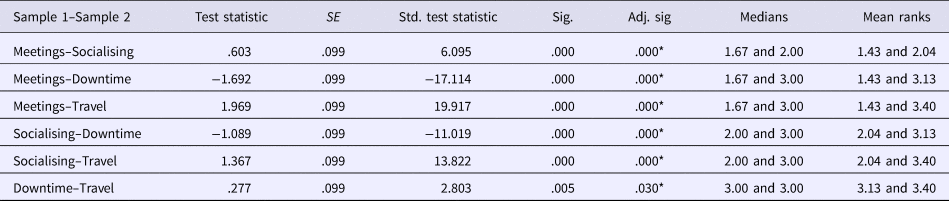
A Friedman test was carried out to compare phubbing frequency scores for the grouped categories ‘travel’, ‘socialising’, ‘meetings’, and ‘downtime’. There was a significant difference between the categories, χ2(3) = 561.048, p < .05. Dunn-Bonferroni post hoc tests showed significant differences between the following pairs: travel and meetings (p < .05), downtime and meetings (p < .05), travel and socialising (p < .05), downtime and socialising (p < .05), travel and downtime (p < .05), and socialising and meetings (p < .05). More specifically, participants reported being significantly more likely to phub when travelling/commuting (Mdn = 3.00) and having downtime (Mdn = 3.00) than when socialising (Mdn = 2.00) and attending meetings (Mdn = 1.67). Additionally, participants reported being significantly more likely to phub when travelling/commuting (Mdn = 3.00, mean rank = 3.40) than having downtime (Mdn = 3.00, mean rank = 3.13), and more likely to phub when socialising (Mdn = 2.00) than when attending meetings (Mdn = 1.67; see Table 5).
Dunn-Bonferroni Post Hoc Test Results for Phubbing Situations

Note: Test statistic = difference in mean ranks.
* p < .05
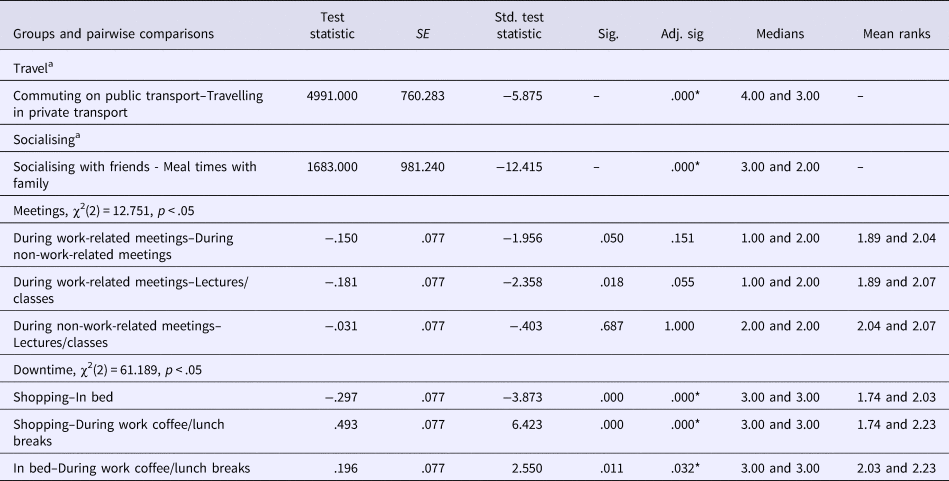
Wilcoxon and Dunn-Bonferroni post hoc tests on the individual items revealed that participants were significantly more likely (p < .05) to phub when commuting on public transport (Mdn = 4.00) than travelling in private transport (Mdn = 3.00). They were also significantly more likely (p < .05) to phub during work/coffee lunch breaks (Mdn = 3.00, mean rank = 2.23) than when in bed (Mdn = 3.00, mean rank = 2.03) or while shopping (Mdn = 3.00, mean rank = 1.74), and more likely to phub when in bed than while shopping. With regard to socialising, participants were significantly more likely to phub when socialising with friends (Mdn = 3.00) than during mealtimes with family (Mdn = 2.00). No significant difference was found between meeting items, despite a significant Friedman's test, χ2(2) = 12.751, p < .05 (see Table 6).
Wilcoxon Signed-Rank and Dunn-Bonferroni Post Hoc Test Results for ‘Phubbing Situations’ — Items Within Groups

Note: Test statistic = difference in mean ranks. Supervisors = Work supervisors/managers. aExamined using Wilcoxon signed-rank test.
* p < .05
The finding that the client and the supervisor are phubbed the least perhaps reflects participants’ professional attitude towards using smartphones in the workplace. Given this is an Australian sample, this finding should not be surprising, as Al-Saggaf and Burmeister's (Reference Al-Saggaf and Burmeister2014) study found that Australian information technology professionals, for example, enjoy a strong sense of professionalism in the worklace. The finding that participants were significantly more likely to phub when socialising than when attending meetings can be explained by injunctive norms related to smartphone use. It is generally perceived as more rude to phub while socialising or attending meetings than while relaxing or commuting (i.e., is less socially acceptable). Likewise, phubbing during meetings generally has more severe consequences (e.g., can result in a warning or the loss of a job). The finding that participants were significantly more likely to phub while socialising with friends than during mealtimes with family is interesting. While internalised norms related to smartphone use may permit phubbing while socialising with friends because smartphone users are more comfortable around their friends, and their friends are likely to phub them too, phubbing during mealtimes with family violates well-established table manners, especially in Australia. A meal with the family usually occurs once during the day and it is likely the occasion is treated as special. This means that in the case of phubbing during mealtimes with family, injunctive norms matter more than internalised norms related to smartphone use.
Discussion
In order to understand phubbing behaviour, this study investigated the frequency with which participants look at their smartphones while having a face-to-face conversation with others, and their characteristics. As expected, the results of this study showed that the majority of participants (62.34%) reported that they look at their smartphone while having a face-to-face conversation with others. This finding supports previous research by Chotpitayasunondh and Douglas (Reference Chotpitayasunondh and Douglas2016), McDaniel and Coyne (Reference McDaniel and Coyne2016), Roberts and David (Reference Roberts and David2016), and Wang et al. (Reference Wang, Xie, Wang, Wang and Lei2017). This finding also highlights the need for future research to investigate the effects of this phenomenon on social relationships, as well as to develop programs and strategies aimed at addressing its negative effects and educating the public on those negative effects.
The results of this study found that females did not phub more frequently than males. The finding that there was no significant difference between median phubbing frequency scores for males and females is not in line with previous research, which found that females phubbed more frequently than males (Chotpitayasunondh & Douglas, Reference Chotpitayasunondh and Douglas2016; Karadağ et al., Reference Karadağ, Tosuntaş, Erzen, Duru, Bostan, Şahin and Babadağ2015). This may be due to the demographics/composition of our sample, which was different to those in the other studies. The results of this study found that people from urban areas did not phub more frequently than people from rural areas. The finding of no significant difference between median phubbing frequency scores for urban and rural participants also does not support previous research (Vernon & Uink, Reference Vernon and Uink2017), which found that people from urban areas phubbed more frequently than people from rural areas. This may be due to the fact that Vernon and Uink (Reference Vernon and Uink2017) did not look at significant differences (only reported descriptive statistics). The results of this study found that younger people phubbed more frequently than older people. Specifically, it was found that there was a weak but significant negative correlation between age and phubbing frequency. As mentioned previously, it is likely that older people phub less frequently than younger people because they are less likely to use, or be addicted to, their smartphones (Andone et al., Reference Andone, Błaszkiewicz, Eibes, Trendafilov, Montag and Markowetz2016; David & Roberts, Reference David and Roberts2017; de Sola et al., 2017; de Sola Gutierrez et al., Reference De-Sola Gutierrez, de Fonseca and Rubio2016), and are less likely to use, or be addicted to, the internet (Kuss et al., Reference Kuss, Griffiths, Karila and Billieux2014; Kuss & Lopez-Fernandez, Reference Kuss and Lopez-Fernandez2016), social media (Kuss & Griffiths, Reference Kuss and Griffiths2017), and SMS (Pew Research Center, 2011), all factors that have been found to predict phubbing behaviour. These findings are valuable, as they can be used to inform ‘stop phubbing’ programs, policies and campaigns (i.e., help identify target markets).
With regard to ‘who people phub’, H1 stated that people are more likely to look at their smartphone while having a face-to-face conversation with people with whom they have a closer relationship than with people with whom they have a distant relationship. The statistical analysis confirmed this hypothesis. Specifically, the study found that participants were significantly more likely to phub friends and family than strangers and people at work. The study found that participants were significantly more likely to phub their colleagues and subordinates than work supervisors/managers and clients/customers. This finding supports previous research (Turner & Reinsch, Reference Turner and Reinsch2007). Additionally, within these groups, excluding ‘people at work’ discussed above, it found that participants were significantly more likely to phub close friends and friends than acquaintances and strangers, and were more likely to phub their partners, parents, siblings and children than their grandparents and other relatives. In terms of the effect of phubbing on the partner, we already know that phubbing is associated with heightened feelings of jealousy and that the loss of partner's attention can make partners feel neglected, unnoticed, less important, turned off, lonely, uninteresting, isolated, angry/irritated/annoyed, sad, jealous, to name a few (Krasnova et al., Reference Krasnova, Abramova, Notter and Baumann2016). In the case of children who need their parents’ attention at this vulnerable age, phubbing them is particularly problematic as it may have a detrimental effect on their future development and psychological wellbeing (Oduor et al., Reference Oduor, Neustaedter, Odom, Tang, Moallem, Tory and Irani2016).
With regard to ‘situations in which people phub’, H2 stated that people are more likely to look at their smartphones while having a face-to-face conversation with people in situations where internalised norms permit such behaviour. This hypothesis is also supported. The study found that participants were significantly more likely to phub when travelling/commuting and having downtime than when socialising and attending meetings. It also found that they were significantly more likely to phub when travelling/commuting than when having downtime, and were more likely to phub when socialising than when attending meetings. Within these groups, the study found that participants were significantly more likely to phub people while commuting on public transport than travelling in private transport. This could be due to the fact that people are more likely to be preoccupied while travelling privately (i.e., driving). The study also found that participants were significantly more likely to phub during work coffee/lunch breaks than while in bed or while shopping, and more likely to phub when in bed than while shopping. This could be due to the frequency with which people generally use their smartphones in these situations and how likely they are to be around other people (or people who are awake). The finding of no significant difference between meeting items, despite a significant Friedman's test, is likely due to the conservative nature of Dunn-Bonferroni post-hoc tests (i.e., differences were there — it just could not detect them). It is possible that significant differences could have been found if post-hoc Wilcoxon signed-rank tests had been used. This is something for consideration in a future study.
Conclusion
The aim of this study was to understand phubbing behaviour, including how common it is. It addressed the following research questions: How does phubbing differ across different relationship groups (i.e., family vs. people at work)? How does phubbing differ within the same relationship group (i.e., in the case of family relations: parents vs. children)? In which situations (i.e., in bed or at the dinner table) are people more likely to phub others? The results of this study showed that the majority of participants reported phubbing others. It was found that females did not phub more frequently than males and that people from urban areas did not phub more frequently than people from rural areas. It was also found that younger people phubbed more frequently than older people. More importantly, the study revealed that people are more likely to phub others with whom they have a closer relationship than with people with whom they have a distant relationship. Similarly, the study revealed that people are more likely phub in situations where internalised norms permit such behaviour.
A number of limitations to the present study and suggestions for future research are outlined. First, the study relied on self-report questions. While self-report questions are very common in this kind of research, their use does raise some issues. For example, there is no guarantee that the participant is answering the questions truthfully or accurately. Also, factors such as embarrassment and mood can influence the findings (Podsakoff & Organ, Reference Podsakoff and Organ1986). The ‘divided attention’ problem that smartphone users exhibit may also make it difficult for participants to remember the details about their smartphone usage patterns (Vorderer et al., Reference Vorderer, Hefner, Reinecke and Klimmt2017). In addition, their recall may also be affected by the passage of time. Participants may not also be aware or conscious when they are looking at their smartphones during a face-to-face conversation. These issues could affect the findings. To address these issues, a future study could consider using an app for participants to use to record how often they phub others. Second, the non-representative nature of the sample; for example, a large proportion of the participants were females and from rural areas, which could affect the findings; thus, caution should be taken when generalising from these findings. To address the generalisability of the findings issue in future, the study could be repeated using a random sampling method. Related to the issue of the generalisability, while a sample size of 387 participants is good, a future study could recruit a larger sample to address this issue. Third, although not a limitation per se, that all of the reported medians were quite low, with the maximum being 3 or ‘sometimes’, should be taken into consideration when interpreting the results. To explain, although we found, for example, that participants were significantly more likely to phub their colleagues than their superiors, the low medians show that overall they were likely to engage in this phubbing at most ‘sometimes’, that is, not ‘often’ or ‘all the time’. But this may be due to the demographics/composition of our sample; that is, a large proportion of the participants were slightly older, female, and from rural areas.
The study makes a number of key contributions to the literature. The adoption of social norms as the theoretical lens is a significant contribution to the literature, considering the dearth of studies that used this framework. This is also the first study that has compared phubbing across different relationship groups (e.g., people phubbed family members more frequently than people at work). It is also the first study that has compared phubbing within the same relationship group (e.g., people phubbed children more frequently than grandparents). These findings highlight which relationship groups and individuals are affected by phubbing more than others. The study is also the first that has investigated in which situations people are likely to phub others and offered comparisons across situation types (e.g., people phubbed while socialising more frequently than during meetings) and within the same situation type (e.g., people phubbed in bed more frequently than during work coffee/lunch breaks). A follow-up study should next be conducted using qualitative interviews to understand in depth why people phub certain people over others, and in certain situations over others.
Author ORCIDs
Yeslam Al-Saggaf, 0000-0001-7299-5578
Conflict of interest
None.