Human rights are often the first casualties of a crisis. For governments confronted with armed conflicts, civil wars, insurrections, severe economic shocks, natural disasters, and similar threats, the pressures to restrict individual liberties can be overwhelming. International law scholars have long recognized that “the response of a state to a public emergency is an acid test of its commitment to the effective implementation of human rights.”Footnote 1
Several major human rights agreements take account of these threats by authorizing states to “escape” temporarily from some of their treaty commitments during times of crisis, but subjecting the suspension of rights to a carefully calibrated system of limitations, safeguards, notifications, and review procedures. The legal literature recognizes the importance of these escape mechanisms to the international system of human rights protection.Footnote 2 Yet derogations have received almost no attention from international relations (IR) scholars. This is surprising, inasmuch as derogations have implications for two important areas of IR scholarship—the design of international agreements and compliance with human rights treaties.
The literature on the design of international agreements argues that states consider both substantive standards (such as the depth and precision of rules) and procedural issues (such as voting rules and monitoring mechanisms) when negotiating treaties. States respond to different problem types and risks by selecting from a range of design and flexibility options to calibrate an overall level of international commitment.Footnote 3 Escape clauses are one such option. They reduce uncertainty by authorizing temporary deviations from treaty rules if exigent circumstances arise. Ceteris paribus, escape provisions encourage more states to ratify a treaty than would do so without such clauses, and they enable the negotiation of deeper obligations than could be attained without such provisions. But escape mechanisms can also weaken international agreements by authorizing deviant behavior precisely when treaty compliance is needed most.Footnote 4
Escape clauses are especially important in the human rights context, since they are triggered during periods when individual liberties are under serious threat. Yet derogations are far less studied than other design elements of human rights agreements, and their relationship to treaty compliance is undertheorized.Footnote 5 Recent IR scholarship explains why countries ratify human rights treaties and with what consequences.Footnote 6 Other studies analyze the flexibility tools that states invoke when they join or withdraw from these treaties.Footnote 7 Yet we know almost nothing about how and why states use flexibility mechanisms while they are treaty members.Footnote 8
Derogations are also relevant to understanding compliance with human rights agreements. They provide a safety valve for the enormous pressures that governments face to repress individual liberties during times of crisis. Without this escape option, states facing such emergencies would be more likely to repress derogable rights (often surreptitiously) in violation of international law. Hence, IR scholars interested in when and why states comply with human rights treaties should also be interested in the design and use of derogations clauses.
Our study is the first (to our knowledge) to offer a theory and evidence for which states derogate from human rights treaties and why they do so. We argue that derogations are a rational response to domestic political uncertainty. More specifically, derogations enable governments facing threats at home to buy time and legal breathing space to confront crises while, at the same time, signaling to concerned domestic audiences that rights suspensions are temporary and lawful. Our conclusions are based on comprehensive new data sets of derogations and states of emergency around the world from 1976 to 2007.
The article contains three core findings. First, we show that stable democracies and countries where domestic courts can exercise strong oversight of the executive are more likely to derogate than other regimes—a conclusion consistent with the finding that democracies are more likely than other regimes to file reservations when they join human rights treaties.Footnote 9 Our study goes further, however, identifying the most frequent derogators as a subset of democracies in which “compliance constituencies”Footnote 10 can hold governments accountable for repressing rights. We argue that these regimes derogate with a specific goal in mind: to flag potentially unpopular rights restrictions, to spin the bad news in their favor, and to signal to judges and to domestic interest groups who push for treaty compliance that emergency restrictions are necessary, temporary, and lawful. This explanation is bolstered by a related finding—that the countries most likely to provide information about the duration of a derogation and the rights being suspended have stable democratic governments and strong judicial oversight of the executive.
Second, the above-described logic of derogating does not apply in countries where the judiciary is weak or voters cannot easily remove leaders from office. Such states join but routinely breach human rights agreements.Footnote 11 These states thus have little need to escape from the treaties because they are unlikely to be held accountable for violating them. When these countries do derogate, however, they generally do so without providing information about rights restrictions and in multiple consecutive years, a finding that supports the legal literature's concern with states that abuse derogations to shield so-called “permanent emergencies.”Footnote 12
These serial, insincere derogators also account for our article's third finding: countries that derogate once are far more likely to do so again. To understand why, we develop a hazard model to predict derogation length. We discover that autocracies and countries with weak judiciaries are especially likely to keep derogations in place for long periods, just as we would expect. However, stable democracies and countries with robust judiciaries are also likely to derogate for long periods—but only if they face extreme levels of political violence. We then examine the small number of countries that are stable democracies with robust judiciaries that derogate serially for five or more consecutive years.
Our three findings are at odds with the expectations of the treaties' drafters, who questioned the ability of domestic institutions to cabin emergency powers and sought to limit repression by creating international standards and international notification and monitoring mechanisms. We show that these treaty design features are important not because they require derogating states to disclose rights restrictions internationally, but rather because they enable those countries to signal to domestic audiences that suspensions are necessary, temporary, and lawful. Our study thus adds to a growing body of work concluding that domestic politics—not international reciprocity, retaliation, or reputation—is the crucial determinant of state compliance with international human rights law.Footnote 13
The Human Rights Treaty Derogations Regime
When a state faces a threat to its security or continued survival, the pressure to adopt emergency measures—including suspensions of civil and political liberties that the state has previously pledged to uphold—is often overwhelming.Footnote 14 The drafters of the International Covenant on Civil and Political Rights (ICCPR) and the European and American Conventions on Human Rights—three major human rights treaties negotiated in the years following World War II—were well aware of these dangers. They recognized that crises provide convenient excuses for governments to enhance their powers, dismantle democratic institutions, and repress political opponents. Yet the drafters also accepted that sovereign nations have a responsibility to protect their citizens and domestic institutions.Footnote 15 To balance these competing concerns, the treaties' drafters included an escape clause that sanctioned restrictions of certain rights during emergencies but subjected those restrictions to the strictures of international law.
Several considerations help to explain why governments adopted this approach. First, as the U.K. emphasized when arguing in favor of the ICCPR's derogation clause in 1947, “under general international law in time of war States were not strictly bound by conventional obligations unless the conventions contained provisions to the contrary.” An express treaty provision delineating the scope of permissible escape was therefore needed “to prevent States from arbitrarily derogating from their obligations in respect of human rights in time of war” or other emergencies.Footnote 16
Second, the treaties' drafters questioned the efficacy of domestic institutions to limit emergency suspensions of rights. The drafters recognized that both the executive and the legislature could authorize infringements of individual liberties, and that courts would often defer to the political branches.Footnote 17 Adherence to national rules governing the public proclamation and judicial review of emergency measures would not, therefore, ensure the treaty compatibility of rights restrictions that were “no longer exclusively a matter of domestic concern.”Footnote 18
Third, the treaties adopted a detailed international regime of limitations, safeguards, notifications, and review procedures. Article 4(1) of the ICCPR is illustrative. When a public emergency that “threatens the life of the nation” is officially proclaimed, a treaty party may derogate from certain civil and political liberties, but only “to the extent strictly required by the exigencies of the situation.” Article 4(2) contains a second substantive limitation: a derogating state may not lawfully suspend fundamental rights designated as nonderogable, including the prohibitions of murder, torture, slavery, and discrimination.Footnote 19 In terms of notification and review procedures, Article 4(3) requires the derogating country to inform the United Nations secretary general of the rights and freedoms suspended, the reasons for the suspension, and the date when emergency measures will end. The secretary general publicizes this information and circulates it to other treaty parties, who may challenge the derogation before an international monitoring body—the UN Human Rights Committee. The committee also reviews derogations when examining complaints filed by individuals, when analyzing periodic reports from states parties, and when issuing general comments interpreting the ICCPR.Footnote 20
Fourth, these careful calibrations of the international derogations regime explain why escape clauses appear in some human rights agreements but not in others. The drafters of the three treaties in our study agreed that certain “fundamental” liberties, including the right to life and the prohibition of torture, were nonderogable because they were “indispensable for the protection of the human being.”Footnote 21 It is therefore unsurprising that both earlier and later treaties devoted to these rights—such as the 1948 Convention Against Genocide and the 1984 Convention Against Torture—prohibit derogations.Footnote 22 The drafters' concern with preventing discrimination also explains why the gender and race conventions do not permit derogations.Footnote 23 In contrast, derogations are seen as irrelevant to economic and social rights treaties, whose provisions are far more malleable than those of civil and political rights agreements.Footnote 24
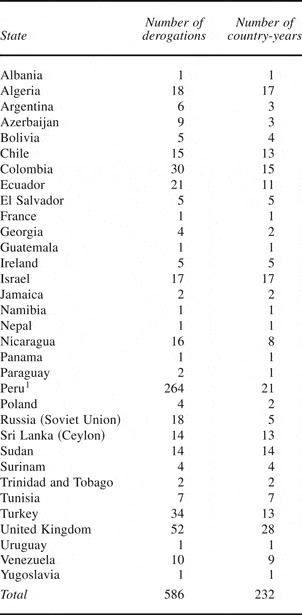
During the past half century, thirty-three states have invoked the escape clauses in the three treaties in our study. As Table 1 illustrates, these countries are responsible for nearly 600 instances of derogation in 232 “country years,” that is, years in which a state party filed a derogation or a previously filed derogation remained in effect.
All derogations from the European and American Conventions and ICCPR

Notes : Thirty-three states in list.
1. Peru is a striking outlier. The country has filed more derogations than any other state by a large order of magnitude. Peru has also filed multiple derogations in each year that it derogates. The derogations spike in the early 1990s, a time of significant domestic unrest following the election of President Alberto Fujimori that resulted, on 5 April 1992, in the autogolpe (or self-coup) in which Fujimori, with the support of the military, suspended the constitution, shut down the Congress, and purged the judiciary. We do not treat Peru as an outlier in our statistical analysis, however, because our dependent variable is binary, that is, a state either derogates in a particular year or it does not.
Table 1 reveals that a diverse array of nations have utilized the treaties' escape provisions. These include nations that have experienced widespread and long-standing civil unrest or terrorist threats (such as Colombia, Israel, Turkey, and Sri Lanka), as well as UN Security Council members France, Russia, and the U.K. In addition, several countries that derogate do so in multiple years and for multiple crises. We analyze these descriptive statistics in greater detail later in this article.
The Two Faces of Derogation
The IR literature on treaty design recognizes that escape mechanisms serve several salutary functions. The flexibility they provide acts as an insurance policy, reassuring nervous governments that they can lawfully opt out of certain treaty commitments during times of crisis. The option to escape also facilitates the negotiation of broader and deeper agreements and makes ratification more palatable to a larger number of countries.Footnote 25 But escape clauses also have potentially negative consequences, in that they officially condone a deviation from pre-existing treaty commitments precisely when those commitments are most at risk of being undermined.Footnote 26
The legal literature also acknowledges these competing perspectives. Many legal scholars stress the potential for abuse of escape clauses. For example, they argue that derogations can undermine the raison d'être of human rights treaties and should be subject to strict international standards and monitoring mechanisms.Footnote 27 Other scholars counter that sovereign nations have a legitimate right to defend their constitutional and democratic orders during times of crisis.Footnote 28 They emphasize that derogations require states to disclose repressive policies publicly and conform their actions to international safeguards and monitoring procedures—requirements that reduce the incidence and extent of potential rights violations.Footnote 29 Seen from this perspective, derogations are not threats to the system of international human rights protection but, conversely, hallmarks of respect for treaty norms by states that “take human rights seriously.”Footnote 30
A Theory of Why States Derogate: Buying Time and Reducing Censure
The two competing perspectives outlined in the previous section emphasize the international dimension of derogations. Our theory proceeds from a different premise—the uncertain domestic political environment that governments confront during emergencies, an environment in which the pressure to restrict rights is often overwhelming. We argue that derogations are a rational response to this uncertainty, enabling governments to buy time and legal breathing space from voters, courts, and interest groups to combat crises by temporarily restricting civil and political liberties. A derogation sends a credible signal to these domestic actors—many of whom are predisposed to challenge or find fault with such restrictions—that suspending rights is necessary, temporary, and lawful. In response to a derogation, domestic publics, judges, and nongovernmental organizations (NGOs) are more likely to refrain, in the near term, from challenging rights-restrictive policies than if the government had adopted those same policies without derogating.
Emergencies, Rights Restrictions, and Restraining the Accountability Impulses of Voters and Judges
Responses to emergencies tend to concentrate power in the executive and to constrict individual liberties.Footnote 31 Support for these responses can be widespread, especially where a threat is external or when emergency measures target foreigners or activities outside the state. These factors, together with the fear of future attacks, may encourage domestic actors to “rally 'round the flag”Footnote 32 and accept restrictions of individual liberties. Responses to emergencies that infringe the civil and political rights of citizens are less popular, however.Footnote 33 In addition, public backing for rights restrictions is strongest immediately following an emergency and wanes as the crisis recedes.Footnote 34 It is thus increasingly important for governments to convince voters that restrictions of rights are necessary and temporary responses to emergencies.
Executive officials also need to convince domestic judges of the legality of their responses. In ordinary times, courts in many countries view restrictions of human and constitutional rights with skepticism. But judicial attitudes shift markedly once a state of emergency has been declared. At first, courts are highly deferential to the government and far more willing to uphold restrictions than during periods of normalcy. If the crisis is prolonged, however, judicial review becomes increasingly intrusive and the government is more likely to be held responsible for infringing rights.Footnote 35
In sum, governments responding to a crisis face a dual challenge. They must buy time and policy breathing space to adopt emergency measures, including measures that restrict civil and political liberties. And they must do so in a way that reduces the risk of censure from voters, interest groups, and domestic judges.
A derogation from a human rights treaty helps to achieve both of these ends. It does so by sending a credible signal that rights restrictions are necessary and temporary, and that the government has publicly committed itself to returning to full compliance with its treaty-based pledge to respect civil and politics liberties. More specifically, a derogation bolsters the state's claim that it faces a genuine crisis, increasing the likelihood that voters, domestic interest groups, and judges will support its actions in the short run. But such bolstering comes at a cost—an official, public statement that emergency measures will conform to the substantive and procedural constraints dictated by international law.
This buying time and reducing censure argument does not, however, depend on robust international review of derogations. As we mentioned above, the drafters of the three treaties in our study expected international standards and monitoring mechanisms to constrain the use of escape clauses. In practice, however, international tribunals are quite deferential to assertions that a national threat exists. Some scholars have even charged governments with using derogations to play a two-level game in which “internal political strife is managed by extraordinary means, allowing greater effectiveness with fewer constraints,” while “external obligations are satisfied with cursory monitoring and international legitimization.”Footnote 36
These critiques overlook the influence of derogations on domestic politics and domestic judicial review of emergency measures. Consider as an example a notice of derogation which provides that, due to ongoing violent demonstrations in one region of the country, the government is restricting freedom of assembly and association in that region for twelve months. Following the global script of the international derogations regime enhances the credibility of the government's assertion that the threat is genuine and serious, eliciting greater support and deference from domestic audiences for restricting rights during the twelve-month period. Once in possession of this information, however, voters and civil society groups can monitor whether the government in fact suspends only these two freedoms, whether it applies the restrictions only in the designated region, and whether suspensions last for more than one year or after the threat has subsided. These groups can also use this information to bolster challenges—in both political and judicial venues—that deviations from the terms of the derogation are illegal and that the government should be held accountable for the resulting rights violations.
As this example illustrates, derogations are most useful to certain types of regimes. As a short-run mechanism to garner support from voters and interest groups, a derogation is only appealing to governments that are accountable to voters. We therefore expect to find evidence that stable democracies, where citizens can freely express political preferences and hold elected leaders accountable for their decisions, are likely to derogate more frequently than other regime types.
Derogations should also appeal to governments that seek to reduce, at least in the short term, judicial oversight and censure of emergency measures. We therefore expect to find evidence that countries in which domestic courts are authorized to review the legality of executive branch actions are likely to derogate more frequently than countries where the courts do not possess such powers.
By contrast, derogations serve little purpose where judicial institutions are weak or voters cannot easily remove leaders from office. Governments in these countries join human rights treaties and routinely violate treaty norms.Footnote 37 They thus have little need to derogate because they are unlikely to be held accountable for violations with or without a derogation. Indeed, for some of these states, a derogation may be more harmful than simply violating the treaty if the derogation draws attention to repression that would otherwise remain hidden. We therefore expect to find evidence that countries with these characteristics are less likely to derogate.
The Relationship Between Providing Information and Reducing Censure
If we are correct that derogations temporarily reduce the risk that voters and courts will censure governments for restricting rights, we should observe governments using the derogation notifications required by the treaties to provide information about rights restrictions to domestic audiences. On paper, these notification rules are quite demanding. But anecdotal evidence suggests that some countries do not comply, or do not comply fully, with these requirements, filing “notices of derogation [that] are too general, too brief, and do not give a clear indication of what articles … have been suspended.”Footnote 38 Studies of the American and European human rights conventions reach similar conclusions.Footnote 39
This variation in the provision of information allows us to investigate further our theory that states derogate to buy time against public or judicial censure. Among derogating nations, we expect stable democracies and countries with courts that can rule on the legality of executive actions to explain: (1) which rights are suspended, and (2) how long suspensions are expected to last. When the government provides this information in a derogation notice, it puts its credibility on the line by making official, public assertions about the scope of emergency rights restrictions and the period in which they will remain in effect. The information also provides clear benchmarks for voters and courts to hold officials accountable if they exceed those parameters, both when the derogation is filed and in future years.Footnote 40
In contrast, in countries where judicial institutions are weak and voters cannot easily remove leaders from office, we expect that governments will derogate less frequently, but that, when they do derogate, they will provide little if any information about the rights suspended or the timing of their suspension. In repressive political environments, drawing attention to the violations is not helpful to governments.
Serial Derogations
A third implication of our theory is that stable democracies and countries with courts that can review executive action should not derogate serially, that is, refrain from filing derogations year after year in response to an ongoing emergency. If a derogation becomes a long-standing or permanent response to a crisis, voters and courts will learn that the action is just a convenient excuse to repress rights. These groups will also begin to mobilize or litigate to hold that government accountable. In short, for our theory to be most convincing, we should find evidence that stable democracies and countries with strong courts are not serial derogators, even if they derogate more than once in response to different crises or threats.
Our theory generates the opposite prediction for states that are insincere participants in human rights treaties. We expect many of these countries to adopt emergency measures without derogating at all. But when these states do invoke the escape mechanism in human rights treaties, they do so for reasons other than buying time and reducing censure from domestic audiences. As a result, these states have no need to avoid serial or open-ended derogations.
Alternative Theories of Why States Derogate
In this section, we identify alternative theories of why states derogate, which regimes are more likely to derogate than others, the type and extent of information that derogating states provide, and how frequently they derogate.
Embeddedness in the International Human Rights System
Derogations may be a function of how deeply a state is embedded in the international legal system that protects human rights. This theory proceeds from the premise that human rights agreements primarily function as screening devices, attracting members that support the treaties and can readily comply with their terms.Footnote 41 If treaties screen in this way, we would expect countries that have ratified a larger number of treaties to be more committed to the human rights system as a whole.
The embeddedness theory generates two competing hypotheses based on the opposing conceptions of derogations discussed above. If derogations are a mark of respect for the international system, including its flexibility mechanisms, we would expect deeply embedded countries to be more likely to derogate than other states in times of crisis. We would also expect these countries to be more likely to disclose information in their derogation notices, including the liberties restricted and the duration of their suspension, and to avoid serial derogations as inconsistent with the temporary nature of the escape clauses.
On the other hand, if derogations devalue the international human rights system, more embedded states should be less likely to derogate when emergencies arise. This reduced incidence of derogation may reflect a policy decision to avoid rights restrictions, for example, by conditioning emergency powers on adherence to treaty-protected liberties. Conversely, the reduced propensity to derogate may reflect the government's attempt to avoid the public disclosures required by the treaties' escape clauses.
Self-Binding by Democratizing and Transitional Countries
Another plausible theory is that derogations provide a mechanism for governments to bolster their future commitment to respecting individual liberties. This theory uses domestic politics—specifically, self-binding behavior—to explain human rights adherence. States incur the sovereignty costs of joining human rights agreements to “tie the hands of future governments” and to “lock in democratic rule” at home.Footnote 42 As a result, democratizing, newly democratic, and transitional governments have the most to gain (and the least to lose) from ratifying human rights agreements.Footnote 43
Applying this theory to derogations yields two opposing hypotheses. If derogations provide a necessary safety valve for officials to counter threats during a crisis, then the act of derogating enables the government to signal to skeptical domestic audiences—such as interest groups and opposition political parties—that the suspension of rights is only temporary and that the government is willing to defend its policies openly and subject them to scrutiny. If this hypothesis is correct, we would expect democratizing, newly democratic, and transitional states to be more likely to derogate than stable democracies and stable autocracies when faced with a crisis, to identify which rights and freedoms they are suspending and for what length of time, and to avoid filing serial derogations to shield long-standing emergencies—actions at odds with the goal of tying the hands of future governments.
If, conversely, derogations undermine the international human rights system, as many legal scholars have argued, we would expect transitional and democratizing governments to be more likely to avoid derogations as compared to other regimes. These governments would eschew derogations to avoid weakening a system to which they have committed as a means of signaling to domestic or international audiences their determination to become a fully stable, democratic, and rights-respecting country.
Derogations as Insincere Acts
Third, and in striking contrast to the previous two theories, derogations might be insincere acts.Footnote 44 This explanation aligns with scholars who argue that human rights treaties are poor screening devices, enabling countries that habitually repress individual liberties to obtain the expressive benefits of joining the treaties but without modifying their behavior.Footnote 45 These states can achieve this seemingly inconsistent result, according to this theory, because international “monitoring and enforcement of human rights treaty obligations are often minimal, thereby making it difficult to give the lie to a country's expression of commitment to the goals of a treaty.”Footnote 46
Extending this logic to derogations is straightforward. States recognize that international review mechanisms are generally weak and that, as a result, they have little to lose by invoking the treaty-granted power to escape. At worst, a derogation is a nugatory act with no effect on domestic policies. At best, it facilitates the state's ability to justify a restriction of individual liberties as consistent with its treaty commitments.
If derogations are insincere acts, we would expect to observe a large number of derogations by states of all political types. However, states should provide little or no information in their derogation notices, since doing so might increase, although perhaps only marginally, the likelihood of being held accountable for repressing rights. Finally, the theory predicts that countries will derogate serially or for long periods of time, since there is little cost associated with doing so. These expectations are directly contrary to our theory, which views derogations as sincere and potentially costly policy choices, but only for certain types of governments.
Derogations as International Signals
Finally, the decision to derogate may be influenced by a state's concern over the message that escaping from a treaty sends to international (rather than domestic) audiences that could punish them for restricting rights. One such punishment is the loss of foreign aid or trade privileges. Scholars anticipate that countries receiving large amounts of foreign aid or trade heavily will be especially vulnerable to human rights pressures from other nations.Footnote 47 The countries most likely to offer aid or to use trade and other economic tools to punish human rights violators are the United States and European Union (EU) members.Footnote 48 The United States and EU have both conditioned, albeit inconsistently, their external economic policies upon a recipient country's protection of treaty-based individual liberties.
If derogations are a mark of respect for the international system, a country that enjoys trade concessions or receives foreign aid might derogate to provide a legal justification for suspending rights in a crisis. Its concern is not pushback from domestic voters or courts but from the United States and EU, who could withdraw these benefits. If derogations are an attempt to deflect international censure during crises, we would expect countries that receive substantial aid from, or that trade heavily with, the United States or EU to be more likely than other states to derogate, provide information about the nature and duration of the derogation, and avoid serial escapes.
If, in contrast, derogations undermine the international human rights system, we would expect countries that receive substantial levels of aid from, or that trade heavily with, the United States or the EU, to be less likely than other states to derogate, for fear of being censured.
Derogations Data
To investigate the phenomenon of derogations from three civil and political rights treaties, we consulted the Web sites of the United Nations Treaty Section and the Council of Europe Treaty Office, the Annual Reports of the Inter-American Commission on Human Rights, notices of derogation provided by the Organization of American States, and other primary and secondary sources. From this information, we coded every notice of derogation filed by states parties to the ICCPR, the European Convention on Human Rights, and the American Convention on Human Rights between the date of the treaties' entry into force through the end of 2008.Footnote 49 (As of that date, 164 states had ratified the ICCPR; 47 states had ratified the European convention, and 24 nations had ratified the American convention.)
In total, we coded nearly 600 instances of derogation in 232 country years in which a state party filed a derogation or a previously filed derogation remained in effect. Figure 1 depicts the total number of derogations in force in each year.Footnote 50
Number of derogations in force in each year, 1977–2007

Our main dependent variable—treaty derogation—is coded 1 for each county year that derogates from at least one treaty, and 0 otherwise. We also code variables for whether derogating governments provided any information relating to the derogation, including its expected duration and the rights and freedoms suspended. Both variables—information-time and information-rights—are proportions of the number of derogations filed each year that include this information over the total number of derogations filed. Finally, we code a count variable—derogation-duration—that is the number of years that the derogation persists.
Domestic Emergencies Data
The precondition for a derogation is a state of emergency.Footnote 51 To identify the universe of domestic emergencies with implications for human rights, we developed a detailed set of coding instructions and asked coders to review the Human Rights Country Reports published by the U.S. Department of State each year from 1976 to 2007. Coders searched the reports for a list of key words to identify both officially declaredFootnote 52 and undeclared domestic emergencies,Footnote 53 including those relating to national security, terrorism, political unrest, natural disasters, civil wars, and armed conflicts emanating from outside a state's borders. If a State Department report for a given country-year did not disclose the existence of a declared or undeclared emergency, coders were instructed to review at least three additional primary and secondary sources to determine if a state of emergency existed for the relevant country-year.Footnote 54
To code the relevant universe of observations, we identified those countries eligible to derogate from a treaty. Between 1977 and 2007, the time frame of our statistical analysis, 3,555 country-years involve states parties that are eligible to derogate from at least one of the treaties in our study. Of these, 1,193 are eligible to file a derogation based on the presence of emergency conditions. This universe of cases allows us to determine statistically which institutional characteristics influence a country's decision to file a derogation by comparing all eligible countries that derogate with eligible countries that do not.
Our decision to limit our analysis to the total number of country-years in which a state of emergency existed—and a country was therefore eligible to derogate—warrants additional explanation. The historical conditions experienced by a country are not randomly assigned.Footnote 55 However, we assume that, on average, a state's human rights policy choices are not intended to influence the domestic conditions necessary to declare a state of emergency and consequently to file a treaty derogation. This independence, which we believe accurately reflects political conditions, allows us to focus only on derogation-eligible country-years without compromising our statistical estimates.Footnote 56
Statistical Methodology and Assumptions
We develop several statistical modelsFootnote 57 to predict first, whether a state is likely to derogate in a given year; second, whether it is likely to provide information about the expected duration of the derogation and the nature of the restrictions; and third, whether it derogates repeatedly. We examine serial derogations—a special case of repeat derogations—with a hazard model for duration and in case studies. This section lays out the assumptions and methodological choices underlying these models.
We estimate our derogation models using a generalized estimation equation (GEE) for logistic regression to account for multiple observations of the same country in the sample of derogation-eligible country-years. The equation is designed to assess the effect of a set of independent variables on the likelihood of observing a derogation.Footnote 58 Our unit of analysis is the eligible-country-year from 1977 to 2007 (N = 1193). A small percentage of the cells in our data contain no information. Following King, Honaker, Joseph, and Scheve, we use multiple imputation.Footnote 59 However, we also estimate our models using listwise deletion from missing data and report any discrepancies in the footnotes.
We include time polynomials in all of our main derogation modelsFootnote 60 to account for the possibility that a state's derogations in the past affect its decision to derogate in the present, an issue we discuss in more detail below.Footnote 61 The time polynomials are appropriate given the use of a binary dependent variable.
We estimate our information-time and information-rights models using linear regression equations to predict the proportion of derogations that are filed with additional information.Footnote 62 Our unit of analysis is the derogation-country-year from 1977 to 2007 (N = 228). We use a lagged dependent variable rather than time polynomials because we are concerned with only dynamic effects and not duration dependence, which is an additional concern when the dependent variable is binary.Footnote 63
Finally, for those states that choose to derogate, we estimate derogation-duration in years from the beginning of the derogation until it ceases. We use a Cox proportional hazard model with robust standard errors clustered on country to estimate this model.Footnote 64 The unit of analysis is the duration spell.Footnote 65
Independent Variables
All of the theories previously discussed make predictions about the regime characteristics of derogating countries. To test these competing predictions, we use the Polity IV data project to create several binary variables.Footnote 66 The original 21-point Polity score ranges from +10 (strongly democratic) to −10 (strongly autocratic). The level of democracy or autocracy is defined by the competitiveness of political participation, the openness and competitiveness of executive recruitment, and constraints on the chief executive. A weighting scheme is used with these three components to determine the democracy and autocracy score for each regime.Footnote 67 We code states as a stable democracy when the state has a Polity score greater than or equal to 7 in the current year and each of the previous five years, otherwise 0. For political transitions, we code democratization as 1 if, between a given year and five years previous, a state makes a significant change in a democratic direction, that is, from an autocracy to either an anocracy or a democracy, or from an anocracy to a democracy.Footnote 68
Our theory also predicts that countries in which domestic courts have the power to review and strike down executive branch decisions are likely to derogate—and to supply information—more frequently than countries where the courts do not have such powers of review, but are less likely to derogate serially. To test this hypothesis, we use data supplied by Regan, Frank, and Clark.Footnote 69 The variable is coded as 1 if a court exists within the country that can rule on executive actions, and 0 otherwise.Footnote 70
To test the alternative theory that derogations are a function of embeddedness in the international human rights system, we code treaties as a proportion that varies from 0 to 1. The numerator is the count of the number of UN human rights treaties that a given state has ratified in a given year in addition to one of several regional human rights treaties.Footnote 71 The denominator is the count of the number of treaties that are open for ratification in a given year.
To test the alternative theory that countries derogate to send international signals, we test whether aid and trade flows from democracies within the EU and from the United States increase an eligible state's probability of filing a derogation. The variables are the logged sum (+1) of all aid and trade from the United States and the EU, supplied by the Organization for Economic Cooperation and Development (OECD) and International Trade Data from the Correlates of War Project.Footnote 72 In the Appendix, we also use an alternative measure of aid.Footnote 73
It is important to separate the potential effects of the independent variables from the effects of a crisis environment. We measure political violence using data included in the Major Episodes of Political Violence data set.Footnote 74 The variable ranges from 0 to 10 and provides information on levels of domestic political violence, including civil violence, civil war, ethnic violence, and ethnic war.
We include a set of standard demographic control variables that allow us to isolate further the effects of these independent variables on derogation. population size is the natural logarithm of a state's population estimate. Real per capita income is the natural logarithm of a state's real per capita income values.Footnote 75
Results
Derogation
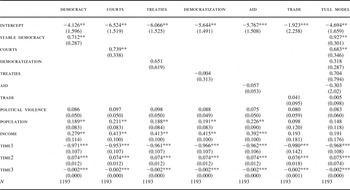
Table 2 displays results from six alternatively specified GEE for logistic regression. Each equation, estimated on the binary dependent variable derogation, is estimated with Huber-White robust standard errors, clustered by country. The first five models vary by the inclusion of the key independent variable of theoretical interest. The sixth model includes all of these variables and demonstrates that the results are robust to alternative explanations.
Alternative generalized estimation equations for binary dependent variable of treaty derogations by eligible states from 1977 to 2007

Notes: Robust standard errors in parentheses.
*** p < .01;
** p < .05.
Most strikingly, the results in columns (1) and (2) of Table 2 provide support for our theory that derogations are conscious policy choices by governments to buy time and reduce censure from domestic audiences. Eligible countries that are stable democracies are more likely to derogate than eligible countries that are other regime types. Eligible countries whose domestic courts can review executive actions are more likely to derogate than eligible countries without such judicial oversight. Strikingly, eligible countries are more likely to derogate if they have both a judicial constraint on the executive and are stable democracies than countries that have only one or the other of these institutions.
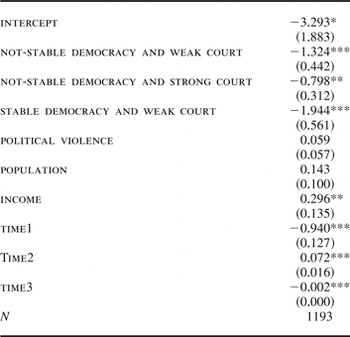
We confirm this result by creating four binary variables from courts and stable democracy. In Table 3 we include three of these categories (1) strong-courts and not-stable democracy, (2) weak-courts and stable democracy, and (3) weak-courts and not-stable democracy. The excluded category is strong-courts and stable democracy. By comparing the three categories included in the model with strong-courts and stable democracy, we demonstrate that the coefficient on each alternative category is negative and statistically significantly different than our category of theoretical interest—strong-courts and stable democracy. This confirms that countries with both of these political and judicial institutions behave differently than other states in times of crisis.Footnote 76 We used the simulation capabilities in the ZeligFootnote 77 package in R to estimate predicted probabilities for each of these categories, depicted in Figure 2, which clearly illustrates this result.
Generalized estimation equation for binary dependent variable of treaty derogation for eligible states from 1977 to 2007 with alternative codings of the court and stable democracy independent variables

Notes: Robust standard errors in parentheses.
*** p < .01;
** p < .05.
Probability of treaty derogation

The model's findings also reject the four competing hypotheses we described earlier. First, the statistical evidence on treaties presented in column (3) of Table 2 shows that states that are more deeply embedded in the international human rights system behave no differently than less-embedded countries. Second, column (4) of Table 2 indicates that derogations are neither concentrated among, nor avoided by, democratizing or transitional regimes. Third, states are generally not derogating insincerely. If derogations were insincere acts, many states would derogate because there would be potential gains and no corresponding costs. The aggregate data show, however, that only a small number of treaty members that experience emergencies actually derogate—approximately 20 percent of eligible states in our sample. Fourth, we found no evidence to support the theory that countries derogate to send international signals. Specifically, the results in columns (5) and (6) of Table 2 show that aid or trade flows from countries within the EU and from the United States neither increase nor decrease an eligible state's probability of filing a derogation.Footnote 78
Information
A second condition is required to explain our theory fully: stable democracies and countries with robust judicial oversight must provide information about the content of a derogation and its expected duration to buy time and reduce censure from voters and courts. As previously explained, this information assists domestic actors in holding officials to the limited scope and term of rights suspensions, both when the derogation is filed and in future years.
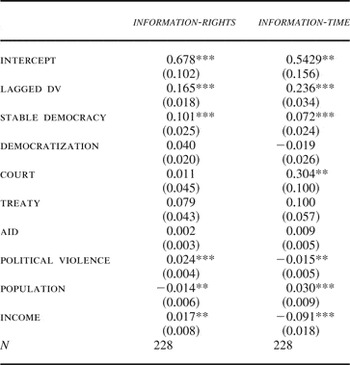
Table 4 displays our linear regression results. The first model predicts the proportion of treaty derogations filed with information about the rights to be derogated (information-rights). The second model predicts the proportion of treaty derogations filed with information about the expected length of the derogation (information-time).Footnote 79
Generalized estimation equations for continuous dependent variables of derogation information from eligible states from 1977 to 2007

Notes: Robust standard errors in parentheses.
*** p < .01;
** p < .05.
The evidence further supports our argument. Of countries that have derogated, stable democracies are more likely than any other type of regime to file a derogation that provides information both on the rights suspended and on the duration of their suspension. Countries where courts provide a strong institutional check on executive decision making are also more likely to provide information on the duration of an emergency (though not on the rights restrictions) when compared to derogating states that have courts that cannot rule on executive actions.
We also found anecdotal evidence that governments in stable democracies justify emergency rights suspensions by citing their future accountability to voters and courts. The detention rules that the U.K. adopted following the terrorist attacks of 11 September 2001 provide a striking example. In November 2001, the British Home Secretary issued an order derogating from the European Convention's arbitrary arrest and detention rules. He explained that “the Government would not keep the measures in place any longer than was necessary” and added that he expected voters “to criticise me … and if I get it wrong, my head … is on the block.”Footnote 80 Four years later, the Home Secretary defended a bill to derogate from the Convention by announcing “stronger and more rapid judicial scrutiny over how [detention orders] were imposed.”Footnote 81 In other stable democracies that derogate, institutional rules suggest that voters and judges closely monitor rights suspensions.Footnote 82
In contrast, we have found no evidence that governments in countries that are not stable democracies appeal to their voters or courts when they derogate and restrict rights during times of crisis. That autocratic governments do not defend suspensions on the basis of their accountability to voters is hardly surprising. With regard to courts, we find that judges, even when they are formally empowered to review emergency decrees, give strong or even complete deference to the executive, as in Sri Lanka in the 1980sFootnote 83 and Russia in the mid-1990s.Footnote 84 Some autocratic states, such as Venezuela under Hugo Chavez, have also attempted to strip courts of the power to review whether emergency rights suspensions are consistent with human rights treaties.Footnote 85 Our statistical results in Table 4 provide no support for the alternative hypotheses.
Serial Derogations
A third condition must be satisfied for our theory to be fully convincing: governments with stable democratic institutions and courts that can rule on executive actions must not derogate serially—which we define as derogating in five or more consecutive years—as Nicaragua did in the early 1980s and Azerbaijan did in the mid-1990s; or file a single, multiyear, or indefinite derogation, as Israel has since 1991.Footnote 86 If derogations persist over many years, voters and judges will eventually conclude that the derogation is an excuse for repressing rights and will begin to mobilize against the government or strike down its policies.
Our findings, presented in Tables 2 and 3 earlier, include temporal polynomial variables that are all statistically significant. The joint significance of these terms indicates that countries that have derogated in the recent past are more likely to do so again when an emergency arises in the future. The more time that elapses after a derogation is filed, however, the less likely it is that the country will derogate again. Thus, we have strong evidence of a path-dependent relationship that could run counter to our theory. If a democratic state with a strong court derogates repeatedly in response to an ongoing crisis, its plea for support (from voters) and deference (from judges) for restricting rights will increasingly fall on deaf ears. We hasten to add, however, that the two principal institutional variables that support our theory—stable democracy and courts—are statistically significant despite the explanatory strength of the temporal relationship.
To further analyze this trend, we begin with a statistical analysis of derogation length and then use case studies to analyze the handful of serial derogations by stable democracies with strong courts. Our hazard model indicates that neither the stable democracy nor the courts variable systematically predicts derogation-duration.Footnote 87 Figure 3 plots the hazards of derogation-duration on five different samples of states—the predicted coefficients are reported in the Appendix.
Hazard model of duration of derogation period as a function of political violence

Figure 3 illustrates three additional insights that provide nuance to our findings. First, political violence is a strong predictor of derogation-duration in the sample of all derogating states. Countries with higher levels of violence derogate for longer periods than countries with lower levels—many derogate serially, for over five years; stated differently, political violence decreases the hazard rate (that is, increases the survival time) of derogation periods.Footnote 88 Second, stable democracies and countries with strong courts are unlikely to derogate for long periods, as our theory predicts, except when they face extreme levels of violence; for both, the survival time of derogation periods drops off quickly when political violence is low but is prolonged when political violence is high. Third, the duration of derogations by states other than stable democracies or states without strong courts is not especially sensitive to violence levels.
Figure 3 thus provides additional support for our theory, with the caveat that countries with stable democratic governments or strong courts are likely to derogate serially, for long periods, when they face extreme political violence. Our data disclose only five such countries: Colombia, Israel, Turkey, Venezuela, and the U.K. A more fine-grained analysis of derogations by these countries shows that their behavior is generally consistent with our theory and our findings on political violence levels.
First, derogations in several of the five countries involve rights suspensions adopted in response to grave external threats. For example, the U.K. derogated from the ban on arbitrary arrest and detention in the European convention and the ICCPR for four years following the 2001 terrorist attacks. The derogation did not, however, apply to citizens of that country.Footnote 89 Between 1976 and 1984 and again from 1988 to 2001, the U.K. derogated from these same rights in response to widespread murders, bombings, and civil disturbances in Northern Ireland.Footnote 90 These restrictions were applied only to “persons reasonably suspected of involvement in terrorism” in that region, mainly members of the Irish Republican Army.Footnote 91 Israel's derogation from the ICCPR, in place continuously since 1991, has a similar justification. It refers to “continuous threats and attacks on [the country's] very existence” from “threats of war, of actual armed attacks, and campaigns of terrorism resulting in the murder and injury to human beings.”Footnote 92
Our theory applies most forcefully when governments with stable democratic institutions and strong courts restrict the rights of citizens (who can vote it out of office) or target political opponents (repressive acts that judges may view skeptically as excuses for officials to remain in power). In contrast, where rights suspensions respond to severe external threats or lethal attacks by foreigners, voters and judges are more likely to “rally 'round the flag” and support the government.Footnote 93 A comparison of states of emergencies in the Middle East emphasizes this point. It contrasts Israel's long-standing emergency, which “has been a means, not so much to suppress its own citizens, but to allow for repressive measures against Palestinians and maintaining its war readiness,” from those in autocratic Egypt and Syria, which “have maintained states of emergency for extended periods of time [to] ensur[e] that their leaders retain unchallenged control over the State apparatus.”Footnote 94
Second, several serial derogations by the five counties responded to distinct threats. Colombia provides the most striking example. Between 1992 and 1995, it filed six short-term derogations and extensions (of between five days and three months each) following discrete episodes of violence, assassinations, and kidnappings by terrorist organizations, guerrilla groups, drug cartels, and organized criminals.Footnote 95 Derogations by Venezuela in 1992 and 1993, years when the country was a stable democracy, followed a similar pattern.Footnote 96
Our theory can account for a stable democratic government with strong courts that derogate repeatedly when faced with multiple threats from different sources—provided that the government explains its actions to domestic audiences. We therefore find it striking that the derogation notices of both Colombia and Venezuela identified which rights the government suspended, how long restrictions were expected to last, and the justifications for the restrictions.
Third, several stable democracies with strong courts filed amendments that reduced a derogation's geographic scope or the number of rights suspended. Turkey's derogation from the European convention is illustrative. In August 1990, the country notified its suspension of multiple derogable rights in ten southeastern provinces in response to a wave of more than one hundred killings by “terrorists, acting partly out of foreign bases.” In early 1991, Turkey lifted the restrictions in several provinces. In May 1992, it canceled its derogation in the remaining provinces for all but one of the previously suspended rights.Footnote 97 Venezuela followed a similar pattern in 1994 when it suspended several rights in the ICCPR in response to a severe economic collapse, but in 1995 reinstated those rights in most of the country and partially terminated its earlier derogation.
These incremental reductions of emergency rights suspensions are consistent with our theory. When the government narrows a derogation over time and publicizes that fact, voters and judges may view officials as acting in good faith to reduce rights suspensions as the threat that triggered the emergency subsides. They may thus treat each new notification as a reason to defer temporarily to the government and to refrain from challenging the remaining rights restrictions.
In sum, a more fine-grained analysis of serial derogations by Colombia, Israel, Turkey, Venezuela, and the U.K.—the five countries in our sample with stable democratic institutions and strong courts that have derogated serially—reveals behavior consistent with our theory and with our findings on derogation-duration and political violence. We recognize, however, that our theory does not fully explain all serial derogations by these states. Further research is required to understand these cases, in particular, to explain why these states publicize serial or long-term rights restrictions internationally when doing so is contrary to the letter and spirit of human rights treaties.
Robustness Checks
We undertake several additional tests to ensure the robustness of our findings, none of which change our results. Our robustness checks include several treatment effect models,Footnote 98 Heckman selection models,Footnote 99 a count model, and additional control variables that we estimate in conjunction with the primary models that we previously presented.
The goal of the matching procedure is to produce two groups of country-years that are equivalent in terms of a set of control variables. The drawback of this procedure is that we can test only one relationship at a time and we cannot assess dynamic effects. The Heckman model allows us to analyze the data-generating process by which country-years enter the eligible sample. Previously, we explained why this process and the decision to file a treaty derogation are independent. Thus, we must be even more cautious in interpreting these results given the Heckman model's stringent parametric assumptions.Footnote 100
Our core models predict any derogation in a given year rather than the number of derogations because whether a state derogates more than once per year is partly a function of domestic constitutional provisions that we cannot fully account for in our statistical analysis. For example, Article 137 of the Peruvian Constitution provides that states of emergency may not exceed sixty days, but may be extended by a new declaration. The country's derogations tracked this domestic constitutional requirement, with the result that Peru filed an average of 16.5 derogations each year (each sixty days or less) from 1983 to 1992—far more than any other country in our sample (see Table 1).
However, we also examined whether our model is robust to explaining the annual derogation count. We estimated both a negative binomial regression and a generalized estimation equation on the count of derogations filed each year. In both models, the stable democracy and court finding are positive and significant. Thus, eligible countries with these institutional features are on average derogating more often than other eligible countries.
We also consider the derogation behavior of other states within a relevant geographic space.Footnote 101 We refer to the countries within this geographic space as “the peer group,” which we model using a spatial lag.Footnote 102 We have also tested our main hypotheses with regime type variables that are constructed using alternative codings of the variables. For the main analysis we coded states as a stable democracy when the state has a Polity score greater than or equal to 7 in the current year and each of the previous five years, otherwise 0. We also generated an alternative variable when the state has a Polity score greater than or equal to 6.
We estimated several alternative models with different political violence variables. First, we added a squared version of the political threat variable from our main model. Had the squared term been statistically significant, it would have provided evidence that states are less likely to derogate during the worst emergencies. The null finding suggests instead that states derogate in response to a variety of emergencies, while the finding from our hazard model suggests that they derogate longer when political violence is high. Second, we estimated models with five binary threat variables (drawn from the Cross-National Research on USAID's Democracy and Governance Programs) that measure the presence of protest, rebellion, violent rebellion, civil war, and armed conflict. We chose the political violence variable because the other variables have no data prior to 1990. However, our main findings are robust to the use of these alternative variables.Footnote 103
Conclusion
This article offers the first systematic empirical evidence on derogations from human rights treaties in times of emergency. Our core theory—that stable democracies and countries with strong judiciaries derogate to buy time and reduce censure from voters, interest groups, and judges—is strongly supported by statistical analyses and case studies based on the new data sets we have assembled. In contrast, the evidence does not support four alternative sets of hypotheses put forth by recent IR scholarship.
Our findings have several broader implications for future research on treaty escape and flexibility clauses and on compliance with international human rights law. First, we provide novel and counterintuitive evidence of how governments behave during emergencies, when the pressure to restrict human rights is at its apex. Scholars have long expressed concern that derogations undermine human rights treaties by providing an authorized mechanism for states to abridge civil and political liberties.Footnote 104 Our findings suggest that these concerns have been overstated. The governments of stable democracies and those with strong courts—those countries most likely to seek to escape—derogate to provide themselves breathing space to respond to domestic crises by suspending individual liberties without breaching their treaty obligations. But they do so selectively and with disclosures of information intended to reassure domestic audiences that the state's long-term commitment to the treaties is not in jeopardy.
In a few instances, we find troubling evidence that these countries derogate year after year. When analyzed more closely, however, even these serial derogations exhibit characteristics that are consistent with our theory. In particular, prolonged derogations by stable democracies with strong courts are correlated with high levels of political violence that is perpetrated by foreigners or that involves extraterritorial threats.
Second, our study provides additional evidence that the logic of compliance with human rights treaties is different than that of other international agreements. In particular, we show that states derogate mainly for domestic political and institutional reasons, not due to internationally oriented logics of reciprocity, retaliation, or a concern with reputation. Our findings thus accord with Simmons, and run contrary to theories expounded by Guzman and Goldsmith and Posner.Footnote 105 Our findings suggest that future studies should focus on the relationships among treaty design, the provision of information, and domestic courts, political institutions, and voters.
Third, our article reveals that scholars in international relations and international law alike need to examine not only the structure of flexibility mechanisms but also their use in practice. Stated differently, the literature on institutional designFootnote 106 provides a necessary but not sufficient foundation for understanding where international law works and where it does not.
Finally, our findings may be useful to government officials and lawyers who negotiate international agreements. Our results suggest that the system that authorizes escape from human rights treaties during times of crisis may result in fewer harmful consequences than many legal scholars had feared, at least in countries that have democratic institutions and strong courts and do not face high levels of political violence. But design and operation of that system are hardly perfect, not the least because insincere treaty ratifiers can derogate freely without incurring domestic or international costs—a finding that accords with emerging research showing that autocracies increase violations of most rights covered by the ICCPR during emergencies.Footnote 107 This suggests the possibility of redesigning derogations clauses and other treaty flexibility tools in ways that enhance rather than undermine compliance with international law.