INTRODUCTION
Little tunny Euthynnus alletteratus (Rafinesque, 1810), together with bullet tuna Auxis rochei (Risso, 1810), and Atlantic bonito Sarda sarda (Bloch, 1793), are the most abundant small tuna species in the Mediterranean Sea. These species are commercially exploited on the Spanish coast by traditional fisheries. Despite its economic and ecological importance, knowledge about the biology related to these species in the Mediterranean Sea is scarce. Only few publications have reported the current biological information about these species: sexual maturity is reached at 56.5 and 57 cm length on the southern Spain coast (Rodriguez-Roda, Reference Rodríguez-Roda1966) whereas on the southern Tunisia coast the estimated length at first maturity was 42.8 cm and 44.8 cm for males and females, respectively (Hajjej et al., Reference Hajjej, Hattour, Allaya, Jarboui and Bouain2010) and, the size distribution for little tuna shows a multimodal shape suggesting that the reproductive stock is made up of different cohorts (age 3 and older) (Macías et al., Reference Macías, Lema, Gómez-Vives, Ortiz de Urbina and de la Serna2006).
Tuna are gonochoristic species and do not exhibit sexual dimorphism. Furthermore, like the other tuna species, little tunny is a multiple spawner fish with an asynchronous oocyte development and indeterminate fecundity (Schaefer, Reference Schaefer, Block and Stevens2001).
Many authors have reported cases of intersexuality from marine pelagic fish outside the Mediterranean Sea, as for example: Katsuwonus pelamis L. (Raju, Reference Raju1960), Scomber japonicus Houttuyn (Okiyama & Kawaguchi, Reference Okiyama and Kawaguchi1974) or Thunnus orientalis (Temminck & Schlegel) (Sawada et al., Reference Sawada, Seoka, Okada, Miyashita, Murata and Kumai2002), and inside the Mediterranean Sea, as for example: Thunnus thynnus (L.) (Caprioli et al., Reference Caprioli, Costa, Cataldi, Boglione and Cataudella2007) and Scomber japonicus Houttuyn (Ozekinci et al., Reference Ozekinci, Ayaz, Altinagac, Cengiz and Oztekin2009). Moreover, De Metrio et al. (Reference De Metrio, Corriero, Desantis, Zubani, Cirillo, Deflorio, Bridges, Eicker, de la Serna, Megalofonou and Kime2003) observed a high percentage of intersex in the Mediterranean Xiphias gladius L.
The main goal of this paper is to report the description of the first records of intersexuality in little tunny. In addition, we show a histological description of gonads of both the sexually mature intersexual fish and normal mature fish.
MATERIALS AND METHODS
A total of 449 little tunny were sampled between April and June 2003 to 2012 during annual scientific surveys developed in traps from La Azohía (Murcia) on the south-eastern Spanish Mediterranean coast and Tarifa (Cádiz). Each specimen was measured for fork length to the nearest millimetre and weighed to the nearest 10 g. Gonads were removed from the gut cavity and identified as being male or female and gonad weight measured to the nearest g. From most of the gonads, a section of approximately 2 cm wide from the middle of one gonad lobe was fixed in Bouin's fixative solution for four hours and then preserved in 70% ethanol.
Gonad stages and sexual maturity of specimens were determined using a macroscopic classification of five steps: immature; early maturing or quiescent; maturing; spawning; and spent.
We selected some mature individuals for a histological description. A cross-section from the preserved portion of gonad was embedded in paraffin using conventional techniques, sectioned at 10 µm and stained with Mallory's trichrome staining. Histological sections were examined and photographed under a Nikon photomicroscope for further description and maturity classification. Gonad stages and sexual maturity of specimens were histologically determined using a classification scheme modified from Schaefer (Reference Schaefer1996).
RESULTS
From the 449 little tunny analysed in this study, we observed two individuals whose gonads showed external characteristics of both sexes (intersex). These little tunny were caught in the La Azohía trap in May 2011 (63 cm FL) and June 2012 (39.8 cm FL) respectively.
We assigned the macroscopic sexual stage to the analysed individuals: 3% immature and 97% sexually mature. The mature individuals were 70% quiescent, 16% maturing and/or spawning and 11% spent.
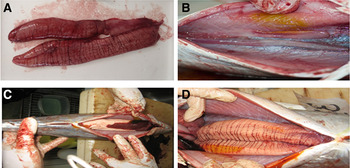
The intersex little tunny caught in May 2011 presented macroscopic characteristics of a sexually mature individual (Figure 1A). In contrast, the intersex individual caught in June 2012 was macroscopically classified as immature (Figure 1B). Figure 1C and D show macroscopic characteristics of normal mature individuals, male and female, respectively sampled in the same months.
Macroscopic characteristics of intersex individuals versus both normal male and female (sampled during the same months of capture): (A) intersex mature individual; (B) intersex immature individual; (C) male mature individual; (D) female mature individual.

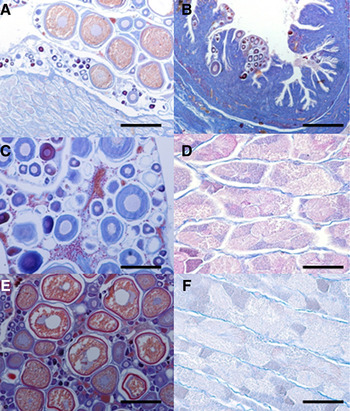
The histological examination of the sexually mature intersexual fish revealed the presence of testicular and ovarian tissue in the same lobe. Each type of tissue was distributed forming discrete patches in the gonad (Figure 2A). In addition, some patches of underdeveloped ovarian tissue were observed in the gonad. This tissue resembled ovarian in an immature developmental stage (Figure 2B). The most advanced oocytes presented in the ovarian tissue of the intersex fish were late vitellogenic oocytes without the presence of matured oocytes (migratory nucleus or hydrated oocytes) or postovulatory follicles, whereas the amount of atretic follicles was low (less than 10% of atresia) (Figure 2C). This tissue resembled the ovary of a mature female.
Microscopic characteristics of intersex mature individual caught in 2011 versus both normal mature male and female (sampled during the same months of capture): (A) microphotograph showing the presence of testicular and ovarian tissue in the same gonad, scale bar = 500 µm; (B) ovarian tissue from intersex individual resembling immature developmental stage of a normal ovary, scale bar = 500 µm; (C) ovarian tissue from intersex individual showing vitellogenic oocytes, scale bar = 500 µm; (D) testicular tissue from intersex individual showing characteristics of a testis in early spermatogenic stage, scale bar = 100 µm; (E) ovarian tissue in migratory nucleus stage from a normal female, scale bar = 500 µm; (F) testicular tissue in early spermatogenesis stage from a normal male, scale bar = 100 µm.

The testicular tissue was in early spermatogenesis phase (Figure 2D), showing all developing stages of the male germ cell line (from spermatogonia to late spermatids and few spermatozoa) at the proliferative region. This fish appeared to be in the middle of the spermatogenetic process, showing abundant spermatocyte cysts as well as cysts containing all spermatid stages, but few spermatozoa and the lumina was empty (Figure 2D). This tissue resembles the testis of a mature fish. A high proportion of the females caught in the trap were classified macroscopically as quiescent stage but also mature active females were caught in the traps. Histologically analysed females presented early and late vitellogenesis and migratory nucleus stage (Figure 2E). The maturity stage of the ovarian portion of the intersex fish is in accordance with the maturity stages of the ovaries of normal individuals caught in the same location and season. The normal males of little tunny were in early spermatogenesis stage (Figure 2F) similar to the testicular portion of the hermaphrodite gonad.
DISCUSSION
In the present study we have found a low prevalence (2.3%) of intersexual little tunny. On one hand, this may represent natural levels of intersexuality; on the other hand, this may represent anthropogenic pollution. Many studies indicate links between anthropogenic contaminants and reproductive abnormalities such as different levels of intersexuality in both invertebrate and vertebrate species of marine wildlife (e.g. Colborn & Clement, Reference Colborn and Clement1992; De Metrio et al., Reference De Metrio, Corriero, Desantis, Zubani, Cirillo, Deflorio, Bridges, Eicker, de la Serna, Megalofonou and Kime2003). The exposure to natural and synthetic hormones (oestrogens and androgens) or aromatase inhibitors and other man-made chemicals (including organochlorine pesticides, polychlorinated biphenyls, polycyclic aromatic hydrocarbons, surfactants and plasticizers) affect sexual differentiation in gonochoristic species and induce sex reversal and/or intersex (Colborn & Clement, Reference Colborn and Clement1992; Piferrer & Donaldson, Reference Piferrer and Donaldson1992; De Metrio et al., Reference De Metrio, Corriero, Desantis, Zubani, Cirillo, Deflorio, Bridges, Eicker, de la Serna, Megalofonou and Kime2003). Rodríguez-Roda (Reference Rodríguez-Roda1966) and Hajjej et al. (Reference Hajjej, Hattour, Allaya, Jarboui and Bouain2010) studied 415 and 397 little tunny, respectively; none of these fish showed macroscopic characteristics of intersexuality. It may therefore be assumed that our results could provide support for an increase in the levels of several contaminants in recent years in the Mediterranean Sea.
Thus, we conclude, due to low prevalence observed, that a continuous monitoring is necessary to test this hypothesis.
ACKNOWLEDGEMENTS
The survey programme was supported by different projects from the IEO based in Malaga—GPM-3, GPM-4 and GPM1213 programmes (IEO) and PNDB programme (EU-IEO). We are very grateful to the fishermen and skipper of the Azohía trap (Murcia), and to the personnel of the Oceanographic Centre of Mazarrón for providing their facilities during the sampling. We would also like to thank Andrew Paterson for style corrections.