In the literature on the acquisition of syntactic structure, the English dative alternation has received special attention. The English dative alternation takes two forms: the prepositional (PP) dative (1a) and the double-object (DO) dative (1b). This alternation is a nice test-case for theories of structure learning for several reasons. Both forms of the alternation are used widely in speech to children (Campbell & Tomasello, Reference Campbell and Tomasello2001; Snyder & Stromswold, Reference Synder and Stromswold1997), so we can reasonably expect children to be familiar with it. It emerges in children's spontaneous speech by their third birthdays (Snyder & Stromswold, Reference Synder and Stromswold1997; Viau, Reference Viau2007), so we can expect children to produce it in experimental studies by that age. Finally, English contains numerous words that can participate in both forms of the alternation, but also a significant number that occur in only one of the two structures (1c–f), which allows us to detect overgeneralization of the alternation (Baker, Reference Baker1979; Gropen, Pinker, Hollander, Goldberg, & Wilson, Reference Gropen, Pinker, Hollander, Goldberg and Wilson1989; Levin, Reference Levin1993; Pinker, Reference Pinker1984).
(1a) Martin gave the book to the library.
(1b) Martin gave the library the book.
(1c) Martin donated the book to the library.
(1d) *Martin donated the library the book.
(1e) *Martin asked the question to the librarian.
(1f) Martin asked the librarian the question.
Although all of these features make the English dative alternation particularly attractive to child language researchers, the data on the acquisition of the alternation have not painted a particularly coherent picture of how children learn and represent these structures. Children produce both forms of the dative alternation in spontaneous speech before or around their third birthdays, and they produce the DO dative more than three times as often as the PP dative (Conwell, O'Donnell, & Snedeker, Reference Conwell, O'Donnell, Snedeker, Danis, Mesh and Sung2011; Snyder & Stromswold, Reference Synder and Stromswold1997). This bias to produce the DO dative is consistent with their caregivers’ speech, which also contains about three times the number of DO datives as PP datives (Conwell et al., Reference Conwell, O'Donnell, Snedeker, Danis, Mesh and Sung2011; Snyder & Stromswold, Reference Synder and Stromswold1997). However, in lab tasks, children will extend novel verbs from the DO dative to the PP dative, but not the other way around (Conwell & Demuth, Reference Conwell and Demuth2007), suggesting that they are more conservative in their use of the higher frequency DO dative. Studies of children's comprehension of the two dative forms generally show poorer understanding of the DO dative (Arunachalam, Reference Arunachalam2017; Osgood & Zehler, Reference Osgood and Zehler1981; Rowland & Noble, Reference Rowland and Noble2010), and priming studies show verb-general priming of both dative structures, but provide some evidence that children are less facile in their comprehension and production of the DO dative than the PP dative (Huttenlocher, Vasilyeva, & Shimpi, Reference Huttenlocher, Vasilyeva and Shimpi2004; Rowland, Chang, Ambridge, Pine, & Lieven, Reference Rowland, Chang, Ambridge, Pine and Lieven2012; Thothathiri & Snedeker, Reference Thothathiri and Snedeker2008). Taken together, these studies show that children may have better (or at least, more verb-general) understanding of the lower-frequency PP dative than of the more frequent DO dative. This pattern of results is puzzling in light of the widespread tendency for children to acquire higher-frequency forms before lower-frequency forms (Ambridge, Kidd, Rowland, & Theakston, Reference Ambridge, Kidd, Rowland and Theakston2015; Naigles & Hoff-Ginsberg, Reference Naigles and Hoff-Ginsberg1998; Theakston, Lieven, Pine, & Rowland, Reference Theakston, Lieven, Pine and Rowland2004; Yang, Reference Yang2004). Furthermore, the empirical data to date suggest that children's learning of the English dative does not follow an all-or-nothing pattern. Rather, children appear to master one or both dative forms in some contexts, but then fail to show lexically general use or comprehension in other contexts (Arunachalam, Reference Arunachalam2017; Conwell & Demuth, Reference Conwell and Demuth2007; Rowland & Noble, Reference Rowland and Noble2010; Huttenlocher et al., Reference Huttenlocher, Vasilyeva and Shimpi2004; Thotathiri & Snedeker, Reference Thothathiri and Snedeker2008). This indicates that children's abilities with these structures are influenced by more than just the presence or absence of a verb-general representation, and that their mastery of a syntactic form is reliant on more than its overall frequency in their experience. Children's comprehension and use of syntactic structures may be affected by a number of factors beyond simply ‘having’ or ‘not having’ a verb-general representation of those structures. Considering how such factors influence children's linguistic behavior will allow us to more completely understand the process by which children become expert users of language.
That children's use of a given structure may be influenced by a number of variables is not particularly surprising; adults’ choice of which structure to use is affected by several factors (Bresnan, Cueni, Nikitina, & Baayen, Reference Bresnan, Cueni, Nikitina, Baayan, Boume, Kramer and Zwarts2007). These include the discourse status of the arguments (i.e., given vs. new), animacy, and the phonological weight of the arguments. Briefly, arguments with referents that have already been established in the discourse are more likely to appear in first post-verbal position (Bresnan et al., Reference Bresnan, Cueni, Nikitina, Baayan, Boume, Kramer and Zwarts2007; Waryas & Stremel, Reference Waryas and Stremel1974; Wasow, Reference Wasow2002), animate recipients are more likely in first post-verbal position than inanimate recipients (Bock, Loebell, & Morey, Reference Bock, Loebell and Morey1992; Bresnan et al., Reference Bresnan, Cueni, Nikitina, Baayan, Boume, Kramer and Zwarts2007), and phonologically ‘lighter’ (i.e., shorter) arguments also tend to appear in first post-verbal position (Wasow, Reference Wasow2002). This means that, when the theme is given, more animate, and/or shorter than the recipient, the PP dative is more likely to be used, and when the recipient is given, more animate, and/or shorter than the theme, the DO dative is more likely to be used (Bresnan et al., Reference Bresnan, Cueni, Nikitina, Baayan, Boume, Kramer and Zwarts2007; de Marneffe, Grimm, Arnon, Kirby, & Bresnan, Reference de Marneffe, Grimm, Arnon, Kirby and Bresnan2012). These are probabilistic tendencies, not hard-and-fast rules (Bresnan et al., Reference Bresnan, Cueni, Nikitina, Baayan, Boume, Kramer and Zwarts2007; Bresnan & Nikitina, Reference Bresnan, Nikitina, Uyechi and Wee2009). However, they are consistent with the patterns of pronoun use previously reported in dative forms in child-directed speech (Conwell et al., Reference Conwell, O'Donnell, Snedeker, Danis, Mesh and Sung2011; de Marneffe et al., Reference de Marneffe, Grimm, Arnon, Kirby and Bresnan2012). Because pronouns refer to established referents and are short, they are most likely to appear in first post-verbal position. Personal pronouns, which indicate animate referents, are also more likely to appear in first post-verbal position. Because datives spoken to children often describe the transfer of objects or information between the child and the speaker, this creates conditions highly biased to support the use of DO datives with pronominal recipients. Therefore, children's increased experience with pronominal recipients in the DO dative is to be expected given the factors that predict increased use of both pronouns and the DO dative. Furthermore, children's selection of which dative form to use also appears to be influenced by length, givenness, and pronominality of arguments (de Marneffe et al., Reference de Marneffe, Grimm, Arnon, Kirby and Bresnan2012; Stephens, Reference Stephens2015). Indeed, Stephens (Reference Stephens2015) showed that children have a strong bias to avoid the DO dative in production tasks unless they are using a recipient that is given in the discourse. This is different from the pattern seen with adults, whose selection of a dative form is driven by verb biases, as well as by givenness.
This elevated experience with DO datives with pronominal recipients may also explain why children perform more poorly with DO datives than with PP datives in laboratory tasks (Arunachalam, Reference Arunachalam2017; Conwell & Demuth, Reference Conwell and Demuth2007; Rowland & Noble, Reference Rowland and Noble2010; Stephens, Reference Stephens2015). Most lab-based dative tasks require children to interpret datives that contain full noun phrase themes and recipients. These are relatively rare in children's experience with datives, but much more rare in their experience with DO datives than in their experience with PP datives. Furthermore, the PP dative includes an overt preposition (to) that clearly marks the recipient argument, while the DO datives in these studies contain two adjacent full noun phrases with only argument order to distinguish which NP corresponds to which argument. Indeed, Rowland and Noble (Reference Rowland and Noble2010) reported that differentiating the two noun phrases in a DO dative by making one of them a proper noun improved children's performance with this form. Therefore, children's poor performance with the DO dative in laboratory tasks may be due not only to the unfamiliarity of DO datives with two full noun phrases, but to the additional processing needed to assign thematic roles to two adjacent noun phrases that are not differentiated in the surface form. That is, children may have verb-general knowledge of these structures, but be unable to access or use that knowledge in lab tasks because of the challenge posed by the two sequential noun phrases.
Pronouns may, therefore, play a crucial role in children's use of the English dative alternation. Children's spontaneous dative productions contain proportionally more pronouns than do adults’ productions (de Marneffe et al., Reference de Marneffe, Grimm, Arnon, Kirby and Bresnan2012). Children also show a strong effect of argument pronominality on which dative form is used, which parallels an effect in child-directed speech (de Marneffe et al., Reference de Marneffe, Grimm, Arnon, Kirby and Bresnan2012; Stephens, Reference Stephens2015). However, these data alone cannot explain whether children's poor performance with DO datives in lab tasks is a result of the unfamiliarity of encountering and producing such forms with two full noun phrases, or if it results from an actually weaker (or more difficult to access) representation of the DO form. Children's spontaneous productions could be based on such over-specified forms as verb–pronoun combinations (e.g., give + me; Conwell et al., Reference Conwell, O'Donnell, Snedeker, Danis, Mesh and Sung2011), which would explain why they can produce the DO dative in spontaneous discourse, but struggle with it in lab tasks. Alternatively, children's spontaneous DO productions might be based on fully lexically general representations that look item-specific because a predisposition to use pronominal arguments results in the production of a limited set of forms. Comprehension tasks allow researchers to ensure that both forms of the alternation are represented in the dataset, and to directly manipulate the presence of different argument types in different positions. If the cause of children's difficulty with the DO dative in lab tasks is due to their lack of experience with full NPs as both recipient and theme in this structure, pronominal arguments should facilitate their comprehension of the DO form. Because children typically show good verb-general comprehension of the PP dative in lab tasks (Osgood & Zehler, Reference Osgood and Zehler1981; Rowland & Noble, Reference Rowland and Noble2010), the use of pronouns should not affect their ability with that structure.
The experiments presented here ask whether and how a highly frequent pronominal argument affects young children's comprehension of the English dative alternation. Experiment 1 establishes a baseline of comprehension of the two dative forms with full noun phrases. Experiments 2 and 3 ask whether pronominal arguments, specifically the personal pronoun me, in first post-verbal and second post-verbal positions, respectively, affect children's ability to understand English dative forms. Because pronouns immediately after the verb are more common in the DO dative, if experience with pronominal arguments creates a facilitative effect, then participants should show improved performance with the DO dative in Experiment 2, but poorer performance with both structures in Experiment 3, as pronouns in second post-verbal position are rare in either dative structure. If, however, children's prior performance with the DO dative in comprehension tasks results from lexically specific verb + pronoun combinations, then we would not expect the use of pronominal arguments with novel verbs to affect comprehension of the DO dative.
Experiment 1
Prior work has found that young children show better comprehension and production of the PP dative than of the DO dative (Arunachalam, Reference Arunachalam2017; Conwell & Demuth, Reference Conwell and Demuth2007; Osgood & Zehler, Reference Osgood and Zehler1981; Rowland & Noble, Reference Rowland and Noble2010; Stephens, Reference Stephens2015). Experiment 1 was intended to replicate this result with the methods and population that would be used in Experiments 2 and 3, to allow for direct comparison of the results across all three studies.
Method
Participants
Twenty-four three-year-old English-learning children (10 male) completed this study (age range: 3;1–4;0; mean age 3;5; standard deviation 3.5 months). An additional 12 children participated, but were excluded from the analysis due to side bias (defined as selecting the video on the same side on every trial; 7), failure to complete all trials (2), uncooperativity (2), and experimenter error (1). A parent or guardian provided informed consent for each participant and each child verbally assented to participation. Children were tested either in a lab setting or in a quiet room at their childcare center.
Stimuli
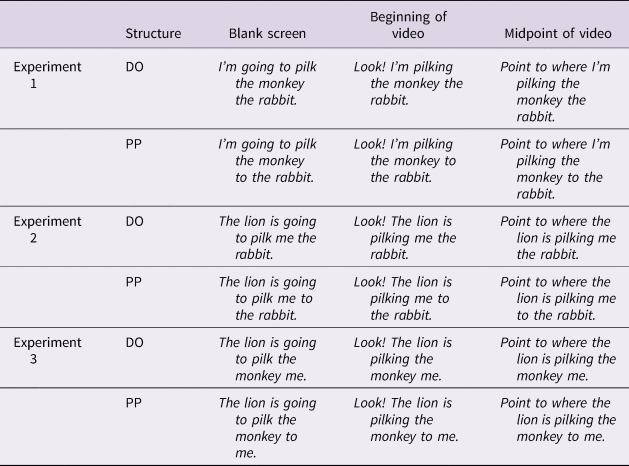
The stimuli for this study consisted of short video clips of cartoon animals engaged in novel transfer events, which were modified from the stimuli used by Rowland and Noble (Reference Rowland and Noble2010). In every video, the agent was a lion who transferred one animal (e.g., a rabbit) to another animal (e.g., a monkey) via novel means (e.g., on a skateboard). The recipient animal was always holding the theme animal at the end of the video and the theme animal was always smaller than the recipient animal. A female native speaker of American English produced three dative utterances describing the scene. The subject was always the first person pronoun I, the verb was always a novel word, and the post-verbal arguments were always both full noun phrases. Examples of the verbal stimuli can be found in Table 1. Additional practice trials used videos that also depicted cartoon animals and were described by three similar utterances, but depicted intransitive or transitive events.
Examples of the verbal stimuli for all three experiments

Design
This study used a two alternative forced choice paradigm in which children were presented with two videos simultaneously, only one of which was described by the audio. Participants indicated which video was described by placing their finger directly on it. The two videos always contained the same animals. A sample trial is shown in Figure 1. Half of participants (12) heard the PP dative on every trial and the other half heard only the DO dative.
A sample trial for all three experiments. Video stimuli were modified from those used by Rowland and Noble (Reference Rowland and Noble2010) and were the same across all experiments. In both videos, the lion is the agent. See Table 1 for examples of the differences in verbal stimuli across the experiments.

Procedure
Children were seated approximately 12 inches from a laptop computer. They were told that they would see two movies at a time and that they should indicate which movie the speaker was talking about by placing their finger directly on it. Before each trial, children were shown still images from the two videos that would be presented next. Along with the experimenter, they named the animals in each image. This step was included to confirm that children knew the appropriate labels for the animals in the scenes and also to ensure that children saw that the same animals were present in both videos. All children completed four practice trials, which had the same design as the experimental trials, but involved intransitive or transitive scenes. Children received feedback from the experimenter on the practice trials. Upon completion of the practice trials, children were asked whether they wanted to continue, and if they agreed, they proceeded to the eight test trials. No feedback was provided on test trials. The entire procedure took about 8 minutes per participant.
Results
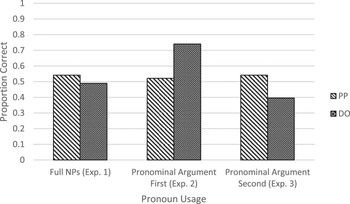
Results from this experiment are shown in Figure 2. The data were analyzed using a logistic regression implemented with the lme4 package (Bates, Maechler, Bolker, & Walker, Reference Bates, Maechler, Bolker and Walker2015) in R (R Core Team, 2015). The dependent measure was accuracy. The fixed factor was dative form (PP vs. DO) and participant was included as a random effect. Children were only included in the analysis if they completed all trials; there were no missing datapoints. Overall, participants in this experiment selected the correct video on 54.2% of PP trials and on 49% of DO trials. This is not a significant difference between the two conditions (β = 0.22, standard error = 0.345, z = 0.64, p = .524). These results are not consistent with previously reported findings that children show better comprehension of PP datives than of DO datives (Arunachalam, Reference Arunachalam2017; Rowland & Noble, Reference Rowland and Noble2010). In this study, children in both conditions showed performance that was not significantly different from chance (PP: binomial test 52/96 trials, p = .47, two-tailed; DO: binomial test 47/96 trials, p = .919, two-tailed). There was no evidence of a change in performance between the first and second halves of the experimental session (χ 2(1) = 0.783, p = .38).
Results from all three experiments.

Why children in this experiment did not show the same pattern of comprehension of the PP and DO datives as children in previous research is unclear. Children in this study had the same average age as the children in Rowland and Noble's (Reference Rowland and Noble2010) study, so the difference is not likely due to children in this study being younger than those in previous experiments. One important difference between this experiment and that conducted by Rowland and Noble is that their study included twice as many participants, which may account for the lack of effect seen here. Another notable feature of these results is that more children were excluded for side bias than in previous studies (7 here vs. 1 reported in Rowland & Noble, Reference Rowland and Noble2010), suggesting that children from this population found the task more difficult than participants in prior research. It may be the case that children in the geographic region sampled for this study are less familiar with the dative alternation than are children in other regions. Critically, however, Experiment 1 provided a baseline for comprehension of both dative forms with full noun phrases by participants from the same population that was sampled for Experiments 2 and 3.
Experiment 2
Children in Experiment 1 showed roughly chance performance on the comprehension task, regardless of which dative form they heard. Although this result was unexpected, it served as the baseline for Experiment 2. Experiment 2 asked whether the use of the personal pronoun me in first post-verbal position influenced children's ability to comprehend either or both dative structures. The majority of datives that children hear contain a pronoun in first post-verbal position, and this pronoun is frequently me (Conwell et al., Reference Conwell, O'Donnell, Snedeker, Danis, Mesh and Sung2011). Improved performance in the presence of this pronoun would suggest that children's interpretation of dative forms is affected by their experience with specific words or phrasal types in these structures. This would indicate that children's poor comprehension of DO datives with novel verbs in previous studies is the result of difficulty interpreting a structure that has an unfamiliar, non-canonical form (i.e., containing two adjacent unmarked noun phrases), rather than an inability to comprehend the DO structure in a verb-general manner.
Method
Participants were 24 three-year-old English-learning children (12 male; age range 3;0–3;11; mean age 3;6; standard deviation 3.35 months) who had not participated in Experiment 1. An additional 13 children participated in the experiment, but were excluded from analysis due to side bias (5), failure to complete all test trials (3), failure to respond accurately on any practice trials (1), incorrectly reported age (2), documented language delay (1), and monolingualism in a language other than English (1). A parent or guardian provided informed consent for each participant and each child verbally assented to participation.
Stimuli
The video stimuli for this experiment were identical to those in Experiment 1. As in Experiment 1, the audio stimuli were recorded by a female native English speaker and consisted of three dative utterances using a novel verb to describe the scene. However, in this experiment, the subject was always a full noun phrase (the lion), the first post-verbal argument was always the first person pronoun me, and the second post-verbal argument was always a full noun phrase. Example stimuli can be found in Table 1. Although the pronoun me had a different referent on each trial, the speaker was consistent across trials, meaning there was no vocal differentiation of trials and voice could not be used as a cue to the referent of the pronoun. Children gave no indication that they expected the speaker's voice to change when the referent of the pronoun changed. The practice trials in this study were the same as those for Experiment 1.
Design
Like Experiment 1, this experiment used a two alternative forced choice design in which children were presented with two videos simultaneously and asked to indicate which video was described by placing their finger directly on it. As in Experiment 1, the two videos always contained the same animals. Half of participants (12) heard the PP dative on every trial and the other half heard only the DO dative.
Procedure
The procedure for this experiment was the same as for Experiment 1.
Results
Results from this study are shown in Figure 2. The data were analyzed using a logistic regression implemented with the lme4 package (Bates et al., Reference Bates, Maechler, Bolker and Walker2015) in R (R Core Team, 2015). The dependent measure was accuracy. The fixed factor was dative form (PP vs. DO) and participant was included as a random effect. There were no missing datapoints. Overall, participants in this experiment selected the correct video on 52.1% of PP trials and on 74% of DO trials. This is a significant difference between the two conditions (β = 1.23, standard error = 0.56, z = 2.18, p = .029). In this experiment, children in the PP condition did not show performance that was significantly different from chance (binomial test 50/96 trials, p = .76, two-tailed), but children in the DO condition did (binomial test 71/96 trials, p < .001, two-tailed). There was no evidence of a change in performance between the first and second halves of the study session (χ 2(1) = 0.206, p = .65).
These results show a notable difference from the results of Experiment 1, in which children were not different from chance performance in either condition. The results show that the presence of the pronoun me immediately following the verb in a dative utterance facilitated comprehension by three-year-old children for the DO dative only. There was no advantage to having the same pronoun in the first post-verbal position for PP datives, as compared to a full noun phrase argument. Children's experience with the dative alternation contains a large proportion of pronouns, particularly me, in first post-verbal position regardless of which form of the alternation is used (Conwell et al., Reference Conwell, O'Donnell, Snedeker, Danis, Mesh and Sung2011). The lack of advantage for pronouns in the PP dative in this experiment may be due to the fact that the specific personal pronoun me is only rarely used to describe theme arguments in datives in natural speech. This is because themes are typically inanimate in datives, although some animate entities can be the theme in a dative (i.e., give me the baby). Because this experiment was concerned with children's comprehension of the syntactic structure itself, and not their sensitivity to the semantic categories of the arguments, the stimuli were designed to contain only animate referents. One might propose that the lack of advantage for pronouns in PP datives is attributable to the unfamiliarity of a personal pronoun in this position in PP datives. Critically, however, children were no worse at comprehending PP datives with a pronoun in this position, which indicates that their comprehension was not disrupted by their presence either. However, to examine whether the use of the personal pronoun me as the theme was the main reason that children did not show a pronoun advantage for the PP in Experiment 2, Experiment 3 will consider comprehension of the dative alternation with personal pronouns in second post-verbal position.
Experiment 3
In Experiment 2, children showed a comprehension advantage for DO datives that had the personal pronoun me in first post-verbal position, but not for PP datives with a personal pronoun in that same position. Comprehension of PP datives was unchanged by the presence of a personal pronoun in that position. To address whether this pattern is due to the strangeness of using me as the theme argument, and not children's ability to comprehend the DO and PP datives per se, Experiment 3 considered how children's comprehension of the dative forms is affected by the use of me in second post-verbal position (i.e., as the recipient in a PP dative and as the theme in a DO dative). A full noun phrase in first post-verbal position and a pronominal argument in second post-verbal position is marked for the PP dative in adult speech (Bresnan & Nikitina, Reference Bresnan, Nikitina, Uyechi and Wee2009), and is also rare in child-directed speech (de Marneffe et al., Reference de Marneffe, Grimm, Arnon, Kirby and Bresnan2012). Additionally, many native speakers find a full noun phrase followed by a pronominal argument in the DO dative to be unnatural to the point of near-ungrammaticality (but see Bresnan & Nikitina, Reference Bresnan, Nikitina, Uyechi and Wee2009, for evidence that the form is not completely unattested or prohibited). Therefore, we would expect comprehension of both forms to match that of Experiment 1 (i.e., to be at chance) if the lack of facilitation for pronouns in the PP dative in Experiment 2 is due to the lack of such forms in children's experience and/or their unnatural quality. Alternatively, children in Experiment 2 may have used the animacy information inherent in the personal pronoun me to facilitate thematic role assignment. Because recipients are more likely to be animate than themes, children could have assumed that the entity labeled with the word me was more likely to be the recipient than the one described with a full noun phrase. If children showed better performance with the DO dative in Experiment 2 because they assumed that the argument described with me was the recipient, then the use of the same pronoun in second post-verbal position could facilitate comprehension of the PP dative because, in that case, the animacy information in the pronoun would support correct assignment of the recipient role to the pronominal argument.
Method
Participants were 24 three-year-old English-learning children (13 male; age range 3;0–3;11; mean age 3;3; standard deviation 2.87 months) who had not participated in Experiment 1. An additional 5 children participated in the experiment, but were excluded from analysis due to side bias (1), failure to complete all test trials (1), failure to produce any unambiguous responses (2), and incorrectly reported age (1). A parent or guardian provided informed consent for each participant and each child verbally assented to participation.
Stimuli
The video stimuli for this experiment were identical to those in Experiment 1. As in Experiment 1, the audio stimuli were recorded by a female native English speaker and consisted of three dative utterances using a novel verb to describe the scene. However, in this experiment, the subject was always a full noun phrase (the lion), the first post-verbal argument was always a full noun phrase, and the second post-verbal argument was always the personal pronoun me. Example stimuli can be found in Table 1. The practice trials in this study were the same as those for Experiment 1.
Design
Like Experiments 1 and 2, this experiment used a two alternative forced choice design in which children were presented with two videos simultaneously and asked to indicate which video was described by placing their finger directly on it. As in Experiments 1 and 2, the two videos always contained the same animals. Half of participants (12) heard the PP dative on every trial and the other half heard only the DO dative.
Procedure
The procedure for this experiment was the same as for Experiment 1.
Results
The results from this experiment are shown in Figure 2. The data were analyzed using a logistic regression implemented with the lme4 package (Bates et al., Reference Bates, Maechler, Bolker and Walker2015) in R (R Core Team, 2015). The dependent measure was accuracy. The fixed factor was dative form (PP vs. DO), and participant was included as a random effect. Because children were excluded from the analysis if they did not complete all test trials, there were no missing datapoints. Overall, participants in this experiment selected the correct video on 54.2% of PP trials and on 39.6% of DO trials. There is no significant difference between the two conditions (β = 0.65, standard error = 0.42, z = 1.55, p = .121). In this experiment, children in the PP condition did not show performance that was significantly different from chance (binomial test 52/96 trials, p = .475, two-tailed), while children in the DO condition were marginally worse than chance (binomial test 38/96 trials, p = .052, two-tailed). Performance did not change between the first and second halves of the experimental session (χ 2(1) = 0.35, p = .55).
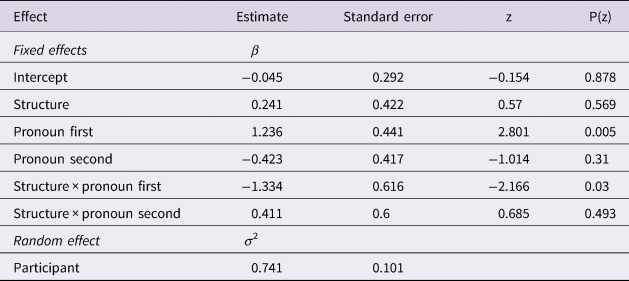
To permit direct examination of how pronoun use affects comprehension, the data from all three experiments were combined and analyzed using a multiple logistic regression implemented in R. The dependent measure was accuracy. The fixed factors were dative form (PP vs. DO; DO was the reference level) and pronoun condition (no pronouns vs. first post-verbal position vs. second post-verbal position; no pronouns was the reference level). The model also included random slopes by participant and a random intercept for trial.Footnote 1 Because trial did not affect the model fit (σ 2 = 0), it was removed. Complete results of this analysis are shown in Table 2. There was a significant effect of having a pronoun in first post-verbal position (β = 1.236, standard error = 0.441, z = 2.801, p = .005), and a significant interaction of structure and pronoun in first post-verbal position (β = –1.334, standard error = 0.616, z = –2.166, p = .03). This outcome shows that children's comprehension of novel verb-containing dative forms is affected by the presence of pronominal arguments only for DO datives containing a pronoun immediately following the verb (i.e., as the recipient argument). Additionally, a two-way chi-square test was conducted to determine whether children's performance differed between the first and second halves of the experimental sessions. Across studies, there was no evidence of such a difference (χ 2(1) = 1.369, p = .24).
Results from a multiple logistic regression analysis of the data from all three experiments. For the Structure factor, DO was the reference category, and for the Pronoun factor, full NP was the reference category.

Discussion
The central question of this research is whether the presence of a highly frequent pronominal argument (me) affects children's ability to comprehend English dative structures. Specifically, it asked whether children's experience with the dative alternation, which involves a large proportion of pronouns (Conwell et al., Reference Conwell, O'Donnell, Snedeker, Danis, Mesh and Sung2011), may explain their patterns of performance in laboratory tasks with these forms. Children hear and produce more DO datives than PP datives, but three-year-olds show greater difficulty comprehending and producing DO datives in lab tasks (Arunachalam, Reference Arunachalam2017; Conwell & Demuth, Reference Conwell and Demuth2007; Osgood & Zehler, Reference Osgood and Zehler1981; Rowland & Noble, Reference Rowland and Noble2010; Stephens, Reference Stephens2015). Experiment 1 established baseline performance with full noun phrases in the dative alternation. Experiment 2 demonstrated that the presence of the pronoun me in first post-verbal position facilitated children's comprehension of the DO dative with novel verbs, but did not affect their comprehension of PP datives. This was not merely an effect of having a personal pronoun as the recipient argument, as Experiment 3 demonstrated that performance with PP datives did not improve when me was used in second post-verbal position. This effect appeared to be specific to personal pronouns as the recipient argument in the DO dative.
Because all of the stimuli in these studies contained novel verbs, this pattern of behavior was likely not an effect of children's prior experience with highly frequent verb–pronoun combinations, which has been posited as a possible influence on three-year-olds’ performance on such tasks (Conwell et al., Reference Conwell, O'Donnell, Snedeker, Danis, Mesh and Sung2011). Furthermore, their improved performance with me as the recipient in the DO structure could not be attributed solely to differentiation of the two arguments, in the way that Rowland and Noble (Reference Rowland and Noble2010) hypothesized that proper nouns facilitated DO comprehension by differentiating the two noun phrases, which reduced the processing load required to assign a structure to the sentence. That hypothesis cannot explain the present results because children in all three of these studies showed chance levels of comprehension for the PP dative, which does not contain two undifferentiated noun phrases. Moreover, the animacy information carried by personal pronouns does not appear to be used to assign the pronominal argument to the recipient role (i.e., the typically more animate role) because children's comprehension improved when the recipient was me only in the DO dative, and not in the PP dative.
The results of these three studies instead suggest that several aspects of children's experience combine to impact their comprehension of novel verbs in the dative alternation. The familiarity of the verb + me sequence in the DO structure clearly boosted children's ability to understand that form of the alternation. Note, however, that it did not have to be a specific verb in combination with the pronoun, as implied by Conwell et al. (Reference Conwell, O'Donnell, Snedeker, Danis, Mesh and Sung2011). Conwell and colleagues hypothesized that children's ability to produce and comprehend the DO dative in natural settings, but their conservatism with the same form in lab settings, stemmed from an over-reliance on high-frequency verb + pronoun combinations learned from their experience. However, those high-frequency sequences were tied to specific verbs and specific pronouns (e.g., give + me). The studies presented here showed that me as the recipient in the DO dative could boost comprehension even when the verb was unfamiliar. A lexically based account of this pattern might posit that children's dative forms are not, therefore, verb-based (as proposed in Campbell & Tomasello, Reference Campbell and Tomasello2001), but rather that they are somehow pronoun-based. This would render the child's representation of the DO dative with me as the recipient into something like: [VERB] me [NP], and would further require that children have DO datives centered on every possible English pronoun that can take a recipient role. This explanation, however, cannot account for the consistent chance performance of children with the PP dative, nor does it explain why children interpreted DO datives with pronominal themes as adults would interpret PP forms.
Instead, these data suggest that children have verb-general representation of the DO dative, but that a wide range of factors affect their ability to use it. This is consistent with Rowland and Noble's (Reference Rowland and Noble2010) account, but adds the important detail that differentiation of the post-verbal arguments alone is not adequate to facilitate comprehension. While it is true that children in these studies show better comprehension of the DO dative when the recipient is a pronoun, and therefore differentiated from the theme, the same improvement does not occur when the theme is a pronoun, as in Experiment 3. The DO dative with a pronominal theme and a full NP recipient is extremely rare in child-directed speech (Conwell et al., Reference Conwell, O'Donnell, Snedeker, Danis, Mesh and Sung2011), and borders on ungrammaticality for adult native speakers of English (Bresnan & Nikitina, Reference Bresnan, Nikitina, Uyechi and Wee2009), so it is not surprising that the participants in Experiment 3 showed poor comprehension of this form. However, it is evidence that mere differentiation of the post-verbal arguments in the DO dative will not improve children's comprehension. Rather, it appears that children's familiarity with pronouns as recipients in the DO dative specifically boosts their ability to comprehend this structure when it contains a novel verb, perhaps as a function of the canonical nature of such a form. This pattern is somewhat consistent with the predictions of Chang, Dell, and Bock's (Reference Chang, Dell and Bock2006) dual-path model of arguments structure acquisition. Chang and colleagues demonstrated that experience with specific lexical content in syntactic roles could affect their model's behavior with abstract forms. In this case, children may learn that the DO dative canonically contains a pronoun in first post-verbal position, and they are therefore able to interpret those forms easily, but that less canonical forms pose a challenge, especially for younger language users.
Together, the three experiments presented in this paper demonstrate that children's poor performance with the DO dative in laboratory tasks is not due to a lack of verb-general representation of that form. Furthermore, they show that merely differentiating the two post-verbal arguments in the dative alternation is not enough to support verb-general comprehension of these forms. Rather, the effect of the pronoun me on dative comprehension depends on the dative structure and on the argument being pronominalized. Three-year-old children have clearly learned to comprehend pronominal recipients such as me in the DO dative, even with novel verbs. However, pronouns appear to be useful for children's comprehension only in that case. This suggests that children's experience affects their expectations about how syntactic structures will manifest, and that those expectations, in turn, affect their ability to comprehend the language that they hear.
Acknowledgments
I thank Caroline Rowland for generously sharing the video stimuli, Gregor Horvath, Shanda Lauer, and Samantha Hamernick for their assistance modifying the stimuli, and Amanda Auen, Allyson Kuznia, Stephanie Leach, and Felix Pichardo for assistance running child participants. I also thank the families of those children who participated in the lab, as well as the families and staff of A Child's World, the NDSU Center for Child Development, and the Academy for Children, for their support of this research. This manuscript was improved by comments from two anonymous reviewers and the editor, and I am grateful for their time and thoughtfulness.