Basic standards for organic farming worldwide are supplied by the International Federation of Organic Agriculture Movements (IFOAM), an umbrella organization including numerous national interest groups. In accordance with the IFOAM basic standards the first rules on organic livestock production were implemented in the EU in 1999 (Council Of The European Communities, 1999). Hence, the rules of the Swedish organic certification body, KRAV, are based on the EU legislation. With reference to production animals, the goals of organic farming are to provide conditions and opportunities of life for animals that are in harmony with their physiology, natural behaviour and well-being in order to produce milk and meat in a sustainable system, while maintaining good animal health and welfare. Although there are studies pointing towards better animal welfare in organic herds (Hörning, Reference Hörning2000) concerns have been expressed among veterinary practitioners and animal researchers that animal health in organic dairy farming is not satisfactory. Among the concerns, some relate to negative energy balance due to poor nutrition that could appear in organically managed cows (OMC). Restrictions in the dietary proportions of concentrates relative to dry matter intake for OMC may reduce the cows' ability to consume enough energy for maintenance and milk production (Hardarson, Reference Hardarson2001; Roesch et al. Reference Roesch, Doherr and Blum2005). The cows share the same average genetic potential for milk production, so a potential lack of energy could increase the risk of negative energy balance. Another issue of concern is that restrictions in the use of antibiotics and other pharmaceuticals in organic management may influence animal health in a negative way because of neglecting to treat when necessary (Hansson et al. Reference Hansson, Hamilton, Ekman and Forslund2000; von Borell & Sorensen, Reference von Borell and Sorensen2004). There are, however, studies where reduced use of antibiotics did not influence animal health in a negative way (Vaarst et al. Reference Vaarst, Bennedsgaard, Klaas, Nissen, Thamsborg and Ostergaard2006; Ivemeyer et al. Reference Ivemeyer, Maeschli, Walkenhorst, Klocke, Heil, Oser and Notz2008). There are also some differences in housing conditions and in the handling of the animals between conventionally and organically managed dairy cows. In Sweden, for instance, organic dairy herds must use an antiparasite strategy without drugs, give fresh milk for raising calves, and provide access to regular exercise and a prolonged grazing season. The differences described above may possibly lead to differences in animal health.
Assessment of animal health is, however, a difficult task in the absence of obvious standard indicators. The most important health issue in dairy cows in the western world is poor udder health, often expressed as mastitis. Detailed information on somatic cell counts (SCC) as an indicator of mastitis, and veterinary treatments of mastitis is available in many situations and makes udder health a potentially good health marker in dairy cows. Other diseases are more unusual and are therefore somewhat harder to assess. Another possible and widely used aspect of animal health is sexual reproductive functions. Reproductive performance is extensively registered and has been reported to be influenced by stress and malnutrition (Sasser et al. Reference Sasser, Williams, Bull, Ruder and Falk1988; von Borell et al. Reference von Borell, Dobson and Prunier2007), which is why it provides another set of suitable health markers.
Previous comparative studies of milk yield are rather concordant and show that organically managed dairy cows yield less milk than their conventionally managed counterparts (Roesch et al. Reference Roesch, Doherr, Schären, Schällibaum and Blum2007; Rozzi et al. Reference Rozzi, Miglior and Hand2007; Fall et al. Reference Fall, Emanuelson, Martinsson and Jonsson2008a). Divergent results in comparisons of health and RP in organically and conventionally managed herds are, however, found in the scientific literature. Some studies indicate better udder health in organic management (Hamilton et al. Reference Hamilton, Hansson, Ekman, Emanuelson and Forslund2002; Bennedsgaard et al. Reference Bennedsgaard, Thamsborg, Vaarst and Enevoldsen2003; Hamilton et al. Reference Hamilton, Emanuelson, Forslund, Hansson and Ekman2006) whereas others indicate worse or no difference (Hovi & Roderick, Reference Hovi and Roderick2000; Hardeng & Edge, Reference Hardeng and Edge2001; Fall et al. Reference Fall, Emanuelson, Martinsson and Jonsson2008a). Hardeng & Edge (Reference Hardeng and Edge2001) and Hamilton et al. (Reference Hamilton, Hansson, Ekman, Emanuelson and Forslund2002) both found better overall health performance in organic than in conventional dairy husbandry in Norway and Sweden. In a study of general health and RP in a research herd with both organic and conventional management, Fall et al. (Reference Fall, Forslund and Emanuelson2008b) did not find any relevant differences. Other studies of RP confirm that there are no differences between the management types (Roesch et al. Reference Roesch, Doherr and Blum2005; Roesch et al. Reference Roesch, Doherr and Blum2006; Fall et al. Reference Fall, Forslund and Emanuelson2008b).
The combination of an expanding organic dairy production and limited and inconsistent previous publications on animal health in organic dairy production, make additional studies an urgent issue. Hence, the objective of this study was to evaluate differences in milk yield as well as in udder health and RP, selected as markers for animal health, between organically and conventionally managed dairy cows under Swedish conditions.
Materials and Methods
Study design, herds, animals and data
Forty herds, located in an area in south-eastern Sweden (Uppland, Sörmland, Östergötland, and Småland) were included in the study. The selection was done among herds participating in the Swedish Official Milk Recording Scheme (SOMRS), not planning to discontinue milk production before the beginning of 2007 and keeping ⩾40 cows. Only organic herds that had produced milk according to the Swedish organic standards (www.krav.se) for >2 years and had conformed to the rule of feeding 95% organic feed and 5% conventional feed were eligible for inclusion. All 52 eligible organic herds were asked to participate in the study and 24 of them assented. By simple random sampling, 156 herds of the eligible 283 conventional herds in the area were selected and asked to participate in the study and 32 assented. By simple random sampling, 20 organic and 20 conventional from the assenting herds were selected for the study. Random selection of herds was done using computer-generated random numbers. All herds were visited three times by the principal investigator during 2005 and 2006 and information about housing and management was collected.
All cows and heifers with at least one calving during 2005 were included in the study. If an animal had had more than one calving, only the first was used. Lactation was defined as the first 305 d following calving.
Information on monthly test-day milk yield and SCC, breed, parity, calving and insemination dates, veterinary consultations, and housing type originated from the SOMRS, the National Animal Disease Recording System (NADRS), and from questionnaires presented to the farmers at the herd visits. Data were available from the beginning of 2005 to the end of 2006. Milk yield is presented as energy-corrected milk (ECM).
Statistical analysis
Linear mixed models were used to study associations between monthly test-day milk yields and herd management, separately for first-parity and older cows. Linear mixed models were also used to study SCC, separately for first-parity and older cows. The rationale to study first-parity cows separately was the known differences in the shapes of the lactation curves of milk yield and SCC. SCC was analysed on the natural log scale (lnSCC) to achieve normally distributed residuals. There were three hierarchical levels in the data for milk yield and SCC, i.e. management type, herd and cow, and the random effects of herd and cow were thus included in the models.
A Cox's proportional hazards regression model was used to study associations between time to veterinary-treated cases of mastitis and herd management. An observation was considered censored if no case of mastitis occurred during the lactation and the risk time was set to 305 d or at removal, when applicable. Herds with <2% reported lactational incidences of mastitis (n=3) were excluded from the analysis because the reporting was not considered reliable. Associations between herd management and RP were studied using a logistic regression model for pregnancy success at first insemination (PS) and a Cox's proportional hazards regression model for calving interval (CI). A successful first insemination (PS=1) was defined as a new calving within 270 to 300 d after the first registered insemination for the calving in question. An unsuccessful first insemination (PS=0) was defined as calving >300 d after the first registered insemination or when there was a second registered insemination. If there was a calving or pregnancy check without a previously reported insemination, or a calving occurred before 270 d after the first registered insemination, the information was considered missing (PS=). Hence observations (n=611) were omitted because conclusions about PS were impossible to make. In the Cox's proportional hazards model an observation was considered censored if there was no record of a subsequent calving. The time of censoring was set to 31 December 2006 (the last day of data recording) or at removal from the herd if that occurred before 31 December 2006. There were two hierarchical levels in these three models, viz. management type and herd, and a frailty effect for herd was therefore included in the Cox's proportional hazards regression models and a random effect for herd in the logistic regressions model.
The predictor variable of main interest was management type and it was forced to stay in all models. Other predictor variables were breed, parity, season of calving and housing type. In models for milk yield and SCC there was also a variable for week of lactation. Breed was a categorical variable with three classes: Swedish Holstein, Swedish Red and other. Parity was a categorical variable with three classes: 1, 2 and ⩾3. Because the analyses of milk yield and SCC were stratified on first-parity or older cows, parity could only be applied in the model for older cows, namely parity 2 or ⩾3. Season of calving was a categorical variable with 12 classes, one for each month. Housing was a dichotomous variable: free and tie stall. Week of calving was a categorical variable with 22 classes, one for each 2-weeks in lactation. An interaction between week in lactation and management type was forced to stay in the models of milk yield and SCC. In the PS-model the time from calving to first insemination was introduced as a predictor variable with four classes ordered in quartiles. Furthermore, milk yield was included as a predictor in the models of RP. It was a continuous variable and was measured as the mean daily yield of ECM of all test-milking occasions during the second and third months of lactation (Danell, Reference Danell1982). To allow for non-linear associations a quadratic and a cubic term of milk yield was also introduced; milk yield was centred around the overall mean to avoid colinearity between the linear, quadratic and cubic terms.
Model building was done by backward stepwise elimination of main effects with P<0·2 (F test) as the exclusion criterion. Previously eliminated effects were allowed to re-enter at each elimination of an effect, with P<0·2 as the re-entering criterion. All possible first-order interactions were subsequently added to the model and the backward stepwise elimination process was continued until P<0·05 for all remaining effects in the final model.
Fit of the mixed linear models was visually assessed by using plots of standardized residuals against the predicted values at the lowest hierarchical level and by using a normal probability plot in which the lowest level residuals were plotted against the quartiles. Influential observations were detected after examining Cook's distances and ‘difference in fit’ (DFFITS). Owing to a lack of computer capacity, influence statistics could not be calculated directly for the model of milk yield and SCC in older cows (12 711 observations). The data-set was therefore randomly split into two sets of equal size and influence statistics were calculated applying the final model on each set. The procedure was iterated ten times and finally a mean value for Cook's distances and DFFITS for all observations were calculated.
The overall fit of the logistic model was assessed with a Hosmer-Lemeshow χ2 goodness-of-fit test using deciles as cut-offs.
Fit of the multilevel Cox's proportional hazards models was examined through checking the assumptions of proportional hazards. This was done by visual assessment of log-log survivor plots, stratified by the class variables one at a time.
All statistical analyses were performed using SAS® (SAS Institute Inc., Cary NC, USA) except for the Cox's proportional hazards models that were performed using Stata Software (StataCorp LP, College Station TX, USA).
Results
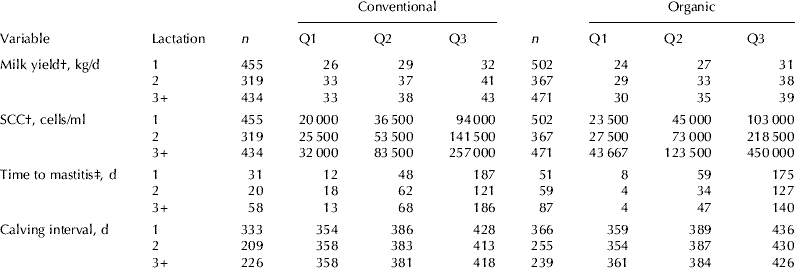
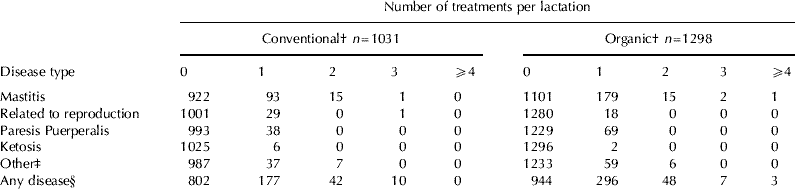
The herds were of comparable size (median of 58 cows in conventionally managed cows (CMC) and 60 in organically managed cows (OMC)) and free stall was more frequent in organically (14 out of 20) than in conventionally managed herds (7 out of 20). OMC were fed a more roughage-based diet. Further descriptive statistics on the study herds were given previously (Fall et al. Reference Fall, Grohn, Forslund, Essen-Gustafsson, Niskanen and Emanuelson2008c). Table 1 show the distribution of selected variables studied in the organically and conventionally managed herds. PS was 49, 45, and 43% in first, second and third or greater parity cows, respectively, in the conventionally managed herds, while corresponding figures for organically managed herds were 48, 51 and 48%. Table 2 shows the distribution of veterinary treated cases of disease per lactation.
Quartiles of variables related to milk yield, udder health and reproductive performance studied in cows from organically and conventionally managed Swedish dairy herds
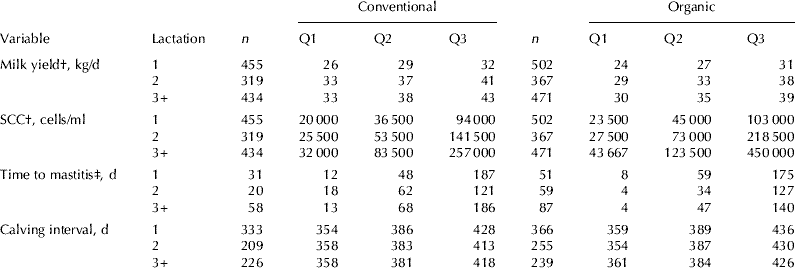
† Average milk yield and SCC from all test milking occasions from 30 to 90 days in milk
‡ Time from calving to the first veterinary treated case of mastitis for cows with at least one veterinary treated case of mastitis
Distribution of cows according to number of veterinary treated cases of diseases per cow in conventionally and organically managed Swedish dairy herds

† n=number of cows
‡ Other disease represents all registered disease treatments except for mastitis, reproduction related, Paresis puerperalis and ketosis
§ Any disease represents all registered disease treatments
Milk yield and udder health
In the models for milk yield and SCC the observations were divided into first-parity and older cows with 7902 observations from 957 cows in first parity (455 CMC and 502 OMC) and 12 711 observations from 1591 older cows (753 CMC and 838 OMC). The observations were not evenly distributed across breeds. Thus, the Swedish Red breed had 584 and 1004 individuals in first-parity and older cows, respectively, the Swedish Holstein had 274 and 404 individuals, respectively, whereas the ‘mixed or other breed’ had only 99 and 183 individuals. Distribution of herd management in the breed groups was even with the exception of ‘mixed or other breed’ where OMC were over-represented (71 out of 99 and 136 out of 183 in first-parity and older cows, respectively).
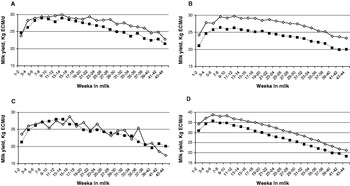
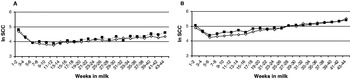
One erroneous observation was detected and removed while examining the influence statistics. The final models of milk yield and SCC for cows in first lactation contained the effects of management type, breed, week of lactation, and its interaction with management type and season. The final models for older cows contained the effects of management type, breed, parity, week of lactation, and its interaction with management type and season. Least square means of milk yield and lnSCC are displayed in Figs 1 and 2, respectively. Back-transformed least square means for lnSCC to the original scale for first lactation cows started from roughly 120 000 cells/ml, rapidly sinking down to a nadir about 50 000 cells/ml after 5–6 weeks and slowly rising to about 90 000 cells/ml in late lactation. For older cows the lactation started with a SCC of around 145 000 cells/ml, sinking to a nadir of roughly 80 000 cells/ml after 5–6 weeks and slowly increasing to about 235 000 cells/ml in late lactation. There were no significant differences between management types in either of the SCC models at any point in time.
Least square means estimated from linear mixed models of milk yield (kg ECM/d). (A) First-parity cows of Swedish Holstein breed. Significant (P<0·05) differences between groups from weeks 27–34 and 37–38. (B) First-parity cows of Swedish Red breed. Significant (P<0·05) differences between groups all lactation. (C) First-parity cows of mixed and other breeds. Significant (P<0·05) differences between groups weeks 35–36. (D) Second-parity and older cows. Significant (P<0·05) differences between groups all lactation. Organically managed cows are represented by dotted lines lines (-▪-) and conventionally managed cows by solid lines (-◊-).

Least square means estimated from linear mixed models of log-transformed Somatic Cell Counts. (A) First-parity cows. (se for the time-points range from 0·10 to 0·12). (B) Second-parity and older cows. (se for the time-points range from 0·11 to 0·13). Organically managed cows are represented by dotted lines lines (-▪-) and conventionally managed cows by solid lines (-◊-).

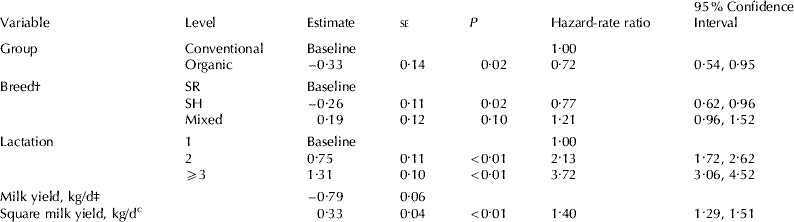
Data for the Cox's proportional hazards regression model on time to veterinary-treated cases of mastitis comprised information from 2219 lactations (1003 CMC and 1216 OMC), of which 1951 were right censored (902 CMC and 1049 OMC), i.e. had no cases of mastitis recorded within the observation period. Results from the final model are presented in Table 3. There were no signs of violations of the proportional hazard assumption.
Results of the final Cox's proportional hazards regression model on the effect of organic or conventional management on time to veterinary treatment of mastitis in conventionally and organically managed Swedish dairy herds

† Hazard-rate ratio
Reproductive performance
The logistic regression analysis of PS comprised 1871 observations (925 CMC and 946 OMC) and the results are presented in Table 4. Cox's proportional hazards regression analysis on length of CI included 2374 observations (1145 CMC and 1229 OMC) of which 728 (372 CMC and 356 OMC) were right censored. Results from the final Cox's proportional hazards regression model are presented in Table 5. There were no signs of violations of the proportional hazard assumption.
Results of the final multilevel logistic regression model† on pregnancy success at first insemination in conventionally and organically managed Swedish dairy herds

† Generalized χ2/DF=0·99; Hosmer-Lemeshow was 15·2 with (8 df) (P=0·05)
‡ Milk yield was measured as the mean ECM/d of all test-milking occasions during the second and third month of lactation. The Odds Ratio was evaluated for a difference of 10 kg/d
Results of the final Cox's proportional hazards regression model on calving interval in cows from conventionally and organically managed Swedish dairy herds
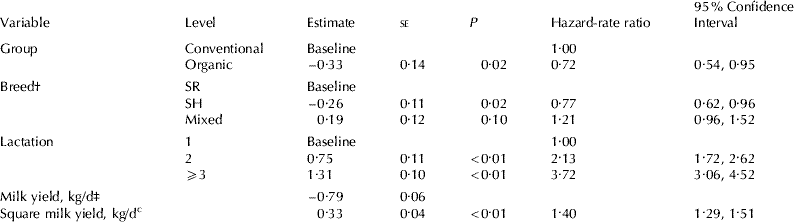
† SR=Swedish Red breed, SH=Swedish Holstein breed
‡ Milk yield was measured as the mean ECM/d of all test-milking occasions during the second and third month of lactation. The HR was evaluated for a difference of 10 kg/d
Discussion
Milk yield
The most distinct result in this study was that OMC produced less ECM than CMC. This is consistent with several earlier studies that conclude that OMC yield less milk than CMC (Hardeng & Edge, Reference Hardeng and Edge2001; Roesch et al. Reference Roesch, Doherr, Schären, Schällibaum and Blum2007; Rozzi et al. Reference Rozzi, Miglior and Hand2007; Fall et al. Reference Fall, Emanuelson, Martinsson and Jonsson2008a). In the present study, we confirmed these findings for cows in second parity or more. For first-parity cows, however, the results were more complex. Organically managed cows of Swedish Red breed consistently yielded less than CMC of the same breed, whereas OMC of Swedish Holstein breed yielded similar amounts of milk for approximately the first 5 months, followed by lower yields in late lactation. From these findings one might expect the organically managed first-parity Swedish Holsteins to be in deeper negative energy balance. No such signs were present, however, in the study of metabolic parameters in the same herds (Fall et al. Reference Fall, Grohn, Forslund, Essen-Gustafsson, Niskanen and Emanuelson2008c). Reasons, other than a higher mobilization of body reserves, for the relatively high yield in first-parity Holstein cows could be, for instance, differences in feeding strategy, but we did not have the detailed information needed to explore those differences further. The last breed group ‘mixed or other’ contained few individuals, which is why no conclusions should be taken from the irregular milk yield profiles. An important aspect of milk yield in this study is that the variation was larger within the management groups than between the groups i.e. the highest and lowest yielding farms (at herd level) were both found in the organically managed group (data not shown). Furthermore, since the farms predominantly have only one breed, there is also a potential confounding effect of farm and breed, although there were enough farms with multiple breeds to avoid complete confounding.
Udder health
We found no indication that SCC differed between the management types. Previously published studies provide rather divergent results when comparing subclinical udder health between CMC and OMC. Consistent with the present study, Fall et al. (Reference Fall, Emanuelson, Martinsson and Jonsson2008a) did not find any differences in individual average SCC or in the proportion of monthly SCC tests >200 000 cells/ml in a Swedish research herd with both CMC and OMC. Furthermore, bulk-tank SCC was compared in a British study (Ellis et al. Reference Ellis, Innocent, Mihm, Cripps, McLean, Howard and Grove-White2007) without detecting any differences. In studies by Roesch et al. (Reference Roesch, Doherr, Schären, Schällibaum and Blum2007), Nauta et al. (Reference Nauta, Baars and Bovenhuis2006) and Hardeng et al. (Reference Hardeng and Edge2001) significantly higher overall geometric means of SCC in OMC were found. Roesch et al. (Reference Roesch, Doherr, Schären, Schällibaum and Blum2007) found the difference to be significant in early lactation (median 31 d), but not in later lactation (median 102 d). When Hardeng et al. (Reference Hardeng and Edge2001) stratified the analysis on lactation number they found a significantly lower geometric mean for OMC in second lactation and a higher geometric mean for OMC in sixth lactation or higher, but no significant differences were found in the remaining lactations. Furthermore, Hardeng et al. (Reference Hardeng and Edge2001) studied the proportion of SCC recordings >200 000 cells/ml but no difference between the groups was identified. In a Swiss study of 152 organic herds, Busato et al. (Reference Busato, Trachsel, Schallibaum and Blum2000) found that the geometric mean SCC in bulk-tank milk was 15% lower than the Swiss average of 100 000 cells/ml. In line with the findings of Busato et al. (Reference Busato, Trachsel, Schallibaum and Blum2000), a Swedish study of udder health scores in 26 organically compared with 102 conventionally managed herds indicated better udder health in OMC (Hamilton et al. Reference Hamilton, Emanuelson, Forslund, Hansson and Ekman2006).
Our results for SCC were further supported by the non-significant differences between CMC and OMC in the time to first mastitis treatment. This was well in line with the earlier findings of Fall et al. (Reference Fall, Emanuelson, Martinsson and Jonsson2008a) where no difference in the lactational incidence of mastitis treatment was detected. However, Hardeng & Edge (Reference Hardeng and Edge2001), Bennedsgaard et al. (Reference Bennedsgaard, Thamsborg, Vaarst and Enevoldsen2003) and Hamilton et al. (Reference Hamilton, Emanuelson, Forslund, Hansson and Ekman2006) found a lower incidence of mastitis treatments in OMC in Norwegian, Danish and Swedish cows, respectively, than in CMC. Ellis et al. (Reference Ellis, Innocent, Mihm, Cripps, McLean, Howard and Grove-White2007) also demonstrated significantly fewer reported clinical cases of mastitis in OMC in 28 British herds, whereas Langford et al. (Reference Langford, Rutherford, Jack, Sherwood, Lawrence and Haskell2009) found a non-significant tendency (0·05⩽P<0·1) that a smaller proportion of cows in organically managed British herds were affected by mastitis per year than in their conventionally managed counterparts. The study by Langford et al. (Reference Langford, Rutherford, Jack, Sherwood, Lawrence and Haskell2009) was, however, based on farmer recall data while all other studies were based on registry data. The result regarding mastitis frequency from another, older British study was contradictory, pointing to a higher incidence in OMC (Hovi & Roderick, Reference Hovi and Roderick2000). Previously published studies have shown that high milk yield is a risk factor for clinical mastitis (Barnouin et al. Reference Barnouin, Bord, Bazin and Chassagne2005; O'Reilly et al. Reference O'Reilly, Green, Peeler, Fitzpatrick and Green2006). In line with this, Busato et al. (Reference Busato, Trachsel, Schallibaum and Blum2000) and Bennedsgaard et al. (Reference Bennedsgaard, Thamsborg, Vaarst and Enevoldsen2003) considered lower production levels in OMC as a potential explanation for better udder health in OMC. Accordingly, the organically managed herds in the present study, having significantly lower milk production, might have been expected to have better udder health, which was not supported by our analyses. On the other hand, as the same udder health status was achieved in both management types, one could argue that the organically managed herds had better udder health management as they achieved it with a more restrictive antibiotic policy.
A natural conclusion based on available literature is that udder health in OMC as well as differences to CMC varies between countries. Two plausible reasons for this are that the IFOAM framework for organic farming is implemented differently in different countries and that general management factors probably vary between countries as well. In the present study, for example, we perceived from questionnaires that farmers in both management types had a rather indifferent attitude towards homeopathic remedies, which is probably not very representative for organic management outside Sweden. Differences between the Swedish studies are somewhat harder to understand than differences between countries. A contributing factor could perhaps be selection bias in the study by Hamilton et al. (Reference Hamilton, Emanuelson, Forslund, Hansson and Ekman2006) where the organically managed herds actively chose to participate, while they were compared with all conventionally managed herds of comparable size in the same region.
In contrast to most other countries, Swedish organic rules and regulations do not promote alternative medicine over conventional veterinary medicine. Hence, all reported mastitis treatments are prescribed by veterinarians and are done in accordance with principles of school medicine. In order to restrain the consumption of antibiotics the organic rules do, however, prescribe a doubled withdrawal period for delivery of milk after treatment with registered pharmaceuticals (compared with the one laid down by the Swedish National Food Administration). Sceptical veterinary practitioners and conventional farmers argue that these conditions make organic farmers more unwilling to consult veterinarians for diseased animals, which leads to poor health. There were, however, no such indications in the present study, where no differences in udder health were found.
Reproductive performance
Analysis of PS in the present study did not reveal any difference between management types, whereas CI indicated a significantly lower HR for OMC compared with CMC. Some earlier studies (Roesch et al. Reference Roesch, Doherr and Blum2005; Nauta et al. Reference Nauta, Baars and Bovenhuis2006; Roesch et al. Reference Roesch, Doherr and Blum2006; Fall et al. Reference Fall, Forslund and Emanuelson2008b) reported no difference in RP, assessed as calving-to-first insemination and CI. In contrast, a Norwegian study by Reksen et al. (Reference Reksen, Tverdal and Ropstad1999) also found that RP was impaired during winter in OMC, probably as a result of malnutrition.
A lowered concentrate supplementation rate has been shown to reduce RP (Sehested et al. Reference Sehested, Kristensen and Soegaard2003). Consequently, OMC, which are restricted in the concentrate rations by the rules of organic farming, could be at risk of an impaired RP. However, in a previously published study of metabolic profiles in periparturient cows at the same farms as in the present study (Fall et al. Reference Fall, Grohn, Forslund, Essen-Gustafsson, Niskanen and Emanuelson2008c) no signs of difference in negative energy balance were found between the management groups. Hence, the lack of difference in PS in the present study was somewhat expected.
Assessment of RP should ideally use measurements with a biological interpretation and background and should, as far as possible, avoid parameters that are affected by or reflect management decisions. PS is, in our judgement, an appropriate variable measuring biological effects, while CI is perhaps more questionable in that sense since it is affected by the voluntary waiting period, which is a decision made by the farmer. Nevertheless, it was included in the study as a commonly used measure representing RP with essential economical impact. Thus, the lower HR demonstrated for CI in OMC, most likely reflected management differences rather than biological effects. The overall median CI for Swedish dairy herds in 2005 was 400 d (Löf et al. Reference Löf, Gustafsson and Emanuelson2007b). Those cows in this study that were not censored were closer to the best 25th percentile in Swedish herds (CI 386 d; Löf et al. Reference Löf, Emanuelson and Gustafsson2007) indicating that the study herds were well managed—not a surprising result as they had agreed to participate.
A problem in performing this kind of study is to ensure the quality of registry data. A recent study of the NADRS concluded that estimates of morbidity are conservative compared with farmer registrations (Mörk et al. Reference Mörk, Lindberg, Alenius, Vågsholm and Egenvall2009). Another recent Swedish validation study reported that herd-level reproductive indicators retrieved from SOMRS are somewhat affected by slowness in data management (Löf et al. Reference Löf, Emanuelson and Gustafsson2007a). None of these studies investigated potential differences between organically and conventionally managed herds, but we have no reason to believe in systematic differences in the reporting between the management types, especially within this sample of apparently well-managed herds. Another weakness of the study, as in all register-based studies, is the lack of information on covariates, and the influence of unmeasured confounders cannot be excluded. Yet the combination of these two registers represents one of the largest data sources available. Differences with regard to the implementation of the IFOAM Basic Standards for organic production should be considered further in inter-country comparisons.
In conclusion, this study did not indicate any important differences in animal health between conventional and organic dairy cow management in Sweden. CI was, however, shown to be prolonged in OMC, which is more of an economic interest than a sign of poor animal health.
The authors thank the Swedish Dairy Association for providing the registry data and the Swedish Research Council for Environment, Agricultural Sciences and Spatial Planning for financial support. The authors would also like to acknowledge Östen Dahl, Katja and Tove Fall for helpful discussions.